
Modal Verbs of Necessity ESL Games & Activities
It's a date!
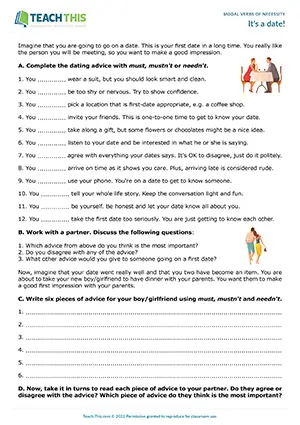
ESL Must and Mustn't Activity - Grammar and Writing Exercises: Gap-fill, Writing Sentences - Speaking Activity: Discussion, Freer Practice - Pair Work
In this intriguing must and mustn't activity, students write and discuss advice about going on a date using must, mustn't and needn't. Students begin by imagining...
Necessary Skills
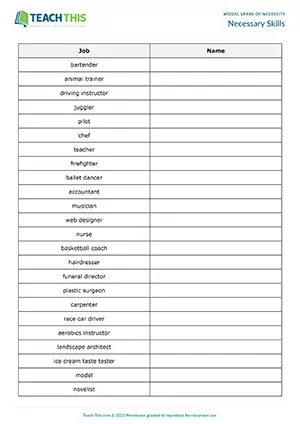
ESL Have to and Need to Game - Speaking: Asking and Answering Questions, Freer Practice
In this free modal verbs of necessity game, students ask yes/no questions with 'have (got) to' and 'need to' in order to find out which secret job each classmate has. Students imagine that...
Necessity
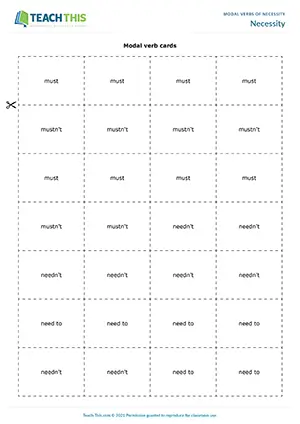
ESL Modal Verbs of Necessity Game - Speaking: Matching, Forming Sentences - Pair Work
This productive modal verbs of necessity game helps students practice making sentences with the modal verbs of necessity: must, mustn't, need to and needn't. Students take it in turns to turn over...
You'll need to...
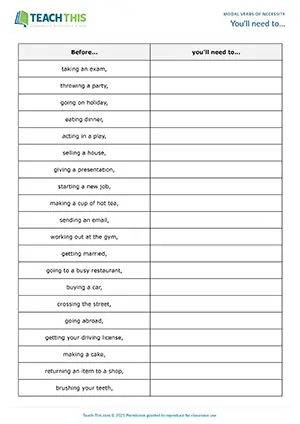
ESL Future Necessity Game - Speaking: Matching, Forming and Writing Sentences - Pair Work
In this useful modal verbs of necessity game, students practice expressing future necessity with 'will need to.' Students take it in turns to turn over a card. Each card represents something a person will need...
Bare Necessity
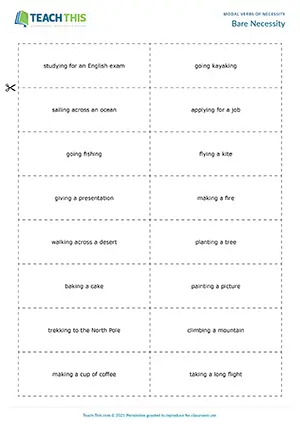
ESL Modal Verbs of Necessity Game - Vocabulary and Speaking: Forming Sentences, Guessing - Group Work
In this fun have to and need to game, students guess activities from statements expressing necessity. One player from each team comes to the front of the class. Show an activity card to both players. Players then...
Did you need to take that?
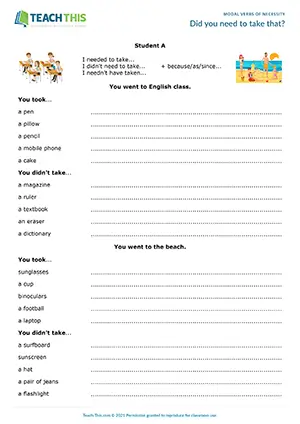
ESL Past Necessity Activity - Grammar and Speaking: Writing Sentences, Discussion, Freer Practice - Group Work
In this engaging needed to and didn't need to speaking activity, students practice expressing past necessity by talking about the need for certain items in different situations. In two groups, students imagine...
Understanding Modal Verbs of Necessity
Modal verbs of necessity are words like 'must', 'have to', 'need to', and 'needn't' that speakers use to say whether something is required, unnecessary, or forbidden. When students treat 'must' and 'have to' as always interchangeable, they miss a real distinction: 'must' typically expresses a personal obligation or strong recommendation, while 'have to' signals an external rule, and mixing them up can make a speaker sound either inappropriately commanding or oddly detached from the requirement they are describing.
This page covers modal verbs of necessity at Intermediate and Upper-intermediate levels (B1 to B2), with six activities spanning card-matching games, writing and discussion tasks, and a team guessing game, including one free download.
The table below maps the key modal expressions used to talk about necessity in English, covering obligation, lack of obligation, prohibition, and past and future forms.
| Modal / Expression | Function | Affirmative Structure | Negative Structure | Example |
|---|---|---|---|---|
| must | strong personal obligation or prohibition | subject + must + base verb | subject + mustn't + base verb | 'You must wear a seatbelt.' |
| have to | external obligation | subject + have/has to + base verb | subject + don't/doesn't have to + base verb | 'You have to show your passport at the border.' |
| need to | necessity | subject + need(s) to + base verb | subject + don't/doesn't need to + base verb | 'You need to book a table in advance.' |
| needn't | no necessity | subject + needn't + base verb | n/a (already negative) | 'You needn't bring anything.' |
| had to | past obligation | subject + had to + base verb | subject + didn't have to + base verb | 'She had to work late last night.' |
| will need to | future necessity | subject + will need to + base verb | subject + won't need to + base verb | 'You will need to apply early.' |
| needn't have | past action completed but unnecessary | subject + needn't have + past participle | n/a | 'You needn't have brought so much food.' |
| didn't need to | past action not required | subject + didn't need to + base verb | n/a | 'He didn't need to wait so long.' |
When to Use Modal Verbs of Necessity
Expressing a personal obligation or strong recommendation: A speaker chooses 'must' when the obligation comes from their own judgment or strong feelings rather than an external rule, as in 'You must try the pasta here. It is absolutely wonderful.'
Describing an external requirement: A speaker uses 'have to' when the obligation is imposed by someone or something outside themselves, making clear they are reporting a rule rather than expressing a personal view, as in 'All employees have to complete the safety training before their first shift.'
Pointing out a completed but unnecessary action: A speaker uses 'needn't have' to signal that an action someone already completed turned out to be unnecessary, often carrying a tone of mild surprise or reassurance, as in 'You needn't have bought flowers. We already have plenty at home.'
3-Step Framework for Teaching Modal Verbs of Necessity
1. Establish the Four Core Modals with a Card-Matching Game: Introduce 'must', 'mustn't', 'need to', and 'needn't' together through a card-matching game where students turn over a modal verb card and an action card. If the two cards combine into a meaningful sentence, the student reads it aloud and must add a justification: combining 'mustn't' with 'drive fast', for example, produces 'You mustn't drive fast because you might have an accident.' That justification requirement gives the game its grammar depth: students cannot just match cards mechanically; they have to produce a reason on the spot. If they cannot justify the sentence, the cards go back.
2. Extend to Advice-Writing with a Real-Life Scenario: Once students control the basic forms, move to a writing and discussion task that puts the modals to work in a personal, meaningful context. Students imagine their date went really well and that they are about to take their new boyfriend or girlfriend to have dinner with their parents, and they write six pieces of advice using must, mustn't, and needn't to help their partner make a good first impression. Writing six pieces of advice pushes students to range across all three modals rather than defaulting to only one.
3. Introduce Past Necessity Forms at Upper-Intermediate Level: Round off the sequence by moving students from present necessity into past necessity forms. Students imagine they visited a series of places, look at the items they took and did not take, and write sentences about each item using three distinct structures: 'I needed to take...', 'I didn't need to take...', and 'I needn't have taken...'. That three-way distinction is the key teaching point: the difference between something that was genuinely unnecessary and something that turned out to have been unnecessary in hindsight.
Common Mistakes with Modal Verbs of Necessity
Using 'must' for past obligation instead of 'had to': Students often use 'must' when talking about past obligations, not realizing that 'must' has no past form for obligation and that 'had to' is the correct substitute. Wrong: 'Yesterday I must finish the report before leaving.' Correct: 'Yesterday I had to finish the report before leaving.'
Confusing 'mustn't' with 'don't have to': Students often use 'mustn't' when they mean 'don't have to', not realizing that 'mustn't' expresses prohibition while 'don't have to' simply means something is not required. Wrong: 'The meeting starts at nine, but you mustn't arrive early.' Correct: 'The meeting starts at nine, but you don't have to arrive early.'
Common Questions About Teaching Modal Verbs of Necessity
What is a good 'have to' and 'need to' speaking game?
The free game Necessary Skills puts students in a mingle where they hold a secret job card and walk around asking 'have to' and 'need to' questions to identify each other's jobs, for example 'Do you need to be a good communicator?' The student who matches the most jobs correctly wins.
What is a fun game for practicing 'will need to'?
In the game You'll need to..., students flip over a card and try to match it to an activity on the worksheet, producing a sentence such as 'Before taking an exam, you'll need to study hard.' A correct sentence earns a point; a card that doesn't fit goes back to the pile, so every flip is a small gamble.
What is an engaging way to practice 'have to' and 'need to'?
Students compete in the game Bare Necessity by giving necessity clues about a hidden activity, using statements like 'You have to...' or 'You need a...', while their team tries to guess it. A first guess scores five points and drops by one each attempt, so students are under real pressure to make their clues count.
Become a Teach This Member
Get unlimited access to the full library, plus new resources added every week.
Unlimited Resource Access
Download from 3000+ worksheets, activities, and games.
Save 5+ Hours Weekly
Cut lesson prep time with ready-to-use resources, plus teacher notes and answer keys.
Trusted Professional Quality
Classroom-tested, editable resources created by experienced ESL professionals.
Fresh Content Weekly
Get 5 new resources added to the library each week.
Here's what our members are saying...


