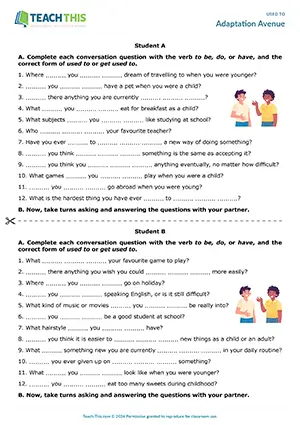
Adaptation Avenue

Intermediate (B1) 25 minutes
ESL Used to Activity preview, Intermediate B1, forming, asking and answering questions from prompts, controlled and freer practice, group and pair work

ESL Used to Activity - Grammar and Speaking: Forming, Asking and Answering Questions, Controlled and Freer Practice - Group and Pair Work

In this handy used to speaking activity, students practice forming, asking and answering 'used to' and 'get used to' conversation questions...

ESL Used to Activity - Grammar and Speaking: Forming, Asking and Answering Questions from Prompts, Controlled and Freer Practice - Group and Pair Work In this handy used to speaking activity, students practice forming, asking and answering 'used to' and 'get used to' conversation questions. First, in two groups, students complete each conversation question with the verb 'to be', 'do', or 'have', and the correct form of 'used to' or 'get used to'. Students then pair up with someone from the other group and take turns asking and answering the 'used to' conversation questions with their partner. Afterwards, students share what they found out about their partner with the class.

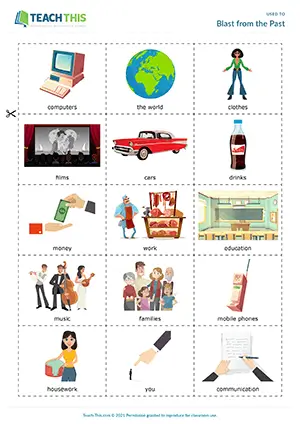
Blast from the Past

Intermediate (B1) 20 minutes
ESL Used to Game preview, Intermediate B1, forming sentences, impromptu speech, group work

ESL Used to Game - Grammar and Speaking: Forming Sentences, Impromptu Speech - Group Work

In this imaginative used to game, students talk about how things were different in the past using 'used to' and 'didn't use to'. In groups, students take turns picking up a card (e.g. computers) and talking about...

ESL Used to Game - Grammar and Speaking: Forming Sentences, Impromptu Speech - Group Work In this imaginative used to game, students talk about how things were different in the past using 'used to' and 'didn't use to'. In groups, students take turns picking up a card (e.g. computers) and talking about the topic on the card for 30 seconds, saying how the thing was different in the past, e.g. 'Computers used to have floppy disks. The monitors didn't use to be flat like they are today, etc…' For every sentence with 'used to' and 'didn't use to' the student makes, they score one point. The student with the most points at the end of the game is the winner.

Did you use to...?

Intermediate (B1) 30 minutes
ESL Used to Activity preview, Intermediate B1, survey, writing, asking and answering questions, freer practice

ESL Used to Activity - Grammar and Speaking: Survey, Writing, Asking and Answering Questions, Freer Practice

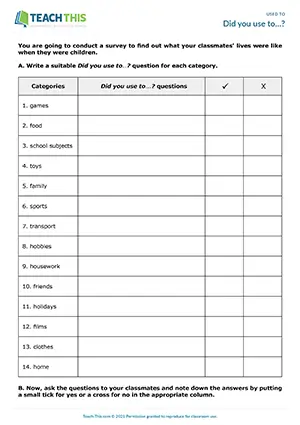
In this engaging used to speaking activity, students conduct a survey to find out what their classmates' lives were like as children by asking and answering 'Did you use to...?' questions. First, students...

ESL Used to Activity - Grammar and Speaking: Survey, Writing, Asking and Answering Questions, Freer Practice In this engaging used to speaking activity, students conduct a survey to find out what their classmates' lives were like as children by asking and answering 'Did you use to...?' questions. First, students write a suitable 'Did you use to...?' question for each category. For example, in the games category, a student might write 'Did you use to play hide and seek as a child?' Next, students go around the class, asking each other their questions and noting down the answers by putting a small tick for yes or a cross for no in the appropriate column. Finally, students report their findings to the class.

Growing Up

Intermediate (B1) 30 minutes
ESL Used to Board Game preview, Intermediate B1, answering questions, guided discussions, communicative practice, group work

ESL Used to Board Game - Grammar and Speaking: Answering Questions, Discussions, Communicative Practice - Group Work

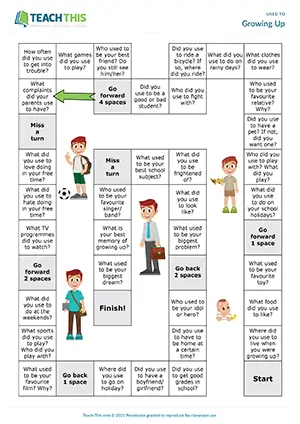
In this free used to board game, students practice 'used to' and the past simple by discussing and answering questions about childhood memories...

ESL Used to Board Game - Grammar and Speaking: Answering Questions, Guided Discussions, Communicative Practice - Group Work In this free used to board game, students practice 'used to' and the past simple by discussing and answering questions about childhood memories. The game is ideal for teenagers or adults and provides students with a great opportunity to practice building a conversation about growing up. Players take turns rolling the dice and moving their counter along the board. When a player lands on a square, the student on their right asks them the question on the square about their experience of growing up. The player then uses 'used to' and the past simple to answer the question. Next, the group explores the topic by asking follow-up questions and giving comments. The first player to reach the finish wins the game.

Memories

Intermediate (B1) 25 minutes
ESL Used to Game preview, Intermediate B1, guessing, writing, asking and answering questions from prompts, pair work

ESL Used to Game - Grammar and Speaking: Guessing, Writing, Asking and Answering Questions, Freer Practice - Pair Work

In this insightful used to game, students guess a partner's answers to 'I used to...' sentences about their childhood by asking 'Did you use to...?' questions. First, students read 'I used to...' sentences, think about...

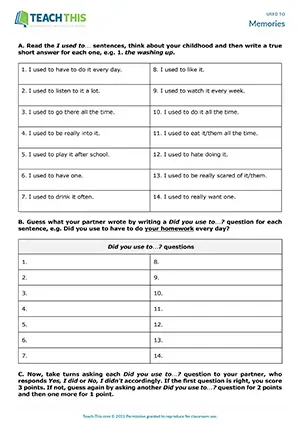
ESL Used to Game - Grammar and Speaking: Guessing, Writing, Asking and Answering Questions from Prompts, Freer Practice - Pair Work In this insightful used to game, students guess a partner's answers to 'I used to...' sentences about their childhood by asking 'Did you use to...?' questions. First, students read 'I used to...' sentences, think about their childhood and write a true short answer for each one, e.g. 'I used to have to do it every day.' Answer: the washing up. Students then try to guess what their partner wrote by writing a 'Did you use to...?' question for each sentence, e.g. 'Did you use to have to do your homework every day?' Next, students take turns asking each 'Did you use to...?' question to their partner, who responds Yes, I did or No, I didn't accordingly. If the first question is right, the student scores three points. If not, the student guesses again by asking another 'Did you use to...?' question for two points and then one more for one point. If none of the questions are right, their partner reveals the correct answer. The student with the most points at the end of the game wins.

My Childhood

Intermediate (B1) 25 minutes
ESL Used to Game preview, Intermediate B1, writing sentences, true or false, asking and answering questions, guessing, group and pair work

ESL Used to Game - Grammar and Speaking: Writing Sentences, True or False, Asking and Answering Questions, Guessing - Group and Pair Work

In this amusing used to game, students give true and false information about their childhood. First, in two groups, students answer each prompt with...

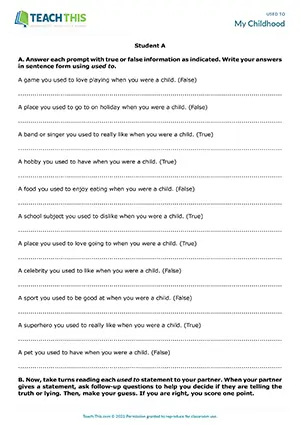
ESL Used to Game - Grammar and Speaking: Writing Sentences, True or False, Asking and Answering Questions, Guessing - Group and Pair Work In this amusing used to game, students give true and false information about their childhood. First, in two groups, students answer each prompt with true or false information as indicated, writing their answers in sentence form with 'used to'. Next, students pair up with someone from the other group and take turns reading each 'used to' statement to their partner, e.g. 'I used to love playing chess when I was a child.' Their partner then asks follow-up questions to help them decide whether the answer is true or false. Their partner then guesses if the student is lying or telling the truth and the correct answer is revealed. If their partner guesses correctly, they score a point. The student with the most points at the end of the game wins.

People used to...

Intermediate (B1) 30 minutes
ESL Used to Game preview, Intermediate B1, sentence completion, forming sentences, guessing, group and pair work

ESL Used to Game - Grammar and Vocabulary: Sentence Completion, Forming Sentences, Guessing, Freer Practice - Group and Pair Work

In this fun used to game, students guess inventions by listening to a partner talk about what people used to do and didn't use to do before they existed...

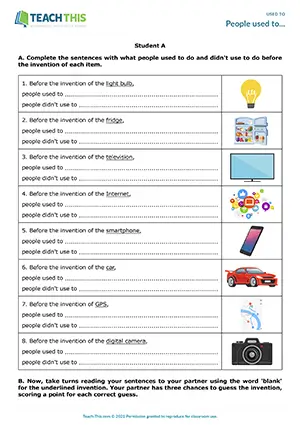
ESL Used to Game - Grammar and Vocabulary: Sentence Completion, Forming Sentences, Guessing, Freer Practice - Group and Pair Work In this fun used to game, students guess inventions by listening to a partner talk about what people used to do and didn't use to do before they existed. First, in two groups, students complete sentences with what people used to do and didn't use to do before the invention of each item on their worksheet. Next, students pair up with someone from the other group and take turns reading their sentences to their partner using the word 'blank' for the underlined invention, e.g. 'Before the invention of the 'blank', people used to...' Their partner then has three chances to guess the invention. For each correct guess, students score a point. If their partner is having trouble guessing, students make more sentences with 'used to' and 'didn't use' to until they have had three guesses. The student with the most points at the end of the game wins.

Then and Now

Intermediate (B1) 30 minutes
ESL Used to Activity preview, Intermediate B1, writing sentences, asking and answering questions from prompts, pair work

ESL Used to Activity - Grammar and Speaking: Writing Sentences, Asking and Answering Questions, Freer Practice - Pair Work

In this free used to vs. present simple activity, students ask and answer questions about the way things used to be when they were 12 and the way things are now...

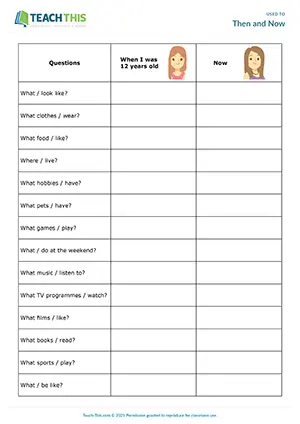
ESL Used to Activity - Grammar and Speaking: Writing Sentences, Asking and Answering Questions from Prompts, Freer Practice - Pair Work In this free used to vs. present simple activity, students ask and answer questions about the way things used to be when they were 12 and the way things are now. First, students answer questions about when they were 12 years old. Go through the 'Did you use to...?' questions from the prompts with the class, e.g. 'What did you use to look like when you were 12 years old?' Students then write answers to the questions under the heading, writing their answers in sentence form using 'used to', e.g. 'I used to have long brown hair and spots.' Next, students answer questions about how they are now. Go through the question prompts again with the class, but this time using the present simple, e.g. 'What do you look like now?' Students then write answers to the questions under the heading 'Now' using the present simple, e.g. 'Now, I have short blonde hair, and I wear make-up.' In pairs, students then take turns asking and answering the questions about the way things used to be when they were 12 and the way things are now. Finally, students tell the class about how their partner has changed.

Used To Practice

Intermediate (B1) 30 minutes
ESL Used To Worksheet preview, Intermediate B1, unscrambling, rewriting sentences, gap-fill, writing questions from prompts, pair work

ESL Used To Worksheet - Grammar Exercises: Unscrambling, Rewriting Sentences, Gap-fill, Writing Questions - Speaking Activity: Freer Practice - Pair Work

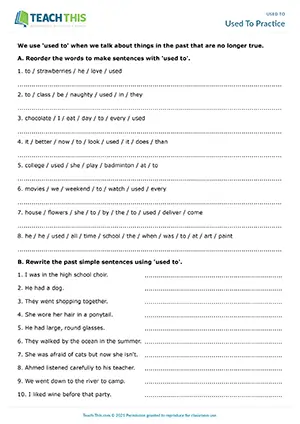
In this productive used to worksheet, students practice forms of 'used to' in affirmative and negative statements and Wh questions. To begin, students reorder...

ESL Used To Worksheet - Grammar Exercises: Unscrambling, Rewriting Sentences, Gap-fill, Writing Questions from Prompts - Speaking Activity: Freer Practice - Pair Work In this productive used to worksheet, students practice forms of 'used to' in affirmative and negative statements and Wh questions. To begin, students reorder words to form sentences with 'used to'. Students then rewrite past simple sentences using 'used to'. Next, students use verbs from a box to write negative 'didn't use to' sentences. After that, students use prompts to make Wh questions with 'did you use to'. Finally, students ask and answer the questions with a partner.

Life Changes

Upper-intermediate (B2) 25 minutes
ESL Used to Activity preview, Upper-intermediate B2, asking and answering questions from prompts, guided discussions, freer practice, pair work

ESL Used to Activity - Grammar and Speaking: Asking and Answering Questions, Discussions, Freer Practice - Pair Work

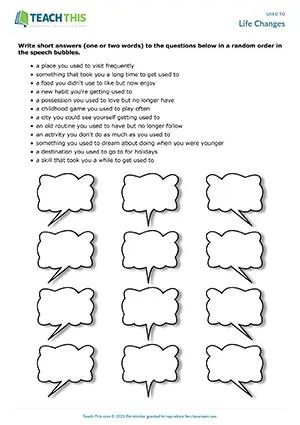
This interesting used to speaking activity is ideal for practicing or reviewing the various forms of 'used to', e.g. get used to, getting used to, etc. In the activity, students ask and answer questions about the...

ESL Used to Activity - Grammar and Speaking: Asking and Answering Questions from Prompts, Guided Discussions, Freer Practice - Pair Work This interesting used to speaking activity is ideal for practicing or reviewing the various forms of 'used to', e.g. get used to, getting used to, etc. In the activity, students ask and answer questions about the past and present using the various forms. First, students answer questions on their worksheet by writing short answers in a random order in speech bubbles. Next, students exchange worksheets with a partner. Students then take turns choosing an answer from one of their partner's speech bubbles and asking them questions to find out what the answer refers to. For example, if a student wrote the word 'beach' in one of the speech bubbles, their partner might ask 'Did you use to visit the beach frequently? The student replies yes or no accordingly. When a student asks the right question, their partner explains their answer. After the answer has been explained and discussed, the student puts a tick next to the bubble, and students swap roles. Afterwards, students report back to the class on the most interesting things they found out about their partner.

Looking back

Upper-intermediate (B2) 35 minutes
ESL Used to Activity preview, Upper-intermediate B2, asking and answering questions from prompts, guided discussions, freer practice, pair work

ESL Used to Activity - Grammar and Speaking: Asking and Answering Questions, Discussions, Freer Practice - Pair Work

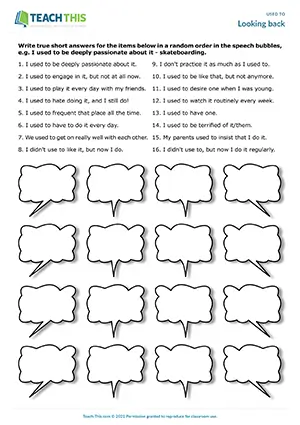
In this memorable used to speaking activity, students practice expressions with 'used to' and 'would' by talking about past habits and memories. Students begin by writing true short answers for the items...

ESL Used to Activity - Grammar and Speaking: Asking and Answering Questions from Prompts, Guided Discussions, Freer Practice - Pair Work In this memorable used to speaking activity, students practice expressions with 'used to' and 'would' by talking about past habits and memories. Students begin by writing true short answers for the items on the worksheet in a random order in the speech bubbles, e.g. I used to be deeply passionate about it - skateboarding. Next, students swap worksheets with a partner. Students then take turns choosing an answer from one of their partner's speech bubbles and asking them to talk about it, e.g. 'Tell me about skateboarding.' Their partner uses the expression with 'used to' to talk about the topic, e.g. 'I used to be deeply passionate about skateboarding. I would go to the skate park every day and practice for hours.' The student then asks follow-up questions and the pair develops a short conversation about the topic. After their partner has explained the answer and it's been discussed, the student puts a tick next to the speech bubble, and the students swap roles. Finally, students report back to the class on the most interesting things they found out about their partner.

Recent Changes

Upper-intermediate (B2) 30 minutes
ESL Used to Game preview, Upper-intermediate B2, sentence completion, reading sentences, guessing, group and pair work

ESL Used to Game - Grammar: Sentence Completion, Reading Sentences, Guessing - Group and Pair Work

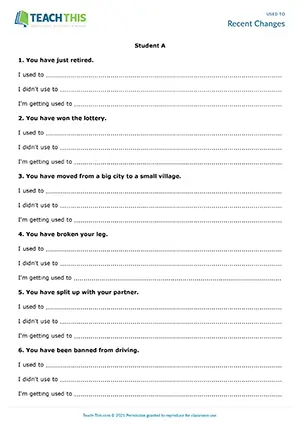
In this entertaining used to game, students practice 'used to', 'didn't use to' and 'getting used to' by guessing situations from recent changes. The worksheet shows recent changes in the student's life...

ESL Used to Game - Grammar: Sentence Completion, Reading Sentences, Guessing - Group and Pair Work In this entertaining used to game, students practice 'used to', 'didn't use to' and 'getting used to' by guessing situations from recent changes. The worksheet shows recent changes in the student's life. The students' task is to write sentences about what they used to do, didn't use to do, and what they are getting used to, regarding each situation. In two groups, students complete the sentences in a way that is appropriate for each situation. Next, students pair up with someone from the other group and take turns reading out the three sentences for each situation. Their partner has three chances to guess the situation. For each correct guess, students score a point. The student with the most points at the end of the game wins.

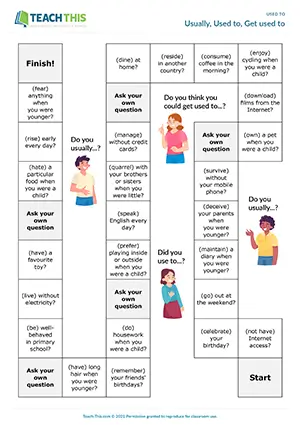
Usually, Used to, Get used to

Upper-intermediate (B2) 25 minutes
ESL Used to Board Game preview, Upper-intermediate B2, asking and answering questions from prompts, freer practice, pair work

ESL Used to Board Game - Grammar and Speaking: Asking and Answering Questions, Freer Practice - Pair Work

Here is a fun used to board game to help students ask and answer questions about things they usually do, used to do, or could/couldn't get used to doing. In pairs, students take turns rolling...

ESL Used to Board Game - Grammar and Speaking: Asking and Answering Questions from Prompts, Freer Practice - Pair Work Here is a fun used to board game to help students ask and answer questions about things they usually do, used to do, or could/couldn't get used to doing. In pairs, students take turns rolling the dice and moving their counter along the board. When a student lands on a square, they form a question from the prompt on the square with either 'Do you usually...?', 'Did you use to...?' or 'Do you think you could get used to...?' The student then asks the question to their partner who answers accordingly. If the question is formed correctly, the student stays on the square. If not, the student moves back two squares. The first student to reach the finish wins the game.

Understanding Used to

'Used to' describes habits, states, or situations that were true in the past but are no longer true now, as in 'She used to walk to school' or 'They used to live in Madrid.' Students who replace it with the simple past can still be understood, but they lose a signal that the situation has genuinely changed, which weakens the contrast they are trying to express.

This page covers 'used to' across B1 and B2 levels with 13 activities including board games, impromptu speech games, surveys, guessing games, and a worksheet, with two activities available as free downloads.

The table below maps all the key forms of 'used to' alongside the related structures 'get used to' and 'be used to', which students commonly confuse with each other.

FormStructureExampleNote
Affirmative statement subject + used to + base verb 'She used to walk to school.' True in the past, no longer true now
Negative statement subject + didn't use to + base verb 'He didn't use to like vegetables.' Also written as 'used not to' in formal English
Yes/No question Did + subject + use to + base verb? 'Did they use to live here?' Note: 'use to', not 'used to', after 'did'
Wh- question Wh- word + did + subject + use to + base verb? 'Where did you use to go on holiday?' Same rule: 'use to' after 'did'
Get used to (present) subject + is/am/are + getting used to + noun/gerund 'She is getting used to the new schedule.' Describes the process of adapting now
Be used to (state) subject + is/am/are + used to + noun/gerund 'He is used to working late.' Describes a state of being fully accustomed
Would for past habits subject + would + base verb 'As a child, she would play in the park.' Only for repeated actions, not states; no negative or question form

When to Use Used to

Signaling a complete lifestyle change: A speaker reaches for 'used to' when they want to mark a clear break between an old way of living and a new one, making it the natural choice in personal essays and interviews, as in 'I used to work in finance, but everything changed when I moved abroad.'

Describing adaptation to a new environment: 'Getting used to' suits situations where someone is in the middle of adjusting and the process still feels noticeable, which makes it common in conversations about relocating or starting a new routine, as in 'I'm still getting used to driving on the left.'

Expressing nostalgia or shared cultural memory: 'Used to' carries an emotional weight that the simple past does not, making it the preferred choice when a speaker wants to evoke a sense of loss or longing about a shared past, as in 'We all used to meet at that cafe on Fridays.'

3-Step Framework for Teaching Used to

1. Lock Down the Forms First: Start with a worksheet that moves students through the positive and negative forms in sequence. Have them rewrite past simple sentences using 'used to', then use verbs from a box to produce negative 'didn't use to' sentences. That contrast between the two forms in writing is worth doing before any speaking, because students who have tested both forms on paper make far fewer slips when they switch to spontaneous production.

2. Get Students Speaking with Timed Cards: Once the forms are secure, raise the energy with a timed speaking game. Students pick up a topic card and talk for 30 seconds about how that thing was different in the past, producing as many 'used to' and 'didn't use to' sentences as they can, with examples like 'Computers used to have floppy disks. The monitors didn't use to be flat like they are today.' Each correct sentence scores a point, which keeps students pushing for accuracy under time pressure.

3. Extend to All Three Forms with a Guessing Game: Once students handle 'used to' and 'didn't use to' confidently, push them into 'getting used to' as well. In a guessing game format, students write three sentences about a recent change in their life, one for each form, then read them aloud while their partner has three chances to identify the situation. Covering all three forms in a single set of sentences forces students to think about meaning and not just grammar patterns.

Common Mistakes with Used to

Using 'used to' for a single past event: Students often use 'used to' to describe a one-time past event rather than a repeated habit or ongoing state, treating it as a general past tense marker. Wrong: 'I used to go to Paris last summer.' Correct: 'I went to Paris last summer.'

Keeping 'used' after the auxiliary 'did': Students often write 'used to' instead of 'use to' in questions and negatives, carrying the past tense marker twice when 'did' already signals the past. Wrong: 'Did you used to play football?' Correct: 'Did you use to play football?'

Common Questions About Teaching Used to

What is an engaging board game for practicing 'used to' at intermediate level?

The board game Growing Up is a free download that puts 'used to' in a natural B1 context. When a player lands on a square, the student on their right asks a question about growing up, the player answers using 'used to' and the past simple, and the group then explores the topic with follow-up questions and comments.

What is a fun 'used to' game for B1 students?

In the game People used to..., students describe a hidden invention to a partner using only 'used to' and 'didn't use to' sentences, reading their clues with the word 'blank' for the underlined invention, for example 'Before the invention of the 'blank', people used to...' The partner then has three chances to guess the invention.

What is a good 'used to' speaking activity for intermediate students?

Contrasting 'used to' with the present simple is the aim of the activity Then and Now, a free download where students write past answers using 'used to', for example 'I used to have long brown hair and spots', then write present simple answers. In pairs, they ask and answer both sets of questions and report back to the class.

Become a Teach This Member

Get unlimited access to the full library, plus new resources added every week.

Unlimited Resource Access

Download from 3000+ worksheets, activities, and games.

Save 5+ Hours Weekly

Cut lesson prep time with ready-to-use resources, plus teacher notes and answer keys.

Trusted Professional Quality

Classroom-tested, editable resources created by experienced ESL professionals.

Fresh Content Weekly

Get 5 new resources added to the library each week.

Join Now Just $29.99 quarterly