
Family & Relationships ESL Games, Activities & Worksheets
Family Battleships
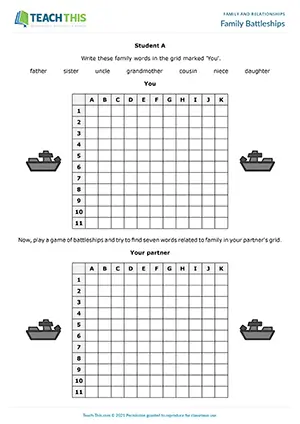
ESL Family Vocabulary Game - Vocabulary: Battleships - Pair Work
In this enjoyable family vocabulary game, students play battleships to practice vocabulary related to family. Students begin by writing seven family words on their grid. Students then play a game of battleships where they have to find...
Family Bingo
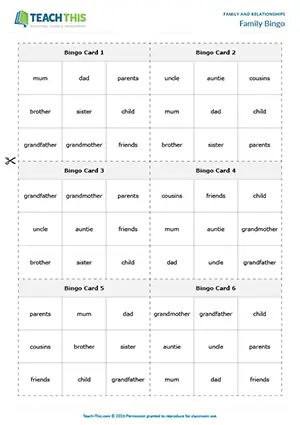
ESL Family Vocabulary Game - Vocabulary: Bingo, Matching
In this family vocabulary game, students play bingo by listening to family and relationship words and matching them to the words on their bingo cards. Give each student a bingo card. Begin the game by reading out a family or relationship word from the...
Family Flashcards and Worksheet
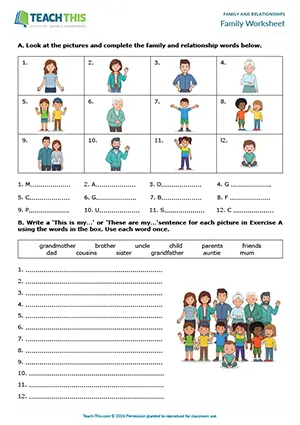
ESL Family Vocabulary Flashcards and Worksheet - Flashcards: Eliciting, Drilling, Sentence Frames - Vocabulary and Writing: Spelling Completion, Writing Sentences
In this family and relationships resource, students learn 12 common family and relationship words and practice them with flashcards and a worksheet...
Family Riddles
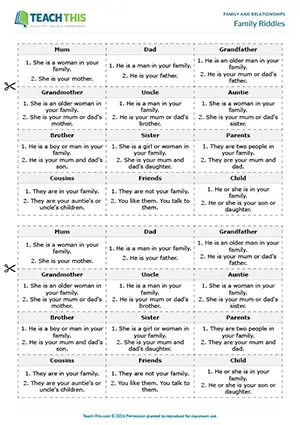
ESL Family Vocabulary Game - Listening and Speaking: Describing, Guessing - Pair Work
In this family words game, students review family and relationship words by listening to clues and guessing the answers. In pairs, students take turns picking up a card and reading the first clue to their partner. Their partner listens and tries to guess...
Family and Relationships Bingo

ESL Family and Relationships Game - Vocabulary: Bingo, Matching - Group Work
In this fun family and relationships vocabulary game, students play bingo by listening to definitions and matching them to family and relationship words. In groups, the bingo caller reads a definition at random from the caller's sheet. The other students...
Relationships Match

ESL Family and Relationships Games - Vocabulary: Matching, Describing, Guessing - Group Work
Here are two entertaining family and relationship games to help students practice vocabulary related to family and relationships. First, students play a game of dominoes where they complete a...
Relationship Vocabulary Practice

ESL Family and Relationships Worksheet - Vocabulary Exercises: Matching, Categorising, Unscrambling, Gap-fill
This free family worksheet helps elementary students learn and practice basic family and relationship words. To start, students match family and relationship vocabulary from a box to pictures. Students then...
Family Races
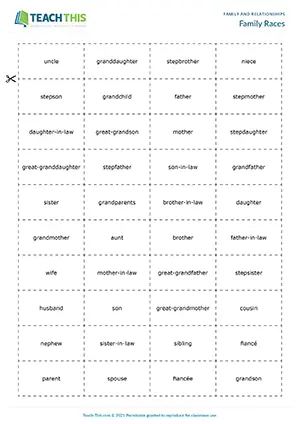
ESL Family Games - Vocabulary: Spelling, Matching, Identifying, Describing, Guessing - Group Work
These engaging family vocabulary games help students learn and practice a wide variety of family-related vocabulary. The games consist of a spelling relay, a board race and a describing game...
Family Time!

ESL Family Vocabulary Worksheet - Vocabulary Exercises: Gap-fill, Identifying, Matching, Writing Sentences
This comprehensive family worksheet helps students to learn and practice words that describe families and relationships. Students begin with a gap-fill exercise where they complete a text about...
The Watanabe Family

ESL Family Tree Activity - Vocabulary and Speaking: Asking and Answering Questions, Labelling - Pair Work
In this memorable family tree speaking activity, students practice family vocabulary by completing a family tree. In two groups, students look at the family tree and complete sentences on their worksheet...
We Are Family
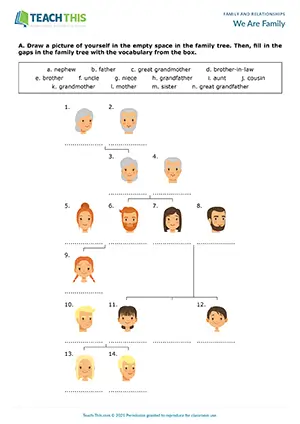
ESL Family Tree Worksheet - Vocabulary Exercises: Labelling, Writing Short Answers, Categorising, Word Search
This rewarding family tree worksheet helps students learn and practice family vocabulary. First, students draw a picture of themselves in an empty space in a family tree. Students then fill in gaps in the family tree...
A Family Picnic
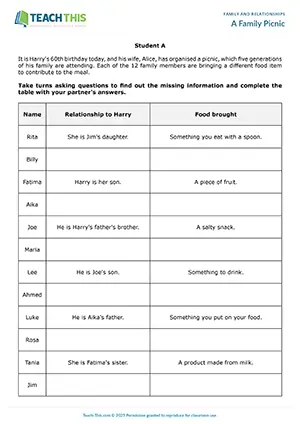
ESL Family Activity - Reading and Vocabulary: Information Gap, Table Completion, Unscrambling, Gap-fill - Pair Work
Here is a useful family vocabulary activity to help students practice words related to family relations. First, in pairs, students do an information gap activity...
Family and Relationships Crossword

ESL Family Crossword - Vocabulary Activity: Writing Clues, Describing, Guessing - Pair and Group Work
In this handy family crossword activity, students complete a crossword by describing and guessing words related to family and relationships. In two groups, students invent and write down clues...
Family Tree

ESL Family Tree Activity - Vocabulary and Speaking: Asking and Answering Questions, Identifying, Labelling - Pair Work
In this free family tree speaking activity, students practice family vocabulary and possessives by working together to complete a family tree. The students' task is to complete a family tree by...
It Runs in the Family

ESL Family Activities - Vocabulary and Speaking: Running Dictation, Matching, Asking and Answering Questions, Freer Practice - Pair and Group Work
Here is an interesting family members speaking activity to help students practice family relations vocabulary. First, students take part in a running...
Keep it in the Family

ESL Family Game - Vocabulary and Speaking: Describing, Defining, Guessing - Group Work
In this fun family vocabulary game, students describe and define nouns, adjectives, adjective-noun collocations, phrasal verbs and idioms related to family. In groups, students take it in turns...
Match Up
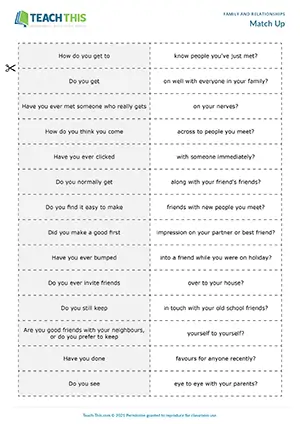
ESL Family Phrasal Verbs and Idioms Activity - Vocabulary and Speaking: Pelmanism, Forming, Asking and Answering Questions, Discussion - Group Work
In this insightful family phrasal verbs and idioms game and discussion activity, students form and ask questions containing phrasal verbs and idioms related to...
Relationship Phrasal Verbs

ESL Relationship Phrasal Verbs Worksheet - Vocabulary, Writing and Reading Exercises: Gap-fill, Sentence Completion - Speaking Activity: Discussion - Pair Work
This productive relationship phrasal verbs worksheet helps students practice phrasal verbs that are commonly used to talk about relationships. First...
Using Family and Relationships Vocabulary
Family and relationships vocabulary includes words for relatives, personal connections and relationship status. Using these words with possessives and clear descriptions helps students explain how people are connected, rather than simply list family members.
This page has 18 resources across A1, A1-A2, A2, B1 and B2, including vocabulary games, worksheets, family tree activities and practice with relationship phrasal verbs and idioms. Relationship Vocabulary Practice and Family Tree are available as free downloads.
The table shows useful words and phrases for explaining family connections.
| Word or phrase | Meaning or use | Example |
|---|---|---|
| sibling | A brother or sister | 'I have two siblings: a brother and a sister.' |
| cousin | A child of an aunt or uncle | 'My aunt's daughter is my cousin.' |
| niece or nephew | A daughter or son of your sibling, or of your spouse's sibling | 'My sister's son is my nephew.' |
| partner | A person someone has a romantic relationship with | 'Sam lives with his partner.' |
| be married to | Identify someone's spouse | 'Maya is married to Ben.' |
| get on with | Have a friendly relationship with someone | 'I get on well with my cousins.' |
When to Use Family and Relationships Vocabulary
Introduce someone clearly: Combine a relationship word with a name or another identifying detail. 'This is my cousin, Alex' tells the listener both who the person is and how you are connected.
Explain connections between people: Identify whose relative you mean when describing a family tree or story. 'Leila is Amir's aunt' is clearer than 'Leila is the aunt' when several families are involved.
Discuss relationships and experiences: Move beyond naming relatives by describing contact or shared activities, as in 'I get on well with my sister, and we cook together.' Students can discuss a fictional family or people they know instead of sharing personal details.
3-Step Framework for Teaching Family and Relationships Vocabulary
This sequence suits elementary to pre-intermediate classes. The more advanced phrasal verb and idiom resources can support separate lessons.
1. Recognise Relationships from Definitions: Use bingo cards containing family and relationship words. Students listen to definitions and cross off matching words, checking meaning before they need to explain relationships themselves.
2. Build and Explain Sentences: Move to dominoes where students complete sentences with relationship words and read the results aloud. Follow with the describing game, giving classmates 30 seconds to guess a word from a description. This shifts students from recognising definitions to producing their own clues.
3. Exchange Information about a Family: Students complete sentences about a family tree, then ask a partner questions to fill the gaps in their own tree. They explain relationships using the prepared sentences and add names in the correct places, applying the vocabulary to a shared information task.
Common Mistakes with Family and Relationships Vocabulary
Using the wrong preposition after married: Use 'married to' when naming someone's spouse. 'Married with children' describes a different situation and does not identify the spouse. Incorrect: 'She is married with an engineer.' Correct: 'She is married to an engineer.'
Confusing the direction of a relationship: Work out the relationship from the speaker's position. Your sister's daughter is your niece; you are her aunt or uncle. Incorrect: 'My sister's daughter is my aunt.' Correct: 'My sister's daughter is my niece.'
Common Questions About Teaching Family and Relationships Vocabulary
What is a fun game for practicing family vocabulary?
The game Family Battleships turns spelling practice into a search for hidden family words. Students call out grid coordinates to uncover letters on a partner's worksheet, using each hit to work out the words. The race to find all seven words gives students a reason to keep checking letters and recognising vocabulary.
What is a useful worksheet for teaching family vocabulary?
The free worksheet Relationship Vocabulary Practice builds from recognising family words to using them in sentences. Students match words to pictures, categorise them and connect them with definitions. They then reorder words and complete sentences, giving teachers a sequence for checking meaning before moving into sentence construction.
What is a good speaking activity for practicing family vocabulary?
The free activity Family Tree gives students missing information to discover through speaking. Partners ask who people are and explain their family relationships, using the answers to complete a family tree. They then swap roles, so both students practice asking questions and describing how family members are connected.
Become a Teach This Member
Get unlimited access to the full library, plus new resources added every week.
Unlimited Resource Access
Download from 3000+ worksheets, activities, and games.
Save 5+ Hours Weekly
Cut lesson prep time with ready-to-use resources, plus teacher notes and answer keys.
Trusted Professional Quality
Classroom-tested, editable resources created by experienced ESL professionals.
Fresh Content Weekly
Get 5 new resources added to the library each week.
Here's what our members are saying...


