
Modal Verbs of Deduction & Speculation ESL Games, Activities & Worksheets
Could be, Might be, Must be
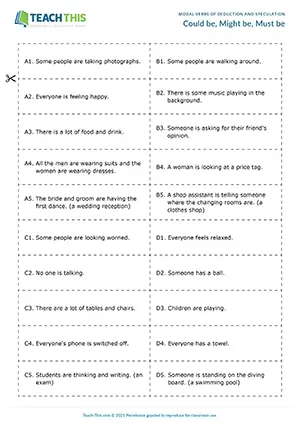
ESL Modal Verbs of Deduction Activity - Speaking: Guessing, Forming Sentences, Writing Clues - Pair and Group Work
In this free modal verbs of deduction speaking activity, students make deductions with could be, might be, can't be and must be, and guess places from descriptions. Students take it in turns to read their first...
Deduction and Speculation
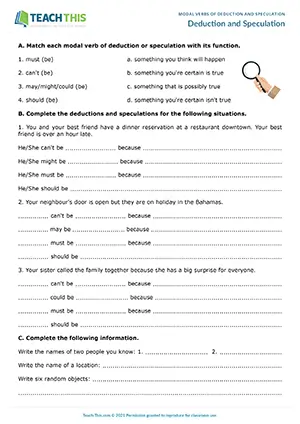
ESL Modal Verbs of Deduction and Speculation Worksheet - Grammar and Writing Exercises: Matching, Sentence Completion, Gap-fill, Paragraph Writing
In this productive modal verbs of speculation and deduction worksheet, students make deductions and speculate on what is happening in mysterious...
It could be...
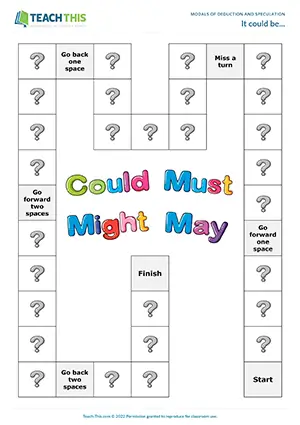
ESL Modal Verbs of Deduction and Speculation Board Game - Grammar and Speaking: Forming Sentences, Freer Practice - Group Work
Here is a fun modal verbs of deduction and speculation board game for intermediate students. In groups, students take turns reading out a situation on a...
The Deductions Game
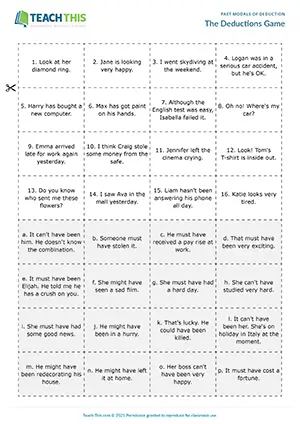
ESL Past Modal Verbs of Deduction Game - Grammar and Speaking: Matching, Forming Sentences - Group Work
In this useful past modal verbs of deduction game, students speculate on situations using past modal verbs of deduction and try to match sentences and situations together. In groups, students take it in...
What's the truth?
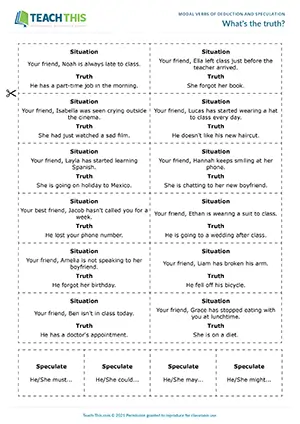
ESL Modal Verbs of Speculation Game - Speaking: Discussion, Guessing, Freer Practice - Group Work
In this imaginative modal verbs of speculation game, students speculate the truth behind various situations. Students take it in turns to pick up a situation card. The other students in the group then take a...
Who is it?
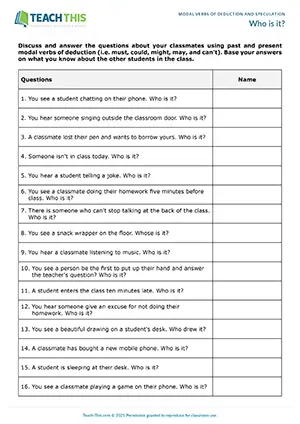
ESL Modal Verbs of Deduction Activity - Speaking: Discussion - Group Work
This free modal verbs of deductions speaking activity helps students to practice past and present modal verbs of deduction. In groups, students read each question on the worksheet, e.g. 'You hear a student telling a joke. Who is it?' Students...
Deducing the Past
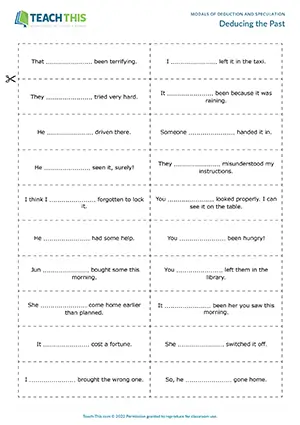
ESL Modal Verbs of Deduction Game - Grammar: Matching, Gap-fill - Pair Work
In this engaging past modal verbs of deduction game, students match deductions to situations and complete the deductions with the modal verbs: must have, might have, may have, can't have, or couldn't have. In groups, students take it in...
Modals of Deduction and Speculation Practice
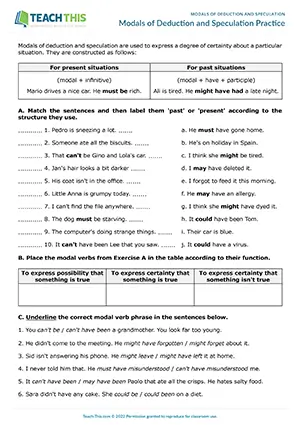
ESL Modal Verbs of Deduction and Speculation Worksheet - Grammar Exercises: Matching, Categorising, Gap-fill, Rewriting - Speaking Activity - Pair Work
Here is a comprehensive modal verbs of deduction and speculation worksheet for upper-intermediate students. First, students match sentences that...
Understanding Modal Verbs of Deduction and Speculation
Modal verbs of deduction and speculation are words like 'must', 'can't', 'might', 'could', and 'may' that speakers use when they reason about something they cannot know for certain. When students misuse these modals, for example choosing 'must' when 'might' fits the evidence, they state a firm conclusion where the situation only supports a possibility, which can make them sound overconfident or simply wrong to a native speaker.
This page covers modal verbs of deduction and speculation across Pre-intermediate, Intermediate, and Upper-intermediate levels (A2 to B2), with eight activities including grammar worksheets, board games, card games, and group speaking tasks, with two available as free downloads.
The table below maps the key modal verbs of deduction and speculation in English, showing their degree of certainty and how the form shifts between present and past time.
| Modal Verb | Degree of Certainty | Time | Structure | Example |
|---|---|---|---|---|
| must | near certain (positive) | present | subject + must + be/base verb | 'She must be tired.' |
| must have | near certain (positive) | past | subject + must have + past participle | 'She must have left already.' |
| can't / couldn't | near certain (negative) | present | subject + can't/couldn't + be/base verb | 'That can't be right.' |
| can't have / couldn't have | near certain (negative) | past | subject + can't/couldn't have + past participle | 'He can't have forgotten about it.' |
| might / may / could | possible | present | subject + might/may/could + be/base verb | 'It might be a mistake.' |
| might have / may have / could have | possible | past | subject + might/may/could have + past participle | 'It might have been a mistake.' |
| should | expected or logical | present | subject + should + be/base verb | 'They should be here by now.' |
| should have | expected or logical | past | subject + should have + past participle | 'She should have arrived by now.' |
When to Use Modal Verbs of Deduction and Speculation
Expressing near certainty in speech: A speaker chooses 'must' rather than 'think' or 'believe' when the visible evidence makes one conclusion feel almost unavoidable, as in 'You have been traveling for twenty hours. You must be exhausted.'
Ruling something out definitively: A speaker uses 'can't' when known facts make a conclusion feel logically impossible rather than merely unlikely, as in 'That can't be right. I sent the email myself this morning.'
Keeping options open in writing: A writer chooses 'might' or 'may' when presenting a hypothesis where the evidence allows for more than one explanation, signaling appropriate caution to the reader, as in 'The sudden drop in temperature may have triggered the equipment failure.'
3-Step Framework for Teaching Modal Verbs of Deduction and Speculation
1. Introduce the Modals Through Progressive Clue-Giving: Start at Pre-intermediate level with a speaking activity that makes the difference between 'could be', 'might be', and 'must be' immediately clear from context. Students read out clues about a mystery place one by one, and each clue gets progressively easier, so by clue 4 or 5 students should know the place being described. Watching their certainty narrow from 'could be' toward 'must be' shows the modals doing real communicative work in real time. The clue-writing extension also gives students productive output practice at the same time as the receptive deduction work.
2. Build Grammar and Writing Accuracy with a Detective Task: Move to a worksheet that takes students from matching modal functions through to extended writing. The distinctive mechanic is that students brainstorm two names, a location, and six random objects, complete a gap-fill text placing those elements inside a missing person's case, and then take on the role of a detective to write a theory about how all the information could be connected to that case. This pushes students to produce modal verbs of deduction and speculation across a sustained piece of writing, not just isolated sentences.
3. Sharpen Past Modal Forms with a Concentration-Style Card Game: At Upper-intermediate level, shift focus to the past deduction forms: 'must have', 'might have', 'may have', 'can't have', and 'couldn't have'. Students turn over one situation card and one deduction card, and if the situation matches the deduction, they complete the sentence with an appropriate past modal. If the group agrees the choice is correct, the student keeps both cards and takes another turn. If not, both cards go back face-down in the same place. The memory element adds a precision layer: students need to recall both card positions and the correct modal form at the same time.
Common Mistakes with Modal Verbs of Deduction and Speculation
Dropping 'have' in past modal deductions: Students often drop 'have' when making past deductions, treating the past modal form as if it works the same way as the present form. Wrong: 'She must be at the party last night.' Correct: 'She must have been at the party last night.'
Using 'mustn't' instead of 'can't' for negative deductions: Students often use 'mustn't' as the negative of 'must' for logical deductions, confusing it with the obligation meaning, when 'can't' is the correct choice to express that something is logically impossible. Wrong: 'She passed all her exams. She mustn't be stupid.' Correct: 'She passed all her exams. She can't be stupid.'
Common Questions About Teaching Modal Verbs of Deduction and Speculation
What is a good board game for practicing modal verbs of deduction and speculation?
The board game It could be... gets students racing to explain situation cards using the right modal verb. The first student to give a correct explanation rolls the dice and moves along the board. Students use 'must' when they are certain and 'could', 'may', or 'might' when they are less sure, which keeps the modal choice meaningful every turn.
What is an engaging game for practicing modal verbs of speculation?
What makes the game What's the truth? engaging is that the whole group speculates at the same time. One student reads a situation card such as 'Your friend Noah is always late to class' and everyone else holds a different modal verb card and has to keep speculating until someone guesses the truth.
What is a fun activity for practicing modal verbs of deduction?
In the free activity Who is it?, students read a scenario such as 'You hear a student telling a joke. Who is it?' and use modal verbs of deduction to agree on one classmate who fits. That classmate then tells the class whether they agree, which makes the deduction feel real rather than just a grammar exercise.
Become a Teach This Member
Get unlimited access to the full library, plus new resources added every week.
Unlimited Resource Access
Download from 3000+ worksheets, activities, and games.
Save 5+ Hours Weekly
Cut lesson prep time with ready-to-use resources, plus teacher notes and answer keys.
Trusted Professional Quality
Classroom-tested, editable resources created by experienced ESL professionals.
Fresh Content Weekly
Get 5 new resources added to the library each week.
Here's what our members are saying...


