
Problem-Solution Essays EAP Worksheets
From Problem to Paragraph

EAP Problem-Solution Essays Activity - Reading and Writing: Categorising, Matching, Planning and Writing a Paragraph, Peer Review and Feedback - Pair Work
This problem-solution paragraph writing activity helps students identify common problems, propose realistic solutions, and organise their ideas into a...
Problem-Solution Essays 1

EAP Problem-Solution Essays Worksheet - Writing Exercises: Gap-fill, Categorising, Identifying, Writing an Outline and Essay
In this free problem-solution essays worksheet, students are introduced to problem-solution essay structure and attempt a problem-solution essay writing practice. First, students read a...
Problem-Solution Quest
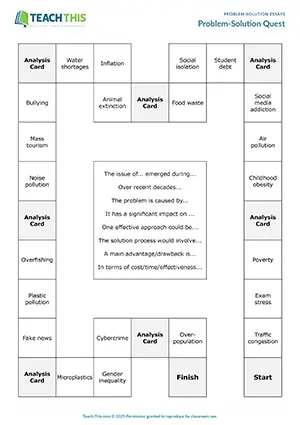
EAP Problem-Solution Board Game - Speaking: Impromptu Speech, Critical Thinking, Creating an Outline, Presenting, Freer Practice - Group Work
This engaging problem-solution board game develops students' ability to analyse problems, develop solutions, and evaluate them across various topics...
Racism
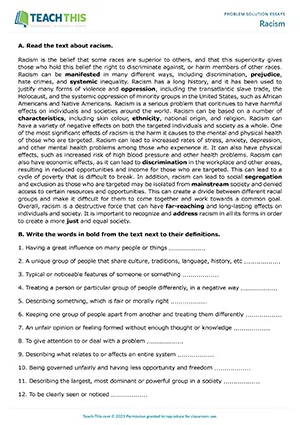
EAP Problem-Solution Essays Worksheet - Reading and Writing Exercises: Outlining, Gap-fill, Writing an Essay - Speaking Activity: Discussion
In this problem-solution essay writing practice, students discuss a text about racism and then plan and write a problem-solution essay that addresses the...
SPSE Essays
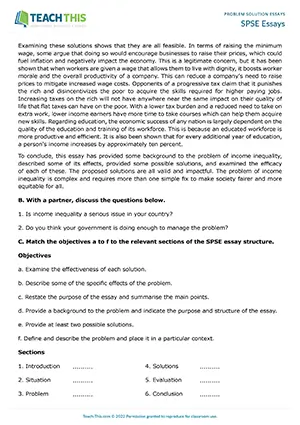
EAP Problem-Solution Essays Worksheet - Writing: Matching, Writing an Essay - Speaking Activity: Discussion, Communicative Practice - Group Work
In this productive SPSE essays worksheet, students are introduced to SPSE essay structure and attempt an SPSE essay writing practice. First, students...
Understanding Problem-Solution Essays
A problem-solution essay explains a problem, proposes responses and considers how effectively those responses could address it. The writer needs to connect each solution to the problem identified and explain its likely benefits, practical requirements and limitations.
This page contains five B2 resources, including paragraph practice, essay-writing worksheets and a board game that leads into outlining. One worksheet is available as a free download.
The table compares useful organisation choices. Follow the assignment requirements and choose a structure that makes the relationships between problems, responses and evaluation clear.
| Structure or component | Purpose | Planning question |
|---|---|---|
| Block structure | Explain the problems together before presenting the solutions | 'Will readers be able to connect each proposed response to the relevant problem?' |
| Chain structure | Discuss a problem and its response before moving to the next pair | 'Does each solution address the problem immediately preceding it?' |
| Situation | Establish the context and scope | 'Who is affected, and in what setting?' |
| Problem | Explain what needs addressing and why it matters | 'What specific difficulty requires a response?' |
| Solution | Describe a proposed action and how it could help | 'Who would do what, and how would that address the difficulty?' |
| Evaluation | Consider benefits, limitations and feasibility | 'What would make this proposal workable, and what might limit it?' |
How to Develop Problems and Solutions in an Essay
Define a manageable problem: Help students narrow a broad issue to a specific difficulty in a stated context. This makes it easier to propose an action whose relevance and feasibility can be examined within the essay.
Explain the mechanism: After naming a solution, ask students to explain how it would affect the problem. A proposal needs more than a positive label; readers should understand the action, the people responsible and the intended effect.
Evaluate before recommending: Compare proposals using relevant criteria such as access, cost, practicality and likely impact. Distinguish supported findings from predictions, and acknowledge conditions that would need to be met rather than promising that a solution will work everywhere.
3-Step Framework for Teaching Problem-Solution Essays
Use this B2 sequence across suitable lessons to move from matching a response to a problem, through paragraph development, to a complete essay. The first two stages develop different parts of the same paragraph activity.
1. Match problems with relevant responses: Pairs sort problem and solution cards into columns, match them and discuss an additional solution for each problem. Ask them to explain the connection in each pair so they establish a reason for selecting a response before planning their writing.
2. Develop and review a paragraph: Pairs choose one problem, answer planning questions and write a paragraph following the question sequence. They exchange paragraphs and use a checklist to provide one positive comment and one improvement point. Use this feedback to check whether the paragraph explains the problem-response relationship established in the first stage.
3. Extend the process to an essay: Students read about racism, prepare vocabulary and discuss the problems described alongside potential responses. They combine information from the text with their ideas to create an outline, review writing advice and draft an essay. Partner checklist feedback then helps them examine the organisation and explanation of their proposals at essay level.
Common Mistakes with Problem-Solution Essays
Proposing an action without showing its relevance: A solution must address the difficulty described. In this hypothetical example, students cannot use an online course because they lack reliable internet access. Weak connection: 'The course should include more online videos.' Relevant proposal: 'Providing materials that can be downloaded when a connection is available could reduce dependence on continuous internet access.'
Presenting an intended result as guaranteed: Explain the conditions and limits of a proposal instead of treating a prediction as an established fact. Overstatement: 'A new reporting system will eliminate every incident.' Qualified evaluation: 'A reporting system could help identify incidents, but its value would depend on whether people can use it safely and whether reports lead to appropriate action.'
Common Questions About Teaching Problem-Solution Essays
What game helps students plan problem-solution essays?
The board game Problem-Solution Quest gets students explaining problems, proposing solutions and responding to analysis prompts. After playing, groups organise the analysis cards into essay components and use them to build an outline. Presenting that outline connects the spoken practice with decisions about how to organise a problem-solution essay.
What free worksheet helps teach problem-solution essay structure?
The worksheet Problem-Solution Essays 1 introduces block and chain structures, then gives students practice with language for describing problems and solutions. They examine a model essay, discuss possible solutions and create a block-structure outline. Writing an essay and exchanging peer feedback takes students from recognising the pattern to applying it.
What worksheet helps teach students to evaluate solutions?
The worksheet SPSE Essays introduces situation, problem, solution and evaluation through a model essay. Students identify the purpose of each section, discuss a problem and compare possible solutions by considering their advantages and disadvantages. They then turn their notes into an outline and essay, making evaluation part of the writing process.
Become a Teach This Member
Get unlimited access to the full library, plus new resources added every week.
Unlimited Resource Access
Download from 3000+ worksheets, activities, and games.
Save 5+ Hours Weekly
Cut lesson prep time with ready-to-use resources, plus teacher notes and answer keys.
Trusted Professional Quality
Classroom-tested, editable resources created by experienced ESL professionals.
Fresh Content Weekly
Get 5 new resources added to the library each week.
Here's what our members are saying...


