Business Problems and Solutions

Intermediate (B1) 45 minutes
Business problems worksheet preview showing vocabulary, reading and writing exercises, matching, writing sentences, guided discussions, presenting, and freer practice for intermediate B1 level students

Business Problems Worksheet - Vocabulary, Reading and Writing Exercises: Matching, Writing Sentences - Speaking: Discussion, Presenting, Freer Practice - Group Work

In this useful business problems worksheet, students identify and discuss common business issues and practice linking causes to solutions and suggesting...

Business Problems Worksheet - Vocabulary, Reading and Writing Exercises: Matching, Writing Sentences - Speaking: Guided Discussions, Presenting, Freer Practice - Group Work In this useful business problems worksheet, students identify and discuss common business issues and practice linking causes to solutions and suggesting reasoned proposals. First, students match common business problems to their definitions. Students then match the problems to potential causes. Next, students read a model for linking a business problem's cause to a potential solution and formulating a reason. After that, students choose a problem and cause from the worksheet and use the model to write a solution with reasoning. Following that, in groups, students discuss business scenarios, identify the main problem, explore possible causes using Exercise B, and suggest solutions using the model. Once a group agrees on the best solution, they formulate a clear reason and write it down. Finally, each group prepares a short presentation, with each student presenting a part of the talk: the problem, possible causes, the solution, and the reasoning. After each presentation, the class asks questions and discusses the proposed solution.

Problem Solvers Board Game

Intermediate (B1) 25 minutes
Business problems board game preview featuring vocabulary and speaking activities, identifying problems, problem solving, impromptu speech, and freer practice for intermediate B1 level students

Business Problems Board Game - Vocabulary and Speaking: Identifying, Problem Solving, Impromptu Speech, Freer Practice - Group Work

Here is a free business problems board game to help students practice identifying business problems, implementing solutions, and responding to business...

Business Problems Board Game - Vocabulary and Speaking: Identifying, Problem Solving, Impromptu Speech, Freer Practice - Group Work Here is a free business problems board game to help students practice identifying business problems, implementing solutions, and responding to business challenges. Players take turns rolling the dice and moving their counter along the board. When a player lands on a 'Problem' square, they pick up a corresponding card, read the business problem aloud, and identify the type of business problem shown in the middle of the game board. When a player lands on a 'Solution' square, they take a solution card, read it aloud, and say which business problem the solution helps fix and how they would implement it. When landing on a 'Challenge' square, the player picks up a challenge card, reads it aloud, and responds to the business scenario described by suggesting a suitable solution. For each response, the other students evaluate the answer or solution. If a player provides a correct answer or suitable solution, they stay on their square. If not, they move back to their previous square. The first player to reach the finish wins the game.

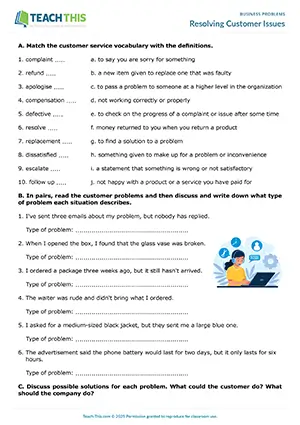
Resolving Customer Issues

Intermediate (B1) 35 minutes
Customer service activity preview showing vocabulary matching exercises, guided discussion, role-plays, freer and communicative practice for intermediate B1 level customer service training

Customer Service Activity - Vocabulary Exercise: Matching - Speaking Activity: Guided Discussion, Role-Plays, Freer and Communicative Practice - Pair Work

In this insightful customer service activity, students identify customer issues, discuss possible solutions, and role-play complaint dialogues between a customer...

Customer Service Activity - Vocabulary Exercise: Matching - Speaking Activity: Guided Discussion, Role-Plays, Freer and Communicative Practice - Pair Work In this insightful customer service activity, students identify customer issues, discuss possible solutions, and role-play complaint dialogues between a customer and a representative. First, students match customer service vocabulary with definitions. In pairs, students then read customer problems and discuss and write down what type of problem each situation describes. Next, students discuss possible solutions for each problem, considering what the customer and the company could do to resolve the issue. After that, pairs role-play four customer service conversations between a customer with a complaint and a customer service representative using a framework, situations, and language that uses the target vocabulary, taking turns to be the customer and the representative. Finally, pairs present one of their role-plays to the class.

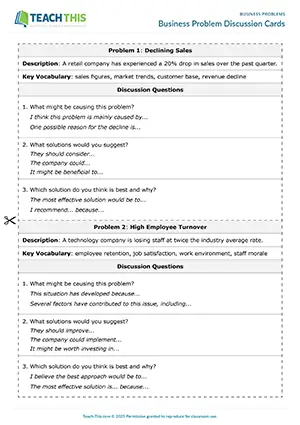
Business Problem Discussion Cards

Upper-intermediate (B2) 40 minutes
Business problems activity preview featuring speaking activities, problem solving, guided discussion, freer and communicative practice for upper-intermediate B2 level business English students

Business Problems Activity - Speaking: Problem Solving, Discussion, Freer and Communicative Practice - Group Work

In this business problems discussion activity, students practice using business vocabulary and functional language to discuss business issues and suggest solutions. In groups, students take turns selecting...

Business Problems Activity - Speaking: Problem Solving, Discussion, Freer and Communicative Practice - Group Work In this business problems discussion activity, students practice using business vocabulary and functional language to discuss business issues and suggest solutions. In groups, students take turns selecting a card and reading the business problem, its description, and the key vocabulary aloud to the group. The group then discusses the problem using the questions on the card and suggests solutions using the vocabulary and language prompts. At the end of the discussion, the group chooses the best solution and writes it on their worksheet, along with an explanation of why they chose it. For any new or difficult words on the cards, students look up the definitions and write them on the worksheet. After all four problems have been discussed, each group shares one problem they discussed and presents their recommended solution using the target vocabulary and language from the card.

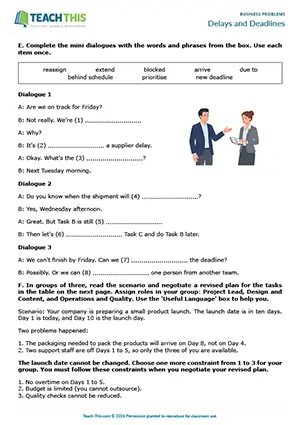
Delays and Deadlines

Upper-intermediate (B2) 60 minutes
Business problems worksheet and activity preview featuring matching, ordering, short answer questions, true or false, gap-fill, roleplay, negotiation, giving a short presentation for upper-intermediate B2 level business English students

Business Problems Worksheet and Activity - Vocabulary and Reading Exercises: Matching, True or False, Gap-fill - Speaking: Role-play, Presenting - Group Work

In this workplace delays worksheet and activity, students work with realistic workplace delays and practice explaining what happened, suggesting...

Business Problems Worksheet and Activity - Vocabulary and Reading Exercises: Matching, Ordering, Short Answer Questions, True or False, Gap-fill - Speaking: Role-play, Negotiation, Giving a Short Presentation - Group Work In this workplace delays worksheet and activity, students work with realistic workplace delays and practice explaining what happened, suggesting options, and agreeing on a revised plan to meet a launch deadline. First, students match a series of delay problems to their causes. Students then sequence a timeline of events. Next, students answer questions about the timeline. After that, students read the timeline again and mark statements as true or false. Students then complete mini dialogues with words and phrases from a box. Following that, in groups, students read a scenario about a product launch, the problems that happened and choose one more constraint. Next, students negotiate a revised plan for tasks in a table using assigned roles. When the students have finished, they agree on three actions to avoid delays with the product launch. After that, groups prepare and present a one-minute group update to the class, addressing three points. Finally, students discuss questions about work-related plans and delays in their groups.

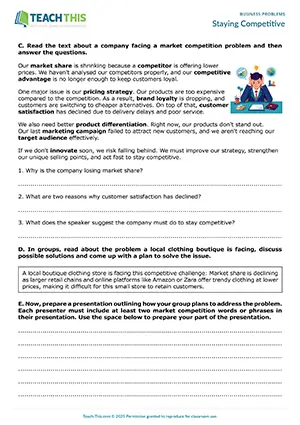
Staying Competitive

Upper-intermediate (B2) 35 minutes
Business problems worksheet preview showing reading and vocabulary exercises, matching, gap-fill, discussion, delivering presentations, and freer practice for upper-intermediate B2 level market competition vocabulary

Business Problems Worksheet - Reading and Vocabulary Exercises: Matching, Gap-fill -Speaking Activity: Discussion, Delivering a Presentation, Freer Practice - Group Work

In this market competition worksheet, students learn market competition vocabulary and practice using it by addressing and planning solutions to a...

Business Problems Worksheet - Reading and Vocabulary Exercises: Matching, Gap-fill -Speaking Activity: Discussion, Delivering a Presentation, Freer Practice - Group Work In this market competition worksheet, students learn market competition vocabulary and practice using it by addressing and planning solutions to a business problem. First, students match market competition vocabulary to definitions. Students then complete sentences with the market competition words and phrases. Next, students read a text about a company facing a market competition problem and answer comprehension questions about it. After that, in groups, students read about a problem a local clothing boutique is facing, discuss possible solutions and come up with a plan to solve the issue. Students then prepare a short group presentation that outlines a plan to address the problem. Finally, groups present their plans to the class, who vote on which one they think is the most effective.

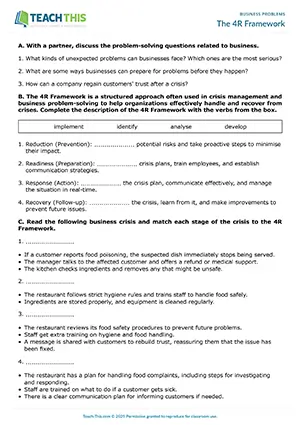
The 4R Framework

Upper-intermediate (B2) 30 minutes
Business problems worksheet preview featuring reading and vocabulary exercises, gap-fill, matching, discussion, problem-solving, and freer practice for upper-intermediate B2 level crisis management

Business Problems Worksheet - Reading and Vocabulary Exercises: Gap-fill, Matching - Speaking Activity: Discussion, Problem-Solving, Freer Practice - Group Work

In this informative business problems worksheet, students learn about the 4R Framework for crisis management and business problem-solving...

Business Problems Worksheet - Reading and Vocabulary Exercises: Gap-fill, Matching - Speaking Activity: Discussion, Problem-Solving, Freer Practice - Group Work In this informative business problems worksheet, students learn about the 4R Framework for crisis management and business problem-solving and apply it to a hypothetical business crisis. First, in pairs, students discuss three problem-solving questions related to business. Students then complete a description of the 4R Framework with verbs from a box. Next, students read about a business crisis and match each stage of the crisis to the 4R Framework. After that, in groups, students read a business crisis scenario, discuss the problem and complete a 4R Framework to help solve the issue. Finally, students discuss follow-up questions in their group.

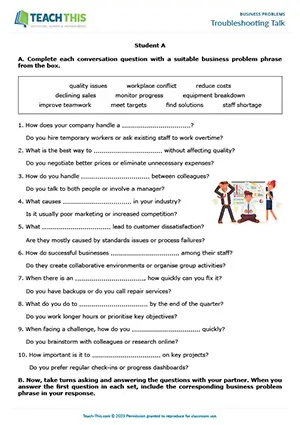
Troubleshooting Talk

Upper-intermediate (B2) 30 minutes
Business problems activity preview featuring speaking and vocabulary activities, gap-fill, asking and answering questions, controlled and freer practice, group and pair work for upper-intermediate B2 level business English students

Business Problems Activity - Vocabulary and Speaking: Gap-fill, Asking and Answering Questions, Controlled and Freer Practice - Group and Pair Work

In this business problems discussion activity, students complete, ask and answer conversation questions that contain business problem phrases. First, in two...

Business Problems Activity - Vocabulary and Speaking: Gap-fill, Asking and Answering Questions, Controlled and Freer Practice - Group and Pair Work In this business problems discussion activity, students complete, ask and answer conversation questions that contain business problem phrases. First, in two groups, students complete conversation questions with business problem phrases. Students then pair up with someone from the other group and take turns asking the conversation questions to their partner, who responds accordingly. For the first question in each set, students include the corresponding phrase in their response. Afterwards, students share what they learned about their partner with the class.

Discussing Business Problems and Solutions

Discussing business problems involves describing an issue clearly, exploring possible causes and proposing actions with reasons. Students need language that separates confirmed information from assumptions and helps colleagues understand, question and agree on a response.

This page contains eight resources across B1 and B2, including worksheets, discussion activities, role-plays and one free board game.

The table shows communication functions with hypothetical workplace examples. These illustrate language choices rather than recommendations for a particular business.

Communication functionPurposeExample language
Describe the problem Identify a specific issue that others can discuss. 'Several orders have arrived after the agreed delivery date.'
Suggest a possible cause Offer an explanation without presenting an assumption as a fact. 'This may be linked to the new delivery schedule.'
Clarify the situation Check information before recommending action. 'Which orders were affected, and when were they dispatched?'
Propose an option Introduce a possible response for consideration. 'We could review the schedule with the supplier.'
Explain the reasoning Connect a suggestion to the issue it addresses. 'That would help us identify where the delays occur.'
Confirm the next step Make responsibilities and timing clear. 'So, Maya will contact the supplier today and update us tomorrow.'

How to Discuss Business Problems Clearly

Establish a shared understanding: Describe what happened and its effect before moving to solutions. Encourage students to ask for missing information and distinguish a possible cause from one supported by the scenario.

Connect suggestions to reasons: Ask students to explain how each proposal addresses the problem. Phrases such as 'We could...' introduce an option, while 'This would help because...' makes the reasoning available for others to evaluate.

Make agreement specific: Before finishing a discussion, confirm the selected action, who will carry it out and when an update is expected. In role-plays, keep commitments within the information and authority provided by the assigned role.

3-Step Framework for Teaching Business Problem-Solving

This B2 sequence moves from using problem-related phrases to presenting a proposal and negotiating a plan. Use the separate scenarios across lessons as appropriate to the class.

1. Practice Describing and Discussing Problems: Students complete conversation questions with business problem phrases in two groups, then pair with someone from the other group to ask and answer them. They use a specified phrase in their first response and report what they learned. This builds familiarity with language they can draw on when explaining a problem.

2. Develop and Explain a Proposal: Students match competition vocabulary to definitions, complete sentences and read about a company facing a market problem. Groups then discuss a clothing boutique's situation and prepare a presentation outlining their proposed response. The move from vocabulary work to a shared plan gives the language a clear communicative purpose.

3. Negotiate a Revised Plan: Students match workplace delays to causes, sequence events and complete short dialogues. With assigned roles, they then negotiate a revised product-launch plan under a scenario constraint, agree on three preventative actions and present a short update. This extends proposal-making into responding to others and reaching a workable agreement within the task.

Common Mistakes with Business Problem-Solving Language

Using an infinitive immediately after suggest: Use an -ing form or a clause when proposing an action. Incorrect: 'I suggest to review the delivery schedule.' Correct: 'I suggest reviewing the delivery schedule' or 'I suggest that we review the delivery schedule.'

Presenting a suspected cause as confirmed: Overstating the available information can lead the discussion away from checking what happened. Too certain without evidence: 'The supplier caused the delay.' More accurate when the cause is unknown: 'The delay may be linked to the supplier. We need to check the dispatch dates.'

Common Questions About Teaching Business Problem-Solving

What worksheet helps teach business problem-solving?

The worksheet Business Problems and Solutions connects business problems with possible causes before introducing a model for proposing solutions with reasons. Students apply the model to scenarios, agree on a solution and prepare a group presentation. Each student explains part of the proposal, and classmates ask questions about the group's reasoning.

What speaking activity helps students discuss business problems?

Business Problem Discussion Cards is a group activity in which students discuss four business problems using vocabulary and language prompts. For each problem, they agree on a solution and record why they chose it. Groups then present one recommendation, giving students practice explaining their decisions rather than simply listing possible solutions.

What free game helps students practice business problem-solving?

The Problem Solvers Board Game asks students to identify business problems, explain how a solution could be implemented and respond to challenges. Other players evaluate each response, deciding whether the player stays on the square or moves back. The different card types give students practice describing issues and proposing responses aloud.

Become a Teach This Member

Get unlimited access to the full library, plus new resources added every week.

Unlimited Resource Access

Download from 3000+ worksheets, activities, and games.

Save 5+ Hours Weekly

Cut lesson prep time with ready-to-use resources, plus teacher notes and answer keys.

Trusted Professional Quality

Classroom-tested, editable resources created by experienced ESL professionals.

Fresh Content Weekly

Get 5 new resources added to the library each week.

Join Now Just $29.99 quarterly