
Suffixes ESL Games, Worksheets & Activities
Noun Suffixes
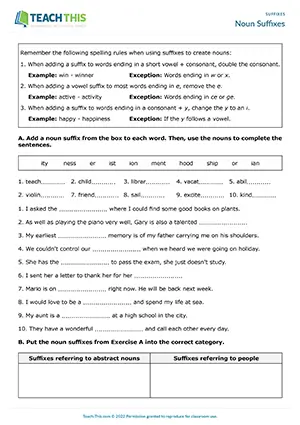
ESL Noun Suffixes Worksheet - Vocabulary Exercises: Matching, Gap-fill, Categorising, Word Completion, Error Correction
Here is a comprehensive noun suffixes worksheet for intermediate students. First, students add a noun suffix from a box to each word and then use the nouns to complete sentences. Students then...
Suffix Question Time

ESL Suffixes Activity - Vocabulary and Speaking: Word Completion, Asking and Answering Questions, Controlled and Freer Practice - Pair Work
In this free suffixes speaking activity, students complete questions that contain abstract nouns using suffixes and then ask, answer and discuss the questions...
Adjective Suffixes
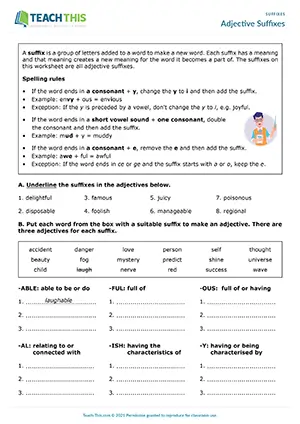
ESL Adjective Suffixes Worksheet - Vocabulary Exercises: Identifying, Matching, Gap-fill, Writing Sentences
In this productive adjective suffixes worksheet, students identify and practice using the adjective suffixes: -able, -al, -ful, -ish, -ous, and -y. Students start by underlining suffixes in adjectives...
Saving the Environment

ESL Suffixes Worksheet - Reading, Speaking and Vocabulary Exercises: Opinion Sharing, Identifying, Writing Definitions and Sentences, Gap-fill, Modifying Words
This insightful suffixes worksheet helps students practice the eight suffixes: -ship, -ity, -al, -ical, -age, -ible, -tion, and -wide. Students begin by reading...
Suffix Blockbusters
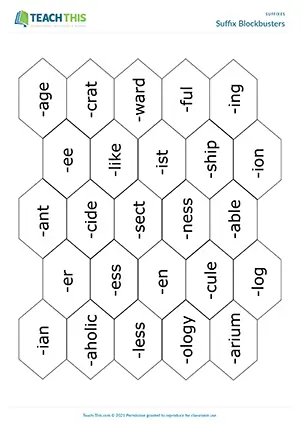
ESL Suffixes Game - Vocabulary: Guessing - Group Work
In this fun suffixes game, students guess words that contain certain suffixes from given clues. Draw a five-by-five hexagon grid on the board and write suffixes into the 25 hexagons. The aim of the game is to connect the hexagons from one side of...
Suffix Dominoes

ESL Abstract Nouns and Suffixes Game - Vocabulary: Matching, Forming Sentences - Group Work
In this creative abstract nouns and suffixes game, students match suffixes to words to make abstract nouns and then use the nouns to make sentences. The first player puts down one of their dominoes...
Verb to Noun Connect 4
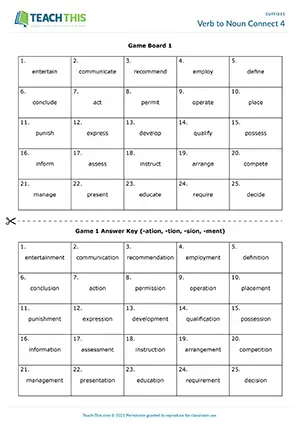
ESL Suffixes Game - Vocabulary: Matching, Spelling - Group Work
In this engaging suffixes game, students play Connect 4 by changing verbs into nouns using specific suffixes. The aim of the game is to get four squares in a row, while at the same time trying to stop the other player from getting four in a row...
Understanding Suffixes
A suffix is a group of letters added to the end of a word to change its meaning or its grammatical function, so adding -ness to 'dark' creates the noun 'darkness', and adding -ful to 'hope' creates the adjective 'hopeful'. The same root word can take different suffixes to become a noun, an adjective, or a verb, which means suffix knowledge multiplies the number of words a student can use from a single root.
Students who do not know common suffixes often reach for the wrong word class in a sentence, writing 'She has a lot of kind' instead of 'She has a lot of kindness', which breaks the sentence and signals a significant gap in vocabulary range to any reader.
This page covers suffixes at B1 and B2 levels, with seven resources including worksheets, group games, and a speaking activity, with one activity available as a free download.
The table below shows common suffixes grouped by the word class they produce, with an example root word and the resulting form for each.
| Suffix | Word Class Produced | Example Root | Example Word |
|---|---|---|---|
| -ness | noun | dark | darkness |
| -ment | noun | achieve | achievement |
| -tion / -sion | noun | educate / decide | education / decision |
| -er / -or | noun (person) | teach / direct | teacher / director |
| -ful | adjective | hope | hopeful |
| -less | adjective | care | careless |
| -able / -ible | adjective | depend / sense | dependable / sensible |
| -ish | adjective | self | selfish |
| -ous | adjective | danger | dangerous |
| -ly | adverb | quick | quickly |
| -en | verb | wide | widen |
| -ify | verb | simple | simplify |
When to Use Suffixes
Making Writing More Concise: Suffixes let a writer pack meaning into a single word rather than a longer phrase, tightening the style and making the writing feel more controlled, as in 'the arrival of the team' rather than 'the time when the team arrived.'
Signaling a Formal Register: Noun and adjective suffixes often mark a more formal level of language, so choosing 'reliability' over 'being reliable' immediately raises the tone in a report or application, as in 'We value reliability and professionalism in all team members.'
Decoding Unknown Words While Reading: Recognizing a suffix helps a reader make an educated guess at an unfamiliar word without stopping to look it up, so a student who knows -ible signals 'capable of' can work out an unknown word from context, as in 'The instructions were barely comprehensible.'
3-Step Framework for Teaching Suffixes
1. Introduce Suffix Categories Through Sorting: Start with noun suffixes and have students attach endings from a box to root words before using the nouns in sentences. A sorting task follows: students separate the suffixes into two categories, those that produce abstract nouns and those that refer to people. This gets students noticing the meaning difference, not just the spelling pattern.
2. Extend to Adjectives With a Creative Writing Hook: Once students are confident with noun suffixes, move to adjectives. The set covered includes -able, -al, -ful, -ish, -ous, and -y. After gap-fill practice with a film summary, push students to write what they think happens next in the story using at least three of the adjectives from the worksheet. Attaching the target forms to a story they have invented makes the vocabulary stick.
3. Consolidate With a Sentence-Production Game: Finish with a dominoes game where students match word and suffix cards to form abstract nouns. Scoring works on two levels: one point for placing a domino that correctly forms an abstract noun, and an extra point if the student then uses that noun in a sentence. The second point pushes students beyond recognition into production.
Common Mistakes with Suffixes
Misspelling the Root When Adding a Suffix: Students often forget the spelling rules that apply when a suffix is added, such as dropping a final 'e' or doubling a final consonant, producing a misspelled form that obscures the intended word. Wrong: 'The managment praised the team.' Correct: 'The management praised the team.'
Using a Noun Form Where an Adjective Is Needed: Students often attach a noun-forming suffix to a root when the sentence requires an adjective, because they recognize the root word but have not yet learned which suffix produces which word class. Wrong: 'The situation was very danger.' Correct: 'The situation was very dangerous.'
Common Questions About Teaching Suffixes
What is a fun game for practicing suffixes?
Team competition drives recall in the game Suffix Blockbusters, where two teams race to name a word with a given suffix. The teacher gives a meaning clue for each hexagon on a board grid, for example 'to cut' for -sect, and both teams race to say a matching word such as 'dissect.' The first team to connect their hexagons wins.
What is a useful worksheet for teaching suffixes?
The worksheet Noun Suffixes takes students through five stages: adding a suffix from a box to form a noun, completing sentences with those nouns, sorting suffixes into abstract noun and person categories, correcting errors in sentences, and adding a root word to a given suffix. The sequence builds both recognition and accurate production.
What speaking activity works well for practicing suffixes?
As a free speaking activity, Suffix Question Time combines suffix practice with real conversation. Students complete questions by adding the correct suffix from the set -hood, -dom, -ship, -ness, or -tion to each word stem, scoring a point for each correct answer. Once all questions are correctly formed, students ask, answer, and discuss them with a partner.
Become a Teach This Member
Get unlimited access to the full library, plus new resources added every week.
Unlimited Resource Access
Download from 3000+ worksheets, activities, and games.
Save 5+ Hours Weekly
Cut lesson prep time with ready-to-use resources, plus teacher notes and answer keys.
Trusted Professional Quality
Classroom-tested, editable resources created by experienced ESL professionals.
Fresh Content Weekly
Get 5 new resources added to the library each week.
Here's what our members are saying...


