
Describing Places ESL Games, Activities & Worksheets
Describing a Town or City
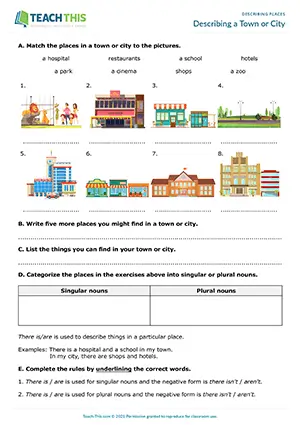
ESL Describing Places Worksheet - Vocabulary and Grammar Exercises: Matching, Listing, Categorising, Error Correction, Gap-fill, Sentence Completion
In this comprehensive describing places worksheet, students learn and practice describing a town or city using singular and plural nouns and 'There is/are'...
Place Detectives
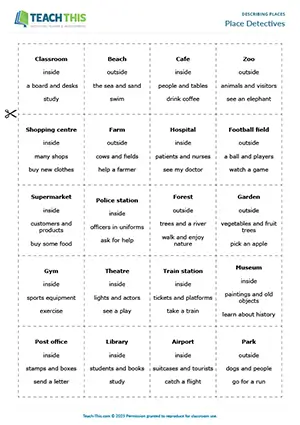
ESL Describing Places Game - Speaking: Describing, Forming Sentences, Guessing, Controlled Practice - Pair Work
In this enjoyable describing places game, students describe places in and around towns and cities for a partner to guess. In pairs, one student begins by taking a card and describing the place...
A Day out in Tokyo
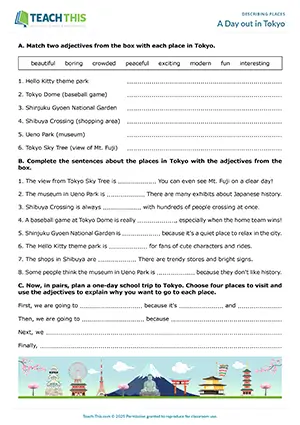
ESL Describing Places Worksheet - Vocabulary Exercises: Matching, Gap-fill, Sentence Completion
In this inventive describing places worksheet, students use a set of adjectives to describe places in Tokyo and then plan a one-day trip to the city. First, students match two adjectives from a box...
Guess the Country
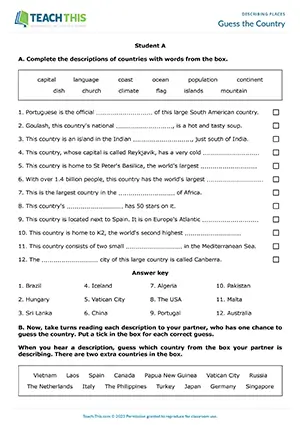
ESL Describing Places Game - Vocabulary: Gap-fill, Guessing - Pair Work
Here is a fun describing countries game to help students practice vocabulary for describing places. In two groups, students complete descriptions of countries with words from a box. Next, students pair up with someone from the other...
It's a place where...
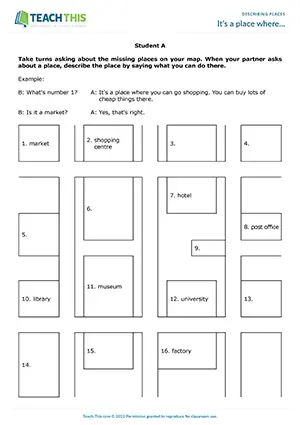
ESL Describing Places Activity - Speaking: Describing, Guessing - Pair Work
In this free describing places speaking activity, students describe places in a town or city by saying what you can do there. In pairs, students take turns asking about one of the missing places on their map. Their partner then describes the place by...
The Place Where I Live
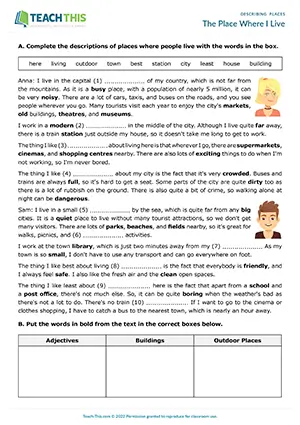
ESL Describing Places Worksheet - Vocabulary: Gap-fill, Categorizing, Binary Choice, Unscrambling - Speaking Activity: Asking and Answering Questions - Pair Work
In this productive describing places worksheet, students practice a range of vocabulary and language related to describing places in a town and city...
A Room with a View
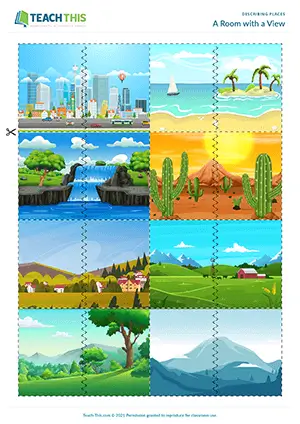
ESL Describing Places Activity - Speaking and Writing: Describing, Asking and Answering Questions - Pair Work
In this engaging describing places activity, students describe a place in half of a picture to their classmates in order to find someone who has the other half and then write a description of the place...
Describe the Place

ESL Describing Places Board Game - Speaking: Describing, Guessing - Pair Work
In this fun describing places board game, students describe places in a town or city for a partner to guess. Teams take turns rolling the dice and moving their counter along the board. If a team lands on a picture square, one student in the team picks up...
Ideal Holiday Destinations
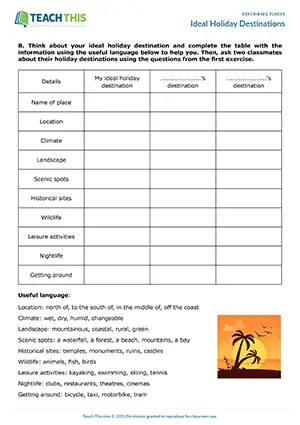
ESL Describing Places Activity - Reading Exercise: Comprehension Questions - Speaking Activity: Asking and Answering Questions, Discussion - Pair Work
In this free talking about places activity, students describe their ideal holiday destination and find out about their classmates' holiday destinations...
Race through the City
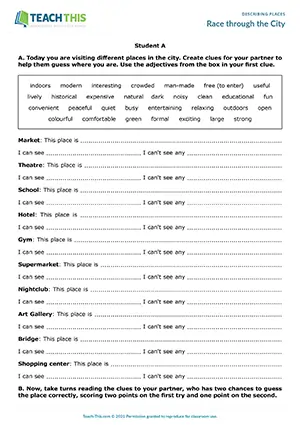
ESL Describing Places Game - Speaking: Writing Clues, Describing, Guessing - Group and Pair Work
In this useful describing places game, students use adjectives to write clues describing different places in a city and then read them to a partner who tries to guess each place. In two groups...
Adjective Land
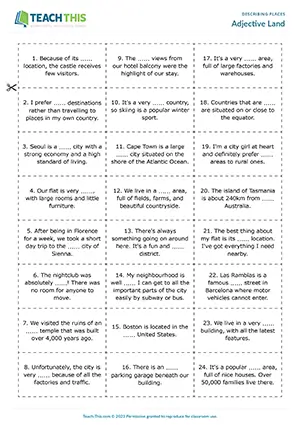
ESL Describing Places Games - Vocabulary and Speaking: Matching, Gap-fill, Describing, Guessing, Freer Practice
Here are three fun describing places games to help students practice adjectives that describe places. First, students play a matching game where they take turns picking up a sentence card and...
Places We Prefer
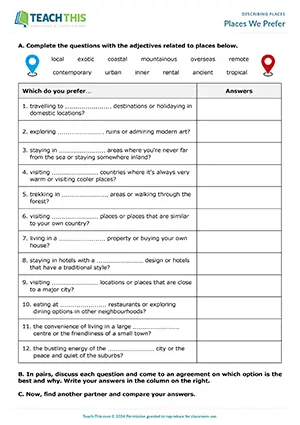
ESL Describing Places Activity - Vocabulary and Speaking: Gap-fill, Discussion, Controlled and Freer Practice - Pair Work
In this insightful describing places activity, students discuss their preferences about different places and practice adjectives that describe places. First, students complete 'Which do you prefer...?'...
Setting the Scene

ESL Describing Places Worksheet - Vocabulary and Writing Exercises: Vocabulary Search, Writing Descriptions
In this handy describing places worksheet, students learn adjectives that describe places, famous landmarks and buildings, and practice writing descriptions of places. First, students write synonyms and...
Town Taboo

ESL Describing Places Game - Speaking: Describing, Guessing - Group Work
In this enjoyable describing places game, students describe and guess words related to different types of places and areas. In groups, students take turns picking up a card and describing the place-related word in bold to the other students without...
Describing Places Crossword
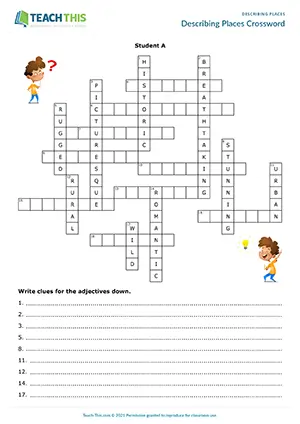
ESL Describing Places Activity - Vocabulary: Writing Clues, Describing, Guessing - Group and Pair Work
In this rewarding describing places crossword activity, students define and guess adjectives that describe places. In two groups, students invent and write down clues for the adjectives written on their crossword...
Using Describing Places Language
Describing places means using vocabulary and language structures to communicate what a location is like, covering its physical features, atmosphere, facilities, and what you can do there. Students who lack this language cannot explain where they live to a new acquaintance, recommend somewhere worth visiting, or make sense of travel writing and tourist information.
This page covers describing places from A1 to C1 level, with 15 resources including worksheets, pair games, speaking activities, a board game, and a writing worksheet, with two available as free downloads.
This table shows the key structures used to describe places in English, organized by communicative purpose, with an example of each.
| Communicative Purpose | Key Structure | Example |
|---|---|---|
| Identifying what is in a place | There is/are + noun | 'There are lots of old buildings and a busy market square.' |
| Describing what a place is like | Subject + is/are + adjective(s) | 'The city is noisy and overcrowded.' |
| Saying what you can do there | It's a place where you can + verb | 'It's a place where you can hike and swim.' |
| Describing location | Subject + is + prepositional phrase | 'It's situated on the coast, about two hours from the capital.' |
| Comparing places | Subject + is + comparative adjective + than | 'The north is more mountainous than the south.' |
| Recommending a place | You should visit + place + because + reason | 'You should visit the old town because it's full of history.' |
How to Use Describing Places Language
Writing a Travel Review: When posting a review of a hotel, restaurant, or destination, mix factual description with sensory detail to help a reader picture the place, as in 'The hotel sits at the edge of a pine forest, with a quiet terrace overlooking a lake that is completely still in the early morning.'
Telling Someone How to Recognize a Venue: When meeting someone at an unfamiliar location, describe the building or space clearly enough that the other person can identify it on arrival, as in 'It's a low red-brick building set back from the road, with a small car park at the front and a blue door.'
Describing a Setting in Creative Writing: Fiction writers use place description to establish mood and anchor the reader in a scene before the action begins, as in 'The village was silent and grey, the streets narrow and wet, with shuttered windows on every side.'
3-Step Framework for Teaching Describing Places Language
1. Introduce the Language Through Structured Clue-Building: Start by giving students a clear set of sentence frames to hang their describing language on. Three frames work well at lower levels: one that puts the student in the place ('I'm...'), one that describes what's there ('There is...' or 'There are...'), and one that states the purpose of being there ('I'm here to...'). Asking students to build clues using all three in sequence pushes them to think about a place from three different angles at once, which produces far richer descriptions than asking them to describe freely.
2. Move to Guided Production Under Pressure: Once students can use the frames, raise the stakes by putting the language into a format where accuracy has a consequence. A board game structure works well here: students complete three sentence cards to describe a place, for example 'This place is busy. There are lots of seats. People come here to travel to places far away,' and their partner has one chance to guess correctly before the team loses ground. The single-chance rule pushes students to select details that are precise enough to identify the place, not just vaguely accurate.
3. Push to Extended Writing With a Real Audience in Mind: The most demanding step is asking students to describe the same place twice for two completely different purposes. Give them a place they know and ask them first to describe it honestly using six negative adjectives, then to rewrite the description as if they were a travel agent selling it as a holiday destination to tourists using six positive adjectives. Writing for a real audience with a clear communicative goal produces far more precise and varied language than a neutral description task.
Common Mistakes with Describing Places Language
Describing a Place in Isolation Rather Than in Relation to Something: Students often write bare adjective sentences that tell the reader nothing useful, instead of anchoring the description to a specific feature or comparison that a reader can picture. Wrong: 'My city is big and busy.' Correct: 'My city has a busy port and a large market that runs along the main street.'
Repeating the Same Adjectives Across Every Place Description: Students often rely on a handful of high-frequency adjectives like 'big,' 'nice,' and 'beautiful' regardless of the place being described, which produces flat, interchangeable descriptions. Wrong: 'The park is nice. The market is nice. The river is also very nice.' Correct: 'The park is peaceful, the market is lively, and the river is spectacular at sunset.'
Common Questions About Teaching Describing Places Language
What is a fun board game for practicing describing places?
In Describe the Place, one student picks up a card and describes the place using three sentence completions while their teammate has one chance to guess correctly. A wrong guess sends the team back two squares. The pressure of a single chance and the risk of losing ground makes every description count.
What is a useful worksheet for describing places?
Describing a Town or City takes students from matching places to pictures through to correcting errors in There is and There are sentences. Students finish by writing sentences describing their own town or city and reading them to the class.
What is an engaging speaking activity for describing places?
It's a place where... is a free map activity where students describe missing locations using a single sentence frame, for example 'It's a place where you can meet your friends and drink beer.' Their partner guesses the place and writes it on the map. Students then compare maps to check their answers.
Become a Teach This Member
Get unlimited access to the full library, plus new resources added every week.
Unlimited Resource Access
Download from 3000+ worksheets, activities, and games.
Save 5+ Hours Weekly
Cut lesson prep time with ready-to-use resources, plus teacher notes and answer keys.
Trusted Professional Quality
Classroom-tested, editable resources created by experienced ESL professionals.
Fresh Content Weekly
Get 5 new resources added to the library each week.
Here's what our members are saying...


