
Present Simple Passive ESL Games & Worksheets
Hotel Inspection
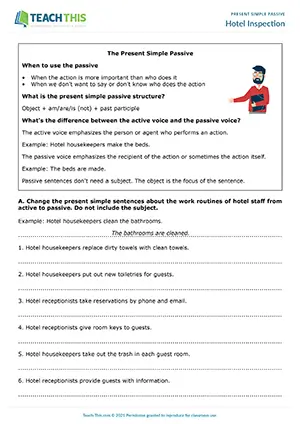
ESL Present Simple Passive Worksheet - Grammar Exercises: Rewriting Sentences, Gap-fill, Categorising, Writing Sentences, Error Correction
In this comprehensive present simple passive worksheet, students practice identifying and writing sentences in the present simple passive. Students start by...
Passive Descriptions
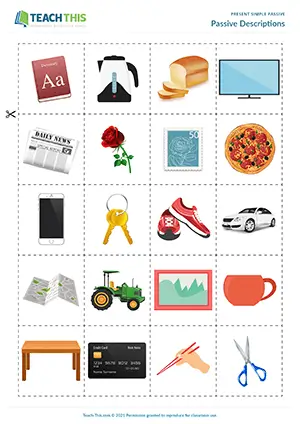
ESL Present Simple Passive Game - Grammar and Speaking: Describing, Forming Sentences, Guessing, Freer Practice - Group Work
In this free present simple passive game, students practice describing objects using the present simple passive. In groups, students take turns picking up a card...
Present Simple Passive Quiz

ESL Present Simple Passive Game - Grammar: Gap-fill, True or False, Guessing - Group and Pair Work
In this fun present simple passive game, students complete true or false facts with the present simple passive and then take part in a quiz. First, in two groups, students complete true or false facts with the...
Rewrite it
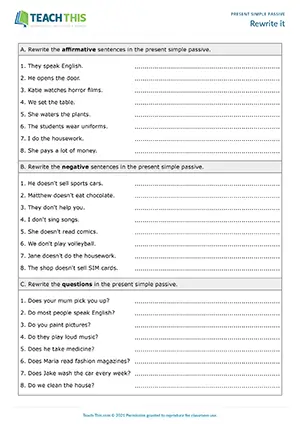
ESL Present Simple Passive Worksheet - Grammar and Writing Exercises: Rewriting Sentences
In this useful present simple passive worksheet, students practice the affirmative, negative and interrogative forms of the present simple passive. First, students read the present simple affirmative...
What do they have in common?
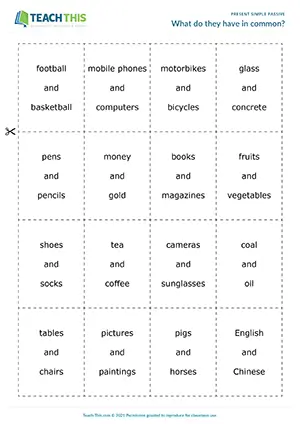
ESL Present Simple Passive Game - Grammar and Speaking: Forming Sentences, Freer Practice - Pair Work
In this engaging present simple passive game, students make sentences about what two things have in common. Teams take turns picking up a card and asking the opposing team what the two things on...
Processes

ESL Describing Processes Worksheet - Grammar and Writing Exercises: Gap-fill, Binary-Choice, Changing Word Forms, Writing Paragraphs
This present simple passive worksheet helps students practice describing processes with the present simple passive. First, students look at pictures showing the...
Understanding the Present Simple Passive
The present simple passive describes what happens to something or what is done to it, using the structure 'is' or 'are' plus the past participle: 'Coffee is grown in Brazil.' It shifts focus away from the person or thing doing the action and onto what receives it.
Students who rely exclusively on the active voice produce writing that sounds repetitive and sometimes awkward, particularly in formal or academic contexts where the doer is unknown, unimportant, or deliberately left unnamed.
This page covers the present simple passive across Intermediate (B1) and Upper-intermediate (B2) levels, with six activities including grammar worksheets, group guessing games, and a process-writing task, with one activity available as a free download.
The present simple passive has three forms: affirmative, negative, and interrogative, each using 'is' for singular subjects and 'are' for plural subjects, followed by the past participle of the main verb.
| Form | Active Structure | Passive Structure | Example Shift |
|---|---|---|---|
| Affirmative (singular) | subject + verb + -s/-es + object | object + is + past participle | 'Someone cleans the room.' to 'The room is cleaned.' |
| Affirmative (plural) | subject + verb + object | object + are + past participle | 'Workers pack the boxes.' to 'The boxes are packed.' |
| Negative (singular) | subject + doesn't + base verb + object | object + isn't + past participle | 'Nobody repairs the machine.' to 'The machine isn't repaired.' |
| Negative (plural) | subject + don't + base verb + object | object + aren't + past participle | 'They don't sell tickets here.' to 'Tickets aren't sold here.' |
| Interrogative (singular) | Does + subject + base verb + object? | Is + object + past participle? | 'Does someone check the bag?' to 'Is the bag checked?' |
| Interrogative (plural) | Do + subject + base verb + object? | Are + objects + past participle? | 'Do they make these products here?' to 'Are these products made here?' |
When to Use the Present Simple Passive
Describing Manufacturing and Origin: Writers use the present simple passive to describe how products are made or where they come from, shifting focus to the product rather than the maker, as in 'The car is assembled in Germany and exported worldwide.'
Reporting Rules and Policies: The present simple passive appears naturally in official documents and signs to state what is required or prohibited without directing the message at a specific person, as in 'Smoking is not permitted on these premises.'
Presenting Scientific Facts: Scientific writing uses the present simple passive to state general truths about how things function or are classified, keeping the focus on the subject being described rather than the researcher, as in 'Water is filtered through layers of rock before it reaches the surface.'
3-Step Framework for Teaching the Present Simple Passive
1. Establish the Three Forms Through Sentence Transformation: A rewriting task is a strong starting point. Give students a set of active sentences and ask them to rewrite each one in the present simple passive, then repeat the process with the negative and interrogative forms. Reviewing the answers as a class after each section lets students check their form and correct errors before moving on, which builds a solid base of accuracy across all three forms.
2. Build Fluency Through Guided Description: Once students can construct the forms accurately, move them into a speaking activity where they describe objects using the passive. Students pick up a card and describe the object using the passive along with the pronouns it, they, this, or these to anchor each sentence, for example 'It's made from paper' and 'It's used in the classroom.' The other students listen and guess the object, which forces students to produce several passive sentences in a row spontaneously.
3. Extend to Connected Writing with Sequence: The final step pushes students from single sentences to full paragraphs. At upper-intermediate level, students use sequence words from a box together with the present simple passive to describe a complete process, then write two processes of their own using the same structure. Having students present one of their processes to the class adds a spoken output stage and reinforces the form across two different modes.
Common Mistakes with the Present Simple Passive
Wrong Auxiliary Verb Agreement: Students often use 'is' with plural subjects or 'are' with singular subjects, confusing the auxiliary verb with the number of the noun that becomes the new subject. Wrong: 'The cars is made in Japan.' Correct: 'The cars are made in Japan.'
Using the Base Form Instead of the Past Participle: Students often write the base form or present tense form of the main verb after 'is' or 'are', forgetting that the passive requires the past participle. Wrong: 'The report is write every month.' Correct: 'The report is written every month.'
Common Questions About Teaching the Present Simple Passive
What is a good game for practicing the present simple passive?
The game What Do They Have in Common? is a team game where students use the present simple passive to describe similarities. Teams pick up a card and challenge the opposing team, which has two minutes to produce as many passive sentences as possible, for example 'Football and basketball are played in teams.' Each correct sentence scores a point.
What present simple passive worksheet covers both active and passive forms?
The worksheet Hotel Inspection covers both active and passive forms. Students begin by changing present simple active sentences into the passive, then complete sentences with verbs from a box and identify whether each sentence is active or passive. It also includes an error correction section, so students practice transformation, identification, and editing in a single worksheet.
What is a fun present simple passive activity?
Students complete true or false statements using the present simple passive form of verbs in brackets in the game Present Simple Passive Quiz. They then read their facts to a partner, who guesses if each one is true or false, turning grammar practice into a lively knowledge challenge. The activity takes 25 minutes.
Become a Teach This Member
Get unlimited access to the full library, plus new resources added every week.
Unlimited Resource Access
Download from 3000+ worksheets, activities, and games.
Save 5+ Hours Weekly
Cut lesson prep time with ready-to-use resources, plus teacher notes and answer keys.
Trusted Professional Quality
Classroom-tested, editable resources created by experienced ESL professionals.
Fresh Content Weekly
Get 5 new resources added to the library each week.
Here's what our members are saying...


