
Concrete Nouns ESL Games, Activities & Worksheets
Concrete Conundrum
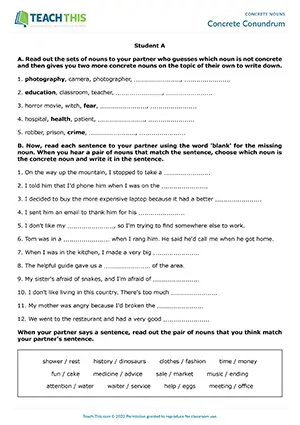
ESL Concrete Nouns Activity - Vocabulary: Identifying, Providing Nouns, Matching, Binary Choice, Gap-fill - Pair Work
In this free concrete nouns activity, students practice identifying concrete nouns with a partner. First, students read out sets of nouns to their partner who guesses which noun is not concrete and then...
I Need a Noun
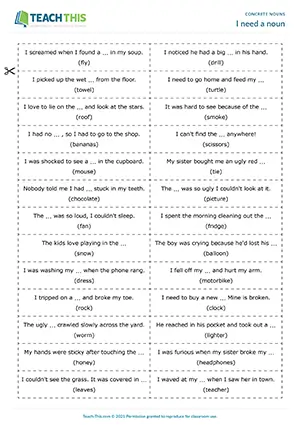
ESL Concrete Nouns Game - Vocabulary: Miming, Guessing - Group Work
In this fun concrete nouns game, students mime and guess missing concrete nouns in sentences. In two teams of two, students take it in turns to pick up a card and read the sentence on the card using the word 'blank' for the missing concrete...
Introduction to Concrete Nouns
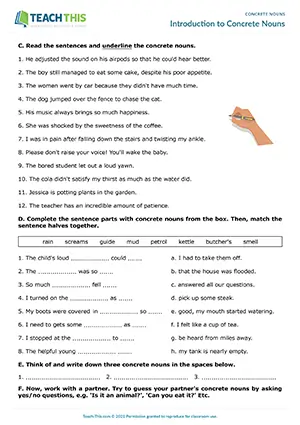
ESL Concrete Nouns Worksheet - Vocabulary Exercises: Identifying, Gap-fill, Matching - Speaking Activity: Asking and Answering Questions, Guessing - Pair Work
In this productive concrete nouns worksheet, students identify and practice using concrete nouns. First, students look at a set of words and circle the concrete...
Understanding Concrete Nouns
Concrete nouns name things you can experience through your senses: things you can see, touch, hear, smell, or taste, such as 'table,' 'music,' or 'coffee.' Students who cannot identify concrete nouns reliably will struggle with follow-on grammar tasks, since the distinction between concrete and abstract underpins decisions about articles and whether a noun can be counted.
This page covers concrete nouns at Pre-intermediate (A2) and Intermediate (B1) levels, with three resources including a pair identification activity, a miming game, and a worksheet with a speaking extension, with one resource available as a free download.
The table below maps the five sensory categories of concrete nouns, showing what each category covers, examples of concrete nouns in each category, and an abstract noun counterpart to illustrate the contrast.
| Sensory Category | What It Covers | Concrete Noun Examples | Abstract Counterpart |
|---|---|---|---|
| Sight | Things you can see | 'mountain,' 'flame,' 'painting' | 'beauty,' 'imagination' |
| Touch | Things you can physically feel | 'stone,' 'fabric,' 'ice' | 'comfort,' 'tension' |
| Hearing | Things you can hear | 'bell,' 'thunder,' 'engine' | 'emotion,' 'inspiration' |
| Smell | Things you can smell | 'rose,' 'petrol,' 'pine' | 'nostalgia,' 'memory' |
| Taste | Things you can taste | 'lemon,' 'salt,' 'chocolate' | 'hunger,' 'desire' |
When to Use Concrete Nouns
Creating Vivid Descriptions in Writing: Writers choose concrete nouns deliberately when they want a reader to visualize a scene rather than interpret a feeling, so 'the smell of pine needles and wet soil' places the reader in the forest far more powerfully than 'a sense of nature.'
Writing Clear Instructions and Technical Content: Technical writers and instructors rely on concrete nouns because they leave no room for misinterpretation, so a safety notice that says 'wear a helmet, gloves, and steel-capped boots' communicates far more precisely than one that says 'wear appropriate protective gear.'
Anchoring Persuasion in Physical Detail: Advertisers and persuasive writers use concrete nouns to ground abstract claims in tangible reality, so 'a leather seat, a walnut dashboard, and a glass of cold water' sells a car more effectively than 'luxury and comfort.'
3-Step Framework for Teaching Concrete Nouns
1. Start With Identification in a Pair Challenge: Open with a pair activity that immediately tests whether students can spot the odd one out. One student reads a set of nouns aloud and their partner guesses which noun is not concrete, then has to give two more concrete nouns on the same topic for their partner to write down. The activity then shifts to a gap-fill where students read sentences using the word 'blank' for the missing noun and choose the correct concrete noun from a pair to complete it.
2. Reinforce the Concept Through Miming: Follow up with a miming game that gives students a physical, memorable way to encounter concrete nouns in context. One student reads a sentence aloud using the word 'blank' for the missing noun, then mimes the noun for their partner while the other team times one minute. If the team fails to guess, the other team gets one chance to steal the card, so every team stays focused throughout.
3. Consolidate With a Worksheet and Speaking Task: Round off with a worksheet that moves through identification, gap-fill, and sentence matching before finishing with a speaking task. Students circle the concrete nouns in a word set, use them in sentences, underline concrete nouns in reading passages, and complete sentence halves with concrete nouns from a box. They then write down three concrete nouns of their own and challenge a partner to guess them by asking yes/no questions.
Common Mistakes with Concrete Nouns
Classifying Feelings and Sensations as Concrete Nouns: Students often label nouns like 'pain,' 'hunger,' or 'anger' as concrete because they feel physical and immediate, but these words name internal experiences rather than things that can be directly perceived through the senses. Wrong: 'Pain is a concrete noun because you can feel it.' Correct: 'Pain is an abstract noun; a bruise or a wound is concrete.'
Reaching for Abstract Nouns in Descriptive Writing: Students often use abstract nouns when a concrete noun would make their writing more precise and vivid, producing descriptions that tell the reader what to feel rather than showing them what is there. Wrong: 'The room was full of sadness and memories.' Correct: 'The room was full of dusty photographs and empty chairs.'
Common Questions About Teaching Concrete Nouns
What is a fun game for practicing concrete nouns?
The game I Need a Noun has one student read a sentence aloud using 'blank' for the missing concrete noun, then mime it for their partner to guess within one minute. If the team fails, the opposing team gets one chance to steal the card, so every student stays focused even when it is not their turn.
What is a good concrete nouns worksheet?
The worksheet Introduction to Concrete Nouns covers recognition through to production. Students circle concrete nouns, complete gap-fill sentences, and match sentence halves, then write three concrete nouns of their own for a partner to guess through yes/no questions. That final stage forces students to think carefully about what qualifies as concrete, not just recall examples from the exercises.
Become a Teach This Member
Get unlimited access to the full library, plus new resources added every week.
Unlimited Resource Access
Download from 3000+ worksheets, activities, and games.
Save 5+ Hours Weekly
Cut lesson prep time with ready-to-use resources, plus teacher notes and answer keys.
Trusted Professional Quality
Classroom-tested, editable resources created by experienced ESL professionals.
Fresh Content Weekly
Get 5 new resources added to the library each week.
Here's what our members are saying...


