
Be Going To Wh Questions ESL Games, Activities & Worksheets
What Are You Going to Do?
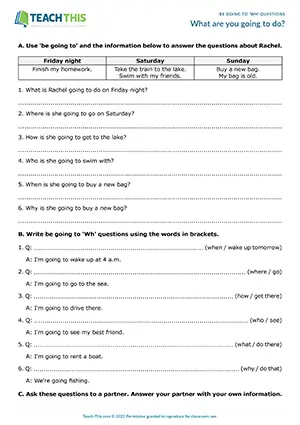
ESL Be Going To Wh Questions Activity - Speaking: Forming, Asking and Answering Questions, Freer Practice
In this free 'be going to' Wh questions speaking activity, students practice forming, asking and answering 'be going to' Wh questions about future plans to find classmates with matching...
Wh Questions About the Future
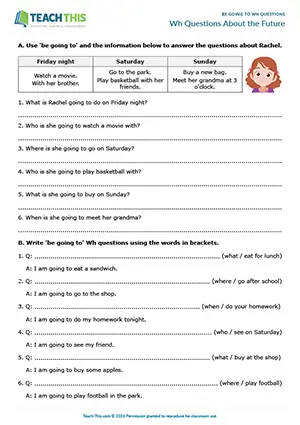
ESL Be Going To Wh Questions Worksheet - Grammar Exercises: Writing and Answering Questions - Speaking Activity: Asking and Answering Questions - Pair Work
Here is a productive 'be going to' Wh questions worksheet to help students practice forming, asking and answering 'be going to' questions with who, what...
Answer Me Quickly
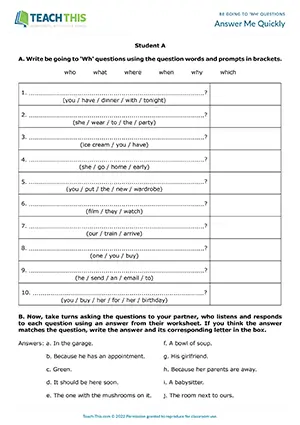
ESL Be Going To Wh Questions Activity - Grammar and Speaking: Forming, Asking and Answering Questions - Pair Work
In this fun 'be going to' Wh questions speaking activity, students create 'be going to' Wh questions from prompts and then race to match them with suitable answers. First, students write ten 'be going...
Connect Four Questions
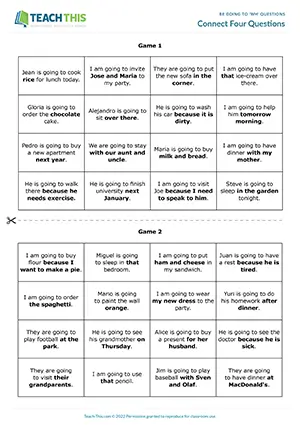
ESL Be Going To Wh Questions Game - Grammar: Forming Questions - Group Work
In this engaging 'be going to' Wh questions game, students play Connect 4 by forming questions from answers. Players take turns choosing a square and making a 'be going to' Wh question from the answer in the square. For example, if the square...
Destiny Detectives
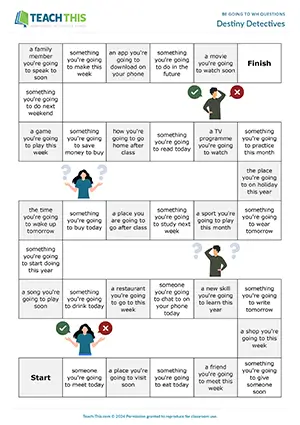
ESL Be Going To Board Game - Grammar and Speaking: Forming Sentences, True or False, Asking and Answering Questions, Guessing, Freer Practice - Group Work
In this 'be going to' true or false board game, students make 'be going to' statements from prompts and classmates ask 'be going to' Wh questions to work out...
Quick Questions
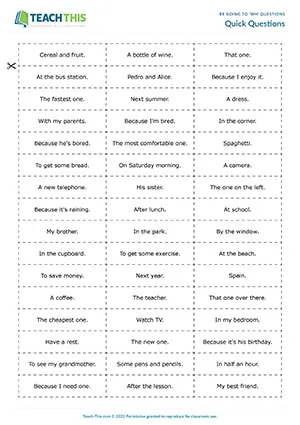
ESL Be Going To Wh Questions Game - Grammar and Speaking: Forming Questions, Freer Practice - Group Work
In this fast-paced 'be going to' Wh questions game, students race to form Wh questions with 'be going to' that match specific short answers. In groups, students take turns picking up a card and reading...
What Are You Going to Write?
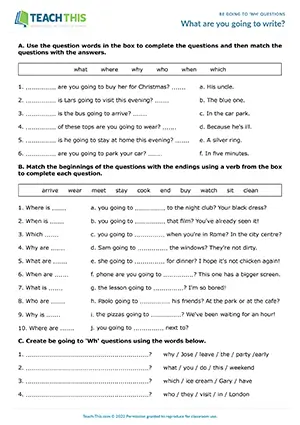
ESL Be Going To Wh Questions Worksheet - Grammar Exercises: Matching, Gap-fill, Forming Questions - Speaking Activity: Asking and Answering Questions - Pair Work
This useful 'be going to' Wh questions worksheet helps students practice or review a variety of Wh questions with 'be going to'. First, students use...
Understanding Be Going To Wh Questions
'Be going to' Wh questions use the structure wh-word + am/is/are + subject + going to + base verb to ask for specific details about future plans and intentions, as in 'What are you going to do this weekend?' or 'Where are they going to stay?' Students who keep statement word order rather than inverting the subject and auxiliary produce questions that sound like statements, which makes them harder for a listener to recognize as questions and can cause genuine confusion in conversation.
This page covers be going to Wh questions at A1-A2 and A2 levels, with seven activities including grammar worksheets, speaking games, and a board game, with one activity available as a free download.
The table below maps the most common wh-words used in 'be going to' questions, the structure for each, and an example showing what each question asks about.
| Wh-Word | Structure | Example Question | What It Asks About |
|---|---|---|---|
| What | What + am/is/are + subject + going to + base verb? | 'What are you going to do this weekend?' | the activity or thing |
| Where | Where + am/is/are + subject + going to + base verb? | 'Where are they going to stay?' | the place |
| When | When + am/is/are + subject + going to + base verb? | 'When are you going to leave?' | the time |
| Who | Who + am/is/are + subject + going to + base verb? | 'Who is she going to meet?' | the person |
| How | How + am/is/are + subject + going to + base verb? | 'How are you going to get there?' | the method or means |
| Why | Why + am/is/are + subject + going to + base verb? | 'Why are they going to cancel the meeting?' | the reason |
| How long | How long + am/is/are + subject + going to + base verb? | 'How long are you going to stay?' | the duration |
| How many / How much | How many/much + noun + am/is/are + subject + going to + base verb? | 'How many people are they going to invite?' | the quantity |
When to Use Be Going To Wh Questions
Asking for More Detail About a Plan: When someone states a future plan but leaves out key details, a Wh question is the natural way to fill in the missing information, which is why these questions appear constantly in everyday conversation, as in 'You said you're going to move, so where are you going to live?'
Starting a Conversation About Future Plans: 'Be going to' Wh questions are one of the most common ways to open a conversation about what someone has planned, because they invite a full answer rather than just yes or no, as in 'What are you going to do over the long weekend?'
Probing the Details of a Plan in a Formal Setting: In interviews, presentations, and project discussions, Wh questions with 'be going to' let a listener dig into the specifics of a proposal, making them a key tool for academic and professional communication, as in 'How are you going to measure the success of this project?'
3-Step Framework for Teaching Be Going To Wh Questions
1. Build the Form Through Targeted Writing: Start with a worksheet that teaches question formation step by step before students speak a word. The most focused exercise at this stage asks students to write Wh questions that target specific underlined information in a sentence, which trains them to identify what the question word is replacing before they produce the question. Once the written exercises are complete, students put their self-written questions to a real classmate and note down the answers, giving the grammar work an immediate communicative purpose.
2. Practice in a Find-Someone-Who Format: Move students into a mingle activity where they first write short answers of one to three words to a set of Wh questions about their own plans, then go around the class asking the same questions to find classmates with matching answers. When a student finds a match, both students write each other's names in the last column and move on. Encourage students to answer in full sentences rather than single words, for example 'I'm going to stay home', so that the activity builds both question and answer fluency at the same time.
3. Raise the Stakes with a True or False Board Game: Finish with a board game where getting the question right actually matters. Students roll the dice and move along the board. When a student lands on a square, they pick up a true or false card and make a 'be going to' statement, giving either true or false information. The rest of the group then asks Wh questions such as 'Where are you going to meet her?' to work out whether the student is telling the truth. Students who guess correctly score a point, so accurate question formation directly affects the outcome of the game.
Common Mistakes with Be Going To Wh Questions
Using 'Do' as the Question Auxiliary: Students often insert 'do' or 'does' into 'be going to' questions because they apply the present simple question rule instead of inverting the verb 'be'. Wrong: 'What does she going to do?' Correct: 'What is she going to do?'
Using 'What' Instead of 'How' for Method or Means: Students often use 'what' when asking about how something will be done because their first language uses a single question word where English distinguishes between 'what' and 'how', resulting in a question that targets the wrong information. Wrong: 'What are you going to travel to Paris?' Correct: 'How are you going to travel to Paris?'
Common Questions About Teaching Be Going To Wh Questions
What is a good game for practicing be going to Wh questions?
The game Connect Four Questions ties accuracy to a competitive outcome. Players choose a square on a grid and form a 'be going to' Wh question from the answer shown, for example 'What is Ryan going to eat for lunch?' A judge checks each question against a key, and the first player to connect four squares wins.
What is a fun be going to Wh questions speaking activity?
In the activity Answer Me Quickly, students write ten 'be going to' Wh questions from prompts and then race a partner to match each question with a suitable answer from their worksheet. If a student thinks their partner's answer fits the question, they write it down and move on. The first pair to match all their questions and answers wins.
What is a useful be going to Wh questions worksheet for pre-intermediate students?
The worksheet What Are You Going to Write? takes students from structured grammar practice through to a communicative speaking task. By the end, students are writing their own 'be going to' Wh questions, putting them to a partner, and trying to catch them out with two true answers and one lie.
Become a Teach This Member
Get unlimited access to the full library, plus new resources added every week.
Unlimited Resource Access
Download from 3000+ worksheets, activities, and games.
Save 5+ Hours Weekly
Cut lesson prep time with ready-to-use resources, plus teacher notes and answer keys.
Trusted Professional Quality
Classroom-tested, editable resources created by experienced ESL professionals.
Fresh Content Weekly
Get 5 new resources added to the library each week.
Here's what our members are saying...


