
Adjective-Noun Collocations ESL Games, Worksheets & Activities
Adjective-Noun Dominoes

ESL Adjective-Noun Collocations Game - Vocabulary: Matching - Group Work
In this free adjective-noun collocations game, students practice common adjective-noun collocations by building a collocation chain. In groups, the first player puts down one of their dominoes on either side of the domino on the table, making sure that...
Perfect Pairs
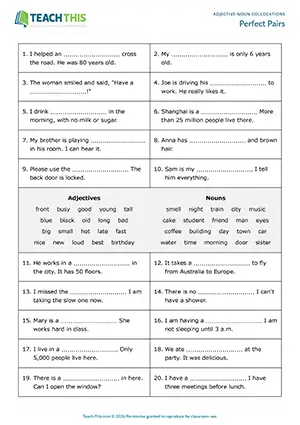
ESL Adjective-Noun Collocations Game - Vocabulary: Matching, Gap-fill - Pair Work
In this productive adjective-noun collocations game, students complete gap-fill sentences by matching adjectives and nouns to make everyday word pairs. In pairs, students take turns rolling the dice. If a student rolls an odd number, they complete...
Useful Collocations
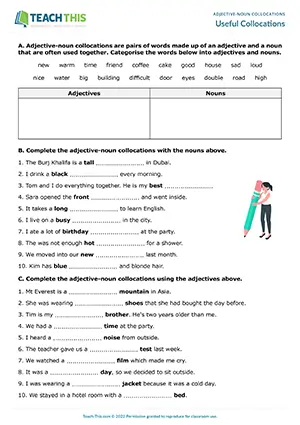
ESL Adjective-Noun Collocations Worksheet - Vocabulary Exercises: Categorising, Gap-fill, Matching - Speaking Activity: Asking and Answering Questions - Pair Work
In this adjective-noun collocations worksheet, students learn common word pairs and use them in simple sentences and questions. Students begin by...
The Race Is On
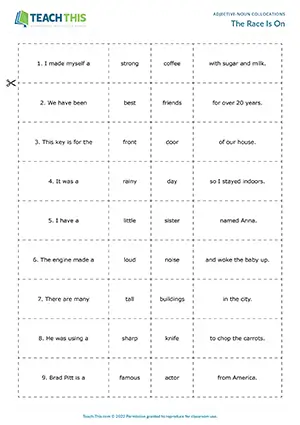
ESL Adjective-Noun Collocations Game - Vocabulary: Matching, Sentence Completion - Pair Work
In this rewarding adjective-noun collocations game, students race to form sentences containing adjective-noun collocations. First, in pairs, students match adjective cards with noun cards to form...
What's the Collocation?

ESL Adjective-Noun Collocations Game - Vocabulary: Miming, Guessing, Sentence Completion - Group Work
In this free adjective-noun collocations game, students race to guess missing collocations in sentences. In groups, students take it in turns to pick up a card and read the sentence on the card using the word 'blank'...
Which is Correct?
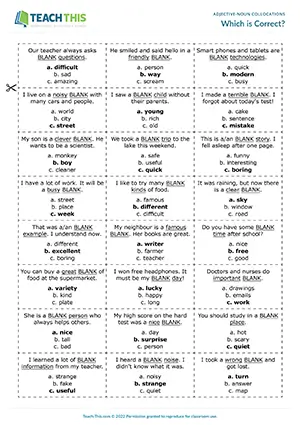
ESL Adjective-Noun Collocations Game - Vocabulary: Guessing, Sentence Completion - Group Work
In this fast-paced adjective-noun collocations game, students race to choose the best adjective or noun to complete adjective-noun collocations in sentences. In groups, students take it in turns to pick up a...
A Meaningful Interaction

ESL Adjective-Noun Collocations Activity - Vocabulary and Speaking: Gap-fill, Asking and Answering Questions, Controlled and Freer Practice - Group and Pair Work
In this productive adjective-noun collocations speaking activity, students complete, ask and answer conversation questions containing useful adjective-noun...
Big and Bad Collocations
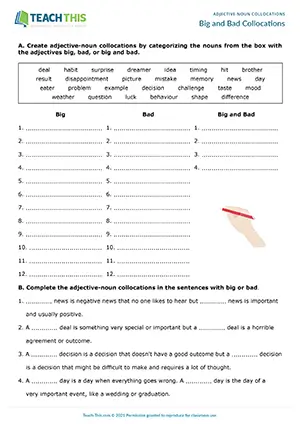
ESL Adjective-Noun Collocations Worksheet - Grammar and Vocabulary Exercises: Categorising, Gap-fill, Binary Choice
Here is a useful adjective-noun collocations worksheet to help students learn and practice nouns that are commonly used with the adjectives big and bad. To begin, students create adjective-noun...
Create a Collocation
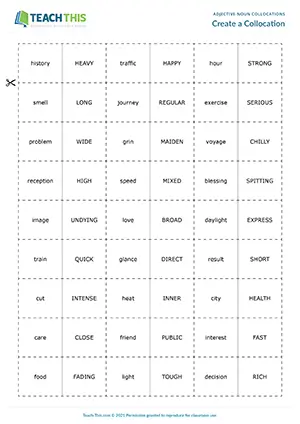
ESL Adjective-Noun Collocations Game - Vocabulary: Matching, Forming Sentences from Prompts - Group Work
In this enjoyable adjective-noun collocations game, students play dominoes by matching adjectives and nouns together to make collocations and then using the collocations in sentences. The first player...
Adjective-Noun Collocations Practice
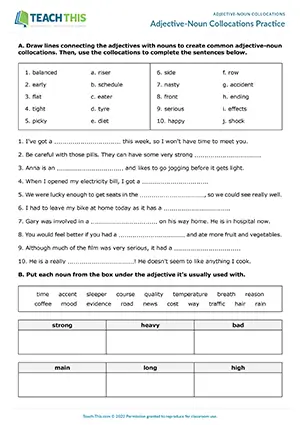
ESL Adjective-Noun Collocation Worksheet - Vocabulary Exercises: Matching, Gap-fill, Error Correction - Speaking Activity: Asking and Answering Questions - Pair Work
Here is a comprehensive adjective-noun collocations worksheet for upper-intermediate students. First, students match adjectives with nouns to create adjective-noun...
Conversational Collocations
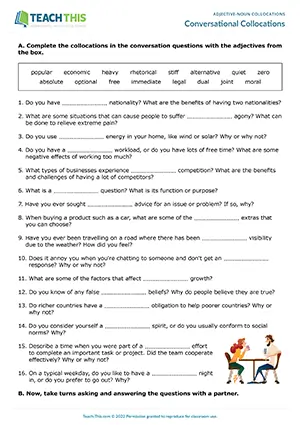
ESL Adjective-Noun Collocations Activity - Vocabulary and Speaking: Gap-fill, Asking and Answering Questions, Controlled and Freer Practice - Pair Work
In this insightful adjective-noun collocations speaking activity, students complete collocations in conversation questions with adjectives and then discuss...
Let's Make Collocations
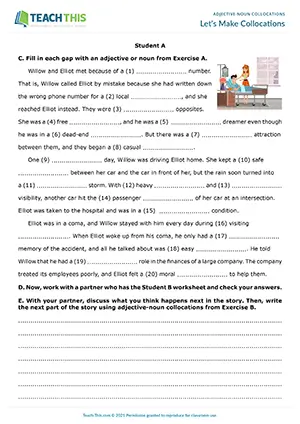
ESL Adjective-Noun Collocation Activities - Vocabulary Exercises: Matching, Gap-fill - Speaking and Writing Activity: Information Gap, Paragraph Writing - Pair Work
In this engaging adjective-noun collocations worksheet and pairwork activity, students practice making adjective-noun collocations and using them in stories...
Understanding Adjective-Noun Collocations
Adjective-noun collocations are fixed word pairings where a particular adjective combines naturally with a particular noun, such as 'heavy traffic' or 'strong coffee,' and where swapping the adjective for a near-synonym sounds wrong to a native speaker's ear. Students who rely on direct translation or guesswork instead of learning these pairings as units will regularly produce combinations that are technically logical but immediately noticeable as non-native, such as 'big traffic' or 'powerful coffee.'
This page covers adjective-noun collocations from A1-A2 through to B2, with 13 activities including games, worksheets, and speaking activities, with two available as free downloads.
English adjectives often lock onto specific nouns in ways that defy direct translation; the table below shows common pairings alongside near-synonyms that do not collocate naturally.
| Adjective | Collocates With | Does NOT Collocate With | Example Phrase |
|---|---|---|---|
| heavy | traffic, rain, responsibility | strong traffic, powerful traffic | 'heavy traffic' |
| strong | coffee, opinion, wind | powerful coffee, heavy coffee | 'strong coffee' |
| big | mistake, difference, problem | powerful mistake, heavy mistake | 'big mistake' |
| good | news, idea, reason | strong news, heavy news | 'good news' |
| high | price, temperature, quality | tall price, big temperature | 'high price' |
| deep | sleep, trouble, breath | strong sleep, big breath | 'deep sleep' |
When to Use Adjective-Noun Collocations
Expressing Degree and Intensity Precisely: When a speaker wants to convey a specific degree or quality, a collocating adjective carries precision that a generic one cannot, as in 'a bitterly cold morning' rather than 'a very cold morning,' where the collocation signals that the cold is sharp and biting, not merely low in temperature.
Sounding Natural in Professional Writing: In emails, reports, and professional correspondence, correct collocations signal fluency to a native-speaking reader, so a writer chooses 'a tight deadline' rather than 'a close deadline' to communicate pressure without the phrasing drawing attention to itself.
Building Rapport in Everyday Conversation: High-frequency social collocations carry the texture of natural small talk, so a speaker who reaches for 'a rough day' or 'a big deal' fits into conversation in a way that a more literal paraphrase would not.
3-Step Framework for Teaching Adjective-Noun Collocations
1. Activate with a Team Race: Open with a fast team race to flood the board with collocations before students have time to second-guess themselves. Write a noun on the board and give teams one minute to write down as many adjective-noun collocations as they can with it. The scoring rule is what sharpens the thinking: teams earn one point for a collocation another team also has, but two points for a correct collocation that no other team has, so the scoring pushes students to go beyond the obvious and reach for less common pairings.
2. Bridge to Conversation: Move from recognition to real talk by having students complete collocations in questions and then immediately use them with a partner from a different group. The production constraint is what keeps this step meaningful: for the first question in each set, students must include the corresponding adjective-noun collocation in their response, so they cannot simply answer in general terms and avoid using it. Finish by asking pairs to share what they learned about each other, giving the collocations one more airing in a natural context.
3. Consolidate through Creative Writing: Finish with a task that asks students to own the collocations rather than just recognize them. After matching and gap-fill work at word and sentence level, pairs read a short story built on collocations as its building blocks, then write the next part of the story using adjective-noun collocations from the earlier exercise. Reading stories aloud to the class at the end gives every collocation a final, memorable moment in context.
Common Mistakes with Adjective-Noun Collocations
Using 'strong' instead of 'heavy': Students often apply 'strong' to weather and volume because it suggests intensity in their first language, producing collocations that a native speaker would not use. Wrong: 'We had strong rain all weekend.' Correct: 'We had heavy rain all weekend.'
Using 'big' with abstract nouns that take 'great': Students often reach for 'big' as a default intensifier with abstract nouns because it is one of the first adjectives they learn, not realizing that many abstract nouns collocate with 'great' instead. Wrong: 'It was a big pleasure to meet you.' Correct: 'It was a great pleasure to meet you.'
Common Questions About Teaching Adjective-Noun Collocations
What is a fun game for teaching adjective-noun collocations?
Context guessing locks collocations into memory because students must retrieve the word from meaning alone. In the free game What's the Collocation?, one student reads a sentence using the word 'blank' for the missing collocation while the rest of the group races to guess it. If students struggle, the reader can mime the collocation to help.
What is a useful worksheet for practicing adjective-noun collocations?
The worksheet Adjective-Noun Collocations Practice takes students through matching, gap-fill, and error correction in sequence. Students match adjectives with nouns to build collocations, use them to complete sentences, sort nouns by the adjective they pair with, and correct wrong collocations in context before finishing with a speaking stage.
What is an effective speaking activity for adjective-noun collocations?
The activity Conversational Collocations moves students from controlled to freer practice in one sequence. Students fill in adjectives to complete collocations in conversation questions, check the meaning of each pairing as a class, and then take turns asking and answering the questions with a partner before sharing their answers with the class.
Become a Teach This Member
Get unlimited access to the full library, plus new resources added every week.
Unlimited Resource Access
Download from 3000+ worksheets, activities, and games.
Save 5+ Hours Weekly
Cut lesson prep time with ready-to-use resources, plus teacher notes and answer keys.
Trusted Professional Quality
Classroom-tested, editable resources created by experienced ESL professionals.
Fresh Content Weekly
Get 5 new resources added to the library each week.
Here's what our members are saying...
Become a Teach This Member
Get unlimited access to the full library, plus new resources added every week.
Unlimited Resource Access
Download from 3000+ worksheets, activities, and games.
Save 5+ Hours Weekly
Cut lesson prep time with ready-to-use resources, plus teacher notes and answer keys.
Trusted Professional Quality
Classroom-tested, editable resources created by experienced ESL professionals.
Fresh Content Weekly
Get 5 new resources added to the library each week.
Here's what our members are saying...


