
Referenced Essays EAP Worksheets & Games
Harvard Referencing
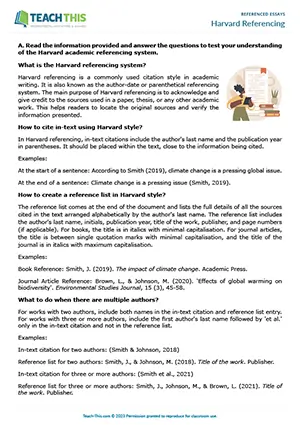
EAP Harvard Referencing Worksheet - Reading and Writing Exercises: Writing End of Text References, Identifying, Error Correction
This Harvard referencing worksheet helps students learn and practice the key elements of Harvard referencing. First, students read information about the...
Academic Integrity

EAP Academic Integrity Worksheet - Reading Exercises: Matching, Identifying, True or False
In this informative academic integrity worksheet, students learn about the key concepts of academic integrity and how to avoid plagiarism and collusion. First, students unscramble words to...
Citing and Referencing
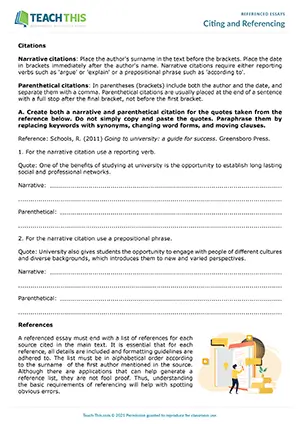
EAP Citing and Referencing Worksheet - Reading and Writing Exercises: Writing Academic Citations, Short answer Questions, Creating References
In this comprehensive citing and referencing worksheet, students learn and practice some basic conventions of citing and referencing using APA style. Students...
Evaluating Sources

EAP Evaluating Sources Worksheet - Reading and Writing Exercises: Matching, Evaluating Sources, Multiple Choice
In this detailed evaluating sources worksheet, students are introduced to the CRAAP test as a method of evaluating the suitability of sources for integration into a referenced academic essay. Students...
Identifying Bias in Sources

EAP Evaluating Sources Worksheet - Reading Exercises: Matching, Comprehension Questions - Speaking Activity: Discussion
In this referenced essays worksheet, students learn how to identify and avoid biased sources. First, students discuss three questions about online...
Integrating Source Information
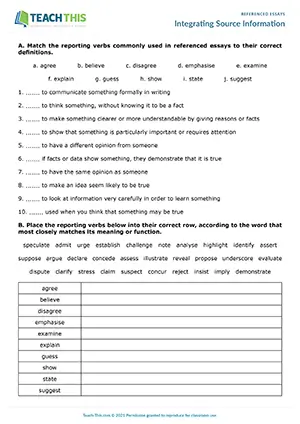
EAP Source Integration Worksheet - Reading and Writing Exercises: Matching, Categorising, Paraphrasing, Citations
In this in-depth integrating source information worksheet, students learn how to integrate information from sources into referenced essays in APA style using reporting verbs and a simple four-step technique...
Mastering Harvard Citations
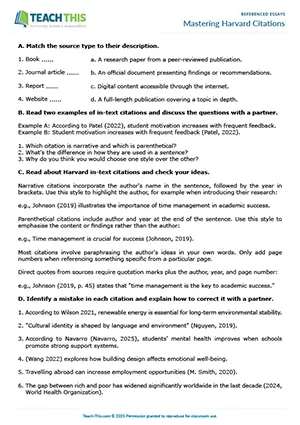
EAP Harvard Citations Worksheet - Reading and Writing Exercises: Matching, Error Correction, Gap-fill, Writing Citations - Speaking Activity - Pair Work
In this Harvard referencing worksheet, students practice using Harvard-style in-text citations (narrative and parenthetical) correctly in academic writing....
Paraphrasing and Summary Writing
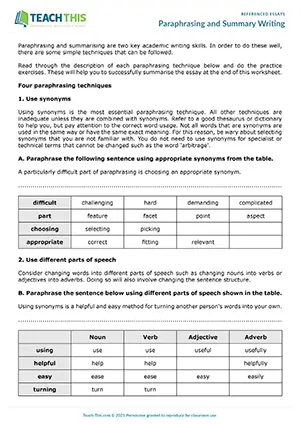
EAP Paraphrasing and Summary Writing Worksheet - Reading and Writing Exercises: Paraphrasing, Identifying, Summarising
In this useful summary writing and paraphrasing worksheet, students learn paraphrasing techniques and use them to produce a one-paragraph summary of an essay. First, students read...
Referenced Essay Basics
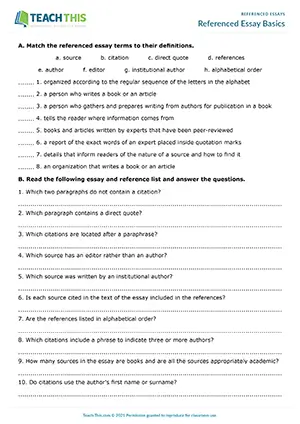
EAP Referenced Essay Basics Worksheet - Reading and Writing Exercises: Matching, Short Answer Questions, Identifying
This free referenced essay worksheet helps students to understand key referenced essay terms as well as become familiar with the features and basic formatting requirements of referenced essays...
Understanding Referenced Essays
A referenced essay develops a response to a question using relevant sources, clear reasoning and traceable attribution. Readers should be able to distinguish the writer's analysis from borrowed information and locate the sources used to support the discussion.
This page contains nine resources across B1 and B2, covering academic integrity, source evaluation, paraphrasing, source integration and citation and reference conventions. The materials include APA and Harvard examples, with one free worksheet available.
The table explains the roles of common referencing components. Use the referencing guide specified by the assignment; APA and different Harvard guides should not be treated as interchangeable.
| Component | Purpose | Checking question |
|---|---|---|
| Source selection | Choose material suited to the question and the claim | 'Why is this source appropriate for this particular point?' |
| Paraphrase or summary | Represent source information accurately in new wording | 'Have I preserved the meaning and identified the source?' |
| Quotation | Use exact wording where it serves the discussion | 'Have I marked the quotation and supplied the details required by the referencing guide?' |
| In-text citation | Identify the source of information where it is used | 'Can readers tell which claim this citation supports?' |
| Reference-list entry | Provide details that help readers locate a cited source | 'Are the source details complete and formatted consistently?' |
| Writer's analysis | Explain how source material contributes to the essay | 'Have I connected the evidence to my point rather than leaving it unexplained?' |
How to Develop a Referenced Essay
Research with a question in mind: Select sources because they help address the essay question, not simply because they mention the topic. Consider their evidence, relevance and limitations, and compare perspectives where appropriate.
Keep source details with notes: Record attribution while reading and distinguish exact quotations from paraphrases and personal comments. This makes it easier to check meaning and supply accurate references when drafting.
Check content and referencing separately: First review whether each paragraph develops a supported point. Then check citation placement, source details and consistency with the required style, including the connection between in-text citations and reference-list entries.
3-Step Framework for Teaching Referenced Essays
Use this B2 sequence across suitable lessons to develop responsible source use, accurate paraphrasing and consistent attribution. The final stage uses APA examples; follow a different guide when the assignment requires it.
1. Recognise responsible source use: Students match academic-integrity terms to definitions, examine examples of source use and consider which statements require citation. They compare an original extract with several versions that use it and explain their judgements. Emphasise that changing wording does not remove the need to acknowledge a borrowed idea.
2. Represent ideas accurately in new wording: Students practice alternatives involving vocabulary, word forms, sentence structure and voice. They then identify a thesis statement, topic sentences and supporting ideas in an essay and paraphrase those sentences. Ask them to compare each version with the original for meaning, qualifications and grammatical accuracy rather than changing words mechanically.
3. Connect citations with retrievable sources: Students examine APA examples, practice narrative and parenthetical citations and investigate the details of a journal reference. They then create an alphabetised reference list from information about three sources. Use this work to check that students understand the different roles of a citation and a full reference before applying the conventions to an essay.
Common Mistakes with Referenced Essays
Assuming that paraphrasing removes the need for citation: New wording does not make a source's distinctive idea the writer's own. Incorrect assumption: 'I changed the wording, so I do not need to cite the source.' Better approach: Cite the source of the paraphrased idea and check that the wording and structure are sufficiently independent.
Listing a source without identifying where it is used: A reference list alone may leave readers unable to trace a specific claim. Unclear attribution: A paragraph presents findings from a study, but the study appears only in the reference list. Clear attribution: Add an appropriate in-text citation where the findings are discussed and ensure it corresponds to the full reference.
Common Questions About Teaching Referenced Essays
What free worksheet helps teach referenced essays?
The worksheet Referenced Essay Basics introduces key terms before students examine a model essay. Questions focus on the essay's features and formatting, followed by an exercise identifying errors in citations and references. This gives students a concrete example to explore before they apply the conventions required for their own assignment.
How can I teach students to choose sources for essays?
The worksheet Evaluating Sources introduces source-evaluation terms and the CRAAP test. Students examine an author's biography and a reference, then judge descriptions of five potential sources for an essay. Applying the criteria to different examples gives students practice explaining source choices rather than accepting information simply because it appears relevant.
What worksheet helps teach source integration?
The worksheet Integrating Source Information introduces reporting verbs and groups them by meaning or function. Students then follow an introduce, integrate, cite and connect sequence to practice using source material in a text. The worksheet uses APA style, connecting attribution with the explanation needed to make evidence part of an argument.
Become a Teach This Member
Get unlimited access to the full library, plus new resources added every week.
Unlimited Resource Access
Download from 3000+ worksheets, activities, and games.
Save 5+ Hours Weekly
Cut lesson prep time with ready-to-use resources, plus teacher notes and answer keys.
Trusted Professional Quality
Classroom-tested, editable resources created by experienced ESL professionals.
Fresh Content Weekly
Get 5 new resources added to the library each week.
Here's what our members are saying...


