
Business Networking Role-Plays, Games & Worksheets
Business Greetings and Introductions

Business Networking Worksheet - Vocabulary, Grammar and Reading Exercises: Error Correction - Speaking Activity: Role-Play - Pair Work
This comprehensive business networking worksheet helps students practice phrases to greet and introduce themselves and others in professional settings. First...
Business Networking Board Game

Business Networking Board Game - Vocabulary and Speaking: Gap-fill, Impromptu Speech, Freer Practice - Group Work
In this engaging business networking board game, students practice networking vocabulary and talking in response to networking discussion...
Connect and Converse

Business Networking Activity - Vocabulary and Speaking: Gap-fill, Asking and Answering Questions, Controlled and Freer Practice - Group and Pair Work
In this insightful networking activity, students complete, ask and answer conversation questions containing networking words and phrases. First, in two groups...
Networking Bingo
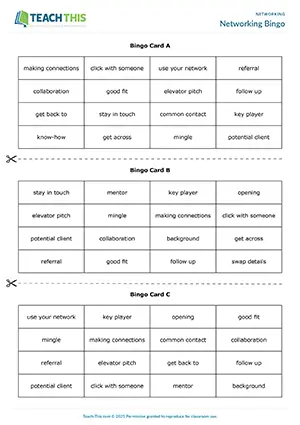
Business Networking Game - Vocabulary: Bingo, Matching - Group Work
In this free networking vocabulary game, students play bingo by listening to definitions of networking words and phrases and marking the matching terms on their cards. In groups, the bingo caller reads a definition at random from the caller's sheet,...
Networking Role-Play

Business Networking Role-Play - Speaking Activity: Role-Play, Communicative Practice - Group Work
In this useful business networking role-play, students take on the roles of professionals attending a networking event and practice introducing themselves and steering conversations toward a...
The Business Networking Challenge

Business Networking Game - Vocabulary: Matching - Group Work
This productive business networking game helps students learn practical business networking strategies and responses for handling common networking interactions. In groups, students take turns picking up a question card and reading...
Taking Part in Business Networking
Taking part in business networking involves introducing yourself, learning about other people's work and developing relevant professional conversations. Students need language for explaining their roles, showing interest and moving between topics without turning an exchange into a rehearsed monologue.
This page contains six B2 resources, including a worksheet, speaking activities, a role-play and games, with one free game.
The table shows networking functions with hypothetical examples that can be adapted to the setting and relationship.
| Networking function | Purpose | Example language |
|---|---|---|
| Introduce yourself | Give the other person a clear starting point. | 'Hello, I'm Maya. I work in product development.' |
| Explain your role | Describe your work without assuming specialist knowledge. | 'I help our team turn customer feedback into product improvements.' |
| Invite the other person to speak | Learn about their work or interests. | 'What kind of projects are you working on at the moment?' |
| Ask a follow-up question | Show interest in something the speaker has mentioned. | 'You mentioned a new project. What does it involve?' |
| Connect to a relevant topic | Introduce a related professional interest. | 'That relates to something our team is exploring. Could I ask how you approached it?' |
| Close the exchange politely | End the conversation while acknowledging the other person. | 'It was good to hear about your work. Enjoy the rest of the event.' |
How to Communicate at Networking Events
Keep introductions easy to respond to: Give a short explanation of your role or professional interest, then leave room for the other person. In classroom practice, role information can give learners without work experience a starting point.
Build on what you hear: Encourage students to ask a relevant follow-up question before moving to a new topic. Referring to something the partner has said makes the conversation responsive rather than a sequence of unrelated prepared questions.
Guide the conversation without forcing it: Link a topic you want to explore to the current exchange and check that the other person is willing to discuss it. Keep questions appropriate to the context and allow the conversation to end naturally.
3-Step Framework for Teaching Business Networking
This B2 sequence uses separate resources to connect suitable responses, vocabulary use and spoken discussion. It can be spread across lessons.
1. Recognise Suitable Responses: Students listen to questions about networking interactions and race to select matching response cards. Reading the chosen responses aloud connects a situation with a possible way to handle it, giving learners examples to consider before longer exchanges.
2. Use Vocabulary in Conversation: Students complete networking questions with words and phrases, then pair with someone from the other group to ask and answer them. They use a specified expression in their first response and report what they learned. This moves from matching responses to developing answers with a partner.
3. Respond with Less Preparation: Students play a board game that combines completing spoken vocabulary clues with thirty-second responses to networking discussion prompts. The two task types bring together word choice and extended speaking. Treat the timed response as classroom practice, not as a rule for how long someone should speak at a real event.
Common Mistakes with Business Networking Language
Omitting for after responsible: Use responsible for when explaining duties. Incorrect: 'I'm responsible managing customer accounts.' Correct: 'I'm responsible for managing customer accounts.'
Ignoring information the other person has shared: An unrelated prepared question can make the exchange feel disconnected. Disconnected response: After 'We've just launched a new service', asking 'How many offices do you have?' Relevant follow-up: 'What does the new service offer?'
Common Questions About Teaching Business Networking
What role-play helps students practice business networking?
Networking Role-Play gives students professional profile cards and a business topic to explore. They introduce themselves, circulate and guide conversations towards their assigned topic while gathering information to answer a question. Afterwards, students reveal their roles and goals and discuss what they learned, giving the networking exchanges a specific communicative purpose.
What worksheet helps teach business introductions?
The worksheet Business Greetings and Introductions develops phrases for introducing yourself and others through vocabulary work, error correction and a model dialogue. Pairs then write a conversation between two people meeting for the first time to learn about their companies and roles. Performing the dialogue gives students supported practice using the language.
What free game helps students practice networking vocabulary?
The game Networking Bingo asks students to match spoken definitions with words and phrases on their cards. To confirm a four-in-a-row win, students make a realistic networking sentence with each expression. This adds a contextual check to the matching task, so recognising the meaning alone is not enough to claim that win.
Become a Teach This Member
Get unlimited access to the full library, plus new resources added every week.
Unlimited Resource Access
Download from 3000+ worksheets, activities, and games.
Save 5+ Hours Weekly
Cut lesson prep time with ready-to-use resources, plus teacher notes and answer keys.
Trusted Professional Quality
Classroom-tested, editable resources created by experienced ESL professionals.
Fresh Content Weekly
Get 5 new resources added to the library each week.
Here's what our members are saying...


