
Crime, Law & Punishment ESL Activities, Worksheets, Role-Plays & Games
Law and Order Crossword

ESL Crime, Law and Punishment Activity - Vocabulary: Crossword, Writing and Giving Clues, Describing, Guessing - Group and Pair Work
In this useful crime vocabulary activity, students do a crossword where they describe and guess words related to crime, law and punishment. In two groups...
Criminal Bets
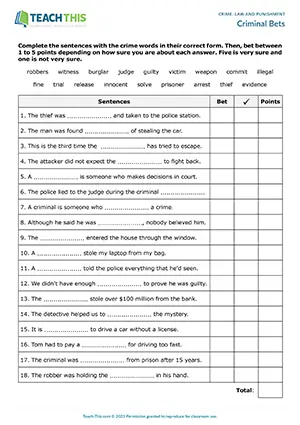
ESL Crime Game - Vocabulary: Gap-fill, Betting
In this free crime and punishment vocabulary game, students complete sentences with crime-related words and then place bets on their answers. First, students complete sentences with crime-related vocabulary, making sure the verbs are...
Stop Thief!
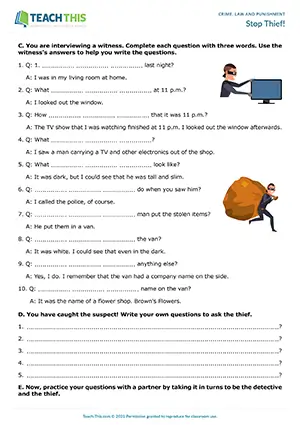
ESL Crime Worksheet - Vocabulary and Grammar Exercises: Gap-fill, Identifying, Unscrambling, Matching, Writing Questions - Speaking Activity: Role-Play - Pair Work
In this productive crime worksheet, students practice crime vocabulary and take on the role of detectives, making past and present simple questions relating to a crime...
Crime and Punishment Vocabulary
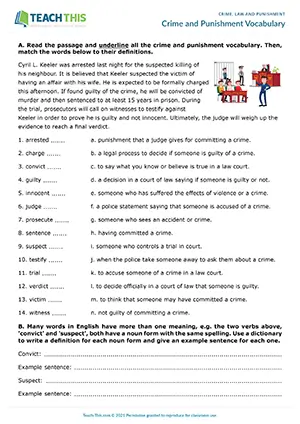
ESL Crime and Punishment Worksheet - Reading and Vocabulary Exercises: Identifying, Matching, Dictionary Work, Gap-fill
This free crime and punishment worksheet helps students to learn and practice words related to crime and criminal trials. This worksheet can be used in...
Judgement Day
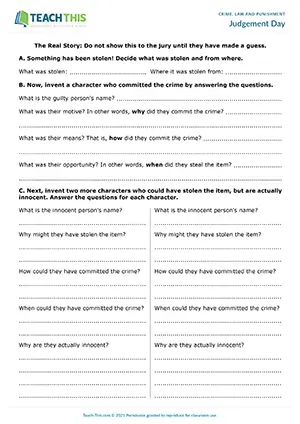
ESL Crime, Law and Punishment Role-Play - Speaking Activity: Form Completion, Presenting, Discussion, Freer Practice - Group Work
In this imaginative crime, law and punishment role-play activity, students invent a theft and present evidence and suspects to a jury, who try to identify the perpetrator...
Mock Criminal Trial Role-Play
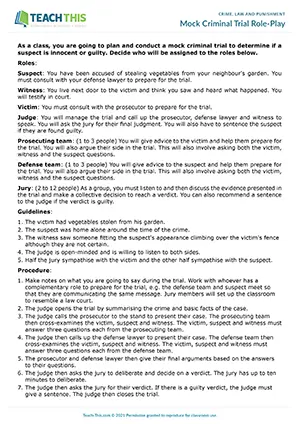
ESL Criminal Trial Role-Play - Speaking Activity: Free Practice
In this handy criminal trial role-play activity, students take part in a mock criminal trial in order to practice vocabulary related to crime, law and punishment. Explain that the students are going to plan and conduct a mock criminal trial to determine if a suspect...
The Perfect Plot
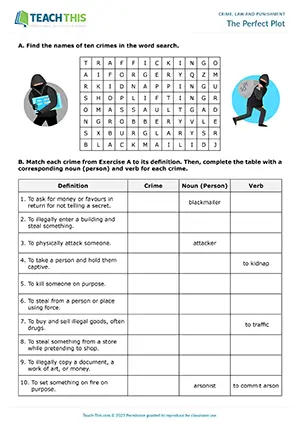
ESL Crime Worksheet - Vocabulary, Reading and Writing Exercises: Word Search, Matching, Gap-fill, Writing and Presenting a Criminal Plot, Freer Practice
This insightful crime vocabulary worksheet helps students practice nouns and verbs used to discuss common crimes. First, students find the names of ten crimes...
The Prison Cell
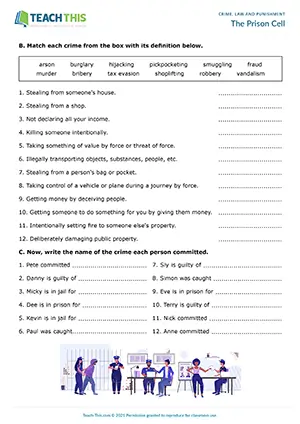
ESL Crime Role-Play - Vocabulary and Speaking Activity: Asking and Answering Questions, Table Completion, Matching, Gap-fill - Group Work
This engaging crime role-play and worksheet helps students learn and practice the names of crimes. In groups, students take on the role of the criminal on their card...
30 Second Jail Talk
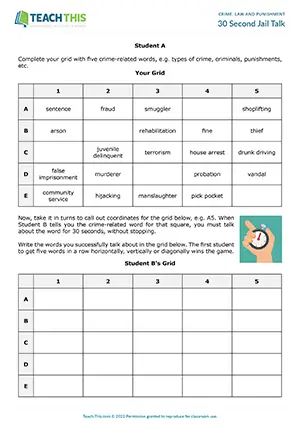
ESL Crime Vocabulary Game - Speaking and Vocabulary: Impromtu Speech - Pair Work
In this fun crime vocabulary game, students talk about crime-related words for one minute. The activity covers types of crime, criminals and punishments. In pairs, students begin by adding five crime-related words of their own to their grid on the...
Using Crime and Punishment Vocabulary
Crime, law and punishment vocabulary covers the English words used to name criminal acts, the people involved in the justice system, and the outcomes courts impose on those found guilty. Students who lack this vocabulary struggle to follow news stories, understand legal contexts, or discuss social issues in English, which limits their ability to engage with some of the most common topics in real-world conversation and reading.
This page covers crime, law and punishment vocabulary across A2, B1, B2, and C1 levels, with nine resources including worksheets, speaking activities, role-plays, and vocabulary games, with two resources available as free downloads.
The table below shows the key crime and punishment vocabulary, including the noun form of the crime, the person who commits it, the verb form, and an example sentence for each.
| Crime | Criminal | Verb | Example Sentence |
|---|---|---|---|
| murder | murderer | to murder | 'He was charged with the murder of his business partner.' |
| robbery | robber | to rob | 'The robber threatened the cashier before taking the money.' |
| burglary | burglar | to burgle | 'Someone burgled the house while the family was on holiday.' |
| theft | thief | to steal | 'She was caught stealing clothes from the department store.' |
| fraud | fraudster | to defraud | 'He defrauded the company of thousands of dollars.' |
| vandalism | vandal | to vandalize | 'A group of vandals vandalized the town hall last night.' |
| assault | assailant | to assault | 'He was arrested for assaulting a police officer.' |
| kidnapping | kidnapper | to kidnap | 'The gang kidnapped a local businessman and demanded a ransom.' |
When to Use Crime and Punishment Vocabulary
Watching crime drama and fiction: Crime fiction is one of the most popular genres in English-language television, film, and literature, and learners who lack this vocabulary miss key plot points and character motivations, making it hard to follow a courtroom scene when a character says something like 'The jury has reached a verdict — not guilty.'
Describing a crime or incident to authorities: When someone needs to report a crime, describe a situation to police, or give a formal account of an incident, precise vocabulary makes the difference between being understood and being misinterpreted, as when a witness says 'I saw someone breaking into the house next door' rather than using a vague word like 'stealing.'
Participating in debates about justice: Ethics, sentencing policy, and the purpose of punishment are frequent debate topics in academic and professional English settings, and students cannot argue a position clearly without the specific vocabulary the topic demands, as in making the case that 'community service is a more proportionate sentence than imprisonment for minor offenses.'
3-Step Framework for Teaching Crime and Punishment Vocabulary
1. Build Vocabulary from Context: The most durable way to teach crime and punishment vocabulary is to let students encounter the words in a realistic text before drilling them in isolation. A worksheet that asks students to read a passage about a crime and underline all the vocabulary they find, then use context clues from that same text to match words to their definitions, gives learners a meaningful first encounter with the words. The dictionary work that follows, specifically writing definitions and example sentences for the noun forms 'convict' and 'suspect,' pushes students to engage with the vocabulary at a deeper level before any production is expected.
2. Use the Vocabulary Communicatively: Once students know the crime names, put them in a situation where they need to use the vocabulary to find things out. A role-play where every student takes on the role of a criminal and must ask questions to discover what crimes the other people in their group committed forces real communicative use of the words. Students complete a chart with what they find out, then write the name of the crime each person committed based on the information they gathered, which means the vocabulary has to be accurate, not just approximate.
3. Push for Fluency with the Full Range: For the final stage, a speaking game that demands sustained, unscripted talk about crime vocabulary builds the kind of active retrieval that moves words from passive recognition to confident use. Students add five crime-related words of their own to a grid, then take turns calling out grid coordinates. When a coordinate is called, the student whose word it is starts a one-minute timer and talks about that crime-related word without stopping. If they succeed, the word transfers to their partner's grid. The first student to get five words in a row wins.
Common Mistakes with Crime and Punishment Vocabulary
Wrong verb collocation with 'sentence': Students often use 'give' with 'sentence' when English requires 'pass' in a legal context, and 'do' or 'serve' when referring to the time spent in prison. Wrong: 'The judge gave him a sentence of five years and he is now doing his sentence in a high-security prison.' Correct: 'The judge passed a sentence of five years and he is now serving his sentence in a high-security prison.'
Confusing 'accused' and 'convicted': Students often use 'convicted' to mean simply that someone has been charged or blamed for a crime, not realizing that 'convicted' means a court has already found them guilty. Wrong: 'The police convicted him of the robbery, but the trial hasn't started yet.' Correct: 'The police accused him of the robbery, but the trial hasn't started yet.'
Common Questions About Teaching Crime and Punishment Vocabulary
What is a useful worksheet for teaching crime and punishment vocabulary?
The worksheet Crime and Punishment Vocabulary starts with a reading passage where students underline crime words and use context clues to match them to definitions, then complete dictionary work and a gap-fill. It covers the vocabulary students need to discuss crimes and criminal trials in English.
What is a fun game for practicing crime vocabulary?
The game Criminal Bets has students complete gap-fill sentences with crime-related words, bet between 1 and 5 points on each answer depending on how confident they are, then score correct answers as positive points and wrong answers as negative. The student with the most points wins.
What is an engaging role-play activity for crime vocabulary?
The activity Judgement Day has student groups invent a theft, build three suspects with means, motive, and opportunity, then present the case to another group acting as jury. The jury questions the group and votes on who is guilty before the answer is revealed.
Become a Teach This Member
Get unlimited access to the full library, plus new resources added every week.
Unlimited Resource Access
Download from 3000+ worksheets, activities, and games.
Save 5+ Hours Weekly
Cut lesson prep time with ready-to-use resources, plus teacher notes and answer keys.
Trusted Professional Quality
Classroom-tested, editable resources created by experienced ESL professionals.
Fresh Content Weekly
Get 5 new resources added to the library each week.
Here's what our members are saying...


