
Past Tenses ESL Games, Activities & Worksheets
Complete the Question
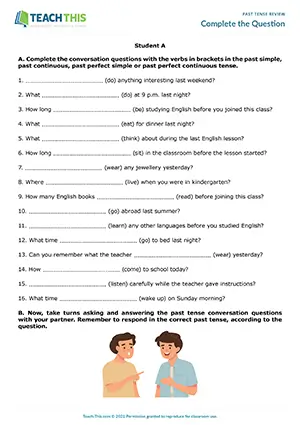
ESL Past Tenses Activity - Grammar and Speaking: Forming, Asking and Answering Questions - Group and Pair Work
In this engaging past tense speaking activity, students form, ask and answer conversation questions in the past simple, past continuous, past perfect simple and past perfect continuous tense. In two...
Let's Review Past Tenses
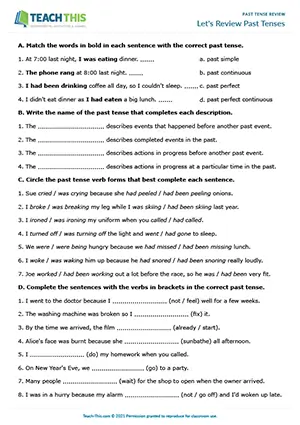
ESL Past Tenses Worksheet - Grammar Exercises: Matching, Gap-fill, Binary Choice
In this useful past tenses worksheet, students revise the past simple, past continuous, past perfect and past perfect continuous tense. First, students match words in bold in sentences with the correct past tense. Next, students write the name of...
Past Tense Race
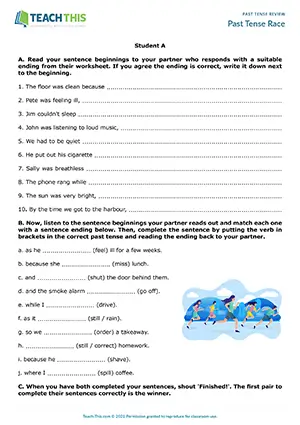
ESL Past Tenses Activity - Grammar and Speaking: Matching, Sentence Completion - Pair Work
In this free past tenses activity, pairs race against each other to complete their partner's sentences with appropriate endings, putting verbs in the sentences in the correct past tense form. Student A starts...
Past Tense Review Battleships
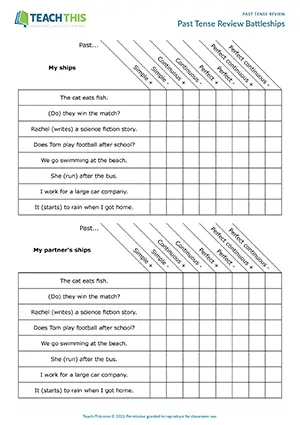
ESL Past Tenses Game - Grammar and Speaking: Forming Sentences - Pair Work
In this fun past tenses game, students play battleships using the affirmative and negative forms of the past simple, past continuous, past perfect and past perfect continuous. To start, students mark four ships on their grid. Students then play a game...
What's the Sentence?
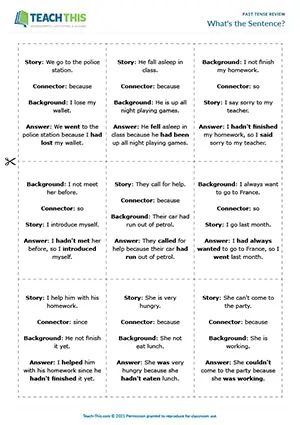
ESL Past Tenses Game - Grammar and Speaking: Forming Sentences - Group Work
In this challenging past tenses game, students listen to information and race to make sentences using the past simple with either the past perfect or past continuous. In groups, students take turns picking up a card and reading out the 'story'...
Past Tense Artists
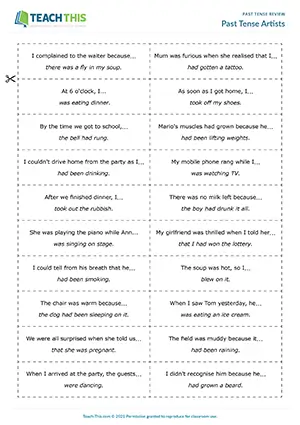
ESL Past Tenses Game - Grammar: Drawing, Guessing, Sentence Completion - Group Work
In this entertaining past tenses game, students race to guess mixed past tense sentences from drawings. One student from Team A comes up to the board and is given a card. The student reads the...
Past Tense Pairs

ESL Past Tenses Activity - Grammar, Speaking and Listening: Matching, Categorising, Gap-fill, Binary Choice - Pair Work
In this productive past tenses activity, students work with a partner to complete sentences containing various past tense verb forms. In pairs, one student...
Past Tenses Board Game
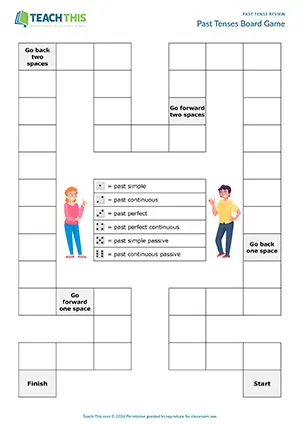
ESL Past Tenses Board Game - Grammar and Speaking: Forming Sentences, Freer Practice - Pair Work
In this enjoyable past tenses board game, students practice forming sentences on a variety of topics using six past tense structures. In groups, students take turns rolling the dice to choose...
Understanding Past Tenses
Past tenses are the verb forms English uses to talk about actions, events, and states that happened before now, covering the past simple, past continuous, past perfect, and past perfect continuous. Mixing these forms up, or defaulting to the past simple for everything, leaves listeners unsure whether one event came before another or was still in progress when a second event occurred.
This page brings together eight activities and worksheets covering B1 and B2 levels, spanning speaking games, pair races, a battleships game, and a board game, with one activity available as a free download.
The table below shows the structure, time reference, and an example sentence for each of the four past tenses.
| Tense | Structure | Time Reference | Example Sentence |
|---|---|---|---|
| Past Simple | subject + past form of verb | A completed action at a specific time in the past | 'She called the office at 9 a.m.' |
| Past Continuous | subject + was/were + verb-ing | An action in progress at a specific moment in the past | 'They were waiting when the manager arrived.' |
| Past Perfect Simple | subject + had + past participle | An action completed before another past action | 'He had left by the time we got there.' |
| Past Perfect Continuous | subject + had been + verb-ing | An ongoing action that continued up to a point in the past | 'She had been working for three hours when the power went out.' |
When to Use Past Tenses
Setting the Scene: Writers and speakers use the past continuous to paint a picture of what was already in progress when a key event happened, giving the listener or reader context before the main action lands, as in 'It was raining and people were rushing past when she spotted the note on the bench.'
Explaining What Went Wrong: The past perfect lets a speaker make clear that one event was already finished before a second event happened, which is the natural choice when explaining the cause of a problem, as in 'The client had already signed the contract before we noticed the error.'
Stressing Duration Before a Result: The past perfect continuous signals that an activity had been going on for some time before a later event, which adds weight to the outcome and explains why it mattered, as in 'She had been saving for two years when the company finally made her an offer.'
3-Step Framework for Teaching Past Tenses
1. Build Question Formation Fluency: Start with controlled speaking practice where students complete conversation questions using verbs in brackets in the correct past tense, covering all four past tenses in one activity. Students then pair up with someone from the other group to ask and answer those questions, which trains them to choose the right form on the spot rather than defaulting to the past simple every time.
2. Lock In Form with a Competitive Game: Move to a battleships format where, instead of calling out a grid reference, each player produces a past tense sentence or question according to the item and tense form shown on each axis. The competitive edge keeps accuracy sharp because a wrong sentence means no hit, and students get repeated production practice across affirmative and negative forms.
3. Push Toward Fluent, Flexible Production: Finish with a board game that challenges students to form sentences on the spot across six past tense structures, using topic cards drawn at random. The group judges whether each sentence is grammatically correct and relevant to the topic, so accuracy and meaning stay in play together at the same time.
Common Mistakes with Past Tenses
Past Continuous for Completed Actions: Students often use the past continuous to describe a completed action when the past simple is the correct choice, confusing an action that was in progress with one that was finished. Wrong: 'I was finishing my homework at 8 p.m.' Correct: 'I finished my homework at 8 p.m.'
Missing 'Had' in the Past Perfect: Students often drop 'had' when talking about an earlier past event, defaulting to the past simple instead of the past perfect and losing the sense of which action came first. Wrong: 'When I arrived, she already left.' Correct: 'When I arrived, she had already left.'
Common Questions About Teaching Past Tenses
What is an effective activity for practicing past tenses?
The free activity Past Tense Race gets students choosing between past tense forms under pressure. Pairs race to complete their partner's sentences with appropriate endings, putting verbs in the correct past tense form. The first pair to complete their sentences correctly wins, keeping both accuracy and competition in play.
What is a useful worksheet for reviewing all four past tenses?
The worksheet Let's Review Past Tenses covers six exercises including matching, gap-fill, and binary choice tasks. Students start by matching words in bold with the correct past tense and finish by matching sentence halves and supplying a verb from a box in its correct past tense form, making it a structured review from recognition through to production.
What is a fun game for teaching past tenses?
In the game What's the Sentence?, players take turns reading out 'story', 'connector', and 'background' parts of a card while the other students race to form the correct sentence using the past simple with either the past perfect or past continuous. The first student to say the correct answer keeps the card.
Become a Teach This Member
Get unlimited access to the full library, plus new resources added every week.
Unlimited Resource Access
Download from 3000+ worksheets, activities, and games.
Save 5+ Hours Weekly
Cut lesson prep time with ready-to-use resources, plus teacher notes and answer keys.
Trusted Professional Quality
Classroom-tested, editable resources created by experienced ESL professionals.
Fresh Content Weekly
Get 5 new resources added to the library each week.
Here's what our members are saying...


