
- Business Negotiations Worksheets, Role-Plays and Games | Teach-This
-
Business Negotiations Worksheets, Role-Plays & Games
Expressing a Negotiation Position
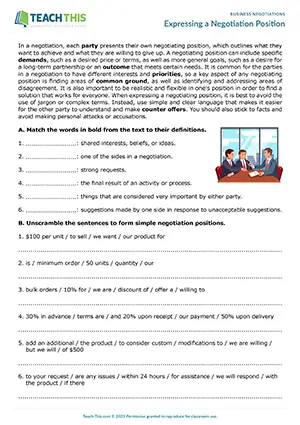
Business English Negotiations Worksheet - Vocabulary, Reading and Writing Exercises: Matching, Unscrambling, Labelling, Writing Sentences
In this useful negotiation positions worksheet, students learn and practice expressing simple negotiation positions. First, students match keywords related to...
Business English Negotiations Worksheet - Vocabulary, Reading and Writing Exercises: Matching, Unscrambling, Labelling, Writing Sentences from Prompts In this useful negotiation positions worksheet, students learn and practice expressing simple negotiation positions. First, students match keywords related to negotiations in a text to their definitions. Students then unscramble sentences to reveal six examples of simple negotiation positions. Next, students read about four common negotiation position types and match them to example sentences. Lastly, students imagine they are negotiating the sale of an apartment and use background information to write four negotiation positions that correspond to each of the four position types.Make the Deal
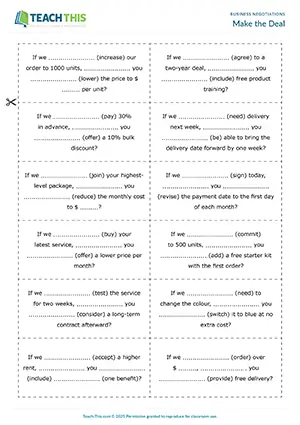
Business English Negotiations Activity - Completing, Asking and Answering Questions, Discussion, Freer and Communicative Practice - Group Work
In this engaging business negotiations activity, students use second conditional questions to negotiate offers and counteroffers, justify choices...
Business English Negotiations Activity - Completing, Asking and Answering Questions, Discussion, Freer and Communicative Practice - Group Work In this engaging business negotiations activity, students use second conditional questions to negotiate offers and counteroffers, justify choices, and agree on a group answer. In groups, students take turns picking up a question card and completing it in the second conditional with realistic numbers or terms, using the verbs and prompts in brackets, e.g. 'If we increased our order to 1000 units, would you lower the price to $9 per unit?' The student then asks the group the completed question, framing it from the buyer, client, or tenant side. Each group member answers in turn from the supplier, provider, or landlord side, using negotiation language where possible and giving brief reasons. Students then discuss the scenario and come up with a group answer that they think would be best for the situation. The student who drew the card writes the agreed group answer on the back of the card. This continues until all the question cards have been used or time is up. When the groups have finished, go through selected questions and have the groups share their answers with the class.Offers and Counteroffers
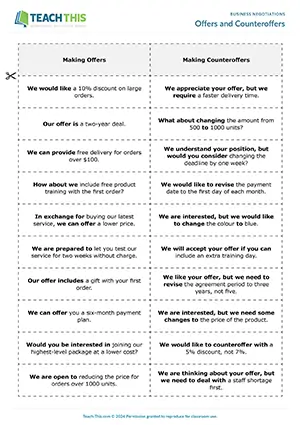
Business English Negotiation Games - Vocabulary and Speaking: Categorising, Gap-fill, Role Play, Controlled and Freer Practice - Pair Work
Here are two engaging business negotiation games to help students learn and practice language for making offers and counteroffers in negotiations. First, in pairs...
Business English Negotiation Games - Vocabulary and Speaking: Categorising, Gap-fill, Role Play, Controlled and Freer Practice - Pair Work Here are two engaging business negotiation games to help students learn and practice language for making offers and counteroffers in negotiations. First, in pairs, students race to correctly categorise language cards under 'making offers' or 'making counteroffers' headings. Students take turns picking up a card, reading it aloud, and categorising it under 'making offers' or 'making counteroffers'. The first pair to correctly categorise all the cards is the winner. Next, students play a role-play game where they score points for using the language in bold on the cards. For the first role-play, Student A takes the cards for making offers, and Student B takes the cards for making counteroffers. Students then role-play the first negotiation. Each time a student makes an offer or counteroffer, they try to use the language in bold on one of their cards. If a student uses the language successfully, they score one point and remove the card from the game. This continues until the negotiation is finished. Students then repeat the game with the second role-play. This time, Student A uses the counteroffer cards, and Student B uses the offer cards. The student with the most points at the end wins.Employment Contract Negotiation
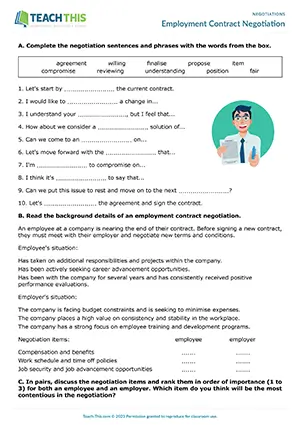
Business English Negotiations Role Play - Vocabulary, Reading and Speaking: Gap-fill, Discussion, Role-Play, Communicative Practice - Pair and Group Work
In this authentic negotiations role-play activity, students simulate an employment contract negotiation between an employee and an employer. First, students...
Business English Negotiations Role Play - Vocabulary, Reading and Speaking: Gap-fill, Guided Discussion, Role-Play, Communicative Practice - Pair and Group Work In this authentic negotiations role-play activity, students simulate an employment contract negotiation between an employee and an employer. First, students complete negotiation phrases with vocabulary from a box. Students then preview the background details of an upcoming employment contract negotiation between an employee and an employer and rank the negotiation items in order of importance for both parties. Next, in two groups, employees and employers, students formulate a negotiation strategy using information on cards and the background details. Each student then pairs up with someone from the other group and role-plays an employment contract negotiation, scoring points in the negotiation depending on the terms agreed to for each item. The aim is for both sides in the negotiation to score reasonably high and come to a mutually beneficial agreement. Afterwards, pairs share their scores with the class and give feedback on their negotiations.First Conditional Business
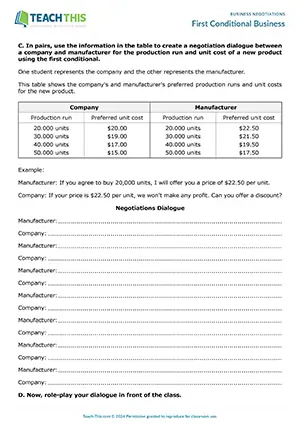
Business English Negotiations Worksheet and Role-Play - Grammar and Reading Exercises: Changing Word Forms - Speaking Activity: Creating a Dialogue - Pair Work
In this business negotiations worksheet and role-play, students practice the first conditional in a business negotiation context. First, students complete...
Business English Negotiations Worksheet and Role-Play - Grammar and Reading Exercises: Changing Word Forms, Ordering - Speaking Activity: Creating a Dialogue - Pair Work In this business negotiations worksheet and role-play, students practice the first conditional in a business negotiation context. First, students complete sentences using the first conditional and verbs in brackets. Next, students read a dialogue and number the parts to create a logical and coherent conversation between two people, negotiating a deal. Finally, in pairs, students use information in a table to create a negotiation dialogue between a company and manufacturer for the production run and unit cost of a new product using the first conditional. Afterwards, students role-play their dialogues to the class.Negotiations Pelmanism
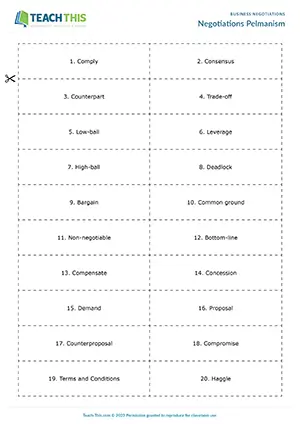
Business English Negotiations Game - Vocabulary: Matching, Pelmanism - Group Work
Here is a free business negotiations game to help students review and practice vocabulary that is commonly used in business negotiations. In groups, students take it in turns to turn over one...
Business English Negotiations Game - Vocabulary: Matching, Pelmanism - Group Work Here is a free business negotiations game to help students review and practice vocabulary that is commonly used in business negotiations. In groups, students take it in turns to turn over one negotiations vocabulary card and one definition card. If the negotiations vocabulary matches the definition, the student reads the two cards aloud, keeps the two cards and has another turn. If not, the student turns the cards back over, keeping them in the same place. The game continues until all the cards have been matched. The student with the most pairs of cards at the end of the game wins.Negotiation Stages
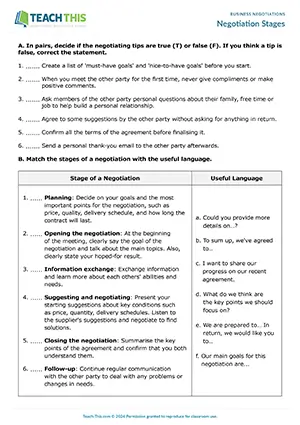
Business English Negotiations Worksheet - Reading and Vocabulary Exercises: True or False, Matching, Binary Choice - Speaking Activity: Role Play - Pair Work
In this productive business negotiations worksheet and role-play, students practice language for the various stages of a business negotiation. To begin, in pairs...
Business English Negotiations Worksheet - Reading and Vocabulary Exercises: True or False, Matching, Binary Choice - Speaking Activity: Role Play - Pair Work In this productive business negotiations worksheet and role-play, students practice language for the various stages of a business negotiation. To begin, in pairs, students decide whether tips for negotiating are true or false. If students think a tip is false, they correct the statement so that it's true. Working alone, students then match stages of a negotiation with useful language. Next, students read a negotiation dialogue and underline language that matches the negotiation stages. After that, students circle the correct preposition in each sentence. In pairs, students then take part in a negotiation role-play to practice the stages and language from the worksheet. Lastly, pairs report back to the class on the outcome of their role-play and what they agreed on.Price Negotiations
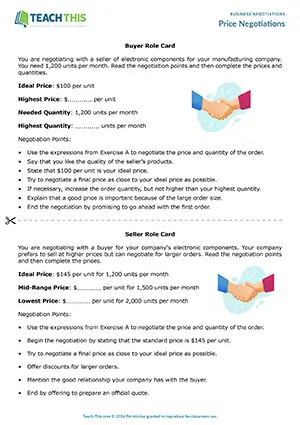
Business English Negotiations Worksheet - Reading and Vocabulary Exercises: Matching, Gap-Fill - Speaking Activity: Role-Play, Communicative Practice - Pair Work
In this handy business negotiations worksheet and role-play, students practice expressions for price negotiations. First, students match expressions for price...
Business English Price Negotiations Worksheet - Reading and Vocabulary Exercises: Matching, Gap-Fill - Speaking Activity: Role-Play, Communicative Practice - Pair Work In this handy business negotiations worksheet and role-play, students practice expressions for price negotiations. First, students match expressions for price negotiations to sentence endings. Students then indicate who would say each sentence by writing B for buyer or S for seller. Next, students complete a price negotiation dialogue between a buyer and seller with the price negotiation expressions. After that, in pairs, students take part in a price negotiation role-play to practice the expressions from the worksheet. Finally, pairs report back to the class on the outcome of their negotiations and the price they agreed on. - Numbers ESL Games, Activities and Worksheets | Teach-This
-
Numbers ESL Games, Activities & Worksheets
Let's Practice Numbers

ESL Numbers Worksheet - Vocabulary Exercises: Matching, Crossword, Writing Sentences, Gap-fill
This free numbers worksheet helps students learn and practice numbers 1 to 20. First, students write numbers 1 to 20 using words from a box. Students then spell numbers to find a hidden message...
ESL Numbers Worksheet - Vocabulary Exercises: Matching, Crossword, Writing Sentences from Prompts, Gap-fill This free numbers worksheet helps students learn and practice numbers 1 to 20. First, students write numbers 1 to 20 using words from a box. Students then spell numbers to find a hidden message. Next, students count pictures and write sentences with 'There is/are...', e.g. 'There are three chickens'. In the last exercise, students fill in missing words to spell increasingly higher numbers.Numbers 1 to 20 Worksheet
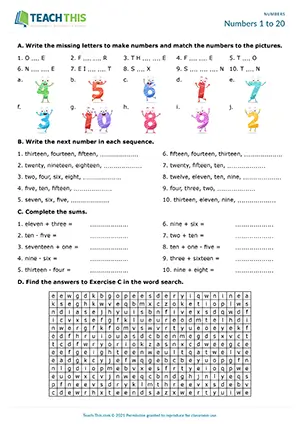
ESL Numbers Worksheet - Vocabulary Exercises: Forming Words, Matching, Sequencing, Sums, Word Search
This comprehensive numbers worksheet helps students learn and practice spelling numbers 1 to 20. Students begin by writing missing letters to make numbers and then matching the numbers to...
ESL Numbers Worksheet - Vocabulary Exercises: Forming Words, Matching, Sequencing, Sums, Word Search This comprehensive numbers worksheet helps students learn and practice spelling numbers 1 to 20. Students begin by writing missing letters to make numbers and then matching the numbers to pictures. Students then write the next number in a set of sequences. Next, students complete sums. Lastly, students find the numbers from Exercise C in a word search.Sum it up
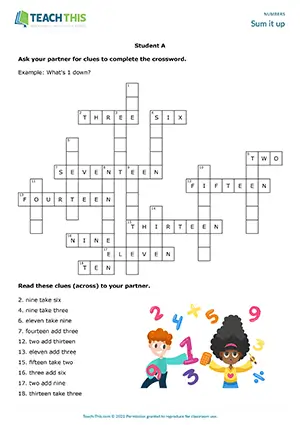
ESL Numbers Crossword - Speaking Activity: Crossword, Doing Sums - Pair Work
In this engaging numbers crossword activity, students complete a number crossword by doing sums. In pairs, students take it in turns to ask their partner for a clue to one of the missing numbers on their crossword. Their partner then reads the sum...
ESL Numbers Crossword - Speaking Activity: Crossword, Doing Sums - Pair Work In this engaging numbers crossword activity, students complete a number crossword by doing sums. In pairs, students take it in turns to ask their partner for a clue to one of the missing numbers on their crossword. Their partner then reads the sum that corresponds to that number and the other student does the sum. When the student has the answer, they say and spell the number. If the spelling is correct, the student writes the number on their crossword. If not, the student must try to spell the number again until they get it right.Can I check your phone number?

ESL Phone Numbers Activity - Listening and Speaking: Checking, Correcting - Group Work
In this useful saying phone numbers activity, students check and correct phone numbers. This activity is useful for practicing numbers 0 to 9. In groups, students assume the identity of the person whose name...
ESL Phone Numbers Activity - Listening and Speaking: Checking, Correcting - Group Work In this useful saying phone numbers activity, students check and correct phone numbers. This activity is useful for practicing numbers 0 to 9. In groups, students assume the identity of the person whose name and phone number is at the top of their card. The other names and phone numbers on their card are the other students in their group, but each phone number is wrong. The students' task is to speak to each person in their group and correct their phone number. Students go around their group, speaking to each classmate in turn. When a student speaks to another classmate, they ask for their name and check the phone number next to the name on their card. Their classmate then gives the student the correct phone number. The student confirms the number back and corrects the phone number on their card. When the students have finished, they compare cards with a partner to make sure they have the same corrected phone numbers.Cardinal or Ordinal?

ESL Numbers Worksheet - Vocabulary Exercises: Matching, Word Completion, Gap-fill, Identifying, Error Correction
This rewarding cardinal and ordinal numbers worksheet helps students practice differentiating between cardinal and ordinal numbers and using them correctly. First, students match cardinal...
ESL Numbers Worksheet - Vocabulary Exercises: Matching, Word Completion, Gap-fill, Binary Choice, Identifying, Error Correction This rewarding cardinal and ordinal numbers worksheet helps students practice differentiating between cardinal and ordinal numbers and using them correctly. First, students match cardinal numbers with ordinal numbers. Students then complete each ordinal number with the correct ending: -st, -nd, -rd, or -th. Next, students use numbers to complete sentences and then decide whether the numbers are cardinal or ordinal numbers. After that, students complete sentences about cardinal and ordinal numbers. Students then move on to underline the correct number, word, or phrase to complete each sentence. Following that, students identify the odd number out in each set and write why it is different. Finally, students correct mistakes in sentences that use cardinal and ordinal numbers.Mathematical Bingo
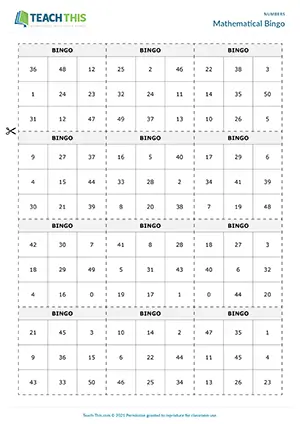
ESL Numbers Game - Vocabulary: Doing Sums, Matching
In this entertaining numbers game, students play bingo by completing sums and matching the answers to numbers on a bingo card. This game helps students practice numbers 0 to 50. Sums are called out at random from a caller's sheet. Students then...
ESL Numbers Game - Vocabulary: Doing Sums, Matching In this entertaining numbers game, students play bingo by completing sums and matching the answers to numbers on a bingo card. This game helps students practice numbers 0 to 50. Sums are called out at random from a caller's sheet. Students then do the sum. If a student has the answer on their bingo card, they cross the number off. When a student has crossed off all nine numbers, they shout 'bingo' and read out the numbers. If the numbers are correct, the student wins the round. Students play several rounds using a different bingo card each time.Numbers Board Game

ESL Numbers Board Game - Vocabulary and Speaking: Gap-fill, Answering Questions - Group Work
In this engaging numbers board game, students use numbers between 1 and 100 to complete facts and talk in response to number-related questions. Players take turns rolling the dice and moving...
ESL Numbers Board Game - Vocabulary and Speaking: Gap-fill, Answering Questions - Group Work In this engaging numbers board game, students use numbers between 1 and 100 to complete facts and talk in response to number-related questions. Players take turns rolling the dice and moving their counter along the board. When a player lands on a square, another student picks up a card and reads out the sentence, using the word 'blank' for the underlined number in bold, e.g. 'The Earth has BLANK moon.' The player listens to the sentence, chooses a number from the game board, and says it aloud to complete the sentence, e.g. 1. If the player says the correct number shown on the card, they stay on the square. If not, the player moves their counter back two squares. If a player lands on a question square, they answer the number-related question using one number in their answer. If a player can't answer the question, they go back two squares. The first player to reach the finish wins the game.Hundreds Trivia

ESL Large Numbers Activity and Quiz - Vocabulary: Running Dictation, Unscrambling, Quiz, Guessing - Group and Pair Work
Here is a fun numbers activity and trivia quiz to help students practice numbers between 100 and 1000. First, students take part in a running dictation. Student A...
ESL Large Numbers Activity and Quiz - Vocabulary: Running Dictation, Unscrambling, Quiz, Guessing - Group and Pair Work Here is a fun numbers activity and trivia quiz to help students practice numbers between 100 and 1000. First, students take part in a running dictation. Student A is the writer and Student B is the reader. The readers run to 'Set A', read the first set of numbers, remember them, run back, and dictate them to their partner, who writes the numbers down. This continues until all ten sets of numbers have been dictated. Students then swap roles for 'Set B' and the process is repeated. The first pair to write all the number sets down correctly wins. In two groups, students then put words in the correct order to form trivia questions about numbers. Next, students pair up with someone new from the other group and take turns reading each trivia question along with two possible answers to their partner, who has to guess the correct answer. For each correct answer, students score one point. The student with the most points at the end of the quiz wins.Mathematical Geniuses

ESL Large Numbers Game - Vocabulary and Listening: Problem-solving, Guessing, Controlled Practice - Group Work
In this fast-paced numbers game, students race to calculate answers to mathematical problems. In groups, students take turns picking up a card and reading the mathematical problem on...
ESL Large Numbers Game - Vocabulary and Listening: Problem-solving, Guessing, Controlled Practice - Group Work In this fast-paced numbers game, students race to calculate answers to mathematical problems. In groups, students take turns picking up a card and reading the mathematical problem on the card to the other students. The other students listen and then race to calculate the correct answer using paper to make their calculations. The first student to put up their hand and give the correct answer wins and keeps the card. If a student gives an incorrect answer, they are out of the round, and the other students continue trying to calculate the answer. If no one can guess the correct answer, the card is removed from the game. The student with the most cards at the end of the game wins.Numbers Stress Test

ESL Numbers Game - Vocabulary: Listening, Pronunciation, Identifying - Group Work
In this amusing numbers game, students practice distinguishing between the sounds of -teen and -ty numbers. In groups of three, one student is the speaker, and the other two students are players. The speaker calls out a -teen or -ty number from...
ESL Numbers Game - Vocabulary: Listening, Pronunciation, Identifying - Group Work In this amusing numbers game, students practice distinguishing between the sounds of -teen and -ty numbers. In groups of three, one student is the speaker, and the other two students are players. The speaker calls out a -teen or -ty number from one of the cards spread face-up on the table. The first player to touch the correct card scores a point. If the speaker mispronounces a number, a player can challenge them by asking the teacher to check the speaker's pronunciation. If the pronunciation is wrong, the player scores a point. The first player to score 12 points wins the round. Students then swap roles, and a new round begins. This process continues until all the students have been the speaker. The student who wins the most rounds is the winner.Confusing Numbers

ESL Confusing Numbers Activity - Vocabulary and Pronunciation: Stressing Syllables, Matching - Group Work
In this free confusing numbers activity, students practice saying large numbers ending with teen and ty. In groups, the student with 'start' on their card begins by saying the number indicated in the...
ESL Confusing Numbers Activity - Vocabulary and Pronunciation: Stressing Syllables, Matching - Group Work In this free confusing numbers activity, students practice saying large numbers ending with teen and ty. In groups, the student with 'start' on their card begins by saying the number indicated in the 'Say' column next to 'start'. The other students listen carefully and try to find the number in the 'Hear' column on their card. This can be quite challenging as the numbers have a very similar sound, e.g. 118 and 180. So, students need to pay particular attention to how they pronounce the numbers. If a student sees a matching number in the 'Hear' column, they say the corresponding number in the 'Say' column for the other students to recognise. The turn then passes from student to student until they reach the finish. When the students have finished, distribute the cards for Game B. The groups then repeat the activity with the new game cards.Numbers Quiz

ESL Numbers Quiz Game - Listening and Speaking: Dictation, Listening for Detail, Matching - Pair Work
In this productive numbers game, students dictate and write down large numbers and then use the numbers to complete a quiz. Each student memorizes a number on a card. Students then write numbers...
ESL Numbers Quiz Game - Listening and Speaking: Dictation, Listening for Detail, Matching - Pair Work In this productive numbers game, students dictate and write down large numbers and then use the numbers to complete a quiz. Each student memorizes a number on a card. Students then write numbers 1 to 16 on a piece of paper and go around the class telling each other their numbers. Students listen to their classmates' numbers and write them on the piece of paper. When the students have written down all 15 numbers, they sit down and add their number at the end. In pairs, students compare numbers with their partner. Next, pairs try to match the numbers with facts on a worksheet and write down their answers. Pairs score one point for each correct answer. The pair with the most points wins the game.The Population Game

ESL Large Numbers Game - Vocabulary and Speaking: Asking and Answering Questions, Guessing - Group Work
In this memorable large numbers game, students guess the exact population of a country by asking Are there more/less than questions. In groups, students take it in turns to pick up a card and...
ESL Large Numbers Game - Vocabulary and Speaking: Asking and Answering Questions, Guessing - Group Work In this memorable large numbers game, students guess the exact population of a country by asking Are there more/less than questions. In groups, students take it in turns to pick up a card and tell the group the name of the country on the card, e.g. Brunei. The group members then take turns asking a question to the student to determine the exact population of the country. They do this by asking Are there questions with more than and less than, e.g. 'Are there more than one million people living in Brunei?' The student with the card answers Yes, there are or No, there aren't, according to the number written on the card. If a group member receives a 'yes' answer, they ask another question. If the answer is 'no', play passes to the next student. This continues until a group member has established the exact population on their turn. When this happens, the student asks an Are there question about the exact population size, e.g. 'Are there 422,500 people living in Brunei?' That student wins the round and keeps the card. The student with the most cards at the end of the game wins.Fractional Facts

ESL Fractions Game - Vocabulary: Matching, Guessing - Group and Pair Work
In this enjoyable fractions guessing game, students complete numerical facts by guessing fractions. In two groups, students begin by matching fractions to numerical facts and writing them down next to each sentence. Next, students pair up with...
ESL Fractions Game - Vocabulary: Matching, Guessing - Group and Pair Work In this enjoyable fractions guessing game, students complete numerical facts by guessing fractions. In two groups, students begin by matching fractions to numerical facts and writing them down next to each sentence. Next, students pair up with someone from the other group and take turns reading the facts to their partner using the word 'blank' for the number in bold. After hearing the sentence, their partner chooses a fraction from a box on their worksheet that they think completes the fact. If the fraction is correct, the student puts a tick next to the fact. The student with the most correct guesses at the end of the game wins.Fraction and Percentage Dominoes
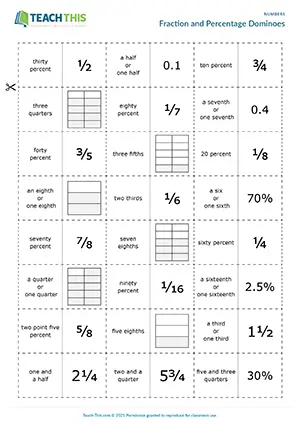
ESL Fractions and Percentages Game - Vocabulary: Matching - Group Work
In this handy fractions and percentages game, students play dominoes by matching numerical concepts expressed in different terms or symbols. The first player tries to match quantities of equal value by placing a domino down either...
ESL Fractions and Percentages Game - Vocabulary: Matching - Group Work In this handy fractions and percentages game, students play dominoes by matching numerical concepts expressed in different terms or symbols. The first player tries to match quantities of equal value by placing a domino down either before or after the domino on the table. If the player does this successfully, they read the fraction or percentage aloud. The next player then tries to put down one of their dominoes at either end of the domino chain and so on. The first player to get rid of all their dominoes wins the game.Talking Numbers

ESL Maths Vocabulary Worksheet - Vocabulary Exercises: Matching, Gap-fill, Multiple Choice - Speaking Activity: Asking and Answering Questions - Pair Work
In this insightful numbers worksheet, students practice vocabulary related to maths. To begin, students match each maths noun to its definition. Students then...
ESL Maths Vocabulary Worksheet - Vocabulary Exercises: Matching, Gap-fill, Multiple Choice - Speaking Activity: Asking and Answering Questions - Pair Work In this insightful numbers worksheet, students practice vocabulary related to maths. To begin, students match each maths noun to its definition. Students then use words in a box to complete maths-related sentences. Next, students underline the correct maths word to complete each sentence. After that, students use maths vocabulary from a box to complete trivia questions. Students then guess and tick what they think is the correct answer for each question. Finally, students ask and answer maths conversation questions with a partner, giving as much detail as possible.


