
- Conditionals Review
-
conditionals Review ESL Games, Activities & Worksheets
First vs. Second Conditional
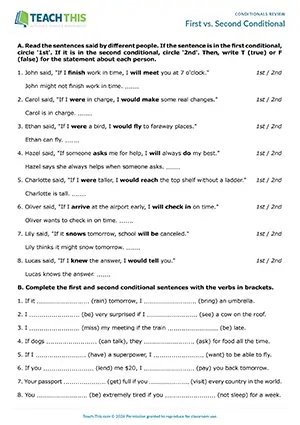
ESL First vs. Second Conditional Worksheet - Grammar Exercises: Binary Choice, True or False, Gap-fill, Rewriting Sentences, Sentence Completion
This useful first vs. second conditional worksheet helps students understand and use both structures, focusing on the difference between real future...
ESL First vs. Second Conditional Worksheet - Grammar Exercises: Binary Choice, True or False, Gap-fill, Rewriting Sentences, Sentence Completion This useful first vs. second conditional worksheet helps students understand and use both structures, focusing on the difference between real future possibilities and hypothetical situations. First, students read statements made by different people and circle '1st' if the sentence is in the first conditional or '2nd' if it is in the second. Students then mark a statement about each person as most likely true or false. Next, students complete first and second conditional sentences with verbs in brackets. After that, students rewrite sentences, changing the first conditional into the second conditional. Lastly, students complete second conditional sentences with their own ideas by writing an if-clause for each sentence. show lessZero and First Conditional Challenge

ESL Zero and First Conditional Board Game - Grammar and Speaking: Forming Sentences - Group Work
In this useful zero vs. first conditional board game, students use verb prompts to make zero and first conditional sentences. Players take turns rolling the dice and moving their counter along the board...
ESL Zero and First Conditional Board Game - Grammar and Speaking: Forming Sentences from Prompts - Group Work In this useful zero vs. first conditional board game, students use verb prompts to make zero and first conditional sentences. Players take turns rolling the dice and moving their counter along the board. When a player lands on a square, they pick up a verb card, e.g. exercise / stay. The player then makes a zero or first conditional sentence as indicated on the square using the two verbs, e.g. 'If people exercise regularly, they stay fit and healthy.' If the group agrees that the sentence uses the correct conditional form and makes sense, the player stays on the square. If not, the player goes back to their previous square. The first player to reach the finish wins the game. show lessConditional Battleships
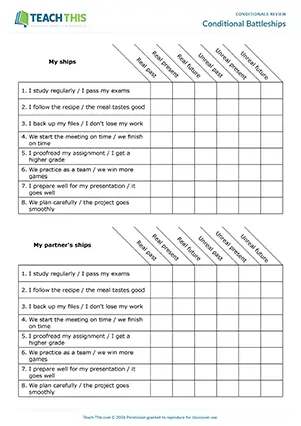
ESL conditionals Game - Grammar and Speaking: Forming Sentences, Freer Practice - Pair Work
In this rewarding conditionals game, students play battleships by producing conditional sentences from prompts, practicing real and unreal past, present and future forms. First, students mark four ships on...
ESL conditionals Game - Grammar and Speaking: Forming Sentences from Prompts, Freer Practice - Pair Work In this rewarding conditionals game, students play battleships by producing conditional sentences from prompts, practicing real and unreal past, present and future forms. First, students mark four ships on their grid. Students then take turns choosing a square on their 'My partner's ships' grid, stating the conditional type and the prompt number, e.g. 'Unreal past, prompt 3', and then making a sentence according to the prompt and conditional type. If the sentence is correct, the other student looks at their 'My ships' grid and says hit or miss. The student who made the sentence then marks the square with an 'H' for hit or 'X' for miss on their 'My partner's ships' grid. If the sentence is incorrect, the shot is invalid. The first student to sink all of their partner's ships wins the game. show lessConditional Cards

ESL conditionals Review Game - Grammar, Writing and Speaking: Sentence Completion, Freer Practice - Group Work
In this fast-paced conditionals review game, students race each other to complete zero to third conditional sentences. In groups, one student begins by turning over a card and reading the if-clause of...
ESL conditionals Review Game - Grammar, Writing and Speaking: Sentence Completion, Freer Practice - Group Work In this fast-paced conditionals review game, students race each other to complete zero to third conditional sentences. In groups, one student begins by turning over a card and reading the if-clause of the conditional sentence aloud. The other students in the group then race to complete the main clause of the conditional sentence. This can be done in written form with each student racing to write down an answer, or the students shout out an ending to the sentence. The first student to produce a grammatically correct and appropriate main clause to complete the conditional sentence wins and keeps the card. The next student then picks up a card, and so on. The student with the most cards at the end of the game wins. show lessConditional Completion

ESL conditionals Review Activity - Grammar, Writing and Speaking: Sentence Completion, Discussion, Communicative Practice - Group Work
In this conditionals review activity, students complete sentence stems using a range of conditional forms and then compare and discuss their answers...
ESL conditionals Review Activity - Grammar, Writing and Speaking: Sentence Completion, Discussion, Communicative Practice - Group Work In this conditionals review activity, students complete sentence stems using a range of conditional forms and then compare and discuss their answers. First, students complete conditional sentences with their own ideas using a variety of conditional forms (zero, first, second and third). When everyone has finished, students compare and discuss their answers in groups of three or four. Afterwards, groups share interesting things they found out about their classmates. show lessConditional Conundrum

ESL conditionals Review Game - Grammar: Matching, Changing Word Forms, Forming Sentences - Group Work
In this productive conditionals review game, students practice using first, second and third conditionals with a range of subordinate conjunctions to form complex sentences. In each group, two students are...
ESL conditionals Review Game - Grammar: Matching, Changing Word Forms, Forming Sentences from Prompts - Group Work In this productive conditionals review game, students practice using first, second and third conditionals with a range of subordinate conjunctions to form complex sentences. In each group, two students are players, and one student is the referee. Players take turns turning over one subordinate conjunction card and one sentence card. If the player thinks the two cards make a correct pair, the player forms a complex sentence, changing verb forms as needed to make a correct first, second, or third conditional sentence. If the referee confirms the pair matches the answer key and the sentence is grammatically correct, the player keeps the two cards and has another turn. If not, the player turns the cards back over, keeping them in the same place, and the next player takes a turn. After eight correct matches, roles rotate so everyone is the referee once. The game continues until all the cards have been matched. The student with the most pairs of cards at the end of the game wins. show lessConditional Thoughts
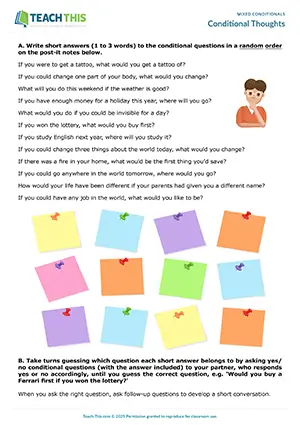
ESL conditionals Review Activity - Grammar and Speaking: Writing Short Answers, Asking and Answering Questions, Freer Practice - Pair Work
In this insightful conditionals review activity, students practice asking and answering questions using different conditional forms. First, students answer the...
ESL conditionals Review Activity - Grammar and Speaking: Writing Short Answers, Asking and Answering Questions, Freer Practice - Pair Work In this insightful conditionals review activity, students practice asking and answering questions using different conditional forms. First, students answer the conditional questions by writing short answers in a random order on the post-it notes. Next, in pairs, students swap worksheets and take turns guessing which question each short answer belongs to. They do this by asking yes/no conditional questions (with the answer included) to their partner, who responds yes or no accordingly, until their partner guesses the correct question. When the student asks the right question, they ask follow-up questions to develop a short conversation. The activity continues until both students have guessed what all 12 answers refer to. Finally, students report back to the class on the most interesting things they found out about their partner. show lessConditional Chains
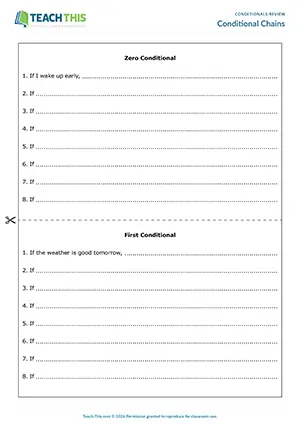
ESL conditionals Review Activity - Grammar and Writing: Writing Sentences - Group Work
In this creative conditionals activity, students review the zero, first, second and third conditionals by writing chain sentences. In groups of four, students write a result clause for the first zero, first, second or third conditional sentence on...
ESL conditionals Review Activity - Grammar and Writing: Writing Sentences from Prompts - Group Work In this creative conditionals activity, students review the zero, first, second and third conditionals by writing chain sentences. In groups of four, students write a result clause for the first zero, first, second or third conditional sentence on their card and on the next line write the result clause as an if-clause by changing the verb form. Next, students pass their card to the person on their right. The next student then repeats the process. This continues until the card is complete with eight conditional sentences in a chain. Finally, students read out their conditional chain sentences to the class. show lessCountdown
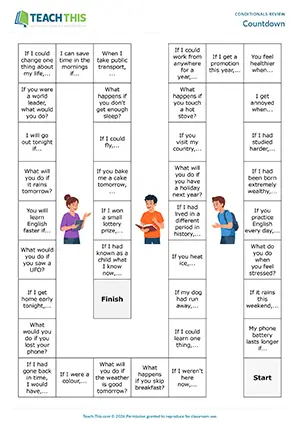
ESL conditionals Review Board Game - Grammar and Speaking: Sentence Completion, Answering Questions, Freer Practice - Group Work
In this free conditionals review board game, students race to complete zero, first, second and third conditional sentences and answer conditional questions in a...
ESL conditionals Review Board Game - Grammar and Speaking: Sentence Completion, Answering Questions, Freer Practice - Group Work In this free conditionals review board game, students race to complete zero, first, second and third conditional sentences and answer conditional questions in a 15-second time frame. In groups, students take turns rolling the dice and moving their counters along the board. When a student lands on a square, they have 15 seconds to complete the conditional sentence using the clause in the square or answer the question. If the other students agree that the sentence completion or answer is correct, the student stays on the square. If a student can't think of anything to say, makes a grammatical mistake, or doesn't complete the task within 15 seconds, they move back two squares. The first student to reach the finish wins the game. show lessFirst to Third conditionals Review
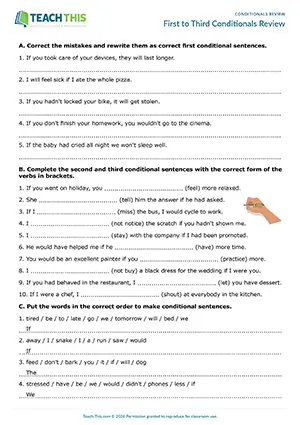
ESL conditionals Review Worksheet - Grammar Exercises: Error Correction, Gap-fill, Unscrambling, Matching, Identifying, Sentence Completion
Here is a free conditionals review worksheet to help students practice or review first, second and third conditionals. Students begin by correcting mistakes in...
ESL conditionals Review Worksheet - Grammar Exercises: Error Correction, Gap-fill, Changing Word Forms, Unscrambling, Matching, Identifying, Sentence Completion Here is a free conditionals review worksheet to help students practice or review first, second and third conditionals. Students begin by correcting mistakes in first conditional sentences and rewriting them. Next, students complete second and third conditional sentences with the correct form of the verbs in brackets. Students then put words in the correct order to make conditional sentences. After that, students match sentence halves to form conditional sentences and then indicate which conditional is being used in each sentence. Finally, students complete conditional sentences with their own ideas by adding an if-clause or a main clause to each sentence. show lessMake your Own Dominoes
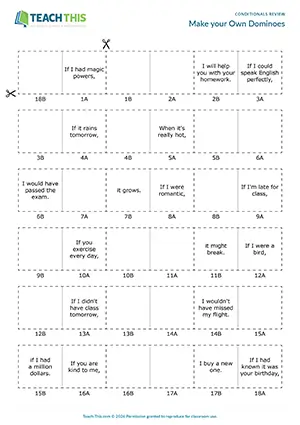
ESL conditionals Review Game - Grammar: Sentence Completion, Matching - Group Work
In this enjoyable conditionals review game, students practice zero, first, second and third conditionals by completing sentences and playing games of dominoes. In groups, students read and complete...
ESL conditionals Review Game - Grammar: Sentence Completion, Matching - Group Work In this enjoyable conditionals review game, students practice zero, first, second and third conditionals by completing sentences and playing games of dominoes. In groups, students read and complete each conditional sentence with an if-clause or main clause as indicated on the dominoes. Next, students cut the dominoes out and swap them with another group. Students then play dominoes with the first player trying to make a conditional sentence by placing a domino down either before or after the domino on the table. If the player can make a sentence, they read it to the group to show the match is correct. The next player then tries to put down one of their dominoes at either end of the domino chain, and so on. The first player to get rid of all their dominoes wins the game. show lessSecond vs. Third Conditional

ESL Second vs. Third Conditional Worksheet - Grammar Exercises: Error Correction, Sentence Completion - Speaking Activity: Asking and Answering Questions - Pair Work
This comprehensive second vs. third conditional worksheet helps students distinguish between and practice forming and using these two conditional...
ESL Second vs. Third Conditional Worksheet - Grammar Exercises: Error Correction, Sentence Completion - Speaking Activity: Asking and Answering Questions - Pair Work This comprehensive second vs. third conditional worksheet helps students distinguish between and practice forming and using these two conditional structures. Students begin by reading second and third conditional sentence examples and underlining the correct information about the two tenses. Next, students match second and third conditional sentence halves together and underline the correct tenses. Students then find and correct mistakes in second and third conditional sentences. After that, students complete each sentence with a verb from a box in its second or third conditional form. Students then complete second and third conditional sentence pairs with their own answers and guesses about a partner. Finally, students ask their partner 'What would you do/have done if...?' questions to find out if their guesses were correct. show lessThe conditionals Race

ESL conditionals Review Game - Grammar: Matching - Speaking Activity: Discussion, Communicative Practice - Group Work
In this engaging conditionals review game, students play dominoes by matching halves of zero, first, second and third conditional sentences together. The first player tries to make a conditional sentence...
ESL conditionals Review Game - Grammar: Matching - Speaking Activity: Discussion, Communicative Practice - Group Work In this engaging conditionals review game, students play dominoes by matching halves of zero, first, second and third conditional sentences together. The first player tries to make a conditional sentence by placing one of their dominoes at either end of the first domino and matching an if clause with an appropriate result clause. When a player makes a sentence, they read it to the group. The next player then tries to put down one of their dominoes at either end of the domino chain, and so on. The first player to get rid of all their dominoes wins the game. Finally, students discuss the conditional sentences and say whether they are true for them or not, and if they agree or disagree with what each sentence says. show lessThe Farmer and His Sons
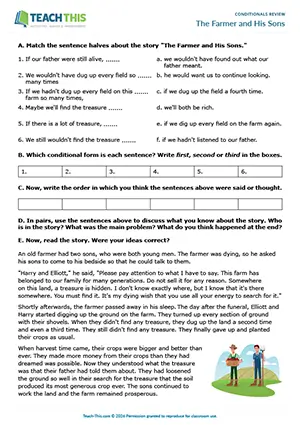
ESL conditionals Review Worksheet - Grammar, Reading and Writing Exercises: Matching, Categorising, Writing Sentences - Pair Work
In this thought-provoking conditionals review worksheet, students work with an Aesop fable to practice the first, second and third conditionals. First, students...
ESL conditionals Review Worksheet - Grammar, Reading and Writing Exercises: Matching, Categorising, Writing Sentences - Pair WorkIn this thought-provoking conditionals review worksheet, students work with an Aesop fable to practice the first, second and third conditionals. First, students match sentence halves together about a story. Students then write whether each sentence is in the first, second or third conditional. Next, students write the order in which they think the sentences were said or thought. After that, in pairs, students discuss what they know about the story from the sentences. Students then read the story to find out if their ideas were correct. Following that, students look at their sentence order and correct it if necessary. With their partner, students then write a possible moral for the story. Finally, working alone, students imagine that it's ten years later in the story and write first, second, and third conditional sentences about the two people in the story. show lessUnder What Condition?

ESL Real conditionals Activity - Grammar and Writing: Writing Sentences, Guessing, Discussion - Pair Work
In this fun real conditionals activity, students guess the circumstances in which a partner did, does or will do certain things using past, present and future real conditionals. First, students write ten sentences...
ESL Real conditionals Activity - Grammar and Writing: Writing Sentences from Prompts, Guessing, Discussion - Pair Work In this fun real conditionals activity, students guess the circumstances in which a partner did, does or will do certain things using past, present and future real conditionals. First, students write ten sentences about their past, present or expected future habits or plans using phrases from a box and the appropriate verb tense, choosing habits that they sometimes did, do or will do under certain conditions. Next, in pairs, students swap worksheets and write real conditional sentences explaining the circumstances in which they think their partner did, does or will do what they wrote. Finally, students read the complete conditional sentences to their partner to see if their guesses are correct and then discuss the actual circumstances. show lessWe will finish first unless...
ESL conditionals Review Game - Grammar: Sentence Completion - Group Work
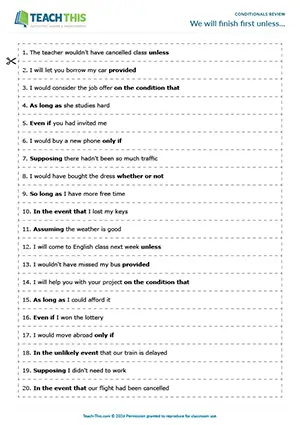
In this lively conditionals review game, students race to complete first, second, and third conditional sentences with various conditional words and phrases such as 'unless' and 'as long as'. A member from each team runs to your desk...
ESL conditionals Review Game - Grammar: Sentence Completion - Group Work In this lively conditionals review game, students race to complete first, second, and third conditional sentences with various conditional words and phrases such as 'unless' and 'as long as'. A member from each team runs to your desk, picks up the first sentence strip, and takes it back to their team. Teams then race to complete the sentence, making sure it is logical and grammatically correct, e.g. 'The teacher wouldn't have cancelled class unless it had been an emergency.' As soon as a team has completed the sentence, a student from the team comes to you with their strip. If the sentence is correct, give the student the second strip, and so on. If a sentence is incorrect, the team has to rewrite it. Teams can only get the next strip by producing a logical and grammatically correct sentence. The first team to complete all 20 sentences correctly wins the game. show lessHere's what our members are saying...
- Mixed Conditionals
-
Mixed conditionals ESL Games, Activities & Worksheets
Conditional Time Warp
ESL Mixed conditionals Game - Grammar and Speaking: Forming Sentences from Prompts - Group Work
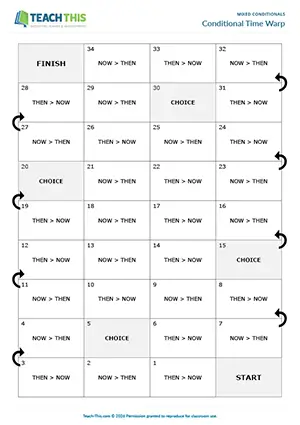
In this challenging mixed conditional board game, students use verb prompts and the time cues 'now' and 'then' to create mixed conditional sentences. In groups, players take turns rolling the dice and moving...
ESL Mixed conditionals Game - Grammar and Speaking: Forming Sentences from Prompts - Group Work In this challenging mixed conditional board game, students use verb prompts and the time cues 'now' and 'then' to create mixed conditional sentences. In groups, players take turns rolling the dice and moving their counters along the board. When a player lands on a square, they pick up a verb card and use both verbs in a mixed conditional sentence in any order. If the square says THEN > NOW, the player makes a conditional sentence using the past condition and present result pattern, e.g. 'If I had planned better back then, I wouldn't stress now.' If the square says NOW > THEN, the player makes a sentence using the present condition and past result pattern, e.g. 'If I planned better now, I wouldn't have stressed then.' If the square says 'CHOICE', the player may choose either pattern. If the group agrees that the sentence uses the correct pattern, includes the required time markers and is grammatically correct, the player stays on the square. If not, the player goes back to their previous square. The first player to reach the finish wins the game. show lessMixed Conditional Chains
ESL Mixed conditionals Activity - Grammar and Writing: Writing Sentences - Group Work
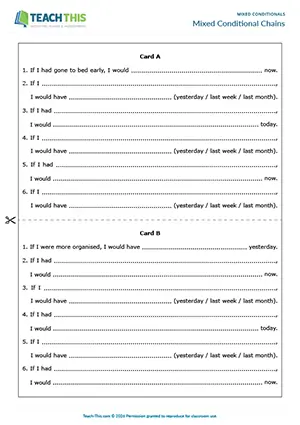
In this useful mixed conditionals activity, students practice mixed conditionals by writing sentence chains that alternate between past and present time reference. To begin, students read the...
ESL Mixed conditionals Activity - Grammar and Writing: Writing Sentences from Prompts - Group Work In this useful mixed conditionals activity, students practice mixed conditionals by writing sentence chains that alternate between past and present time reference. To begin, students read the if-clause in Sentence 1 and complete the result clause, e.g. 'If I had gone to bed early, I would be less tired now.' In Sentence 2, students rewrite the first sentence's result as the if-clause, but they do not write the result clause, e.g. 'If I were less tired,...' Next, students pass their card to the person on their right. That student completes the result clause for Sentence 2, then rewrites it as the if-clause of the following sentence and passes the card on, e.g. 'I would have gone for a walk yesterday. If I had gone for a walk yesterday,...' This continues with students completing one result clause and one if-clause until the card is complete with six mixed conditional sentences in a chain. Finally, students read out the mixed conditional chain sentences to their group. show lessMixed conditionals Domino Challenge
ESL Mixed conditionals Game - Grammar: Matching - Group Work
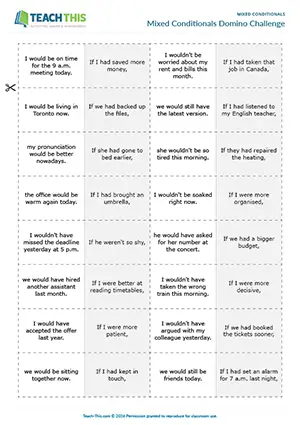
In this rewarding mixed conditionals game, students play dominoes by matching sentence halves to form mixed conditional sentences with past and present time references. To begin, the first player tries to make a mixed conditional sentence by...
ESL Mixed conditionals Game - Grammar: Matching - Group Work In this rewarding mixed conditionals game, students play dominoes by matching sentence halves to form mixed conditional sentences with past and present time references. To begin, the first player tries to make a mixed conditional sentence by placing one of their dominoes at either end of the first domino and matching an if-clause with an appropriate result clause. When a player makes a sentence, they read it to the group. The next player then tries to put down one of their dominoes at either end of the domino chain, and so on. The first player to get rid of all their dominoes wins the game. Finally, students take turns reading the mixed conditional sentences, changing pronouns or details when needed. The group then discusses whether each statement could be true for them or someone they know, and whether the result logically follows from the if-clause. show lessMixed conditionals in Action
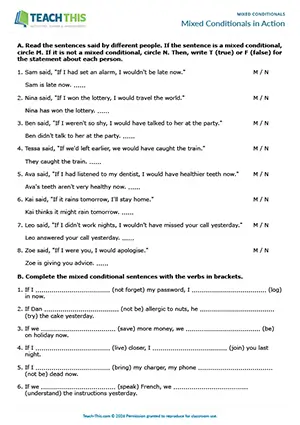
ESL Mixed conditionals Worksheet - Grammar Exercises: Binary Choice, True or False, Gap-fill, Rewriting Sentences, Sentence Completion
In this comprehensive mixed conditionals worksheet, students practice using mixed conditionals to connect past situations with present results and present...
ESL Mixed conditionals Worksheet - Grammar Exercises: Binary Choice, True or False, Gap-fill, Rewriting Sentences, Sentence Completion In this comprehensive mixed conditionals worksheet, students practice using mixed conditionals to connect past situations with present results and present situations with past results. First, students read statements made by different people and circle if the sentence is a mixed conditional or not. Students then mark a statement about each person as true or false based on the conditional sentence. Next, students complete mixed conditional sentences with the correct verb forms in brackets. After that, students rewrite sentences, changing the second or third conditional into a mixed conditional. Finally, students complete mixed conditional sentences with their own ideas by writing an if-clause for each sentence. show lessMixed Conditional Medley
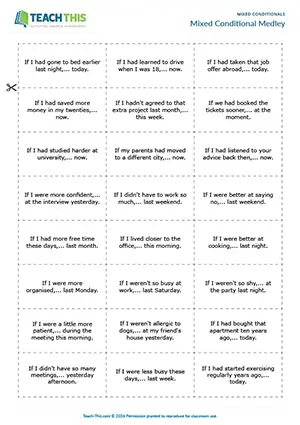
ESL Mixed conditionals Game - Grammar and Speaking: Sentence Completion, Freer Practice - Group Work
In this fast-paced mixed conditionals game, students race to complete time-shift conditional sentences. In groups, one student begins by picking up a card and reading the if-clause and time marker...
ESL Mixed conditionals Game - Grammar and Speaking: Sentence Completion, Freer Practice - Group Work In this fast-paced mixed conditionals game, students race to complete time-shift conditional sentences. In groups, one student begins by picking up a card and reading the if-clause and time marker, using the word 'blank' for the missing part of the sentence, e.g. 'If I had gone to bed earlier last night, BLANK today.' The other students in the group then race to complete the main clause. The first student to say a grammatically correct and appropriate main clause to complete the mixed conditional sentence wins and keeps the card. The next student then picks up a card, and so on. The student with the most cards at the end of the game wins. show lessSticky-Note Time Machine
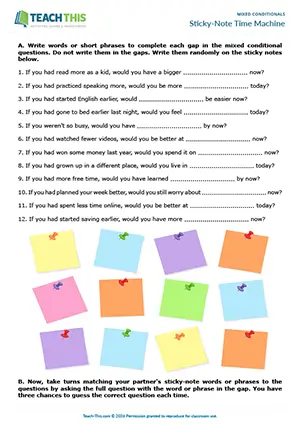
ESL Mixed conditionals Game - Grammar and Speaking: Writing Short Answers, Asking and Answering Questions, Guessing, Discussion, Freer Practice - Pair Work
In this rewarding mixed conditionals game, students practice asking and answering questions using mixed conditional forms to connect past situations with...
ESL Mixed conditionals Game - Grammar and Speaking: Writing Short Answers, Asking and Answering Questions, Guessing, Discussion, Freer Practice - Pair Work In this rewarding mixed conditionals game, students practice asking and answering questions using mixed conditional forms to connect past situations with present results and present situations with past results. First, students write words or short phrases to complete each gap in mixed conditional questions. However, students do not write them in the gaps. Instead, they write them randomly on sticky notes. Next, in pairs, students take turns matching their partner's sticky-note words or phrases to the questions by asking the full question with the word or phrase in the gap. The student has three chances to match it to the correct question. If the student guesses the correct question on the first try, they score three points. On the second try, they score two points. On the last try, one point. When a student guesses correctly, they write the words or phrase in the question and their score at the end. If a student fails to guess the correct question, the answer is not revealed. The student with the most points at the end of the game wins. Afterwards, students reveal any unanswered items and complete the remaining gaps. Finally, students discuss the questions with their partner using their own real-life examples. show lessTime-Shift Countdown
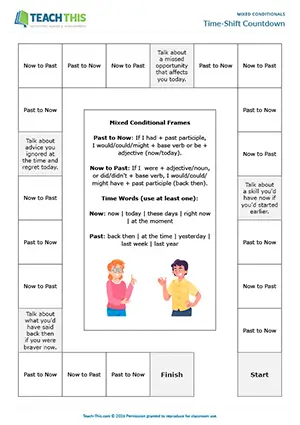
ESL Mixed conditionals Game - Grammar and Speaking: Forming Sentences, Short Answers, Freer Practice - Group Work
In this engaging mixed conditionals board game, students practice forming and using mixed conditional sentences with past and present time expressions. Players take turns rolling the dice and moving...
ESL Mixed conditionals Game - Grammar and Speaking: Forming Sentences, Short Answers, Freer Practice - Group Work In this engaging mixed conditionals board game, students practice forming and using mixed conditional sentences with past and present time expressions. Players take turns rolling the dice and moving their counters along the board. When a player lands on a square, they have 15 seconds to complete the task, using a correct mixed conditional form and an appropriate time expression. If a player lands on a 'Past to Now' square, another student picks up a card and reads out the prompt. The player then makes a mixed conditional sentence showing a past condition with a present result. If a player lands on a 'Now to Past' square, another student picks up a card and reads out the prompt. The player then makes a mixed conditional sentence showing a present condition with a past result. If a player lands on a 'Talk about...' square, they have 15 seconds to respond to the discussion prompt by making a mixed conditional sentence that includes a suitable time expression. In all cases, if the other students agree that the sentence is grammatically correct, matches the time shift required by the square, and includes a time expression, the player stays on the square. If not, they move back two squares. The first player to reach the finish wins the game. show lessWhat if?
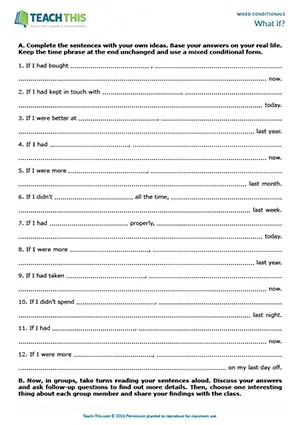
ESL Mixed conditionals Activity - Grammar, Writing and Speaking: Sentence completion, Discussion, Communicative Practice - Group Work
In this interesting mixed conditionals activity, students complete sentences based on their real lives using mixed conditional forms and then discuss their answers...
ESL Mixed conditionals Activity - Grammar, Writing and Speaking: Sentence completion, Discussion, Communicative Practice - Group Work In this interesting mixed conditionals activity, students complete sentences based on their real lives using mixed conditional forms and then discuss their answers. First, students complete mixed conditional sentences by writing answers that are based on their real lives, e.g. 'If I had bought a better laptop, I would be able to work faster now.' The situations are hypothetical, but students should start from real facts where possible. Next, in groups, students take turns reading their sentences aloud, and the group discusses the answers and asks follow-up questions to find out more details. Afterwards, groups share one interesting thing they found out about each group member. show lessHere's what our members are saying...
- Giving Advice
-
Giving Advice ESL Games, Activities & Worksheets
You should...

ESL Should Activity - Speaking: Asking and Answering Questions, Controlled and Freer Practice - Pair Work
Here is a productive giving advice speaking activity to introduce students to using 'should' to ask for and give advice. In pairs, Student A begins by reading each statement and asking their partner for advice...
ESL Should Activity - Speaking: Asking and Answering Questions from Prompts, Controlled and Freer Practice - Pair Work Here is a productive giving advice speaking activity to introduce students to using 'should' to ask for and give advice. In pairs, Student A begins by reading each statement and asking their partner for advice using the word 'should', e.g. 'I need to get some money. What should I do?' Student B listens and then gives advice with 'should' using the places shown on their worksheet, e.g. 'You should go to the bank.' Student A then writes the place next to the statement. Afterwards, students swap roles and repeat the activity. Finally, go through the answers with the class by reading the statements and eliciting the advice.Problems and Advice
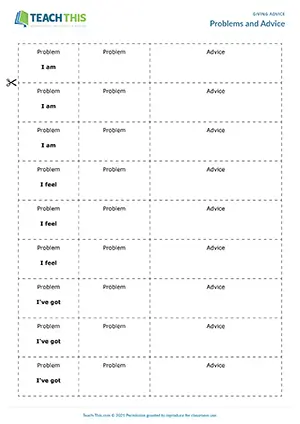
ESL Problems and Advice Game - Vocabulary: Sentence Completion, Writing Statements, Matching - Pair and Group Work
In this useful giving advice game, students practice stating problems and giving advice. Students begin by writing sentences that state problems and give advice. Students then cut the sentences into problem...
ESL Problems and Advice Game - Vocabulary: Sentence Completion, Writing Statements, Matching - Pair and Group Work In this useful giving advice game, students practice stating problems and giving advice. Students begin by writing sentences that state problems and give advice. Students then cut the sentences into problem cards (phrase + problem) and advice cards. Next, students play a game where they match the cards together to state problems and give related advice. One student begins by putting down a phrase card showing the first half of a problem. The next student then tries to complete the problem using one of their cards. The following student then puts down a card showing a matching piece of advice for the problem. If the student does this, they keep the three cards and put down a new phrase card. If a student cannot put down a suitable card at any time, they pick one up from the appropriate pile, and it's the next student's turn to put down a card. The player with the most cards at the end of the game wins.Should and Shouldn't

ESL Should and Shouldn't Worksheet - Vocabulary Exercises: Identifying, Matching, Binary Choice, Gap-fill, Writing Sentences - Speaking Activity: Freer Practice - Pair Work
Here is a comprehensive should and shouldn't worksheet to help students learn and practice giving advice with should and shouldn't. Students begin by...
ESL Should and Shouldn't Worksheet - Vocabulary Exercises: Identifying, Matching, Binary Choice, Gap-fill, Writing Sentences - Speaking Activity: Freer Practice - Pair Work Here is a comprehensive should and shouldn't worksheet to help students learn and practice giving advice with should and shouldn't. Students begin by reading sentences about giving advice and answering three questions. Students then match problems with the correct advice. Next, students circle 'should' or 'shouldn't' in sentences that give advice. After that, students complete advice with 'should' or 'shouldn't' and verbs from a box. Students then move on to read problems and write advice using should or shouldn't. Finally, students write down three problems of their own, ending with the question 'What should I do?' Students then read their problems to their partner, who gives them advice using should or shouldn't.Should and Shouldn't Board Game

ESL Should and Shouldn't Board Game - Speaking: Offering Advice, Freer Practice - Group Work
In this fun giving advice board game, students read problems and give advice with should and shouldn't. Players take turns rolling the dice and moving their counter along the board. When a player lands...
ESL Should and Shouldn't Board Game - Speaking: Offering Advice, Freer Practice - Group Work In this fun giving advice board game, students read problems and give advice with should and shouldn't. Players take turns rolling the dice and moving their counter along the board. When a player lands on a square, they read the problem and give advice, saying one thing the person should do and one thing they shouldn't do. The other students listen to the advice and judge the player's response. If it's grammatically correct and appropriate, the player stays on the square. If not, the player goes back two squares. The first player to reach the finish wins the game. If you have a weak class, students play by giving one piece of advice with should or shouldn't. The game can also be played with other phrases for giving advice.Advice Dominoes
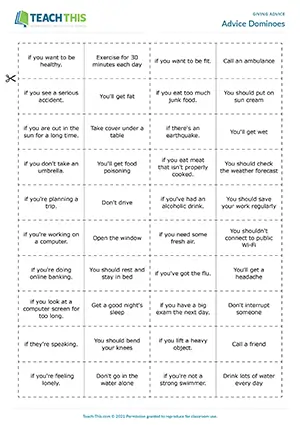
ESL Giving Advice Game - Grammar and Vocabulary: Matching - Group Work
In this enjoyable giving advice with conditionals game, students play dominoes to practice the zero and first conditional for giving advice. The first player puts down one of their dominoes on either side of the domino on the table, making sure...
ESL Giving Advice Game - Grammar and Vocabulary: Matching - Group Work In this enjoyable giving advice with conditionals game, students play dominoes to practice the zero and first conditional for giving advice. The first player puts down one of their dominoes on either side of the domino on the table, making sure that the main and if clauses go together to make a zero or first conditional sentence for giving advice. The other players then take turns matching their dominoes in the same way by putting them down at either end of the domino chain and making a suitable conditional sentence for giving advice. The first player to get rid of all their dominoes wins the game.Advice for the Modern World
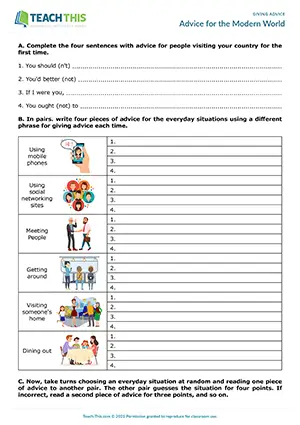
ESL Everyday Advice Game - Speaking: Sentence Completion, Writing Sentences, Guessing - Pair Work
In this engaging giving advice game, students use four phrases to write advice for everyday situations and then play a guessing game using the advice. First, students complete four phrases with advice for...
ESL Everyday Advice Game - Speaking: Sentence Completion, Writing Sentences, Guessing - Pair Work In this engaging giving advice game, students use four phrases to write advice for everyday situations and then play a guessing game using the advice. First, students complete four phrases with advice for people visiting their country for the first time. Next, in pairs, students write four pieces of advice for everyday situations using a different phrase for giving advice each time. Each pair then joins with another pair. One pair chooses an everyday situation at random and reads one piece of advice to the other pair, who guesses which situation the advice is for. If the pair guesses correctly, they score four points. If not, the pair reads a second piece of advice for three points, and so on. When a pair correctly guesses a situation or four pieces of advice have been read out, the pairs swap roles. This continues until both pairs have given advice for all the situations. Pairs then play a second round where they take turns reading all four pieces of advice for each situation. If a pair has a piece of advice that is different from the other pair, they score a point. The pair with the most points at the end of the game wins.Advice Needed
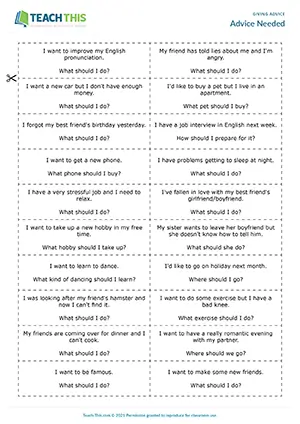
ESL Should for Advice Game - Speaking: Giving Advice, Communicative Practice - Group Work
In this free should for advice game, students give the best advice they can using the modal verb 'should'. In groups, students take turns picking up a card, reading out the situation on the card and asking for...
ESL Should for Advice Game - Speaking: Giving Advice, Communicative Practice - Group Work In this free should for advice game, students give the best advice they can using the modal verb 'should'. In groups, students take turns picking up a card, reading out the situation on the card and asking for advice. The other students then each give a different piece of advice for the situation using 'should'. The student with the card listens and awards the card to the person who gives the best advice. The student with the most cards at the end of the game wins. Afterwards, students tell the class the best advice they were given for each situation.Agony Aunt

ESL Giving Advice Activity - Writing and Speaking: Writing Responses, Discussion, Freer Practice - Group Work
In this imaginative giving advice speaking activity, students take on the role of an agony aunt called Abby and give advice. First, students read a message on a card asking Abby for advice about a...
ESL Giving Advice Activity - Writing and Speaking: Writing Responses, Guided Discussion, Freer Practice - Group Work In this imaginative giving advice speaking activity, students take on the role of an agony aunt called Abby and give advice. First, students read a message on a card asking Abby for advice about a particular problem and write a reply using the advice phrase from the question in the message. Next, in groups, students read and discuss all the advice given by other students for their assigned problem. Groups then choose the best advice and write a final response using the phrase. Finally, groups take turns reading their problem and advice to the class, who gives feedback, saying whether they agree with the advice or not.Asking For and Giving Advice

ESL Giving Advice Worksheet - Writing Exercises: Listing, Writing and Reading Mini-Dialogues, Writing Email Replies
Here is an insightful giving advice worksheet to help students practice phrases for asking and giving advice on everyday topics. First, students write a list of six things they would ask advice for, e.g. a low...
ESL Giving Advice Worksheet - Writing Exercises: Listing, Writing and Reading Mini-Dialogues, Writing Email Replies Here is an insightful giving advice worksheet to help students practice phrases for asking and giving advice on everyday topics. First, students write a list of six things they would ask advice for, e.g. a low GPA, a broken heart, etc. Next, students write mini-dialogues, asking for and giving advice on their six topics. Students then role-play the dialogues with a partner. After that, students imagine that they run an online advice column, read three emails asking for advice and write replies, giving the best advice they can. Finally, students read their replies to the class, who say whether they agree with the advice or not.Careers Advice

ESL Careers Advice Game - Speaking: Sentence Completion, Guessing - Pair Work
In this rewarding giving advice game, students give careers advice and their classmates try to guess the matching jobs. In teams of two, students complete each job card with career advice for someone who would want to do that job in the future...
ESL Careers Advice Game - Speaking: Sentence Completion, Guessing - Pair Work In this rewarding giving advice game, students give careers advice and their classmates try to guess the matching jobs. In teams of two, students complete each job card with career advice for someone who would want to do that job in the future. Next, teams take turns reading the career advice on a job card without saying what the job is. The other team listens and tries to guess which job they are giving career advice for. If the team correctly guesses the job, they win and keep the card. If not, the team reading out the advice keeps the card. The team with the most cards at the end of the game wins.I've got a Problem

ESL Giving Advice Activity - Speaking: Stating Problems and Giving Advice, Communicative Practice - Intermediate (B1)
This versatile giving advice speaking activity helps students practice phrases for stating problems and giving advice. Half the students are problem people and the other half are advice givers. Write a phrase...
ESL Giving Advice Activity - Speaking: Stating Problems and Giving Advice, Communicative Practice - Intermediate (B1) This versatile giving advice speaking activity helps students practice phrases for stating problems and giving advice. Half the students are problem people and the other half are advice givers. Write a phrase to state a problem and give advice that you want the students to practice on the board, e.g. 'I'm having a hard time...' and 'You ought to...' The problem people then think of a minor problem they have and state the problem using the phrase, e.g. 'I'm having a hard time getting to class on time. I'm always late for class.' The problem person then explains their problem to an advice giver, who offers a piece of advice using the target phrase, e.g. 'You ought to organize your time better.' The problem person notes down the advice and moves on to ask advice from another advice giver. This continues until the problem person has received five pieces of advice. Students then swap roles and repeat the activity using other phrases to state a problem and give advice, e.g. 'I'm having trouble..' and 'You had better...' Finally, students state their problem and tell the class the best and worst piece of advice they received.Jon's Story
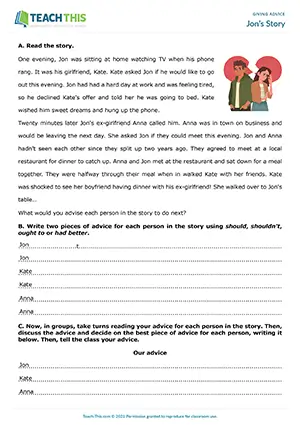
ESL Giving Advice Activity - Reading, Writing and Speaking: Reading a Text, Writing Sentences, Discussion - Group Work
In this interesting giving advice activity, students read a short story and then write and discuss advice for the people in the story. First, students read the short story together as a class. Students then...
ESL Giving Advice Activity - Reading, Writing and Speaking: Reading a Text, Writing Sentences, Guided Discussion - Group Work In this interesting giving advice activity, students read a short story and then write and discuss advice for the people in the story. First, students read the short story together as a class. Students then think about what advice they would give each person in the story on what to do next. After that, students write two pieces of advice for each person using should, shouldn't, ought to or had better. Next, in groups, students take turns reading their advice for each person to the group, who discusses it and decides on the best piece of advice for each person, writing their answers down on the worksheet. Afterwards, groups discuss the dilemma in the story as a class and report back on the advice they came up with.Should, Ought to, Had Better
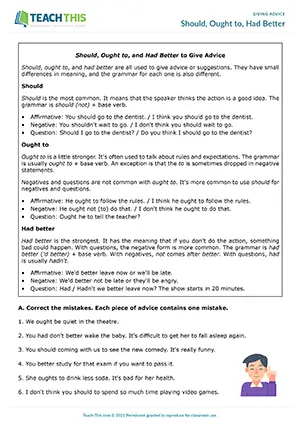
ESL Giving Advice Worksheet - Vocabulary Exercises: Error Correction, Unscrambling, Matching, Forming Sentences
Here is a handy giving advice worksheet to help students learn and practice how to give advice using should, ought to, and had better. Students start by finding and correcting mistakes in advice...
ESL Giving Advice Worksheet - Vocabulary Exercises: Error Correction, Unscrambling, Matching, Forming Sentences Here is a handy giving advice worksheet to help students learn and practice how to give advice using should, ought to, and had better. Students start by finding and correcting mistakes in advice. Next, students unscramble words to make advice and then match the advice with problems. Finally, students read problems, choose a suitable piece of advice for each one from a box and write an affirmative or negative sentence with it using should, ought to, or had better.The Best Advice

ESL Stating Problems and Giving Advice Activity - Speaking: Asking and Answering Questions, Writing Sentences, Communicative Practice
In this communicative stating problems and giving advice speaking activity, students ask for and give advice and then choose the best piece of advice they received...
ESL Stating Problems and Giving Advice Activity - Speaking: Asking and Answering Questions from Prompts, Writing Sentences, Communicative Practice In this communicative stating problems and giving advice speaking activity, students ask for and give advice and then choose the best piece of advice they received. In pairs, students ask their partner for advice about the problem on their card and write down the advice they receive. Students then pair up with a new partner and repeat the process until they have spoken to eight people. Next, students choose the best piece of advice and write on their card why they think it's the best. Afterwards, students tell the class about their problem and the best advice they received.Travel Advice
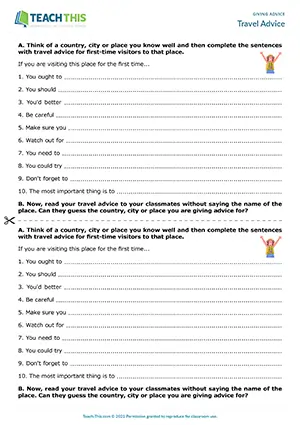
ESL Travel Advice Game - Speaking: Sentence Completion, Guessing - Group Work
In this creative giving travel advice game, students write travel advice for a place they know well and then use the advice in a guessing game. First, students think of a country, city or place...
ESL Travel Advice Game - Speaking: Sentence Completion, Guessing - Group Work In this creative giving travel advice game, students write travel advice for a place they know well and then use the advice in a guessing game. First, students think of a country, city or place they know well. Students then complete sentences with travel advice for first-time visitors to that place, giving advice on things like attractions, shopping, food and drink, climate, public transport, customs, crime, etc. Next, in groups of five or six, students take turns reading their travel advice to the group without saying the name of the place. The other students listen and then guess which country, city or place the student is giving advice for, scoring one point for each correct answer. The student with the most correct guesses in each group wins. As an extension, groups choose one student from their group to read their travel advice to the class for them to guess.What's your advice?
ESL Advice Game - Writing: Writing Sentences - Group Work
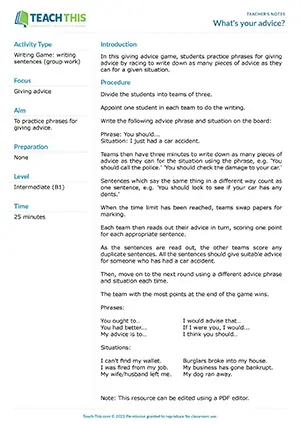
In this free giving advice game, students practice phrases for giving advice by racing to write down as many pieces of advice as they can for a given situation. Write an advice phrase and situation on the board, e.g. 'You should...' and 'I just had...
ESL Advice Game - Writing: Writing Sentences - Group Work In this free giving advice game, students practice phrases for giving advice by racing to write down as many pieces of advice as they can for a given situation. Write an advice phrase and situation on the board, e.g. 'You should...' and 'I just had a car accident.' Teams then have three minutes to write down as many pieces of advice as they can for the situation using the phrase, e.g. 'You should call the police.' Each team then reads out their advice in turn, scoring one point for each appropriate sentence. Then, move on to the next round using a different advice phrase and situation each time. The team with the most points at the end of the game wins.Awesome Advice
ESL Giving Advice Game - Grammar, Vocabulary and Speaking: Sentence Completion, Freer Practice - Group Work
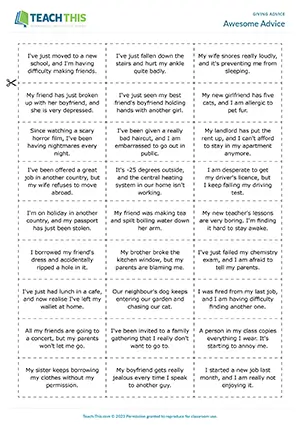
In this fast-paced giving advice game, students race to give advice for different problems using modals of advice and the second conditional. In groups, students take turns picking up an advice...
ESL Giving Advice Game - Grammar, Vocabulary and Speaking: Sentence Completion, Freer Practice - Group Work In this fast-paced giving advice game, students race to give advice for different problems using modals of advice and the second conditional. In groups, students take turns picking up an advice card and a problem card, reading the advice prompts and problem to the group, and placing the two cards face-up on the table. As soon as the cards are on the table, all the students race to come up with advice for the problem using the two prompts on the advice card. When a student thinks they can make two suitable sentences, they put their hand up and give their advice. If the other students agree that the two pieces of advice are grammatically correct and match the problem, the student wins and keeps the two cards. If the advice is grammatically incorrect or doesn't match the problem, or the student fails to put up their hand before speaking, they are out of the round, and the other students continue trying to come up with advice. The student with the most pairs of cards at the end of the game is the winner.Guess the Problem
ESL Giving Advice Game - Speaking: Forming Sentences, Guessing - Group Work
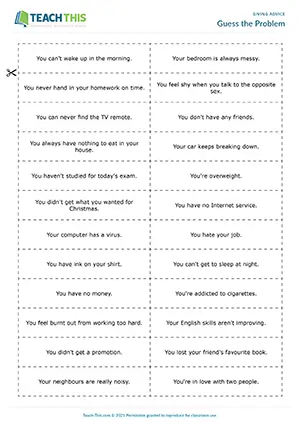
In this entertaining giving advice game, students give advice and their classmates try to guess what the problem is. In groups, students take turns picking up a card, reading the problem on the card and giving advice for it. The other students...
ESL Giving Advice Game - Speaking: Forming Sentences, Guessing - Group Work In this entertaining giving advice game, students give advice and their classmates try to guess what the problem is. In groups, students take turns picking up a card, reading the problem on the card and giving advice for it. The other students listen and guess the problem. The first student to state the problem wins and keeps the card. If no one manages to guess the problem after a lot of advice has been given, the student giving the advice keeps the card. The next student then picks up a card, and so on. The student with the most cards at the end of the game wins.What should I do?

ESL Advice Game - Speaking: Forming Sentences, Communicative Practice - Group Work
In this amusing giving advice game, students try to give the best advice they can for a variety of problems. In groups, students take turns picking up a card, reading the problem on the card to the group...
ESL Advice Game - Speaking: Forming Sentences, Communicative Practice - Group Work In this amusing giving advice game, students try to give the best advice they can for a variety of problems. In groups, students take turns picking up a card, reading the problem on the card to the group and then asking, 'What should I do?' The other students listen and then each give some advice in turn. The student with the card listens and awards the card to the person, who they think gave the best advice. The next student then picks up a card, and so on. The student with the most cards at the end of the game wins. Finally, students report back to the class on the best advice they received.You Might Want to Connect Four

ESL Advice Game - Vocabulary and Speaking: Forming Sentences, Freer and Communicative Practice - Pair Work
In this productive giving advice game, students play Connect Four by giving advice for different scenarios using specific phrases. To begin, the first player chooses a square from the game board...
ESL Advice Game - Vocabulary and Speaking: Forming Sentences from Prompts, Freer and Communicative Practice - Pair Work In this productive giving advice game, students play Connect Four by giving advice for different scenarios using specific phrases. To begin, the first player chooses a square from the game board. The other player then picks up a problem card and reads out the scenario. The first player then uses the phrase from the square to give advice for the problem. If the other player agrees that the advice is grammatically correct and appropriate, the player marks the square with an 'O' or 'X'. It is then the other player's turn to choose a square. The first player to get four squares in a row wins the game. If nobody manages to do this, the player with the most squares wins. Afterwards, pairs play a second game using the remaining problem cards.Here's what our members are saying...
- First Conditional
-
First Conditional ESL Games, Worksheets & Activities
Christmas conditionals
ESL First Conditional Activity - Grammar: Sentence Completion, Guessing - Group and Pair Work
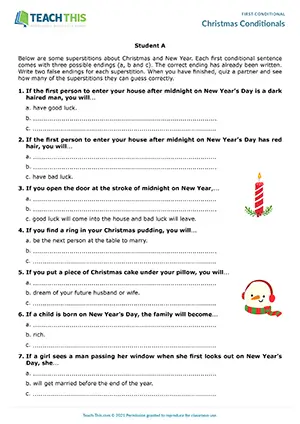
This festive first conditional activity combines the topic of Christmas and New Year superstitions with the first conditional. The worksheets contain Christmas and New Year superstitions written as first...
ESL First Conditional Activity - Grammar: Sentence Completion, Guessing - Group and Pair Work This festive first conditional activity combines the topic of Christmas and New Year superstitions with the first conditional. The worksheets contain Christmas and New Year superstitions written as first conditional sentences. Each one comes with three possible endings. The correct ending is already written on the worksheet. In two groups, students write two false endings for each first conditional sentence. Next, students pair up with someone from the other group and take turns reading each superstition and three endings to their partner, who guesses which ending is correct. The student with the most correct guesses in each pair wins.Conditional Chain Game
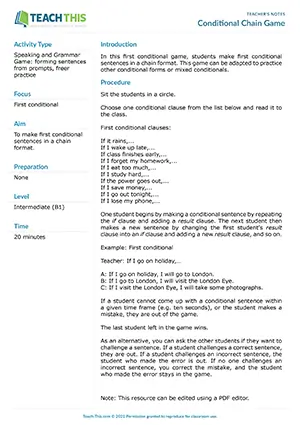
ESL First Conditional Game - Grammar and Speaking: Forming Sentences, Freer Practice
In this entertaining first conditional game, students create a spoken chain by turning prompts into first conditional sentences. The format is flexible and can be adapted to practice other conditional forms. To begin, you say an if-clause...
ESL First Conditional Game - Grammar and Speaking: Forming Sentences from Prompts, Freer Practice In this entertaining first conditional game, students create a spoken chain by turning prompts into first conditional sentences. The format is flexible and can be adapted to practice other conditional forms. To begin, you say an if-clause. The first student then repeats the if-clause and adds a result clause. The next student makes a new sentence by changing the first student's result clause into an if-clause and adding a new result clause, and so on. If a student cannot come up with a conditional sentence within a given time frame (e.g. ten seconds) or the student makes a mistake, they are out of the game. The last student left in the game wins.First Conditional Advice
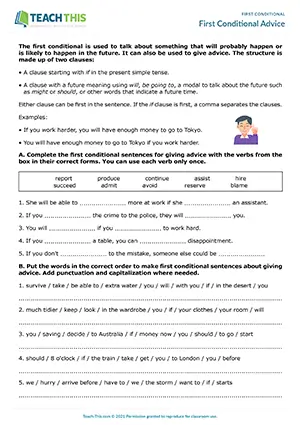
ESL First Conditional Worksheet - Grammar, Reading and Writing Exercises: Gap-fill, Identifying, Writing a Paragraph
In this free first conditional worksheet, students practice giving advice using the first conditional with 'will' and other modal verbs. Students start by completing first conditional sentences about giving advice...
ESL First Conditional Worksheet - Grammar, Reading and Writing Exercises: Gap-fill, Unscrambling, Identifying, Writing a Paragraph In this free first conditional worksheet, students practice giving advice using the first conditional with 'will' and other modals. Students start by completing first conditional sentences about giving advice with words from a box. Next, students put words in the correct order to make first conditional sentences about giving advice, adding punctuation and capitalization where needed. Students then read an email to an advice columnist and underline the if-clauses and put brackets around the clauses with a future meaning. Students then take on the role of the advice columnist and write a response to an email, giving advice using the first conditional. Finally, students read their reply to a partner, who says whether they agree with the advice given or not. Afterwards, there is a class feedback session to hear the students' advice and discuss who gave the best response.First Conditional Card Game
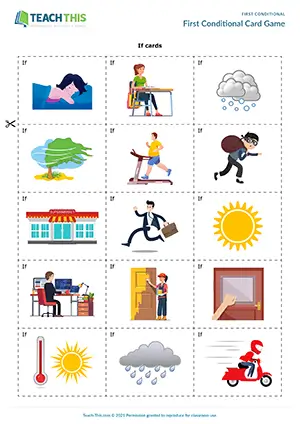
ESL First Conditional Game - Grammar and Speaking: Forming Sentences from Picture Prompts, Freer Practice - Group Work
In this engaging first conditional game, students practice making first conditional sentences by matching picture prompts for if-clauses to suitable result cards. The first student turns over the top...
ESL First Conditional Game - Grammar and Speaking: Forming Sentences from Picture Prompts, Freer Practice - Group Work In this engaging first conditional game, students practice making first conditional sentences by matching picture prompts for if-clauses to suitable result cards. The first student turns over the top 'If' card and makes the beginning of a first conditional sentence using the picture on the card. For example, if the picture shows a person staying up late, the student might say, 'If you stay up late,...' All the students then look at their result cards and try to find an appropriate match to complete the first conditional sentence. The student with a matching card then completes the sentence, e.g. '...you will feel tired the next day.' If everyone agrees the sentence is appropriate, the student who completed the sentence keeps both cards. The second student then turns over the next 'If' card, and so on. The first student to get rid of all their result cards wins the game.First Conditional Chain
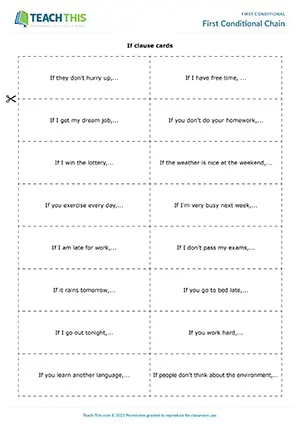
ESL First Conditional Activity - Grammar and Writing: Sentence Completion - Group Work
In this imaginative first conditional activity, students practice forming and linking first conditional sentences by collaboratively creating sentence chains. First, students write their name and an if-clause at the top of the worksheet, e.g. 'If they don't...
ESL First Conditional Activity - Grammar and Writing: Sentence Completion - Group Work In this imaginative first conditional activity, students practice forming and linking first conditional sentences by collaboratively creating sentence chains. First, students write their name and an if-clause at the top of the worksheet, e.g. 'If they don't hurry up,...' Each student then passes their paper to the person on their right, who completes the second half of the first conditional sentence with a result clause, e.g. '...they will miss the bus.' The student then folds the paper so that the first if-clause cannot be seen and passes the paper to the student on their right. The next student then uses the result clause to write the if-clause for a new first conditional sentence, e.g. 'If they miss the bus,...' The student then folds the paper to hide the result clause and passes it to the next student, and so on. When the last sentence has been completed, students unfold the worksheet and give it back to the person whose name is at the top. This person corrects any mistakes they find and then reads the sentences to the group. Finally, each group chooses the best set of sentences and reads them to the class.First Conditional Dominoes
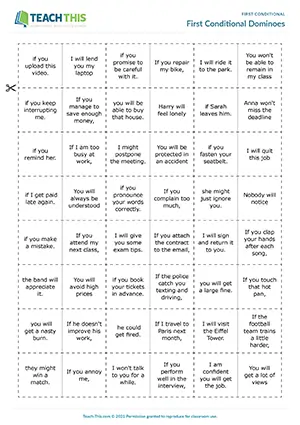
ESL First Conditional Game - Grammar: Matching - Group Work
This rewarding first conditional game helps learners review and reinforce first conditional sentence structures by matching clause halves to build complete sentences. The first player tries to make a first conditional sentence by placing a...
ESL First Conditional Game - Grammar: Matching - Group Work This rewarding first conditional game helps learners review and reinforce first conditional sentence structures by matching clause halves to build complete sentences. The first player tries to make a first conditional sentence by placing a domino down either before or after the domino on the table. If the player can make a sentence, they read it to the group to show the match is correct. The next player then tries to put down one of their dominoes at either end of the domino chain, and so on. The first player to get rid of all their dominoes wins the game.First Conditional Focus
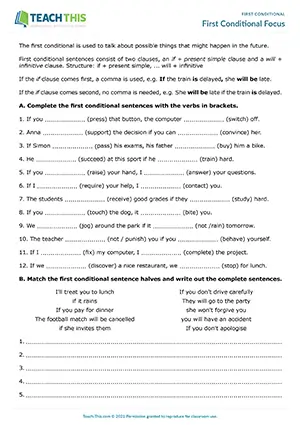
ESL First Conditional Worksheet - Grammar Exercises: Gap-fill, Sentence Completion, Writing Sentences - Speaking Activity: Asking and Answering Questions - Pair Work
This insightful first conditional worksheet helps to teach students how to form and use the first conditional to talk about real future possibilities. First, students...
ESL First Conditional Worksheet - Grammar Exercises: Gap-fill, Sentence Completion, Writing Sentences - Speaking Activity: Asking and Answering Questions - Pair Work This insightful first conditional worksheet helps to teach students how to form and use the first conditional to talk about real future possibilities. First, students complete first conditional sentences with verbs in brackets. Students then match first conditional sentence halves together and write out the complete sentences. Next, students complete first conditional sentences with their own ideas. Afterwards, students answer first conditional questions and create one more question of their own. Finally, in pairs, students ask and answer the questions with their partner.First Conditional Story
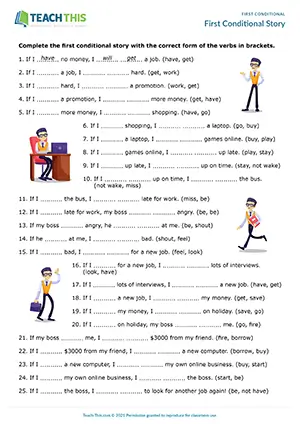
ESL First Conditional Worksheet - Grammar Exercise: Gap-fill
This useful first conditional worksheet helps to introduce students to first conditional verb forms and structure. Working alone, students complete first conditional sentences in a story with the correct form of the verbs in brackets. When the students have...
ESL First Conditional Worksheet - Grammar Exercise: Gap-fill This useful first conditional worksheet helps to introduce students to first conditional verb forms and structure. Working alone, students complete first conditional sentences in a story with the correct form of the verbs in brackets. When the students have completed the story, check the answers with the class by eliciting each sentence in turn from a student. Students score one point for each correct sentence. The student with the most points wins.Five-in-a-row
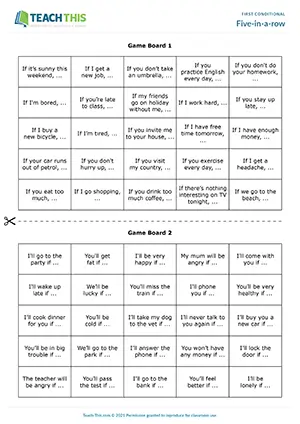
ESL First Conditional Game - Speaking: Completing Sentences, Freer Practice - Pair Work
In this fun first conditional game, students complete if-clauses or result clauses to build first conditional sentences. In pairs, students take turns choosing an if-clause square and making a first conditional...
ESL First Conditional Game - Speaking: Completing Sentences from Prompts, Freer Practice - Pair Work In this fun first conditional game, students complete if-clauses or result clauses to build first conditional sentences. In pairs, students take turns choosing an if-clause square and making a first conditional sentence by adding a suitable result clause. If a student forms a grammatically correct and logical first conditional sentence, they draw their O or X symbol in the square. If not, play passes to the other student. The aim of the game is to be the first student to get five squares in a row. The first student to do this is the winner. Pairs then repeat the process with the second game board, but this time the squares contain result clauses. The students' task this time is to make a first conditional sentence by adding an appropriate if-clause to complete the sentence.If and When
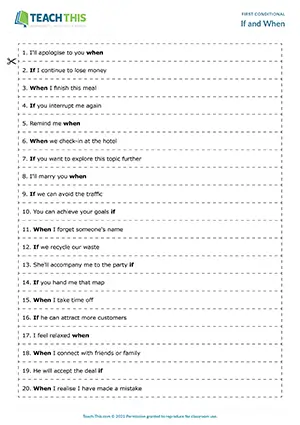
ESL First Conditional Game - Grammar: Sentence Completion - Group Work
In this creative first conditional game, students race to complete first conditional sentences and future time clauses with 'when'. Give each team an incomplete sentence strip. Teams then race to complete the first sentence, making sure...
ESL First Conditional Game - Grammar: Sentence Completion - Group Work In this creative first conditional game, students race to complete first conditional sentences and future time clauses with 'when'. Give each team an incomplete sentence strip. Teams then race to complete the first sentence, making sure the sentence is logical and grammatically correct. As soon as a team has completed the sentence, one student from the team comes up to your desk with the strip. If it's correct, you give the student the second strip, and so on. If a sentence is incorrect, the team has to rewrite it. The first team to complete all the strips wins the game.What did I write?
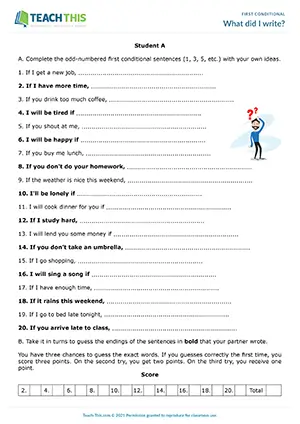
ESL First Conditional Game - Grammar: Sentence Completion, Guessing, Freer Practice - Pair Work
In this interesting first conditional game, students complete sentence starters with their own ideas and then try to guess the endings their partner wrote, reinforcing both if-clauses and result clauses in the...
ESL First Conditional Game - Grammar: Sentence Completion, Guessing, Freer Practice - Pair Work In this interesting first conditional game, students complete sentence starters with their own ideas and then try to guess the endings their partner wrote, reinforcing both if-clauses and result clauses in the first conditional. In two groups, students complete the endings of first conditional sentences with their own ideas. Next, students pair up with someone from the other group. Students then play a game where they guess the endings of the first conditional sentences their partner wrote. Student B starts and has three chances to guess the ending of Student A's first sentence. If Student B guesses correctly the first time, they score three points. On the second try, two points. On the third try, one point. It's then Student A's turn to guess the second sentence, and so on. The student with the most points at the end of the game wins.What will happen?
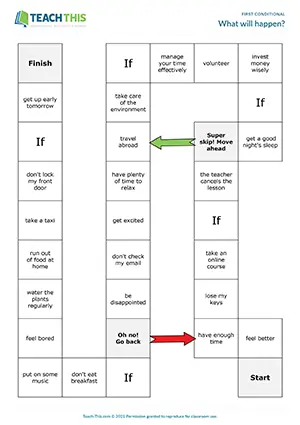
ESL First Conditional Board Game - Grammar and Speaking: Forming Sentences, Freer Practice - Group Work
In this free first conditional board game, students practice making first conditional sentences from prompts. In groups, students take turns rolling the dice and moving their counters along the board...
ESL First Conditional Board Game - Grammar and Speaking: Forming Sentences from Prompts, Freer Practice - Group Work In this free first conditional board game, students practice forming first conditional sentences from prompts. In groups, students take turns rolling the dice and moving their counters along the board. When a student lands on a square, they make a first conditional sentence using the prompt in either the if‑clause or the result clause and adjust the form as needed. For example, if a prompt reads 'feel better', the student might say, 'If I feel better, I will go out at the weekend.' If the sentence is grammatically correct and appropriate, the student stays on the square. If not, they go back two squares. If a student lands on a square marked 'If', they can make any first conditional sentence they want. The first student to reach the finish wins the game.First Conditional Practice
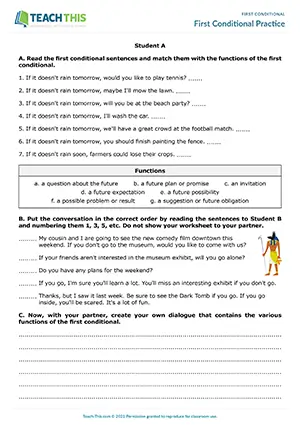
ESL First Conditional Activity - Grammar: Matching, Ordering, Writing a Dialogue, Role-Play - Pair Work
In this enjoyable first conditional activity, students identify different ways of using the first conditional and practice using them in two conversations. First, students read first conditional sentences and...
ESL First Conditional Activity - Grammar: Matching, Ordering, Writing a Dialogue, Role-Play - Pair Work In this enjoyable first conditional activity, students identify different ways of using the first conditional and practice using them in two conversations. First, students read first conditional sentences and match them with the functions of the first conditional. Next, in pairs, students put a conversation that demonstrates the functions in the correct order by reading the sentences to their partner and numbering them from 1 to 10. Afterwards, pairs create their own dialogues that contain the various functions of the first conditional and then read them to the class.If...
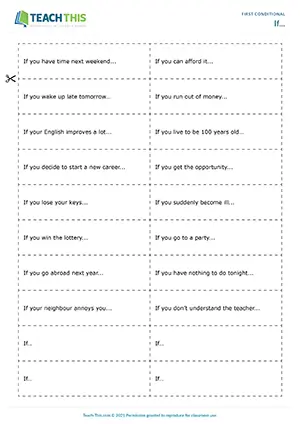
ESL First Conditional Game - Grammar and Speaking: Forming and Answering Questions, Freer Practice - Group Work
In this rewarding first conditional game, students practice asking first conditional questions and responding with phrases of probability. Begin by writing probability phrases on the board...
ESL First Conditional Game - Grammar and Speaking: Forming and Answering Questions from Prompts, Freer Practice - Group Work In this rewarding first conditional game, students practice asking first conditional questions and responding with phrases of probability. Begin by writing probability phrases on the board, e.g. I doubt if, It's unlikely, will definitely, will probably, etc. In groups, students then take turns picking up an if-clause card and asking the student on their right a first conditional question using the clause. If the student picks up a blank If... card, they create their own first conditional question. If the question is grammatically correct and logical, the student scores a point. The other student then answers the question using a phrase of probability from the board. If the answer is grammatically correct, the answering student also scores a point. The student with the most points at the end of the game wins.Here's what our members are saying...


