
- Possessives
-
possessive adjectives, Pronouns & Nouns ESL Games, Worksheets & Activities
Match it
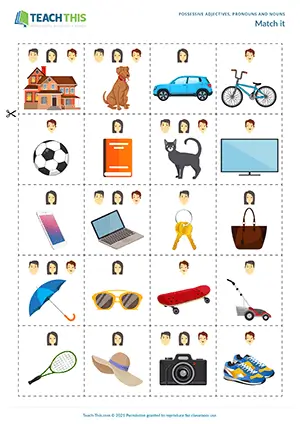
ESL possessive Adjective Games - Vocabulary, Grammar and Speaking: Matching, Forming Sentences
In this engaging set of possessive adjective games, students play a guessing game, memory game and matching game where they make sentences with his, her, and their. First, students play a guessing...
ESL possessive Adjective Games - Vocabulary, Grammar and Speaking: Matching, Forming Sentences, Freer Practice In this engaging set of possessive adjective games, students play a guessing game, memory game and matching game where they make sentences with his, her, and their. First, students play a guessing game about who the objects on the cards belong to. Next, students take it in turns to turn over a picture card (showing who owns the object) and a possessive adjective card. If the cards match, the student makes a sentence with the possessive adjective, e.g. 'It's his bicycle'. The student then keeps the two cards and has another turn. The student with the most pairs of cards wins the game. Next, one student takes the picture cards and the other two students take the possessive adjective cards. The student with the picture cards turns over the top card, shows the card to the two students and says 'It's...' The two students then race to find the correct possessive adjective and give it to the student, completing the sentence at the same time, e.g. 'It's their house'. The first student to do this keeps both cards. The student with the most pairs of cards at the end of the game wins.It must be true!
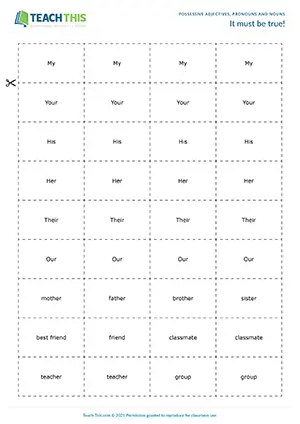
ESL possessive adjectives Game - Grammar: Sentence Construction
In this free possessive adjectives game, students create true sentences about themselves and others by arranging possessive adjective, noun, and predicate cards into sentences. In groups, students have ten minutes to make...
ESL possessive adjectives Game - Grammar: Sentence Construction In this free possessive adjectives game, students create true sentences about themselves and others by arranging possessive adjective, noun, and predicate cards into sentences. In groups, students have ten minutes to make true sentences about themselves and others by arranging the cards into sentences. When the time is up, groups read out their sentences in turn, scoring one point for each true or believable sentence. The group with the most points wins the game.possessive adjectives Connect Four
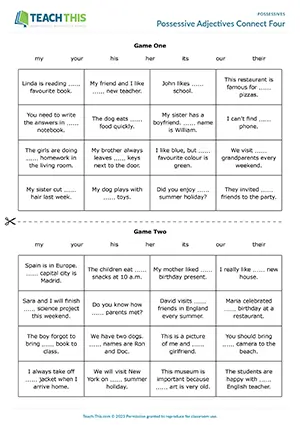
ESL possessive adjectives Game - Grammar: Gap-fill
In this rewarding possessive adjectives game, students play Connect Four by completing sentences with my, your, his, her, its, our and their. Players take turns choosing a square and completing the sentence with an appropriate possessive...
ESL possessive adjectives Game - Grammar: Gap-fill In this rewarding possessive adjectives game, students play Connect Four by completing sentences with my, your, his, her, its, our and their. Players take turns choosing a square and completing the sentence with an appropriate possessive adjective, e.g. 'James is driving his car.' The third student checks the answer sheet. If the possessive adjective is correct, the player marks the square with an 'O' or an 'X' accordingly. It is then the other player's turn to choose a square. The first player to get four squares in a row wins the game. If that is not possible, the player with the most squares wins. When a group has finished, they play Game Two and the students swap roles, giving the third student a chance to play.This is your worksheet

ESL possessive adjectives Worksheet - Grammar Exercises: Matching, Labelling, Underlining, Gap-fill, Unscrambling
This comprehensive possessive adjectives worksheet helps students learn and practice a variety of possessive adjectives. First, students match sentence halves together and then underline the...
ESL possessive adjectives Worksheet - Grammar Exercises: Matching, Labelling, Underlining, Gap-fill, Unscrambling This comprehensive possessive adjectives worksheet helps students learn and practice a variety of possessive adjectives. First, students match sentence halves together and then underline the possessive adjective in each sentence. Next, students complete a table with the possessive adjectives. Students then underline the correct words in sentences. After that, students complete sentences with the correct possessive adjectives. Students then move on to put words in the correct order to create sentences, adding a possessive adjective to each sentence. Lastly, students complete each sentence using a suitable possessive adjective and a noun from a box.What's your favourite...?

ESL possessive adjectives Game - Speaking and Writing Activity: Writing Short Answers, Asking and Answering Questions, Writing Sentences
In this fun possessive adjectives game, students play a true or false guessing game about favourites to practice the possessive adjectives: my, your, his...
ESL possessive adjectives Game - Speaking and Writing Activity: Writing Short Answers, Asking and Answering Questions from Prompts, Writing Sentences In this fun possessive adjectives game, students play a true or false guessing game about favourites to practice the possessive adjectives: my, your, his and her. First, students write answers about their favourites, making five answers true and five false. In pairs, students then take it in turns to ask and answer questions about their favourites using the possessive adjectives 'my' and 'your', e.g. 'What's your favourite place?' The student who asked the question then decides if their partner is lying or telling the truth. The correct answer is revealed, and the student makes a note of the answer. Students score one point for each correct guess. The student with the most points at the end wins. Afterwards, students write sentences about their partner's favourites using the possessive adjectives 'his' or 'her', e.g. 'Her favourite place is the beach'. Finally, students tell a new partner or the class about their partner's favourites using the possessive adjectives 'his' or 'her'.Accurate Apostrophes

ESL Apostrophe Games - Grammar and Speaking: Matching, Forming Sentences, Freer Practice
In these two entertaining apostrophe games, students make nouns possessive by adding an apostrophe or apostrophe+s. Each student stands up with an apostrophe card and an apostrophe+s card...
ESL Apostrophe Games - Grammar and Speaking: Matching, Forming Sentences from Prompts, Freer Practice In these two entertaining apostrophe games, students make nouns possessive by adding an apostrophe or apostrophe+s. Each student stands up with an apostrophe card and an apostrophe+s card. Students then play a game where they listen to nouns and hold up the correct possessive ending card to make the noun possessive. If any students hold up the wrong card, they sit down and are out of the game. The last student left standing is the winner. After that, in two teams, one player from each team comes to the front of the class and stands in front of an apostrophe card and apostrophe+s card. Call out a singular or plural noun at random. The first player to grab the correct possessive ending card to make the noun possessive scores a point for their team. The winning player then tries to make a sentence using the possessive noun. If the player does this successfully, their team scores an extra point. Students then take it in turns to come to the front of the class and play for their team. The team with the most points at the end of the game wins.Happy Families
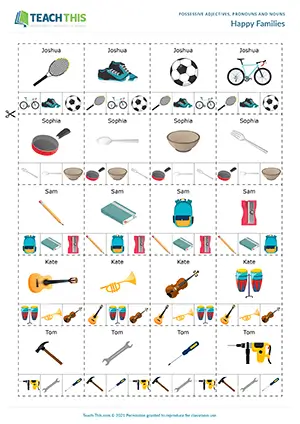
ESL possessive Nouns Game - Grammar and Speaking: Asking and Answering Questions, Freer Practice
In this productive possessive nouns game, students play a Happy Families card game to practice possessive nouns. Each card contains a picture of an object and the name of the person who the item...
ESL possessive Nouns Game - Grammar and Speaking: Asking and Answering Questions, Freer Practice In this productive possessive nouns game, students play a Happy Families card game to practice possessive nouns. Each card contains a picture of an object and the name of the person who the item belongs to. There are also three small pictures at the bottom which are the other items the student needs to collect to complete the set. Students collect cards by taking it in turns to ask another group member for an item belonging to the set they want to collect, e.g. 'Do you have / Have you got Joshua's tennis racket?' If the group member has the card, they give it to the student. The student then gives the group member one of their unwanted cards in return, so students always have five cards. If the group member doesn't have the card, play passes to the next student. Students continue in this way until someone has collected a set of four cards. That student wins the round and scores a point. The students then shuffle the cards and deal them out again and so on. The student with the most points at the end of the game is the winner.possessive adjectives and Pronouns
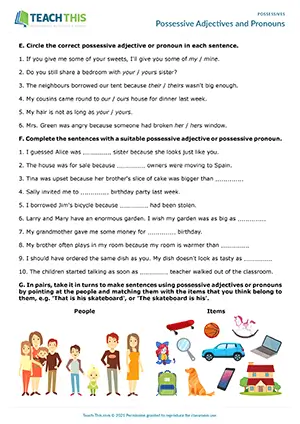
ESL possessive adjectives and Pronouns Worksheet - Vocabulary and Grammar Exercises: Binary Choice, Gap-fill - Speaking Activity: Forming Sentences
This useful possessives worksheet helps students learn and practice possessive adjectives and pronouns. Students begin by completing a table with...
ESL possessive adjectives and Pronouns Worksheet - Vocabulary and Grammar Exercises: Binary Choice, Gap-fill - Speaking Activity: Forming Sentences This useful possessives worksheet helps students learn and practice possessive adjectives and pronouns. Students begin by completing a table with missing possessive adjectives and pronouns. Next, students circle the correct words to complete the grammar rules for using possessive adjectives and possessive pronouns. Students then complete sentences with the correct possessive adjectives and possessive pronouns. Students then move on to circle the correct possessive adjective or pronoun for each sentence shown. Next, students complete sentences with a suitable possessive adjective or possessive pronoun. Lastly, in pairs, students take it in turns to make sentences using possessive adjectives or pronouns by pointing at the people and matching them with the items that they think belong to them, e.g. 'That is his skateboard', or 'The skateboard is his'.possessive Nouns and Pronouns
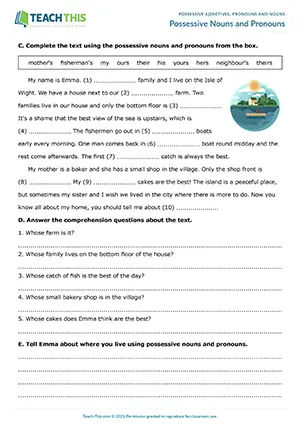
ESL possessive Nouns and Pronouns Worksheet - Grammar Exercises: Rewriting, Gap-fill, Answering Comprehension Questions, Writing Sentences
In this insightful possessives worksheet, students practice possessive nouns and possessive pronouns. Students begin by writing the correct...
ESL possessive Nouns and Pronouns Worksheet - Grammar Exercises: Rewriting Phrases, Gap-fill, Answering Reading Comprehension Questions, Writing Sentences In this insightful possessives worksheet, students practice possessive nouns and possessive pronouns. Students begin by writing the correct possessive noun using 's or s'. Next, students fill in gaps in sentences with the correct possessive pronoun. After that, students complete a text using possessive nouns and pronouns from a box and answer comprehension questions about the text. Finally, students write about where they live in response to the text using possessive nouns and pronouns.possessive Pronoun Race

ESL possessive Pronouns Game - Grammar: Matching, Sentence Completion
In this fast-paced possessive pronouns game, students race to complete sentences with possessive pronouns. Students take it in turns to pick up a sentence card and read it to the other two students. The students listen to the sentence and then race...
ESL possessive Pronouns Game - Grammar: Matching, Sentence Completion In this fast-paced possessive pronouns game, students race to complete sentences with possessive pronouns. Students take it in turns to pick up a sentence card and read it to the other two students. The two students listen to the sentence and then race to grab the correct possessive pronoun card to finish the sentence. The first student to grab the correct card and say the possessive pronoun wins and keeps the two cards. The student with the most cards at the end of the game wins.possessive Pronouns
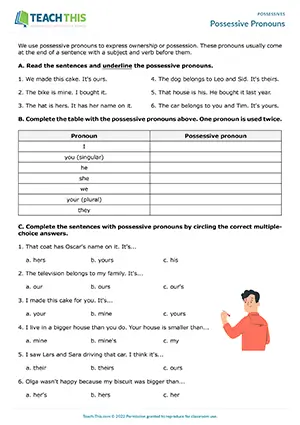
ESL possessive Pronouns Worksheet - Grammar Exercises: Identifying, Multiple Choice, Table and Sentence Completion, Rewriting Sentences, Unscrambling
In this free possessive pronouns worksheet, students practice the possessive pronouns: mine, yours, his, hers, ours, yours, theirs. First, students read...
ESL possessive Pronouns Worksheet - Grammar Exercises: Identifying, Multiple Choice, Table and Sentence Completion, Rewriting Sentences, Unscrambling In this free possessive pronouns worksheet, students practice the possessive pronouns: mine, yours, his, hers, ours, yours, theirs. First, students read sentences and underline the possessive pronoun in each one. Students then write possessive pronouns in a table. Next, students complete sentences with possessive pronouns by circling the correct multiple-choice answers. Students then move on to complete each sentence with the correct possessive pronoun. After that, students rewrite sentences to include possessive pronouns. Lastly, students put words in the correct order to create sentences, adding a suitable possessive pronoun.Whose is it?
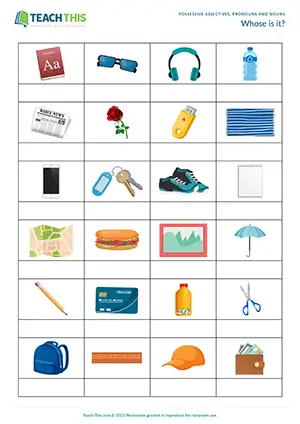
ESL possessive Pronouns Game - Speaking: Labelling, Forming Sentences
In this enjoyable possessive pronouns speaking activity, students play a memory game to practice possessive pronouns. Give each student a picture of an object and each pair a picture to share. The students then play a memory game where...
ESL possessive Pronouns Game - Speaking: Labelling, Forming Sentences from Prompts In this enjoyable possessive pronouns speaking activity, students play a memory game to practice possessive pronouns. Give each student a picture of an object and each pair a picture to share. The students then play a memory game where they try to remember who owns what object. Students go around the class telling each other the object they have, including the object they share with their partner. Students then join back up with their partner and try to remember who owns which object by writing the name of the person under the corresponding picture on their worksheet. Students then use the information to make sentences with possessive pronouns, e.g. 'The dictionary is his'. 'The sunglasses are mine'. 'The MP3 player is hers', etc. Each object is then called out in turn. The first pair to make a correct statement with a possessive pronoun scores a point. The pair with the most points at the end of the game wins.Correct it
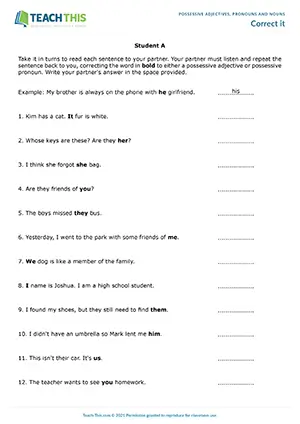
ESL possessive adjectives and Nouns Game - Grammar: Error Correction
In this handy possessive adjectives and nouns error correction game, students correct sentences by changing subject pronouns to possessive adjectives or object pronouns to possessive pronouns. The sentences on the worksheet contain errors...
ESL possessive adjectives and Nouns Game - Grammar: Error Correction In this handy possessive adjectives and nouns error correction game, students correct sentences by changing subject pronouns to possessive adjectives or object pronouns to possessive pronouns. The sentences on the worksheet contain errors. There are subject pronouns where the possessive adjectives should be and object pronouns where the possessive pronouns should be. The students' task is to take it in turns to read a sentence to their partner and have them correct the mistake. Their partner listens to the sentence and repeats it back to their classmate, correcting it with either a possessive adjective or possessive pronoun. The student then writes their partner's answer in the space provided. The first pair of students to complete all the answers correctly wins.Who does this belong to?

ESL possessives Activity - Speaking: Reading, Listening, Summarizing, Matching
In this creative possessives speaking activity, students practice language for talking about possessions. Students take it in turns to read the text on their biography card to the other group members who listen and summarize the important facts on their...
ESL possessives Activity - Speaking: Reading, Listening, Summarizing, Matching In this creative possessives speaking activity, students practice language for talking about possessions. Students take it in turns to read the text on their biography card to the other group members who listen and summarize the important facts on their summary cards. Next, students take it in turns to give an object to the student with the matching biography card, explaining the reason for their choice, e.g. 'I think this is Richard's laptop because...' or 'This laptop belongs to Richard because...' When the students have placed all the cards, they are told that there should be three objects for each person. Students then review each person's belongings and make any necessary changes. When the groups have finished, they explain how they divided the possessions and why. Afterwards, review the correct answers with the class. As an extension, in their groups, each student writes down three of their favourite possessions on slips of paper and passes them to another group, who uses the target language to guess who wrote each possession and why.Here's what our members are saying...
- Noun Phrases
-
Noun Phrases ESL Games & Activities
A Fun but Challenging Game

ESL Noun Phrases Game - Grammar and Vocabulary: Matching, Gap-fill - Group Work
In this engaging noun phrases game, students complete sentences by creating noun phrases with adjective pairs and 'but'. Teams take turns picking up a noun card and placing it face up on the table, e.g. town. That team then has one minute to...
ESL Noun Phrases Game - Grammar and Vocabulary: Matching, Gap-fill - Group Work In this engaging noun phrases game, students complete sentences by building noun phrases with adjective pairs joined by 'but'. Teams take turns picking up a noun card and placing it face up on the table, e.g. town. That team has one minute to choose a sentence where they think the noun belongs and form a noun phrase using one of the adjective pairs with 'but' between the adjectives. The other team checks the completed sentence. If they agree it is correct, the team scores one point. The team then writes the noun phrase in the sentence, e.g. 'It's in a remote but charming town called Aliston...'If the other team thinks it is incorrect, the team subtracts one point and returns the noun card to the bottom of the pile. It's then the other team's turn to play. The game continues until all the sentences have been completed. The team with the most points wins the game.Noun Phrase Pelmanism
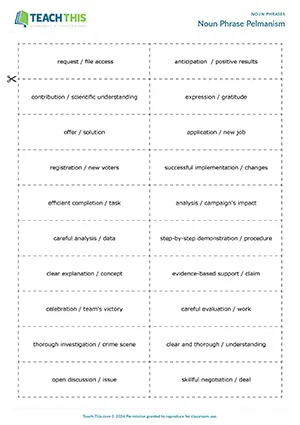
ESL Noun Phrases Game - Vocabulary and Speaking: Matching, Pelmanism, Forming Phrases - Pair Work
In this productive noun phrases game, students match verb phrases to prompts from which they form noun phrases. In pairs, students take turns turning over one verb phrase card and one noun...
ESL Noun Phrases Game - Vocabulary and Speaking: Matching, Pelmanism, Forming Phrases from Prompts - Pair Work In this productive noun phrases game, students match verb phrases to prompts from which they form noun phrases. In pairs, students take turns turning over one verb phrase card and one noun phrase prompt card. If the verb phrase matches the noun phrase prompt (e.g. 'She requested access to the files' and 'request/file access'), the student reads the verb phrase card aloud and then uses the prompt card to form a noun phrase, e.g. 'Her request for file access.' If the other student agrees that the noun phrase is correct and matches the verb phrase, the student keeps both cards and has another turn. If the two cards don't match, the student turns them back over, keeping them in the same place. There are 20 verb phrase and noun phrase pairs in total. The student with the most pairs of cards at the end of the game wins.Reforming Race

ESL Noun Phrases Game - Grammar, Vocabulary and Speaking: Reforming Sentences, Controlled and Freer Practice - Pair Work
In this free noun phrases game, students practice changing verb phrases in sentences to noun phrases. In pairs, students take turns picking up a card and...
ESL Noun Phrases Game - Grammar, Vocabulary and Speaking: Reforming Sentences, Controlled and Freer Practice - Pair Work In this free noun phrases game, students practice changing verb phrases in sentences to noun phrases. In pairs, students take turns picking up a card and reading out the top sentence on the card to the other student, e.g. 'The little girl was obviously pleased to receive a new bicycle for Christmas.' The other student then tries to change the sentence by replacing the verb phrase with a noun phrase, retaining the original meaning, e.g. 'The little girl's pleasure at receiving a new bicycle for Christmas was obvious.' If the student successfully manages to say the sentence written at the bottom of the card or a similarly accurate sentence, they move their counter ahead one space diagonally. If the student is unable to form a correct sentence, they stay where they are. The two students then swap roles. The first student to reach the finish wins the game.Wayne and Wendy's Wonderful Wedding
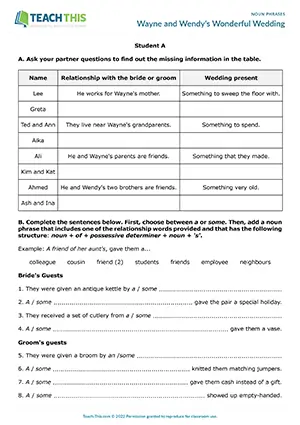
ESL Noun Phrases Activity - Grammar and Vocabulary: Information Gap, Asking and Answering Questions, Table and Sentence Completion - Pair Work
Here is a useful noun phrases activity to help students practice double possessive noun phrases with possessive determiners. First, students ask their partner...
ESL Noun Phrases Activity - Grammar and Vocabulary: Information Gap, Asking and Answering questions, Table and Sentence Completion - Pair Work Here is a useful noun phrases activity to help students practice double possessive noun phrases with possessive determiners. First, students ask their partner for information about guests at a wedding and complete a table with their answers. When both students have completed the table, students work alone to complete sentences using the relationship word bank and the required noun phrase structure. Afterwards, check the correct answers with the class.Here's what our members are saying...
- Family and Relationships
-
Family & Relationships ESL Activities, Worksheets & Games
Family Battleships
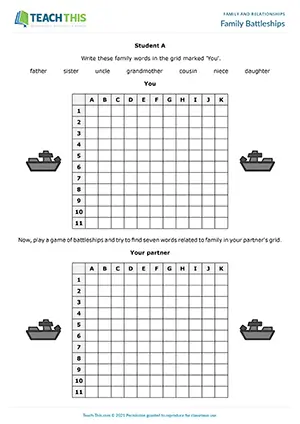
ESL Family Vocabulary Game - Vocabulary: Battleships - Pair Work
In this enjoyable family vocabulary game, students play battleships to practice vocabulary related to family. Students begin by writing seven family words on their grid. Students then play a game of battleships where they have to find...
ESL Family Vocabulary Game - Vocabulary: Battleships - Pair Work In this enjoyable family vocabulary game, students play battleships to practice vocabulary related to family. Students begin by writing seven family words on their grid. Students then play a game of battleships where they have to find seven family-related words on their partner's grid. Students take it in turns to call out coordinates from their partner's grid on the worksheet. If their partner has a letter in that square, they say 'hit' and tell the student the letter. The student then writes the letter in the grid and has another turn. If their partner doesn't have a letter in that square, they say 'miss'. The student then draws an X in the grid and play passes to their partner. The first student to find all seven family words wins the game.Family and Relationships Bingo

ESL Family and Relationships Game - Vocabulary: Bingo, Matching - Group Work
In this fun family and relationships vocabulary game, students play bingo by listening to definitions and matching them to family and relationship words. In groups, the bingo caller reads a definition at random from the caller's sheet. The other students...
ESL Family and Relationships Game - Vocabulary: Bingo, Matching - Group Work In this fun family and relationships vocabulary game, students play bingo by listening to definitions and matching them to family and relationship words. In groups, the bingo caller reads a definition at random from the caller's sheet. The other students listen and look at the family and relationship words on their bingo cards to see if they have a word that matches the definition. If they do, they cross it off. The game continues until a student has crossed off four words in a row. When this happens, the student shouts 'Bingo!' and then reads out the family and relationship words they crossed off. If the words match the definitions that were read out, the student wins the round. Students then continue to see who can cross off all 16 words. Groups play several rounds, with students taking turns to be the bingo caller and with players using a different bingo card each time.Relationships Match

ESL Family and Relationships Games - Vocabulary: Matching, Describing, Guessing - Group Work
Here are two entertaining family and relationship games to help students practice vocabulary related to family and relationships. First, students play a game of dominoes where they complete a...
ESL Family and Relationships Games - Vocabulary: Matching, Describing, Guessing - Group Work Here are two entertaining family and relationship games to help students practice vocabulary related to family and relationships. First, students play a game of dominoes where they complete a sentence with a family or relationship word by placing a domino down either before or after the domino on the table. If the word matches the sentence, the player reads the sentence to the group to show the match is correct. The next player then tries to put down one of their dominoes at either end of the domino chain, and so on. The first player to get rid of all their dominoes wins the game. Next, students play a describing game to practice the vocabulary. Students take turns picking up a card and describing the family or relationship word in the grey square to the other students, who have 30 seconds to guess and say the word. If a student successfully guesses the word, they win and keep the card. If no one manages to guess the word, the card is removed from the game. The student with the most cards at the end of the game wins.Relationship Vocabulary Practice

ESL Family and Relationships Worksheet - Vocabulary Exercises: Matching, Categorising, Unscrambling, Gap-fill
This free family worksheet helps elementary students learn and practice basic family and relationship words. To start, students match family and relationship vocabulary from a box to pictures. Students then...
ESL Family and Relationships Worksheet - Vocabulary Exercises: Matching, Categorising, Unscrambling, Gap-fill This free family worksheet helps elementary students learn and practice basic family and relationship words. To start, students match family and relationship vocabulary from a box to pictures. Students then categorize the family and relationship words into people inside and outside the home. After that, students match the relationship vocabulary to definitions. Students then move on to reorder words to make sentences. In the last exercise, students complete sentences with the family and relationship words from the worksheet.Family Races
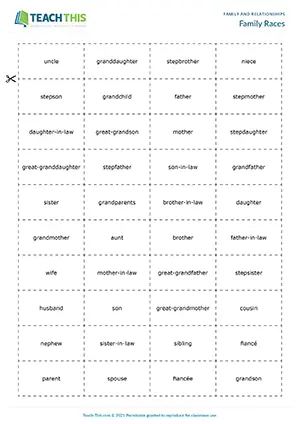
ESL Family Games - Vocabulary: Spelling, Matching, Identifying, Describing, Guessing - Group Work
These engaging family vocabulary games help students learn and practice a wide variety of family-related vocabulary. The games consist of a spelling relay, a board race and a describing game...
ESL Family Games - Vocabulary: Spelling, Matching, Identifying, Describing, Guessing - Group Work These engaging family vocabulary games help students learn and practice a wide variety of family-related vocabulary. The games consist of a spelling relay, a board race and a describing game. In the spelling relay, two teams line up in front of the board. Show a family word card to the student at the back of each line. These students write the family-related word with their fingers on the back of the person in front of them. The word is written on the back of the next student and so on down the line until it reaches the student at the front. That student writes the word on the board. The first team to write the correct word on the board scores a point. In the family board race game, students listen to descriptions of family words and race to the board to grab the card that matches with the description. The first student to pick the right card scores a point for their team. In the describing game, students take it in turns to describe a family word on a card to their respective teams, e.g. 'Your mother's brother is your...' The first team to correctly guess the family word (e.g. uncle) wins and scores a point.Family Time!

ESL Family Vocabulary Worksheet - Vocabulary Exercises: Gap-fill, Identifying, Matching, Writing Sentences
This comprehensive family worksheet helps students to learn and practice words that describe families and relationships. Students begin with a gap-fill exercise where they complete a text about...
ESL Family Vocabulary Worksheet - Vocabulary Exercises: Gap-fill, Identifying, Matching, Writing Sentences This comprehensive family worksheet helps students to learn and practice words that describe families and relationships. Students begin with a gap-fill exercise where they complete a text about a family using vocabulary from a box. Students then circle the correct word or phrase in sentences to describe the family relationships in the text. Next, students read descriptions and write the name of the person each description is about. In the last exercise, students write sentences using the vocabulary from the worksheet to describe their own family relationships or those of a family they know.The Watanabe Family

ESL Family Tree Activity - Vocabulary and Speaking: Asking and Answering Questions, Labelling - Pair Work
In this memorable family tree speaking activity, students practice family vocabulary by completing a family tree. In two groups, students look at the family tree and complete sentences on their worksheet...
ESL Family Tree Activity - Vocabulary and Speaking: Asking and Answering Questions from Prompts, Labelling - Pair Work In this memorable family tree speaking activity, students practice family vocabulary by completing a family tree. In two groups, students look at the family tree and complete sentences on their worksheet. Students then pair up with someone from the other group and take it in turns to ask and answer questions in order to complete their family tree. Student A starts by asking 'Who is Jin?' Student B uses the completed sentences from the first exercise to answer the question, e.g. 'Jin is Aiko's cousin and Akira's niece'. Student A then writes the name in the appropriate place on the family tree. Students continue asking and answering the questions until they have both completed their family trees.We Are Family
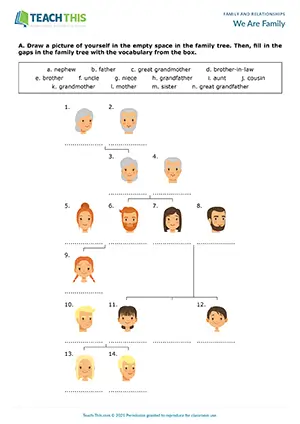
ESL Family Tree Worksheet - Vocabulary Exercises: Labelling, Writing Short Answers, Categorising, Word Search
This rewarding family tree worksheet helps students learn and practice family vocabulary. First, students draw a picture of themselves in an empty space in a family tree. Students then fill in gaps in the family tree...
ESL Family Tree Worksheet - Vocabulary Exercises: Labelling, Writing Short Answers, Categorising, Word Search This rewarding family tree worksheet helps students learn and practice family vocabulary. First, students draw a picture of themselves in an empty space in a family tree. Students then fill in gaps in the family tree with vocabulary from a box. Next, students answer possessive questions about the names of family members. After that, students sort alternative words for family members into their correct categories. Finally, students do a word search where they locate family words from the worksheet.A Family Picnic
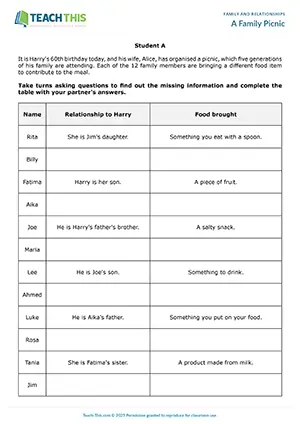
ESL Family Activity - Reading and Vocabulary: Information Gap, Table Completion, Unscrambling, Gap-fill - Pair Work
Here is a useful family vocabulary activity to help students practice words related to family relations. First, in pairs, students do an information gap activity...
ESL Family Activity - Reading and Vocabulary: Information Gap, Table Completion, Unscrambling, Gap-fill - Pair Work Here is a useful family vocabulary activity to help students practice words related to family relations. First, in pairs, students do an information gap activity where they take turns asking questions about a family picnic and completing a table with their partner's answers. Students then unscramble letters to form family relations vocabulary. After that, students work with their partner and race to use the information in the table to complete sentences with the family relations vocabulary and food words in a box. The first pair to finish wins. Afterwards, check the correct answers with the class.Family and Relationships Crossword

ESL Family Crossword - Vocabulary Activity: Writing Clues, Describing, Guessing - Pair and Group Work
In this handy family crossword activity, students complete a crossword by describing and guessing words related to family and relationships. In two groups, students invent and write down clues...
ESL Family Crossword - Vocabulary Activity: Writing Clues, Describing, Guessing - Pair and Group Work In this handy family crossword activity, students complete a crossword by describing and guessing words related to family and relationships. In two groups, students invent and write down clues for the family and relationship vocabulary written on their crossword. Next, students pair up with someone from the other group and take it in turns to ask their partner for a clue to one of their missing words. Their partner reads out the clue and the other student tries to guess the family or relationship word. If the student guesses the word successfully, they write it on their crossword. If not, their partner continues to give more clues until the student is able to guess the word. When the students have finished, they check their spelling by comparing crosswords.Family Tree

ESL Family Tree Activity - Vocabulary and Speaking: Asking and Answering Questions, Identifying, Labelling - Pair Work
In this free family tree speaking activity, students practice family vocabulary and possessives by working together to complete a family tree. The students' task is to complete a family tree by...
ESL Family Tree Activity - Vocabulary and Speaking: Asking and Answering Questions from Prompts, Identifying, Labelling - Pair Work In this free family tree speaking activity, students practice family vocabulary and possessives by working together to complete a family tree. The students' task is to complete a family tree by asking their partner about the people on the worksheet, e.g. 'Who's Isabella?' Their partner answers by explaining how the people in the family tree are related to each other, e.g. 'Isabella is Liam's grandmother and Jacob's mother'. The other student then completes the family tree with the information. When the students have finished, they swap worksheets and exchange roles. This gives both students a chance to ask the questions and helps to confirm the answers. Afterwards, the two students identify where a missing family member is on the family tree and complete sentences about how the person is related to the other family members. The first pair to complete the sentences correctly wins.It Runs in the Family

ESL Family Activities - Vocabulary and Speaking: Running Dictation, Matching, Asking and Answering Questions, Freer Practice - Pair and Group Work
Here is an interesting family members speaking activity to help students practice family relations vocabulary. First, students take part in a running...
ESL Family Activities - Vocabulary and Speaking: Running Dictation, Matching, Asking and Answering Questions, Freer Practice - Pair and Group Work Here is an interesting family members speaking activity to help students practice family relations vocabulary. First, students take part in a running dictation. Student A is the writer, and Student B is the reader. Student B runs to 'Set A', reads the first family member definition, remembers it, runs back, and dictates it to their partner, who writes it down. This continues until the five definitions have been dictated. Students then swap roles for 'Set B' and repeat the process. Afterwards, pairs match each definition with two words from a box, one for a male family member and one for a female. The first pair to correctly match all the family relations vocabulary wins. Next, students take part in a speaking activity where they ask yes/no questions to guess which family member they are. A family member card is stuck to each student's back. Students then go around asking yes/no questions to their classmates who respond 'yes' or 'no' accordingly. After asking a few questions, students guess which family member they are. If students guess correctly, they remove the card from their back. If not, their classmates give them additional clues until they are able to guess the family member.Keep it in the Family

ESL Family Game - Vocabulary and Speaking: Describing, Defining, Guessing - Group Work
In this fun family vocabulary game, students describe and define nouns, adjectives, adjective-noun collocations, phrasal verbs and idioms related to family. In groups, students take it in turns...
ESL Family Game - Vocabulary and Speaking: Describing, Defining, Guessing - Group Work In this fun family vocabulary game, students describe and define nouns, adjectives, adjective-noun collocations, phrasal verbs and idioms related to family. In groups, students take it in turns to pick up a card and describe the family-related word or phrase to the other students, e.g. 'It's a noun. It means the son or daughter of an uncle or aunt'. The other students listen to the description and try to guess the answer, i.e. cousin. The first student to guess correctly wins and keeps the card. The student with the most cards at the end of the game is the winner.Match Up
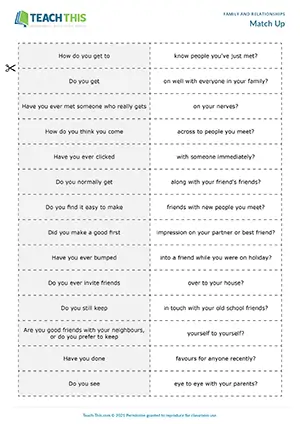
ESL Family Phrasal Verbs and Idioms Activity - Vocabulary and Speaking: Pelmanism, Forming, Asking and Answering Questions, Discussion - Group Work
In this insightful family phrasal verbs and idioms game and discussion activity, students form and ask questions containing phrasal verbs and idioms related to...
ESL Family Phrasal Verbs and Idioms Activity - Vocabulary and Speaking: Pelmanism, Forming, Asking and Answering Questions, Guided Discussion - Group Work In this insightful family phrasal verbs and idioms game and discussion activity, students form and ask questions containing phrasal verbs and idioms related to family and relationships. Students begin by playing a pelmanism game where they form questions by completing phrasal verbs and idioms. In groups, students take turns turning over one card from each set. If the two cards match to make a question, the student keeps the cards and has another turn. If not, the student turns them back over. The student with the most cards at the end of the game wins. Next, students take it in turns to ask the questions on their cards to the other group members and discuss the answers. When the students have finished, they report back to the class on what they found out.Relationship Phrasal Verbs

ESL Relationship Phrasal Verbs Worksheet - Vocabulary, Writing and Reading Exercises: Gap-fill, Sentence Completion - Speaking Activity: Discussion - Pair Work
This productive relationship phrasal verbs worksheet helps students practice phrasal verbs that are commonly used to talk about relationships. First...
ESL Relationship Phrasal Verbs Worksheet - Vocabulary, Writing and Reading Exercises: Gap-fill, Sentence Completion - Speaking Activity: Discussion - Pair Work This productive relationship phrasal verbs worksheet helps students practice phrasal verbs that are commonly used to talk about relationships. First, students complete sentences with prepositions from a box to create phrasal verbs related to relationships. Students then complete sentences with the prepositions and their own ideas. Next, students read three texts and answer questions, matching each question to a person from the texts. Finally, with a partner, students discuss two people's respective situations from the text and come up with some useful tips to help them deal with their broken relationships.Here's what our members are saying...


