
- Relative Clauses
-
relative clauses ESL Games, Worksheets & Activities
Defining relative clauses Practice
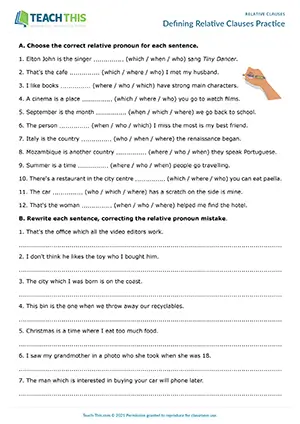
ESL Defining relative clauses Worksheet - Grammar Exercises: Gap-fill, Multiple Choice, Error Correction, Writing Sentences, Rewriting Sentences
This free defining relative clauses worksheet helps students practice defining relative clauses with who, which, where and when. First, students complete...
ESL Defining relative clauses Worksheet - Grammar Exercises: Gap-fill, Multiple Choice, Error Correction, Writing Sentences, Rewriting Sentences This free defining relative clauses worksheet helps students practice defining relative clauses with who, which, where and when. First, students complete each defining relative clause with the correct relative pronoun in brackets. Next, students rewrite defining relative clauses, correcting the relative pronoun mistakes. Students then write definitions for places, things, times and people using defining relative clauses, e.g. 'A kitchen is a room where people store and cook food.' Lastly, students rewrite sentences, combining them together with defining relative clauses.Fold your Arms
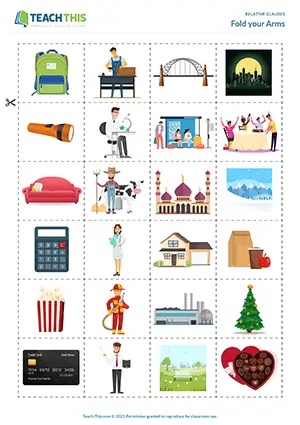
ESL Defining relative clauses Game - Grammar and Speaking: Describing, Forming Sentences, Guessing, Freer Practice - Group Work
In this fun defining relative clauses game, students describe pictures of objects, people, places and times with defining relative clauses. In groups, students...
ESL Defining relative clauses Game - Grammar and Speaking: Describing, Forming Sentences, Guessing, Freer Practice - Group Work In this fun defining relative clauses game, students describe pictures of objects, people, places and times with defining relative clauses. In groups, students take turns to pick up a card, look at the picture, place the card face-down and fold their arms. The student then describes the object, person, place or time to the other students using defining relative clauses. When describing pictures, students must keep their arms folded. This is to stop them from miming or using gestures. Students are also not allowed to say the name of the object, person, place or time or use variations of the word. The first student to guess the word wins and keeps the card. The student with the most cards at the end of the game wins.I didn't know that!
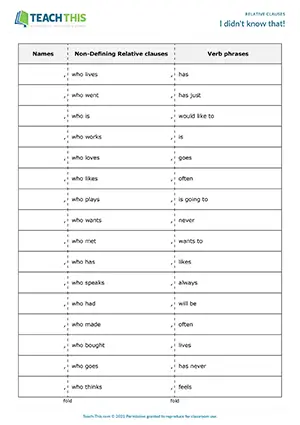
ESL Non-Defining relative clauses Activity - Grammar: Sentence Completion, Guessing, Error Correction, Reforming Sentences - Group Work
In this creative non-defining relative clauses activity, students write imaginary information about their classmates using non-defining relative clauses with 'who'...
ESL Non-Defining relative clauses Activity - Grammar: Sentence Completion, Guessing, Error Correction, Reforming Sentences - Group Work In this creative non-defining relative clauses activity, students write imaginary information about their classmates using non-defining relative clauses with 'who'. First, students write down the names of everyone in their group in the first column of the worksheet. Students then sit in a circle and fold their worksheet so only the 'Non-Defining relative clauses' column is showing and give it to the person on their right, who completes the first non-defining relative clause with 'who' any way they like. Students then pass the worksheet to the person on their right who completes the next relative clause. This procedure is repeated until all the non-defining relative clauses with 'who' have been completed. After that, students do the same with the ‘Verb phrases’ column. When the students have finished, they open out their completed worksheets and read the sentences, correcting any mistakes. Finally, students read their sentences to the group. The student, who is the subject of each sentence, says whether the information is true or not, correcting the sentence to make it true if need be.Keep it going!
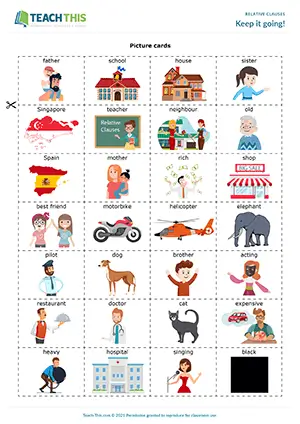
ESL Non-Defining relative clauses Game - Grammar and Speaking: Matching, Forming clauses, Freer Practice - Group Work
In this challenging non-defining relative clauses game, students extend a sentence with non-defining relative clauses to make the longest sentence possible. The first player chooses one of their picture...
ESL Non-Defining relative clauses Game - Grammar and Speaking: Matching, Forming clauses, Freer Practice - Group Work In this challenging non-defining relative clauses game, students extend a sentence with non-defining relative clauses to make the longest sentence possible. The first player chooses one of their picture cards and begins a sentence about the picture, e.g. 'My father...' The players then take turns to add additional information to the sentence by adding a non-defining relative clause with a picture card or adding an appropriate relative pronoun. If the next player puts down a relative pronoun card (e.g. who), the player after must put down a picture card (e.g. pilot) and add a non-defining relative clause as the next part of the sentence. For example, 'My father, who is a pilot,...' If the next player puts down a picture card (e.g. Singapore), they say the next part of the sentence. For example, 'works in Singapore.' The following player must put down an appropriate relative pronoun card to extend the sentence, e.g. 'My father, who is a pilot, works in Singapore, where...' Players write the sentence down as they go. The group with the longest grammatically correct sentence at the end of the game wins.relative Clause Bingo
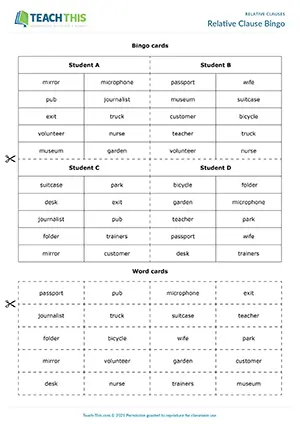
ESL Defining relative clauses Game - Grammar and Speaking: Forming Sentences, Guessing, Freer Practice - Group Work
In this engaging defining relative clauses game, students play bingo by describing people, places and things using defining relative clauses. In groups, students take turns picking up a word card...
ESL Defining relative clauses Game - Grammar and Speaking: Forming Sentences, Guessing, Freer Practice - Group Work In this engaging defining relative clauses game, students play bingo by describing people, places and things using defining relative clauses. In groups, students take turns picking up a word card and describing the person, place or thing on the card using a defining relative clause, e.g. 'It is a place where...' The other students in the group try to guess the word. When the word has been guessed, the students who have the word on their bingo card cross it off. The next student then picks up a word card, and so on. The first student to cross off all the words on their card shouts 'Bingo!' and wins the game.What's the Word?
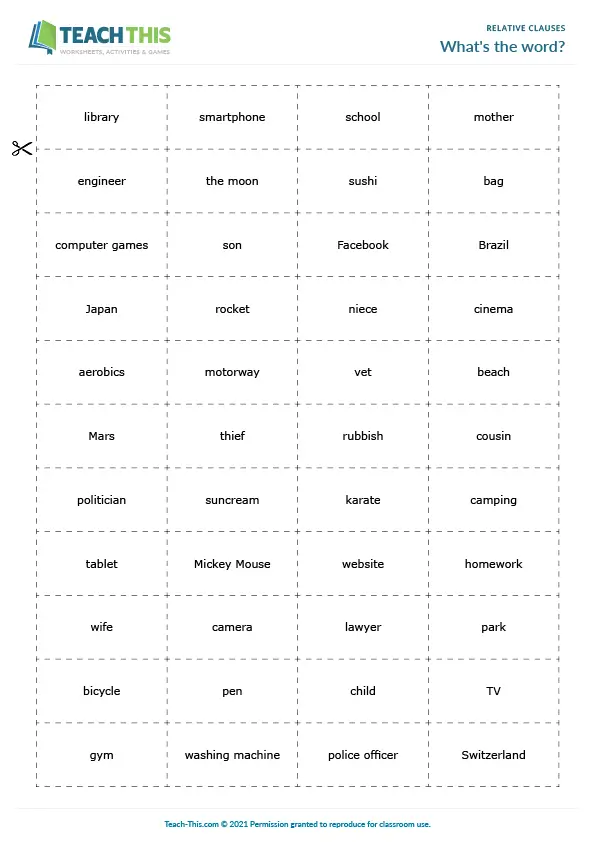
ESL Defining relative clauses Game - Grammar and Speaking: Describing, Forming Sentences, Guessing - Group Work
Here is an entertaining relative clauses game to help students practice defining relative clauses with who, which and where. In groups, students take turns picking up a word card (e.g. library) and...
ESL Defining relative clauses Game - Grammar and Speaking: Describing, Forming Sentences, Guessing - Group Work Here is an entertaining relative clauses game to help students practice defining relative clauses with who, which and where. In groups, students take turns picking up a word card (e.g. library) and giving definitions of the word using defining relative clauses, e.g. 'It's a place where people read books.' The first group member to guess the word keeps the card. The student with the most cards at the end of the game wins.Who, Which, When, Where
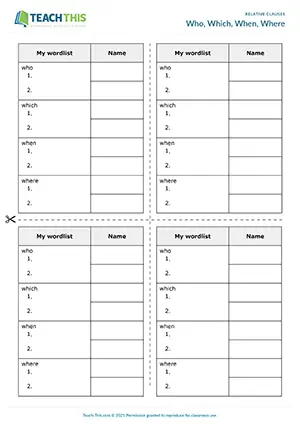
ESL Defining relative clauses Game - Grammar: Writing Sentences, Describing, Guessing - Group Work
In this imaginative defining relative clauses game, students practice describing people, things, places and times with defining relative clauses. Give each student a card containing the relative pronouns who...
ESL Defining relative clauses Game - Grammar: Writing Sentences, Describing, Guessing - Group Work In this imaginative defining relative clauses game, students practice describing people, things, places and times with defining relative clauses. Give each student a card containing the relative pronouns who, which, when, and where. Students then write two words relating to each relative pronoun in the 'My Word List' column on the card. Next, students write descriptions for the words in their word list using defining relative clauses. Afterwards, in groups, students take turns reading a description for a word on their card to the other group members. The first group member to guess the word wins. The student describing the word then writes the name of the person who guessed correctly in the 'Name' column next to the word. This continues until all the words have been guessed. The student who guessed the most words at the end of the game wins.Anita's Strange Day
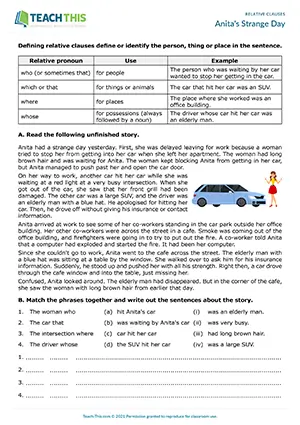
ESL Defining relative clauses Worksheet - Grammar Exercises: Matching, Gap-fill, Rewriting Sentences - Speaking Activity - Discussion - Group Work
Here is a free story-based relative clauses worksheet to help students practice or review defining relative clauses with who, whose, that, which and where...
ESL Defining relative clauses Worksheet - Grammar Exercises: Matching, Gap-fill, Rewriting Sentences - Speaking Activity - Discussion - Group Work Here is a free story-based relative clauses worksheet to help students practice or review defining relative clauses with who, whose, that, which and where. Students start by reading an unfinished story. Students then match phrases together and write out sentences about the story with defining relative clauses. Next, students complete more sentences about the story by choosing the correct relative pronouns. After that, students combine sentences from the story together using relative pronouns. Finally, in groups, students discuss what they think happened next in the story and give possible endings.relative Clause Crossword
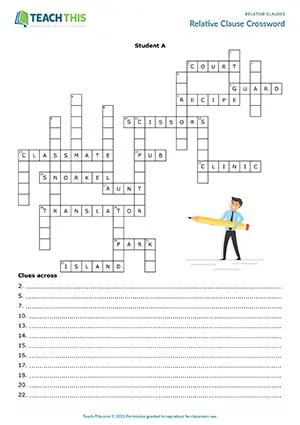
ESL Defining relative clauses Activity - Grammar and Speaking: Writing Clues, Describing, Guessing, Controlled and Freer Practice - Group and Pair Work
In this productive defining relative clauses activity, students practice describing words using defining relative clauses with who, where, which and that...
ESL Defining relative clauses Activity - Grammar and Speaking: Writing Clues, Describing, Guessing, Controlled and Freer Practice - Group and Pair Work In this productive defining relative clauses activity, students practice describing words using defining relative clauses with who, where, which and that. In two groups, students write down definitions for the words on their crossword. Next, students pair up with someone from the other group. Students then take turns asking their partner for a clue to one of the missing words on their crossword. Their partner then defines the word that appears on their half of the crossword using a defining relative clause and the student tries to guess the word. If the student guesses the word successfully, they write it in the crossword. If not, their partner continues to give more clues using defining relative clauses until the student is able to guess the word. When the students have finished, they check their answers and spelling by comparing worksheets.When will I be famous?
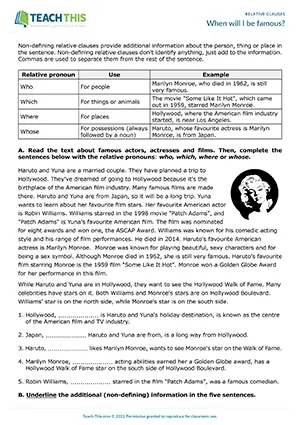
ESL Non-Defining relative clauses Worksheet - Grammar and Reading Exercises: Gap-fill, Identifying, Matching, Rewriting Sentences, Sentence Completion
This useful non-defining relative clauses worksheet helps students practice or review non-defining relative clauses while reading and writing about famous...
ESL Non-Defining relative clauses Worksheet - Grammar and Reading Exercises: Gap-fill, Identifying, Matching, Rewriting Sentences, Sentence Completion This useful non-defining relative clauses worksheet helps students practice or review non-defining relative clauses while reading and writing about famous actors, actresses and films. First, students read an introduction about non-defining relative clauses. Students then read a text about famous actors, actresses and films and complete sentences with non-defining relative pronouns. Next, students underline the additional (non-defining) information in each sentence. After that, students choose phrases to go with sentences and rewrite each sentence using the phrase in a non-defining relative clause. Finally, students use their own ideas to complete sentences with non-defining relative clauses.Word Bluff
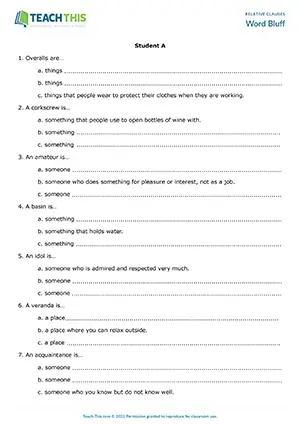
ESL Defining relative clauses Game - Grammar and Speaking: Writing and Reading Sentences, Guessing - Group and Pair Work
In this amusing defining relative clauses game, students invent false definitions for words using defining relative clauses and then guess which definition for a word is correct. The worksheets show the...
ESL Defining relative clauses Game - Grammar and Speaking: Writing and Reading Sentences, Guessing - Group and Pair Work In this amusing defining relative clauses game, students invent false definitions for words using defining relative clauses and then guess which definition for a word is correct. The worksheets show the correct definitions for words. The students' task is to invent two false definitions for each word by completing the defining relative clauses. In two groups, students write their false definitions. Next, students pair up with someone from the other group and play a game where they guess which definition for a word is correct. Students take turns reading out three possible definitions for each word without saying which definition is correct. Their partner then guesses the correct definition. For each correct guess, students score a point. The student with the most points at the end of the game is the winner.Here's what our members are saying...
- Past Perfect Continuous
-
Past Perfect Continuous ESL Worksheets, Games & Activities
Cause and Effect
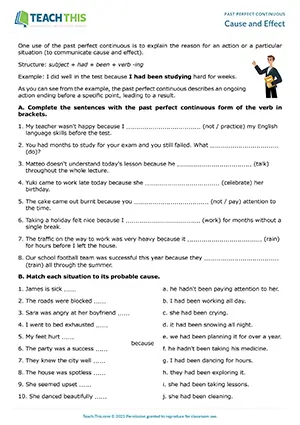
ESL Past Perfect Continuous Worksheet - Grammar and Writing Exercises: Gap-fill, Matching, Writing Sentences, Guessing
In this comprehensive past perfect continuous worksheet, students practice using the past perfect continuous to communicate cause and effect in past situations. First, students complete sentences with...
ESL Past Perfect Continuous Worksheet - Grammar and Writing Exercises: Gap-fill, Changing Word Forms, Matching, Writing Sentences, Guessing In this comprehensive past perfect continuous worksheet, students practice using the past perfect continuous to communicate cause and effect in past situations. First, students complete sentences with the past perfect continuous form of the verbs in brackets. Next, students match situations to their probable causes using 'because' to connect the results on the left to their causes on the right. After that, students answer questions with their own ideas using the negative form of the past perfect continuous. Students then choose three results and write a because-clause for each one explaining the cause using the past perfect continuous. Finally, students swap papers with a partner, read their partner's causes, and guess which results their partner's clauses belong to.How does it end?

ESL Past Simple and Past Perfect Continuous Game - Grammar and Speaking: Matching, Forming Sentences - Group Work
In this free past perfect continuous game, students combine sentence beginnings and endings to explain past results using the past perfect continuous. In groups, players take turns picking up a beginning...
ESL Past Simple and Past Perfect Continuous Game - Grammar and Speaking: Matching, Forming Sentences from Prompts - Group Work In this free past perfect continuous game, students combine sentence beginnings and endings to explain past results using the past perfect continuous. In groups, players take turns picking up a beginning card, reading the first half of the sentence aloud and placing it face up on the table for everyone to see. All the players then race to find a matching ending from the cards on the table. The first player to find the correct ending picks it up and reads it out, putting the verb in brackets in the past perfect continuous form. If the other players agree that the ending matches and is grammatically correct, the player writes the past perfect continuous form of the verb on the ending card and keeps the two cards. If not, the player is out of the round and the other players continue looking for the correct ending. The player with the most cards at the end of the game is the winner.Michael had been wondering...
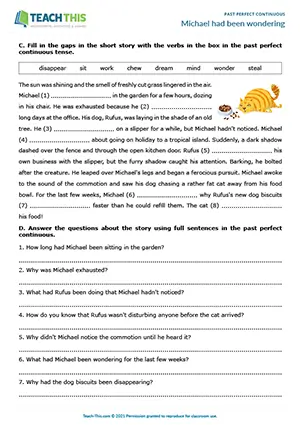
ESL Past Perfect Continuous Worksheet - Grammar and Reading Exercises: Gap-fill, Error Correction, Writing Sentences, Reading Comprehension Questions
In this productive past perfect continuous worksheet, students practice talking about ongoing past actions and their effects. First, students complete sentences...
ESL Past Perfect Continuous Worksheet - Grammar and Reading Exercises: Gap-fill, Error Correction, Writing Sentences from Prompts, Reading Comprehension Questions In this productive past perfect continuous worksheet, students practice talking about ongoing past actions and their effects. First, students complete sentences with verbs in brackets in their past perfect continuous form. Next, students correct mistakes in past perfect continuous sentences and questions. Students then complete a short story with verbs from a box in their past perfect continuous form. Finally, students answer reading comprehension questions about the story using the past perfect continuous.Past Perfect Continuous Practice

ESL Past Perfect Continuous Worksheet - Grammar Exercises: Matching, Identifying, Gap-fill, Sentence Completion
In this useful past perfect continuous worksheet, students practice forming and identifying the past perfect continuous and contrasting it with the past simple. Students begin by matching past...
ESL Past Perfect Continuous Worksheet - Grammar Exercises: Matching, Identifying, Gap-fill, Sentence Completion In this useful past perfect continuous worksheet, practice forming and identifying the past perfect continuous and contrasting it with the past simple. Students begin by matching past perfect continuous sentence halves together. Students then identify past perfect continuous clauses, past simple clauses, affirmative and negative sentences, and questions from the first exercise. Next, students complete sentences with past simple and past perfect continuous verb forms from a box. Finally, students use the past perfect continuous to complete sentences with explanations.Combinations
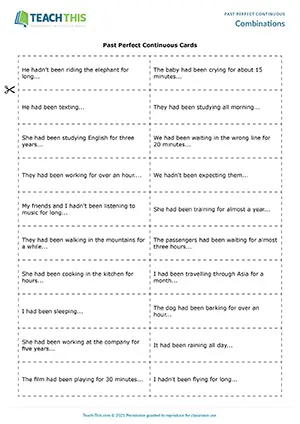
ESL Past Simple and Past Perfect Continuous Game - Grammar and Speaking: Matching, Forming Sentences, Freer Practice - Group Work
In this free past perfect continuous game, students match past perfect continuous and past simple sentence halves using 'when' to make logical sentences...
ESL Past Simple and Past Perfect Continuous Game - Grammar and Speaking: Matching, Forming Sentences from Prompts, Freer Practice - Group Work In this free past perfect continuous game, students match past perfect continuous and past simple sentence halves using 'when' to make logical sentences. In groups, students take turns turning over one past perfect continuous card and one past simple card from each set. If a student can match the two sentence halves with 'when' to make a logical sentence, the student keeps the two cards and scores a point. If a logical sentence cannot be made, the student turns the cards back over. The student with the most points at the end of the game is the winner.Death of a Millionaire
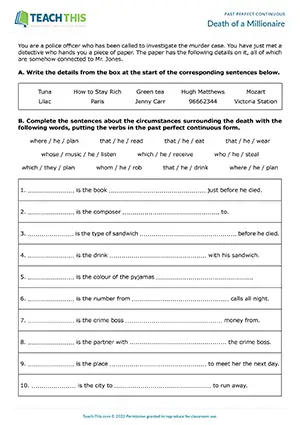
ESL Past Perfect Continuous Activity - Grammar: Running Dictation, Gap-fill, Changing Word Forms - Pair Work
In this creative past perfect continuous activity, students complete a running dictation about a mysterious death and then use clues to write relative clause sentences describing what the victim had been doing...
ESL Past Perfect Continuous Activity - Grammar: Running Dictation, Gap-fill, Changing Word Forms - Pair Work In this creative past perfect continuous activity, students complete a running dictation about a mysterious death and then use clues to write relative clause sentences describing what the victim had been doing. In pairs, one student is the writer and the other is the reader. The reader runs to the text, reads the first sentence or two, runs back and dictates it to their partner, who writes it down. This continues until the text has been fully dictated. When the students have finished, the readers sit with their writing partner to check their text, making any necessary corrections. Students then complete sentences about the circumstances surrounding the death using details from a box along with the words provided, putting the verbs in the past perfect continuous form.Past and Past Perfect Continuous
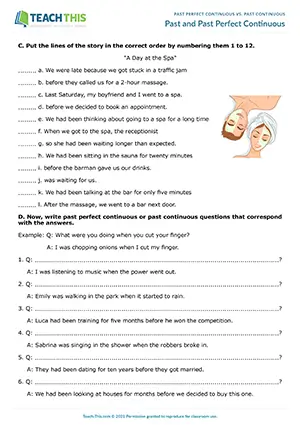
ESL Past Perfect Continuous vs. Past Continuous Worksheet - Grammar Exercises: Binary Choice, Sentence Completion, Ordering, Writing Questions
In this past perfect continuous vs. past continuous worksheet, students learn how the two tenses differ when describing ongoing actions in the past...
ESL Past Perfect Continuous vs. Past Continuous Worksheet - Grammar Exercises: Binary Choice, Sentence Completion, Ordering, Writing Questions from Prompts In this past perfect continuous vs. past continuous worksheet, students learn how the two tenses differ when describing ongoing actions in the past. Students start by identifying the correct past tense in sentences. Next, students complete sentences with their own ideas in the past perfect continuous or past continuous. After that, students put lines of a story in the correct order by numbering sentences 1 to 12. Lastly, students write past perfect continuous or past continuous questions that correspond to a set of answers.Past Perfect Continuous Review

ESL Past Perfect Continuous Worksheet - Grammar Exercises: Sentence Completion, Gap-fill, Comprehension Questions, Paragraph Writing
In this past perfect continuous worksheet, students review the past perfect continuous tense and how it is used with the past simple. To begin, students put words...
ESL Past Perfect Continuous Worksheet - Grammar Exercises: Unscrambling, Sentence Completion, Gap-fill, Comprehension Questions, Writing a Paragraph In this past perfect continuous worksheet, students review the past perfect continuous tense and how it is used with the past simple. To begin, students put words in order to make past perfect continuous sentences about different people. Next, students use their own ideas to complete sentences with a past perfect continuous clause, e.g. 'Before Grace got her first job, she had been volunteering in a hospital.' After that, students complete a story about someone's greatest achievement with verbs in brackets in their past simple or past perfect continuous forms. Students then move on to use the past perfect continuous to answer comprehension questions about the story. Finally, students write about one of their greatest achievements using the past perfect continuous and past simple.Past Perfect Continuous Sentence Flip
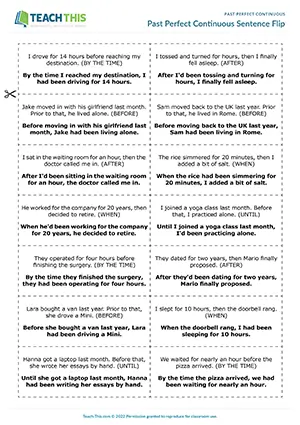
ESL Past Perfect Continuous Game - Grammar and Speaking: Forming Sentences, Controlled Practice - Group Work
In this engaging past perfect continuous game, students listen to sentences and race to change them into past perfect continuous sentences with time conjunctions. In groups, students take turns picking up...
ESL Past Perfect Continuous Game - Grammar and Speaking: Forming Sentences from Prompts, Controlled Practice - Group Work In this engaging past perfect continuous game, students listen to sentences and race to change them into past perfect continuous sentences with time conjunctions. In groups, students take turns picking up a card from the top of the pile and reading out the two sentences at the top of the card along with the time conjunction shown in brackets, e.g. 'I drove for 14 hours before reaching my destination. (by the time)' The other students listen and race to create a past perfect continuous sentence using the time conjunction. The first student to say the correct sentence written at the bottom of the card in bold or a similarly grammatically correct sentence wins and keeps the card, e.g. 'I had been driving for 14 hours by the time I reached my destination.' The student with the most cards at the end of the game wins.Sentence Half Stories
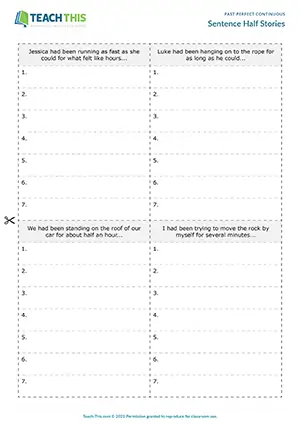
ESL Past Simple vs. Past Perfect Continuous Activity - Grammar and Writing: Writing Sentences, Freer Practice - Group Work
In this fun past simple and past perfect continuous activity, students collaboratively build short stories by alternating past perfect continuous and past simple sentence halves on cards that they pass...
ESL Past Simple vs. Past Perfect Continuous Activity - Grammar and Writing: Writing Sentence Halves from Prompts, Freer Practice - Group Work In this fun past simple and past perfect continuous activity, students collaboratively build short stories by alternating past perfect continuous and past simple sentence halves on cards that they pass around the group. First, students read the past perfect continuous sentence half at the top of their card, e.g. 'They had been riding camels through the desert for half a day...' Students then write a past simple sentence half underneath to continue the sentence, e.g. '...when they saw an ice cream shop.' Next, students fold their card so that only the sentence half they wrote appears and pass it to the person on their right, who writes a past perfect continuous sentence half, e.g. 'They had been looking for one for an hour...' This process is repeated with students writing past perfect continuous and past simple sentence halves alternately until the card is complete. Students then unfold their cards and take turns reading their short stories to the group. Finally, each group chooses the best or most amusing story and reads it to the class.Here's what our members are saying...
- Comparatives
-
Comparatives ESL Games, Activities & Worksheets
Comparative Cards
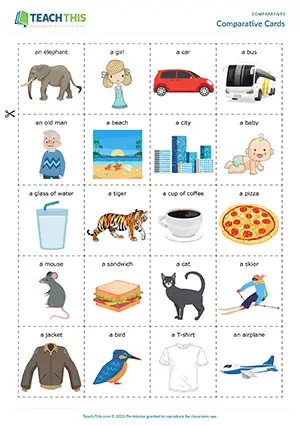
ESL Comparatives Game - Grammar: Forming Sentences - Pair Work
In this free comparatives game, students practice forming comparative sentences with 'than' using nouns cards and common adjectives. In pairs, one student goes first and puts one of their noun cards face up on the table. Students then take turns...
ESL Comparatives Game - Grammar: Forming Sentences - Pair Work In this free comparatives game, students practice forming comparative sentences with 'than' using noun cards and common adjectives. In Pairs, one student goes first and puts one of their noun cards face up on the table. Students then take turns putting down a noun card and making a comparative sentence with 'than', linking the new noun to the adjacent card, e.g. 'A car is faster than a bus.' 'A bus is bigger than an elephant.' Students can put a card down at either end of the chain of cards on the table, similar to dominoes. Each time a student puts down a card, they try to use a different comparative adjective. If they can't, they can repeat an adjective. If a student makes a grammar mistake or can't think of a way to link two noun cards together, they miss a turn. The first student to get rid of all their cards wins the game. As an extension, pairs write out some of the comparative sentences they made and then read them to the class.Fun Facts
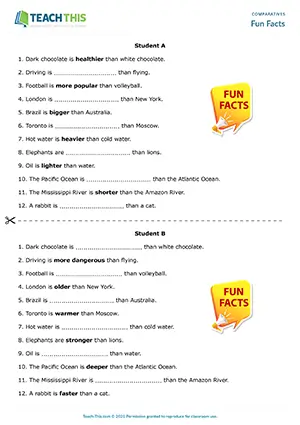
ESL Comparative Adjectives Game - Grammar: Gap-fill, Guessing - Pair Work
In this fun comparative adjectives game, students form and guess missing comparative adjectives in sentences about fun facts. Both students have the same sentences, but where they have a comparative adjective in bold, their partner has a gap...
ESL Comparative Adjectives Game - Grammar: Gap-fill, Guessing - Pair Work In this fun comparative adjectives game, students form and guess missing comparative adjectives in sentences about fun facts. Both students have the same sentences, but where they have a comparative adjective in bold, their partner has a gap and vice versa. Student B starts by reading the first sentence and guessing the missing comparative adjective using one of the adjectives shown. Student B has two chances to guess the comparative adjective. If Student B guesses the correct comparative adjective as shown on Student A's worksheet in bold, Student B scores two points and writes the comparative adjective in the gap. If the guess is wrong, Student B tries again for one point. If Student B cannot guess correctly after two attempts, Student A reveals the comparative adjective, and no points are awarded. It's then Student A's turn to guess the missing comparative adjective in the second sentence, and so on. The student with the most points at the end of the game wins.Introduction to Comparatives
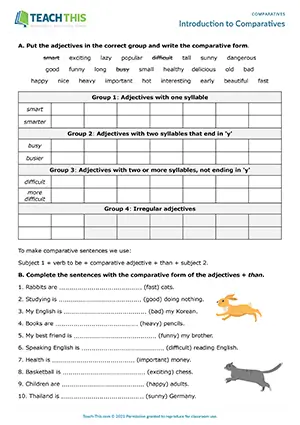
ESL Comparative Adjectives Worksheet - Grammar Exercises: Word Forms, Gap-fill, Sentence Building, Binary Choice
This useful comparatives worksheet helps students learn and practice comparative adjectives with -er and -ier and comparative sentences with 'than'. First, students write the comparative form of...
ESL Comparative Adjectives Worksheet - Grammar Exercises: Word Forms, Gap-fill, Sentence Building, Binary Choice This useful comparatives worksheet helps students learn and practice comparative adjectives with -er and -ier and comparative sentences with 'than'. First, students write the comparative form of adjectives that end in -er and -ier and the comparative forms of good and bad. Students then complete sentences with the comparative form of the adjectives in brackets + than. Students then write comparative sentences with 'than' using the words provided. Finally, students choose the correct comparative form to complete each sentence and write it in the gap.Comparative Showdown
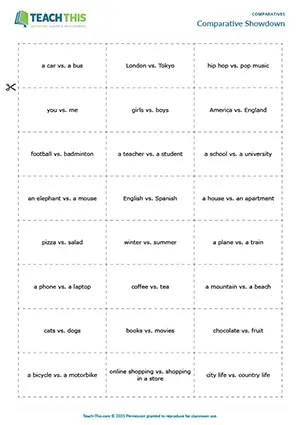
ESL Comparatives Game - Grammar and Speaking: Forming Sentences
In this fast-paced comparatives game, students practice forming comparative sentences with 'than' using a variety of comparative adjectives. One student from each team comes to the front of the class. When you say 'Go!', both...
ESL Comparatives Game - Grammar and Speaking: Forming Sentences from Prompts In this fast-paced comparatives game, students practice forming comparative sentences with 'than' using a variety of comparative adjectives. One student from each team comes to the front of the class. When you say 'Go!', both students race to pick up a card. The student who picks up the card first reads it aloud (e.g. a car vs. a bus) and makes the first comparative sentence using a comparative adjective. The other student then makes a second comparative sentence with a different comparative adjective. This continues back and forth until a student makes a grammar mistake, repeats a comparative adjective already used in that round, or takes more than five seconds to respond. The winning student scores a point for their team. A new student from each team then comes to the front of the class, and the process is repeated. The team with the most points at the end of the game wins.Fill in the Blank
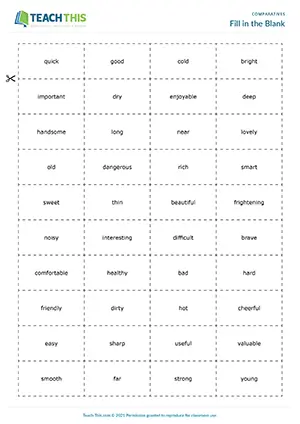
ESL Comparative Adjectives Game - Grammar and Vocabulary: Forming Sentences, Gap-fill, Guessing - Group Work
In this entertaining comparatives game, students race to guess missing comparative adjectives in sentences. Students take turns picking up a card and making a sentence using the comparative form of...
ESL Comparative Adjectives Game - Grammar and Vocabulary: Forming Sentences from Prompts, Gap-fill, Guessing - Group Work In this entertaining comparatives game, students race to guess missing comparative adjectives in sentences. Students take turns picking up a card and making a sentence using the comparative form of the adjective on the card, but instead of saying the comparative adjective, the student uses the word 'blank', e.g. 'Cars are blank than bicycles.' The other group members then race to guess the missing comparative adjective. The first student to guess the full comparative form correctly wins the round and keeps the card. The student with the most cards at the end of the game is the winner.Run Faster
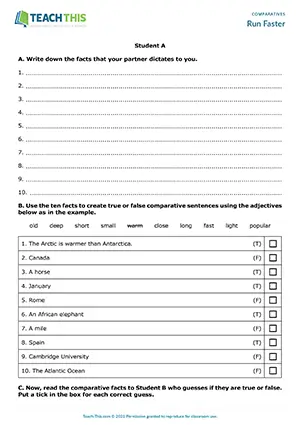
ESL Comparatives Activity - Speaking: Running Dictation - Grammar Game: Writing Sentences, True or False, Guessing - Group and Pair Work
In this free comparatives running dictation activity, students dictate sentences and then use them to make true or false comparative facts, which they use in a...
ESL Comparatives Activity - Speaking: Running Dictation - Grammar Game: Writing Sentences from Prompts, True or False, Guessing - Group and Pair Work In this free comparatives running dictation activity, students dictate sentences and then use them to make true or false comparative facts, which they use in a guessing game. Working with a student from the same group, one student is the writer, and the other is the reader. The reader runs to 'Set A or B' sentences on the wall outside the classroom, reads the first fact, runs back and dictates it to their partner who writes it down. This continues until all ten facts have been fully dictated. Students then swap roles and the process is repeated. Pairs then compare their facts to make sure they are the same. Next, students use the ten facts to create true or false comparative sentences using the adjectives shown. Finally, students pair up with someone from the other group and take turns reading their comparative facts to their partner, who guesses if they are true or false. For each correct guess, students put a tick. The student with the most correct guesses wins.Which bicycle?
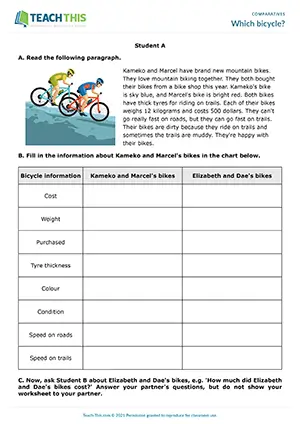
ESL Comparatives Activity - Reading, Grammar and Vocabulary Exercises: Scanning, Sentence Completion - Speaking Activity: Information Gap - Pair Work
In this comparatives information-gap activity, students practice reading for specific information and using comparative adjectives to compare bicycles...
ESL Comparatives Activity - Reading, Grammar and Vocabulary Exercises: Scanning, Unscrambling, Sentence Completion - Speaking Activity: Information Gap - Pair Work In this comparatives information-gap activity, students practice reading for specific information and using comparative adjectives to compare bicycles, then form and write comparative sentences. In two groups, students read the paragraph on the worksheet and then fill in a chart with bicycle information from the text. Next, students pair up with someone from the other group. Students then ask their partner about the other people's bikes and complete the chart with the information. After that, students use the bike information to make comparative sentences, comparing the bikes. Next, students unscramble comparative sentences using the bicycle information to help them. Finally, students write true sentences to compare the bicycles using the comparative forms of adjectives in a box.A lot, Much and Slightly
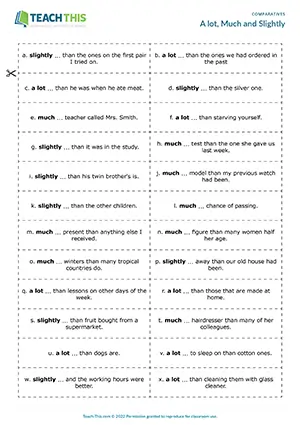
ESL Comparisons Game - Grammar and Speaking: Matching, Sentence Completion, Freer Practice - Group Work
In this creative making comparisons game, students match sentence halves together and connect them with the modifiers 'a lot', 'much' or 'slightly' and suitable comparative adjectives. In groups, players...
ESL Comparisons Game - Grammar and Speaking: Matching, Sentence Completion, Freer Practice - Group Work In this creative making comparisons game, students match sentence halves together and connect them with the modifiers 'a lot', 'much' or 'slightly' and suitable comparative adjectives. In groups, players take turns picking up a sentence-beginning card, reading it aloud, and placing it face up on the desk. All the players then check their cards to see if they have a matching ending. If a player does, they read the ending aloud, completing the sentence with the modifier shown on the ending card and a suitable comparative adjective. If the other players agree the ending matches and the comparative adjective is appropriate, the two cards are removed from the game. If a matching card is played but the players believe it has been read out incorrectly or the comparative adjective is unsuitable, the player takes back their card, and the beginning card is put at the bottom of the pile. If the other players think the ending does not match, the player takes back their card and the game continues. The first player to get rid of all their cards wins the game.As ... As Expressions
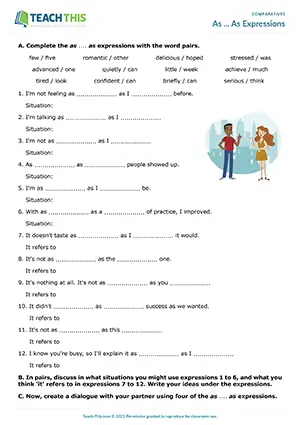
ESL As ... As Expressions Activity - Grammar Exercise: Gap-fill - Speaking Activity: Discussion, Role-Play, Freer Practice - Pair Work
In this useful comparative expressions activity, students practice common comparative expressions with 'as ... as'. First, students complete...
ESL As ... As Expressions Activity - Grammar Exercise: Gap-fill - Speaking Activity: Guided Discussion, Role-Play, Freer Practice - Pair Work In this useful comparative expressions activity, students learn common comparative expressions with 'as ... as'. First, students complete 12 comparative 'as ... as' expressions on their worksheet with word pairs. Next, in pairs, students discuss in what situations they might use expressions 1 to 6, and what they think 'it' refers to in expressions 7 to 12, writing their ideas under the expressions. Afterwards, each pair creates a dialogue using four of the comparative expressions from the worksheet and presents it to the class.Comparative Clues
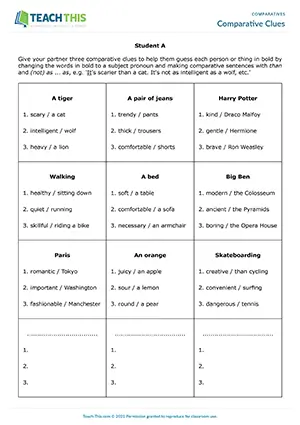
ESL Comparatives Game - Grammar: Forming Sentences, Guessing - Pair Work
In this productive comparatives game, students give comparative clues with 'than' and (not) 'as ... as' to a partner, who tries to guess who or what is being described. First, in pairs, students complete three empty boxes at the bottom of the worksheet...
ESL Comparatives Game - Grammar: Forming Sentences from Prompts, Guessing - Pair Work In this productive comparatives game, students give comparative clues with 'than' and (not) 'as ... as' to a partner, who tries to guess who or what is being described. First, in pairs, students complete three empty boxes at the bottom of the worksheet with their own words and comparative clues. Students then take turns giving their partner three comparative clues to help them guess each person or thing in bold. They do this by changing the words in bold to a subject pronoun and making comparative sentences with 'than' and (not) 'as ... as', e.g. 'It's scarier than a cat. It's not as intelligent as a wolf, etc.' After the three clues have been given, their partner has one chance to guess the answer. Students score one point for each correct guess. The student with the most points at the end of the game is the winner. Finally, students read the clues they created themselves to the class, who try to guess who or what is being described.Comparatives Board Game
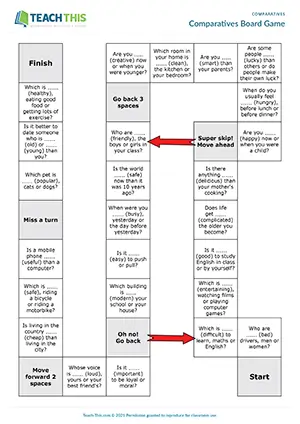
ESL Comparatives Board Game - Grammar and Speaking: Asking and Answering Questions, Freer Practice - Pair Work
In this free comparatives board game, students change adjectives into their comparative forms and then use the comparative adjectives to ask and answer conversation questions...
ESL Comparatives Board Game - Grammar and Speaking: Changing Word Forms, Asking and Answering Questions from Prompts, Freer Practice - Pair Work In this free comparatives board game, students change adjectives into their comparative forms and then use the comparative adjectives to ask and answer conversation questions. Students take turns rolling the dice and moving their counters along the board. When a student lands on a square, they change the adjective in the conversation question into its comparative form and then ask the question to their partner. Their partner then answers the question in sentence form, explaining any reasons in more detail. The two students continue taking turns to asking and answering the comparative conversation questions until one student reaches the finish. That student wins the game.Comparatives Practice
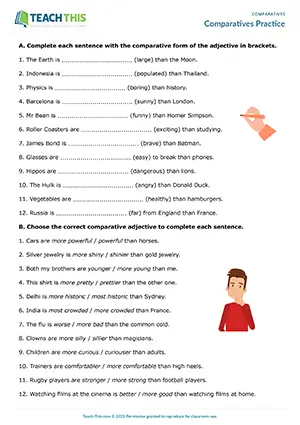
ESL Comparatives Worksheet - Grammar Exercises: Gap-Fill, Binary Choice, Rewriting Sentences
Here is an insightful comparatives worksheet to help students practice comparative adjectives and the 'as ... as' comparative structure. First, students complete sentences with the comparative form...
ESL Comparatives Worksheet - Grammar Exercises: Gap-Fill, Binary Choice, Rewriting Sentences Here is an insightful comparatives worksheet to help students practice comparative adjectives and the 'as ... as' comparative structure. First, students complete sentences with the comparative form of the adjectives in brackets. Next, students choose the correct comparative adjective to complete each sentence. Students then use the 'as ... as' structure to write negative comparative sentences that have the same meaning as the sentences shown. Lastly, students use prompts to write positive or negative 'as ... as' comparative sentences that give their opinion.Comparatives Survey
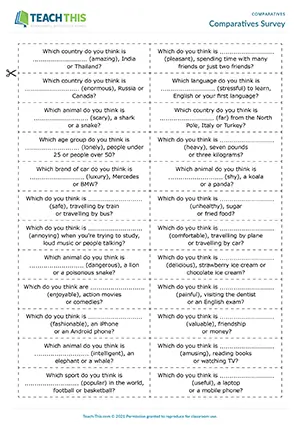
ESL Comparatives Activity - Grammar, Speaking and Writing: Gap-fill, Asking and Answering Questions, Summary Writing, Controlled and Freer Practice
In this interesting comparatives activity, students conduct a class survey where they ask and answer questions using comparative adjectives. Students begin by...
ESL Comparatives Activity - Grammar, Speaking and Writing: Gap-fill, Asking and Answering Questions from Prompts, Summary Writing, Controlled and Freer Practice In this interesting comparatives activity, students conduct a class survey where they ask and answer questions using comparative adjectives. Students begin by completing a survey question on a card with the comparative form of the adjective in brackets. Students then go around the class asking the question on their card and recording their classmates' answers on the back, e.g. 'Which country do you think is more amazing, India or Thailand?' Students must answer each question in sentence form, e.g. 'I think Thailand is more amazing than India.' When the students have spoken to everyone in the class, they write a short summary of their survey results and report back to the class on their findings.Which is better?
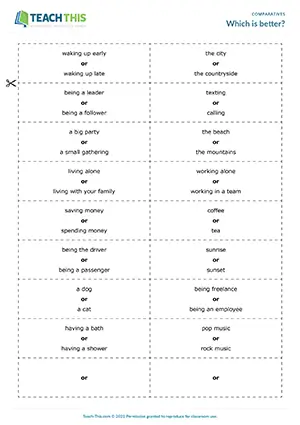
ESL Comparatives Activity - Speaking: Asking and Answering Questions, Discussion, Freer Practice - Group Work
In this engaging comparatives discussion activity, students use comparative structures to decide which of two options is better and explain why, taking turns to ask and discuss prompts in small groups...
ESL Comparatives Activity - Speaking: Asking and Answering Questions, Guided Discussion, Freer Practice - Group Work In this engaging comparatives discussion activity, students use comparative structures to decide which of two options is better and explain why, taking turns to ask and discuss prompts in small groups. Students take turns picking up a card and asking the other students in the group a 'Which is better, ... or ...? Why?' question from the prompt on the card, e.g. 'Which is better, waking up early or waking up late? Why?' Each student then answers the question using comparative forms. After each student has given their answer including at least one reason, the group discusses the topic before moving on to the next card. If a student picks up an 'or' card, they can ask any 'Which is better...?' question they like. When the students have finished, they give feedback to the class on which things they think are better and why.Comparative Communication
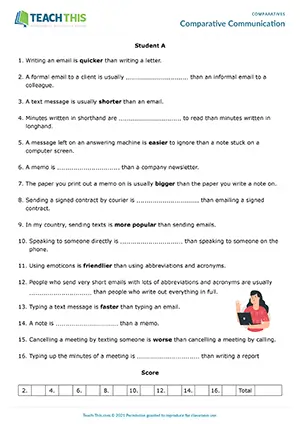
ESL Comparative Adjectives Game - Grammar and Vocabulary: Gap-fill, Guessing - Pair Work
Here is a comparative adjectives guessing game for Business English students or adults to play in class on the topic of workplace communication. Both students have the same sentences on their worksheet...
ESL Comparative Adjectives Game - Grammar and Vocabulary: Gap-fill, Guessing - Pair Work Here is a comparative adjectives guessing game for Business English students or adults to play in class on the topic of workplace communication. Both students have the same sentences on their worksheet, but where one student has a comparative adjective in bold, their partner has a gap and vice versa. Student A starts by reading the first sentence to their partner and guessing the missing comparative adjective. If the comparative adjective is the same as what Student B has in bold on their worksheet, Student A scores three points and writes the comparative adjective in the gap. If the guess is wrong, Student A tries again for two points and then for one point. It's then Student B's turn to guess the missing comparative adjective in the second sentence, and so on. The student with the most points at the end of the game wins. Afterwards, in pairs, students discuss whether they agree or disagree with each sentence and then give feedback to the class.Comparative Correlative: The ..., the ...
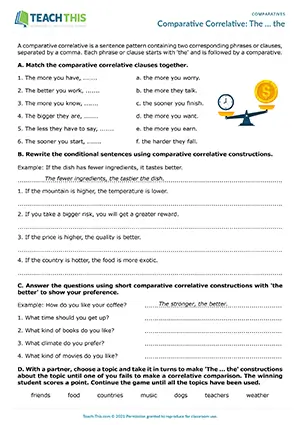
ESL Comparative Correlative Worksheet - Grammar Exercises: Matching, Rewriting Sentences, Writing Answers - Speaking Game: Forming Sentences - Pair Work
This detailed correlative comparisons worksheet helps students practice comparative correlative constructions. Students start by matching...
ESL Comparative Correlative Worksheet - Grammar Exercises: Matching, Rewriting Sentence, Writing Short Answers - Speaking Game: Forming Sentences - Pair Work This detailed correlative comparisons worksheet helps students practice comparative correlative constructions. Students start by matching comparative correlative clauses together. Next, students rewrite conditional sentences using comparative correlative constructions. After that, students answer questions using short comparative correlative constructions with 'the better' to show their preference. Lastly, in pairs, students choose a topic and take turns making 'The ..., the...' constructions about the topic until one of them fails to make a correlative comparison. The winning student scores a point. The student with the most points at the end of the game wins.Complex Comparisons
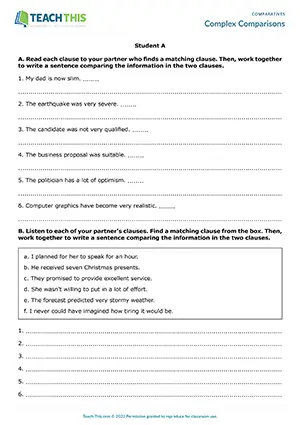
ESL Comparatives Activity - Grammar and Writing: Information Gap, Matching, Writing Sentences, Controlled Practice - Pair Work
In this challenging comparatives activity, students match related clauses and write sentences making complex comparisons between them. In pairs, students match each clause on their worksheet...
ESL Comparatives Activity - Grammar and Writing: Information Gap, Matching, Writing Sentences, Controlled Practice - Pair Work In this challenging comparatives activity, students match related clauses and write sentences making complex comparisons between them. In pairs, students match each clause on their worksheet with a related clause from a box on their partner's worksheet. When they have found a matching pair of clauses, students work together to write a new sentence comparing the information in the two clauses. When the pairs have written all their sentences, review them together as a class.Three Reasons
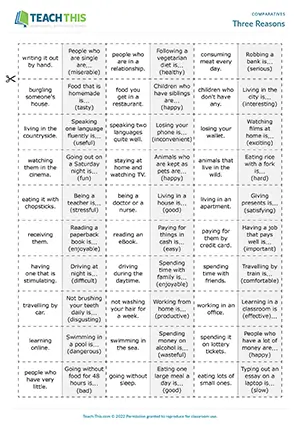
ESL Comparatives Game - Grammar and Speaking: Matching, Forming Sentences, Freer Practice - Group Work
In this creative making comparisons game, students make complex comparisons between verb and noun phrases in order to express an opinion. The first player tries to make a sentence by placing one of...
ESL Comparatives Game - Grammar and Speaking: Matching, Forming Sentences from Prompts, Freer Practice - Group Work In this creative making comparisons game, students make complex comparisons between verb and noun phrases in order to express an opinion. The first player tries to make a sentence by placing one of their dominoes at either end of the domino on the table, matching the beginning half of a sentence with an ending or vice versa. If the player matches two sentence halves correctly, they use the adjective in brackets to make a comparative sentence with 'as ... as' or 'more/less ... than' that best expresses their own opinion, e.g. 'Learning in a classroom is not as difficult as learning online.' The player then has 30 seconds to give three reasons to back up their opinion. If the player is successful, the domino remains in place, and it's the next students turn to play. If the player is unsuccessful or makes a grammatically incorrect sentence, they take back their domino and play passes to the next student. The first player to get rid of all their dominoes wins the game.Tick or Talk?
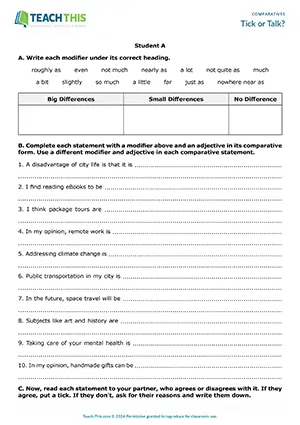
ESL Modifiers and Comparatives Activity - Grammar and Speaking: Sentence Completion, Making and Responding to Statements - Group and Pair Work
In this rewarding modifiers and comparatives activity, students complete comparative statements with a variety of modifiers and adjectives and then talk...
ESL Modifiers and Comparatives Activity - Grammar and Speaking: Sentence Completion, Making and Responding to Statements - Group and Pair Work In this rewarding modifiers and comparatives activity, students complete comparative statements with a variety of modifiers and adjectives and then talk about their ideas. First, in two groups, students write each modifier under a suitable heading: big differences, small differences, or no difference. Working together, students then complete each statement using a modifier from Exercise A and either a comparative adjective + 'than' or an 'as ... as' structure, as appropriate, using a different modifier and adjective in each comparative statement, e.g. 'Going to the beach is far better than going to the mountains.' Next, students pair up with someone from the other group and take turns reading each statement to their partner, who agrees or disagrees with it. If their partner agrees, the student puts a tick next to the statement. If they disagree, the student asks for their reasons and writes them down. Finally, students report back to the class on which statements they and their partner disagreed with and why.Here's what our members are saying...


