
Compound Nouns ESL Games, Worksheets & Activities
Ask Me Anything
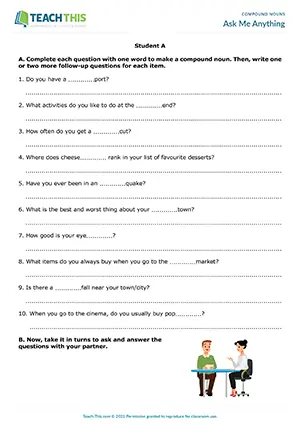
ESL Compound Nouns Activity - Vocabulary and Speaking: Gap-Fill, Asking and Answering Questions, Controlled and Freer Practice - Group and Pair Work
In this fun compound nouns speaking activity, students complete questions with one word to make closed compound nouns. Students then ask and answer the questions...
Compound Noun Dominoes
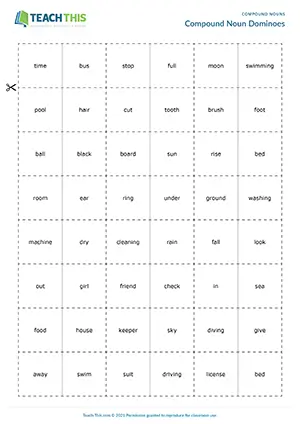
ESL Compound Nouns Game - Vocabulary and Speaking: Matching, Forming Sentences, Freer Practice - Group Work
In this inventive compound nouns game, students combine words together to form compound nouns and use them in sentences. The first player puts down one of their dominoes on either side of...
Picture it
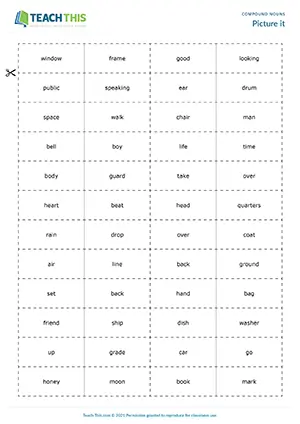
ESL Compound Nouns Game - Vocabulary: Drawing, Guessing, Forming Words - Group Work
In this entertaining compound nouns drawing game, students guess compound nouns from pictures. One student from Team A comes up to the board. Give the student a card containing two words that...
Practice Makes Perfect

ESL Compound Nouns Worksheet - Vocabulary Exercises: Labelling, Matching, Gap-fill, Writing Sentences
This productive compound nouns worksheet helps students learn and practice a variety of compound nouns and their compound elements. Students begin by looking at pictures and completing...
Same Same

ESL Compound Nouns Game - Vocabulary: Forming Words - Group Work
In this free compound nouns game, students race to create as many compound nouns as they can from specific words. You begin the game by picking up a card and calling out the word in bold, e.g. hair. In teams, students then race to write down as many...
Compound Conundrum

ESL Compound Noun Game - Vocabulary and Speaking: Pelmanism, Matching, Forming Sentences, Freer Practice - Pair Work
This imaginative compound nouns game helps students develop their vocabulary knowledge by matching words together to form compound nouns and using them in sentences. In pairs, students...
Nouns Modifying Nouns
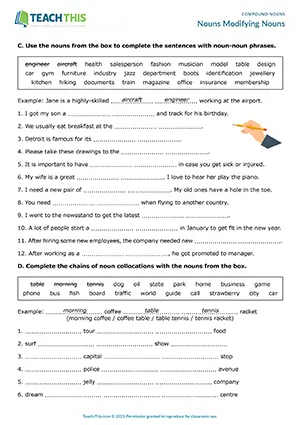
ESL Nouns Modifying Nouns Worksheet - Vocabulary Exercises: Identifying, Writing Definitions, Forming Collocations, Gap-fill
This comprehensive noun-noun phrases worksheet helps students learn and practice how to modify nouns with other nouns. These noun-noun collocations are sometimes called noun adjuncts or qualifying...
What's the Compound Noun?
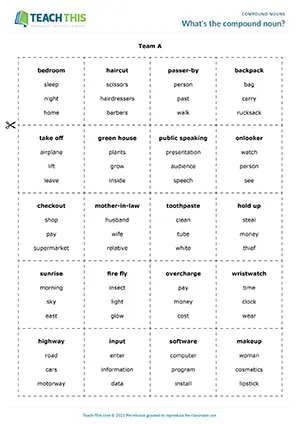
ESL Compound Nouns Game - Vocabulary: Forming Definitions, Guessing - Group Work
In this creative compound nouns game, students define compound nouns using certain words and guess compound nouns from another team's descriptions. First, teams look at their cards and think about how they can define each compound...
Understanding Compound Nouns
Compound nouns combine two or more words to create a single new meaning and can be written as one word, two words, or with a hyphen, as in 'toothbrush,' 'bus stop,' or 'dry-cleaning.' There is no reliable rule for which written form a compound takes, so students need to learn each one as a fixed unit, and guessing wrong produces a form that a reader will immediately notice.
This page covers compound nouns at Intermediate and Upper-intermediate levels, with eight resources including worksheets, drawing and guessing games, a domino game, and a speaking activity, one of which is available as a free download.
The table shows the most common patterns for forming compound nouns in English, with an example of each pattern and a note on whether the compound is typically written as one word, two words, or hyphenated.
| Formation Pattern | Structure | Example | Written Form |
|---|---|---|---|
| Noun + Noun (closed) | noun + noun | sunflower | One word: 'a sunflower' |
| Noun + Noun (open) | noun + noun | car park | Two words: 'a car park' |
| Adjective + Noun | adjective + noun | blackboard | One word: 'a blackboard' |
| Verb + Noun | verb + noun | washing machine | Two words: 'a washing machine' |
| Noun + Verb | noun + verb | sunrise | One word: 'a sunrise' |
| Verb + Preposition | verb + preposition | checkout | One word: 'a checkout' |
| Preposition + Noun | preposition + noun | underground | One word: 'the underground' |
When to Use Compound Nouns
Naming New Concepts and Technologies: English constantly creates compound nouns to name new technologies and concepts because combining two familiar words is the quickest way to give something a precise, recognizable name, as in 'smartphone,' 'laptop,' and 'inbox,' where the parts together signal a meaning neither word carries alone.
Workplace and Professional Vocabulary: Professional environments rely heavily on compound nouns to describe roles, processes, and locations efficiently, so a worker needs to know whether to say 'deadline,' 'workflow,' or 'meeting room' rather than reaching for a longer descriptive phrase each time.
Signposting in Formal and Academic Writing: Academic and formal writers use compound nouns as concise labels for complex ideas, allowing a phrase like 'case study,' 'feedback loop,' or 'decision-making process' to carry a precise shared meaning without needing further explanation each time it appears.
3-Step Framework for Teaching Compound Nouns
1. Build Recognition and Form Through Structured Practice: Start with a worksheet that moves students from recognition to production in clear stages. Students look at pictures and complete compound nouns by choosing words from a box, then match each compound noun with its compound elements to make the internal structure visible. After gap-fill practice, they finish by writing a sentence about each picture using a compound noun, so every stage connects form to meaning.
2. Bring the Structure to Life With a Drawing Game: Follow up with a whole-class drawing game that makes compound noun formation visual and competitive. One student draws two separate words on the board and the first team to shout out the compound noun scores a point. A correct definition earns the team an extra point, but if they cannot define it, the other team can steal that point, which keeps every team alert even when it is not their turn.
3. Push Productive Knowledge With a Definition Challenge: At upper-intermediate level, push students to show they truly own the vocabulary by asking them to define compound nouns rather than just recognize them. Teams pick up a card and define the compound noun to the opposing team, starting with the compound elements. The opposing team has one minute to guess, and whichever team wins the exchange keeps the card, so the pressure stays on both sides of the room at once.
Common Mistakes with Compound Nouns
Writing a Closed Compound as Two Separate Words: Students often write a compound noun as two words when it should be one, typically because the component words look like they belong in a regular noun phrase. Wrong: 'She left her tooth brush in the hotel.' Correct: 'She left her toothbrush in the hotel.'
Pluralizing the First Element of a Compound Noun: Students often add a plural -s to the first word in a compound noun, following the logic of a regular noun phrase rather than the compound noun rule. Wrong: 'She works in the cars industry.' Correct: 'She works in the car industry.'
Common Questions About Teaching Compound Nouns
What is an engaging game for practicing compound nouns?
In the free game Same Same, the teacher calls out a word such as 'hair' and teams race to write as many compound nouns as they can using that word, for example 'hairbrush,' 'hairdresser,' or 'haircut.' Teams score one point for each compound noun not on the teacher's card and two points for any that match.
What is a good speaking activity for practicing compound nouns?
Students in the activity Ask Me Anything complete conversation questions with one word to form a closed compound noun, then write one or two follow-up questions for each. They pair up with someone from the other group to ask and answer the questions, then report back to the class what they found out about their partner.
What is a useful worksheet for teaching compound nouns?
The worksheet Practice Makes Perfect takes students through five stages, from recognizing compound nouns in pictures to producing them in sentences. Students complete compound nouns with words from a box, match each compound noun to its compound elements, complete gap-fill sentences, match words to make new compound nouns, and finish by writing a sentence about each picture.
Become a Teach This Member
Get unlimited access to the full library, plus new resources added every week.
Unlimited Resource Access
Download from 3000+ worksheets, activities, and games.
Save 5+ Hours Weekly
Cut lesson prep time with ready-to-use resources, plus teacher notes and answer keys.
Trusted Professional Quality
Classroom-tested, editable resources created by experienced ESL professionals.
Fresh Content Weekly
Get 5 new resources added to the library each week.
Here's what our members are saying...


