
Future Simple ESL Games, Activities & Worksheets
Guess the Future!
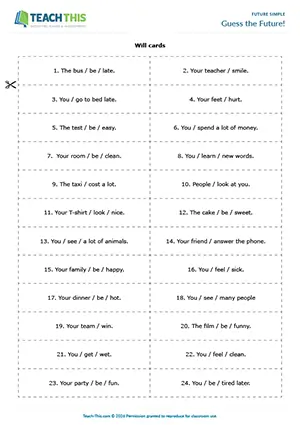
ESL Future Simple Game - Grammar: Matching, Forming Sentences - Group Work
In this rewarding future simple game, students practice making predictions with 'will' in response to 'be going to' plans. In groups, students take turns picking up a 'be going to' card, reading it aloud and placing it face-up on the table, e.g. 'I am going...
I think you will...
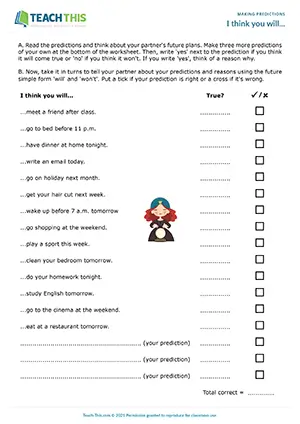
ESL Predictions Game - Grammar and Speaking: Guessing, Forming Sentences, Controlled and Freer Practice - Pair Work
Here is a free future simple game in which students predict their partner's future using 'will' and 'won't'. The aim of the game is to make the most correct predictions. First, working alone, students...
Predictions Practice

ESL Predictions Worksheet - Grammar Exercises: Ordering, Writing Sentences, Matching - Speaking Activity: Freer Practice - Pair Work
Here is a useful future simple worksheet to help students learn how to use the future simple with 'will' and 'won't' to make predictions. First, students...
Whatever will be, will be

ESL Future Simple Predictions Game - Grammar and Speaking: Sentence Completion, Guessing - Pair Work
In this enjoyable future simple game, students practice making predictions using 'will' and 'won't'. First, students read each prediction and write 'I will' or 'I won't' in the column marked 'Me', depending on...
Will you...?
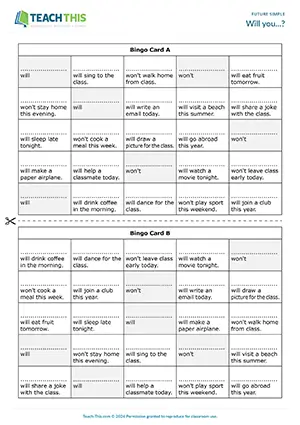
ESL Future Simple Game - Grammar and Speaking: Bingo, Asking and Answering Questions, Controlled Practice
In this fun future simple game, students race to complete a bingo card by asking and answering 'Will you...?' questions. Students go around the class asking 'Will you...?' questions based on the prompts on...
Horoscopes

ESL Future Simple Activity - Writing: Writing Sentences, Note-Taking
In this intriguing horoscope-writing activity, students write short predictions with 'will' and 'won't' for the twelve zodiac signs, then read classmates' horoscopes and later report which predictions came true. First, in pairs, students write horoscopes...
In Twenty Years...

ESL Future Simple Activity - Writing and Speaking: Writing Sentences, Discussion, Freer Practice - Group Work
In this imaginative future simple activity, students make predictions about what their classmates' lives will be like in twenty years using the future simple form 'will'. First, students write their name...
Offers, Promises and Decisions
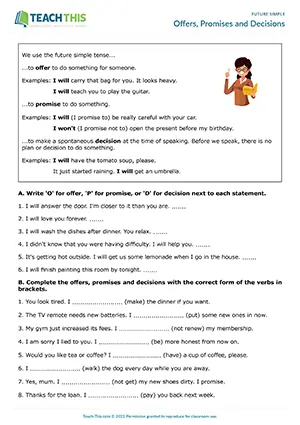
ESL Future Simple Worksheet - Grammar Exercises: Identifying, Gap-fill, Matching, Writing Sentences, Freer Practice
Here is a free future simple worksheet to help students learn how to use 'will' to make offers, promises, and spontaneous decisions. First, students read a set of statements and write 'O' for offer, 'P' for promise...
Predictor

ESL Future Simple Activity - Grammar, Writing and Speaking: Writing and Reading Sentences, Guessing, Gap-fill
In this creative future simple for predictions activity, students make predictions about classmates and practice giving reasons with 'because'. First, students draw the name of a class member from an...
The Various Uses of Will
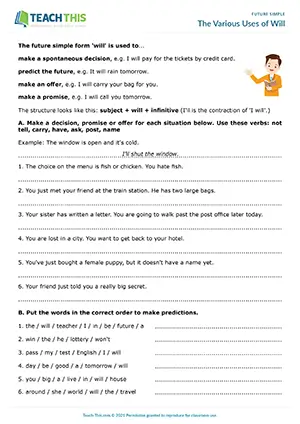
ESL Future Simple Worksheet - Grammar Exercises: Writing Sentences, Unscrambling, Matching - Speaking Activity: Discussion
Here is a comprehensive future simple worksheet to help students learn how to use the future simple with 'will' for predictions, spontaneous decisions, offers, and promises. Students start by reading...
Weekly Horoscopes
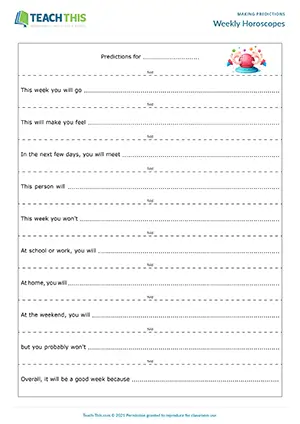
ESL Horoscopes Activity - Grammar: Sentence Completion - Group Work
In this rewarding future simple activity, students write imaginary horoscopes for classmates and use 'will' and 'won't' to make playful predictions. First, students write their name at the top of the worksheet, fold the the worksheet so their...
Will You or Won't You?
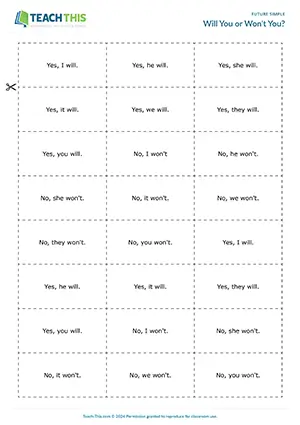
ESL Future Simple Game - Grammar and Speaking: Forming, Asking and Answering Questions - Group Work
In this engaging future simple yes/no questions game, students ask questions with 'will' to elicit specific short answers with the correct pronouns. In groups, players take turns choosing one...
By the Year 3000
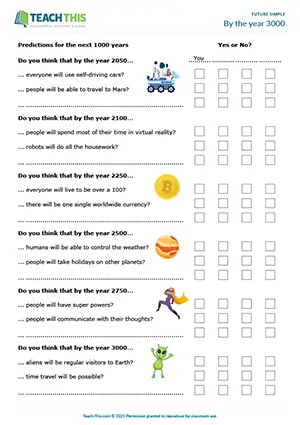
ESL Future Simple Activity - Grammar and Speaking: Survey, Question Completion, Asking and Answering Questions, Summary Writing - Group Work
In this future simple speaking activity, students design and carry out a small-group survey about predictions for the next 1,000 years, then summarize and...
Future Simple Review
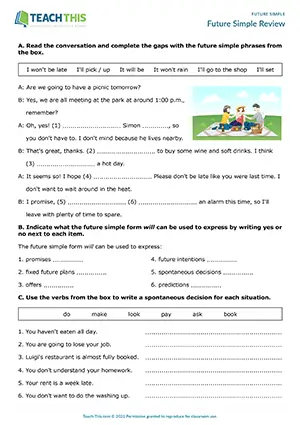
ESL Future Simple Worksheet - Grammar Exercises: Gap-fill, Identifying, Writing Sentences
In this productive future simple worksheet, students review and practice using 'will' for promises, offers, spontaneous decisions, and predictions. Students begin by reading and completing a conversation...
Make a Prediction
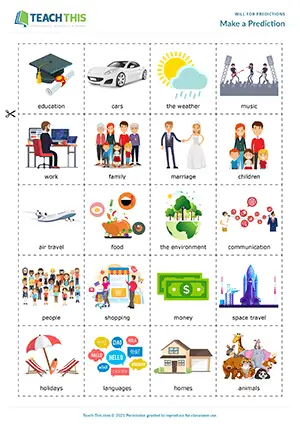
ESL Future Simple Predictions Game - Grammar and Speaking: Matching, Forming Sentences - Group Work
In this fun future simple for predictions game, students use 'will' and a variety of future time expressions to make predictions about different topics. In groups, players take turns turning over a topic card...
TV Pilots
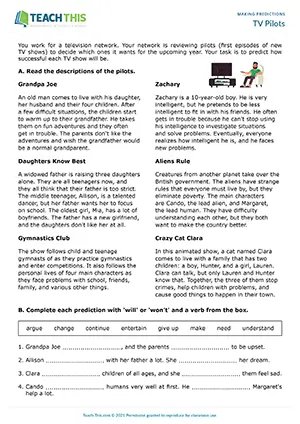
ESL Future Simple Worksheet - Reading, Writing and Grammar Exercises: Gap-fill, Writing Questions and Sentences - Speaking Activity: Discussion - Pair Work
In this intriguing future simple worksheet, students practice using 'will' and 'won't' to make and discuss predictions about TV pilots. Students start by reading...
Understanding Future Simple
The future simple uses 'will' plus a base verb and covers four key functions: making predictions, expressing spontaneous decisions, making offers, and making promises, as in 'I think it will rain' or 'I'll help you with that.' When students use 'going to' for a spontaneous decision or offer, the sentence sounds like a plan already in progress rather than an in-the-moment response, which changes the meaning and can make a genuine on-the-spot reaction come across as oddly premeditated.
This page covers the future simple across three levels from A1 to B1 with 16 activities ranging from bingo and card games to horoscope-writing tasks, totaling around 465 minutes of practice, with two activities available as free downloads.
The future simple with 'will' has four core structural forms that students at A1 to B1 level need to recognize and produce accurately.
| Form | Structure | Example |
|---|---|---|
| Affirmative | subject + will + base verb | 'The journey will take about two hours.' |
| Negative | subject + won't + base verb | 'She won't be at the meeting.' |
| Yes/No Question | Will + subject + base verb + ? | 'Will you come to the party?' |
| Wh- Question | Wh- word + will + subject + base verb + ? | 'Where will they go on holiday?' |
| Short Answer | Yes, subject + will. / No, subject + won't. | Q: 'Will he call?' A: 'Yes, he will.' / 'No, he won't.' |
When to Use Future Simple
Softening Unwelcome News with a Prediction Frame: When a speaker needs to introduce difficult or disappointing information, framing it as a prediction rather than a statement can take some of the sting out of the message, as in 'I think this project will take longer than we planned.'
Expressing Confidence About a Future Outcome: When a speaker feels certain that something will happen and wants to state it without hedging or qualification, 'will' carries that conviction more directly than other future forms, as in 'Don't worry, the doctor will see you soon.'
Warning Someone About Future Consequences: When a speaker wants to alert someone to what will likely happen if they continue on a certain path, 'will' makes the prediction feel direct and immediate rather than vague, as in 'If you don't rest now, you will feel much worse tomorrow.'
3-Step Framework for Teaching Future Simple
1. Introduce the Form Through a Prediction Race: Get students producing 'will' sentences from the very first activity by pairing a plan with a matching prediction. A card-matching race works well here: one student reads a 'be going to' card aloud, such as 'I am going to give my teacher a gift,' and the whole group races to find a 'will' card whose prompt produces a matching prediction. The student who finds it must form the sentence correctly, for example 'Your teacher will smile,' before the group agrees to award the pair. The competitive element keeps the form in focus without the activity feeling like a drill.
2. Sharpen Question Formation with a Short Answer Card Game: Once students can make statements, move them onto forming and asking 'will' questions with precision. In a card game format, each player secretly picks a short answer card such as 'Yes, they will,' then invents a question designed to get exactly that answer from a classmate, for example 'Will Omar and Yumi go home at 3 o'clock?' If the classmate gives the matching short answer, the player discards the card. The first player to get rid of all their cards wins, which keeps question formation practice sharp and purposeful.
3. Open Up to Real Discussion with a Future Survey: Round off by moving students into genuine opinion exchange about the future. A survey activity works well here: students discuss predictions by asking questions like 'Do you think that by the year 2050 everyone will use self-driving cars?', note classmates' answers with ticks and crosses, and then write up their group's findings, for example 'Three people in our group think that everyone will use self-driving cars by the year 2050.' Reporting back to the class at the end turns private predictions into a shared, communicative event.
Common Mistakes with Future Simple
Adding 's' to 'Will' in the Third Person: Students often treat 'will' like a present simple verb and add an 's' for third-person singular subjects, producing forms like 'wills' that do not exist in English. Wrong: 'She wills call you tomorrow.' Correct: 'She will call you tomorrow.'
Inserting 'To' After 'Will': Students often place 'to' between 'will' and the base verb, confusing it with other structures they know such as 'going to' or 'want to.' Wrong: 'I think it will to rain tomorrow.' Correct: 'I think it will rain tomorrow.'
Common Questions About Teaching Future Simple
What is a good game for teaching the future simple to beginner students?
A good game for teaching the future simple to beginners is the free I think you will activity. Students decide whether each sentence will come true for their partner, then say it aloud, for example 'I think you will meet a friend after class.' Their partner confirms if the prediction is right or wrong, and the most accurate predictor wins.
What is a useful worksheet for teaching 'will' for offers, promises, and decisions?
The free Offers, Promises and Decisions worksheet at A2 level is a useful resource for teaching 'will' for offers, promises, and decisions. Students read statements and label each one 'O' for offer, 'P' for promise, or 'D' for decision, complete sentences with the correct verb forms, match statements with responses, and finish by writing their own offers and promises.
What is a fun game for practicing will for predictions?
Make a Prediction is a fun B1 card game for practicing future simple predictions. Players match a topic card with a time expression card to form a sentence like 'Jane will get married in the next ten years.' A crystal ball card lets the player use any time expression. The first student to discard all their cards wins.
Here's what our members are saying...


