
Narrative Tenses ESL Worksheets, Activities & Games
Act out my Story
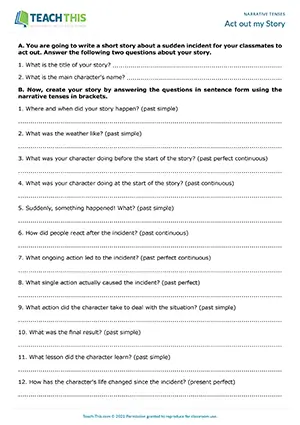
ESL Narrative Tenses Activity - Grammar and Writing: Writing Sentences, Story Writing, Acting - Pair Work
In this engaging narrative tenses activity, students practice using narrative tenses to write a short story from prompts and then read it to another pair, who acts it out. In pairs, students begin by thinking of...
Fairy Tale Fun
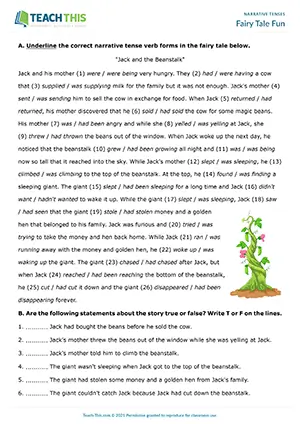
ESL Narrative Tenses Worksheet - Reading and Grammar Exercises: Binary Choice, True or False Reading Comprehension, Gap-fill
In this useful narrative tenses worksheet, students read fairy tale stories and choose and write the correct narrative tense verb forms. Students begin by reading a short version of the fairy tale...
Match and Mime
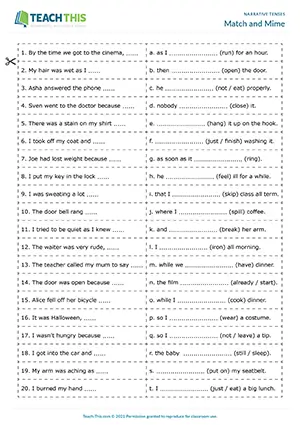
ESL Narrative Tense Games - Grammar: Matching, Gap-fill, Sentence Completion, Miming, Guessing - Pair Work
Here is a fun set of narrative tense games to help students practice narrative tenses. First, students play a pelmanism game where they take turns turning over one sentence beginning card and one ending...
Narrative Tenses Practice
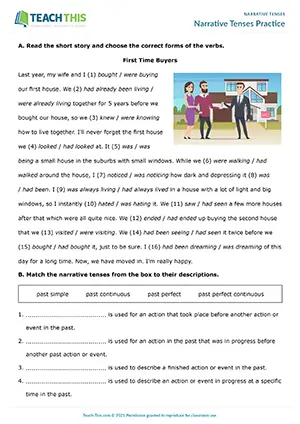
ESL Narrative Tenses Worksheet - Reading, Grammar and Writing Exercises: Binary Choice, Matching, Writing Sentences, Gap-fill, Story Completion
In this free narrative tenses worksheet, students practice four narrative tenses through a short story, matching, and guided writing tasks. Students begin...
Story Time
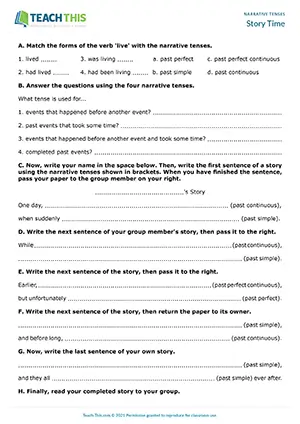
ESL Narrative Tenses Activity - Grammar and Writing: Matching, Short Answer Questions, Story Writing, Sentence Completion - Group Work
This imaginative story writing activity helps students practice using narrative tenses by writing a collaborative circle story. First, students match forms...
Tales from the Waiting Room
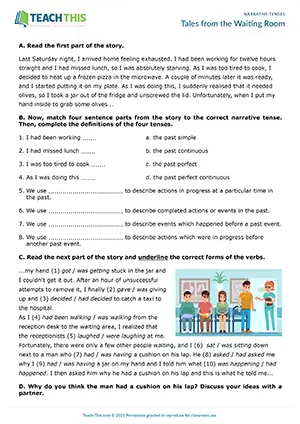
ESL Narrative Tenses Worksheet - Reading and Grammar Exercises: Matching, Gap-fill, Binary Choice - Speaking Activity: Discussion - Pair Work
In this engaging narrative tenses worksheet, students complete and discuss a short story to practise four past narrative tenses. Students begin by reading...
Tell me a Story
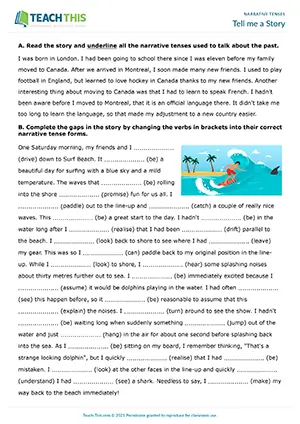
ESL Narrative Tenses Worksheet - Grammar and Reading Exercises: Identifying, Gap-fill, Matching - Speaking Activity: Story Telling - Group Work
In this productive narrative tenses worksheet, students practice narrative tenses to talk about past experiences. First, students read a short story and underline all...
Understanding Narrative Tenses
Narrative tenses are the four past tenses that work together to tell a story in English: the past simple carries the main sequence of events, the past continuous sets the scene or describes background action in progress, the past perfect shows what happened before the story began, and the past perfect continuous describes how long that earlier action had been going on. When students rely on the past simple alone and ignore the other three tenses, their stories come out as flat lists of events with no sense of timing, background, or sequence: a story like 'She walked in. She saw a man. He left. She called the police.' has all the facts but none of the texture that narrative tenses create.
This page covers narrative tenses across B1 and B2 levels with seven activities including worksheets, pair games, and group story-writing tasks, with one activity available as a free download.
The table below shows the four narrative tenses with their grammatical form, narrative function, and an example of each in a story context.
| Tense | Form | Narrative Function | Example |
|---|---|---|---|
| Past Simple | subject + past form | Main completed events in the story sequence | 'She opened the door and stepped inside.' |
| Past Continuous | subject + was/were + verb-ing | Background scene or action in progress when the main event occurred | 'It was raining and people were hurrying past.' |
| Past Perfect | subject + had + past participle | Event that happened before the main story events (flashback) | 'She realized she had left her keys on the bus.' |
| Past Perfect Continuous | subject + had been + verb-ing | Duration of a background or earlier action before the main event | 'He had been waiting for over an hour when she finally arrived.' |
When to Use Narrative Tenses
Building Suspense with Background Action: A writer uses the past continuous to hold the story in mid-action before introducing a sudden interruption, which creates suspense and draws the reader in before the key event lands, as in 'The children were sleeping peacefully when the noise started.'
Signaling a Flashback: A writer uses the past perfect to step back from the current story moment and reveal earlier events, letting the reader understand why things happened without losing the main timeline, as in 'Only then did she remember she had met him once before, years ago in Paris.'
Showing Duration Before the Main Event: A writer uses the past perfect continuous when they want to stress how long a situation had been building before the key moment arrived, adding weight to the main event, as in 'He had been trying to quit for years when the doctor finally gave him no choice.'
3-Step Framework for Teaching Narrative Tenses
1. Read First, Then Recognize: Start with a reading text students already have some connection to, so they can focus on the grammar rather than decoding unfamiliar content. A well-known story works well here because students do not need to track the plot: they already know what happens, which frees their attention to notice and underline the narrative tense choices the writer has made. From there, move them into a gap-fill using a less familiar story, where they must apply the same tense choices themselves. The extension task of rewriting a familiar fairy tale in a different genre is worth keeping, because switching genre forces students to rethink which tense signals a scene, which signals a completed action, and which signals a flashback.
2. Match the Form, Then Perform It: A pelmanism-style matching game gives students a focused way to connect sentence beginnings and endings while producing the correct narrative tense for each. The real energy comes in the second stage, where students complete sentence endings using their own ideas, then read the sentence opening aloud to a partner who must mime the ending. The partner has one minute to guess and say exactly what the student wrote, which means the mime has to be specific enough to communicate a past continuous scene or a past perfect flashback. That physical element makes the tense choices memorable in a way that a written exercise alone rarely achieves.
3. Write It, Then Watch It Come to Life: The most motivating way to push students toward authentic narrative tense use is to give their writing a live audience. Pairs create a short story by answering a set of structured prompts using the narrative tenses specified in brackets, then read it aloud to another pair who act it out in real time. Each student reads alternate sentences and then pauses, while the listening pair mimes the action, only speaking aloud any dialogue that appears word for word in the written story. That constraint keeps both pairs honest: the writers must use narrative tenses accurately to produce a story that is mimeable, and the actors must listen precisely enough to know when dialogue appears.
Common Mistakes with Narrative Tenses
Past Simple Used Instead of Past Perfect for Earlier Events: Students often use the past simple for a flashback event instead of the past perfect, which removes the signal that this event happened before the main story timeline. Wrong: 'She felt afraid because she heard that sound before.' Correct: 'She felt afraid because she had heard that sound before.'
Past Simple Used Instead of Past Continuous for Background Action: Students often use the past simple for an ongoing background action instead of the past continuous, which makes two events sound sequential rather than showing one interrupting the other. Wrong: 'She cooked when the phone rang.' Correct: 'She was cooking when the phone rang.'
Common Questions About Teaching Narrative Tenses
What is a good worksheet for practicing narrative tenses at B1 level?
A narrative tenses worksheet works well when it builds from recognition to free production in stages. The free Narrative Tenses Practice worksheet at B1 starts with a binary-choice reading task, moves through matching tenses to their descriptions and guided sentence writing, then has students complete a story opening before continuing it with all four tenses and their own ideas.
What is a fun activity for practicing narrative tenses through collaborative writing?
A collaborative writing activity works well for narrative tenses when every student has a personal stake in the story. Story Time at B1 has each student write the first sentence, then pass the paper right so other students write the second, third, and fourth sentences in turn before the paper returns to its owner for a final sentence.
What is an effective speaking activity for narrative tenses at B2 level?
Narrative tenses speaking activities are most effective when they connect grammar to real personal experience. Tell me a Story at B2 leads students through reading and gap-fill tasks before finishing with a stage where students talk for two minutes about a memorable experience from their past, using prompts and all four narrative tenses together.
Here's what our members are saying...


