Adjective Detectives

Beginner (A1) 25 minutes
ESL beginner adjectives game preview showing vocabulary practice with everyday items, asking and answering yes/no questions, and pair work activity for A1 level students

ESL Basic Adjectives Game - Vocabulary and Speaking: Guessing, Asking and Answering Questions, Controlled Practice - Pair Work

In this free adjectives game, students choose adjectives for common items, then ask yes or no questions to guess their partner's choices. First, students fill in their 'Your items' grid by deciding whether each...

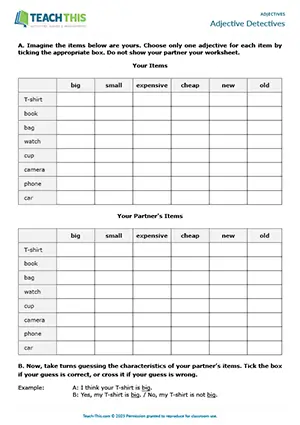
ESL Basic Adjectives Game - Vocabulary and Speaking: Guessing, Asking and Answering Questions, Controlled Practice - Pair Work In this free adjectives game, students choose adjectives for common items, then ask yes or no questions to guess their partner's choices. First, students fill in their 'Your items' grid by deciding whether each item is big or small, cheap or expensive, and old or new, ticking one adjective for each item. Students then take turns guessing the adjectives for their partner's items by asking yes or no questions, e.g. 'Is your T-shirt big?' Students have one guess per adjective pair: size, price, and age. Their partner replies with a short answer, e.g. 'Yes, it is.' or 'No, it's small.' If the answer is yes, the student puts a tick in the appropriate box. If it is no, they put a cross. After three guesses for one item, the students swap roles. When the students have finished, they add up their ticks in their 'Your partner's items' grid. The student with the most ticks wins the game.

Basic Adjectives: Flashcards & Worksheet
Beginner (A1) 30 minutes
ESL beginner adjectives flashcards and worksheet preview showing vocabulary exercises, matching, gap-fill, controlled practice for A1 level students

ESL Basic Adjectives Flashcards and Worksheet - Flashcards: Eliciting, Drilling, Sentence Frames - Vocabulary Exercises: Matching, Gap-fill

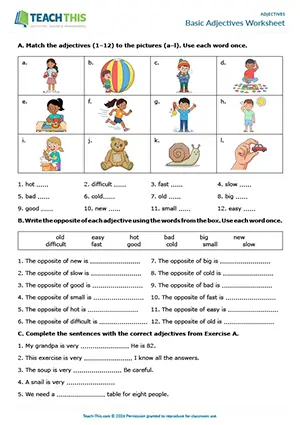
In this useful adjectives resource, students learn 12 basic adjectives and their opposites and practice them with flashcards and a worksheet. To begin, hold....

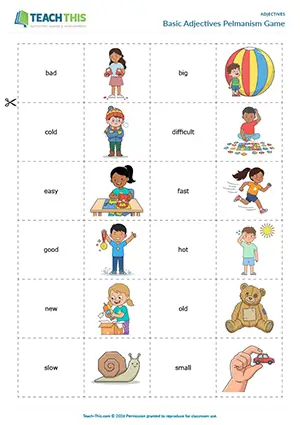
ESL Basic Adjectives Flashcards and Worksheet - Flashcards: Eliciting, Drilling, Sentence Frames - Vocabulary Exercises: Matching, Gap-fill In this useful adjectives resource, students learn 12 basic adjectives and their opposites and practice them with flashcards and a worksheet. To begin, hold up each flashcard. Point to the picture and elicit the adjective. Model and drill pronunciation chorally and individually. Next, write the following frame on the board: 'Is he/she/it... or ...?' 'He/She/It is...' Show the flashcards again and ask different students the question from the board. Elicit suitable responses as you move around the class. Students then match the adjectives to the pictures on the worksheet. Check the answers as a class by pointing to each picture and eliciting the adjective. Next, students write the opposite of each adjective using the words from the box. Finally, students complete sentences with the correct adjectives from Exercise A. As an extension, play a quick review game using the flashcards, e.g. opposite-pair sorting, slap-the-card, or what's missing? This resource can also be used with our 'Basic Adjectives Pelmanism' game and 'Secret Adjective Detective' activity.

Basic Adjectives Pelmanism Game

Beginner (A1) 20 minutes
ESL beginner adjectives games preview showing vocabulary exercises, matching, pelmanism, forming sentences, freer practice, pair work for A1 level students

ESL Basic Adjectives Games - Vocabulary and Speaking: Matching, Pelmanism, Forming Sentences, Freer Practice - Pair Work

In this fun basic adjectives game, students practice 12 basic adjectives by matching word cards to picture cards and making simple sentences. In pairs, the...

ESL Basic Adjectives Games - Vocabulary and Speaking: Matching, Pelmanism, Forming Sentences, Freer Practice - Pair Work In this fun basic adjectives game, students practice 12 basic adjectives by matching word cards to picture cards and making simple sentences. In pairs, the first player turns over one card from each set. If the adjective word matches the picture, the player makes a sentence using the adjective and a suitable sentence frame from the board, i.e. 'It is...' 'It is very...' 'He/She is...' 'He/She is very...' If the sentence is correct, the student keeps the two cards and plays again. If the student cannot make a suitable sentence or the two cards don't match, the student turns them back over, keeping them in the same place. The turn then goes to the other player. The game ends when all picture cards and word cards have been matched. The student with the most pairs of cards at the end of the game wins. This resource can also be used with our 'Basic Adjectives Flashcards and Worksheet' and 'Secret Adjective Detective' activity.

Secret Adjective Detective

Beginner (A1) 20 minutes
ESL beginner adjectives game preview showing vocabulary and speaking, matching, asking and answering questions, guessing, controlled practice, pair work for A1 level students

ESL Basic Adjectives Game - Vocabulary and Speaking: Matching, Asking and Answering Questions, Guessing, Controlled Practice - Pair Work

In this basic adjectives game, students first match six adjectives to clues and then ask and answer questions to find out six more secret adjectives. First, in two groups...

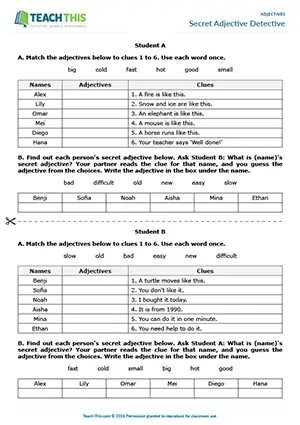
ESL Basic Adjectives Game - Vocabulary and Speaking: Matching, Asking and Answering Questions, Guessing, Controlled Practice - Pair Work In this basic adjectives game, students first match six adjectives to clues and then ask and answer questions to find out six more secret adjectives. First, in two groups, students match adjectives to clues. Next, students pair up with someone from the other group. Students then take turns asking their partner about the secret adjectives of the people in the boxes at the bottom of their worksheet, e.g. 'What is Alex's secret adjective?' Their partner reads the clue for that name from Exercise A, and the other student guesses the adjective from the choices, writing their answer in the box. This continues until all the boxes are complete. The student with the most correct guesses wins the game. This resource can also be used with our 'Basic Adjectives Flashcards and Worksheet' and 'Basic Adjectives Pelmanism' game.

Adjectives Bingo

Elementary (A1-A2) 25 minutes
ESL elementary adjectives bingo game preview with matching exercises and group work activities for A1-A2 level students

ESL Adjectives Game - Vocabulary: Matching - Group Work

In this engaging adjectives game, students play bingo by making simple adjective-noun collocations. In groups of three, students take turns turning over a noun card and saying the noun. All the students then choose one adjective on their bingo...

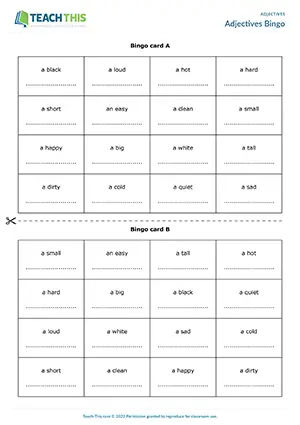
ESL Adjectives Game - Vocabulary: Matching - Group Work In this engaging adjectives game, students play bingo by making simple adjective-noun collocations. In groups of three, students take turns turning over a noun card and saying the noun. All the students then choose one adjective on their bingo card that fits the noun and write the noun on the line. For example, if the noun is 'cat', a student can write the noun in the 'a black' square to make the phrase, 'a black cat'. The first student to get four squares in a row shouts 'Bingo!' Check their phrases using the possible answers list. If the student's answers are correct, they win the round. If not, the game continues. When a student wins, the students swap cards, erase the answers and play two more rounds.

Adjective Match

Elementary (A1-A2) 25 minutes
ESL elementary adjectives matching game preview with gap-fill exercises, pelmanism activities, and pair work for A1-A2 level students

ESL Adjectives Game - Vocabulary: Matching, Gap-fill - Pair Work

In this free adjectives game, students match adjectives to short sentences and read the completed sentences aloud. In pairs, students take turns turning over one sentence card and one adjective card. If the adjective completes the gap-fill sentence...

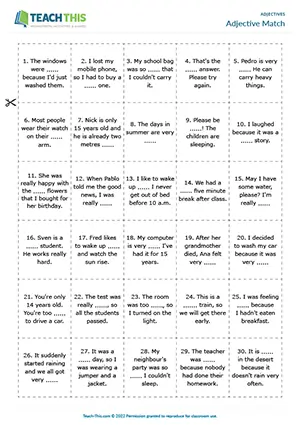
ESL Adjectives Game - Vocabulary: Matching, Gap-fill - Pair Work In this free adjectives game, students match adjectives to short sentences and read the completed sentences aloud. In pairs, students take turns turning over one sentence card and one adjective card. If the adjective completes the gap-fill sentence appropriately, the student reads the sentence aloud, replacing the missing word with the adjective on the card. The student then keeps the two cards and has another turn. If the cards don't match, the student turns them back over, keeping them in the same place, and it's the other student's turn to play. The student with the most pairs of cards at the end of the game wins.

Everyday Adjectives

Elementary (A1-A2) 30 minutes
ESL Everyday Adjectives Worksheet preview, Elementary A1-A2, matching, gap-fill, unscrambling, guessing game

ESL Everyday Adjectives Worksheet - Grammar and Vocabulary Exercises: Matching, Gap-fill - Speaking Game: Guessing, Forming Sentences - Pair Work

In this everyday adjectives worksheet, students learn and practice 12 common adjectives to describe people, prices, and everyday objects around them...

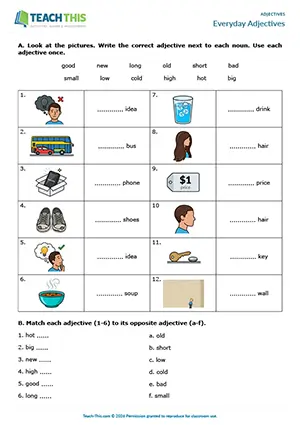
ESL Everyday Adjectives Worksheet - Grammar and Vocabulary Exercises: Matching, Gap-fill, Unscrambling - Speaking Game: Guessing, Forming Sentences - Pair Work In this everyday adjectives worksheet, students learn and practice 12 common adjectives to describe people, prices, and everyday objects around them. Students begin by looking at pictures and writing the correct adjective next to each noun. Students then match each adjective with its opposite. Next, students complete sentences with adjectives from a box. After that, students put words in the correct order to make sentences containing adjectives from the worksheet. Then, in pairs, students underline the adjective in each sentence that is true for them, without showing their partner. Finally, students take turns guessing their partner's answers, e.g. 'Your bedroom is big.' Students are allowed one guess per sentence. Their partner replies, 'Yes' or 'No'. For each correct guess a student makes, they score a point. The student with the most points wins.

A to Z

Pre-intermediate (A2) 25 minutes
ESL Adjectives Board Game preview, Pre-intermediate A2, naming adjectives, vocabulary, group work

ESL Adjectives Board Game - Vocabulary: Naming Things - Group Work

In this fun adjectives board game, students name adjectives beginning with a certain letter or name something that is related to an adjective. Players take it in turns to roll the dice and move their counter along the board. When a player lands on...

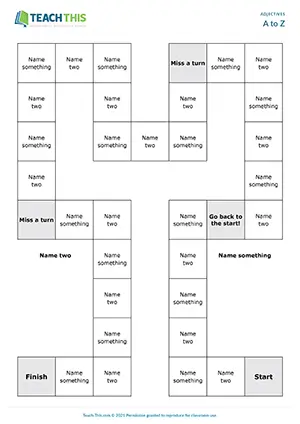
ESL Adjectives Board Game - Vocabulary: Naming Things from Prompts - Group Work In this fun adjectives board game, students name adjectives beginning with a certain letter or name something that is related to an adjective. Players take it in turns to roll the dice and move their counter along the board. When a player lands on a square, the student to their right looks at the category on the square and takes the top card from the corresponding pile, name two or name something. The student then reads the prompt on the card to the player. For the 'name two' category, the player must name two adjectives beginning with a certain letter. For the 'name something' category, the player has to name something related to the adjective indicated on the card. The other students listen and judge the player's response. If the player gives a suitable answer, they stay on the square. If not, the player goes back two spaces. The first student to reach the finish wins the game.

Adjective Associations

Pre-intermediate (A2) 20 minutes
ESL pre-intermediate adjectives game preview featuring a matching activity, word association exercise, describing, and pair work for A2 level students

ESL Adjectives Game - Vocabulary: Matching, Word Association, Describing - Pair Work

In this handy adjectives game, students practice common adjectives and adjective–noun collocations by matching pairs to nouns and then adding extra adjectives to extend the descriptions. In pairs...

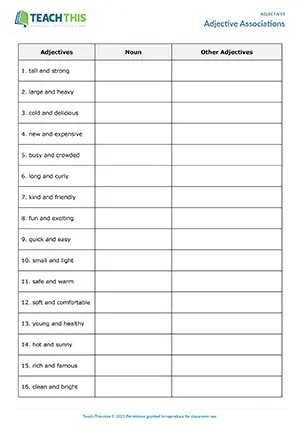
ESL Adjectives Game - Vocabulary: Matching, Word Association, Describing - Pair Work In this handy adjectives game, students practice common adjectives and adjective–noun collocations by matching pairs to nouns and then adding extra adjectives to extend the descriptions. In pairs, students begin by matching each adjective pair to a noun from the list, e.g. 'a tall and slim model'. Next, pairs write two more adjectives for each noun. For example, a 'model' can be tall and slim, and also beautiful and famous. When the pairs have finished, they swap worksheets for marking. Pairs score one point for each correct noun and one point for each adjective that fits the noun. The pair with the most points wins the game.

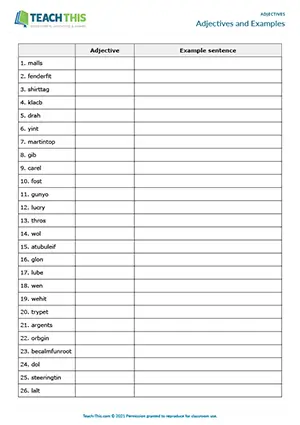
Adjectives and Examples

Pre-intermediate (A2) 45 minutes
ESL Adjectives Game preview, Pre-intermediate A2, unscrambling, writing sentences from prompts, pair work

ESL Adjectives Game - Grammar and Vocabulary: Unscrambling, Writing Sentences - Pair Work

In this enjoyable common adjectives game, students unscramble adjectives and then use each one in a sentence. In pairs, students unscramble common adjectives of opinion, size, shape, age or colour...

ESL Adjectives Game - Grammar and Vocabulary: Unscrambling, Writing Sentences from Prompts - Pair Work In this enjoyable common adjectives game, students unscramble adjectives and then use each one in a sentence. In pairs, students unscramble common adjectives of opinion, size, shape, age or colour. Pairs score one point for each correct answer. Next, pairs write an example sentence for each adjective based on things in the classroom, e.g. 'My bag is small'. Students write their sentences on the worksheet next to each adjective. Pairs then join with another pair and take it in turns to read one of their sentences to each other. The other pair listens and judges the sentence. If the sentence describes the adjective and is grammatically correct, the pair scores one point. If the sentence is unsuitable or contains a grammar mistake, no points are awarded. The pair with the highest score wins.

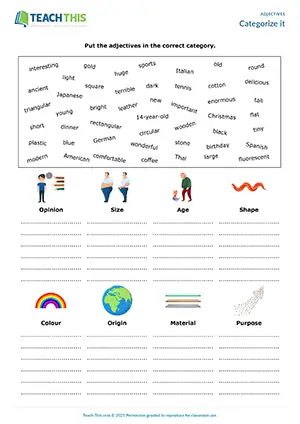
Categorize it

Pre-intermediate (A2) 30 minutes
ESL Adjectives Game preview, Pre-intermediate A2, categorizing, forming sentences from prompts, group work

ESL Adjectives Game - Vocabulary and Speaking: Categorizing, Forming Sentences - Group Work

In this creative adjectives game, students race to categorize adjectives and then make sentences with them. In teams, students race to categorize the adjectives of opinion, size, age, shape, colour, origin...

ESL Adjectives Game - Vocabulary and Speaking: Categorizing, Forming Sentences from Prompts - Group Work In this creative adjectives game, students race to categorize adjectives and then make sentences with them. In teams, students race to categorize the adjectives of opinion, size, age, shape, colour, origin, material and purpose in the box on the worksheet and write them under the appropriate heading. The first team to categorize all the adjectives correctly scores five points. Next, call out an adjective from the worksheet at random, e.g. delicious. The first student to give the correct category (i.e. adjective of opinion) and make a meaningful sentence with the adjective (e.g. This pizza tastes delicious.) scores a point for their team. The team with the most points at the end of the game is the winner. This activity can also be used as a standalone worksheet.

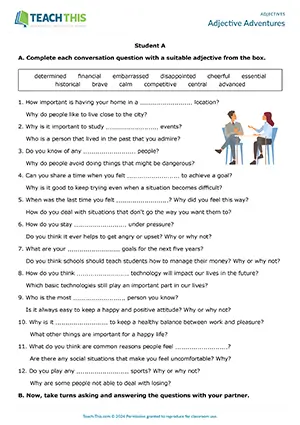
Adjective Adventures

Intermediate (B1) 30 minutes
ESL Adjectives Activity preview, Intermediate B1, completing, asking and answering questions from prompts, group and pair work

ESL Adjectives Activity - Vocabulary and Speaking: Completing Asking and Answering Questions - Group and Pair Work

In this insightful adjectives speaking activity, students complete, ask and answer conversation questions that contain adjectives. First, students complete conversation questions...

ESL Adjectives Activity - Vocabulary and Speaking: Completing Asking and Answering Questions from Prompts, Controlled and Freer Practice - Group and Pair Work In this insightful adjectives speaking activity, students complete, ask and answer conversation questions that contain adjectives. First, students complete conversation questions with adjectives from a box. Next, students pair up with someone from the other group. Students then take turns asking the conversation questions to their partner, who responds accordingly. For the first question in each set, students include the corresponding adjective in their response. Finally, students share what they learned about their partner with the class.

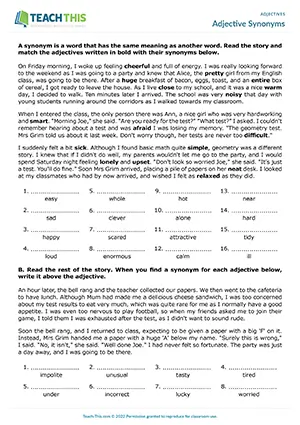
Adjective Synonyms

Intermediate (B1) 25 minutes
ESL Adjectives Worksheet preview, Intermediate B1, matching, identifying, replacing, gap-fill

ESL Adjectives Worksheet - Vocabulary Exercises: Matching, Identifying, Replacing, Gap-fill

In this free adjectives worksheet, students learn and practice adjective synonyms. Students start by reading a story and matching adjectives in bold with their synonyms. Next, students...

ESL Adjectives Worksheet - Vocabulary Exercises: Matching, Identifying, Replacing, Gap-fill In this free adjectives worksheet, students learn and practice adjective synonyms. Students start by reading a story and matching adjectives in bold with their synonyms. Next, students read the rest of the story. When students find a synonym for each adjective shown, they write it above the adjective. Students then move on to replace adjectives in sentences with their synonyms. Lastly, students complete sentences with the adjectives from the story or their synonyms.

Common Adjectives Crossword

Intermediate (B1) 35 minutes
ESL Adjectives Activity preview, Intermediate B1, writing definitions, describing, guessing, group and pair work

ESL Adjectives Activity - Vocabulary: Writing Definitions, Describing, Guessing - Group and Pair Work

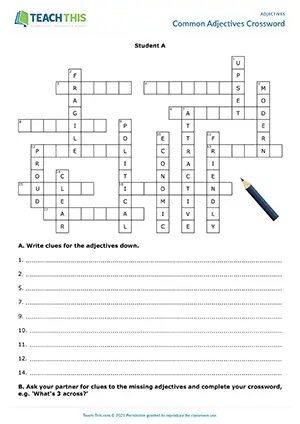
In this inventive adjectives activity, students complete a crossword by describing and guessing common adjectives. In two groups, students invent and write down clues for the adjectives written on their...

ESL Adjectives Activity - Vocabulary: Writing Definitions, Describing, Guessing - Group and Pair Work In this inventive adjectives activity, students complete a crossword by describing and guessing common adjectives. In two groups, students invent and write down clues for the adjectives written on their crossword. Next, students pair up with someone from the other group and take it in turns to ask their partner for a clue to one of their missing adjectives. Their partner reads out the clue for that adjective and the other student tries to guess what it is. If the student correctly guesses the adjective, they write it on their crossword. If not, their partner continues to give more clues until the student is able to guess the word. Afterwards, students check their spelling by comparing crosswords.

Crazy Sentences Game

Intermediate (B1) 55 minutes
ESL Adjectives Game preview, Intermediate B1, writing sentences from prompts, group work

ESL Adjectives Game - Grammar and Vocabulary: Writing Sentences - Group Work

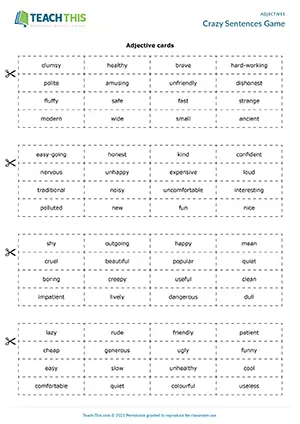
Here is an entertaining adjectives game to help students practice making sentences with adjectives and nouns. Each team turns over one adjective card and one noun card. The teams then race to construct the longest sentence possible with...

ESL Adjectives Game - Grammar and Vocabulary: Writing Sentences from Prompts - Group Work Here is an entertaining adjectives game to help students practice making sentences with adjectives and nouns. Each team turns over one adjective card and one noun card. The teams then race to construct the longest sentence possible with the adjective and noun and write it on the board. After three minutes, check each team's sentence. Teams score one point if a sentence is grammatically correct, another point for inventiveness, and one point for every word in the sentence. If a team writes a grammatically incorrect sentence, they score no points, but other teams can steal a point by successfully correcting the sentence. Teams then discard the adjective and noun, turn over two new cards, and the game continues. The team with the most points at the end of the game wins.

Educational Adjectives

Upper-intermediate (B2) 30 minutes
ESL Adjectives Crossword preview, Upper-intermediate B2, writing clues, describing, guessing, group and pair work

ESL Adjectives Crossword - Vocabulary and Speaking Activity: Writing Clues, Describing, Guessing - Group and Pair Work

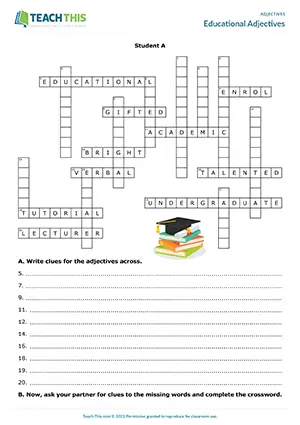
In this productive adjectives activity, students complete a crossword by describing and guessing adjectives related to education. In two groups, students work together to invent and write down clues for the...

ESL Adjectives Crossword - Vocabulary and Speaking Activity: Writing Clues, Describing, Guessing - Group and Pair Work In this productive adjectives activity, students complete a crossword by describing and guessing adjectives related to education. In two groups, students work together to invent and write down clues for the educational adjectives written on their crossword. Next, students pair up with someone from the other group and take turns asking their partner for a clue to one of their missing adjectives. Their partner reads out the clue for that word, and the other student tries to guess what it is. If the student guesses the adjective successfully, they write it on their crossword. If not, their partner continues to give more clues until the student is able to guess the word. Lastly, students check their spelling by comparing crosswords.

Extreme Adjectives Challenge

Upper-intermediate (B2) 20 minutes
ESL Adjective Game preview, Upper-intermediate B2, matching, gap-fill, group work

ESL Adjective Game - Vocabulary: Matching, Gap-fill - Group Work

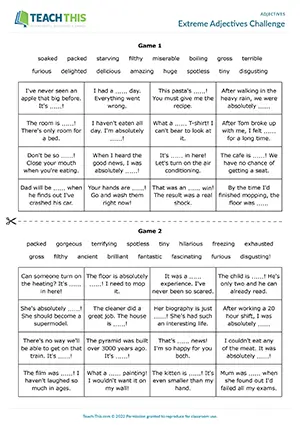
Here is a rewarding extreme adjectives game for upper-intermediate students. In groups of three, two students play the first game and one student acts as judge. The players take it in turns to choose a square and complete the sentence in the square...

ESL Adjective Game - Vocabulary: Matching, Gap-fill - Group Work Here is a rewarding extreme adjectives game for upper-intermediate students. In groups of three, two students play the first game and one student acts as judge. The players take it in turns to choose a square and complete the sentence in the square using one of the extreme adjectives above the board. The student acting as judge then checks the answer sheet. If the extreme adjective is correct, the player marks the square with an 'O' or 'X' accordingly. It's then the other player's turn to choose a square. The first player to get four squares in a row wins the game. Afterwards, students play a second game, giving the student who acted as judge a chance to play.

Extreme Adjective Dominoes

Upper-intermediate (B2) 20 minutes
ESL Adjective Game preview, Upper-intermediate B2, matching, group work

ESL Adjective Game - Vocabulary: Matching - Group Work

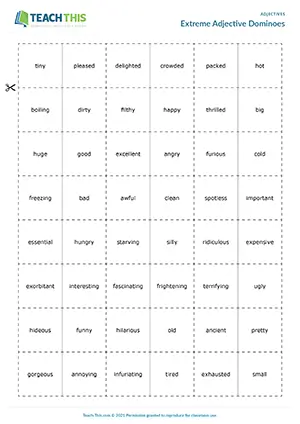
In this fun adjectives game, students play dominoes by matching adjectives with their stronger equivalents. This activity helps students learn to recognize adjectives that have a similar but meaning, e.g. angry and furious, cold and freezing, etc...

ESL Adjective Game - Vocabulary: Matching - Group Work In this fun adjectives game, students play dominoes by matching adjectives with their stronger equivalents. This activity helps students learn to recognize adjectives that have a similar but stronger meaning, e.g. angry and furious, cold and freezing, etc. The first player puts down one of their dominoes on either side of the domino on the table, making sure that one of the adjectives on their domino matches with one of its stronger or weaker equivalents. The next player then puts down an adjective at either end of the domino chain and so on. The first player to get rid of all their dominoes wins the game.

Hand in my Pocket

Upper-intermediate (B2) 30 minutes
ESL Adjectives Activity preview, Upper-intermediate B2, listening, gap-fill, group discussion

ESL Adjectives Activity - Listening and Vocabulary: Gap-fill - Group Work - Speaking Activity: Classroom Discussion

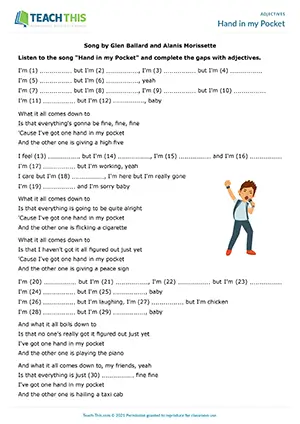
In this interesting adjectives activity, students complete a song gap-fill with adjectives and then discuss the meaning of the adjectives and song. In teams, listen to the song "Hand in my Pocket" by Alanis Morissette...

ESL Adjectives Activity - Listening and Vocabulary: Gap-fill - Group Work - Speaking Activity: Classroom Discussion In this interesting adjectives activity, students complete a song gap-fill with adjectives and then discuss the meaning of the adjectives and song. In teams, students listen to the song "Hand in my Pocket" by Alanis Morissette and complete the song gap-fill with adjectives. When the students have listened to the song two times, they compare and discuss their answers in their teams. Students then listen to the song one more time and confirm their answers with their teammates. After that, teams take it in turns to choose a number and write the missing adjective on the board. Teams score one point for each correct adjective and one point for spelling. If a team spells an adjective incorrectly, another team can steal a point by being the first to correct the spelling. The team with the most points wins. Finally, students discuss the meaning of the adjectives and song.

Restaurant Reviews

Upper-intermediate (B2) 40 minutes
ESL Adjectives Worksheet preview, Upper-intermediate B2, writing notes, categorising, gap-fill, paragraph writing, information exchange

ESL Adjectives Worksheet - Vocabulary and Writing Exercises: Writing Notes, Categorising, Gap-fill, Paragraph Writing - Speaking Activity: Information Exchange

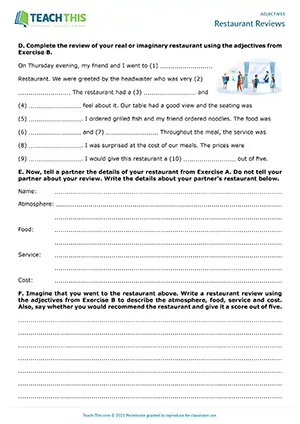
In this productive adjectives worksheet, students learn adjectives to describe atmosphere, food, service and cost of a real or imaginary restaurant...

ESL Adjectives Worksheet - Vocabulary and Writing Exercises: Writing Notes, Categorising, Gap-fill, Paragraph Writing - Speaking Activity: Information Exchange In this productive adjectives worksheet, students learn adjectives to describe atmosphere, food, service and cost, and practice using them in restaurant reviews. Students begin by writing details about the name, atmosphere, food, service and cost of a real or imaginary restaurant. Students then categorize 24 adjectives, according to which aspect of a restaurant experience they best describe. Students then move on to complete a review of their real or imaginary restaurant using the adjectives. After that, students tell a partner the details of their restaurant from the first exercise. Students note down the details of their partner's restaurant and then write a restaurant review using the adjectives to describe the atmosphere, food, service and cost. Students also say whether they would recommend the restaurant and give it a score out of five. Finally, students read their restaurant review to their partner and discuss any similarities or differences.