
Proper Adjectives ESL Worksheets, Games & Activities
All Over the World
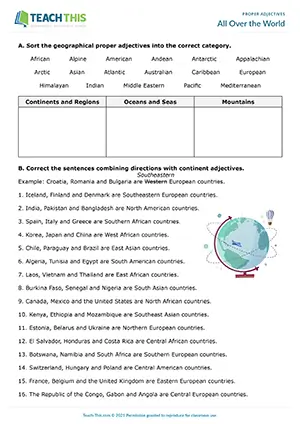
ESL Proper Adjectives Worksheet - Grammar and Vocabulary Exercises: Categorising, Error Correction, Gap-fill, Matching
This free proper adjectives worksheet helps students learn and practice how to use proper adjectives for continents, regions, oceans, seas and mountains. Students begin by sorting geographical...
Country Adjectives
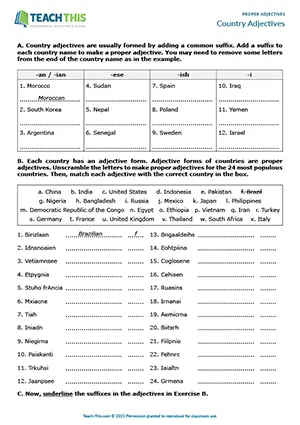
ESL Proper Adjectives Worksheet - Grammar and Vocabulary Exercises: Word Forms, Unscrambling, Identifying, Error Correction, Gap-fill
This productive proper adjectives worksheet helps students learn and practice country adjectives. Students start by unscrambling letters to find proper...
Proper Adjectives Crossword
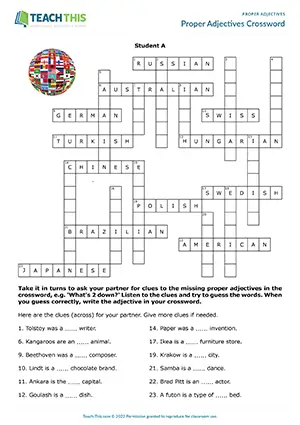
ESL Proper Adjectives Activity - Vocabulary and Speaking: Asking for and Giving Clues, Guessing - Pair Work
In this rewarding proper adjectives activity, students complete a crossword by listening to clues and guessing proper adjectives. In pairs, students take it in turns to ask their partner for clues to the missing proper...
I am Spartan!
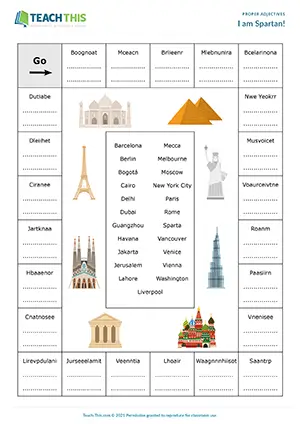
ESL Proper Adjectives Board Game - Vocabulary: Unscrambling, Matching - Group Work
Here is an engaging proper adjectives board game to help students learn and practice city adjectives. Students take it in turns to roll the dice and move their counter along the board. When a student lands on...
Understanding Proper Adjectives
Proper adjectives are adjectives formed from proper nouns, the names of specific people, places, languages, or groups, such as 'French' from France or 'Victorian' from Queen Victoria. When students write the base noun instead of the adjective form, or forget to capitalize, the error stands out immediately and signals a gap in vocabulary accuracy that undermines their writing as a whole.
This page covers proper adjectives at B1 and B2 levels, with four resources including worksheets, a crossword activity, and a board game, with one available as a free download.
Each suffix pattern below applies to a different group of country and place names, and a small number of common proper adjectives are irregular and must simply be learned. The table below shows the main suffix patterns used to form proper adjectives from place and country names, along with examples of irregular forms that follow no predictable rule.
| Suffix | Typically Added To | Example Proper Adjective | Example Phrase |
|---|---|---|---|
| -an / -ian | country or city names | American, Brazilian, Italian | 'an American diner' |
| -ish | some European country names | Spanish, Swedish, Turkish | 'a Swedish design' |
| -ese | some Asian and European country or city names | Japanese, Portuguese, Viennese | 'a Japanese garden' |
| -i | some Middle Eastern and South Asian country names | Iraqi, Pakistani, Israeli | 'a Pakistani writer' |
| -ic | historical, cultural, or geographical proper nouns | Nordic, Icelandic, Socratic | 'a Nordic landscape' |
| Irregular | no predictable suffix pattern | French, Dutch, Greek | 'a French cafe' |
When to Use Proper Adjectives
Identifying origin or nationality: A writer uses a proper adjective to signal the national or cultural origin of something concisely when the noun phrase alternative would feel clunky, as in 'a Greek philosopher' rather than 'a philosopher from Greece.'
Describing cuisine and cultural products: Proper adjectives let speakers categorize food, art, music, or customs by their place of origin in a way that feels natural in everyday conversation, as in 'We had Thai food and watched a French film.'
Academic and professional attribution: In formal writing, proper adjectives let writers attribute theories, movements, and methods to their historical or geographic source without lengthy explanation, as in 'The Keynesian approach to economics shaped post-war policy.'
3-Step Framework for Teaching Proper Adjectives
1. Build the Category Base: Start students with geographical proper adjectives by having them sort adjective forms into categories covering continents, regions, oceans, seas, and mountains. Then sharpen accuracy by asking them to correct sentences that combine direction words with continent adjectives, which is a common area of confusion at this level.
2. Master the Suffix: Move students from recognition to production by focusing on country adjectives. They build new forms by adding a suffix to each country name, then finish by writing sentences that are true for them using a noun and a country adjective, which takes the form from controlled practice into genuine personal expression.
3. Race and Compete: Run a competitive board game where students unscramble adjective forms and match them to the correct place name to claim squares on the board. The steal mechanic keeps every student alert even when it is not their turn: if a player lands on an already-contested square and solves it faster, they can steal the square from the other student.
Common Mistakes with Proper Adjectives
Incorrect suffix choice for country adjectives: Students often apply the wrong suffix when forming a country adjective, producing a non-existent form because they overgeneralize a suffix pattern they already know. Wrong: 'I tried some Japanian food on my trip.' Correct: 'I tried some Japanese food on my trip.'
Using the country name instead of an irregular proper adjective form: Students often place the country name directly before a noun when the correct proper adjective has an irregular form unrelated to the country name, because there is no suffix pattern to guide them. Wrong: 'She bought a Switzerland watch.' Correct: 'She bought a Swiss watch.'
Common Questions About Teaching Proper Adjectives
What is a useful worksheet for teaching proper adjectives?
The free worksheet All Over the World takes students through geographical proper adjectives in four steps. They sort adjective forms into categories, correct sentences that combine direction words with continent adjectives, complete a gap-fill, and match phrases containing proper adjectives with their definitions.
What is a fun board game for practicing proper adjectives?
The board game I am Spartan! keeps students competing for every square on the board. Students unscramble a city adjective, match it with the correct city from a central box, and write their name in the square to claim it. Any player who lands on the same square and solves it faster can steal it.
Become a Teach This Member
Get unlimited access to the full library, plus new resources added every week.
Unlimited Resource Access
Download from 3000+ worksheets, activities, and games.
Save 5+ Hours Weekly
Cut lesson prep time with ready-to-use resources, plus teacher notes and answer keys.
Trusted Professional Quality
Classroom-tested, editable resources created by experienced ESL professionals.
Fresh Content Weekly
Get 5 new resources added to the library each week.
Here's what our members are saying...


