
Verb to be ESL Games, Activities & Worksheets
It Must Be Correct
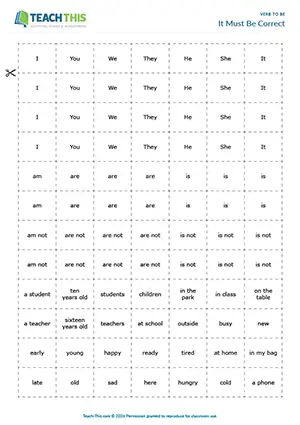
ESL Verb to be Game - Grammar: Sentence Building - Group Work
In this free verb 'to be' game, students practice building short affirmative and negative sentences with 'am', 'is' and 'are'. In groups, players take turns making a sentence with their cards by putting three cards face up in a row on the table...
Aiko and Richard

ESL Verb to be Activity - Grammar and Speaking: Role-Play, Writing, Asking and Answering Questions - Pair Work
In this useful verb 'to be' role-play activity, students take on the role of Aiko or Richard and ask and answer simple personal information questions with the verb 'to be' to complete a profile. Working...
Are you...?

ESL Verb to be Game - Grammar and Speaking: Bingo, Asking and Answering Questions, Controlled Practice
In this engaging verb 'to be' game, students race to complete a bingo card by finding classmates who answer 'Yes, I am.' to 'Are you...?' questions. Students go around the class asking 'Are you...?'...
Find Out

ESL Verb to be Activity - Grammar and Speaking: Information Gap, Asking and Answering Questions - Group Work
In this productive verb 'to be' information gap activity, students find out personal information about four people and practice Wh questions and answers with the verb 'to be'. First, students take on the role of...
Park Street
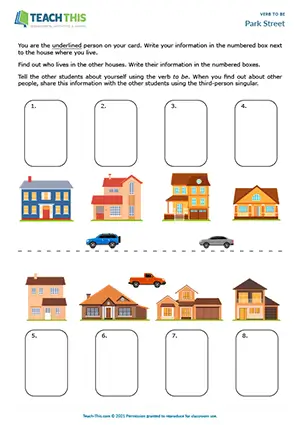
ESL Verb to be Activity - Grammar and Speaking: Asking and Answering Questions from Prompts - Group Work
In this enjoyable verb 'to be' activity, students practice exchanging information about different people living on a street. First, students take on the role of the person on their card and write their...
Snap It Up

ESL Verb to be Game - Grammar: Snap, Matching - Pair Work
In this fast-paced verb 'to be' game, students race to match yes/no questions with short answers. In pairs, both students turn over a card from their pile at the same time and place them on the table next to each other. If the yes/no question and short...
Verb To Be Board Game

ESL Verb to be Board Game - Grammar and Speaking: Forming Sentences and Questions - Group Work
This enjoyable verb 'to be' board game helps students practice making present simple affirmative and negative sentences and questions with the verb 'to be'. In groups, players take turns rolling the...
Verb To Be Practice
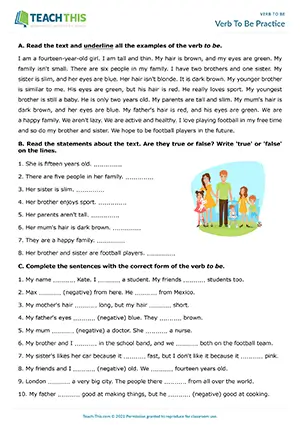
ESL Verb to be Worksheet - Reading and Grammar Exercises: Identifying, True or False, Gap-fill - Speaking Activity - Asking and Answering Questions
In this free verb 'to be' worksheet, students practice the present simple of the verb 'to be' in sentences, questions and short answers. First, students read a text...
Where are you from?

ESL Verb to be Game - Grammar, Speaking and Writing: Forming and Writing Sentence, Memorising
In this rewarding verb 'to be' game, students use the verb 'to be' to talk about cities and nationalities and then test how much information they can remember about their classmates. First, students...
Past and Present

ESL Verb to be Worksheet - Grammar and Writing Exercises: Gap-fills, Writing Answers, Binary Choice, Writing an Email
This insightful verb to be worksheet helps students practice the past and present simple of the verb to be: am, are, is, was and were as well as their negative forms. First, students complete a text with am, is, are...
Secret Identity
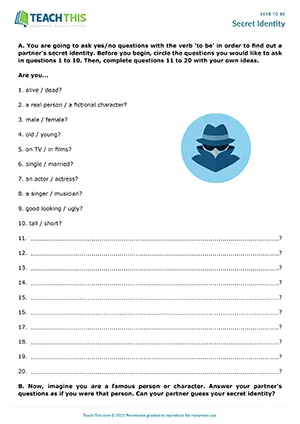
ESL Verb to be Game - Grammar and Speaking: Writing, Asking and Answering Questions - Pair Work
In this entertaining verb to be guessing game, students ask yes/no questions with the verb 'to be' in order to find out a partner's secret identity. First, students circle the questions they would like to ask...
Whose dogs are these?

ESL Verb to be Activity - Grammar and Speaking: Information Gaps, Completing, Asking and Answering Questions, Matching - Pair Work
In this comprehensive verb to be information gap activity, students practice asking and answering questions with the verb 'to be'. First, students complete...
To be or not to be
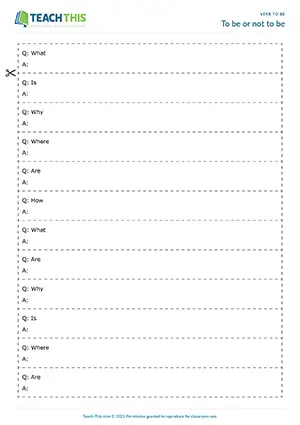
ESL Verb to be Game - Grammar and Writing: Writing Questions and Answers, Guessing - Group Work
In this creative verb to be game, students write and respond to questions with the verb 'to be'. First, students think of a personal information question beginning with the word on their question slip and...
Understanding the Verb to be
The verb to be is the most fundamental verb in English; it states who someone is, what something is, and what people and things are like. Getting its three present forms right, 'am', 'is', and 'are', matters immediately: a student who writes 'She are happy' or 'They is tired' signals a basic grammatical gap that undermines everything else they write or say.
This page covers the verb to be across A1, A1-A2, A2, and B1 levels, with 13 activities including sentence-building card games, bingo, role-plays, information gaps, a board game, and worksheets, with two activities available as free downloads.
The verb to be has more irregular forms than any other English verb; the table below maps the affirmative and negative forms for each subject across the present and past simple, and questions are formed by inverting the subject and verb, for example 'Is she a doctor?'
| Subject | Present Affirmative | Present Negative | Past Affirmative | Past Negative | Example |
|---|---|---|---|---|---|
| I | am | am not / I'm not | was | was not / wasn't | 'I am a teacher. I was at home.' |
| You | are | are not / aren't | were | were not / weren't | 'You are right. You were wrong.' |
| He / She / It | is | is not / isn't | was | was not / wasn't | 'She is kind. He was tired.' |
| We | are | are not / aren't | were | were not / weren't | 'We are ready. We were early.' |
| They | are | are not / aren't | were | were not / weren't | 'They are here. They were late.' |
When to Use the Verb to be
Personal Introduction: Speakers reach for the verb to be first when introducing themselves or describing someone's role in a new setting, because it links a person directly to their identity, job, or nationality, as in 'She is our new project manager and she is originally from Seoul.'
Describing States and Feelings: When a speaker wants to describe a current condition, emotion, or physical state rather than an action, the verb to be is the natural choice, since it presents a fact about a person or thing rather than describing what they do, as in 'He is exhausted and the deadline is tomorrow.'
Locating People and Things: Writers and speakers use the verb to be to place people, objects, or events in a specific location or time frame when no action verb is needed, as in 'The conference is in London next week and all the senior managers are already there.'
3-Step Framework for Teaching the Verb to be
1. Controlled Form Building: Start with a card-based sentence-building activity where students construct short affirmative and negative sentences by placing three cards in a row on the table, one for the subject, one for the verb form, and one for the ending, then read the result aloud. A player who cannot make a sentence takes a card from the top of the draw pile, puts one of their cards at the bottom, and misses a turn, which keeps every student accountable to the form from the very first practice stage.
2. Communicative Question Practice: Move into a mingle activity where students practice 'Are you...?' questions under a bingo format, racing to fill five squares in a row with classmates' names. A strict one-question-per-person rule keeps the language focused: each time a student speaks to a classmate, they are only allowed to ask one question and then must move on, which drives far more repetitions of the target form than a free conversation would.
3. Freer Production with Built-In Feedback: Consolidate with a board game where students produce both sentences and questions from prompts. When a player lands on a 'Question' square, they pick up a card and use the prompt to form a question with the verb 'to be', asking it to another student who must answer it, and landing an incorrect form sends the player back two squares, giving instant error feedback without stopping the game.
Common Mistakes with the Verb to be
Omitting the Verb to Be: Students often drop the verb to be entirely when the meaning seems clear from context, particularly in sentences that link a subject to a noun or adjective, a pattern carried over from languages where the verb can be left out. Wrong: 'She a teacher.' Correct: 'She is a teacher.'
Confusing 'was' and 'were': Students often use 'was' with plural subjects because the present simple distinction between 'is' and 'are' does not map onto past forms in the way learners expect, leading them to treat 'was' as the default past form for every subject. Wrong: 'They was very happy yesterday.' Correct: 'They were very happy yesterday.'
Common Questions About Teaching the Verb to be
What is a useful worksheet for practicing the verb to be?
The worksheet Verb To Be Practice is a free download covering every core form in one lesson. Students read a text about a family, underline all examples of the verb 'to be', then work through gap-fills, true/false sentences, and mini-dialogues using am, am not, is, isn't, are, and aren't, before a 'Find Someone Who' mingle closes the session.
What is a fun game for practicing yes/no questions with the verb to be?
The game Secret Identity gives students a real reason to keep asking questions: they try to uncover a partner's secret identity by asking yes/no questions they have written themselves. The partner responds 'Yes, I am' or 'No, I'm not' to each one, and a class feedback session at the end reveals who asked the most and least questions.
What is a good speaking activity for practicing the verb to be?
Information gap activities push every student to use the verb to be because each person holds details the others need. In the activity Find Out, students take on the role of the person in their chart and go around their group asking and answering questions in character to complete the missing details. The class then checks answers together.
Become a Teach This Member
Get unlimited access to the full library, plus new resources added every week.
Unlimited Resource Access
Download from 3000+ worksheets, activities, and games.
Save 5+ Hours Weekly
Cut lesson prep time with ready-to-use resources, plus teacher notes and answer keys.
Trusted Professional Quality
Classroom-tested, editable resources created by experienced ESL professionals.
Fresh Content Weekly
Get 5 new resources added to the library each week.
Here's what our members are saying...


