
Common & Proper Nouns ESL Games & Worksheets
Brand Name Game
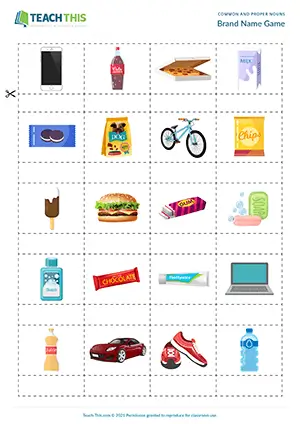
ESL Common and Proper Nouns Game - Vocabulary: Word Association, Matching - Group Work
In this engaging common and proper nouns game, students associate brand names with pictures of common nouns and play a game where they race to find proper nouns that correspond with the common...
Common or Proper?
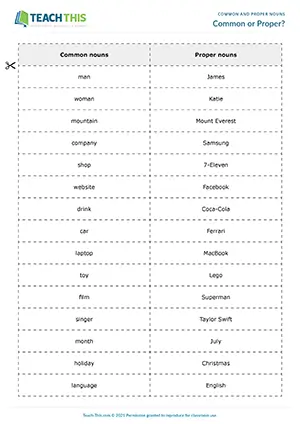
ESL Common or Proper Noun Game - Vocabulary: Categorising, Forming Sentences, Freer Practice, Matching - Pair Work
This free common and proper nouns game is useful for illustrating the difference between the two types of nouns. First, in pairs, students sort common nouns...
Know Your Nouns
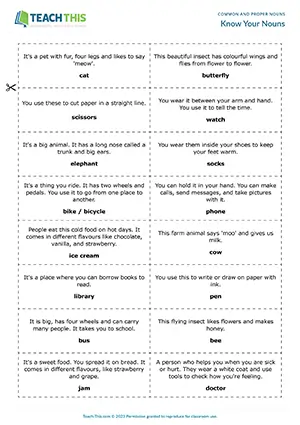
ESL Common and Proper Nouns Game - Grammar and Vocabulary: Naming, Categorising, Spelling - Group Work
In this common and proper nouns board race game, teams race to name, categorise and spell common and proper nouns. You start by reading a description of a noun from a card. The students in each team...
Common to Proper
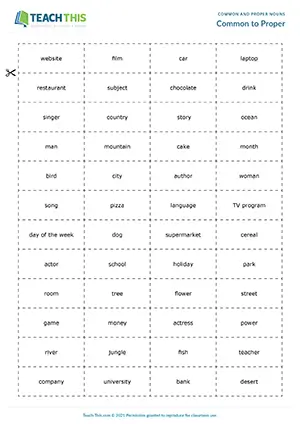
ESL Common and Proper Nouns Game - Vocabulary: Word Association - Group Work
In this fast-paced common and proper nouns game, students race to change common nouns to proper nouns. One student goes first, picks up a card from their pile, and reads the common noun on the card to the group, e.g. website. The other...
Geography Nouns

ESL Common and Proper Nouns Worksheet - Vocabulary Exercises: Categorising, Matching, Identifying, Error Correction, Writing Sentences
In this useful common and proper nouns worksheet, students identify and practice using common and proper nouns. Students begin by putting nouns...
Proper Jeopardy

ESL Common and Proper Nouns Game - Vocabulary: Binary Choice, True or False, Identifying, Categorising, Providing Examples - Group Work
Here is a fun common and proper nouns game to play in class. Draw a Jeopardy-style quiz board with points at the top and categories down the side. Choose a...
Understanding Common and Proper Nouns
A common noun names a general type of person, place, or thing, such as 'city,' 'teacher,' or 'restaurant.' A proper noun names one specific example of that type, such as 'Paris,' 'Dr. Kim,' or 'McDonald's,' and always begins with a capital letter. When students forget to capitalize proper nouns, or write a proper noun in lowercase, their writing signals a gap in basic literacy to any English-speaking reader.
This page covers common and proper nouns at Elementary and Pre-intermediate levels, with six resources including group card games, a board race game, and a worksheet, one of which is available as a free download.
The table maps the main categories of common and proper nouns, with a common noun example, its corresponding proper noun, and the capitalization rule that applies to each category.
| Noun Category | Common Noun | Proper Noun | Capitalization Note |
|---|---|---|---|
| Person | teacher | Dr. Kim | Capitalize the name and any title, e.g. 'Dr. Kim teaches at the school.' |
| City | city | Berlin | Capitalize the city name, e.g. 'She has always wanted to live in Berlin.' |
| Country | country | Brazil | Capitalize the country name, e.g. 'They are moving to Brazil next year.' |
| Company | company | Capitalize the full company name, e.g. 'He got a job at Google.' | |
| Product/Brand | car | Toyota | Capitalize the brand name, e.g. 'She drives a Toyota.' |
| Day/Month | day | Monday | Capitalize days of the week and months, e.g. 'The trip starts on Monday.' |
| Language/Nationality | language | Spanish | Capitalize languages and nationalities, e.g. 'He is learning Spanish.' |
When to Use Common and Proper Nouns
Pinpointing One Specific Person, Place, or Thing: When you need to identify one exact entity rather than any member of a general category, a proper noun removes all ambiguity, so 'She studied at Cambridge' tells the reader far more precisely where she went than 'She studied at a university.'
Formal Written Communication and Correspondence: In letters, reports, and official documents, using the correct proper noun for an organization or institution signals professional accuracy, as in 'Please forward this report to the Human Resources Department at Siemens' rather than a vague reference to a department at a company.
Referring to a Brand or Product in Everyday Speech: In casual and commercial communication, people use proper nouns for brand names because they carry instant recognition that a common noun cannot provide, as in 'Let's grab a coffee at Starbucks' rather than 'Let's grab a coffee at a coffee shop.'
3-Step Framework for Teaching Common and Proper Nouns
1. Build the Concept Through Real-World Associations: Start by tapping into what students already know. Students write a brand name for each common noun picture on their worksheet, then cut the sheet into picture cards and word cards. One student holds the picture cards, calls out a common noun like 'hamburger,' and the rest of the group race to grab the matching proper noun card. A correct answer such as 'Whopper' wins the card pair, and the student with the most cards wins the round.
2. Reinforce Spelling and Categorization With a Board Race: Move to a team game that adds writing accuracy to the recognition task. You read a noun description from a card, teams discuss the noun, and one team member runs to the board to write it under the correct column. The spelling rule is built into the scoring: the noun must be in lowercase for a common noun and capitalized for a proper noun, or the team does not score the point.
3. Push for Fast, Independent Production: Finish with a fast-paced card game that pushes students to produce proper nouns quickly under time pressure. One student reads a common noun from their pile, such as 'website,' and the rest race to call out a matching proper noun. The first student to give a correct answer, like 'Facebook,' wins the card.
Common Mistakes with Common and Proper Nouns
Capitalizing Common Nouns: Students often capitalize common nouns because the word feels important or because the equivalent word is capitalized in their first language. Wrong: 'My Father is a Doctor and he loves his Job.' Correct: 'My father is a doctor and he loves his job.'
Failing to Capitalize Languages and Nationalities: Students often write languages, nationalities, and adjectives derived from country names in lowercase, treating them as common nouns rather than proper nouns. Wrong: 'She speaks french and studies italian literature.' Correct: 'She speaks French and studies Italian literature.'
Common Questions About Teaching Common and Proper Nouns
What is a fun game for practicing common and proper nouns?
Students in the game Common or Proper? take turns placing noun cards under the correct heading, scoring a point for each correctly matched noun and racing to score an extra point by making a meaningful sentence with it. The pair with the most points wins, and an optional pelmanism round adds extra practice matching common and proper noun pairs.
What is a useful worksheet for common and proper nouns?
The worksheet Geography Nouns takes students from categorization to free writing in four steps. Students sort nouns under common or proper headings, match each common noun to its proper noun partner, underline common nouns and capitalize proper nouns in a set of sentences, then write their own sentences using the proper nouns from the worksheet.
What is an engaging game for reviewing common and proper nouns?
In the game Proper Jeopardy, teams choose a square from a quiz board, for example 'true or false 100,' and answer the matching question, such as 'True or false? The word table is a proper noun.' Any team can answer each question, and the team with the most points at the end of the game wins.
Become a Teach This Member
Get unlimited access to the full library, plus new resources added every week.
Unlimited Resource Access
Download from 3000+ worksheets, activities, and games.
Save 5+ Hours Weekly
Cut lesson prep time with ready-to-use resources, plus teacher notes and answer keys.
Trusted Professional Quality
Classroom-tested, editable resources created by experienced ESL professionals.
Fresh Content Weekly
Get 5 new resources added to the library each week.
Here's what our members are saying...


