
Prepositions of Movement ESL Games & Worksheets
Across, Over and Through
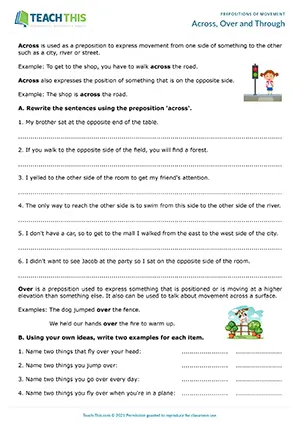
ESL Across, Over and Through Worksheet - Grammar and Vocabulary Exercises: Rewriting Sentences, Writing Short Answers, Binary Choice, Gap-fill
In this useful prepositions of movement worksheet, students learn and practice the three prepositions of movement: across, over and through. First, students...
Let's Get into This
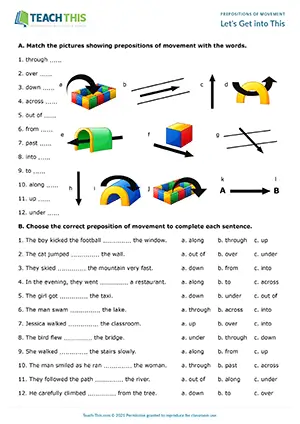
ESL Prepositions of Movement Worksheet - Vocabulary Exercises: Matching, Multiple Choice, Gap-fill, Writing Sentences
This comprehensive prepositions of movement worksheet helps students to learn and practice the prepositions of movement: through, over, down, across, out of, from, past, into, to, along, up, and...
Name Three
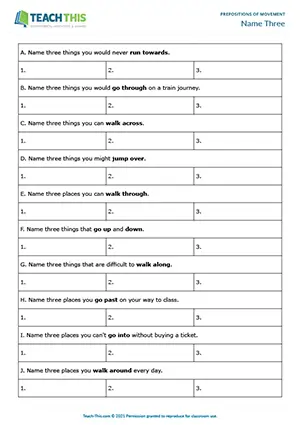
ESL Prepositions of Movement Game - Vocabulary and Speaking: Listing, Forming Sentences, Freer Practice
In this free prepositions of movement game, students name three things that correspond to different prepositions of movement. Read the first item on the worksheet to the class, i.e. 'Name three things you...
Seek it out
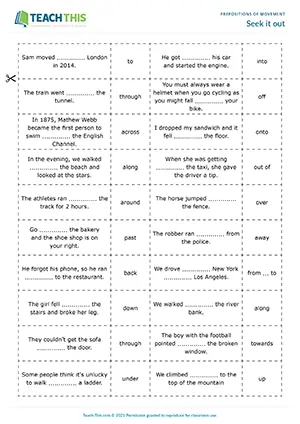
ESL Prepositions of Movement Game - Grammar: Pelmanism, Gap-fill, Matching
In this fun prepositions of movement game, students complete sentences with prepositions of movement. In pairs, students take it in turns to turn over one sentence card and one preposition card. The student then reads the sentence aloud...
Write down the sentences

ESL Prepositions of Movement Game - Grammar: Forming Sentences
In this productive prepositions of movement game, students form imperative sentences with various prepositions of movement. In groups, students take it in turns to choose a verb on the worksheet and write their name in the space below. Next...
Understanding Prepositions of Movement
Prepositions of movement are words that describe how someone or something moves from one place to another, such as 'through', 'across', 'into', and 'towards'. Students who confuse these prepositions produce sentences that suggest the wrong kind of movement, for example writing 'she walked across the tunnel' instead of 'she walked through the tunnel', which tells the reader something physically different happened.
This page covers prepositions of movement at A2 level, with five activities including worksheets, pelmanism card games, and a team brainstorming game, with one activity available as a free download.
The table below maps twelve common prepositions of movement to their core meaning and shows each one in a short example sentence.
| Preposition | Core Meaning | Example Sentence |
|---|---|---|
| across | Moving from one side to the other of a flat surface | 'She walked across the road to the other side.' |
| over | Moving above and to the other side of something | 'The cat jumped over the fence.' |
| through | Moving from one end to the other inside something | 'They drove through the tunnel in under a minute.' |
| into | Moving to the inside of something | 'He walked into the room and sat down.' |
| out of | Moving from the inside of something to the outside | 'She came out of the building and hailed a cab.' |
| up | Moving to a higher position | 'They climbed up the hill as the sun rose.' |
| down | Moving to a lower position | 'The children ran down the slope towards the park.' |
| along | Moving in a line beside something | 'We strolled along the riverbank for about an hour.' |
| past | Moving beyond a point without stopping | 'He walked past the café without going in.' |
| towards | Moving in the direction of something without necessarily arriving | 'She took a few steps towards the door, then stopped.' |
| away from | Moving in the opposite direction from something | 'The dog ran away from the noise as fast as it could.' |
| around | Moving in a curve or circle to the other side | 'They walked around the lake before heading home.' |
When to Use Prepositions of Movement
Describing a Route: Speakers use prepositions like 'along' and 'past' when they want to describe the path taken during a journey rather than just the start and end point, as in 'Turn left, walk along the high street, and go past the library until you see the bank on your right.'
Showing Entry or Exit: Writers choose 'into' and 'out of' when they want to make it clear that someone or something physically enters or leaves an enclosed space, as in 'The suspect walked into the building at 9pm and came out of the side exit twenty minutes later.'
Expressing Direction Without Arrival: Speakers use 'towards' when they want to show that someone or something is moving in the direction of a destination but may not reach it, as in 'A figure was moving towards us through the fog, but it stopped before it got close.'
3-Step Framework for Teaching Prepositions of Movement
1. Introduce the Tricky Three: Start by focusing on the three prepositions students mix up most: 'across', 'over', and 'through'. Students read about each in turn and rewrite sentences using 'across' before tackling the key distinction between 'across' and 'through'. The worksheet makes this explicit by having students read how 'through' differs from 'across' and then choose between the two in a binary-choice exercise.
2. Consolidate With a Card Game: Move students from reading about prepositions to using them under pressure with a pelmanism game. Pairs take turns flipping a sentence card and a preposition card, reading the sentence aloud with the preposition slotted in, and keeping the pair if it fits. The student with the most cards at the end wins, after which students extend the practice by reading sentence cards to their partner with the preposition left out for their partner to supply.
3. Push for Production: Once students can recognize and recall prepositions of movement, give them a sentence-writing challenge that forces them to combine vocabulary creatively. Students each claim their own set of verbs, prepositions, and nouns from the worksheet, then have five minutes to write as many imperative sentences as possible using only their chosen words, with the rule that every sentence must be realistic or physically possible.
Common Mistakes with Prepositions of Movement
Confusing 'across' and 'through': Students often use 'through' with open flat surfaces and 'across' with enclosed spaces, mixing up the two because both prepositions describe moving from one side to the other. Wrong: 'She swam through the river to reach the other bank.' Correct: 'She swam across the river to reach the other bank.'
Confusing 'into' and 'to': Students often write 'into' when they simply mean travelling to a place, not entering an enclosed space, because both prepositions involve movement toward something. Wrong: 'Every morning I take the bus into school.' Correct: 'Every morning I take the bus to school.'
Common Questions About Teaching Prepositions of Movement
What is a fun game for practicing prepositions of movement?
The game Name Three throws up unexpected, creative answers every round. Teams brainstorm three things that match a preposition of movement prompt, for example 'Name three things you would never run towards,' score a point for three suitable answers, then earn a bonus point by using the preposition in a sentence with all three answers.
What is a useful worksheet for teaching prepositions of movement?
Covering twelve prepositions of movement including into, past, along, and out of, the worksheet Let's Get into This takes students from picture-matching and multiple-choice through gap-fill practice before finishing with a set of conversation questions that puts each preposition into real spoken use.
What is a good game for practicing prepositions of movement?
For practice that moves from recognition to production, the game Seek it out is a pelmanism card game where students flip a sentence card and a preposition card, read the sentence aloud with the preposition slotted in, and keep the pair if it matches. A follow-up round has students supply the missing preposition from memory.
Become a Teach This Member
Get unlimited access to the full library, plus new resources added every week.
Unlimited Resource Access
Download from 3000+ worksheets, activities, and games.
Save 5+ Hours Weekly
Cut lesson prep time with ready-to-use resources, plus teacher notes and answer keys.
Trusted Professional Quality
Classroom-tested, editable resources created by experienced ESL professionals.
Fresh Content Weekly
Get 5 new resources added to the library each week.
Here's what our members are saying...


