
Past Perfect Simple & Continuous ESL Worksheets, Games & Activities
Match and Complete
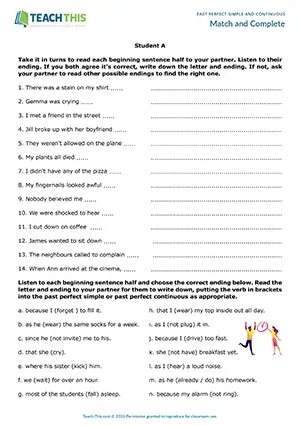
ESL Past Perfect Simple or Past Perfect Continuous Game - Grammar: Matching, Sentence Completion - Pair Work
In this fun past perfect simple or past perfect continuous game, pairs race against each other to match sentence beginnings with endings and complete the verbs in the correct past perfect form...
Past Perfect Simple or Continuous?

ESL Past Perfect Simple or Past Perfect Continuous Worksheet - Grammar Exercises: Gap-fill, Matching, Sentence Completion - Grammar Game: Miming, Guessing
In this free past perfect simple and past perfect continuous worksheet, students compare the two forms and practice choosing and forming them in context...
What's the damage?
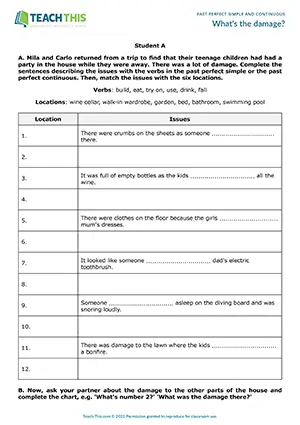
ESL Past Perfect Simple and Past Perfect Continuous Activity - Grammar and Speaking: Matching, Asking and Answering Questions, Information Gap - Pair Work
In this past perfect simple and past perfect continuous speaking activity, students describe party damage, match each problem to a place in the house...
What's the difference?

ESL Past Perfect Simple vs. Past Perfect Continuous Worksheet - Grammar Exercises: Matching, Identifying, Gap-fill, Writing Sentences, Sentence Completion
In this productive past perfect simple vs. past perfect continuous worksheet, students review how the two forms differ and practice using them in context. First...
Understanding the Past Perfect Simple and Continuous
The past perfect simple and the past perfect continuous both use 'had' to describe an action before another point in the past, but they carry different meanings. The past perfect simple, as in 'She had read the book', signals a completed action, while the past perfect continuous, as in 'She had been reading for hours', emphasizes how long the action was going on. Students who default to the simple form in every situation miss the sense of duration and ongoing effort, so a sentence like 'He was exhausted because he had worked' sounds incomplete next to 'He was exhausted because he had been working all night.'
This page covers the past perfect simple and continuous contrast at B1 and B2 levels, with four activities including a contrast worksheet, a competitive pair matching game, an information gap speaking activity, and a worksheet with a miming game extension, with one activity available as a free download.
The table below compares the past perfect simple and the past perfect continuous across eight key features to show when and why each form is used.
| Feature | Past Perfect Simple | Past Perfect Continuous |
|---|---|---|
| Form | had + past participle | had been + verb-ing |
| Focus | completed action or result | ongoing action, duration, or process |
| Stative verbs (know, want, love) | used: 'She had known him for years.' | NOT used: stative verbs take the simple form only |
| Duration signal | not the main focus | emphasizes how long: for, all day, since morning |
| Typical connectors | after, before, by the time, when, already | for, since, all day, when, by the time |
| Affirmative example | 'He had eaten before she arrived.' | 'He had been eating when she arrived.' |
| Negative example | 'They hadn't finished the report.' | 'They hadn't been sleeping well.' |
| Question example | 'Had she read the email?' | 'Had she been waiting long?' |
When to Use the Past Perfect Simple and Continuous
Showing Completed Change vs. Ongoing Effort: Speakers choose the past perfect simple when the completion of an action is the key point, but switch to the continuous when the effort or activity itself is what mattered, as in 'By the time the coach arrived, they had warmed up' versus 'They had been warming up for twenty minutes.'
Polite Explanation for Inconvenience: In professional or service contexts, the past perfect continuous signals empathy by showing that an effort was ongoing rather than simply stating a fact, making an apology or explanation sound more considerate, as in 'We apologize for the delay. Our team had been working through a technical issue since early morning.'
Stative Verbs Require the Simple Form: With verbs that describe states rather than actions, such as know, believe, want, or own, only the past perfect simple is possible, which catches many students out in writing, as in 'She had known about the problem for weeks' cannot become 'She had been knowing about the problem for weeks.'
3-Step Framework for Teaching the Past Perfect Simple and Continuous
1. Start With Visible Contrast: Before students attempt to choose between the two forms in context, they need to see clearly what makes each one distinct. A worksheet that has students first match sentence halves and then physically mark the two forms differently, underlining the past perfect simple and circling the past perfect continuous in the same sentences, gives them a concrete way to see the contrast without relying on abstract rules. Finishing with an open exercise where students complete sentences with their own ideas puts the choice in their hands from an early stage.
2. Make the Choice Communicative With a Pair Race: Once students can identify both forms, a pair race pushes them to make the right choice under time pressure. One student reads a sentence beginning aloud while their partner listens, selects a suitable ending from their own worksheet, then reads it back while putting the verb in brackets into the past perfect simple or past perfect continuous as appropriate. The competitive element comes from the race: the first pair to correctly match and complete all their sentences wins.
3. Anchor Both Forms in a Real-World Context: An information gap activity works well as a final stage because it gives students a genuine reason to produce and choose between both forms. Students work with a scenario where Mila and Carlo came home to find that their teenage children had had a party in the house while they were away and that there was a lot of damage. They complete descriptions of the damage using the past perfect simple or past perfect continuous, match issues to six places in the house, and then fill in a chart by asking their partner about damage to the parts of the house they do not have information about.
Common Mistakes with the Past Perfect Simple and Continuous
Using Continuous for Completed, Countable Actions: Students often use the past perfect continuous when the action clearly finished a specific number of times, when the simple is needed because the action is counted and complete. Wrong: 'She had been writing four reports before the deadline.' Correct: 'She had written four reports before the deadline.'
Using Continuous for Instantaneous Actions: Students often use the past perfect continuous with verbs that describe a single moment rather than an ongoing process, when only the simple form makes sense. Wrong: 'He had been arriving at the station when the train left.' Correct: 'He had arrived at the station when the train left.'
Common Questions About Teaching the Past Perfect Simple and Continuous
What is a good worksheet for teaching the difference between the past perfect simple and continuous?
A worksheet that builds from grammar practice into a speaking game works well for B2 students. The free Past Perfect Simple or Continuous? worksheet starts with gap-fill and matching exercises, then finishes with a miming game. Students read the first part of a sentence aloud, mime the ending they wrote, and their partner scores a point for each correct guess.
What is a fun speaking activity for the past perfect simple and continuous at B2 level?
A past perfect speaking activity at B2 lands best when the context gives students a real reason to choose between the two forms. What's the damage? uses a party damage scenario: students complete descriptions using the past perfect simple or continuous, match each issue to a room in the house, then ask their partner questions to complete a chart.
Become a Teach This Member
Get unlimited access to the full library, plus new resources added every week.
Unlimited Resource Access
Download from 3000+ worksheets, activities, and games.
Save 5+ Hours Weekly
Cut lesson prep time with ready-to-use resources, plus teacher notes and answer keys.
Trusted Professional Quality
Classroom-tested, editable resources created by experienced ESL professionals.
Fresh Content Weekly
Get 5 new resources added to the library each week.
Here's what our members are saying...


