
Adjective-Preposition Collocations ESL Games & Worksheets
Adjectives and Prepositions
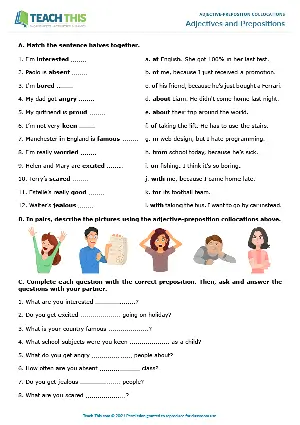
ESL Adjective-Preposition Worksheet - Vocabulary Exercises: Matching, Gap-fill - Speaking Activity: Describing, Asking and Answering Questions - Pair Work
This free adjectives and prepositions worksheet helps students to practice everyday adjective-preposition collocations. Students begin by matching...
Are you ready for this?
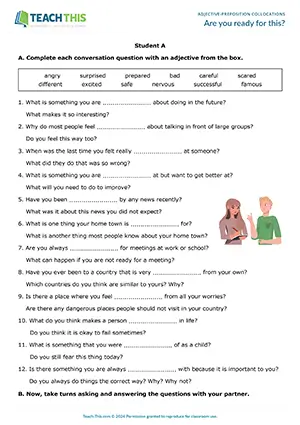
ESL Adjective-Preposition Collocations Activity - Vocabulary and Speaking: Gap-Fill, Asking and Answering Questions - Group and Pair Work
This engaging adjective-preposition collocations speaking activity helps students practice forming, asking and answering conversation questions that...
Common Collocations
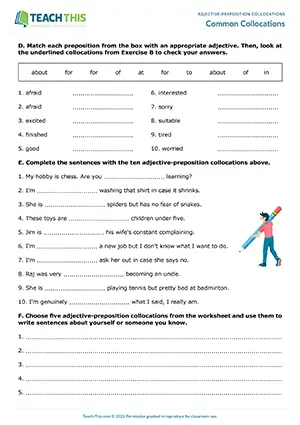
ESL Adjective-Preposition Collocations Worksheet - Reading and Vocabulary Exercises: Identifying, Matching, Gap-fill, Writing Sentences
This productive adjective-preposition collocations worksheet helps students understand and use common adjective-preposition collocations...
Are You Good at Guessing?
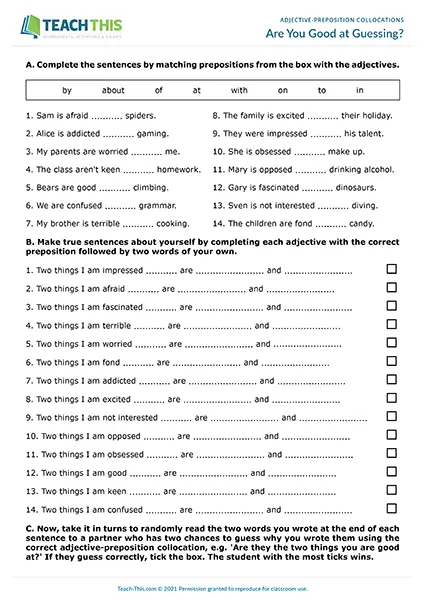
ESL Adjective-Preposition Collocation Game - Vocabulary: Matching, Gap-fill, Sentence Completion, Guessing - Pair Work
In this fun adjective-preposition collocations game, students practice matching prepositions with adjectives and then using the collocations in a guessing game. First, students complete sentences...
Connect 4
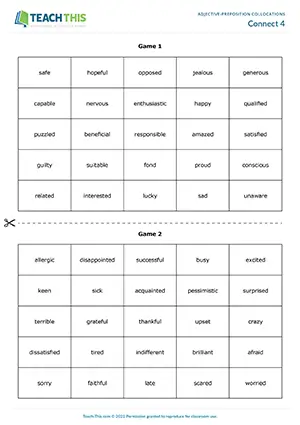
ESL Adjective-Preposition Game - Vocabulary and Speaking: Word Association, Forming Sentences - Group Work
In this engaging adjective-preposition collocations game, students add prepositions to adjectives in order order to make adjective-preposition collocations and then use them in sentences. Two students in...
Preposition Pursuit

ESL Adjective-Preposition Collocations Board Game - Vocabulary and Speaking: Forming Sentences - Group Work
In this useful adjective-preposition collocations board game, students practice making adjective-preposition collocations and using them in sentences. Players take it in turns to roll the dice and...
Understanding Adjective-Preposition Collocations
Adjective-preposition collocations are fixed pairings in which a specific adjective always takes a specific preposition, such as 'interested in,' 'good at,' or 'responsible for,' and where no grammar rule predicts which preposition is correct. Because the pairing is arbitrary, students who guess or translate from their first language will regularly attach the wrong preposition to an adjective they know perfectly well, producing errors that stand out even when everything else in the sentence is right.
This page covers adjective-preposition collocations at B1 and B2 levels, with six activities including two worksheets, two games, a speaking activity, and a board game, with one available as a free download.
Convention, not grammar rules, fixes the preposition that follows an adjective; the table below lists the most common adjective-preposition pairings at B1-B2 level with an example sentence for each.
| Adjective | Preposition | Example Sentence |
|---|---|---|
| good | at | 'She's really good at presenting data.' |
| surprised | at | 'We were surprised at the result.' |
| afraid | of | 'He's afraid of making the wrong decision.' |
| proud | of | 'They're proud of what the team achieved.' |
| tired | of | 'I'm tired of repeating myself.' |
| interested | in | 'She's very interested in environmental issues.' |
| involved | in | 'He's been involved in the project from the start.' |
| responsible | for | 'Who is responsible for the delay?' |
| famous | for | 'The city is famous for its architecture.' |
| ready | for | 'Are you ready for the presentation?' |
| satisfied | with | 'We're not satisfied with the current results.' |
| bored | with | 'Students get bored with endless gap-fill exercises.' |
| worried | about | 'She's worried about the upcoming deadline.' |
| excited | about | 'The team is excited about the new contract.' |
| allergic | to | 'He's allergic to cats.' |
| similar | to | 'This method is similar to the one we tried last year.' |
| different | from | 'The outcome was very different from what we expected.' |
When to Use Adjective-Preposition Collocations
Describing personal skills and abilities: When a speaker describes what someone is capable of or struggles with, adjective-preposition collocations are the natural choice because the preposition points directly to the activity in question, as in 'She's very talented at negotiating contracts.'
Expressing emotional reactions: Speakers reach for adjective-preposition collocations when naming how they feel about a specific thing or situation, because the preposition locks the emotion onto its cause in a way a simple adjective cannot, as in 'He was really upset about the decision.'
Writing precisely in formal contexts: In formal reports, cover letters, and professional emails, the right preposition after an adjective signals precision to the reader, so a writer chooses 'responsible for the project' rather than the vaguer construction 'responsible about the project.'
3-Step Framework for Teaching Adjective-Preposition Collocations
1. Activate through Matching and Picture Description: Start by introducing the target pairings through a sentence-matching task, then immediately push students into speaking. In pairs, students describe pictures using the adjective-preposition collocations from the matching exercise, which forces them to retrieve each pairing actively rather than copy it from the page. This low-stakes picture task is what bridges the gap between seeing a collocation and saying it.
2. Build Fluency through Guided Conversation: Once students can produce the collocations in a structured task, move them into real conversation. Split the class into two groups and have each group complete a different set of conversation questions by filling in adjectives from a box, then pair students up across the two groups so each partner completed different questions. Students take turns asking and answering, responding with the appropriate adjective-preposition collocation each time, and finish by sharing what they found out about their partner with the class. The cross-group pairing is the key move: because each partner's questions are different, students have a genuine reason to listen and respond rather than simply swap worksheets.
3. Push for Production under Competitive Pressure: Finish with a game that pushes students from identifying collocations to building sentences with them under real pressure. Two players compete to claim squares on a grid by correctly adding a preposition to each adjective shown, while the third student acts as referee and checks every answer before a square can be won. Once all squares are claimed, the groups play the grid again with a higher bar: a player must now make an appropriate sentence with the adjective-preposition collocation to win each square, not just supply the correct preposition.
Common Mistakes with Adjective-Preposition Collocations
Using 'of' instead of 'about': Students often attach the preposition that follows the equivalent adjective in their first language, placing 'of' after emotion adjectives that require 'about' in English. Wrong: 'I'm really worried of the exam.' Correct: 'I'm really worried about the exam.'
Using 'with' instead of 'from': Students often follow 'different' with 'with' or 'than' because those prepositions feel logical when comparing two things, not realizing that English uses 'from' in this collocation. Wrong: 'This approach is very different with the last one.' Correct: 'This approach is very different from the last one.'
Common Questions About Teaching Adjective-Preposition Collocations
What is a fun game for practicing adjective-preposition collocations?
Getting students to use collocations in a genuinely communicative way is what the game Are You Good at Guessing? delivers. Students write sentences about themselves, then read only their final two words to a partner, who has two chances to name the full collocation, for example asking 'Are they the two things you're good at?'
What is a useful worksheet for teaching adjective-preposition collocations?
The worksheet Common Collocations builds collocation awareness through a reading-first approach. Students identify adjective-preposition collocations in context before moving through matching and gap-fill exercises, then finish by choosing five collocations and writing their own sentences about themselves or someone they know.
What is an effective board game for practicing adjective-preposition collocations?
The board game Preposition Pursuit has players land on adjective squares and make a sentence using that adjective with a preposition from their personal list, for example 'I'm allergic to cats.' Players can move in any direction to choose their square, and the first player to complete their collocation list wins.
Become a Teach This Member
Get unlimited access to the full library, plus new resources added every week.
Unlimited Resource Access
Download from 3000+ worksheets, activities, and games.
Save 5+ Hours Weekly
Cut lesson prep time with ready-to-use resources, plus teacher notes and answer keys.
Trusted Professional Quality
Classroom-tested, editable resources created by experienced ESL professionals.
Fresh Content Weekly
Get 5 new resources added to the library each week.
Here's what our members are saying...


