
Irregular Verbs ESL Games, Activities & Worksheets
Introduction to Irregular Verbs

ESL Irregular Verbs Worksheet - Grammar Exercises: Word Forms, Gap-fill, Writing Sentences - Speaking Activity: Asking and Answering Questions - Pair Work
This productive irregular verbs worksheet helps students learn and practice ten common irregular verbs in the past simple. First, students write the past...
Irregular Verb Battleships

ESL Irregular Verbs Game - Vocabulary and Speaking: Forming Sentences, Freer Practice - Pair Work
In this fun irregular verbs game, students practice past simple irregular verbs by guessing where their partner's verbs are on the grid and making past simple sentences to sink the ships. First, students...
Irregular Verbs Match Up
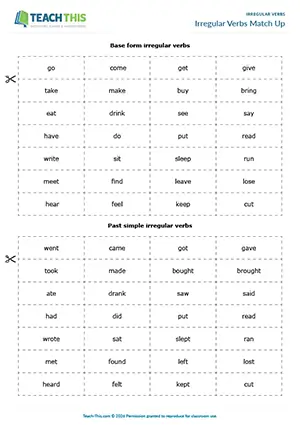
ESL Irregular Verbs Game - Grammar and Speaking: Matching, Forming Sentences, Freer Practice - Pair Work
Here is an entertaining irregular verbs game to help students practice irregular verbs in the past simple. In pairs, students take turns turning over one base form irregular verb card and one past simple...
Irregular Verb Dominoes

ESL Irregular Verbs Game - Grammar: Matching, Gap-fill - Group Work
In this rewarding irregular verbs game, students practice recognising and correctly using past simple forms of irregular verbs in sentences. To begin, the first player tries to place one of their dominoes on either side of the domino on the table by...
Irregular Verbs Bingo
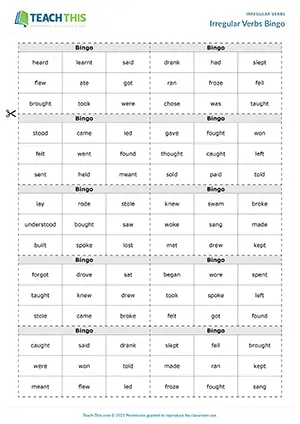
ESL Irregular Verbs Game - Vocabulary: Matching - Group Work
In this free irregular verbs game, students play bingo by listening to the infinitive forms of irregular verbs and matching them to past simple forms of irregular verbs. Call out the infinitive form of irregular verbs from the caller's sheet in a random order...
Irregular Verbs Connect 4

ESL Irregular Verbs Game - Grammar and Speaking: Changing Verb Forms, Forming Sentences, Freer Practice - Pair Work
In this engaging irregular verbs game, students write irregular verbs in their past simple or past participle form and make sentences using them. Tell the students which irregular verb form they...
Make a Sentence
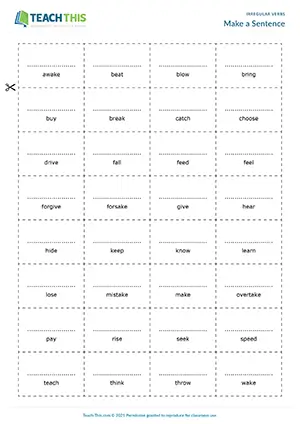
ESL Irregular Verb Game - Grammar and Speaking: Forming Sentences
In this creative past simple irregular verbs game, students change base form irregular verbs to the past simple and use the verbs in past simple sentences. In groups, students take turns picking up a card, changing the base form irregular verb...
Past Simple Irregular Verbs Practice

ESL Past Simple Irregular Verbs Worksheet - Vocabulary and Reading Exercises: Unscrambling, Gap-fill, Scanning, Answering Questions - Speaking Activity
In this comprehensive past simple irregular verbs worksheet, students practice common irregular verbs in their past simple form. Students begin by unscrambling...
Past Tense Talk
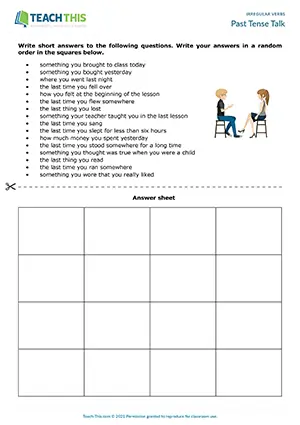
ESL Irregular Verbs Activities - Grammar Game: Pelmanism - Speaking Activity: Asking and Answering Questions, Freer Practice - Pair Work
In this excellent irregular verbs game and activity, students play a pelmanism game to match infinitive and past simple forms and then practice asking...
Three in a row

ESL Irregular Verbs Game - Grammar: Matching - Group Work
Here is a memorable irregular verbs game to help students practice the three forms of the 20 most common irregular verbs in the English language. The aim of the game is to say and find three matching irregular verb cards in a row. One...
What did you do yesterday?

ESL Irregular Verbs Game - Vocabulary and Speaking: Guessing, Gap-fill - Pair Work
In this insightful irregular verbs game, students guess what their partner did yesterday by completing prompts with past simple irregular verbs and checking their guesses with a partner. First, students guess what their partner did...
What's next?
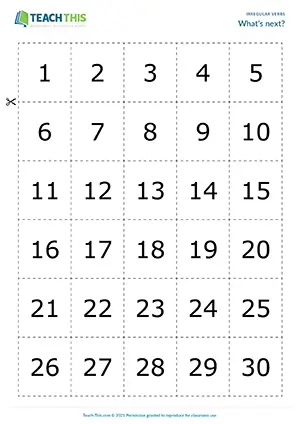
ESL Irregular Verbs Game - Grammar: Matching, Forming Sentences, Freer Practice - Group Work
In this enjoyable irregular verbs activity, students play a game where they practice making sentences with past tense irregular verbs. In groups, students take turns turning over a numbered card from...
When was the last time...?

ESL Irregular Verbs Game - Grammar and Speaking: Answering Questions, Writing Sentences, Guessing, Completing Questions - Pair Work
In this rewarding irregular verbs game, students practice using past simple irregular verbs by answering 'When was the last time...?' questions and...
Past Participle Irregular Verbs Crossword
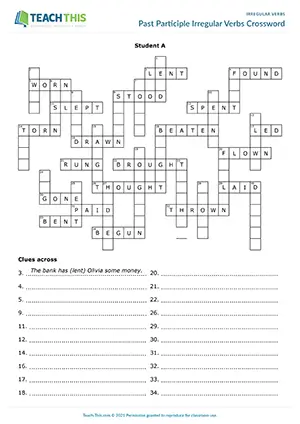
ESL Irregular Verbs Activity - Grammar and Speaking: Writing and Reading Sentences, Gap-fill, Guessing - Group and Pair Work
In this free irregular verbs activity, students write sentences containing past participle irregular verbs and then complete a crossword by guessing missing verbs from a partner's sentences. In two...
Three of a kind

ESL Irregular Verbs Game - Grammar: Matching, Asking Questions - Group Work
In this challenging irregular verbs card game, students race to collect the infinitive, past simple and past participle form of a range of irregular verbs. One student begins by asking another student for a card they need to get three of a kind, e.g. if a...
An Irregular Conversation

ESL Irregular Verbs Activity- Vocabulary and Speaking: Gap-fill, Asking and Answering Questions, Controlled and Communicative Practice - Group and Pair Work
In this communicative irregular verbs speaking activity, students complete conversation questions with infinitive, past simple and past participle...
Irregular Verbs Pelmanism

ESL Irregular Verbs Game - Grammar: Pelmanism, Matching, Gap-fill - Group Work
Here is a handy irregular verbs pelmanism game to help students practice the infinitive, past simple and past participle forms of a range of irregular verbs. In groups of three, students take turns turning over one irregular verb card and one...
Understanding Irregular Verbs
Irregular verbs form their past tense and past participle in unpredictable ways instead of simply adding '-ed' to the base form, so learners must memorize each one individually: 'go' becomes 'went', 'break' becomes 'broke', and 'write' becomes 'written'. When a regular '-ed' ending is placed on an irregular verb, it immediately signals to a fluent speaker that the tense has not yet been grasped, making statements like 'I goed to the store' or 'She breaked the cup' sound completely unnatural in both speech and writing.
This page covers irregular verbs across four levels from A1-A2 to B2, with 17 activities ranging from pair worksheets and card games to group bingo and crossword activities, including three free downloads.
The table below shows the base form, past simple, and past participle of the 20 most commonly taught irregular verbs in English.
| Base Form | Past Simple | Past Participle |
|---|---|---|
| be | was / were | been |
| have | had | had |
| do | did | done |
| say | said | said |
| go | went | gone |
| get | got | got / gotten |
| make | made | made |
| know | knew | known |
| take | took | taken |
| come | came | come |
| see | saw | seen |
| think | thought | thought |
| give | gave | given |
| find | found | found |
| tell | told | told |
| become | became | become |
| leave | left | left |
| feel | felt | felt |
| put | put | put |
| bring | brought | brought |
When to Use Irregular Verb Forms
Narrating Past Events: When speakers tell stories or recount personal experiences, past simple irregular verbs carry the entire sequence of action, so getting one form wrong breaks the momentum of the story and pulls the listener's attention away from the content, as in 'We drived to the coast, ate lunch, and then I falled asleep on the beach.'
Writing in the Present Perfect: The present perfect tense demands the past participle form of the main verb, so a teacher who only knows the past simple will produce errors in formal writing and professional emails, for example writing 'I have wrote three reports this week' instead of 'I have written three reports this week.'
Using the Passive Voice: Every passive voice construction in English requires the past participle of the main verb, so confusing the past simple and the past participle produces errors in formal and academic writing, as in 'The decision was took by the board' rather than 'The decision was taken by the board.'
3-Step Framework for Teaching Irregular Verbs
1. Build the Forms First: Start with a structured written task where students produce past simple forms, complete gap-fill sentences using those forms, and then write full answers to questions as a model for what follows. The key move is the handoff to spoken practice at the end: one student reads a question aloud, the partner selects from three answer options by circling A, B, or C, and then uses that choice to say and write a complete sentence in reply. Writing before speaking means the forms are already in mind before the conversation begins.
2. Make Production High-Stakes: Once the forms are known, put them under pressure with a game where accuracy has real consequences. Students build a grid of irregular verb forms and take turns calling out coordinates to find their partner's hidden verbs. Finding a verb is not enough: the student only sinks the ship by using that verb correctly in a past simple sentence, and if the sentence is wrong, the ship stays afloat. That single rule turns every revealed verb into a genuine production challenge.
3. Extend to All Three Forms: When students are ready to move beyond the past simple, push them to recall the base form, past simple, and past participle of each verb at once. In this card game, players hold a hand of cards showing all three forms and collect sets by asking classmates directly for the exact form they need, for example asking 'Have you got a card with ridden?' If they name the wrong form, they cannot claim the card. That naming requirement keeps the recall active and oral, not just visual.
Common Mistakes with Irregular Verbs
Past Simple Used in Place of the Past Participle: The past simple form of an irregular verb is often used where the past participle is needed, especially in present perfect sentences, because learners have memorized only one irregular form and apply it to all past contexts. Wrong: 'I have saw that film before.' Correct: 'I have seen that film before.'
Using the Past Form After the Auxiliary 'Did': The past simple irregular form is often placed after 'did' in questions and negative sentences instead of switching back to the base form, because the irregular past form has been memorized and applied everywhere. Wrong: 'Did you went to the party?' Correct: 'Did you go to the party?'
Common Questions About Teaching Irregular Verbs
What is a comprehensive worksheet for teaching irregular verbs in the past simple?
A comprehensive past simple irregular verbs worksheet builds from recognition to production. The Past Simple Irregular Verbs Practice worksheet at A2 level begins with students unscrambling letters to form 16 past simple irregular verbs, then moves through gap-fill sentences, a reading text where the verbs appear in context, comprehension questions, and a final partner interview using the same verbs.
What is a fun game for practicing irregular verbs with a class?
A fun game for drilling the link between infinitive and past simple forms is the free Irregular Verbs Bingo. The teacher calls out infinitives while students cross off the matching past simple forms on their cards. When a student crosses off all nine verbs, they win by reading out all nine pairs aloud, giving both the infinitive and past simple form each time.
What is a communicative activity for practicing past participle forms of irregular verbs?
A communicative activity that targets past participles is Past Participle Irregular Verbs Crossword. Students write sentences using past participle verbs, then pair up with someone from another group to complete their crossword. The partner reads clue sentences aloud with 'blank' in place of the missing verb, for example 'The bank has blank Olivia some money.'
Here's what our members are saying...


