
-ed and -ing Adjectives ESL Worksheets, Activities & Games
-ed and -ing Adjective Conversations
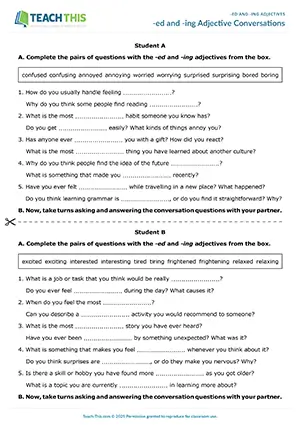
ESL -ed and -ing Adjectives Activity - Vocabulary and Speaking: Gap-fill, Asking and Answering Questions - Group and Pair Work
In this insightful -ed and -ing adjectives speaking activity, students complete conversation questions with adjectives ending in -ed and -ing and then ask...
Let's Talk
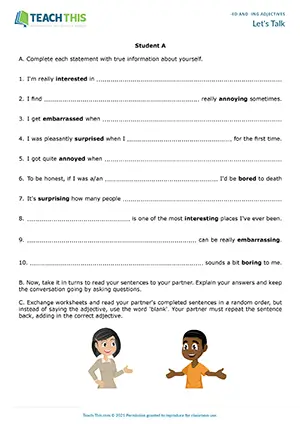
ESL -ed and -ing Adjectives Activity - Grammar, Vocabulary and Speaking: Sentence Completion, Discussion, Guessing, Communicative Practice - Pair Work
In this communicative -ed and -ing adjectives activity, students practice using the two adjective forms to express opinions and feelings about various things...
Tell me about yourself
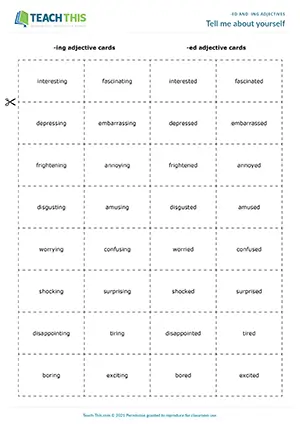
ESL -ed and -ing Adjectives Game - Vocabulary and Speaking: Matching, Forming Sentences, Asking and Answering Questions, Freer Practice - Group Work
In this free -ed and -ing adjectives game, students make sentences and questions with adjectives that end with -ed and -ing. Students take it in turns to...
University Life
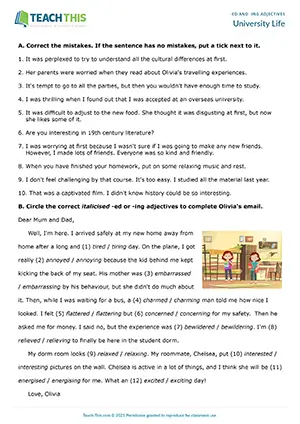
ESL -ed and -ing Adjectives Worksheet - Vocabulary and Writing Exercises: Error Correction, Gap-fill, Email Writing
In this productive adjectives ending -ed and -ing worksheet, students practice identifying and using -ed and -ing adjectives in emails about studying abroad at university. Students start by identifying and...
What's the difference?
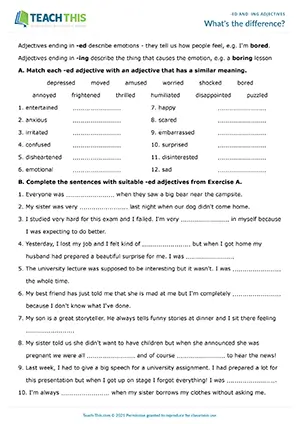
ESL -ed and -ing Adjectives Worksheet - Grammar and Vocabulary Exercises: Matching, Gap-fill, Binary Choice, Answering Questions - Speaking Activity - Pair Work
In this comprehensive -ed and -ing adjectives worksheet, students learn the difference between -ed and -ing adjectives and practice using the adjectives to talk...
You are charming. I am charmed.
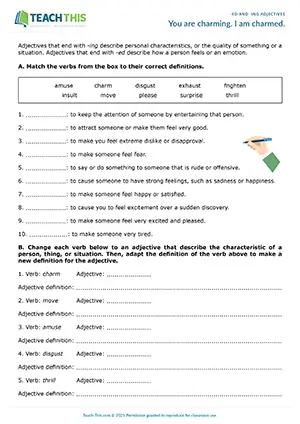
ESL -ed and -ing Adjectives Worksheet - Vocabulary Exercises: Matching, Changing Word Forms, Defining, Gap-fill - Speaking Activity: Describing - Pair Work
In this useful adjectives with -ed and -ing worksheet, students review and practice adjectives that describe feelings, people, things, or situations...
Understanding -ed and -ing Adjectives
An -ed adjective describes how a person feels, such as 'bored,' 'excited,' or 'confused.' An -ing adjective describes the quality of a thing or situation that produces that feeling, such as 'boring,' 'exciting,' or 'confusing.' Students who mix these up, for example writing 'I am very interesting in art,' sound as though they are describing themselves as an interesting person rather than expressing their own interest, which sends an entirely different message to the reader.
This page covers -ed and -ing adjectives at B1 and B2 levels, with six resources including speaking activities, worksheets, and a card game, one of which is available as a free download.
Each -ed and -ing adjective pair comes from the same verb root, with the -ed form describing how a person feels and the -ing form describing the quality of the cause.
| Verb Root | -ed Adjective (how a person feels) | -ing Adjective (quality of the cause) | Example Contrast |
|---|---|---|---|
| bore | bored | boring | 'I was bored by the lecture.' vs. 'The lecture was boring.' |
| interest | interested | interesting | 'She is interested in art.' vs. 'The exhibition is interesting.' |
| excite | excited | exciting | 'The children were excited.' vs. 'It was an exciting match.' |
| amaze | amazed | amazing | 'We were amazed by the result.' vs. 'The result was amazing.' |
| confuse | confused | confusing | 'He felt confused.' vs. 'The instructions were confusing.' |
| tire | tired | tiring | 'I felt tired after the trip.' vs. 'The trip was tiring.' |
| disappoint | disappointed | disappointing | 'She was disappointed.' vs. 'The film was disappointing.' |
| surprise | surprised | surprising | 'They were surprised.' vs. 'It was a surprising decision.' |
| embarrass | embarrassed | embarrassing | 'He was embarrassed.' vs. 'It was an embarrassing moment.' |
| charm | charmed | charming | 'I was charmed by his manner.' vs. 'He has a charming manner.' |
When to Use -ed and -ing Adjectives
Reporting a personal reaction: Speakers use the -ed form when they want to share how an experience affected them personally, making their response the focus rather than the experience itself, as in 'I was completely fascinated by the documentary.'
Recommending or warning about an experience: Writers and speakers reach for the -ing form when they want to characterize an experience for someone who has not yet had it, because the -ing form describes the quality of the thing rather than the speaker's reaction, as in 'The course is demanding but worth every minute.'
Giving feedback or evaluating performance: In professional or academic feedback, both forms can appear in the same statement, and swapping them changes the meaning entirely, so writers must choose deliberately depending on whether they mean to describe the work itself or the person's response to it, as in 'The presentation was confusing, and the audience looked confused.'
3-Step Framework for Teaching -ed and -ing Adjectives
1. Introduce Both Forms in Paired Conversation: Start with a structured speaking task that puts both forms to work together before students have a chance to treat them separately. Two groups each complete a set of conversation questions with -ed and -ing adjectives from a box, ensuring students handle both forms side by side, then pair up with someone from the other group to ask and answer the questions, discussing each topic for a minute. At the end, each student tells the class what they found out about their partner, giving the lesson a genuine communicative payoff.
2. Build Form Awareness Through Word Formation: Deepen understanding with a vocabulary workshop where students trace each adjective back to its verb root. Students change five verbs to adjectives that describe the characteristic of a person, thing, or situation, then adapt the verb definitions to make a new definition for each -ing adjective, before repeating the process for five more verbs to form -ed adjectives that describe a feeling or emotion. Building definitions from scratch forces students to articulate the difference between the two forms in their own words rather than just recognizing them on a page.
3. Consolidate With a Point-Stealing Card Game: Finish with a competitive group card game that demands accurate production of both forms in a single turn. When a player turns over an -ed adjective card such as 'interested,' the player with the matching -ing card 'interesting' must use one adjective to make a sentence, for example 'I think sci-fi films are interesting,' then use the other to ask the group a question, for example 'Are you interested in sci-fi films?' If a player makes a grammar mistake or cannot produce either form, another student can steal the point by making a correct sentence and question with both adjectives.
Common Mistakes with -ed and -ing Adjectives
Using the -ed form to describe a thing: Students often apply the -ed adjective to the thing causing a feeling rather than to the person experiencing it, reversing the intended meaning. Wrong: 'The lesson was bored.' Correct: 'The lesson was boring.'
Using the -ing form after "feel": Students often follow "feel" with an -ing adjective when they need the -ed form, not realizing that "feel" describes a person's internal state, which always takes the -ed adjective. Wrong: 'I feel exhausting after work.' Correct: 'I feel exhausted after work.'
Common Questions About Teaching -ed and -ing Adjectives
What is a useful worksheet for teaching -ed and -ing adjectives?
Four exercises build from error correction to free writing in the worksheet University Life. Students first correct mistakes in sentences, then circle the correct form in an email, complete a second email using adjectives from a box, and finally write a reply using -ed and -ing adjectives of their own.
What is a fun game for practicing -ed and -ing adjectives?
Card matching drives the production in the game Tell me about yourself. Students turn over an -ed adjective card and find its -ing partner. One player makes a sentence using one form, for example 'I think sci-fi films are interesting,' then asks a question using the other. Correct use scores a point; a grammar mistake lets another student steal it.
What is a good speaking activity for teaching -ed and -ing adjectives?
Both forms get equal attention in the activity -ed and -ing Adjective Conversations, making it a solid entry point for lower-level students. Two groups complete conversation questions with -ed and -ing adjectives from a box, then students pair up across groups to ask and answer the questions, discussing each topic for a minute before reporting back to the class.
Become a Teach This Member
Get unlimited access to the full library, plus new resources added every week.
Unlimited Resource Access
Download from 3000+ worksheets, activities, and games.
Save 5+ Hours Weekly
Cut lesson prep time with ready-to-use resources, plus teacher notes and answer keys.
Trusted Professional Quality
Classroom-tested, editable resources created by experienced ESL professionals.
Fresh Content Weekly
Get 5 new resources added to the library each week.
Here's what our members are saying...


