
Verbs ESL Games, Worksheets & Activities
Action Verbs
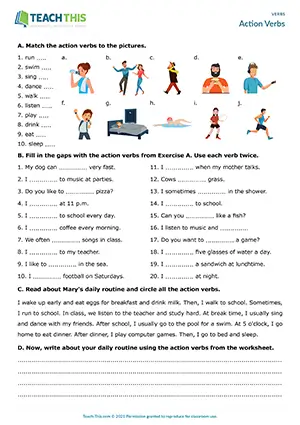
ESL Action Verbs Worksheet - Vocabulary and Writing Exercises: Matching, Gap-fill, Identifying, Writing Sentences
In this handy action verbs worksheet, students learn and practice common physical action verbs. Students begin by matching action verbs to pictures. Students then do a gap-fill exercise where...
Common Verbs Crossword
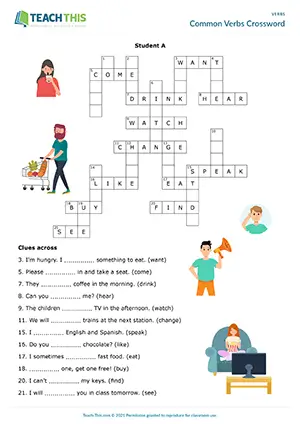
ESL Common Verbs Activity - Vocabulary and Listening: Crossword, Reading Clues, Guessing, Gap-fill - Pair Work
In this free verbs crossword activity, students complete a crossword with common verbs by guessing missing words in sentences. In pairs, students take it in turns to ask their partner for a clue to one of their...
Mime a Line
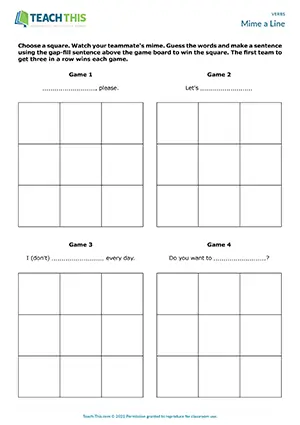
ESL Verbs Miming Game - Vocabulary: Miming Guessing, Forming Sentences - Pair and Group Work
In this entertaining verbs miming game, students practice using verbs and verb phrases with various sentence patterns. Teams take turns choosing a square. One teammate picks up a card...
Collocations Challenge
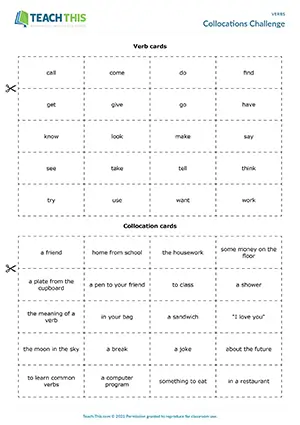
ESL Verb Collocation Games - Vocabulary: Pelmanism, Matching, Forming Sentences, Freer Practice - Group Work
In these two engaging verb collocation games, students practice verb collocations and make sentences with 20 common verbs. The game can be used with the '20 Common Verbs' worksheet which...
20 Common Verbs
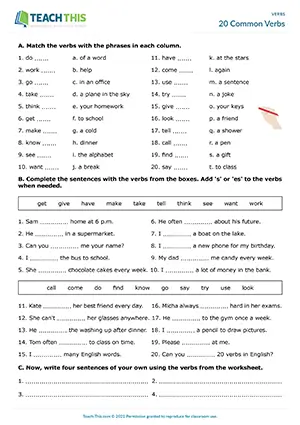
ESL Common Verbs Worksheet - Grammar, Vocabulary and Writing Exercises: Matching, Gap-fill, Writing Sentences
This comprehensive verbs worksheet helps students learn and practice 20 common verbs in English. The worksheet can be used along with 'Collocations Challenge', which provides practice with the same...
Verbs Adventure
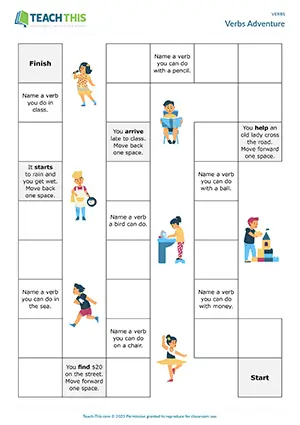
ESL Verbs Board Game - Vocabulary and Speaking: Providing Vocabulary, Forming Sentences - Group Work
In this productive verbs board game, students practice making sentences with common verbs. Players take turns rolling the dice and moving their counter along the board. If the player lands on an empty...
Verb Squares
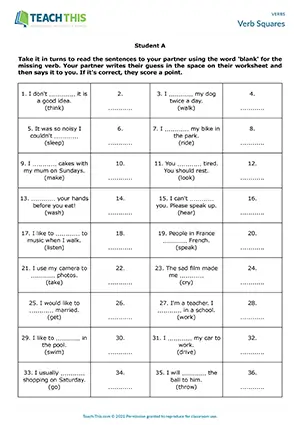
ESL Verbs Game - Vocabulary: Guessing, Gap-fill - Pair Work
In this fun verbs guessing game, students guess missing verbs in sentences. In pairs, students take it in turns to read the sentences on their worksheet to their partner using the word 'blank' for the missing verb. Their partner listens and writes...
Whose sentence is this?
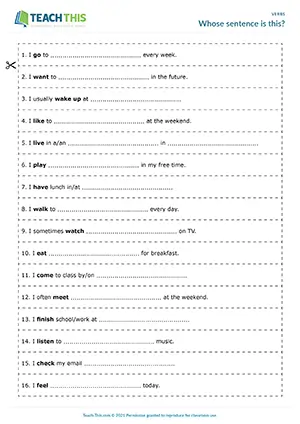
ESL Verbs Game - Vocabulary: Gap-fill, Guessing - Group Work
In this enjoyable common verbs game, students guess who wrote certain sentences. First, students complete sentences on cards with true information, e.g. 'I go to the park every week'. In groups, students then shuffle all their cards together and...
Confusing Verbs
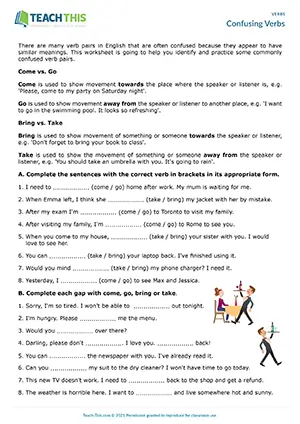
ESL Confusing Verbs Worksheet - Vocabulary Exercises: Binary Choice, Gap-fill, Writing Sentences
This useful confusing verbs worksheet helps students understand the differences between some commonly confused verb pairs. To begin, students read about the differences between come and go...
Do, Mime or Tell
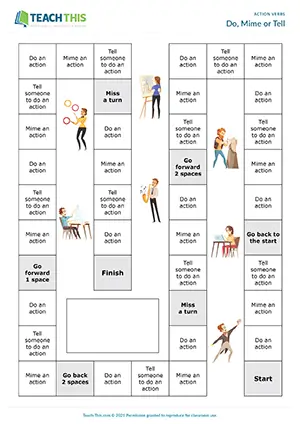
ESL Action Verbs Board Game - Vocabulary: Miming, Guessing - Group Work
In this free action verbs board game, students perform, mime, or tell someone to do various actions described on cards. Players take it in turns to roll the dice and move their counter along the board. When a player lands on a 'Do an action' square, they pick...
Fairy Tale Verbs
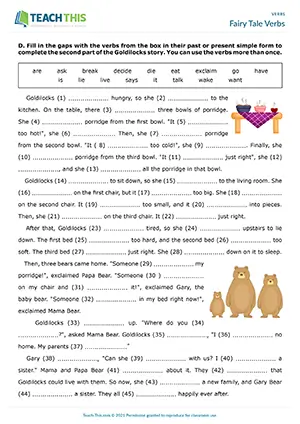
ESL Verbs Worksheet - Vocabulary and Grammar Exercises: Error Correction, Matching, Binary Choice, Gap-fill
This productive verbs worksheet helps students practice common verbs in the past and present simple. Students start by circling the correct verbs and changing the verbs that aren't correct in a set of...
Stative Verbs Practice
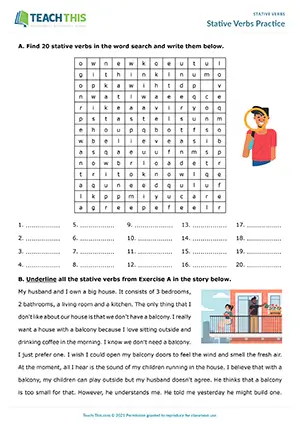
ESL Stative Verbs Worksheet - Vocabulary Exercises: Word Search, Identifying, Binary Choice, Error Correction
In this insightful stative verbs worksheet, students learn 20 common stative verbs and practice using them. Students begin by finding and writing down 20 stative verbs in a word search. Next, students read...
Verb Opposites
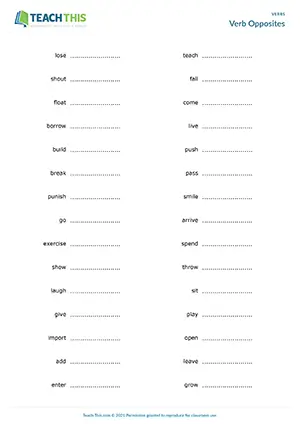
ESL Verb Opposites Activity - Vocabulary: Providing Antonyms, Forming and Writing Sentences, Story Writing - Group and Pair Work
This imaginative verb opposites activity helps to increase students' knowledge of verbs and their opposites. Start by reading out the verbs on the worksheet and...
Action Verb, Stative Verb or Both?
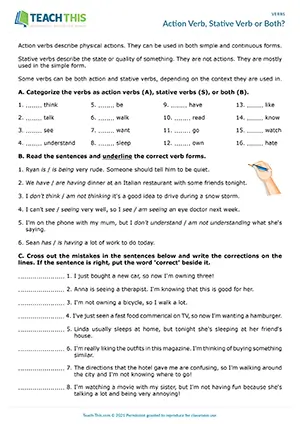
ESL Action and Stative Verbs Worksheet - Vocabulary, Grammar and Writing Exercises: Categorising, Binary Choice, Error Correction, Gap-fill, Writing an email
In this free action vs. stative verbs worksheet, students learn and practice the difference between action verbs and stative verbs. To start, students read a text...
Which Verb?
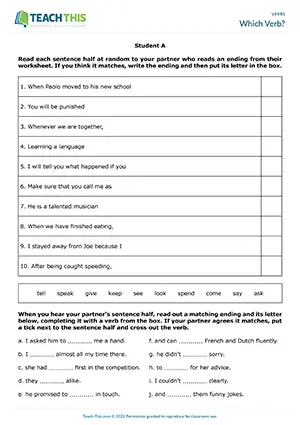
ESL Verbs Collocations Activity - Vocabulary and Speaking: Matching, Gap-fill, Sentence Completion - Pair Work
Here is a rewarding verb collocations speaking activity for intermediate students. In pairs, one student begins by reading a sentence half at random to their partner. Their partner listens and matches...
Educational Verbs
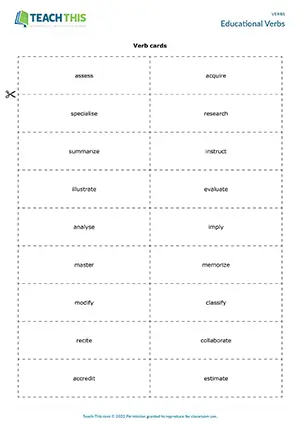
ESL Educational Verbs Game - Vocabulary and Speaking: Matching, Forming Sentences - Pair Work
In this creative verbs game, students match verbs related to education with their definitions and then try to make a meaningful sentence using the verb. In pairs, students take it in turns to turn over...
Group the Verbs
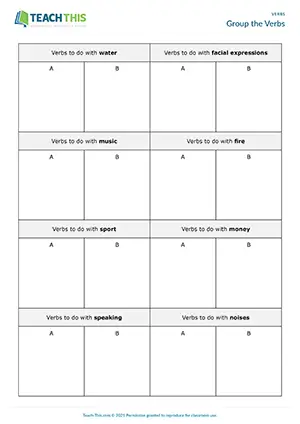
ESL Verbs Game - Vocabulary: Categorising - Pair Work
In this interesting verbs game, students race to place verbs in their correct category. There are eight categories in total with six verbs belonging to each category. Pairs take it in turns to choose a verb from their list and write it in the A or B column under...
It is expected to be fun
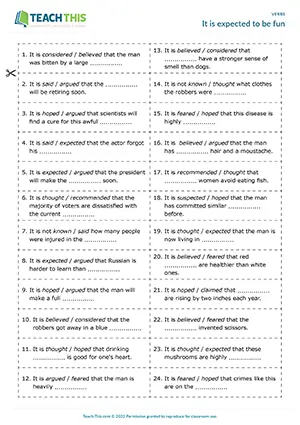
ESL Verbs of Judgement and Evaulation Game - Vocabulary: Matching, Binary Choice - Pair Work
In this intriguing verbs of judgement and evaluation game, students complete sentences with words and verbs of judgement and evaluation. In pairs, students take it in turns to turn over one...
Understanding Verbs
Verbs are the engine of every sentence, telling listeners and readers what someone does, experiences, or is. Without the right verb, a speaker risks being misunderstood, and a student who says 'I am knowing the answer' instead of 'I know the answer' is applying logic to a system that does not always behave logically.
This page offers 18 resources covering levels from A1 to B2, including three free downloads, so teachers can find the right activity for any group and any lesson focus.
The table below gives a quick overview of the resources available, organized by level and duration.
| Resource | Level | Duration | Type | Free |
|---|---|---|---|---|
| Whose Sentence Is This? | A1-A2 | 20 min | Speaking game | No |
| Common Verbs Crossword | A1 | 20 min | Activity | Yes |
| Confusing Verbs | A2 | 25 min | Worksheet | No |
| Do, Mime or Tell | A2 | 30 min | Board game | Yes |
| Verb Opposites | A2 | 45 min | Speaking and writing activity | No |
| Action Verb, Stative Verb or Both? | B1 | 30 min | Worksheet | Yes |
| Group the Verbs | B2 | 35 min | Game | No |
When to Use Verbs
Signaling Whether an Action Is Ongoing or a State Is Permanent: Stative verbs such as 'love,' 'know,' and 'believe' describe a state rather than an action in progress, so they do not normally appear in progressive forms. A speaker who says 'I am loving this film' instead of 'I love this film' creates a sentence that sounds unnatural to a proficient listener.
Choosing Between Direction-Based Verb Pairs in Everyday Situations: The difference between 'bring' and 'take,' or 'come' and 'go,' depends on the speaker's point of reference, not on the action itself. A student who says 'Can you bring this to the office?' when the office is away from both speakers will confuse a listener who expects 'take.'
Building Precision in Formal and Professional Contexts: Emails, reports, and presentations depend on exact verb choice to convey the right relationship between ideas. A student who writes 'we did a mistake' instead of 'we made a mistake' signals a gap in collocational knowledge that a professional reader will notice immediately.
3-Step Framework for Teaching Verbs
1. Anchor Verbs to Personal Information: Give students a sentence frame and ask them to complete it with something true about themselves, for example 'I go to the park every week.' When a student reads a completed sentence aloud, the rest of the class guesses whose sentence it is. Because every sentence must be true, students cannot rely on invented examples and must think carefully about the verb they need.
2. Address Common Verb Pair Confusion Directly: Present pairs that learners regularly mix up, such as 'come' and 'go,' 'bring' and 'take,' and 'say' and 'tell.' Ask students to study sentences showing how each verb in a pair works, then complete a gap-fill that forces them to choose between the two. Seeing both verbs side by side makes the contrast visible rather than abstract.
3. Push Students to Distinguish Action Verbs from Stative Verbs: Students categorize a list of verbs as action verbs, stative verbs, or both, then write an email using at least five action verbs and at least five stative verbs. Writing the email locks the distinction into a realistic context where students see immediately whether their choice produces a natural sentence.
Common Mistakes with Verbs
Using a Stative Verb in a Progressive Form: Students often apply the present continuous by habit, especially when they want to emphasize something happening right now, but stative verbs describe conditions or mental states rather than actions in progress and do not take the '-ing' form. Wrong: 'She is knowing the answer.' Correct: 'She knows the answer.'
Confusing Direction-Based Verb Pairs: Students often default to one verb from a directional pair such as 'come' and 'go,' or 'bring' and 'take,' without considering the speaker's physical position or point of reference, because many languages use a single verb where English uses two. Wrong: 'Can you bring your laptop to the meeting room?' Correct: 'Can you take your laptop to the meeting room.'
Common Questions About Teaching Verbs
What is a fun board game for practicing verbs?
The board game Do, Mime or Tell gives every player a different challenge on every square. On one square a player mimes an action for the group to guess. On another they perform it themselves, and on a third they tell a classmate what to do. The first player to reach the finish wins.
What is a good speaking activity for practicing verb opposites?
Speaking and writing with the same set of verbs is what makes the activity Verb Opposites worth the time. One student reads a sentence aloud and a partner replies using the opposite verb in a new sentence. Pairs finish by writing a short story together using ten verbs from the activity, so every verb gets practiced in two different ways.
What is a useful worksheet for teaching action and stative verbs?
The free worksheet Action Verb, Stative Verb or Both? takes students through the difference in stages. They begin by categorizing a list of verbs, then correct verb mistakes in sentences, and finish by writing an email that uses at least five action verbs and five stative verbs, putting the distinction to work in a realistic context.
Become a Teach This Member
Get unlimited access to the full library, plus new resources added every week.
Unlimited Resource Access
Download from 3000+ worksheets, activities, and games.
Save 5+ Hours Weekly
Cut lesson prep time with ready-to-use resources, plus teacher notes and answer keys.
Trusted Professional Quality
Classroom-tested, editable resources created by experienced ESL professionals.
Fresh Content Weekly
Get 5 new resources added to the library each week.
Here's what our members are saying...


