
Adjectives of Opinion ESL Games, Worksheets & Activities
A Birthday Surprise
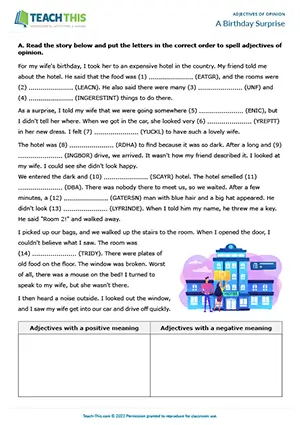
ESL Adjectives of Opinion Worksheet - Reading and Vocabulary Exercises: Gap-fill, Categorising, Ordering, Unscrambling, Binary Choice, Listing
In this productive adjectives of opinion worksheet, students build confidence using 14 common opinion adjectives to describe people, places and things...
Can you guess?
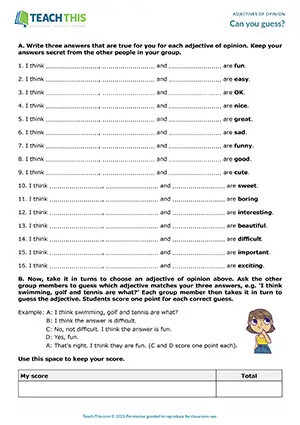
ESL Adjectives of Opinion Game - Vocabulary: Gap-fill, Guessing, Asking and Answering Questions - Group Work
In this free adjectives of opinion game, students practice adjectives of opinion by guessing their classmates' opinions from two clues. To begin, students write two things that are true for them for each...
My Guesses About You
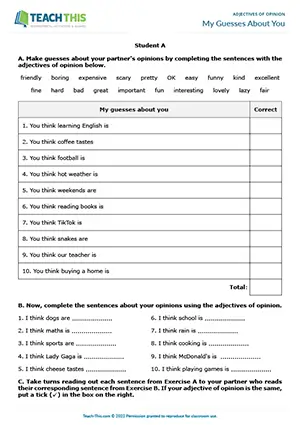
ESL Adjectives of Opinion Game - Vocabulary: Sentence Completion, Guessing - Pair Work
In this fun adjectives of opinion game, students try to predict their partner's opinions and find out how well they really know each other. Working alone, students begin by making guesses about...
Bertha's Bad Bistro
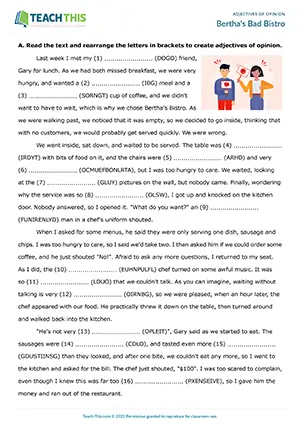
ESL Adjectives of Opinion Worksheet - Vocabulary and Reading Exercises: Unscrambling, Gap-fill - Speaking Activity
In this insightful adjectives of opinion worksheet, students practice common opinion adjectives and their opposites. First, students read a story and unscramble letters to create adjectives of opinion. Next...
Opinion Adjectives Race
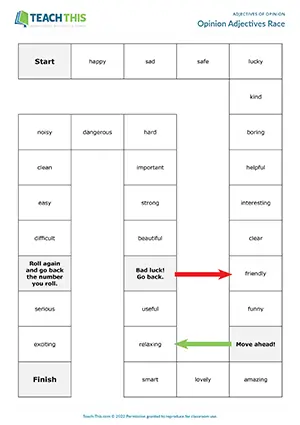
ESL Adjectives of Opinion Board Game - Vocabulary and Speaking: Forming Sentences, Freer Practice - Group Work
In this creative opinion adjectives board game, students practice making sentences with adjectives of opinion. Students take it in turns to roll the dice and move their counter along the board. When a student...
Up, Up and Away!
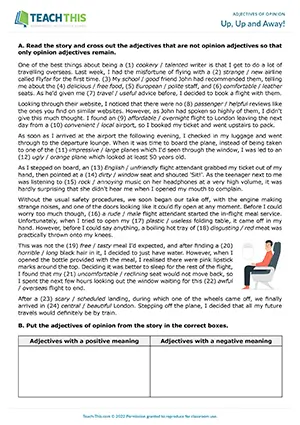
ESL Opinion Adjectives Worksheet - Vocabulary Exercises: Categorizing, Gap-fill - Speaking Activity: Asking and Answering Questions - Pair Work
Here is a useful adjectives of opinion worksheet for intermediate students. Students begin by reading a story and crossing out the non-opinion adjectives so...
What's the adjective?

ESL Opinion Adjectives Game - Vocabulary: Matching, Gap-fill - Pair Work
In this free adjectives of opinion game, students play dominoes by completing sentences with suitable opinion adjectives. The first player puts one of their dominoes down on either side of the domino on the table, matching a sentence...
Adjectives of Opinion Crossword
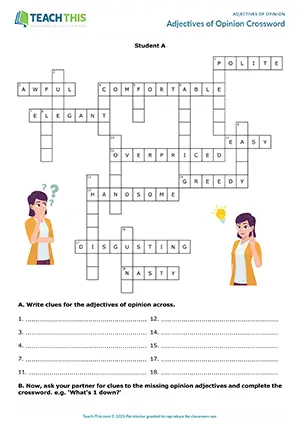
ESL Opinion Adjectives Crossword - Vocabulary and Speaking Activity: Writing Clues, Describing, Guessing - Pair Work
In this rewarding adjectives of opinion speaking activity, students complete a crossword by describing and guessing opinion adjectives. In two groups, students invent and write down clues...
Opinion Adjectives Practice
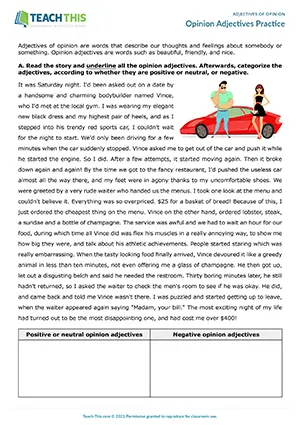
ESL Adjectives of Opinion Worksheet - Vocabulary and Reading Exercises: Categorising, Gap-fill, Matching, Sentence Completion - Speaking Activity - Pair work
This comprehensive opinion adjectives worksheet helps students to identify and practice adjectives of opinion. To begin, students read a story and...
Opinion Exchange

ESL Adjectives of Opinion Activity - Vocabulary and Speaking: Completing, Asking and Answering Questions - Group and Pair Work
In this engaging adjectives of opinion speaking activity, students complete, ask and answer conversation questions that contain commonly used adjectives of...
Understanding Adjectives of Opinion
Adjectives of opinion are words that express a personal judgment or evaluation about a noun, such as 'beautiful,' 'awful,' or 'impressive.' Students who cannot produce a range of these adjectives end up repeating the same few words like 'good' or 'bad,' which makes their writing and speaking feel limited and prevents them from communicating precise personal reactions.
This page covers adjectives of opinion from A1 to B2 level, with 10 activities spanning worksheets, pair games, group board games, and speaking activities, including two available as free downloads.
The table below shows common adjectives of opinion grouped by category, with examples of how they work in both attributive and predicative position.
| Category | Opinion Adjective | Attributive Use | Predicative Use |
|---|---|---|---|
| Positive | beautiful | 'a beautiful painting' | 'The painting is beautiful.' |
| Positive | brilliant | 'a brilliant idea' | 'The idea is brilliant.' |
| Positive | delicious | 'a delicious meal' | 'The meal was delicious.' |
| Positive | powerful | 'a powerful speech' | 'The speech was powerful.' |
| Neutral / Subjective | fun | 'a fun activity' | 'The activity was fun.' |
| Neutral / Subjective | impressive | 'an impressive result' | 'The result was impressive.' |
| Negative | awful | 'an awful experience' | 'The experience was awful.' |
| Negative | dull | 'a dull film' | 'The film was dull.' |
| Negative | terrible | 'a terrible service' | 'The service was terrible.' |
When to Use Adjectives of Opinion
Sharing personal taste in reviews or recommendations: Writers and speakers use opinion adjectives when they want a reader or listener to understand not just what something is but how they personally rate it, giving a review its distinctive point of view, as in 'The food was delicious but the service was terrible.'
Softening a negative judgment in polite conversation: Speakers reach for milder opinion adjectives when they want to express dissatisfaction without causing offence, choosing words that signal a personal view rather than a universal verdict, as in 'I found the film a bit dull, but I can see why some people enjoy it.'
Making a recommendation more persuasive: A well-chosen opinion adjective adds conviction to a recommendation by telling the listener exactly what quality stands out, making the suggestion feel personal and grounded rather than generic, as in 'It's a brilliant place to visit if you enjoy modern art.'
3-Step Framework for Teaching Adjectives of Opinion
1. Activate Through Personal Opinion: Start elementary students with a guessing game that puts personal opinions at the centre of every exchange. Each student writes three true examples for an adjective of opinion, then challenges the group with the prompt structure 'I think swimming, golf and tennis are what?' and classmates race to name the matching adjective. Because every answer is genuine, students quickly see that opinion adjectives describe real individual reactions, not neutral facts.
2. Build Accuracy Under Competitive Pressure: Move students to a board game where every sentence they produce gets judged by the group for accuracy and appropriateness. The scoring mechanic rewards precision: when a student lands on the adjective 'powerful' and says 'My car is very powerful,' they write the noun 'car' in the square using a colored pen, and that noun is then locked out for the rest of the game so each noun can only be used once. This forces students to think carefully about which nouns pair naturally with each opinion adjective.
3. Consolidate Through Sentence-Level Matching: Finish with a dominoes game where students must match sentence fragments to opinion adjectives that fit both grammatically and in meaning. After placing a domino, the player reads the completed sentence aloud, and the group decides whether the adjective and sentence genuinely match before the domino stays in play. The peer-judgment element means students articulate their reasons for accepting or rejecting a word choice, sharpening their awareness of how opinion adjectives signal different degrees of evaluation.
Common Mistakes with Adjectives of Opinion
Wrong adjective order: Students often place an opinion adjective after other descriptive adjectives such as size or colour, when opinion adjectives should come first in a noun phrase. Wrong: 'It was a red, beautiful car.' Correct: 'It was a beautiful red car.'
Using an adjective instead of an adverb after action verbs: Students often use an opinion adjective after an action verb when they need an adverb, because they have learned the adjective form but have not yet made the adjective/adverb distinction. Wrong: 'She danced beautiful at the show.' Correct: 'She danced beautifully at the show.'
Common Questions About Teaching Adjectives of Opinion
What is a fun game for practicing adjectives of opinion?
The game My Guesses About You turns guessing into a scoring challenge. Students complete sentences guessing a partner's opinions, then write their own. They read their guesses aloud while their partner reads the real answers. If the adjective matches, the guesser scores a tick, and the student with the most ticks wins.
What is a useful worksheet for teaching adjectives of opinion?
The worksheet Up, Up and Away! builds vocabulary recognition before moving students into conversation. Students read a story and cross out all non-opinion adjectives so only opinion adjectives remain, then categorize them by positive or negative meaning before completing conversation questions and discussing their answers with a partner.
What is a good speaking activity for adjectives of opinion?
Completing a question before asking it locks in controlled practice. The activity Opinion Exchange has two groups fill in conversation questions with opinion adjectives from a box, then pair up to ask and answer them. For the first question in each set, students must include the corresponding adjective in their response, then share what they learned with the class.
Become a Teach This Member
Get unlimited access to the full library, plus new resources added every week.
Unlimited Resource Access
Download from 3000+ worksheets, activities, and games.
Save 5+ Hours Weekly
Cut lesson prep time with ready-to-use resources, plus teacher notes and answer keys.
Trusted Professional Quality
Classroom-tested, editable resources created by experienced ESL professionals.
Fresh Content Weekly
Get 5 new resources added to the library each week.
Here's what our members are saying...


