
Adjectives of Feeling & Emotion ESL Games, Worksheets & Activities
Feelings and States: Flashcards & Worksheet
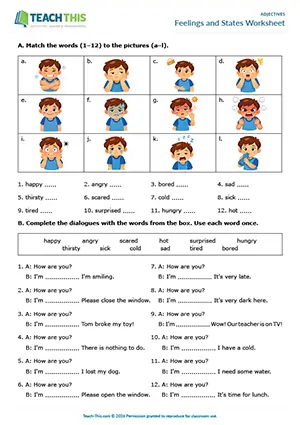
ESL Feelings and States Flashcards and Worksheet - Flashcards: Drilling, Sentence Frames - Vocabulary Exercises: Matching, Gap-fill
In this feelings and states resource, students learn 12 common adjectives for feelings and physical states and practice them with flashcards and a worksheet...
Feelings Battleships

ESL Feelings and Emotions Game - Vocabulary and Speaking: Asking and Answering Questions - Pair Work
In this free adjectives of feeling and emotion game, students play Battleships to practice adjectives of feeling and emotion and family vocabulary by asking and answering yes/no questions. In pairs, students...
Feelings Bingo
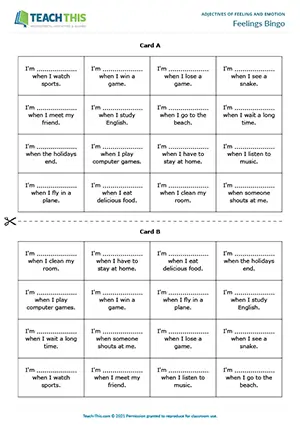
ESL Adjectives of Feeling Game - Vocabulary: Sentence Completion - Group Work
In this feelings bingo game, students make true sentences about everyday situations using adjectives of feeling. In groups, students take turns rolling the feelings dice. When the dice lands on an...
Feelings Vocabulary Workshop
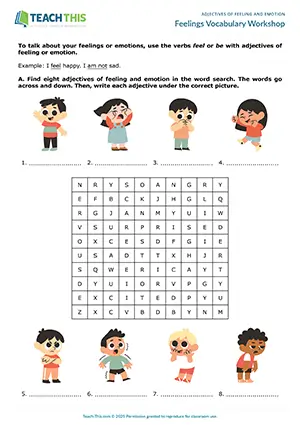
ESL Feelings and Emotions Worksheet - Vocabulary Exercises: Word Search, Matching, Gap-fill - Speaking Activity: Asking and Answering Questions - Pair Work
In this useful feelings and emotions worksheet, students learn and practice eight common adjectives for feelings and emotions and use them to talk...
The Way I Feel
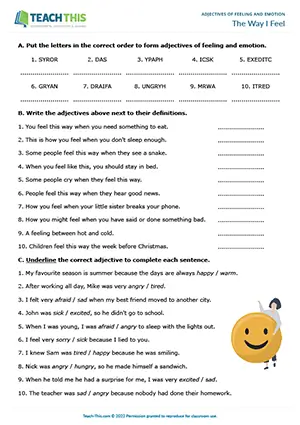
ESL Feelings and Emotions Worksheet - Vocabulary Exercises: Matching, Binary Choice, Gap-fill, Sentence Completion - Speaking Activity: Guessing - Pair Work
In this rewarding feelings and emotions worksheet, students practice ten common adjectives for feelings and emotions. First, students put letters in the...
Anna's Feelings

ESL Feelings and Emotions Worksheet - Vocabulary Exercises: Ordering, Identifying, Gap-fill, Categorising, Writing Sentences - Speaking Activity: Guessing - Pair Work
In this comprehensive adjectives of feeling and emotion worksheet, students practice 12 common feeling and emotion adjectives. First, students put a conversation in...
How were they feeling?

ESL Feelings Activity - Vocabulary and Speaking: Unscrambling, Matching, Guessing - Group and Pair Work
In this enjoyable adjectives of feeling activity, students describe how people were feeling at a party and match the descriptions with feeling and emotion adjectives. In two groups, students unscramble...
Adjective Association
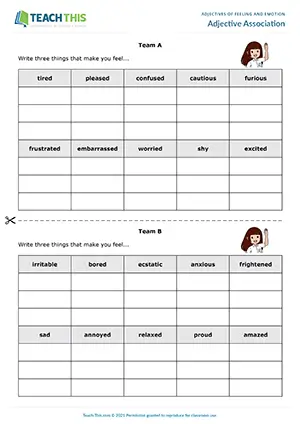
ESL Feelings Game - Vocabulary: Word Association - Group Work
In this fun adjectives of feeling guessing game, students associate things with adjectives that describe feelings. In teams, students write down three things they associate with the ten adjectives of feeling shown on their worksheet...
Describe the Feeling
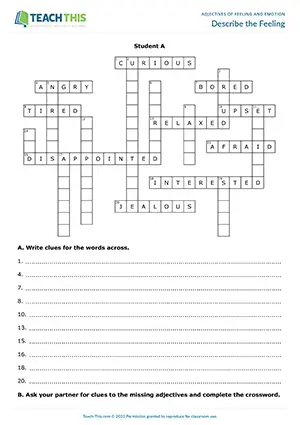
ESL Feelings and Emotions Crossword - Vocabulary Activity: Crossword, Writing Clues, Describing, Guessing - Pair Work
In this rewarding adjectives of feeling and emotion activity, students complete a crossword by describing and guessing feeling and emotion adjectives. In two groups, students invent and write...
How did you feel...?

ESL Feelings and Emotions Board Game - Vocabulary and Speaking: Asking and Answering Questions, Discussion - Pair Work
In this free adjectives of feeling and emotion board game, students practice describing how they felt the last time certain things happened to them. In pairs, students take...
I've got a Feeling

ESL Feelings and Emotions Activity - Vocabulary: Running Dictation, Gap-fill - Pair Work
In this productive adjectives of feeling and emotion activity, students take part in a running dictation where they dictate short texts and complete missing words with adjectives of feeling and...
Let's Talk About Our Feelings

ESL Adjectives of Feeling and Emotion Activity - Vocabulary and Speaking: Gap-fill, Asking and Answering Questions - Group and Pair Work
In this adjectives of feeling and emotion speaking activity, students complete, ask and answer conversation questions containing common adjectives of feeling...
Mixed Emotions
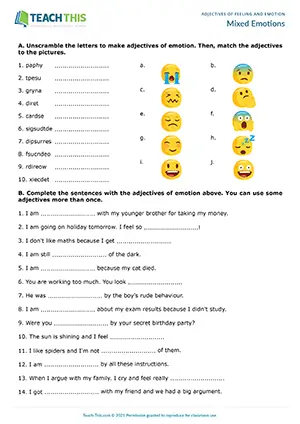
ESL Adjectives of Emotion Worksheet - Grammar and Vocabulary Exercises: Unscrambling, Matching, Gap-fill, Word Search, Writing Sentences
Here is an insightful adjectives of emotion worksheet for intermediate students. Students begin by unscrambling letters to make adjectives of emotion...
Close Encounters of the Third Kind
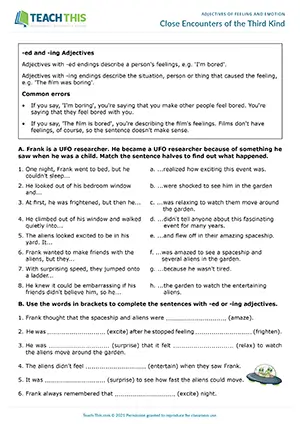
ESL Feelings and Emotions Worksheet - Vocabulary and Grammar Exercises: Matching, Gap-fill, Writing Sentences
In this interesting adjectives of feeling and emotion worksheet, students learn and practice -ed and -ing adjectives that describe feelings and emotions. To start, students match sentence halves...
How do I feel?

ESL Adjectives of Feeling and Emotion Game - Vocabulary and Speaking: Miming, Guessing, Forming Sentences - Group Work
In this engaging feelings and emotions game, students guess situations and related adjectives that describe feelings and emotions from mimes. Students take it in turns to pick up a card from the pile...
When did you last feel...?
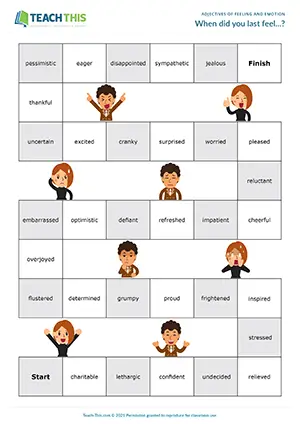
ESL Feelings and Emotions Board Game - Vocabulary and Speaking: True or False, Asking and Answering Questions, Guessing, Freer Practice - Group Work
In this entertaining adjectives of feeling and emotion board game, students review advanced adjectives of feeling and emotion by playing a board game where...
Understanding Adjectives of Feeling and Emotion
Adjectives of feeling and emotion are words that describe a person's internal emotional state, such as 'happy,' 'anxious,' or 'embarrassed.' Students who lack a range of these adjectives often fall back on the same two or three words, which makes their speaking sound flat and makes it harder for listeners to understand exactly what they mean.
This page covers adjectives of feeling and emotion across A1 to B2 levels, with 15 activities including pair games, group games, worksheets, and speaking activities, with two available as free downloads.
When to Use Adjectives of Feeling and Emotion
Expressing a Personal Emotional Reaction: Speakers use feeling and emotion adjectives when they want to convey their own internal response to an event rather than simply describe what happened, giving listeners an immediate sense of how something affected them, as in 'I was so relieved when I heard the news.'
Explaining Behavior in Social Situations: Writers and speakers reach for these adjectives when they need to help an audience understand why a person acted in a certain way, making behavior readable to someone who was not present, as in 'She was nervous, so she spoke very quietly.'
Softening a Request or Apology in Professional Communication: In workplace or formal exchanges, a feeling adjective lets the speaker signal genuine engagement before making a request or expressing regret, which makes the message feel more human and less transactional, as in 'I'm really disappointed we couldn't meet your deadline.'
3-Step Framework for Teaching Adjectives of Feeling and Emotion
1. Introduce the Vocabulary Through Play: Start beginners with a competitive pair game where students practice feeling and emotion adjectives alongside family vocabulary. Rather than pointing to a grid square in the traditional way, each player frames a yes/no question using the target adjective and a family member, such as 'Is your mother happy?' to locate their partner's hidden ships. This context-plus-adjective structure plants the words in memorable, personally relevant combinations right from the first lesson.
2. Build Meaning in Context: Move students on with a description-and-guessing activity set around a party scene where they must match what people were feeling to the right adjective. The guessing element adds real communicative pressure: a partner reads a sentence aloud, saying 'blank' instead of the adjective, for example 'Carlos was feeling blank because he hadn't slept the night before,' and the other student works out the word from the contextual clues. This pushes students to think about meaning, not just recall a label.
3. Activate at Speed: Consolidate with a fast-paced team game where students brainstorm personal associations for each target adjective. One team reads out a category, such as 'Three things that make you feel excited,' and the other team has one minute to call out as many matching answers as possible. Scoring only for exact matches keeps students precise about meaning while maintaining high energy.
Common Mistakes with Adjectives of Feeling and Emotion
Confusing -ed and -ing Adjective Forms: Students often use the -ing form when they need the -ed form, applying the adjective that describes a cause rather than the one that describes the feeling itself. Wrong: 'I am very interesting in art.' Correct: 'I am very interested in art.'
Using a Noun After "feel" Instead of an Adjective: Students often place a noun after the verb "feel" when they need an adjective, which produces a grammatically incorrect or unnatural sentence. Wrong: 'I feel happiness when I see my family.' Correct: 'I feel happy when I see my family.'
Common Questions About Teaching Adjectives of Feeling and Emotion
What is a fun board game for practicing adjectives of feeling and emotion?
The free board game How did you feel...? prompts students to talk about real personal experiences. Players land on a square and their partner asks the 'How did you feel...?' question on it, such as 'How did you feel the last time you had a difficult test?' The student answers and their partner asks follow-up questions to extend the conversation.
What is a good worksheet for teaching adjectives of feeling and emotion?
Students move from recognition to production in the worksheet Feelings Vocabulary Workshop. They work through a word search, a picture-matching task, and a gap-fill, then move into conversation, asking 'How do you feel when...?' questions with a partner and replying with the target adjectives, so the vocabulary gets an immediate communicative workout.
What is an engaging game for practicing adjectives of feeling and emotion?
The board game When did you last feel...? adds a true or false twist to feelings vocabulary. Players draw a card telling them whether to answer truthfully, then respond to the question on their square, such as 'When did you last feel charitable?' Teammates ask follow-up questions and score a point for each lie they correctly identify.
Become a Teach This Member
Get unlimited access to the full library, plus new resources added every week.
Unlimited Resource Access
Download from 3000+ worksheets, activities, and games.
Save 5+ Hours Weekly
Cut lesson prep time with ready-to-use resources, plus teacher notes and answer keys.
Trusted Professional Quality
Classroom-tested, editable resources created by experienced ESL professionals.
Fresh Content Weekly
Get 5 new resources added to the library each week.
Here's what our members are saying...


