
Reflexive Pronouns ESL Games, Activities & Worksheets
Complete the Sentence
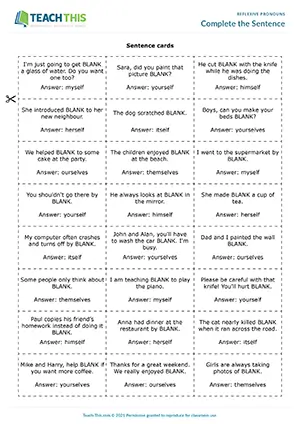
ESL Reflexive Pronouns Game - Vocabulary and Grammar: Matching, Sentence Completion - Group Work
In this fast-paced reflexive pronouns game, students race to complete sentences with reflexive pronouns. In the game, the reader turns over a card and reads the sentence aloud to the players using...
Do It Yourself

ESL Reflexive Pronouns Worksheet - Vocabulary and Grammar Exercises: Matching, Binary Choice, Gap-fill, Sentence Completion, Writing Sentences
Here is a comprehensive reflexive pronouns worksheet for pre-intermediate students. Students begin by matching subject pronouns to reflexive pronouns...
Who did it?

ESL Reflexive Pronouns Activity - Grammar and Speaking: Role-Play, Gap-fill, Asking and Answering Questions, Table Completion - Group Work
Here is an engaging reflexive pronouns speaking activity for pre-intermediate students. In the activity, students act as family members and have to...
Ask Yourself

ESL Reflexive Pronouns Activity - Grammar and Speaking: Gap-fill, Guessing, Asking and Answering Questions, Controlled and Freer Practice
In this free reflexive pronouns speaking activity, students make guesses about their classmates by completing sentences with reflexive pronouns...
Reflexive Pronoun Race
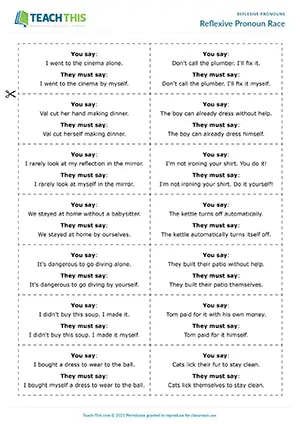
ESL Reflexive Pronouns Game - Speaking: Reforming Sentences, Freer Practice - Group Work
In this entertaining reflexive pronouns game, students race against one another to reword sentences to include reflexive pronouns. Students take it in turns to pick up a card and read the sentence at the top...
Reflexive Verbs

ESL Reflexive Verbs Worksheet - Grammar Exercises: Gap-fill, Categorising, Word Completion, Rewriting Sentences
In this productive reflexive verbs worksheet, students learn and identify verbs that are commonly reflexive and practice using them with reflexive pronouns. Read through how to identify which verbs can...
Understanding Reflexive Pronouns
Reflexive pronouns are pronouns that refer back to the subject of a sentence, such as 'myself', 'yourself', 'himself', 'herself', 'itself', 'ourselves', 'yourselves', and 'themselves'. When students use a regular object pronoun where a reflexive pronoun is needed, or leave the reflexive pronoun out entirely, the sentence either changes its meaning or sounds unfinished to a native speaker.
This page covers reflexive pronouns at A2 and B1 levels, with six resources including a card game, a role-play activity, worksheets, and a speaking activity, with one available as a free download.
English has eight reflexive pronouns, each paired with a specific subject pronoun, and students need to learn all eight forms before they can use them accurately in writing and speech. The table below maps each subject pronoun to its reflexive form and shows the pronoun used naturally in a sentence.
| Subject Pronoun | Reflexive Pronoun | Example Sentence |
|---|---|---|
| I | myself | 'I made myself a cup of tea.' |
| you (singular) | yourself | 'Did you hurt yourself?' |
| he | himself | 'He taught himself to play guitar.' |
| she | herself | 'She introduced herself to the team.' |
| it | itself | 'The cat cleaned itself after eating.' |
| we | ourselves | 'We painted the whole kitchen ourselves.' |
| you (plural) | yourselves | 'Help yourselves to food.' |
| they | themselves | 'They organized the entire event themselves.' |
When to Use Reflexive Pronouns
Emphasising that someone acted without help: A speaker adds a reflexive pronoun after the verb or at the end of a clause to stress that the subject acted independently, without assistance from anyone else, as in 'She fixed the car herself' rather than simply 'She fixed the car.'
Showing that the action loops back to the doer: A reflexive pronoun replaces a regular object pronoun when the subject and object refer to the same person, making it clear that the action affects the doer rather than someone else, as in 'He cut himself while cooking.'
Fixed expressions and idiomatic uses: Several everyday English expressions rely on reflexive pronouns as set phrases that do not follow the standard reflexive rule and must simply be learned as fixed chunks, as in 'Make yourself at home' or 'Help yourself.'
3-Step Framework for Teaching Reflexive Pronouns
1. Build the Form First: Before any game, students need to see how reflexive pronouns are formed and which subject pronoun each one belongs to. Start with a structured worksheet sequence that moves from matching subject pronouns to their reflexive forms, through controlled gap-fill practice, and up to writing sentences with each pronoun using their own ideas.
2. Use the Pronoun in Context: Deepen understanding through a whodunit role-play where students take on family member roles to find out who broke Mum's favourite plate around 5 p.m. Each student completes the sentence on their role card with a reflexive pronoun before interviewing the rest of the group, recording alibis, and using the information to write their conclusion.
3. Reword Under Pressure: Push fluency with a competitive rewording game where students race to rephrase sentences so they include a reflexive pronoun without changing the meaning. A student reads a card aloud, for example 'I went to the cinema alone', and the group races to produce the reflexive version: 'I went to the cinema by myself.'
Common Mistakes with Reflexive Pronouns
Adding a reflexive pronoun to a non-reflexive verb: Students often insert a reflexive pronoun with verbs that do not take one in English, because they translate directly from languages where those verbs are grammatically reflexive. Wrong: 'I feel myself tired after work.' Correct: 'I feel tired after work.'
Using the wrong reflexive form for the subject: Students often use 'themself' instead of 'themselves' for a plural subject, or mix up singular and plural reflexive forms, because they have not fully mapped each subject pronoun to its correct reflexive counterpart. Wrong: 'The children made the costumes themself.' Correct: 'The children made the costumes themselves.'
Common Questions About Teaching Reflexive Pronouns
What is a good reflexive pronouns speaking activity?
The free activity Ask Yourself gets students using reflexive pronouns in real conversations. Students complete sentences with a classmate's name and a reflexive pronoun, for example 'I think Jessica always behaves herself in class', then turn each sentence into a yes/no question to ask that classmate directly, checking guesses and noting down what they find out.
What is an effective reflexive pronouns worksheet?
The worksheet Do It Yourself covers all eight reflexive pronoun forms through five exercise types. Students start by matching subject pronouns to their reflexive counterparts, work through binary choice and gap-fill exercises, and finish by creating their own example sentence for each reflexive pronoun using their own ideas.
What is a fun reflexive pronouns game?
The game Complete the Sentence runs as a fast-paced card race. A reader turns over a card and reads a sentence aloud using 'blank' for the missing pronoun. Students race to grab the correct reflexive pronoun card from their set and hand it to the reader, saying the pronoun at the same time. The player with the most cards wins.
Become a Teach This Member
Get unlimited access to the full library, plus new resources added every week.
Unlimited Resource Access
Download from 3000+ worksheets, activities, and games.
Save 5+ Hours Weekly
Cut lesson prep time with ready-to-use resources, plus teacher notes and answer keys.
Trusted Professional Quality
Classroom-tested, editable resources created by experienced ESL professionals.
Fresh Content Weekly
Get 5 new resources added to the library each week.
Here's what our members are saying...


