
Present Perfect Continuous ESL Activities, Games & Worksheets
A Perfect Review!
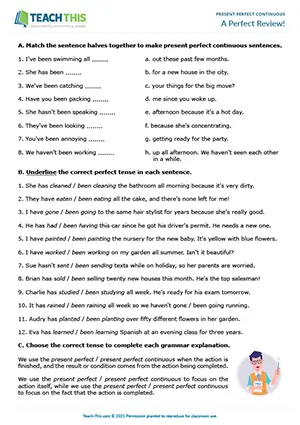
ESL Present Perfect Continuous Worksheet - Grammar Exercises: Matching, Binary Choice, Sentence Completion, Writing Sentences
In this useful present perfect continuous worksheet, students review the uses of the present perfect continuous tense and identify how it is different from the...
Have you been...?
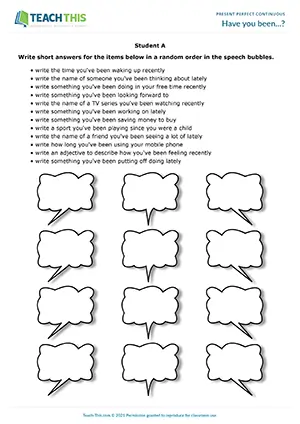
ESL Present Perfect Continuous Activity - Grammar and Speaking: Writing Short Answers, Asking and Answering Questions, Freer Practice - Pair Work
In this present perfect continuous speaking activity, students practice asking and answering 'Have you been...?' questions. Students begin by writing short...
What have I been doing?
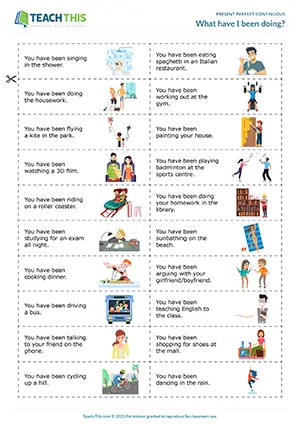
ESL Present Perfect Continuous Game - Grammar and Speaking: Miming, Guessing, Forming Sentences - Group Work
In this free present perfect continuous game, students mime what they have been doing for others to guess. A student from Team A comes to the front of the class and is given a card. The student then asks...
What have they been doing?

ESL Present Perfect Continuous Activity - Grammar and Speaking: Asking and Answering Questions, Forming Sentences - Pair Work
In this engaging present perfect continuous speaking activity, students use picture cards to ask and answer questions in the present perfect continuous tense...
What have you been doing recently?

ESL Present Perfect Continuous Survey - Speaking Activity: Asking and Answering Questions, Freer Practice
In this insightful present perfect continuous activity, students conduct a survey on recent activities and actions to practice the present perfect continuous tense. This activity also helps students practice time...
Are you lying to me?

ESL Present Perfect Continuous Board Game - Speaking and Grammar: True or False, Impromptu Speech, Guessing, Communicative Practice - Group Work
In this fun present perfect continuous board game, students give true or false information about themselves using the present perfect continuous tense. Players...
Early Release

ESL Present Perfect Continuous Activity - Grammar and Speaking: Information Gap, Asking and Answering Questions, Freer and Communicative Practice - Pair Work
In this present perfect continuous information gap activity, students find out what useful acts prisoners have been doing and decide who should be released early...
What do you think they have been doing?
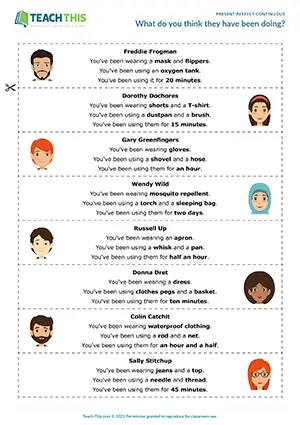
ESL Present Perfect Continuous Role-Play - Grammar and Speaking Activity: Asking and Answering Questions, Sentence Completion, Controlled Practice - Group Work
In this free present perfect continuous activity, students take on a character role and ask questions to find out what other people have been doing. In groups...
What have you been up to?
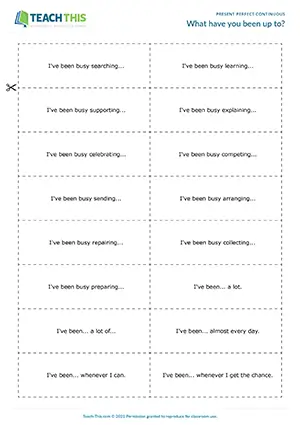
ESL Present Perfect Continuous Activity - Grammar and Speaking: Asking and Answering Questions, Small Talk, Communicative Practice - Pair Work
This communicative present perfect continuous activity helps students develop their small talk conversation skills and practice the present perfect continuous...
Understanding Present Perfect Continuous
The present perfect continuous uses 'have/has been' plus the -ing form of the verb to describe an action that started in the past and is still continuing or has very recently stopped, for example 'She has been working here for three years' or 'I've been running, that's why I'm out of breath.' When students use the present perfect simple instead, saying 'She has worked here for three years' rather than 'She has been working here for three years,' they lose the sense of ongoing duration and the implication that the action is still in progress, which changes the feel of the sentence significantly.
This page covers the present perfect continuous across B1 and B2 levels, with nine resources including a grammar worksheet, speaking activities, a survey, a miming game, a board game, and a role-play, including two free downloads.
This table shows the main forms of the present perfect continuous with the structure and an example for each.
| Form | Structure | Example |
|---|---|---|
| Affirmative | subject + have/has + been + verb-ing | 'She has been working here for two years.' |
| Negative | subject + have/has + not + been + verb-ing | 'He hasn't been sleeping well lately.' |
| Yes/No Question | Have/Has + subject + been + verb-ing + ? | 'Have you been waiting long?' |
| Wh Question | Wh word + have/has + subject + been + verb-ing + ? | 'What have you been doing?' |
| Short Answer (Yes) | Yes, subject + have/has. | 'Yes, I have.' |
| Short Answer (No) | No, subject + haven't/hasn't. | 'No, she hasn't.' |
When to Use Present Perfect Continuous
Explaining a Visible Result: A speaker uses the present perfect continuous when the evidence of an ongoing activity is visible right now, connecting cause to effect, as in 'Have you been running? You look completely worn out.'
Expressing Duration of an Ongoing Activity: When a speaker wants to emphasize how long an action has been going on, the present perfect continuous with 'for' or 'since' signals that it is still happening, as in 'They've been renovating that building since January.'
Expressing Irritation About a Repeated Action: The present perfect continuous can carry emotional weight when a speaker is annoyed by something that has been happening repeatedly, as in 'Someone has been leaving the door open all morning.'
3-Step Framework for Teaching Present Perfect Continuous
1. Make the Contrast Visible on the Page: Open with a worksheet that sets the present perfect continuous against the present perfect simple before students speak. After matching and binary choice exercises, students write sentences showing what each person usually does versus what they have been doing recently, practicing the present perfect continuous to express a recent or temporary change in someone's routine. Seeing the contrast on the page first makes the tense distinction click before any speaking begins.
2. Use Pictures to Unlock the Form: Move into a picture-based activity to get the structure into spoken production. One student picks up a picture card, shows it to their partner and asks 'What has he been doing?', and their partner responds with a full present perfect continuous sentence, for example 'He has been reading a book.' The visual cue removes the pressure of generating content so students can focus entirely on producing the form correctly.
3. Give the Language a Real-World Stake: Push B2 students into a demanding information gap with a genuine decision at the end. Students complete sentences describing the useful things prisoners have been doing, for example 'Gino has been cutting the prison lawns six times a week,' then exchange information with a partner to fill in the rest of their chart. Once both students have the full picture, they decide which prisoner deserves to be released early.
Common Mistakes with Present Perfect Continuous
Omitting 'been' from the Structure: Students often write 'have/has' directly before the -ing form, leaving out 'been' and producing a non-standard form. Wrong: 'She has working here for two years.' Correct: 'She has been working here for two years.'
Using the Continuous Form with Stative Verbs: Students often apply the -ing form to stative verbs that do not normally take the continuous aspect, producing unnatural sentences. Wrong: 'I have been knowing him for years.' Correct: 'I have known him for years.'
Common Questions About Teaching Present Perfect Continuous
What is an interesting game for practicing the present perfect continuous?
The free What have I been doing? is an interesting game at B1 level. A student comes to the front, asks 'What have I been doing?' and has two minutes to mime the sentence on their card to their team. If the team guesses in time, they score two points. If not, the other team gets one chance to guess.
How do I teach the present perfect continuous at B2 level?
Teaching the present perfect continuous at B2 level is most effective when students use the tense under pressure. In Are you lying to me?, players land on a square and speak about that topic in the present perfect continuous, giving true or false information. The rest of the group then guesses whether the player's answer is true or false.
What is a good speaking activity for the present perfect continuous?
A good speaking activity for the present perfect continuous is What have you been up to?, where one student opens with 'Hi, what have you been up to?' and their partner picks a card and replies in the present perfect continuous, for example 'I've been busy searching for a new apartment,' then asks follow-up questions to keep the conversation going.
Here's what our members are saying...


