
Comparatives ESL Games, Activities & Worksheets
Comparative Cards
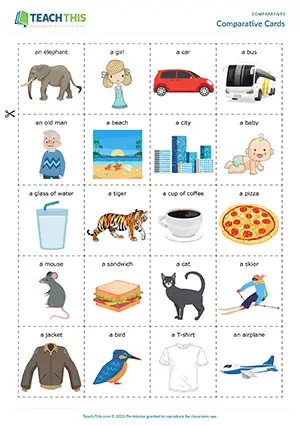
ESL Comparatives Game - Grammar: Forming Sentences - Pair Work
In this free comparatives game, students practice forming comparative sentences with 'than' using nouns cards and common adjectives. In pairs, one student goes first and puts one of their noun cards face up on the table. Students then take turns...
Fun Facts
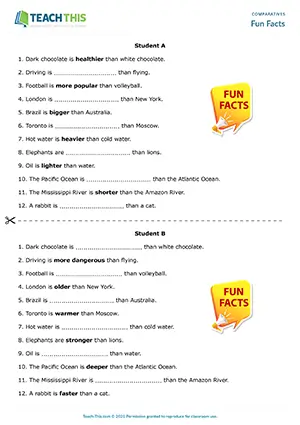
ESL Comparative Adjectives Game - Grammar: Gap-fill, Guessing - Pair Work
In this fun comparative adjectives game, students form and guess missing comparative adjectives in sentences about fun facts. Both students have the same sentences, but where they have a comparative adjective in bold, their partner has a gap...
Introduction to Comparatives
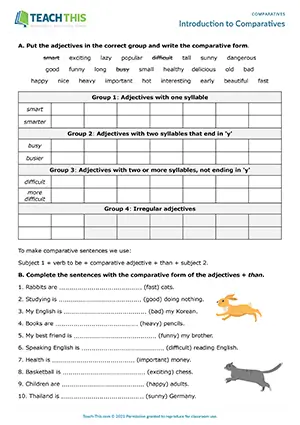
ESL Comparative Adjectives Worksheet - Grammar Exercises: Word Forms, Gap-fill, Sentence Building, Binary Choice
This useful comparatives worksheet helps students learn and practice comparative adjectives with -er and -ier and comparative sentences with 'than'. First, students write the comparative form of...
Comparative Showdown
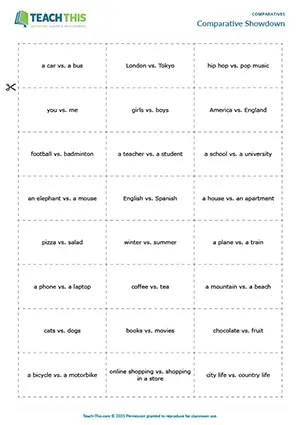
ESL Comparatives Game - Grammar and Speaking: Forming Sentences
In this fast-paced comparatives game, students practice forming comparative sentences with 'than' using a variety of comparative adjectives. One student from each team comes to the front of the class. When you say 'Go!', both...
Fill in the Blank
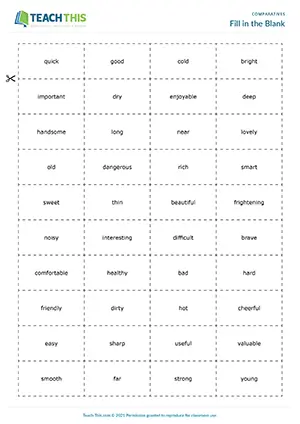
ESL Comparative Adjectives Game - Grammar and Vocabulary: Forming Sentences, Gap-fill, Guessing - Group Work
In this entertaining comparatives game, students race to guess missing comparative adjectives in sentences. Students take turns picking up a card and making a sentence using the comparative form of...
Run Faster
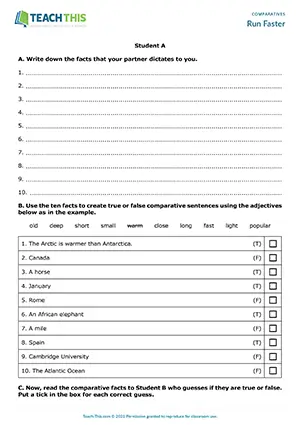
ESL Comparatives Activity - Speaking: Running Dictation - Grammar Game: Writing Sentences, True or False, Guessing - Group and Pair Work
In this free comparatives running dictation activity, students dictate sentences and then use them to make true or false comparative facts, which they use in a...
Which bicycle?
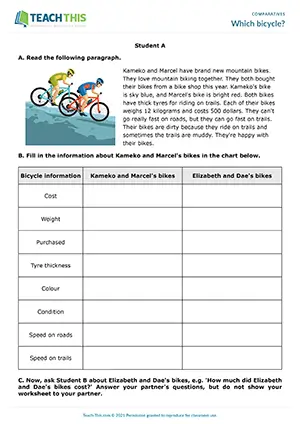
ESL Comparatives Activity - Reading, Grammar and Vocabulary Exercises: Scanning, Sentence Completion - Speaking Activity: Information Gap - Pair Work
In this comparatives information-gap activity, students practice reading for specific information and using comparative adjectives to compare bicycles...
A lot, Much and Slightly
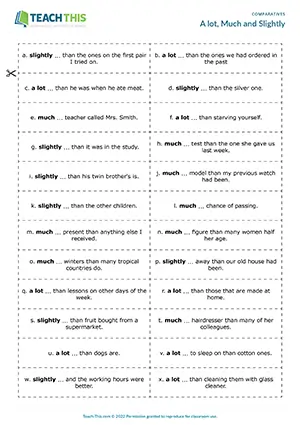
ESL Comparisons Game - Grammar and Speaking: Matching, Sentence Completion, Freer Practice - Group Work
In this creative making comparisons game, students match sentence halves together and connect them with the modifiers 'a lot', 'much' or 'slightly' and suitable comparative adjectives. In groups, players...
As ... As Expressions
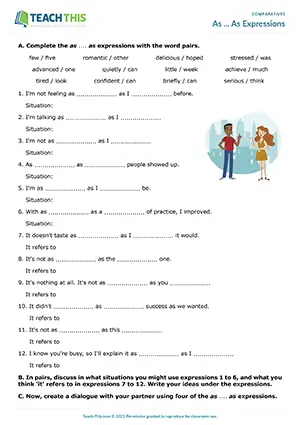
ESL As ... As Expressions Activity - Grammar Exercise: Gap-fill - Speaking Activity: Discussion, Role-Play, Freer Practice - Pair Work
In this useful comparative expressions activity, students practice common comparative expressions with 'as ... as'. First, students complete...
Comparative Clues
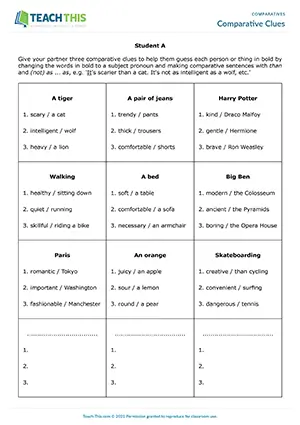
ESL Comparatives Game - Grammar: Forming Sentences, Guessing - Pair Work
In this productive comparatives game, students give comparative clues with 'than' and (not) 'as ... as' to a partner, who tries to guess who or what is being described. First, in pairs, students complete three empty boxes at the bottom of the worksheet...
Comparatives Board Game
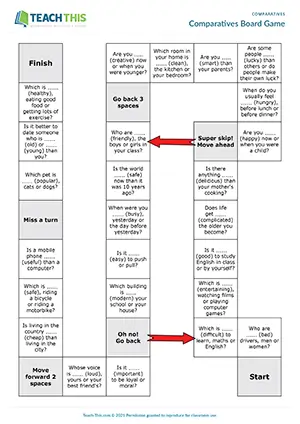
ESL Comparatives Board Game - Grammar and Speaking: Asking and Answering Questions, Freer Practice - Pair Work
In this free comparatives board game, students change adjectives into their comparative forms and then use the comparative adjectives to ask and answer conversation questions...
Comparatives Practice
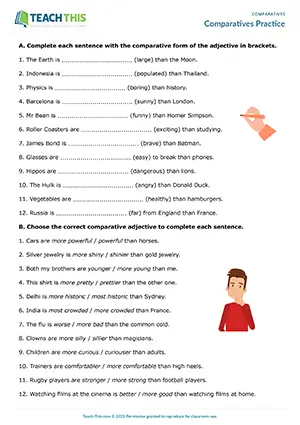
ESL Comparatives Worksheet - Grammar Exercises: Gap-Fill, Binary Choice, Rewriting Sentences
Here is an insightful comparatives worksheet to help students practice comparative adjectives and the 'as ... as' comparative structure. First, students complete sentences with the comparative form...
Comparatives Survey
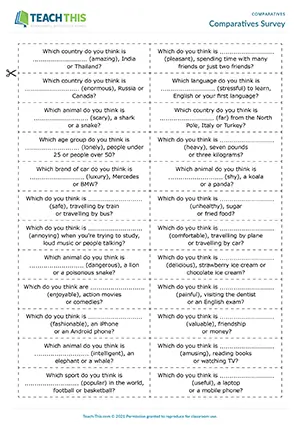
ESL Comparatives Activity - Grammar, Speaking and Writing: Gap-fill, Asking and Answering Questions, Summary Writing, Controlled and Freer Practice
In this interesting comparatives activity, students conduct a class survey where they ask and answer questions using comparative adjectives. Students begin by...
Which is better?
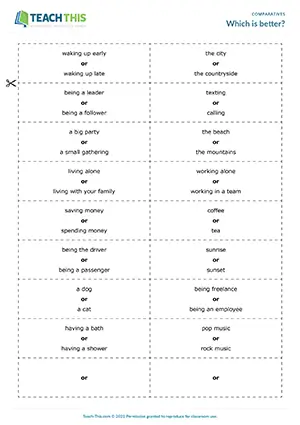
ESL Comparatives Activity - Speaking: Asking and Answering Questions, Discussion, Freer Practice - Group Work
In this engaging comparatives discussion activity, students use comparative structures to decide which of two options is better and explain why, taking turns to ask and discuss prompts in small groups...
Comparative Communication
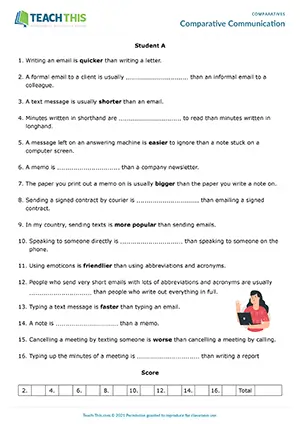
ESL Comparative Adjectives Game - Grammar and Vocabulary: Gap-fill, Guessing - Pair Work
Here is a comparative adjectives guessing game for Business English students or adults to play in class on the topic of workplace communication. Both students have the same sentences on their worksheet...
Comparative Correlative: The ..., the ...
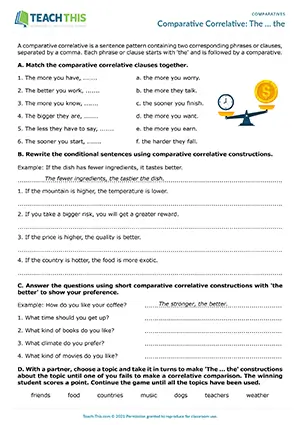
ESL Comparative Correlative Worksheet - Grammar Exercises: Matching, Rewriting Sentences, Writing Answers - Speaking Game: Forming Sentences - Pair Work
This detailed correlative comparisons worksheet helps students practice comparative correlative constructions. Students start by matching...
Complex Comparisons
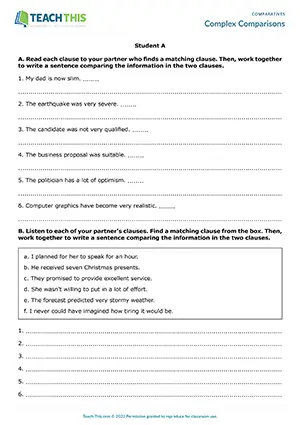
ESL Comparatives Activity - Grammar and Writing: Information Gap, Matching, Writing Sentences, Controlled Practice - Pair Work
In this challenging comparatives activity, students match related clauses and write sentences making complex comparisons between them. In pairs, students match each clause on their worksheet...
Three Reasons
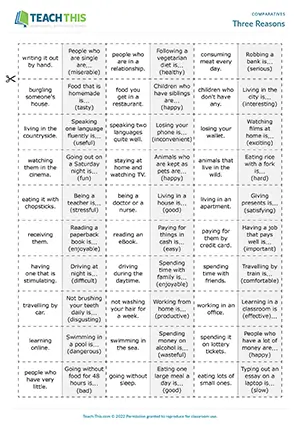
ESL Comparatives Game - Grammar and Speaking: Matching, Forming Sentences, Freer Practice - Group Work
In this creative making comparisons game, students make complex comparisons between verb and noun phrases in order to express an opinion. The first player tries to make a sentence by placing one of...
Tick or Talk?
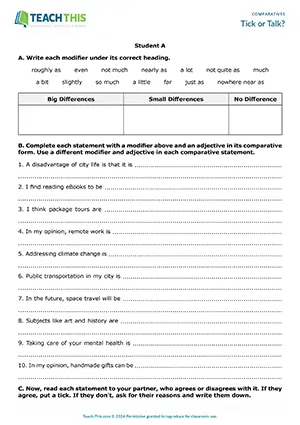
ESL Modifiers and Comparatives Activity - Grammar and Speaking: Sentence Completion, Making and Responding to Statements - Group and Pair Work
In this rewarding modifiers and comparatives activity, students complete comparative statements with a variety of modifiers and adjectives and then talk...
Understanding Comparatives
Comparative adjectives compare two people, things, or ideas to show that one has more or less of a quality than the other, using '-er + than' for shorter adjectives or 'more/less + adjective + than' for longer ones, as in 'This route is shorter than the highway.' and 'Working from home is more flexible than commuting.' Students who apply the wrong formation rule, such as doubling the wrong consonant or using 'more' with a one-syllable adjective, produce forms that undermine both accuracy and fluency. You can also use modifiers such as 'a lot', 'far', or 'slightly' before a comparative to show the size of the difference, and the correlative structure 'the + comparative, the + comparative' to show that two things change together.
This page covers A1-A2 to B2 levels with nineteen activities, including three free downloads.
The table below shows the formation rule for each adjective type, with a base form, comparative, and example sentence.
| Adjective Type | Rule | Base Form | Comparative | Example |
|---|---|---|---|---|
| One syllable | Add -er + than | tall | taller than | 'This building is taller than the one next door.' |
| One syllable ending in -e | Add -r + than | wide | wider than | 'The new road is wider than the old one.' |
| One syllable CVC | Double final consonant + -er + than | big | bigger than | 'A whale is bigger than a dolphin.' |
| Two syllables ending in -y | Change -y to -i + -er + than | happy | happier than | 'She seemed happier than she did last week.' |
| Two syllables (other) | more/less + adjective + than | boring | more boring than | 'The second lecture was more boring than the first.' |
| Three or more syllables | more/less + adjective + than | expensive | more expensive than | 'This model is more expensive than the basic version.' |
| Irregular | Learn individually | good / bad / far | better / worse / farther (further) than | 'The results were better than we expected.' |
When to Use Comparatives
Comparing Two Options to Support a Choice: Use a comparative adjective with 'than' when presenting two alternatives and explaining which one has more or less of a quality. This structure appears frequently in business writing, product descriptions, and spoken recommendations, as in 'The second supplier is more reliable than the first, so we recommend signing with them.'
Showing That Two Things Are Equal: Use the 'as...as' structure when you want to highlight similarity rather than difference, which is common when reassuring someone that an alternative is just as good or when making a neutral comparison, as in 'The online version of the course is just as rigorous as the face-to-face option.'
Grading the Degree of Difference: Add a modifier before the comparative adjective when the size of the difference matters to your point. 'A lot' and 'far' signal a large gap, while 'slightly' and 'a little' signal a small one, as in 'The revised proposal is far more detailed than the original draft.'
3-Step Framework for Teaching Comparatives
1. Establish the Forms with a Focused Worksheet: Start with the Introduction to Comparatives worksheet, which walks students through the three core formation patterns. Students write the comparative form of adjectives ending in '-er' and '-ier' and the irregular forms of 'good' and 'bad', complete sentences with the correct comparative form plus 'than', build their own comparative sentences from given words, and finish with a binary choice exercise. Working through these four exercise types in order gives students repeated exposure to every formation rule before free production begins.
2. Extend to Real Context with an Information-Gap Activity: Follow up with the Which bicycle? activity, which moves students from controlled form practice into purposeful communication. Students scan a paragraph about several bicycles to complete a chart, then exchange information with a partner who has a different version to fill in the missing details. After the information-gap stage, students produce comparative sentences from the completed chart, unscramble pre-written comparative sentences using the bike data as a guide, and write their own true comparative sentences using a box of adjectives.
3. Add Modifiers to Build Precision: Close the sequence with the A lot, Much and Slightly card game, which pushes students beyond basic comparatives by requiring them to grade the degree of difference. Players take turns picking up a sentence-beginning card and placing it face-up. Players check their own cards for a matching sentence ending, and the student with the match reads it aloud while adding one of the modifiers shown on the ending card ('a lot', 'much', or 'slightly') along with a suitable comparative adjective. The group votes on whether the ending, modifier, and adjective all fit logically.
Common Mistakes with Comparatives
Using 'More' with a One-Syllable Adjective: Students frequently add 'more' to short adjectives instead of applying the '-er' ending, producing a double comparative that sounds unnatural. Wrong: 'This task is more hard than the last one.' Correct: 'This task is harder than the last one.'
Omitting 'Than' After a Comparative Adjective: Students often drop 'than' when the second element of the comparison follows immediately, leaving the sentence structurally incomplete. Wrong: 'The new office is bigger the old one.' Correct: 'The new office is bigger than the old one.'
Common Questions About Teaching Comparatives
What is a good free game for practicing comparative sentences?
Comparatives games work well when accuracy is tied to a competitive outcome. In Comparative Cards, one student places a noun card face-up, and players take turns adding a new card to either end of the chain while making a comparative sentence with 'than'. Each turn requires a different adjective. A grammar error or a blank means a missed turn, and the first player to use all their cards wins.
What is a free speaking activity for practicing comparatives?
Comparatives speaking activities give students a genuine reason to ask and listen carefully. In Run Faster, one student in each pair runs to a set of sentences on the wall, memorises a fact, and dictates it to their partner. Once all ten facts are complete, students use them to write true or false comparative sentences, then read their facts to a new partner who guesses true or false.
What is an effective worksheet for practicing comparative adjectives?
A comparatives worksheet covers the most ground when it moves students through recognition and then production. Students complete sentences by supplying the correct comparative form of the adjective in brackets, then choose between two options in a binary choice exercise. After that, they rewrite sentences using the 'as...as' structure, and finish by writing their own positive or negative 'as...as' sentences using prompts.
What is the best worksheet for teaching the 'the...the...' comparative structure?
The 'the...the...' comparative structure clicks fastest when students build from recognition to production. Students start by matching the two halves of correlative sentences, then rewrite conditional sentences as 'the..., the...' constructions. They answer questions using short 'the better' responses to show preferences, and finish with a speaking game where students take turns producing 'the..., the...' sentences until one player cannot continue.
Here's what our members are saying...


