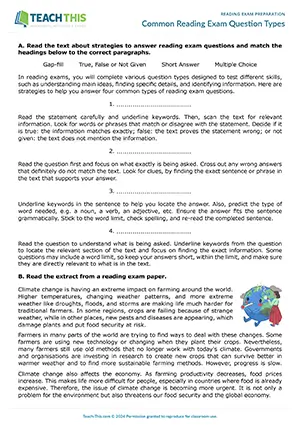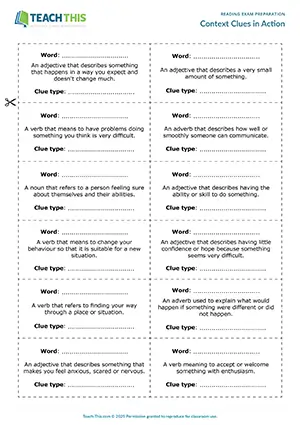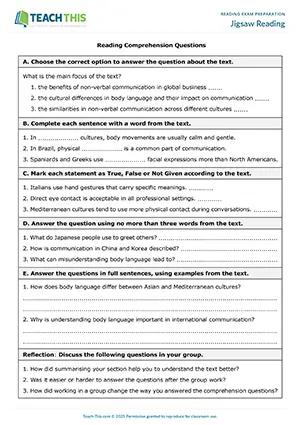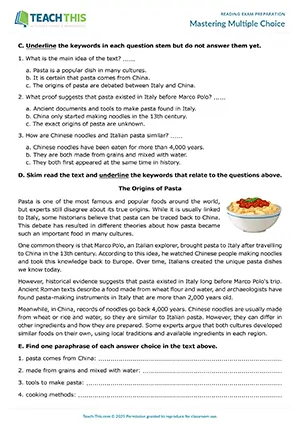

Business English Email Enquiries Worksheet - Reading, Vocabulary and Writing Exercises: Matching, Sentence Completion, Writing Emails from Prompts - Pair Work
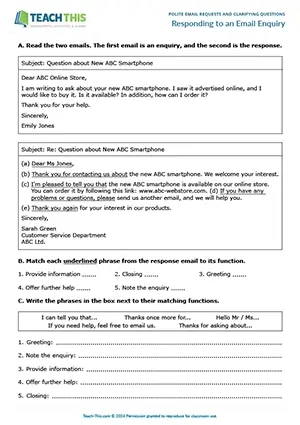
In this email enquiries worksheet, students learn and practice how to write an email that responds to a customer enquiry. First, students read an enquiry email...
Business English Email Enquiries Worksheet - Reading, Vocabulary and Writing Exercises: Matching, Sentence Completion, Writing Emails from Prompts - Pair Work In this email enquiries worksheet, students learn and practice how to write an email that responds to a customer enquiry. First, students read an enquiry email and a response. Students then match phrases in the response email with their functions. Next, students match additional phrases from a box to their functions. After that, students swap worksheets with a partner and write an email enquiry by completing sentences with their own ideas. Students then give back the worksheet to their partner, who writes an email response using the phrases from the worksheet. Finally, students read their email to their partner and discuss whether they think it was a good response or not.
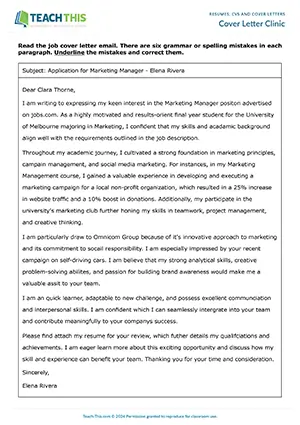
Business English Invitation Emails Worksheet - Reading and Writing Exercises: Binary Choice, Ordering, Identifying, Matching, Email Writing, Peer Feedback
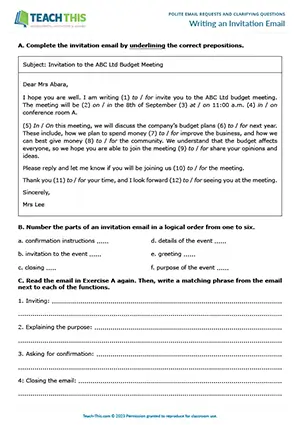
In this useful business invitation emails worksheet, students learn and practice how to write emails issuing work-related invitations. First, students complete an...
Business English Invitation Emails Worksheet - Reading and Writing Exercises: Binary Choice, Ordering, Identifying, Unscrambling, Matching, Email Writing, Peer Feedback In this useful business invitation emails worksheet, students learn and practice how to write emails issuing work-related invitations. First, students complete an invitation email by underlining the correct prepositions. Students then number the parts of an invitation email so that they are in a logical order. Next, students scan the email again to find phrases that match different functions and write them down. After that, students unscramble words to form sentences and use them to complete an invitation email. Following that, students write an invitation email inviting someone to a marketing meeting. Finally, students exchange their completed emails with a partner and use a checklist to provide feedback, putting a tick for each item achieved. Students then revise their emails to address any of the unachieved items.
ESL Have You questions Game - Grammar and Speaking: Guessing, Gap-fill, Asking and Answering questions, Freer Practice
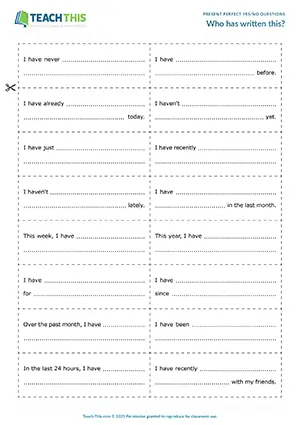
In this engaging present perfect yes/no questions game, students make guesses and complete present perfect statements about their classmates and then find out if their guesses are right or wrong by...
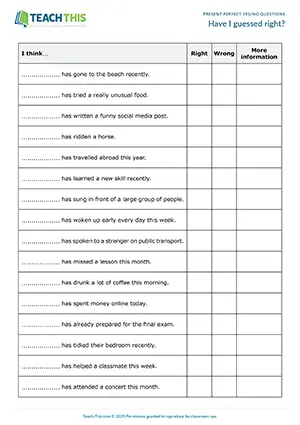
ESL Have You questions Game - Grammar and Speaking: Guessing, Gap-fill, Asking and Answering questions, Freer Practice In this engaging present perfect yes/no questions game, students make guesses and complete present perfect statements about their classmates and then find out if their guesses are right or wrong by asking 'Have you...?' questions. First, students read each sentence, choose a classmate they think the statement might be true for and write the person's name at the beginning of the sentence, e.g. 'Katie has gone to the beach recently.' Next, students go around the class, find the classmate they named in each sentence, and ask them a present perfect yes/no question with 'Have you...?', e.g. 'Katie, have you gone to the beach recently?' Their classmate replies 'Yes, I have' or 'No, I haven't' accordingly. Students put a tick or a cross next to each statement, depending on whether their guess is right or wrong. Students then ask a present perfect follow-up question and write the information in the last column. The student with the most correct guesses wins the game. Finally, students give feedback to the class on what they found out.
ESL Present Perfect Yes No questions Game - Grammar and Speaking: Forming, Asking and Answering questions
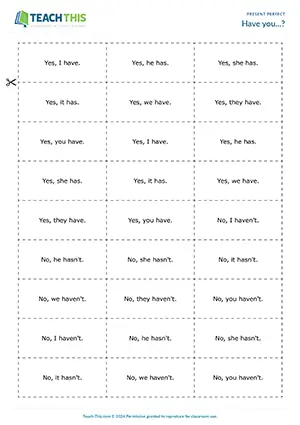
This enjoyable present perfect questions game helps students practice present perfect yes/no questions and short answers. In groups, players take turns choosing one of their short answer cards...
ESL Present Perfect Yes No questions Game - Grammar and Speaking: Forming, Asking and Answering questions This enjoyable present perfect questions game helps students practice present perfect yes/no questions and short answers. In groups, players take turns choosing one of their short answer cards without showing it to anyone, e.g. 'Yes, it has.' The player then thinks of a present perfect yes/no question that will elicit the answer on the card, e.g. 'Has it been sunny today?' The player then asks the question to another student in the group. If the student gives the same short answer that's on the card, the player wins and discards the card. If not, the player keeps the card. The first player to get rid of all their cards wins the game.
ESL Present Perfect Yes No questions Activity - Grammar and Speaking: Asking and Answering questions
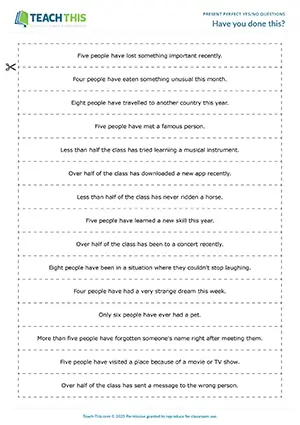
In this insightful present perfect yes/no questions activity, students ask 'Have you...?' questions in order to find out if certain statements about the class are true or false. First, students prepare the...
ESL Present Perfect Yes No questions Activity - Grammar and Speaking: Asking and Answering questions from Prompts, Controlled Practice In this insightful present perfect yes/no questions activity, students ask 'Have you...?' questions in order to find out if certain statements about the class are true or false. First, students prepare the present perfect yes/no question they need to ask to find out if a statement on a slip of paper is true or false, e.g. 'Over half the class has seen a whale.' Students then go around asking their 'Have you...?' question to the other students, e.g. 'Have you ever seen a whale?' Students mark each response by putting a tick or cross on their slip of paper. When a student has enough information and knows whether their statement is true or false, they sit down. Finally, review the answers together as a class. For each statement, first, ask the class whether they think it is true or false. Then, the student who asked the question reveals the actual result based on their findings.
ESL Present Perfect Yes No questions Worksheet - Grammar Exercises: Gap-fill, Error Correction - Speaking Activity: Asking and Answering questions, Freer Practice
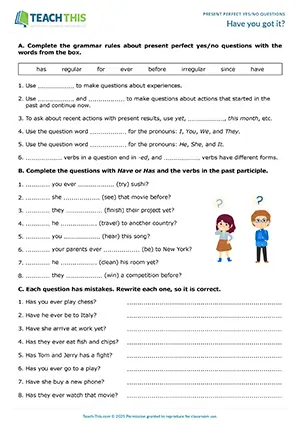
In this comprehensive present perfect yes/no questions worksheet, students learn the structure and function of 'Have...?' and 'Has...?' questions. First...
ESL Present Perfect Yes No questions Worksheet - Grammar Exercises: Gap-fill, Error Correction - Speaking Activity: Asking and Answering questions, Freer Practice In this comprehensive present perfect yes/no questions worksheet, students learn the structure and function of 'Have...?' and 'Has...?' questions. First, students complete grammar rules about present perfect yes/no questions with words from a box. Students then complete questions with 'Have' or 'Has' and verbs in the past participle. Next, students identify errors in questions and rewrite them so that they are grammatically correct. After that, students write present perfect yes/no questions using prompts and verbs in their correct form. Students then move on to use words in brackets to write present perfect yes/no questions that match responses. Finally, students ask and answer similar questions with a partner using the words in brackets and the pronoun 'you'.
ESL Have and Has questions Game - Grammar: Snap, Matching questions and Answers
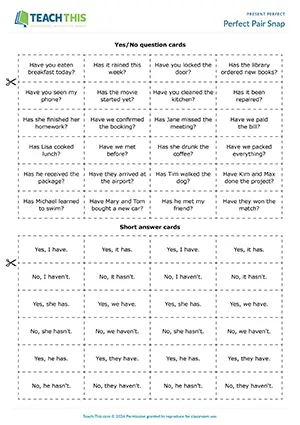
In this fun present perfect game, students play snap by matching 'Have...?' and 'Has...?' questions with short answers. In pairs, both students turn over a card from their pile at the same time and place them...
ESL Have and Has questions Game - Grammar: Snap, Matching questions and Answers In this fun present perfect game, students play snap by matching 'Have...?' and 'Has...?' questions with short answers. In pairs, both students turn over a card from their pile at the same time and place them on the table next to each other. If the present perfect yes/no question and short answer match, the first student to say 'Snap!' scores a point. Students then pick up their own cards, shuffle their pack and play again. Students do not pick up their partner's cards. If the question and answer don't match, students continue turning over cards until a matching pair comes up. If a student says 'Snap!' when the question and answer don't match, the other student scores a point and the game continues. The first student to get 15 points wins the game.
ESL Have You questions Game - Grammar: Asking and Answering questions
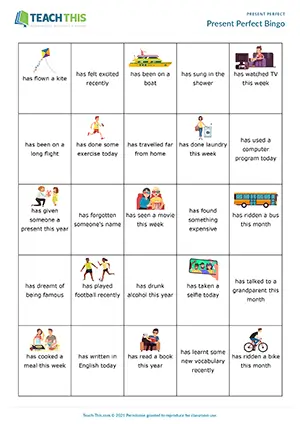
In this free present perfect yes/no questions game, students play bingo by asking and answering 'Have you...?' questions. Students go around asking their classmates present perfect 'Have you...?' questions from the squares on the bingo grid...
ESL Have You questions Game - Grammar: Asking questions from Prompts, Answering questions In this free present perfect yes/no questions game, students play bingo by asking and answering 'Have you...?' questions. Students go around asking their classmates present perfect 'Have you...?' questions from the squares on the bingo grid. If a square relates to a personal experience, students make a question with 'Have you ever...?' When a classmate answers 'Yes, I have' to a question, the student writes their name in the square and then moves on to speak to another student. If a classmate answers 'No, I haven't', the student asks a different question or goes on to speak to someone else. The first student to get five squares in a row in any direction shouts 'Bingo!' When this happens, stop the activity and have the student make five present perfect sentences about the information in the squares, e.g. 'Becky has flown a kite. Derek has been on a long flight, etc.' Then, students continue the game by trying to complete the entire bingo card with names.
ESL Have You questions Game - Grammar and Speaking: Completing, Asking and Answering questions, Guessing
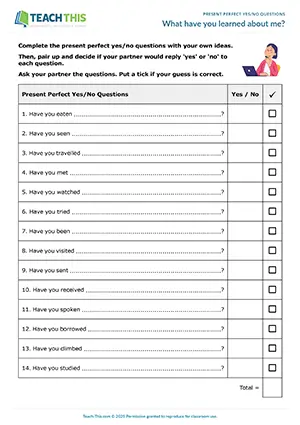
In this intriguing present perfect yes/no questions game, students practice forming, asking and answering questions with 'Have you...?' First, students complete present perfect yes/no questions...
ESL Have You questions Game - Grammar and Speaking: Completing, Asking and Answering questions, Guessing In this intriguing present perfect yes/no questions game, students practice forming, asking and answering questions with 'Have you...?' First, students complete present perfect yes/no questions with their own ideas. Next, divide the students into pairs. Working alone, students decide if their partner would reply yes or no to each question and write their guesses in a yes/no column. Students then take turns asking the questions to their partner to find out if their guesses are right or wrong. Their partner replies 'Yes, I have' or 'No, I haven't' accordingly. Students put a tick for each correct guess. The student with the most correct guesses at the end of the game wins. Finally, students give feedback to the class on what they found out about their partner.
ESL Have You questions Game - Grammar and Speaking: Sentence Completion, Forming, Asking and Answering questions
This productive present perfect yes/no questions game helps students to practice asking and answering 'Have you...?' questions about experiences and recently completed actions. First, students...
ESL Have You questions Game - Grammar and Speaking: Sentence Completion, Forming, Asking and Answering questions This productive present perfect yes/no questions game helps students to practice asking and answering 'Have you...?' questions about experiences and recently completed actions. First, students complete present perfect sentences on cards with true information about themselves. Students then fold up their completed sentences and put them in a box. Next, all the students stand up and take one sentence card from the box. Students then go around the class and find out who wrote the sentence on their card by asking present perfect yes/no questions, e.g. 'Have you been to Egypt before?' When a student finds the person who wrote the sentence, they write the person's name on the card, keep it and take another one from the box. Students repeat the activity until there are no sentences left. The student with the most sentences at the end of the game is the winner. Finally, students report back to the class on what they found out about their classmates.
ESL Has questions Activity - Grammar and Speaking: Information Gap, Writing, Asking and Answering questions, Gap-fill, Freer Practice - Group and Pair Work
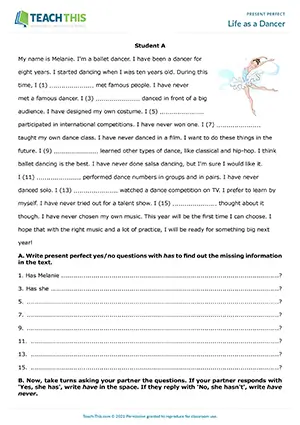
In this rewarding present perfect information gap activity, students write and ask present perfect questions with 'has' in order to complete a text about a dancer...
ESL Has questions Activity - Grammar and Speaking: Information Gap, Writing, Asking and Answering questions, Gap-fill, Freer Practice - Group and Pair Work In this rewarding present perfect information gap activity, students write and ask present perfect questions with 'has' in order to complete a text about a dancer. First, in two groups, students write down the present perfect yes/no questions with 'has' that they need to find out the missing information in a text about a dancer. Next, students pair up with someone from the other group and take turns asking and answering their questions in numerical order. If their partner responds with 'Yes, she has', the student writes have in the space. If they reply with 'No, she hasn't', the student writes 'have never' in the space. Afterwards, students compare their completed texts, which should be identical.
ESL Present Perfect questions Worksheet - Grammar Exercises: Gap-fill, Writing questions and Answers - Speaking Activity: Freer Practice - Pair Work
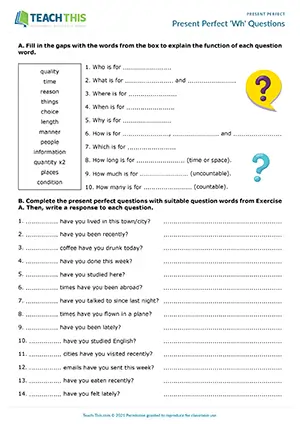
In this free present perfect Wh questions worksheet, students learn the functions of question words and how to form, ask and answer Wh questions in the...
ESL Present Perfect questions Worksheet - Grammar Exercises: Gap-fill, Writing questions and Answers from Prompts - Speaking Activity: Freer Practice - Pair Work In this free present perfect Wh questions worksheet, students learn the functions of question words and how to form, ask and answer Wh questions in the present perfect tense. First, students fill in gaps with words from a box to explain the functions of question words. Next, students complete present perfect questions with suitable question words from Exercise A and write a response to each question. Students then practice writing present perfect Wh questions using prompts. After that, students write present perfect Wh questions corresponding to the underlined information in responses. Finally, students ask and answer the questions in Exercise D with a partner.
ESL Present Perfect Wh questions Activity - Grammar and Speaking: Writing, Asking and Answering questions, Controlled and Freer Practice - Group and Pair Work
In this insightful present perfect speaking activity, students write, ask and answer present perfect Wh conversation questions. First, in two groups, students...
ESL Present Perfect Wh questions Activity - Grammar and Speaking: Writing, Asking and Answering questions, Controlled and Freer Practice - Group and Pair Work In this insightful present perfect speaking activity, students write, ask and answer present perfect Wh conversation questions. First, in two groups, students write present perfect conversation questions from prompts. Students then pair up with someone from the other group. Next, students take turns asking their partner the present perfect questions, noting down their answers, and asking follow-up questions to gain more information when possible. Finally, students report back to the class on the things they found out about their partner.
ESL Present Perfect questions Board Game - Grammar and Speaking: Forming questions, True or False, Guessing, Freer Practice - Group Work
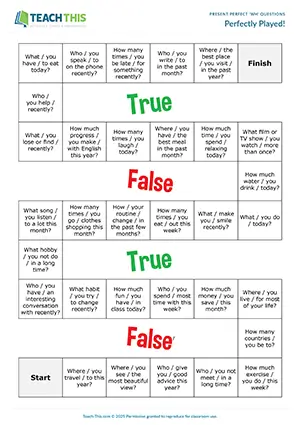
In this fun present perfect Wh questions board game, students practice asking and answering Wh questions in the present perfect. In groups, players take turns...
ESL Present Perfect questions Board Game - Grammar and Speaking: Forming questions from Prompts, Giving True or False Answers, Guessing, Freer Practice - Group Work In this fun present perfect Wh questions board game, students practice asking and answering Wh questions in the present perfect. In groups, players take turns rolling the dice and moving their counter along the board. When a player lands on a square, they pick up a true or false card and look at it without showing anyone. Next, the player forms a present perfect Wh question from the prompt on the square, e.g. 'Where have you travelled to this year?' If the player forms the question correctly, they score a point. The player then gives a true or false present perfect answer to the question as indicated on the card. The other students then guess whether the player's response is true or false, and the player reveals the answer. Each student who guessed correctly scores one point. Then, the next player rolls the dice, and so on. When a player reaches the finish, the game ends and the points are added up. The player with the most points wins the game.
ESL Present Perfect Wh questions Game - Grammar and Speaking: Forming questions, Freer Practice - Group Work
In this entertaining present perfect Wh questions game, students race to make present perfect questions that elicit certain responses. In groups, students take turns taking an answer card from...
ESL Present Perfect Wh questions Game - Grammar and Speaking: Forming questions from Prompts, Freer Practice - Group Work In this entertaining present perfect Wh questions game, students race to make present perfect questions that elicit certain responses. In groups, students take turns taking an answer card from an envelope and reading it aloud to the group, e.g. 'I have gone shopping.' All the students then race to make a present perfect Wh question to elicit the response using a question word from their card, e.g. 'Where have you gone?' The first student to form and ask a suitable question takes the answer card and crosses off the question word on their card, e.g. where. It's then the next student's turn to take an answer card, and so on. The first student to cross off all the question words on their card wins the game.
ESL Present Perfect Wh questions Game - Grammar and Speaking: Writing Sentences, Guessing, Forming questions, Freer Practice - Group Work
In this engaging present perfect Wh questions game, students guess questions from answers written by other students. First, students answer each present...
ESL Present Perfect Wh questions Game - Grammar and Speaking: Writing Sentences, Guessing, Forming questions from Prompts, Freer Practice - Group Work In this engaging present perfect Wh questions game, students guess questions from answers written by other students. First, students answer each present perfect question on their card in sentence form, adding any time adverbial shown in the question, e.g. today, recently, etc. Students then take turns reading an answer at random to the other two students, who race to guess the question from the answer. The first student to guess the correct present perfect Wh question scores one point. The game continues until all three students' questions have been guessed correctly. The student with the most points at the end of the game wins.
ESL Are You Going To questions Activity - Grammar and Speaking: Asking and Answering questions, Freer Practice
In this insightful 'be going to' yes/no questions activity, students practice asking 'Are you going to…?' questions about future plans and finding classmates with matching answers. First, students answer....
ESL Are You Going To questions Activity - Grammar and Speaking: Asking and Answering questions from Prompts, Controlled and Freer Practice In this insightful 'be going to' yes/no questions activity, students practice asking 'Are you going to…?' questions about future plans and finding classmates with matching answers. First, students answer 'Are you going to...?' questions by writing short answers in the column marked 'You'. Students then go around the class asking and answering the 'Are you going to...?' questions to find people with the same answers. When a student finds someone with the same answer, the two students write each other's name in the last column. When everyone has finished, students give feedback to the class on their shared plans.
ESL Be Going To Yes/No questions Game - Grammar: Writing questions, Matching - Group Work
In this fast-paced 'be going to' game, students race to match 'be going to' yes/no questions with short answers. To begin, students look at their question cards and write 'be going to' yes/no...
ESL Be Going To Yes/No questions Game - Grammar: Writing questions from Prompts, Matching - Group Work In this fast-paced be going to game, students race to match 'be going to' yes/no questions with short answers. To begin, students look at their question cards and write 'be going to' yes/no questions from the prompts on their cards. One student then starts by turning over a short answer card for everyone to see and reading it aloud, e.g. 'Yes, I am.' All the students then check their question cards to see if they have a question that matches the answer. The first student to place a matching question card next to the answer card on the table, saying the question at the same time, wins, e.g. 'Are you going to play football this afternoon?' The two matching cards are then set aside, and the next student turns over an answer card. If a student puts down an incorrect question card, they are out of the round, and the other students race to put down a matching question. The first student to get rid of all their question cards wins the game.
ESL Are You Going To Worksheet - Grammar Exercises: Matching, Writing questions and Answers, Gap-fill, Crossword
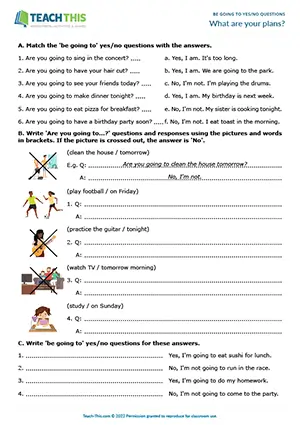
This free be going to yes/no questions worksheet helps students learn and practice how to form questions about future plans. First, students match 'Are you going to...?' questions with...
ESL Are You Going To Worksheet - Grammar Exercises: Matching, Writing questions and Answers from Prompts, Gap-fill, Crossword This free be going to yes/no questions worksheet helps students learn and practice how to form questions about future plans. First, students match 'Are you going to...?' questions with appropriate answers. Next, students write 'Are you going to...?' questions and responses using pictures and prompts. After that, students write 'be going to' yes/no questions for a set of answers. Finally, students complete a crossword using information from a weekly schedule and gap-fill question clues.
ESL Are You Going To Game - Grammar and Speaking: Sentence Completion, Guessing, Asking and Answering questions - Pair Work
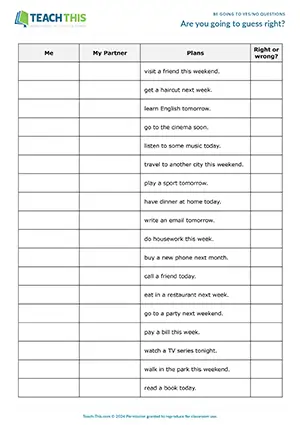
In this enjoyable 'be going to' guessing game, students use 'Are you going to…?' questions and short answers to guess their partner's plans. First, students read each plan and write 'I'm going to' or 'I'm not going...
ESL Are You Going To Game - Grammar and Speaking: Sentence Completion, Guessing, Asking and Answering questions from Prompts - Pair Work In this enjoyable 'be going to' guessing game, students use 'Are you going to…?' questions and short answers to guess their partner's plans. First, students read each plan and write 'I'm going to' or 'I'm not going to' in the column marked 'Me', depending on whether they plan to do the activity or not, e.g. 'I'm going to visit a friend this weekend.' Next, working alone, in pairs, students guess whether their partner is or isn't going to do the same things by writing 'He/She is going to' or 'He/She isn't going to' in the 'My Partner' column, e.g. 'She isn't going to visit a friend this weekend.' Next, students take turns finding out if their guesses are right or wrong by asking their partner 'Are you going to...?' questions, e.g. 'Are you going to visit a friend this weekend?' Their partner then gives their answer. If the student guessed correctly, they put a tick in the last column. If not, the student puts a cross. The student with the most correct guesses at the end of the game wins.
ESL Be Going To Yes/No questions Game - Grammar and Speaking: Forming questions, Freer Practice - Group Work
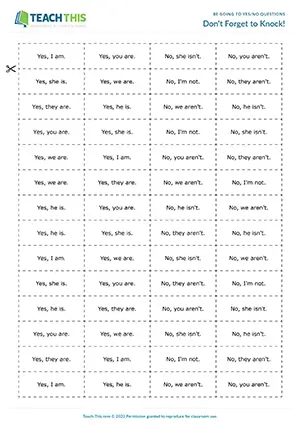
In this fun 'be going to' game, students race to create 'be going to' yes/no questions that include a given prompt word and match specific short answers. In groups, students take turns picking up...
ESL Be Going To Yes/No questions Game - Speaking: Forming questions from Prompts, Freer Practice - Group Work In this fun 'be going to' game, students race to create 'be going to' yes/no questions that include a given prompt word and match specific short answers. In groups, students take turns picking up a short answer card, reading it aloud and placing it face up on the table for everyone to see, e.g. 'Yes, she is.' The student then picks up a word card, reads it out and places it face up next to the answer card, e.g. tomorrow. All the students then race to say a 'be going to' yes/no question using the word that elicits the short answer. As soon as a student has a question, they knock their fist on the table and say it, e.g. 'Is she going to come to class tomorrow?' If the other students agree that the question matches the answer and is grammatically correct, the student wins the round and keeps the two cards. If a student says a question without knocking first or makes an incorrect question, that student is out of the round, and the other students try to form a question. The student with the most pairs of cards at the end of the game wins.
ESL Going To Yes/No questions Activity - Reading and Vocabulary Exercise: Gap-fill - Speaking Activity: Asking and Answering questions, Table Completion, Freer Practice
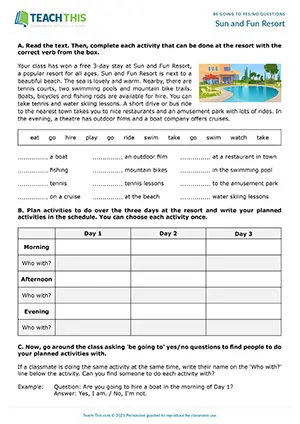
In this productive 'be going to' yes/no questions activity, students plan activities to do at a resort and then ask and answer questions to find people to...
ESL Going To Yes/No questions Activity - Reading and Vocabulary Exercise: Gap-fill - Speaking Activity: Asking and Answering questions, Table Completion, Freer Practice In this productive 'be going to' yes/no questions activity, students plan activities to do at a resort and then ask and answer questions to find people to do their planned activities with. First, students read the introductory paragraph and imagine that they have won a three-day trip to the Sun and Fun Resort. Students then complete each activity that can be done at the resort with the correct verb from the box. After that, students plan activities to do over the three days at the resort and write them in a schedule. Students then go around the class asking 'be going to' yes/no questions to find people to do their planned activities with, e.g. 'Are you going to rent a bicycle in the morning of day 1?' If a classmate is doing the same activity at the same time, they answer 'Yes, I am.' The two students then write down each other's names. If a classmate is doing something different, they reply 'No, I'm not.' Afterwards, there is a class feedback session to find out which student found the most people to do activities with.
ESL Be Going To Yes/No questions Game - Grammar: Forming questions, Matching - Group Work
In this engaging 'be going to' yes/no questions game, students race to find and make yes/no questions with 'be going to' that match certain answers. In groups, students take turns picking up...
ESL Be Going To Yes/No questions Game - Grammar: Forming questions from Prompts, Matching - Group Work In this engaging 'be going to' yes/no questions game, students race to find and make yes/no questions with 'be going to' that match certain answers. In groups, students take turns picking up an answer card, reading it aloud, and placing it face up for everyone to see. All the students then search the question cards on the table to find a question that elicits the answer. The first student to find the correct card, pick it up, and use the prompt to make a suitable 'be going to' yes/no question wins and keeps the two cards. If the other students think a question doesn't match or is grammatically incorrect, the student puts the card back and is out of the round. The other students then continue to search for a matching card or race to make a grammatically correct question. The student with the most pairs of cards at the end of the game wins.
ESL Be Going To Yes/No questions Worksheet - Grammar Exercises: Unscrambling, Matching, Writing questions
This useful 'be going to' yes/no questions worksheet helps students practice yes/no questions with 'be going to' and short answers. First, students put words in the correct order to create...
ESL Be Going To Yes/No questions Worksheet - Grammar Exercises: Unscrambling, Matching, Writing questions from Prompts This useful 'be going to' yes/no questions worksheet helps students practice yes/no questions with 'be going to' and short answers. First, students put words in the correct order to create 'be going to' yes/no questions. Students the match each question with its corresponding answer. Next, students use verbs in a box and subjects in brackets to make 'be going to' yes/no questions. After that, students write yes/no questions with 'be going to' that match certain answers. Lastly, students complete a dialogue with question prompts in their be going to form.
ESL Be Going To Wh questions Activity - Speaking: Forming, Asking and Answering questions, Freer Practice - Pair Work
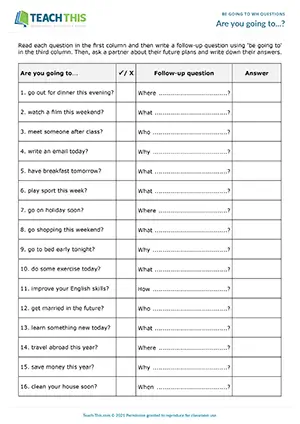
In this 'be going to' Wh questions speaking activity, students practice forming, asking and answering 'be going to' yes/no and Wh questions about future plans. First, students read the 'Are you going to...
ESL Be Going To Wh questions Activity - Speaking: Forming, Asking and Answering questions, Freer Practice - Pair Work In this 'be going to' Wh questions speaking activity, students practice forming, asking and answering 'be going to' yes/no and Wh questions about future plans. First, students read the 'Are you going to...?' questions and write a follow-up Wh question with 'be going to' for each one. In pairs, students then take turns asking their partner about their future plans using the questions on the worksheet. When their partner answers 'Yes, I am' to the first question, the student puts a tick and asks the follow-up question. If their partner answers 'No, I'm not', the student puts a cross and moves on to the next question. When the students have finished, they tell the class about their partner's future plans.
ESL Be Going To Wh questions Game - Grammar: Forming questions - Group Work
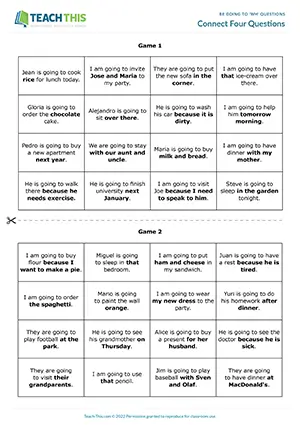
In this engaging 'be going to' Wh questions game, students play Connect 4 by forming questions from answers. Players take turns choosing a square and making a 'be going to' Wh question from the answer in the square. For example, if the square...
ESL Be Going To Wh questions Game - Grammar: Forming questions from Prompts - Group Work In this engaging 'be going to' Wh questions game, students play Connect 4 by forming questions from answers. Players take turns choosing a square and making a 'be going to' Wh question from the answer in the square. For example, if the square read 'Wyan is going to eat a pie for dessert', the player would say 'What is Wyan going to eat for dessert?' The student acting as judge then checks the answer sheet. If the question matches, the player marks the square with an 'O' or 'X' accordingly. It is then the other player's turn to choose a square. The first player to get four squares in a row wins the game. Afterwards, students play a second game, giving the student who acted as judge a chance to play.
ESL Be Going To Wh questions Worksheet - Grammar Exercises: Writing and Answering questions - Speaking Activity: Asking and Answering questions - Pair Work
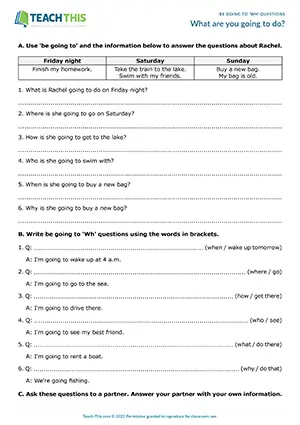
Here is a productive 'be going to' Wh questions worksheet to help students practice forming, asking and answering Wh questions about future plans. First...
ESL Be Going To Wh questions Worksheet - Grammar Exercises: Writing and Answering questions - Speaking Activity: Asking and Answering questions - Pair Work Here is a productive 'be going to' Wh questions worksheet to help students practice forming, asking and answering Wh questions about future plans. First, students use information in a table to answer 'be going to' Wh questions. Next, students write Wh questions with 'be going to' using words in brackets and then ask and answer the questions with a partner. After that, students use question words from a box to write 'be going to' Wh questions asking about underlined information. Students then complete 'be going to' Wh questions with their own ideas and answer them. Finally, students ask their partner the questions and note down their answers.
ESL Be Going To Wh questions Activity - Grammar and Speaking: Forming, Asking and Answering questions - Pair Work
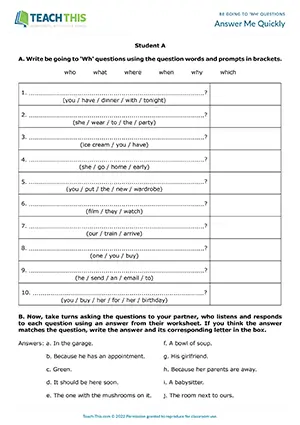
In this fun 'be going to' Wh questions speaking activity, students create 'be going to' Wh questions from prompts and then race to match them with suitable answers. First, students write ten 'be going...
ESL Be Going To Wh questions Activity - Speaking: Forming, Asking and Answering questions from Prompts - Pair Work In this fun 'be going to' Wh questions speaking activity, students create 'be going to' Wh questions from prompts and then race to match them with suitable answers. First, students write ten 'be going' to Wh questions using question words and prompts in brackets on their worksheet. Next, students work with a partner and race other pairs to be the first to match the questions with suitable answers. Students take turns asking the questions to their partner, who listens and responds to each question using an answer from their worksheet. If the student agrees that their partner's answer matches the question, the student writes the answer and its corresponding letter in the box next to the question. If they don't think the answer matches, their partner tries again with another answer. When a pair has matched all the questions and answers, they put up their hands to have their answers checked. The first pair to finish wins.
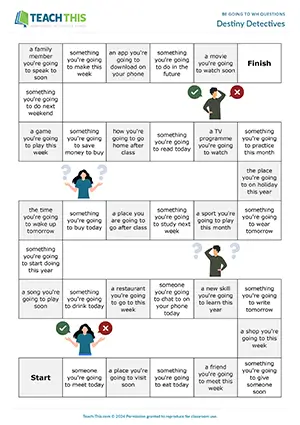
ESL Be Going To Board Game - Grammar and Speaking: Forming Sentences, True or False, Asking and Answering questions, Guessing, Freer Practice - Group Work
In this 'be going to' true or false board game, students make 'be going to' statements from prompts and classmates ask 'be going to' Wh questions to work out...
ESL Be Going To Board Game - Grammar and Speaking: Forming Sentences, True or False, Asking and Answering questions, Guessing, Freer Practice - Group Work In this 'be going to' true or false board game, students make 'be going to' statements from prompts and classmates ask 'be going to' Wh questions to work out whether the statements are true or false. Students take turns rolling the dice and moving their counters along the board. When a student lands on a square, they pick up a true or false card from the pile and look at it, without showing it to anyone. The student then makes a 'be going to' statement about the topic on the square, giving either true or false information as indicated on the card, e.g. 'I'm going to meet my sister after class.' The other students then ask 'be going to' Wh questions to determine if the student is lying or telling the truth, e.g. 'Where are you going to meet her?' After a few questions have been answered, the group members guess whether the student's answer is true or false. The student then reveals the answer. The group members who guessed correctly each score one point. The next student then rolls the dice, and so on. When a student reaches the finish, the game ends and the points are added up. The student with the most points wins the game.
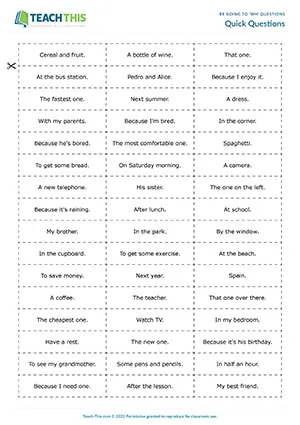
ESL Be Going To Wh questions Game - Grammar and Speaking: Forming questions, Freer Practice - Group Work
In this fast-paced 'be going to' Wh questions game, students race to form Wh questions with 'be going to' that match specific short answers. In groups, students take turns picking up a card and reading...
ESL Be Going To Wh questions Game - Speaking: Forming questions from Prompts, Freer Practice - Group Work In this fast-paced 'be going to' Wh questions game, students race to form Wh questions with 'be going to' that match specific short answers. In groups, students take turns picking up a card and reading out the answer on the card, e.g. Cereal and fruit. All the students then race to create a Wh question with 'be going to' that matches the answer. The first student to say a grammatically correct and appropriate question wins and keeps the card, e.g. 'What are you going to have for breakfast tomorrow?' If group members think a question is incorrect or a winning question is repeated, the student who asked the question is out of the round for that card, and the other students continue racing to come up with a question. The student with the most cards at the end of the game is the winner. As a variation, you can have students write down their questions before saying them.
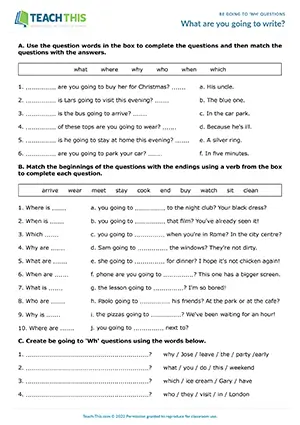
ESL Be Going To Wh questions Worksheet - Grammar Exercises: Matching, Gap-fill, Forming questions - Speaking Activity: Asking and Answering questions - Pair Work
This useful 'be going to' Wh questions worksheet helps students practice or review a variety of Wh questions with 'be going to'. First, students use...
ESL Be Going To Wh questions Worksheet - Grammar Exercises: Matching, Gap-fill, Forming questions - Speaking Activity: Asking and Answering questions - Pair Work This useful be going to questions worksheet helps students practice or review a variety of Wh questions with 'be going to'. First, students use question words in a box to complete questions and then match the questions with answers. Students then match the beginnings of questions with endings using a verb from a box to complete each question. Next, students create Wh questions with 'be going to' using prompts. After that, students use verbs in a box in their 'be going to' form and subjects in brackets to complete Wh questions. Following that, students write 'be going to' Wh questions that match answers in bold. Students then write three 'be going to' Wh questions to ask a partner about their plans this evening. Finally, students ask the questions to their partner, who responds with two truthful answers and one lie. The student then tries to identify the lie each time.
ESL Wh questions Game - Grammar and Speaking: Matching, Forming questions - Group Work
In this free Wh questions game, students race to use question words to make questions that elicit specific answers. In groups, students take turns picking up an answer card and reading the sentence on...
ESL Wh questions Game - Grammar and Speaking: Matching, Forming questions from Prompts - Group Work In this free Wh questions game, students race to use question words to make questions that elicit specific answers. In groups, students take turns picking up an answer card and reading the sentence on the card aloud, putting emphasis on the words in bold. The student then places the card face-up on the table. Next, all the students check their cards to see if they have a question word that can be used to create a question that elicits the answer. The first student to create a suitable question, say it, and place their card down on top of the answer card wins. The two cards are then removed from the game. If the other players think that a question is incorrect or doesn't match the answer, the student takes the card back and the game continues. The first student to get rid of all their question word cards wins the game.
ESL Wh questions Game - Grammar and Speaking: Asking and Answering questions, Guessing, Controlled Practice - Pair Work
In this fun Wh questions game, students practice asking and answering questions using 'who', 'what', and 'where' to identify people, objects, and places. Each card contains three words...
ESL Wh questions Game - Grammar and Speaking: Asking and Answering questions from Prompts, Guessing, Controlled Practice - Pair Work In this fun Wh questions game, students ask questions using 'who', 'what', and 'where' to guess a specific word. Each card contains three words representing a person, a thing and a place, and together form a logical set connected to one topic, e.g. restaurants. In pairs, students take turns picking up a card and saying whether the word in bold is a person, place or thing to their partner, e.g. 'It's a person.' The other student then asks Wh questions about the other two words on the card to help them guess the word in bold, e.g. 'What is it?' and 'Where is it?' The student then guesses the word in bold on the card. If they guess correctly, they win and keep the card. If they cannot guess the word after three attempts, the card is removed from the game. The game continues until all the cards have been used. The student with the most cards at the end of the game wins.
ESL Wh questions Activity - Grammar and Speaking: Error Correction, Asking and Answering questions, Controlled and Freer Practice - Pair Work
In this useful Wh questions error correction activity, students correct mistakes in questions and then use the questions to interview a partner...
ESL Wh questions Activity - Grammar and Speaking: Error Correction, Asking and Answering questions from Prompts, Controlled and Freer Practice - Pair Work In this useful Wh questions error correction activity, students correct mistakes in questions and then use the questions to interview a partner. Working alone, students find mistakes in the questions on their worksheet and correct them. Students then take turns checking their corrections with their partner, who has the answer key. Next, students interview their partner using the questions. Finally, students tell the class what they found out about their partner.
ESL Wh questions Game - Grammar and Speaking: Asking questions - Group Work
In this creative Wh questions game, students ask Wh questions in order to find out more details about a sentence. Write a sentence on the board, e.g. 'The report is on the desk.' Tell the students that they are feeling inquisitive and want to find out as...
ESL Wh questions Game - Grammar and Speaking: Asking questions from Prompts - Group Work In this creative Wh questions game, students ask Wh questions in order to find out more details about a sentence. Write a sentence on the board, e.g. 'The report is on the desk.' Tell the students that they are feeling inquisitive and want to find out as many details as possible about the sentence. Teams then take turns asking a Wh question about the sentence, e.g. 'What is the report about?' For each grammatically correct question a team asks, they score one point. When teams run out of questions, write a new sentence on the board and continue the game. The team with the most points at the end of the game wins.
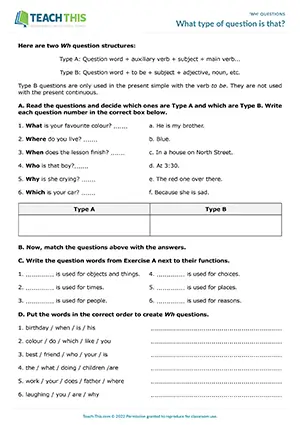
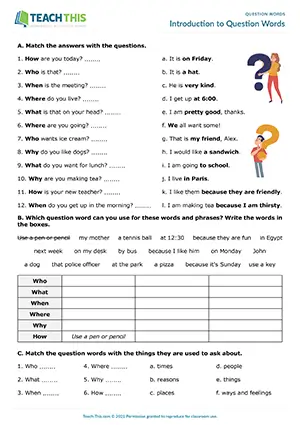
In this productive Wh questions worksheet, students practice Wh questions in the present simple and present continuous. To start, students review two types of...
ESL Wh questions Worksheet - Grammar Exercises: Categorising, Matching, Unscrambling, Writing questions, Error Correction - Speaking Activity - Pair Work In this productive Wh questions worksheet, students practice Wh questions in the present simple and present continuous. To start, students review two types of Wh questions. Students then read questions and decide which type they are. Next, students match the questions with answers. Students then match the question words from Exercise A to their functions. After that, students unscramble words to create Wh questions. Students then move on to write Wh questions that match answers. Next, students rewrite questions, correcting errors. Working alone, students then complete sentences by guessing information about a partner. After that, students write the Wh questions they need to ask to find out the correct answer. Lastly, students ask the questions to their partner to see how many of their guesses were correct.
ESL Wh questions Game - Grammar: Writing Sentences, Guessing, Forming questions, Freer Practice - Group Work
In this entertaining Wh questions game, students guess questions from answers written by other students. First, in groups of three, students answer each Wh question on a card in sentence form...
ESL Wh questions Game - Grammar: Writing Sentences, Guessing, Forming questions from Prompts, Freer Practice - Group Work In this entertaining Wh questions game, students guess questions from answers written by other students. First, in groups of three, students answer each Wh question on a card in sentence form. Students then take turns reading an answer at random to the other two students, who race to guess the question from the answer. The first student to guess the correct Wh question scores one point. The game continues until all three students' questions have been guessed correctly. The student with the most points at the end of the game wins.
ESL Wh questions Activity - Grammar and Speaking: Completing, Asking and Answering questions, Freer Practice - Pair Work
In this engaging Wh questions speaking activity, students complete missing words in questions and then use the questions to interview a partner. First...
ESL Wh questions Activity - Grammar and Speaking: Completing, Asking and Answering questions, Freer Practice - Pair Work In this engaging Wh questions speaking activity, students complete missing words in questions and then use the questions to interview a partner. First, in pairs, students complete Wh questions by deciding what the missing words are in each question, writing one word in each space. Next, students take turns choosing a topic and asking the related questions to their partner, asking Wh follow-up questions to gain more information. Finally, students give feedback to the class on what they found out about their partner.
ESL Wh questions Game - Grammar and Speaking: Asking and Answering questions - Group Work
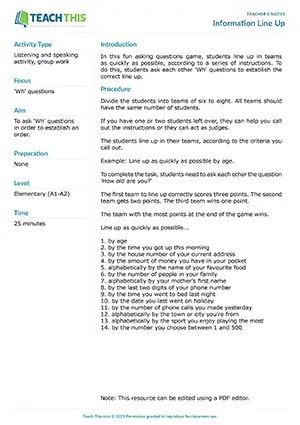
In this energizing Wh questions game, students ask questions to establish an order and race to line up in teams as quickly as possible. To start the game, teams race to call out the correct Wh question...
ESL Wh questions Game - Grammar and Speaking: Asking and Answering questions - Group Work In this energizing Wh questions game, students ask questions to establish an order and race to line up in teams as quickly as possible. To start the game, teams race to call out the correct Wh question from your command. For example, the first command is 'Line up as quickly as possible by age', so teams would race to say the question 'How old are you?' The first team to say the correct question scores a point. The members of each team then race to ask each other the question and line up accordingly. The first team to line up correctly scores one point. Check the winning team is lined up correctly by asking the question to each team member. If any mistakes have been made, the game continues. The team with the most points at the end of the game wins.
ESL Wh questions Activity - Grammar and Speaking: Information Gap, Forming, Asking and Answering questions - Group and Pair Work
In this handy Wh questions information gap activity, students complete a text about someone's life by asking and answering Wh questions. In two groups...
ESL Wh questions Activity - Grammar and Speaking: Information Gap, Forming, Asking and Answering questions - Group and Pair Work In this handy Wh questions information gap activity, students complete a text about someone's life by asking and answering Wh questions. In two groups, students write the Wh questions they need to find out the missing information in a text. Students then pair up with someone from the other group and take turns asking their partner the questions and completing the text with their answers. Finally, students check their texts and spelling by comparing worksheets.
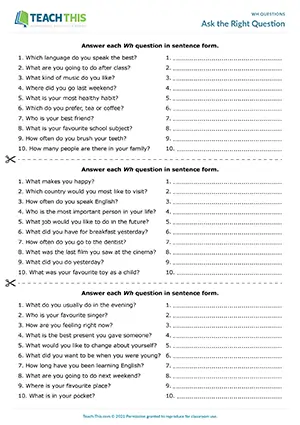
In this free Wh questions worksheet, students practice writing Wh questions for a set of answers. Working alone, students write Wh questions for 20 answers on the worksheet. When the students have finished, they swap worksheets with a classmate...
ESL Wh questions Worksheet - Grammar Exercise: Writing questions From Prompts In this free Wh questions worksheet, students practice writing Wh questions for a set of answers. Working alone, students write Wh questions for 20 answers on the worksheet. When the students have finished, they swap worksheets with a classmate for marking. Students score one point for each correct question. The student with the most points wins.
ESL Past Simple and Present Simple questions Activity - Grammar and Speaking: Forming, Asking and Answering questions
In this insightful Wh questions speaking activity, students use the past simple and present simple to ask about a partner's habits as a child and now. Each topic on the worksheet contains three...
ESL Past Simple and Present Simple questions Activity - Grammar and Speaking: Forming, Asking and Answering questions from Prompts In this insightful Wh questions speaking activity, students use the past simple and present simple to ask about a partner's habits as a child and now. Each topic on the worksheet contains three questions. The first two questions deal with past habits. The third question is a present simple question to find out information about their partner's habits now. In pairs, students ask a past simple yes/no question and then a past simple Wh question to find out information about their partner's past childhood habits. Students then ask a question about their present habits and write all the answers on the worksheet. When everyone has finished, students tell the class what they found out about their partner.
ESL Guess the question Game - Grammar: Guessing, Forming questions - Pair Work
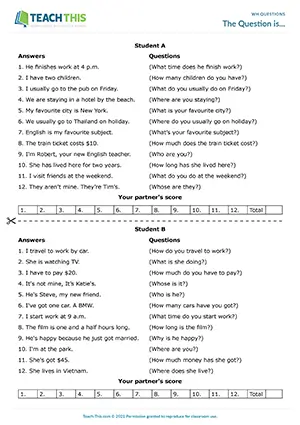
In this fun asking questions game, students listen to a set of answers and try to guess the questions being asked. Student A starts by reading the first answer to their partner who listens and guesses the question. If Student B guesses correctly the first...
ESL Guess the question Game - Grammar: Guessing, Forming questions - Pair Work In this fun asking questions game, students listen to a set of answers and try to guess the questions being asked. Student A starts by reading the first answer to their partner who listens and guesses the question. If Student B guesses correctly the first time, they score three points, on the second try two points, and on their last try one point. Student B then reads out their first answer to Student A who guesses the question, and so on. The student with the most points at the end of the game wins. Alternatively, you can make the game more competitive by having students try to complete all the questions on their partner's worksheet in the fastest possible time.
ESL Wh questions Game - Grammar and Speaking: Forming and Asking questions - Group Work
In this enjoyable asking questions game, students race to make questions from answers. Divide the class into two teams. Choose one player from each team to come to the front of the class...
ESL Wh questions Game - Grammar and Speaking: Forming and Asking questions from Prompts - Group Work In this enjoyable asking questions game, students race to make questions from answers. Divide the class into two teams. Choose one player from each team to come to the front of the class. Read an answer to a question, e.g. 'I normally arrive home at 6 p.m.' Then, ask the two players 'What's the question?' The first player to respond with the correct question scores a point for their team, i.e. 'What time do you normally arrive home?' Then, two new players come to the front of the class, and so on. The team with the most points at the end of the game wins.
ESL Wh questions Activity- Grammar and Speaking: Completing, Asking and Answering questions - Group and Pair Work
In this rewarding Wh questions speaking activity, students practice completing, asking and answering conversation questions that begin with who, what, when, where, why, which, and how. First, in two...
ESL Wh questions Activity- Grammar and Speaking: Completing, Asking and Answering questions from Prompts, Controlled and Freer Practice - Group and Pair Work In this rewarding Wh questions speaking activity, students practice completing, asking and answering conversation questions that begin with who, what, when, where, why, which, and how. First, in two groups, students complete the first question in each pair with a word from a box and the second question with a suitable Wh question word. Next, students pair up with someone from the other group and take turns asking and answering the Wh conversation questions with their partner and developing a short conversation about the topic by giving more information and asking follow-up questions. Afterwards, students share what they found out about their partner with the class.
ESL Wh questions Game - Grammar and Speaking: Asking and Answering questions - Group Work
In this free Wh questions game, students ask Wh questions that elicit certain answers. In groups, students take turns picking up a card and asking questions that will elicit the word or phrase on the card...
ESL Wh questions Game - Grammar and Speaking: Asking and Answering questions - Group Work In this free Wh questions game, students ask Wh questions that elicit certain answers. In groups, students take turns picking up a card and asking questions that will elicit the word or phrase on the card. The first student to answer with the correct word or phrase wins and keeps the card. The next student then picks up a card, and so on. The student with the most cards at the end of the game is the winner.
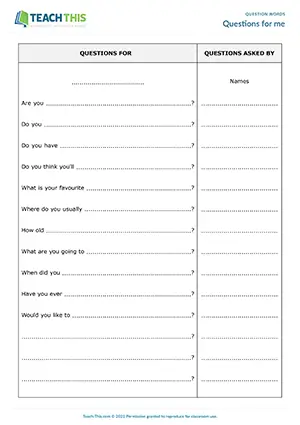
ESL Wh questions Game - Grammar and Speaking: Writing questions and Answers, Answering questions, Freer Practice
In this fast-paced Wh questions game, students write Wh questions and answers about themselves and then race to answer questions written by other students. On each card, students use the Wh...
ESL Wh questions Game - Grammar and Speaking: Writing questions and Answers, Answering questions, Freer Practice In this fast-paced Wh questions game, students write Wh questions and answers about themselves and then race to answer questions written by other students. On each card, students use the Wh question word to write a question about themselves using their name, e.g. 'What kind of films does Anna like?' Students then write the answer in sentence form underneath the question in the third person, e.g. 'She likes thrillers.' Students then fold the card and put it in an envelope. When the students have finished, they take turns taking a card from the envelope and reading the question to the group. The student who is the subject of the question is not allowed to answer. The first student to give a matching answer wins and keeps the card. The student with the most cards at the end of the game wins.
ESL Wh questions Activity - Grammar and Speaking: Forming, Asking and Answering questions, Freer Practice - Pair Work
In this intriguing Wh questions speaking activity, students practice forming, asking and answering questions in a mystery celebrity interview. Each student starts by thinking of a famous mystery celebrity...
ESL Wh questions Activity - Grammar and Speaking: Forming, Asking and Answering questions, Freer Practice - Pair Work In this intriguing Wh questions speaking activity, students practice forming, asking and answering questions in a mystery celebrity interview. Each student starts by thinking of a famous mystery celebrity they want to be for the interview. Students then write interview questions to ask a partner using the prompts on their worksheet. Students also create an interview question of their own at the end. Next, in pairs, students take turns interviewing their partner using the script and questions, noting down their partner's answers on the worksheet. At the end of each interview, the interviewer guesses the name of the famous celebrity their partner is pretending to be. Finally, students role-play their interviews to the class who try to guess each mystery celebrity.
ESL Wh questions Activity - Grammar and Speaking: Writing, Asking and Answering questions - Group and Pair Work
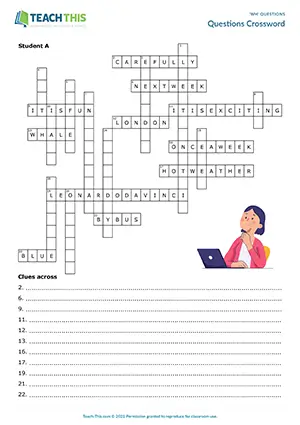
In this imaginative Wh questions activity, students create questions that elicit specific answers in a crossword. First, in two groups, students write Wh questions that would elicit the words and phrases...
ESL Wh questions Activity - Grammar and Speaking: Writing, Asking and Answering questions - Group and Pair Work In this imaginative Wh questions activity, students create questions that elicit specific answers in a crossword. First, in two groups, students write Wh questions that would elicit the words and phrases on their crossword. Next, students pair up with someone from the other group and take turns asking their partner for a question to one of their missing words or phrases. Their partner then asks them the question for that word or phrase, indicating the number of words in the answer. If the student correctly guesses the answer, they write the word or phrase on their crossword. If not, their partner continues to ask more questions until they are able to elicit the correct answer.
ESL Wh questions Game - Grammar and Speaking: Forming, Asking and Answering questions - Group Work
In this interesting Wh questions game, students play Tic-Tac-Toe by creating questions. Copy the grid onto the board, writing the numbers and question words in the squares. Teams then take...
ESL Wh questions Game - Grammar and Speaking: Forming, Asking and Answering questions from Prompts - Group Work In this interesting Wh questions game, students play Tic-Tac-Toe by creating questions. Copy the grid onto the board, writing the numbers and question words in the squares. Teams then take turns choosing a question word from the grid. Team members then use the question word in the square to make a Wh question and ask it to the next team. To win the square, the question must be grammatically correct and contain a minimum of six words. The next team must answer the question appropriately or they lose their turn to choose a square. If a question is grammatically incorrect or less than six words in length, play passes to the next team without them having to answer a question. The first team to get three squares in a row wins the round. Play a few rounds to see which team is the overall champion, changing the position of the question words or creating new ones each time.
ESL Wh questions Board Game - Speaking: Asking and Answering questions, Impromptu Speech, Freer Practice - Group Work
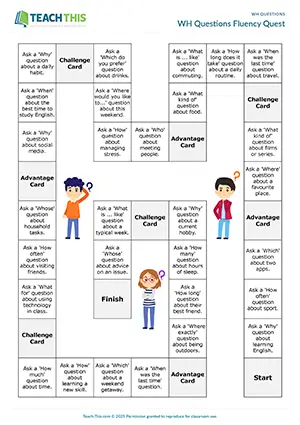
This challenging Wh questions board game develops students' speaking fluency by having them ask and answer prompts in timed turns, using advantage and...
ESL Wh questions Board Game - Speaking: Asking and Answering questions, Impromptu Speech, Freer Practice - Group Work This challenging Wh questions board game develops students' speaking fluency by having them ask and answer prompts in timed turns, using advantage and challenge cards to add variety and strategy. In groups, players take turns rolling the dice and moving their counters along the board. When a player lands on a question square, they use the prompt to ask a Wh question to the student on their right, who answers by talking for 30 seconds. After the question has been answered, the group decides if the question is a clear and relevant Wh question that fits the prompt. If it is, the player scores two points. If the student who answered the question talked for 30 seconds, they score one point. The game also contains advantage and challenge cards that add variety and strategy to play. Advantage cards give helpful boosts, while challenge cards set brief tasks that stretch speaking skills. These cards create risk–reward moments and can lead to extra points for successful attempts. When a player reaches the finish, the game ends and the points are added up. The player with the most points wins the game.
ESL Wh questions Worksheet - Grammar and Writing Exercises: Gap-fill, Writing questions - Speaking: Answering questions, Freer Practice - Pair Work
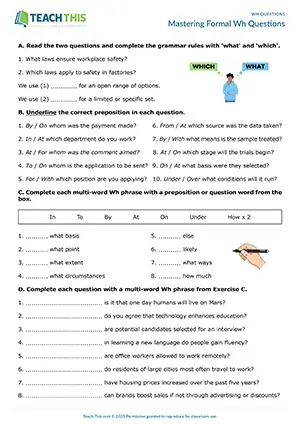
In this comprehensive Wh questions worksheet, students practice forming formal Wh questions with multi‑word Wh phrases and appropriate prepositions. First...
ESL Wh questions Worksheet - Grammar and Writing Exercises: Gap-fill, Binary Choice, Rewriting Sentences, Writing questions - Speaking: Asking and Answering questions, Freer Practice - Pair Work In this comprehensive Wh questions worksheet, students practice forming formal Wh questions with multi‑word Wh phrases and appropriate prepositions. First, students read example questions and complete grammar rules with 'what' and 'which'. Students then underline the correct preposition in each question. Next, students complete each multi-word Wh phrase with a preposition or question word from a box. After that, students complete each question with a multi-word Wh phrase. Next, students rewrite questions in the passive voice, replacing the question words with suitable multi-word Wh phrases to make formal questions. Afterwards, students write ten formal questions they could ask a partner using different multi-word Wh phrases. Finally, in pairs, students take turns asking the questions to their partner, who answers in full sentences and, where possible, includes a reason or brief example.
ESL Wh questions Game - Grammar and Speaking: Asking and Answering questions, Communicative Practice - Group Work
In this fun Wh questions game, students practice asking questions to find out further details about an opening statement. A student from Team A picks up a card and reads the opening statement on the...
ESL Wh questions Game - Grammar and Speaking: Asking and Answering questions, Communicative Practice - Group Work In this fun Wh questions game, students practice asking questions to find out further details about an opening statement. A student from Team A picks up a card and reads the opening statement on the card to Team B. Team B then has two minutes to ask the student as many Wh follow-up questions as they can to find out further details about the opening statement. The student replies to the questions with short imaginary answers. Team B scores one point for each follow-up question they ask. After the two-minute time limit has been reached, teams swap roles. The team with the most points at the end of the game wins.
ESL Do and Does questions Worksheet - Grammar Exercises: Matching, Unscrambling - Speaking Activities: Asking and Answering questions, Freer Practice
In this informative present simple yes/no questions worksheet, students learn and practice yes/no questions in the present simple tense with 'do' and...
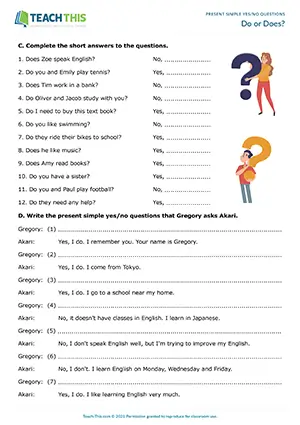
ESL Do and Does questions Worksheet - Grammar Exercises: Table Completion, Matching, Unscrambling - Speaking Activities: Asking and Answering questions, Freer Practice In this informative present simple yes/no questions worksheet, students learn and practice yes/no questions in the present simple tense with 'do' and 'does'. First, students complete a grammar table with 'do' or 'does' to understand the question and answer formation pattern. Students then match present simple yes/no questions with short answers. Next, students reorder words to form yes/no questions and then practice asking and answering the questions with a partner. After that, students complete a table of questions and answers with the correct form of 'do' or 'does'. Students then complete a 'Find someone who...' activity by asking 'Do you...?' questions to find classmates who match certain statements. Finally, students take turns asking and answering yes/no questions with 'do' and 'does' with a partner.
ESL Do You questions Game - Grammar and Speaking: Guessing, Asking and Answering questions, Freer Practice
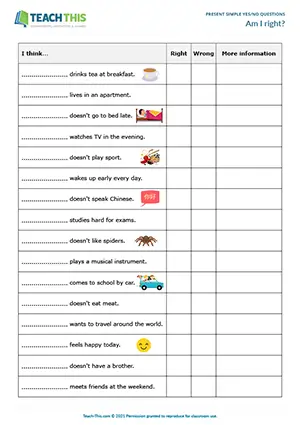
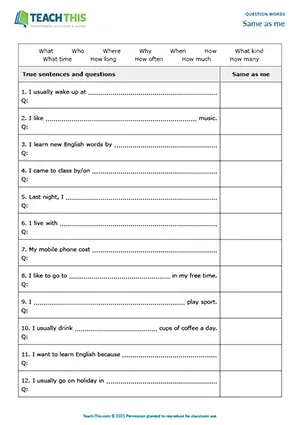
In this free 'Do you...?' questions game, students make guesses and complete present simple statements about their classmates and then find out if their guesses are right or wrong by asking 'Do you...
ESL Do You questions Game - Grammar and Speaking: Guessing, Asking and Answering questions, Freer Practice In this free 'Do you...?' questions game, students make guesses and complete present simple statements about their classmates and then find out if their guesses are right or wrong by asking 'Do you...?' questions. First, students read each sentence, choose a classmate they think the statement might be true for and write the person's name at the beginning of the sentence, e.g. 'Katie drinks tea at breakfast.' Next, students go around the class, find the classmate they named in each sentence and ask them a present simple yes/no question with 'Do you...?', e.g. 'Katie, do you drink tea at breakfast?' Their classmate replies 'Yes, I do' or 'No, I don't' accordingly. Students put a tick or a cross next to each statement, depending on whether their guess is right or wrong. Students then ask a present simple follow-up question and write down the information. The student with the most correct guesses wins the game. Finally, students give feedback to the class on what they found out.
ESL Do and Does questions Worksheet - Grammar Exercises: Gap-fill, Writing questions and Answers
This comprehensive do and does questions worksheet can be used to practice or review present simple yes/no questions with 'do' or 'does' and short answers. Students begin by completing present simple...
ESL Do and Does questions Worksheet - Grammar Exercises: Gap-fill, Writing questions and Answers from Prompts This comprehensive do and does questions worksheet can be used to practice or review present simple yes/no questions with 'do' or 'does' and short answers. Students begin by completing present simple yes/no questions with 'do' or 'does'. Next, students write present simple yes/no questions with 'do' or 'does' for a set of answers. Students then complete short answers to questions. Lastly, students complete a conversation between two people with 'do' or 'does' yes/no questions.
ESL Do You questions Game - Grammar and Speaking: Completing, Asking and Answering questions, Guessing - Pair Work
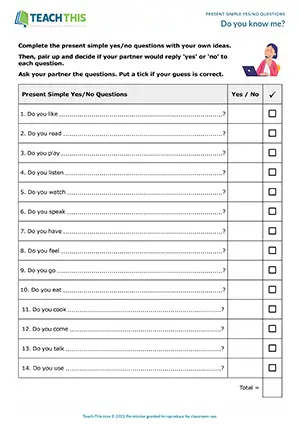
In this fun present simple yes/no questions game, students practice forming, asking and answering questions with 'Do you...?' First, students complete present simple yes/no questions with their own...
ESL Do You questions Game - Grammar and Speaking: Completing, Asking and Answering questions, Guessing - Pair Work In this fun present simple yes/no questions game, students practice forming, asking and answering questions with 'Do you...?' First, students complete present simple yes/no questions with their own ideas. Next, divide the students into pairs. Working alone, students decide if their partner would reply yes or no to each question and write their guesses in a yes/no column. Students then take turns asking the questions to their partner to find out if their guesses are right or wrong. Their partner replies 'Yes, I do' or 'No, I don't' accordingly. Students put a tick for each correct guess. The student with the most correct guesses at the end of the game wins. Finally, students give feedback to the class on what they found out about their partner.
ESL Present Simple Yes No questions Activity - Grammar, Speaking and Writing: Asking and Answering questions, Writing a Paragraph, Freer Practice
In this engaging verb 'to be' and 'do' yes/no questions activity, students practice asking and answering questions with the verb 'to be' and 'do'. Students begin by...
ESL Present Simple Yes No questions Activity - Grammar, Speaking and Writing: Completing, Asking and Answering questions, Writing a Short Paragraph, Freer Practice In this engaging verb 'to be' and 'do' yes/no questions activity, students practice asking and answering questions with the verb 'to be' and 'do'. Students begin by completing 20 present simple yes/no questions with the correct form of the verb 'to be' or 'do'. Students then answer the questions by writing a short answer underneath each question. Next, collect in the worksheets and then redistribute them. The students' task is to find out who their new worksheet belongs to by asking the present simple yes/no questions from the worksheet to their classmates. Students go around asking and answering the questions with different classmates until they find the student whose answers match the ones on their worksheet. Afterwards, students use the information on the worksheet to write a paragraph about their classmate using the third-person singular. Finally, students read their paragraphs to the class.
ESL Do and Does questions Game - Grammar, Writing and Speaking: Writing, Asking and Answering questions - Group Work
In this entertaining present simple yes/no questions game, students practice forming questions with 'do' and 'does'. In teams of two, students form as many...
ESL Do and Does questions Game - Grammar, Writing and Speaking: Writing, Asking and Answering questions from Prompts - Group Work In this entertaining present simple yes/no questions game, students practice forming questions with 'do' and 'does'. In teams of two, students form as many present simple yes/no questions as possible from the words on their worksheet. After a time limit has been reached, the teams stop writing and pair up with an opposing team. Teams then take turns asking their questions to the other team. For every grammatically correct question a team asks, they score two points. For every appropriate short answer the other team gives, they get one point. The team with the most points at the end of the game wins.
ESL Present Simple Yes No questions Worksheet - Grammar and Reading Exercises: Matching, Identifying, Writing questions, Answering questions
In this useful present simple yes/no questions worksheet, students work through a range of exercises to practice yes/no questions and short answers in the present...
ESL Present Simple Yes No questions Worksheet - Grammar and Reading Exercises: Matching, Unscrambling, Identifying, Writing questions, Answering questions In this useful present simple yes/no questions worksheet, students work through a range of exercises to practice yes/no questions and short answers in the present simple with the verb 'to be' and 'do'. Students start by matching present simple yes/no questions with suitable responses. Next, students order words to make yes/no questions in the present simple. Students then underline words to complete yes/no questions and short answers. After that, students write present simple yes/no questions that correspond with a set of answers. Finally, students read a short story about two roommates and answer comprehension questions with yes or no answers.
ESL Present Simple Yes No questions Game - Grammar and Speaking: Forming, Asking and Answering questions - Group Work
This free present simple yes/no questions game helps students practice yes/no questions and short answers with the verb 'to be' and 'do'. In groups, players take turns choosing one of their short...
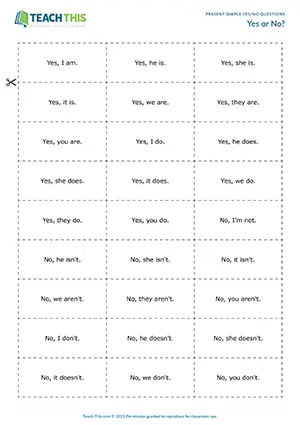
ESL Present Simple Yes No questions Game - Grammar and Speaking: Forming, Asking and Answering questions - Group Work This free present simple yes/no questions game helps students practice yes/no questions and short answers with the verb 'to be' and 'do'. In groups, players take turns choosing one of their short answer cards without showing it to anyone, e.g. 'Yes, it is.' The player then thinks of a present simple yes/no question that will elicit the answer on the card, e.g. 'Is it sunny today?' The player then asks the question to another student in the group. If the student gives the same short answer that is on the card, the player wins and discards the card. If not, the player keeps the card. The first player to get rid of all their cards wins the game.
ESL Present Simple Yes No questions Activity - Grammar and Speaking: Writing Sentences, Guessing, Asking and Answering questions - Pair Work
In this interesting present simple yes/no questions speaking activity, students ask and answer yes/no questions about their daily routine and the daily routine...
ESL Present Simple Yes No questions Activity - Grammar and Speaking: Writing Sentences, Guessing, Asking and Answering questions - Pair Work In this interesting present simple yes/no questions speaking activity, students ask and answer yes/no questions about their daily routine and the daily routine of someone they know. In the 'What time?' column, students write the time they do each routine activity. In the other column, students write what they do. After that, students complete the daily routine of someone they know well using the third-person singular. Next, in pairs, students fold their paper so the 'What time?' column is facing their partner and the 'What do you do?' column is facing them. Students then take turns guessing what their partner does every day at the times shown by asking present simple yes/no questions with 'Do you...?' For example, 'Do you brush your teeth at 8 a.m.?' When their partner replies 'Yes, I do', the student moves on to the next time. This continues until all the right questions have been asked. This process is repeated with someone they know, but this time students ask and answer present simple yes/no questions in the third-person singular.
ESL Does questions Activity - Grammar, Speaking and Writing: Asking and Answering questions, Writing Sentences - Pair Work
In this free does yes/no questions activity, students practice asking and answering yes/no questions in the third-person singular. Students start by writing the...
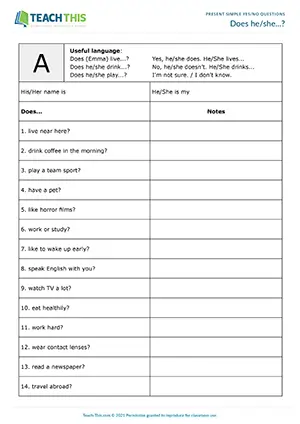
ESL Does questions Activity - Grammar, Speaking and Writing: Asking and Answering questions from Prompts, Writing Sentences - Pair Work In this free does yes/no questions activity, students practice asking and answering yes/no questions in the third-person singular. Students start by writing the name of someone they know very well and their relationship with them at the top of the worksheet, e.g. 'His name is Jason. He is my best friend.' Students then swap their worksheets with a partner and take turns asking their partner present simple yes/no questions about the person at the top of the worksheet using prompts, e.g. 'Does Jason live near here?' Their partner replies yes or no accordingly and gives additional information if possible, e.g. 'Yes, he does. He lives on Park Avenue.' The student then makes notes about their partner's answer on the worksheet. Afterwards, students develop their notes into present simple sentences in the third person singular, e.g. 'Jason is Matt's best friend. He lives near here on Park Avenue.' Finally, students take turns reading their sentences to the class.
ESL Present Simple Yes No questions Activity - Grammar and Reading Exercises: Writing questions - Speaking Activity: Asking and Answering questions - Pair Work
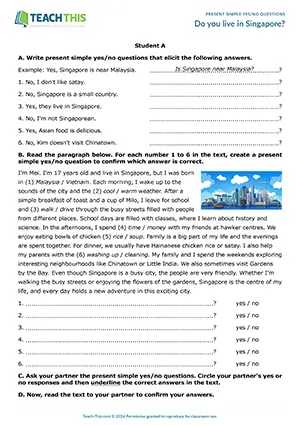
Here is a productive present simple yes/no questions activity to help students practice yes/no questions with the verb 'to be' and 'do'. First, in two groups...
ESL Present Simple Yes No questions Activity - Grammar and Reading Exercises: Writing questions - Speaking Activity: Asking and Answering questions - Pair Work Here is a productive present simple yes/no questions activity to help students practice yes/no questions with the verb 'to be' and 'do'. First, in two groups, students write present simple yes/no questions that elicit a set of answers. Students then read a text about a girl who lives in Singapore and create present simple yes/no questions to confirm which answers in the text are correct. Next, students pair up with someone from the other group and take turns asking the present simple yes/no questions to their partner. Students circle their partner's yes or no responses and underline the correct answers in the text. Finally, students read the text to their partner to confirm their answers are correct.
ESL Do You questions Activity - Grammar and Speaking: Asking and Answering questions
In this present simple yes/no questions speaking activity, students ask and answer present simple questions with 'Do you...?' in order to find out about their classmates' habits and routines. After reviewing...
ESL Do You questions Activity - Grammar and Speaking: Asking and Answering questions from Prompts In this present simple yes/no questions speaking activity, students ask and answer present simple questions with 'Do you...?' in order to find out about their classmates' habits and routines. After reviewing how to construct present simple yes/no questions from the items on the worksheet, students go around the class and ask each other the questions. When a student finds a classmate whose answer matches with an item on the worksheet, the student notes down their name. The student then asks one or two present simple Wh follow-up questions and writes their classmate's response in the last column of the worksheet. Afterwards, students give feedback to the class on what they found out about their classmates.
ESL Do You questions Activity - Grammar and Speaking: Asking and Answering questions
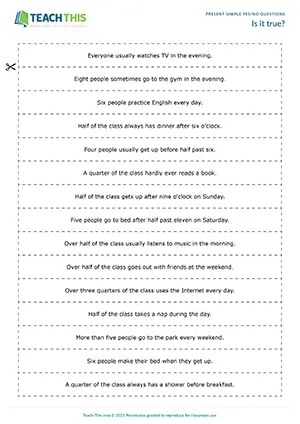
In this insightful present simple yes/no questions speaking activity, students ask 'Do you...?' questions to find out if certain statements are true or false about the class. Give each student a statement...
ESL Do You questions Activity - Grammar and Speaking: Asking and Answering questions from Prompts In this insightful present simple yes/no questions speaking activity, students ask 'Do you...?' questions to find out if certain statements are true or false about the class. Give each student a statement slip. The students' task is to find out if the statement is true or false by interviewing the other students in the class. Individually, students prepare the present simple yes/no question they need to ask. Students then go around asking their question to the other students. Students mark each response by putting a tick or cross on their slip of paper. When a student has enough information and knows whether their statement is true or false, they sit down. Afterwards, the class decides whether they think each statement is true or false before the answer is revealed by the student.
ESL Do You questions Game - Grammar and Speaking: Sentence Completion, Forming, Asking and Answering questions
This memorable 'Do you...?' questions game helps students to practice asking present simple yes/no questions about routine activities. The game also helps students practice various adverbs...
ESL Do You questions Game - Grammar and Speaking: Sentence Completion, Forming, Asking and Answering questions This memorable 'Do you...?' questions game helps students to practice asking present simple yes/no questions about routine activities. The game also helps students practice various adverbs of frequency and time expressions used with the present simple. Students begin by completing present simple sentence cards with true information about themselves. Students then put all the sentences into a box. Next, students take one card each from the box and go around the class asking present simple yes/ no questions to find the person who wrote the sentence on their card, e.g. 'Do you sometimes go fishing with your friend at the weekend?' When a student finds the person who wrote the sentence, they write the person's name on the card, keep it and take another one from the box. The student with the most sentences at the end is the winner.
ESL Present Simple Yes No questions Activity - Grammar, Speaking and Writing: Asking and Answering questions, Writing Short Paragraphs - Pair Work
In this intriguing present simple yes/no questions activity, students ask yes/no questions in the third-person singular to find out what short answers on...
ESL Present Simple Yes No questions Activity - Grammar, Speaking and Writing: Asking and Answering questions from Prompts, Writing Short Paragraphs - Pair Work In this intriguing present simple yes/no questions activity, students ask yes/no questions in the third-person singular to find out what short answers on a worksheet relate to. Each student writes the names of three people they know very well on their worksheet. Students then write five things about each person by choosing information from ten items and writing one or two-word answers for each item in a random order at the bottom of the worksheet. Students then swap worksheets with a partner and take turns asking present simple yes/no questions to find out who and what the short answers relate to. For example, if Student A wrote the names Mia, Emma and Ben and one answer was 'football', Student B might ask 'Does Ben play football?' If Student A answers 'yes', Student B writes 'plays football' under Ben's name. If not, Student B continues asking questions until they have found out who and what the word 'football' relates to. Students continue taking turns asking and answering questions until they have five pieces of information about each person.
ESL To Be and Do questions Activity - Grammar and Speaking: Forming, Asking and Answering questions, Table Completion
In this inventive present simple yes/no questions speaking activity, students establish their own criteria for finding a compatible roommate and then ask and answer present simple yes/no questions with...
ESL To Be and Do questions Activity - Grammar and Speaking: Forming, Asking and Answering questions, Table Completion In this inventive present simple yes/no questions speaking activity, students establish their own criteria for finding a compatible roommate and then ask and answer present simple yes/no questions with the verb 'to be' and 'do' to find the most suitable candidate. First, students think about what kind of roommate they would like to have by completing a 'Roommate Survey Form'. Students consider each pair of statements and put a tick next to the one that best expresses their view. Students then go around the class, asking the two present simple yes/no questions in the first section to help them eliminate classmates who are not compatible in those two areas. Students write the names of the classmates they didn't eliminate at the top of the chart under 'Candidate's names'. Next, students interview each candidate on the remaining points in the second section, putting a tick each time a candidate agrees with their view. Finally, students add up the ticks to see which classmate would be the most suitable roommate and give feedback to the class on their results.
ESL Present Simple Yes No questions Game - Grammar and Speaking: Forming, Asking and Answering questions, Guessing - Pair Work
In this rewarding present simple yes/no questions game, students ask yes/no questions with the verb 'to be' and 'do' to find out their secret identities...
ESL Present Simple Yes No questions Game - Grammar and Speaking: Forming, Asking and Answering questions, Guessing - Pair Work In this rewarding present simple yes/no questions game, students ask yes/no questions with the verb 'to be' and 'do' to find out their secret identities. In pairs, each student picks up a card, without showing it to their partner. The card shows their partner's secret identity. The student's task is to ask their partner present simple yes/no questions to determine what famous person or character they are. Students then take turns asking their partner a yes/no question in the first person, e.g. 'Am I male?' Their partner replies 'yes' or 'no' accordingly. From their partner's response, students are allowed one guess. When a student correctly guesses their secret identity, they keep their partner's card. Their partner then picks up another card, and so on. The student with the most cards at the end of the game wins.
ESL Did You questions Activity - Speaking: Asking and Answering questions, Freer Practice - Group Work
In this engaging 'Did you...?' questions activity, students find someone who did the same things as them yesterday by asking past simple yes/no questions with 'Did you...?' First, students read sentences...
ESL Did You questions Activity - Speaking: Asking and Answering questions from Prompts, Freer Practice - Group Work In this engaging 'Did you...?' questions activity, students find someone who did the same things as them yesterday by asking past simple yes/no questions with 'Did you...?' First, students read sentences on a card that shows what they did yesterday. The students' task is to find someone who did exactly the same as them. All six activities must be the same for a match. Students do this by walking around the class asking past simple yes/no questions with 'Did you...?' For example, 'Did you go to the park yesterday?' When a student finds someone who did the same as them, they write the person's name on the card and sit down with their matching partner. When a pair of students sits down, check their cards to make sure they are the same.
ESL Past Simple Yes No questions Worksheet - Grammar Exercises: Matching, Writing questions and Answers - Speaking Activity: Freer Practice - Pair Work
In this useful past simple yes/no questions worksheet, students practice simple yes-or-no questions and short answers with did and the verb 'to be'. To start...
ESL Past Simple Yes No questions Worksheet - Grammar Exercises: Matching, Writing questions and Answers, Unscrambling - Speaking Activity: Freer Practice - Pair Work In this useful past simple yes/no questions worksheet, students practice simple yes-or-no questions and short answers with 'did' and the verb 'to be'. To start, students match past simple yes/no questions with answers. Next, students answer yes/no questions about someone's day yesterday. After that, students complete past simple yes/no questions and short answers with 'was', 'were', 'weren't', 'did' or 'didn't'. Students then move on to write yes/no questions that match answers. Next, students unscramble words to form past simple yes/no questions. Finally, students write their own past simple yes/no questions and ask them to a partner.
ESL Past Simple Yes No questions Activity - Grammar and Speaking: Writing, Asking and Answering questions, Sentence Completion
In this free questions with 'did' activity, students write, ask and answer 'Did you...?' questions. First, students write down a 'Did you...?' question for each sentence on their worksheet. Students then...
ESL Past Simple Yes No questions Activity - Grammar and Speaking: Writing, Asking and Answering questions from Prompts, Sentence Completion In this free questions with 'did' activity, students write, ask and answer 'Did you...?' questions. First, students write down a 'Did you...?' question for each sentence on their worksheet. Students then find one person who did each of the things shown on the worksheet and write their name at the start of the corresponding sentence by going around the class, asking each other the questions. When a classmate answers 'Yes, I did', the student writes down the classmate's name at the start of the sentence. The student then asks their classmate at least one past simple follow-up question before moving on to speak to someone else. Finally, students share their findings with the class.
ESL Past Simple Yes No questions Game - Grammar and Speaking: Forming, Asking and Answering questions - Group Work
This imaginative past simple yes/no questions game helps students practice yes/no questions and short answers with the verb 'to be' and 'do'. In groups, players take turns choosing one of their...
ESL Past Simple Yes No questions Game - Grammar and Speaking: Forming, Asking and Answering questions - Group Work This imaginative past simple yes/no questions game helps students practice yes/no questions and short answers with the verb 'to be' and 'do'. In groups, players take turns choosing one of their short answer cards without showing it to anyone, e.g. 'Yes, we were.' The player then thinks of a past simple yes/no question that will elicit the answer on the card, e.g. 'Were we in English class yesterday?' The player then asks the question to another student in the group. If the student gives the same short answer that is on the card, the player wins and discards the card. If not, the player keeps the card. The first player to get rid of all their cards wins the game.
ESL Did You questions Activity - Grammar and Speaking: Forming, Asking and Answering questions, Freer Practice
In this enjoyable past simple 'Find Someone Who' activity, students ask and answer yes/no questions in the past simple about what they did last week. Students begin by going through the items on the...
ESL Did You questions Activity - Grammar and Speaking: Forming, Asking and Answering questions from Prompts, Freer Practice In this enjoyable past simple 'Find Someone Who' activity, students ask and answer yes/no questions in the past simple about what they did last week. Students begin by going through the items on the worksheet and preparing the past simple yes/no questions they need to do the activity, e.g. 'Did you buy some chocolate last week?' Students then go around the classroom asking the questions to their classmates. When a student finds someone who answers 'Yes, I did', they write the person's name down on their worksheet and ask a past simple follow-up question, e.g. 'What kind of chocolate did you buy?' When everyone has finished, students give feedback to the class on what they found out.
ESL Past Simple Did You Activity - Speaking: Guessing, Asking and Answering questions, Freer Practice
In this past simple yes/no questions speaking activity, students make guesses about things their classmates did recently. Students then find out if their guesses are right or wrong by asking past simple yes/no...
ESL Past Simple Did You Activity - Speaking: Guessing, Asking and Answering questions, Freer Practice In this past simple yes/no questions speaking activity, students make guesses about things their classmates did recently. Students then find out if their guesses are right or wrong by asking past simple yes/no questions with 'Did you...?' Students start by guessing which of their classmates did the things on the worksheet. Students then complete sentences on their worksheet by writing the names of their classmates in the spaces, e.g. 'Kim got up before seven o'clock this morning.' Next, students find out if their guesses are right or wrong by walking around the class asking questions to the people they wrote on their worksheet, e.g. 'Kim, did you get up before seven o'clock this morning?' If a classmate responds 'Yes, I did', the student puts a tick in the box next to the sentence. If a classmate replies 'No, I didn't', the student puts a cross. The student with the most correct guesses is the winner.
ESL Past Simple Yes No questions Worksheet - Grammar Exercises: Matching, Error Correction, Rewriting Sentences, Gap-fill, Writing questions
In this holiday-themed past simple yes/no questions worksheet, students practice questions and short answers with 'did', 'was' and 'were'. Students start by...
ESL Past Simple Yes No questions Worksheet - Grammar Exercises: Matching, Error Correction, Rewriting Sentences, Gap-fill, Writing questions from Prompts In this holiday-themed past simple yes/no questions worksheet, students practice questions and short answers with 'did', 'was' and 'were'. Students start by matching past simple yes/no questions with short answers. Next, students identify mistakes in past simple yes/no questions and rewrite them. After that, students complete past simple yes/no questions with words from a box. Lastly, students change statements into past simple yes/no questions.
ESL Did You questions Activity - Grammar and Speaking: Asking questions, Freer Practice - Pair Work
In this intriguing past simple yes/no questions activity, students ask 'Did you...?' questions to a partner in order to find out why they wrote certain answers. First, students write short answers for the items on...
ESL Did You questions Activity - Grammar and Speaking: Asking questions from Prompts, Freer Practice - Pair Work In this intriguing past simple yes/no questions activity, students ask 'Did you...?' questions to a partner in order to find out why they wrote certain answers. First, students write short answers for the items on their worksheet in a random order in speech bubbles. Next, students swap worksheets with a partner. Students then take turns asking past simple yes/no questions with 'Did you...?' in order to find out why their partner has written the words in the speech bubbles. For example, if a student sees the word 'laptop' written in one of the bubbles, the student might ask 'Did you buy a laptop last month?' 'Did you give someone a laptop as a present last year?' Etc. When their partner replies 'Yes, I did', the student puts a tick next to the bubble. The student then asks past simple follow-up questions to find out more information and generate discussion. Finally, students report back to the class on the most interesting things they found out about their partner.
ESL Past Simple Yes No questions Game - Grammar and Speaking: Reforming Words, Guessing, Asking and Answering questions - Group Work
In this fun past simple yes/no questions game, students use 'Did you...?' questions to find out what people did at different times in the past. First, students look at verbs...
ESL Past Simple Yes No questions Game - Grammar and Speaking: Reforming Words, Guessing, Asking and Answering questions - Group Work In this fun past simple yes/no questions game, students use 'Did you...?' questions to find out what people did at different times in the past. First, students look at verbs on cards and write the past simple form underneath each verb. Students then think of a time in the past when they did the actions and write the time expression on each card, e.g. yesterday. Students then take turns turning over a card from their pile and showing it to the other students. The other students then race to guess what the student did by asking past simple yes/no questions using the verb and time written on the card, e.g. 'Did you write an email yesterday?' The first student to ask the right question wins and keeps the card. The student with the most cards at the end wins.
ESL Did You Game - Grammar and Speaking: Asking and Answering questions, Guessing - Group Work
In this free past simple yes/no questions game, students guess what their classmates did last night by asking questions with 'Did you...?' Students take turns picking up a picture card that shows what...
ESL Did You Game - Grammar and Speaking: Asking and Answering questions, Guessing - Group Work In this free past simple yes/no questions game, students guess what their classmates did last night by asking questions with 'Did you...?' Students take turns picking up a picture card that shows what the student did last night. The other students then race to guess what the student did by asking them past simple yes/no questions with 'Did you...?' For example, 'Did you watch TV last night?' 'Did you hang out with friends last night?' Etc. The student replies accordingly with 'Yes, I did' or 'No, I didn't'. The first student to ask the right question wins and keeps the card. The student with the most cards at the end of the game wins.
ESL Did You questions Game - Grammar and Speaking: Asking and Answering questions, Controlled Practice - Group Work
In this entertaining past simple yes/no questions game, students ask and answer 'Did you...?' questions in order to find out where they saw other people yesterday. At some point yesterday, each student...
ESL Did You questions Game - Grammar and Speaking: Asking and Answering questions from Prompts, Controlled Practice - Group Work In this entertaining past simple yes/no questions game, students ask and answer 'Did you...?' questions in order to find out where they saw other people yesterday. At some point yesterday, each student saw the other members of their group. The aim of the game is for each student to work out where they saw the other group members. To do this, students use information on a card that shows what they did yesterday. Students ask past simple yes/no questions to each other until they find a place that they both have in common, e.g. 'Did you go to Luigi's restaurant yesterday?' Students respond with 'Yes, I did' or 'No, I didn't', according to the information on their card. When a student finds a place they have in common with another student, they write the other person's name next to the place on their card. The first group to work out where everyone saw everyone else wins the game.
ESL Past Simple Yes No questions Game - Grammar and Speaking: Asking and Answering questions, Guessing - Group Work
In this past simple yes/no questions guessing game, students ask a classmate 'Did you...?' questions in order to find out where they went. One student from...
ESL Past Simple Yes No questions Game - Grammar and Speaking: Asking and Answering questions, Guessing - Group Work In this past simple yes/no questions guessing game, students ask a classmate 'Did you...?' questions in order to find out where they went. One student from Team A starts by taking a card. The card shows where the student went. Team B then tries to find out where the student went by asking them past simple yes/no questions with 'Did you...?' For example, 'Did you watch a movie?' Etc. If the student replies 'Yes, I did', Team B says the name of the place they think the student went or asks another past simple yes/no question for confirmation. If Team B guesses correctly, they win and keep the card. Team B can ask a maximum of ten questions per card. If they don't find out where the student went after ten questions, Team A keeps the card. Then, a student from Team B takes a card, and it's Team A's turn to ask the questions, and so on. The team with the most cards at the end of the game wins.
ESL Past Simple Yes No questions Game - Grammar and Speaking: Sentence Completion, Guessing, Asking and Answering questions - Pair Work
Here is a creative past simple guessing game to help older students practice past simple yes/no questions with the verb 'to be' and saying years. First, students...
ESL Past Simple Yes No questions Game - Grammar and Speaking: Sentence Completion, Guessing, Asking and Answering questions - Pair Work Here is a creative past simple guessing game to help older students practice past simple yes/no questions with the verb 'to be' and saying years. First, students complete sentences about life events by adding in the year that each thing happened to them. Next, in pairs, students take turns reading out a year at random from their worksheet. Their partner then has three chances to guess what happened in that year by asking past simple yes/no questions with the verb 'to be', e.g. 'Was that the year you had your first pet?' If their partner asks the right question, the student awards them one point and writes it in the corresponding column on the worksheet. The student with the most points at the end of the game wins.
ESL Past Simple Yes No questions Game - Grammar and Speaking: Forming, Asking and Answering questions, True or False - Group and Pair Work
In this amusing past simple true or false guessing game, students practice asking and answering past simple questions. A student from Team A picks up a...
ESL Past Simple Yes No questions Game - Grammar and Speaking: Forming, Asking and Answering questions from Prompts, True or False - Group and Pair Work In this amusing past simple true or false guessing game, students practice asking and answering past simple questions. A student from Team A picks up a card, makes a past simple yes/no question from the prompt on the card, and asks the question to one of the players in Team B, e.g. 'Did you play a sport last week?' The chosen player from Team B answers 'Yes, I did', regardless of whether it's true or not. Team A then asks three past simple follow-up questions to the player. After the player has answered the three questions, Team A decides if the player's answer is true or false. The player then reveals the truth. If Team A is correct, they score a point. The teams then swap roles. The team with the most points at the end of the game wins.
ESL Indirect questions Worksheet - Grammar Exercises: Answering, Reforming and Completing questions - Speaking Activity: Freer Practice
This productive indirect questions worksheet helps students learn how to form indirect questions. First, students examine three direct questions and their indirect...
ESL Indirect questions Worksheet - Grammar Exercises: Answering, Reforming and Completing questions - Speaking Activity: Asking and Answering questions, Freer Practice This productive indirect questions worksheet helps students learn how to form indirect questions. First, students examine three direct questions and their indirect equivalents and answer questions about how indirect questions are formed. Next, students change direct questions into indirect questions. Students then complete indirect questions with their own ideas. Lastly, students practice asking and answering the indirect questions with their classmates.
ESL Direct vs. Indirect questions Worksheet - Grammar Exercises: Writing and Rewriting questions - Speaking Activity: Asking and Answering questions
In this free direct and indirect questions worksheet, students learn and practice three rules for changing direct questions into indirect questions. First...
ESL Direct vs. Indirect questions Worksheet - Grammar Exercises: Writing and Rewriting questions, Unscrambling - Speaking Activity: Asking and Answering questions In this free direct and indirect questions worksheet, students learn and practice three rules for changing direct questions into indirect questions. First, students read through an introduction to indirect questions and a grammar rule for verb placement. Students then use the information to change direct questions into indirect questions using the polite expressions: 'Could you tell me...?' and 'Do you know...?' After that, students read the second rule that talks about how the helping verbs do, does or did are omitted from indirect questions. Next, students put words in order to form direct questions with do, does and did, which they then make into indirect questions. After that, students learn the last rule which looks at how to change direct yes/no questions into indirect ones. Students then change yes/no questions into indirect questions using a polite expression with 'if'. Lastly, students write three indirect questions of their own and ask them to their classmates.
ESL Indirect questions Activity - Speaking: Asking and Answering questions, Communicative Practice
In this communicative indirect questions activity, students practice using indirect question phrases to make polite requests and respond by politely accepting or declining them. Each student receives...
ESL Indirect questions Activity - Speaking: Asking and Answering questions from Prompts, Communicative Practice In this communicative indirect questions activity, students practice using indirect question phrases to make polite requests and respond by politely accepting or declining them. Each student receives a card with a situation and a request. Students then go around the class, explaining their situation and using indirect questions to make polite requests to their classmates. Classmates only agree to a request if they genuinely wouldn't mind doing it. For example, a student should agree to drive someone to the airport at 6 a.m. only if they have a car and don't mind waking up early. If a classmate doesn't want to do something, they politely decline and explain why. Students record the names of classmates who accept their request on the back of their card. At the end of the activity, each student gives feedback to the class on how many people agreed to their request.
Here is a comprehensive indirect questions worksheet to help students learn and practice how to ask questions politely. First, students complete indirect questions with words and phrases from a box. Next...
ESL Indirect questions Worksheet - Grammar Exercises: Gap-fill, Unscrambling, Error Correction, Rewriting questions Here is a comprehensive indirect questions worksheet to help students learn and practice how to ask questions politely. First, students complete indirect questions with words and phrases from a box. Next, students put words in the correct order to form indirect questions. Students then correct mistakes in indirect questions. Lastly, students change direct questions into indirect questions using the polite phrases from the worksheet.
ESL Indirect questions Role-Play - Speaking Activity: Forming, Asking and Answering questions, Communicative Practice
In this engaging indirect questions speaking activity, students ask and answer indirect questions in a street interview. Students imagine that they are reporters for a local radio or TV station and...
ESL Indirect questions Role-Play - Speaking Activity: Forming, Asking and Answering questions, Communicative Practice In this engaging indirect questions speaking activity, students ask and answer indirect questions in a street interview. Students imagine that they are reporters for a local radio or TV station and that they are going to interview people on the street to find out public opinion on a chosen topic. Students then select a topic and complete five indirect questions based on the topic, e.g. 'Could you tell me how you feel about cryptocurrency?' Next, in two groups, reporters and passers-by, the passers-by walk around the class as if they were walking along the street. The reporters stop the passers-by and ask if they would mind answering a few questions. The reporter then writes the person's name and interviews them, noting down their answers. When all the reporters have spoken to three people, students swap roles. Finally, students report back to the class on the answers they received.
ESL Indirect questions Role-Play - Speaking Activity: Asking and Answering questions, Communicative Practice - Pair Work
In this free indirect questions speaking activity, students role-play two situations where someone politely asks for information using indirect questions. In pairs, students begin by reading their role...
ESL Indirect questions Role-Play - Speaking Activity: Asking and Answering questions from Prompts, Communicative Practice - Pair Work In this free indirect questions speaking activity, students role-play two situations where someone politely asks for information using indirect questions. In pairs, students begin by reading their role cards for the first situation, which takes place at a ticket office. One student assumes the role of the ticket agent, while the other plays the customer. Next, the two students participate in a role-play where the customer politely asks for information about a flight to London, using indirect questions. Afterwards, pairs move on to a hotel role-play. In this scenario, one student takes on the role of a hotel guest, and the other acts as the hotel receptionist. The guest then uses indirect questions to politely ask for information about the hotel. Finally, pairs present their role-plays to the class.
ESL Indirect questions Board Game - Speaking: Forming, Asking and Answering questions - Group Work
In this fun indirect questions board game, students change direct personal information questions into indirect questions and ask them to other students. In groups, players take turns rolling the dice and...
ESL Indirect questions Board Game - Speaking: Forming, Asking and Answering questions - Group Work In this fun indirect questions board game, students change direct personal information questions into indirect questions and ask them to other students. In groups, players take turns rolling the dice and moving their counter along the board. When a player lands on a square, they read the direct question, change it into an indirect question and ask it to another student in the group, e.g. 'Would you mind telling me who your best friend is?' After the question has been answered, the group members judge the player's question. If the question is grammatically correct and the polite phrase is different from the previous question, the player stays on the square. If the question is wrong, the player goes back two squares. The first player to reach the finish wins the game.
ESL Indirect questions Activity - Writing, Grammar, and Speaking: Writing, Reforming, Asking, and Answering questions, Role-Play, Freer Practice - Pair Work
In this imaginative indirect questions role-play activity, students practice forming, asking, and answering indirect questions in celebrity interviews. First, students...
ESL Indirect questions Activity - Writing, Grammar, and Speaking: Writing, Reforming, Asking, and Answering questions, Role-Play, Freer Practice - Pair Work In this imaginative indirect questions role-play activity, students practice forming, asking, and answering indirect questions in celebrity interviews. First, students write the name of the celebrity they want to be for the interview. Another student then writes ten direct interview questions for the celebrity. Next, in pairs, one student acts as the interviewer and the other as the celebrity. The interviewer reads the first direct question and reforms it as an indirect question using a polite opener from the worksheet. The interviewer then ticks the polite opener. Students may only use each polite opener once. If the celebrity agrees that the indirect question is grammatically correct, they answer it. If not, the celebrity asks the interviewer to repeat the question. After that, the interviewer notes down the celebrity's answer and then reforms the second question, and so on. When the students have finished, they report back to the class on the celebrities' answers. Afterwards, students swap roles and repeat the activity.
ESL Indirect questions Game - Grammar: Rewriting questions - Pair Work
In this enjoyable indirect questions game, students race to rewrite direct questions as indirect questions using different polite phrases. One student from each pair runs to your desk, picks up the first question strip, and takes it back to their...
ESL Indirect questions Game - Grammar: Rewriting questions - Pair Work In this enjoyable indirect questions game, students race to rewrite direct questions as indirect questions using different polite phrases. One student from each pair runs to your desk, picks up the first question strip, and takes it back to their partner. Pairs then race to rewrite the direct question as an indirect question using the given polite phrase. As soon as a pair has completed the indirect question, a student from the pair comes to you with their strip. If the indirect question is correct, give the student the second strip, and so on. If an indirect question is incorrect, the pair has to rewrite it. The first pair to rewrite all 20 indirect questions correctly wins the game.
ESL Yes/No questions Game - Grammar: Writing and Responding to questions
Here is a fun ESL game for practicing a range of yes/no questions. Give each student some pieces of paper. On the board, write some incomplete yes/no questions you want the students to practice, e.g. Are you...? Have you ever...? Do you like...
ESL Yes/No questions Game - Grammar: Writing and Responding to questions Here is a fun ESL game for practicing a range of yes/no questions. Give each student some pieces of paper. On the board, write some incomplete yes/no questions you want the students to practice, e.g. Are you...? Have you ever...? Do you like...? Can you...? Tell the students to complete each question however they like, but they should try to write questions that require a 'yes' answer from other students. When everyone has finished, collect in the pieces of paper and mix them up. Next, put the students' chairs in a circle, and have the students sit on the chairs. Explain that the students have to change chairs if they would answer 'yes' to a question. Read out a yes/no question from one of the pieces of paper that would require a 'yes' answer from some students. As the students stand up, grab a chair and remove it from the game. You could also just sit on a chair as the students stand up and then remove it after. The student left standing is out of the game. Repeat the procedure with another question and so on. The last student left in the game wins.
ESL Yes/No questions Game - Grammar and Speaking: Asking and Answering questions, Guessing
Here is an amusing game to help students practice a variety of yes/no questions, short answers and tenses. Invite one student to the front of the class. The student secretly thinks of a verb and writes it...
ESL Yes/No questions Game - Grammar and Speaking: Asking and Answering questions, Guessing Here is an amusing game to help students practice a variety of yes/no questions, short answers and tenses. Invite one student to the front of the class. The student secretly thinks of a verb and writes it down, e.g. sleep. The other students' task is to guess the verb by taking it in turns to ask the student a yes/no question using the invented verb 'glug'. Example: Have you ever glugged? Yes, I have. Do you glug every day? Yes, I do. Can you glug in class? No, you can't. Are you glugging now? No, I'm not. Is it difficult to glug? No, it isn't. When a student thinks they know the verb, they call out their answer. The first student to guess the correct verb wins and scores a point. The winning student then becomes the next student to choose a verb. The student with the most points at the end of the game is the winner.
ESL Yes/No questions Game - Vocabulary and Speaking: Asking and Answering questions, Guessing
Here is an ESL game for practicing yes/no questions and short answers as well as appearance and clothing. Choose a student and ask that student to step out of the classroom. While the...
ESL Yes/No questions Game - Vocabulary and Speaking: Asking and Answering questions, Guessing Here is an ESL game for practicing yes/no questions and short answers as well as appearance and clothing. Choose a student and ask that student to step out of the classroom. While the student is out of the room, hand a ring to one of the students. All the students in the classroom should see who receives the ring. Call the student back into the room. The student then tries to guess who has the ring by asking yes/no questions. The student can ask up to ten yes/no questions and must ask a question to a different classmate each time. Example: A: Does a boy have the ring? B: Yes. A: Is the boy tall? C: Yes, he is. A: Does he have dark hair? D: No, he doesn't. A: Is he wearing a blue T-shirt? E: No, he isn't. The student is only allowed one guess to name the person who has the ring. If the student guesses correctly, they win the game. The student who has the ring becomes the next person to step out of the room. You can change the number of yes/no questions the student is allowed to ask, depending on the size of your class.
ESL Yes/No question Game - Listening and Speaking: Asking and Answering questions
In this useful listening game, students listen and answer a question and then create a similar question of their own. Have the students stand in a circle. Tell the students that they are going to practice questions and answers they have...
ESL Yes/No question Game - Listening and Speaking: Asking and Answering questions In this useful listening game, students listen and answer a question and then create a similar question of their own. Have the students stand in a circle. Tell the students that they are going to practice questions and answers they have recently studied in class. Throw the ball to a student. When the student catches the ball, ask them a question, e.g. 'Can you swim?' The student who catches the ball answers the question appropriately, e.g. 'Yes, I can.' The student then throws the ball to another student and asks them a similar question and so on, e.g. 'Can you ride a bicycle?' If a student says a grammatically incorrect question or answer, they are out of the game. When this happens, restart the game with a new question. The last two students left in the game win.
ESL Yes/No questions Game - Grammar and Speaking: Asking and Answering questions, Guessing
In this engaging yes/no questions game, students guess the name of a famous person or character by asking 20 yes/no questions. This game is useful for practicing a variety of yes/no questions and short...
ESL Yes/No questions Game - Grammar and Speaking: Asking and Answering questions, Guessing In this engaging yes/no questions game, students guess the name of a famous person or character by asking 20 yes/no questions. This game is useful for practicing a variety of yes/no questions and short answers. Choose one student to come and sit at the front of the class. Write the name of a famous person or character on a piece of paper and give it to the player. The other students then take it in turns to ask the player yes/no questions in order to find out their secret identity. A 'yes' answer from the player earns a student another chance to ask a question. When a student correctly guesses the player's identity, they become the next mystery person. If the students are unable to guess the right answer after 20 questions, the answer is revealed, and a new student is chosen to come to the front of the class. For higher-level students, you can play a variation of the game called 'Animal, Vegetable or Mineral'. Instead of choosing a famous person or character, the player's identity is an animal, vegetable or mineral.
ESL Yes/No questions Game - Grammar and Speaking: Asking and Answering questions
This engaging ESL game is ideal for practicing yes/no questions and short answers. First, review the yes/no question and short answer structure you want the students to practice. Next, students put their heads down and close their eyes. Walk around...
ESL Yes/No questions Game - Grammar and Speaking: Asking and Answering questions This engaging ESL game is ideal for practicing yes/no questions and short answers. First, review the yes/no question and short answer structure you want the students to practice. Next, students put their heads down and close their eyes. Walk around the class and touch one student on the shoulder. That student has the virus. Now, ask the students to open their eyes. Students then go around asking each other yes/no questions using the structure you want them to practice, e.g. 'Can you ride a bicycle?' The students must answer positively to each question, e.g. 'Yes, I can.' The student with the virus must answer negatively, e.g. 'No, I can't.' Any student, who asks the student with the virus a question, gets the virus and must also answer negatively. The aim of the game is to avoid catching the virus. After a few minutes, stop the game and see who survived. Any students who didn't get the virus score a point. Then, repeat the game with a different yes/no question structure and so on. The student with the most points at the end of the game wins.
ESL Yes/No questions Game - Grammar and Speaking: Writing, Asking and Answering questions
Here is an entertaining ESL yes/no questions game for students to play in class. Tell the students that they are going to ask yes/no questions to one another. Ask the students to write a variety of yes/no...
ESL Yes/No questions Game - Grammar and Speaking: Writing, Asking and Answering questions Here is an entertaining ESL yes/no questions game for students to play in class. Tell the students that they are going to ask yes/no questions to one another. Ask the students to write a variety of yes/no questions and set the number of questions they should write, according to the number of people in the class. Next, seat the students in a horseshoe shape and put a chair in the middle facing the horseshoe. Draw two columns on the board, one with a happy face heading and one with a sad face heading. Write the words, 'Yes', 'No' and 'Laugh' next to the two columns and then cross the words out. Explain that the students' task is to ask their classmates questions that will make them use the words yes or no, or make you laugh. Each student sits in the chair in turn and tries to survive a question from each classmate without saying yes or no, or laughing. If a student manages to do this, write their name under the happy face. If not, put their name under the sad face.
ESL question and Answer Game - Speaking: Asking and Answering questions
Here is an entertaining game that helps students practice asking and answering questions. Give each student a balloon with a question inside. Students then attach their balloon to their ankle with a rubber band. Next, students go around...
ESL question and Answer Game - Speaking: Asking and Answering questions Here is an entertaining game that helps students practice asking and answering questions. Give each student a balloon with a question inside. Students then attach their balloon to their ankle with a rubber band. Next, students go around trying to stamp on another student's balloon. When a balloon is popped, everyone stops moving. The student who popped the balloon then asks the question to the student who had their balloon popped. If the student answers the question correctly, they continue trying to pop other balloons. If not, the student is out of the game. The game continues until everyone has had their balloon popped. The remaining students left in the game are the winners.
ESL Answering questions Game - Speaking: Answering questions - Group Work
This fun Q and A game can be used to practice a variety of question and answer structures. You can also use the game in any situation where you want to elicit answers from students such as with flashcards. One player from each team...
ESL Answering questions Game - Speaking: Answering questions - Group Work This fun Q and A game can be used to practice a variety of question and answer structures. You can also use the game in any situation where you want to elicit answers from students such as with flashcards. One player from each team comes to the front of the class. Give a man's shirt to each player. Ask a question to the two players. The two players then race to put on their shirt and button it up to the top. The first player to button up their shirt gets to answer the question. If the player answers the question correctly, they score a point for their team. If the answer is incorrect, the other player buttons up their shirt and gets a chance to answer. Then, two new players come to the front and so on. The team with the most points at the end of the game wins.
ESL Answering questions Game - Speaking: Answering questions - Group Work
Here is a fun question and answer game for students of all ages and levels. On the board, draw a dartboard with points going around it. For darts, you can use an eraser, a small soft ball, or a paper airplane. Ask a question to the class. The first student to...
ESL Answering questions Game - Speaking: Answering questions - Group Work Here is a fun question and answer game for students of all ages and levels. On the board, draw a dartboard with points going around it. For darts, you can use an eraser, a small soft ball, or a paper airplane. Ask a question to the class. The first student to answer correctly throws a dart at the board. Wherever the dart hits, correlates with the number of points scored for that student's team. Alternatively, a student from each team comes up and throws a dart. The student with the highest score gets to answer a question. If they answer correctly, they keep the points they scored. The team with the most points at the end of the game wins.
ESL Answering questions Game - Speaking: Answering questions
Here is an engaging question and answer game to play with your students. Have the students stand in a circle. Tell the students to form guns by clasping both their hands together. Call out a student's name. The two students on either side of...
ESL Answering questions Game - Speaking: Answering questions Here is an engaging question and answer game to play with your students. Have the students stand in a circle. Tell the students to form guns by clasping both their hands together. Call out a student's name. The two students on either side of that student then race to shoot the named student. Ask the slower of the two a question. If the student answers correctly, they stay in the game. If not, they are out. The game continues until there are two students left. The two students then have a duel to find the ultimate champion.
ESL Answering questions Game - Speaking: Answering questions
Here is an amusing question and answer relay race to play with your students. Tell the students that they are going to take part in a relay race using cut out fish. Each student then cuts out the shape of a fish from a piece of paper. Next, mark a start...
ESL Answering questions Game - Speaking: Answering questions Here is an amusing question and answer relay race to play with your students. Tell the students that they are going to take part in a relay race using cut out fish. Each student then cuts out the shape of a fish from a piece of paper. Next, mark a start and finish line on the floor. All the students line up at the start with their kippers (the cut-out fish). Ask a question to each student in turn. If a student answers correctly, they fan their kipper once using a book so that it moves closer to the finish line. Students continue answering questions and fanning their kippers until a student gets their kipper across the finish line and wins the game. Alternatively, you can have teams of two with one player at the start line and the other at the finish. Ask a question to the players at the start. The first player to answer correctly can start fanning their kipper in a relay race. Keep asking questions to the players until all the players have started the race. When a player's kipper crosses the opposing line, the other player fans it back to the start. The first team to get their kipper back across the start line wins the game.
ESL Answering questions Game - Speaking: Answering questions
This is a fun answering questions game to help students practice or revise question and answer structures. Students stand in a circle with their arms folded. You stand in the middle of the circle with a soft ball. Throw or pretend to throw the ball to a student...
ESL Answering questions Game - Speaking: Answering questions This is a fun answering questions game to help students practice or revise question and answer structures. Students stand in a circle with their arms folded. You stand in the middle of the circle with a soft ball. Throw or pretend to throw the ball to a student. If you throw the ball, the student catches it and throws it back. If the student fails to catch the ball or you fake a throw and the student flinches, they must answer a question correctly to stay in the game. If a student doesn't flinch, the game continues. The last student left in the game is the winner.
ESL question and Answer Game - Speaking and Grammar: Writing, Asking and Answering questions
This ESL game is useful for practicing a wide range of question and answer structures. First, each student writes a question using the target language on a piece of paper. All the students then put their heads...
ESL question and Answer Game - Speaking and Grammar: Writing, Asking and Answering questions This ESL game is useful for practicing a wide range of question and answer structures. First, each student writes a question using the target language on a piece of paper. All the students then put their heads down and close their eyes. Walk around the class and touch one student on the shoulder. That student is the 'Killer'. Next, students stand up and start asking their questions to each other, marking down every time they ask their question on the back of the paper. Give the students a few minutes to ask their questions to as many people as they can. During the game, the killer tries to kill as many students as possible by winking at them. If a student is killed, they go back to their seat and sit down. When the time limit has been reached, students raise their hand according to how many times they asked their question. The student who asked their question the most wins the round. Play several rounds using a different question structure each time.
ESL Answer questions Game - Speaking: Answering questions
This entertaining Pac-Man style game motivates students to answer questions. Create a space in the classroom to play the game. When you say 'go', students move around the space. When you say 'stop', the students stop exactly where...
ESL Answer questions Game - Speaking: Answering questions This entertaining Pac-Man style game motivates students to answer questions. Create a space in the classroom to play the game. When you say 'go', students move around the space. When you say 'stop', the students stop exactly where they are. You then ask the class a question. The first student to put up their hand and answer the question correctly is allowed to take one pivoted step to try to touch other students. Each student they are able to touch is out of the game. The game is then repeated and so on. The last student left standing wins the game.
ESL question and Answer Game - Speaking: Asking and Answering questions
Here is a useful question and answer game to play while you are waiting for some students to turn up at the start of class. Write two column headings labelled 'You' and 'Me' on the board. Go around the class and play rock, paper, scissors with each...
ESL question and Answer Game - Speaking: Asking and Answering questions Here is a useful question and answer game to play while you are waiting for some students to turn up at the start of class. Write two column headings labelled 'You' and 'Me' on the board. Go around the class and play rock, paper, scissors with each student. If a student wins, they ask you a question. If the student forms the question correctly, they score a point. You then answer the question and write the score under the 'You' column. If you win, you ask the student a question and score a point. The student then answers the question and you write the score under the 'Me' column. After everyone has played, add up the scores to find out who won.
ESL question and Answer Game - Speaking: Asking and Answering questions
Here is a lively question and answer game to play with your students. Choose two students to be the 'Catchers' and blindfold them. The other students find a spot in the classroom and stand still. The catchers' task is to find the other students. The other...
ESL question and Answer Game - Speaking: Asking and Answering questions Here is a lively question and answer game to play with your students. Choose two students to be the 'Catchers' and blindfold them. The other students find a spot in the classroom and stand still. The catchers' task is to find the other students. The other students remain completely silent to avoid being caught. To avoid being caught, students are also allowed to move three steps in the whole game. When a catcher finds a student, they ask the student a target question set by the teacher. The student then answers the question and leaves the game. The last student left standing wins.
ESL question and Answer Game - Speaking: Forming, Asking and Answering questions, True or False, Guessing
This insightful question and answer game works well with older students. Ask one student to leave the classroom. While the student is out of the room, the class thinks of three questions to ask the...
ESL question and Answer Game - Speaking: Forming, Asking and Answering questions, True or False, Guessing This insightful question and answer game works well with older students. Ask one student to leave the classroom. While the student is out of the room, the class thinks of three questions to ask the student. However, the three questions need to be questions that no one knows the answers to. When the class has three questions, the student comes back in. The student has to answer two questions truthfully and lie about one answer. After the three questions have been asked, everyone in the class says which answer they think was a lie. The student then reveals the answer. Each student who guessed correctly scores a point. Repeat the game with another student and so on. The student with the most points at the end of the game wins. This game can be sped up by having the students come up with a list of 20 questions first.
ESL question and Answer Game - Speaking: Asking and Answering questions - Group Work
Here is an imaginative ESL question and answer game to play in class. Draw a football pitch and players on the board. Have some kind of football sticker that you can move around the pitch. Divide the...
ESL question and Answer Game - Speaking: Asking and Answering questions - Group Work Here is an imaginative ESL question and answer game to play in class. Draw a football pitch and players on the board. Have some kind of football sticker that you can move around the pitch. Divide the students into two teams. Ask the students to give their football team a name. Set a time limit of five minutes for each half of the game. The game starts in the centre of the football pitch. To score, the teams pass the ball forwards through the players before beating the goalkeeper. To do this, the teams race each other to correctly answer questions set by the teacher. When a team is the first to answer a question correctly, the ball moves from one player to the next in the direction that the team is playing. If a team answers incorrectly and the other team answers correctly, the ball goes in the other direction. When the time limit has been reached, play the second half of the game. The team that scores the most goals wins.
This useful tag questions worksheet helps students learn how to make tag questions. In the first exercise, students match question tags to sentences to make tag questions. Students then complete...
ESL Tag questions Worksheet - Grammar Exercises: Matching, Gap-fill, Error Correction, question Completion This useful tag questions worksheet helps students learn how to make tag questions. In the first exercise, students match question tags to sentences to make tag questions. Students then complete tag questions with words from a box. Students then move on to correct mistakes in tag questions. In the last exercise, students write tags to complete tag questions.
ESL Tag question Games - Grammar: Matching, Pelmanism - Pair Work
In these enjoyable tag question games, students match affirmative and negative statements with their respective tags to make tag questions. In pairs, students have five minutes to match affirmative or negative sentence cards and tag...
ESL Tag question Games - Grammar: Matching, Pelmanism - Pair Work In these enjoyable tag question games, students match affirmative and negative statements with their respective tags to make tag questions. In pairs, students have five minutes to match affirmative or negative sentence cards and tag cards together to make tag questions. Pairs score one point for each correct tag question. The pair with the most points wins the game. After that, pairs play a pelmanism game with the cards. Students then take turns turning over two cards. If a student turns over a matching sentence and tag, they keep the two cards and have another turn. The student with the most cards at the end of the game wins.
ESL Tag questions Worksheet - Grammar Exercises: Binary Choice, Matching, Gap-fill - Speaking Activity: Role-Play, Freer Practice - Pair Work
This comprehensive tag questions worksheet helps students practice forming and understanding tag questions for everyday conversations. First...
ESL Tag questions Worksheet - Grammar Exercises: Binary Choice, Matching, Gap-fill - Speaking Activity: Role-Play, Freer Practice - Pair Work This comprehensive tag questions worksheet helps students practice forming and understanding tag questions for everyday conversations. First, students underline the correct words to complete tag questions. Students then match question tags to statements to form tag questions. Next, students complete a conversation with question tags from a box. After that, in pairs, students role-play a conversation between a new student and a teacher where the student asks tag questions to check information. Afterwards, students swap roles so that both students have equal practice using tag questions. Finally, pairs present their conversations to the class.
ESL Tag questions Activity - Grammar and Speaking: Guessing, Sentence Completion, Asking and Answering questions
Here is a free tag questions speaking activity to help students practice tag questions and short answers. Students begin by writing the name of a classmate in each sentence that they think best matches...
ESL Tag questions Activity - Grammar and Speaking: Guessing, Sentence Completion, Asking and Answering questions Here is a free tag questions speaking activity to help students practice tag questions and short answers. Students begin by writing the name of a classmate in each sentence that they think best matches the statement. When the students have finished, they ask their classmates tag questions to see if their statements are right or wrong. Students score one point for each correct statement. The student with the most correct statements is the winner.
ESL Tag questions Game - Grammar and Speaking: Asking and Answering questions, Confirming Information - Group Work
Here is a productive tag questions game that helps students practice mixed question and answer forms, tag questions and short answers. First, students use the cards marked number 1 and take turns...
ESL Tag questions Game - Grammar and Speaking: Asking and Answering questions, Confirming Information - Group Work Here is a productive tag questions game that helps students practice mixed question and answer forms, tag questions and short answers. First, students use the cards marked number 1 and take turns forming questions from the prompts and asking the questions to the person shown on their card without writing down any answers. When the students have finished, they use card number 2 to write tag questions to check how many answers they can remember correctly. Next, students check how much they remember by taking turns to ask and answer their tag questions. For each tag question that receives a yes answer, students score one point. The student with the most points at the end of the game wins.
ESL Tag questions Game - Grammar and Speaking: Sentence Completion, True or False, Asking and Answering questions, Freer Practice - Pair Work
In this amusing tag questions game, students guess whether statements about a partner are true or false and then ask tag questions to confirm the information...
ESL Tag questions Game - Grammar and Speaking: Sentence Completion, True or False, Asking and Answering questions, Freer Practice - Pair Work In this amusing tag questions game, students guess whether statements about a partner are true or false and then ask tag questions to confirm the information. First, students complete statements with true and false information. Half the sentences should be true and half should be false. Next, students swap worksheets with a partner. Students then read their partner's statements and decide if they are true or false, writing their answer next to each statement. After that, students take turns asking a tag question to confirm the information based on their opinion. For example, if Student A wrote 'I like going to parties', but Student B thinks the statement is false, they ask 'You don't like going to parties, do you?' If Student B thinks the sentence is true, they would ask 'You like going to parties, don't you?' Their partner then reveals the correct answer by answering the tag question. The student with the most correct guesses at the end of the game wins.
ESL Tag questions Game - Grammar and Speaking: Guessing, Writing, Asking and Answering questions - Pair Work
In this insightful tag questions game, students write and ask tag questions in order to confirm true information about a partner. To begin, in pairs, students complete tag questions in a way that...
ESL Tag questions Game - Grammar and Speaking: Guessing, Writing, Asking and Answering questions - Pair Work In this insightful tag questions game, students write and ask tag questions in order to confirm true information about a partner. To begin, in pairs, students complete tag questions in a way that they think is true for their partner. Half the questions require a positive response and half require a negative response. Students then take turns asking and answering the questions with their partner. Each time their partner replies using one of the short answers shown on the worksheet, the student crosses it off. The aim of the game is to cross out as many answers as possible. To cross off all the answers, every question must be true for their partner. The student who crosses off the most answers in each pair wins.
ESL Tag questions Activity - Grammar, Speaking and Writing: Asking and Answering questions, Writing Sentences - Group Work
In this interesting tag questions activity, students conduct a survey to find out their classmates' opinions on certain topics using tag questions and then...
ESL Tag questions Activity - Grammar, Speaking and Writing: Asking and Answering questions, Writing Sentences - Group Work In this interesting tag questions activity, students conduct a survey to find out their classmates' opinions on certain topics using tag questions and then write about the results. Students begin by ticking statements on the worksheet that they agree with. Students then interview the other members of their group to find out their opinion on each statement by asking tag questions, e.g. 'You would like to be ten years younger, wouldn't you?' For each statement a group member agrees with, students put a tick for 'yes' in the appropriate column. Afterwards, students add up the ticks for each statement and write the total in the last column. Students then write sentences about their group's opinions using the phrases: All of us, Most of us, Some of us, None of us, etc. Afterwards, groups report back their results to the class.
ESL Tag questions Activity - Grammar and Speaking: Guessing, Completing and Writing Sentences, Asking and Answering questions
In this engaging tag questions activity, students use tag questions to check information that they are sure and unsure of. To begin, students complete six sentences on the worksheet with the...
ESL Tag questions Activity - Grammar and Speaking: Guessing, Completing and Writing Sentences, Asking and Answering questions In this engaging tag questions activity, students use tag questions to check information that they are sure and unsure of. To begin, students complete six sentences on the worksheet with the names of students they are sure match with the information in the statements. Students then write six more statements about their classmates, three they are quite sure of and three they are unsure of. Students write a mixture of affirmative and negative statements in various tenses. When the students have finished, they check the information by asking tag questions to the people they wrote about. Students put a tick or cross next to each statement, depending on whether it is right or wrong. When everyone has finished, students tell the class how many statements they guessed correctly.
ESL Tag questions Game - Grammar: Matching - Group Work
In this rewarding tag question dominoes game, students match question tags to affirmative and negative statements and vice-versa. The first player puts a domino down either before or after the domino on the table, making sure the affirmative...
ESL Tag questions Game - Grammar: Matching - Group Work In this rewarding tag question dominoes game, students match question tags to affirmative and negative statements and vice-versa. The first player puts a domino down either before or after the domino on the table, making sure the affirmative or negative statement matches with the question tag on the domino or vice-versa. The player then reads the tag question to the group for confirmation. If the tag question is incorrect, the player must take the domino back. Play then passes to the next student, and so on. The first player to get rid of all their dominoes wins the game.
ESL question Tags Game - Grammar: Matching - Group Work
In this fun question tags game, students play snap by matching affirmative and negative sentences to question tags and vice-versa. One player goes first and turns over the top card from their pile and places it face-up in the 'sentence' or 'tag' box...
ESL question Tags Game - Grammar: Matching - Group Work In this fun question tags game, students play snap by matching affirmative and negative sentences to question tags and vice-versa. One player goes first and turns over the top card from their pile and places it face-up in the 'sentence' or 'tag' box. The other player then puts down one of their cards in the appropriate box, and so on. The first player to shout 'Snap!' when they see that a sentence and tag match to make a tag question wins all the cards in both boxes. The third student then writes down the tag question. The first player to get all the cards wins the game. Afterwards, students swap roles, giving the writer a chance to play.
ESL Tag questions Activity - Grammar and Speaking: Completing, Asking and Answering questions, Freer Practice
In this free tag questions speaking activity, students conduct a class questionnaire using tag questions. First, students complete questions on the worksheet with positive and negative tags. Students...
ESL Tag questions Activity - Grammar and Speaking: Completing, Asking and Answering questions, Freer Practice In this free tag questions speaking activity, students conduct a class questionnaire using tag questions. First, students complete questions on the worksheet with positive and negative tags. Students also create two more tag questions of their own. Students then go around the class asking the tag questions to students who they think can confirm the information in each question. When a classmate answers appropriately, confirming the information in the question, the student writes down their name. The student then asks a follow-up question to gain more information, noting down the answer. When everyone has finished, students give feedback to the class on what they found out.
ESL question Tags Game - Grammar and Listening: Matching, question Completion - Group Work
In this entertaining question tags game, students race to complete sentences with positive or negative question tags. In groups, the student with the questions picks up a card and reads the beginning of...
ESL question Tags Game - Grammar and Listening: Matching, question Completion - Group Work In this entertaining question tags game, students race to complete sentences with positive or negative question tags. In groups, the student with the questions picks up a card and reads the beginning of a tag question aloud. The other two students then race to find the correct tag to complete the question from their set. The first student to give the question tag to the reader and say the complete tag question wins and keeps both cards. The student with the most cards at the end of the game wins. Afterwards, students swap roles, giving the reader a chance to play.
ESL question Tags Activity - Grammar and Speaking: Completing, Asking and Answering questions, Controlled and Freer Practice - Group and Pair Work
In this handy tag questions speaking activity, students practice completing, asking and answering tag conversation questions. First, in two groups, students...
ESL question Tags Activity - Grammar and Speaking: Completing, Asking and Answering questions, Controlled and Freer Practice - Group and Pair Work In this handy tag questions speaking activity, students practice completing, asking and answering tag conversation questions. First, in two groups, students complete question tags in conversation questions. Students then pair up with someone from the other group and take turns asking and answering the conversation questions with their partner and developing a short conversation about the topic by giving more information and asking follow-up questions. Finally, students share what they found out about their partner with the class.
ESL question Tags Game - Grammar and Speaking: Forming, Asking and Answering questions - Group Work
This creative question tags game can be used to review tag questions and short answers. Draw a four by five grid on the board. Number the squares and write a question tag in each one. Next, teams take...
ESL question Tags Game - Grammar and Speaking: Forming, Asking and Answering questions - Group Work This creative question tags game can be used to review tag questions and short answers. Draw a four by five grid on the board. Number the squares and write a question tag in each one. Next, teams take turns choosing a question tag from the grid. The students in the team use the tag in the square to make a tag question. The team then asks the tag question to the next team. To win the square, the tag question must be grammatically correct and contain a minimum of six words. The next team must answer the question appropriately or they lose their turn to choose a square. If a tag question is grammatically incorrect or less than six words in length, play passes to the next team, without them having to answer a question. The aim of the game is for the teams to get three squares in a row. The first team to do this wins the game.
ESL Tag questions Game - Grammar and Speaking: Writing, Asking and Answering questions, Guessing - Pair Work
In this intriguing tag questions game, students form, ask and answer questions and then check how many answers they can remember by asking tag questions. Students fold their worksheets and hold the...
ESL Tag questions Game - Grammar and Speaking: Writing, Asking and Answering questions, Guessing - Pair Work In this intriguing tag questions game, students form, ask and answer questions and then check how many answers they can remember by asking tag questions. Students fold their worksheets and hold the paper so the question prompts are facing them. Students then take turns to form, ask and answer the questions with their partner without writing down any answers. When the students have finished, they unfold their worksheet and write a tag question for each item to check how many answers they remember. Students then take turns asking and answering their tag questions. For each correctly remembered item, students score one point. The student with the most points wins the game.
ESL Tag questions Game - Grammar: Unscrambling, Writing Sentences, Guessing, Matching - Group Work
In this memorable question tags game, students practice using affirmative or negative tags after imperative clauses to soften the imperatives. Students begin by unscrambling words to form imperative...
ESL Tag questions Game - Grammar: Unscrambling, Writing Sentences, Guessing, Matching - Group Work In this memorable question tags game, students practice using affirmative or negative tags after imperative clauses to soften the imperatives. Students begin by unscrambling words to form imperative sentences ending in question tags. Next, in teams, students write three imperatives for each person shown. The imperatives must end with question tags to soften them. After that, teams take turns reading a set of tag questions to another team, one tag question at a time. After each tag question has been read out, the other team guesses which person would say the tag question. If a team guesses correctly after the first tag question, they score three points. After the second question, they receive two points. After the third question, they get one point. The team with the most points at the end of the game wins.
ESL Present Simple Wh questions Activity - Grammar and Speaking: Information Gap, Writing, Asking and Answering questions, Freer Practice - Pair Work
In this free present simple information gap activity, students complete a text about a football player's routine on matchday by asking and answering...
ESL Present Simple Wh questions Activity - Grammar and Speaking: Information Gap, Writing, Asking and Answering questions from Prompts, Freer Practice - Pair Work In this free present simple information gap activity, students complete a text about a football player's routine on matchday by asking and answering Wh questions. In two groups, students complete the present simple Wh questions they need to find out the missing information in the text on their worksheet. Next, students pair up with someone from the other group. Students then ask the present simple Wh questions to their partner and complete the gaps in the text with their answers. Afterwards, students compare worksheets to check their answers.
ESL Present Simple questions Activity - Grammar and Speaking: Information Gap, Asking and Answering questions, Controlled Practice - Group Work
In this present simple questions speaking activity, students practice asking Wh questions about personal information. The students' task is to take on...
ESL Present Simple questions Activity - Grammar and Speaking: Information Gap, Asking and Answering questions Prompts, Controlled Practice - Group Work In this present simple questions speaking activity, students practice asking Wh questions about personal information. The students' task is to take on the identity of a person at a party and complete the missing information on their worksheet about other people at the party. Students go around asking present simple Wh questions to the other people in their group and they complete their worksheet with the missing information. When the students have finished, they report back to the class on the people they met at the party using the present simple.
ESL Present Simple questions Activity - Grammar and Speaking: Forming, Asking and Answering questions, Freer Practice
In this insightful present simple Wh questions activity, students ask and answer questions to find people with the same habits and routines. Students begin by forming present simple Wh questions from prompts...
ESL Present Simple questions Activity - Grammar and Speaking: Forming, Asking and Answering questions from Prompts, Freer Practice In this insightful present simple Wh questions activity, students ask and answer questions to find people with the same habits and routines. Students begin by forming present simple Wh questions from prompts. Students then write answers to the questions in the column marked 'You'. Next, students go around the class asking and answering the questions to find people with the same answers. When a student finds someone with the same habit or routine, the two students write each other's names on the worksheet. Afterwards, students give feedback to the class on what they found out.
ESL Present Simple Wh questions Activity - Grammar and Speaking: Information Gap, Forming, Asking and Answering questions, Controlled Practice - Pair Work
This productive present simple information gap activity helps students to practice asking and answering Wh questions in the third-person singular. In the activity...
ESL Present Simple Wh questions Activity - Grammar and Speaking: Information Gap, Forming, Asking and Answering questions, Controlled Practice - Pair Work This productive present simple information gap activity helps students to practice asking and answering Wh questions in the third-person singular. In the activity, students exchange personal information about four people in order to complete missing information in a chart. Students take turns asking present simple Wh questions from the prompts to their partner and completing the chart with their answers. Afterwards, students compare worksheets to check their answers.
This free present simple Wh questions worksheet helps students learn and practice Wh questions in the present simple tense. Students start by matching each question word with its correct usage...
ESL Present Simple Wh questions Worksheet - Grammar Exercises: Matching, Gap-fill, Categorizing, Writing questions from Prompts This free present simple Wh questions worksheet helps students learn and practice Wh questions in the present simple tense. Students start by matching each question word with its correct usage. Students then complete present simple questions with a suitable question word. Next, students sort the questions into the correct columns, according to their grammatical form. Lastly, students write present simple Wh questions that elicit a set of answers.
ESL Present Simple Wh questions Activity - Grammar and Speaking: Information Gap, Asking and Answering questions, Writing Sentences, Table Completion - Pair Work
In this interesting present simple Wh questions with do activity, students ask and answer questions in the third-person singular in order to complete...
ESL Present Simple Wh questions Activity - Grammar and Speaking: Information Gap, Asking and Answering questions, Writing Sentences, Table Completion - Pair Work In this interesting present simple Wh questions with do activity, students ask and answer questions in the third-person singular in order to complete information about four people's free-time routines. In pairs, students take turns asking their partner questions to complete information about the four people's free-time routines, e.g. 'What does Nora do on Saturday afternoons?' Their partner looks at the corresponding information in the chart on their worksheet and makes a present simple sentence using the third person, e.g. 'She goes to the park.' The other student then writes the activity in the chart. This continues until both students have completed their charts.
ESL Present Simple questions Game - Grammar and Speaking: Writing, Asking and Answering questions - Pair Work
In this amusing present simple questions game, students ask a series of questions and their partner delays their answer to each question until the next question is asked. Student A begins by...
ESL Present Simple questions Game - Grammar and Speaking: Writing, Asking and Answering questions, Controlled and Freer Practice - Pair Work In this amusing present simple questions game, students ask a series of questions and their partner delays their answer to each question until the next question is asked. Student A begins by asking present simple 'What...?' questions to their partner, who delays their answer to each question until the next question is asked. For example, when Student A asks the first question 'Where do you go swimming?', their partner doesn't reply. When Student A asks the second question 'Where do you cook?', the student replies to the first question, e.g. 'In a swimming pool.' When the students have finished, they swap roles and Student B asks their present simple 'Why...?' questions. Afterwards, students create their own list of ten present simple questions using one type of question word and play the game again with a different partner.
ESL Present Simple questions Activity - Grammar and Speaking: Asking and Answering questions, Reporting Information
In this useful present simple speaking activity, students find out information about their classmates' habits and routines by asking and answering Wh questions. Give each student a question card about...
ESL Present Simple questions Activity - Grammar and Speaking: Asking and Answering questions, Reporting Information In this useful present simple speaking activity, students find out information about their classmates' habits and routines by asking and answering Wh questions. Give each student a question card about routine activities. The students' task is to find out the answer to the question on their card by speaking to everybody in the class. Students go around the class asking and answering their questions and noting down their classmates' responses. When the students have finished, they take turns reporting back to the class on the information they found out.
ESL Daily Routines Activity - Grammar and Speaking: Asking and Answering questions, Writing Sentences, Controlled and Freer Practice - Pair Work
In this free present simple questions activity, students ask and answer Wh questions about daily routines. In pairs, students take turns interviewing their partner...
ESL Daily Routines Activity - Grammar and Speaking: Asking and Answering questions, Writing Sentences, Controlled and Freer Practice - Pair Work In this free present simple questions activity, students ask and answer Wh questions about daily routines. In pairs, students take turns interviewing their partner about their daily routine and writing their answers in sentence form. When both students have finished, they compare their daily routines and look for similarities and differences. Pairs then take turns reporting back to the class on the information they found out. As an extension, students write a paragraph about their partner's daily routine in the present simple.
ESL Habits and Routines Activity - Grammar and Speaking: Sentence Completion, Forming, Asking and Answering questions, Freer Practice
This engaging present simple questions activity helps to teach students how to ask and answer questions about habits and routines. To begin, students...
ESL Habits and Routines Activity - Grammar and Speaking: Sentence Completion, Forming, Asking and Answering questions from Prompts, Freer Practice This engaging present simple questions activity helps to teach students how to ask and answer questions about habits and routines. To begin, students complete present simple sentences on the worksheet about their habits and routine, e.g. 'In the evening, I usually watch TV at home.' Students then work in pairs and write down present simple Wh questions that correspond to the sentences, e.g. 'What do you usually do in the evening?' Next, students go around the classroom asking and answering their questions. When a student finds someone with the same answer, the student says 'Likewise'. The two students then write each other's names in the last column of the worksheet. Afterwards, students discuss their findings with the class.
ESL Present Simple Activity - Grammar and Speaking: Error Correction, Asking and Answering questions, Freer Practice - Pair Work
In this present simple error correction activity, students correct mistakes in third-person singular Wh questions and then use the questions to interview a partner...
ESL Present Simple Activity - Grammar and Speaking: Error Correction, Asking and Answering questions from Prompts, Freer Practice - Pair Work In this present simple error correction activity, students correct mistakes in third-person singular Wh questions and then use the questions to interview a partner about someone they know well. Students start by finding six mistakes in present simple Wh questions and correcting them. Next, students take turns checking their corrections with their partner, who has the answer key. After that, students interview their partner about a person they know well using the 12 questions on their worksheet. Finally, students tell the class what they found out.
ESL Present Simple questions Activity - Grammar and Speaking: Forming, Asking and Answering questions, Discussions - Group Work
In this enjoyable present simple speaking activity, students practice asking and answering Wh questions with the verb 'to be' and 'do'. In groups...
ESL Present Simple questions Activity - Grammar and Speaking: Forming, Asking and Answering questions, Guided Discussions - Group Work In this enjoyable present simple speaking activity, students practice asking and answering Wh questions with the verb 'to be' and 'do'. In groups, students take turns picking up a card and asking the other students in the group a present simple Wh question by adding 'do', 'does' or the verb 'to be' to the question prompt on the card. The other students then respond in turn. When the question has been fully answered, the next student picks up a card, and so on. Afterwards, students give feedback to the class on what they found out about their classmates.
ESL Present Simple Wh questions Activity - Grammar and Speaking: Forming, Asking and Answering questions, Controlled and Freer Practice - Group and Pair Work
In this present simple speaking activity, students practice forming, asking and answering present simple Wh conversation questions. First, in two...
ESL Present Simple Wh questions Activity - Grammar and Speaking: Forming, Asking and Answering questions, Controlled and Freer Practice - Group and Pair Work In this present simple speaking activity, students practice forming, asking and answering present simple Wh conversation questions. First, in two groups, students complete each present simple Wh question with the verb 'to be' or 'do', 'you' or 'your', and the verb in brackets where shown. Students then pair up with someone from the other group and take turns asking and answering the present simple conversation questions with their partner. Afterwards, students share what they found out about their partner with the class.
ESL Present Simple questions Board Game - Grammar and Speaking: Forming questions, True or False - Group Work
In this fun present simple questions board game, students practice asking and answering Wh questions about daily routines and habits. Players take turns rolling the dice and moving their counter along the...
ESL Present Simple questions Board Game - Grammar and Speaking: Forming questions from Prompts, Giving True or False Answers - Group Work In this fun present simple questions board game, students practice asking and answering Wh questions about daily routines and habits. Players take turns rolling the dice and moving their counter along the board. When a player lands on a square, they pick up a true or false card and look at it. The student on their right then asks the player a present simple Wh question from the prompt on the square. The player gives a true or false answer in sentence form, according to the instructions on their card. If a player lands on a question mark square, the student on the right can ask any present simple Wh question they like. All the students, including the one who asked the question, guess whether the player's answer is true or false. The player then reveals the answer. Each student who guessed correctly scores one point. When a player reaches the finish, the game ends. The player with the most points wins the game.
ESL Present Simple Wh questions Activity - Grammar and Speaking: Sentence Completion, Asking and Answering questions, Freer Practice - Pair Work
In this creative present simple Wh questions game, students practice writing true and false present simple sentences and asking and answering Wh questions to...
ESL Present Simple Wh questions Activity - Grammar and Speaking: Sentence Completion, Asking and Answering questions, Guessing, Freer Practice - Pair Work In this creative present simple Wh questions game, students practice writing true and false present simple sentences and asking and answering Wh questions to find lies. First, each student completes a card with one present simple affirmative truth, one negative truth, and one lie in the affirmative or negative, adding adverbs of frequency where needed. Next, in pairs, one student goes first and reads their three statements one at a time in any order, e.g. 'I usually take the bus to school.' Their partner listens and asks a present simple Wh question about each statement to help them determine which one is a lie, e.g. 'What bus do you take?' The student answers truthfully about the true statements and lies about the false statement to protect it. Their partner then guesses which statement is a lie. If their partner guesses the lie correctly, they score one point. The two students then swap roles and repeat the game. Afterwards, students change partners and repeat the game until they have spoken to ten people. The student with the highest score at the end of the game wins.
ESL Present Simple Wh questions Game - Grammar and Speaking: Forming, Asking and Answering questions, Freer Practice - Group Work
Here is a fast-paced present simple questions game to help students practice making Wh questions. In groups, students take turns picking up a card and...
ESL Present Simple Wh questions Game - Grammar and Speaking: Forming, Asking and Answering questions, Freer Practice - Group Work Here is a fast-paced present simple questions game to help students practice making Wh questions. In groups, students take turns picking up a card and asking as many present simple Wh questions as they can about the topic on the card in two minutes. Students ask their questions to the other group members in turn. Students score a point for each correctly formed present simple Wh question they ask relating to the topic. Each question must be answered by a group member before the student can ask another question. The student with the most points at the end of the game wins.
ESL Wh questions with Did Worksheet - Grammar Exercises: Matching, Gap-fill, Writing questions - Speaking Activity: Freer Practice - Pair Work
This comprehensive past simple Wh questions worksheet helps students learn and practice Wh questions with 'did'. Students start by matching past simple Wh...
ESL Wh questions with Did Worksheet - Grammar Exercises: Matching, Gap-fill, Unscrambling, Writing questions - Speaking Activity: Freer Practice - Pair Work This comprehensive past simple Wh questions worksheet helps students learn and practice Wh questions with 'did'. Students start by matching past simple Wh questions with answers. Next, students complete sentences and questions with the correct question words. Students then put words in the correct order to create Wh questions with 'did'. Students then move on to create past simple Wh questions with 'did' that match a set of answers. After that, students complete a dialogue with past simple Wh questions and then practice the dialogue with a partner. Lastly, students use the theme of the dialogue to ask their partner what they did last Saturday night. Students try to find out as much information as they can about their evening using past simple Wh questions with 'did'.
ESL Past Simple questions Activity - Grammar and Speaking: Information Gap, Asking and Answering questions, Freer Practice - Pair Work
In this free past simple information gap activity, students ask and answer Wh questions in the past simple to complete missing information in a chart...
ESL Past Simple questions Activity - Grammar and Speaking: Information Gap, Asking and Answering questions from Prompts, Freer Practice - Pair Work In this free past simple information gap activity, students ask and answer Wh questions in the past simple to complete missing information in a chart. In pairs, students take turns using the prompts on their worksheet to ask past simple Wh questions to their partner. Students then write the missing information in the chart. When the students have finished, they compare charts to check their answers.
ESL Past Simple Wh questions Activity - Grammar and Speaking: Asking and Answering questions, Freer Practice - Pair Work
In this enjoyable past simple speaking activity, students use Wh questions to find out about a classmate's last holiday. Students begin by creating past simple...
ESL Past Simple Wh questions Activity - Grammar and Speaking: Asking and Answering questions from Prompts, Freer Practice - Pair Work In this enjoyable past simple speaking activity, students use Wh questions to find out about a classmate's last holiday. Students begin by creating past simple questions from the prompts on their worksheets. Students then answer the questions by completing information about their last holiday in the column marked 'Me'. After that, students ask and answer the past simple questions and complete the chart with information about a partner's previous holiday. When everyone has finished, students tell the class about their partner's last holiday.
ESL Past Simple Running Dictation - Grammar and Speaking Activity: Forming, Asking and Answering questions, Table Completion - Pair and Group Work
In this free past simple running dictation activity, students ask and answer past simple Wh questions about holidays. In pairs, one student is the writer and...
ESL Past Simple Running Dictation - Grammar and Speaking Activity: Forming, Asking and Answering questions from Prompts, Table Completion - Pair and Group Work In this free past simple running dictation activity, students ask and answer past simple Wh questions about holidays. In pairs, one student is the writer and the other is the reader. The readers run to the text, read a sentence or two, and then return and dictate what they read to their partner, who writes it down. When the students have finished, they use prompts on a worksheet to create past simple questions about holidays. Students then use the questions to write notes about their own holiday in a chart. After that, students ask three classmates about their last holiday using the questions and complete the other columns in the chart. As a follow-up, students write a paragraph about their last holiday in the past simple.
ESL Past Simple questions Game - Grammar and Speaking: Forming questions - Group Work
In this entertaining past simple Wh questions game, students race to make past simple questions that elicit certain short answers. In groups, students take turns taking a short answer card from an...
ESL Past Simple questions Game - Grammar and Speaking: Forming questions from Prompts - Group Work In this entertaining past simple Wh questions game, students race to make past simple questions that elicit certain short answers. In groups, students take turns taking a short answer card from an envelope and reading it aloud to the group, e.g. a new phone. All the students then race to make a past simple Wh question to elicit the response using a question word from their card, e.g. 'What did you buy?' The first student to form and ask a suitable question takes the answer card and crosses off the question word on their card, e.g. what. It's then the next student's turn to take an answer card, and so on. The first student to cross off all the question words on their card wins the game.
ESL Past Simple Wh questions Game - Grammar and Speaking: Forming and Asking questions, Answering questions, Freer Practice - Pair Work
In this fun past simple questions game, students try to answer all their opponent's questions correctly. In pairs, Student B begins by rolling the dice and...
ESL Past Simple Wh questions Game - Grammar and Speaking: Forming and Asking questions from Prompts, Answering questions, Freer Practice - Pair Work In this fun past simple questions game, students try to answer all their opponent's questions correctly. In pairs, Student B begins by rolling the dice and adding up the numbers rolled. Student A then formulates the past simple question that corresponds to the number on their worksheet. For example, if Student B rolls a two, Student A asks question two on their worksheet, i.e. 'What did you wear yesterday?' If Student B answers correctly, Student A crosses off the question. If Student B makes a grammatical mistake or is unable to answer appropriately, the question remains active and can be asked again, depending on the number rolled. This process continues with students taking turns to roll the dice and ask and answer questions. The first student to correctly answer all their partner's questions wins the game.
ESL Past Simple Wh questions Activity - Grammar and Speaking: Asking and Answering questions - Pair Work
In this insightful past simple Wh questions activity, students practice asking Wh questions and using the past simple tense with time expressions to talk about experiences earlier in life...
ESL Past Simple Wh questions Activity - Grammar and Speaking: Asking and Answering questions from Prompts, Controlled and Freer Practice - Pair Work In this insightful past simple Wh questions activity, students practice asking Wh questions and using the past simple tense with time expressions to talk about experiences earlier in life. In pairs, students take turns asking each other 'When was the first time...?' questions from the worksheet. Students write down their partner's response and then ask follow-up questions to develop a conversation about each event. When the students have finished, they tell the class what they found out about their partner. As an extension, students write a short biographical account about their partner's experiences.
ESL Past Simple Information Gap Activity - Grammar, Writing and Speaking: Information Gap, Writing, Asking and Answering questions - Pair Work
In this rewarding past simple information gap activity, students write and then ask past simple Wh questions in order to complete a text. In two groups, students...
ESL Past Simple Information Gap Activity - Grammar, Writing and Speaking: Information Gap, Writing, Asking and Answering questions from Prompts - Pair Work In this rewarding past simple information gap activity, students write and then ask past simple Wh questions in order to complete a text. In two groups, students write down the past simple Wh questions they need to find out the missing information in the text on their worksheet. Students then pair up with someone from the other group and take turns asking and answering questions in numerical order to find out the missing information. Students write the information in the blank spaces in the text on their worksheet. When the students have asked all their questions, they check their answers and spelling by comparing texts.
ESL Past Simple questions Activity - Grammar and Speaking: Forming, Asking and Answering questions - Group and Pair Work
In this engaging past simple speaking activity, students practice forming, asking and answering past simple Wh conversation questions. To begin, in two...
ESL Past Simple questions Activity - Grammar and Speaking: Forming, Asking and Answering questions from Prompts, Controlled and Freer Practice - Group and Pair Work In this engaging past simple speaking activity, students practice forming, asking and answering past simple Wh conversation questions. To begin, in two groups, students complete each past simple Wh question with the verb 'to be' or 'do', 'you' or 'your', and the correct form of the verb in brackets where shown. Students then pair up with someone from the other group and take turns asking and answering the past simple conversation questions with their partner. Afterwards, students share what they found out about their partner with the class.
In this useful past simple questions worksheet, students learn and practice past simple Wh question word order using the QuASI structure. First, students match questions with correct...
ESL Past Simple Wh questions Worksheet - Grammar Exercises: Matching, Categorizing, Error Correction, Writing questions from Prompts In this useful past simple questions worksheet, students learn and practice past simple Wh question word order using the QuASI structure. First, students match questions with correct answers in order to practice question words. Next, students read about the QuASI structure and how it is used, to help remember the correct word order for Wh questions. Students then categorize words into a table to demonstrate the QuASI structure. Students then use the QuASI structure to rewrite questions, correcting the mistakes. After that, students use the QuASI structure to write questions for a set of answers. Lastly, students read a short passage and create past simple Wh questions about the story, beginning with the question words provided. As an extension, students practice asking and answering their questions about the story with a partner.
ESL Past Simple questions Activities - Grammar Exercises, Writing questions, Gap-fill - Speaking Game: Relay, Forming questions - Group Work
In these productive past simple Wh question activities, students complete a worksheet to practice past simple verb forms and Wh questions. Students then play...
ESL Past Simple questions Activities - Grammar Exercises, Writing questions, Gap-fill - Speaking Game: Relay, Forming questions from Prompts - Group Work In these productive past simple Wh question activities, students complete a worksheet to practice past simple verb forms and Wh questions. Students then play a relay race game where they make past simple questions that would elicit specific answers. First, students complete a verb chart with missing verbs. Students then write past simple Wh questions that would elicit a set of answers. Next, students complete gaps with question words to explain what each question word is used for. Afterwards, students play a past simple questions relay race game. Each team stands in a line, facing the board. Read the first answer to the class. The student at the back of each line thinks of a past simple Wh question that will elicit the answer and whispers it to the student in front of them. This continues down the line until it reaches the student at the front. The first team to have their student at the front make an appropriate question scores one point for using an appropriate question word and another point for making a suitable question. The team with the most points at the end wins.
ESL Past Simple Wh questions Activity - Grammar and Speaking: Asking and Answering questions, Freer Practice
This free past simple questions speaking activity helps students practice Wh questions and time expressions in the past. Students go around the class asking and answering the questions on the worksheet...
ESL Past Simple Wh questions Activity - Grammar and Speaking: Asking and Answering questions from Prompts, Freer Practice This free past simple questions speaking activity helps students practice Wh questions and time expressions in the past. Students go around the class asking and answering the questions on the worksheet, e.g. 'When did you last watch a film?' Each time a student asks a 'When did you last...?' question, they complete the 'When' column with their classmate's answer and ask a past simple Wh follow-up question to find out more information, noting down the answer in the last column. When everyone has finished, students tell the class what they found out.
ESL Past Simple Wh questions Activity - Grammar and Speaking: Forming, Asking and Answering questions - Pair Work
Here is an interesting past simple questions activity to help teach students how to ask and answer past simple Wh questions. In the activity, students interview each other about things they did in the past...
ESL Past Simple Wh questions Activity - Grammar and Speaking: Forming, Asking and Answering questions from Prompts - Pair Work Here is an interesting past simple questions activity to help teach students how to ask and answer past simple Wh questions. In the activity, students interview each other about things they did in the past. First, students use verbs, picture prompts and question words to write down past simple Wh questions on their worksheet. Students then take turns asking and answering the questions with a partner about the last time they did the things on their worksheet. When the students have finished, they tell the class what they found out about their partner.
ESL Past Simple Wh questions Activity - Grammar, Writing and Speaking: Writing questions and Answers, Reading and Completing a Dialogue - Pair Work
This memorable past simple holiday questions activity helps students ask and answer questions about their last holiday. Pairs begin by reading a conversation...
ESL Past Simple Wh questions Activity - Grammar, Writing and Speaking: Writing questions and Answers, Reading and Completing a Dialogue - Pair Work This memorable past simple holiday questions activity helps students ask and answer questions about their last holiday. Pairs begin by reading a conversation about Julia Robert's last holiday. Working alone, students then change the underlined parts of the dialogue with information about their last holiday. Students also add four more past simple Wh follow-up questions and answers to the conversation from a list on their worksheet. Finally, students practice the new dialogue with their partner and present it to the class.
ESL Past Simple Wh questions Activity - Speaking: Role-play, Asking and Answering questions, Guessing, Table Completion, Gap-fill - Group and Pair Work
In this intriguing past simple Wh questions activity, students work together to solve a mystery about where different people went earlier in the day. In the...
ESL Past Simple Wh questions Activity - Speaking: Role-play, Asking and Answering questions from Prompts, Guessing, Table Completion, Gap-fill - Group and Pair Work In this intriguing past simple Wh questions activity, students work together to solve a mystery about where different people went earlier in the day. In the activity, each student takes on the role of a person who visited a specific place earlier in the day. Their goal is to ask questions to gather information and determine where each person went. First, students look at a table on their worksheet and prepare the questions they need to ask. Next, students go around their group, asking and answering the questions to collect clues about where each person went, noting down the information in the table. After that, in pairs, students use the information to guess the place each person went and complete sentences with the names and places. Finally, review the correct answers with the class.
ESL Past Simple questions Game - Grammar and Speaking: Gap-fill, Guessing, Asking and Answering questions - Pair Work
In this engaging past simple guessing game, students write, ask and answer a variety of past simple Wh questions with the verb 'to be' and 'do' about a partner's past. First, students write past simple Wh...
ESL Past Simple questions Game - Grammar and Speaking: Gap-fill, Guessing, Asking and Answering questions from Prompts - Pair Work In this engaging past simple guessing game, students write, ask and answer a variety of past simple Wh questions with the verb 'to be' and 'do' about a partner's past. First, students write past simple Wh questions to ask their partner by filling in gaps in questions and creating questions of their own. Next, students guess their partner's answer to each question and write down their guess. Students then take turns asking and answering the questions on the worksheet to find out if their guesses were right or wrong. If a student's guess was the same or very similar to their partner's answer, the student puts a tick. If not, the student puts a cross. The student who guessed the most correct answers about their partner's past wins.
ESL Past Simple Wh questions Activity - Grammar, Writing and Speaking: Completing and Answering questions, Discussion - Group Work
In this inventive past simple questions activity, students review past simple Wh questions by writing questions for other classmates to answer. Students write...
ESL Past Simple Wh questions Activity - Grammar, Writing and Speaking: Completing and Answering questions, Guided Discussion - Group Work In this inventive past simple questions activity, students review past simple Wh questions by writing questions for other classmates to answer. Students write their name at the bottom of the worksheet and then hand their paper to the person on their right, who completes the first past simple Wh question (What did...?) for the person whose name is at the bottom of the worksheet. The student also writes their name next to the question to show who wrote it. The student then folds the paper, so the question is hidden and passes it to the person on their right, who writes the next question and their name, and so on. When all the questions have been written, students hand the worksheet back to the person whose name is written on the sheet. Students then unfold their worksheets and read the questions. Finally, students find the person who wrote each question and answer it.
ESL Past Simple Wh questions Activity - Grammar and Speaking: Asking and Answering questions, Controlled and Freer Practice
Here is a past simple questions speaking activity to help students ask Wh questions and talk about past events. In the activity, students go around the class asking and...
ESL Past Simple Wh questions Activity - Grammar and Speaking: Asking and Answering questions, Controlled and Freer Practice Here is a past simple questions speaking activity to help students ask Wh questions and talk about past events. In the activity, students go around the class asking and answering the 'When did you last...?' questions on the worksheet, e.g. 'When did you last watch a movie at the cinema?' When a student asks a question to a classmate, they complete the 'When' column with their answer, ask for their name and write it under the 'Who' column, and then ask past simple Wh follow-up questions to find out more information, e.g. 'What did you watch?' 'Who did you go with?', noting down the answers in the last column. Afterwards, students share what they found out with the class.
ESL Past Simple Wh questions Game - Grammar and Speaking: Asking and Answering questions, Freer Practice - Group Work
Here is a compelling past simple questions game to help students practice asking and answering Wh questions. Two team leaders take turns secretly choosing...
ESL Past Simple Wh questions Game - Grammar and Speaking: Asking and Answering questions, Freer Practice - Group Work Here is a compelling past simple questions game to help students practice asking and answering Wh questions. Two team leaders take turns secretly choosing a past simple verb from a list. The leader then thinks of a past simple Wh question that will elicit a response using the chosen verb. The question is not allowed to contain any form of that verb. The leader then asks the past simple question to one of the students in the middle of the class. If the student answers using the verb in the past simple tense, they come over to the leader and join their team. Every time a student joins a team, they become the new team leader. The new and old leaders then work together to think of the next question. Teams take turns playing until there are no more students left in the middle of the room. The team with the most members at the end of the game wins.
ESL Past Simple questions Activity - Grammar, Writing and Speaking: Information Gap, Writing, Asking and Answering questions - Group and Pair Work
In this free past simple information gap activity, students write and ask past simple Wh questions in order to complete a text about Leonardo DiCaprio...
ESL Past Simple questions Activity - Grammar, Writing and Speaking: Information Gap, Writing, Asking and Answering questions from Prompts - Group and Pair Work In this free past simple information gap activity, students write and ask past simple Wh questions in order to complete a text about Leonardo DiCaprio's life. In two groups, students read a text about Leonardo DiCaprio's life and write the ten past simple Wh questions they need to find out the missing information. Next, students pair up with someone from the other group and take turns asking and answering the questions in numerical order to find out the information missing in the text, writing their partner's answers in the spaces. When the students have finished, they compare their completed texts, which should be identical.
ESL question Words Activity - Grammar and Speaking: Forming, Asking and Answering questions, Controlled and Freer Practice - Pair Work
In this free question words activity, students complete conversation questions with question words and then ask and answer the questions with a partner...
ESL question Words Activity - Grammar and Speaking: Forming, Asking and Answering questions, Controlled and Freer Practice - Pair Work In this free question words activity, students complete conversation questions with question words and then ask and answer the questions with a partner. Working alone, students use 12 question words to complete conversation questions, using each question word once. Students then take turns asking the questions to a partner, noting down their answers and asking Wh follow-up questions to gain more information. Afterwards, students give feedback to the class on what they found out about their partner.
This productive question words worksheet helps students learn and practice how to use question words. Students begin by matching answers with questions. Next, students think about which question word...
ESL question Words Worksheet - Grammar Exercises: Matching, Categorizing, Gap-fill, Writing questions This productive question words worksheet helps students learn and practice how to use question words. Students begin by matching answers with questions. Next, students think about which question word can be used for words and phrases and sort them accordingly. Students then match the question words with the things they are used to ask about. After that, students use the question words to complete questions. Finally, students write questions that would elicit given answers.
ESL question Words Activity - Grammar and Speaking: Forming, Asking and Answering questions, Controlled and Freer Practice - Pair Work
In this insightful question words activity, students complete questions with question words and then ask and answer the questions with a partner. First, students...
ESL question Words Activity - Grammar and Speaking: Forming, Asking and Answering questions, Controlled and Freer Practice - Pair Work In this insightful question words activity, students complete questions with question words and then ask and answer the questions with a partner. First, students complete questions with question words using short answers to help them. Next, students take turns asking the questions to a partner and writing down their answers in the last column. Students also ask follow-up questions to gain more information when possible. Afterwards, students report back to the class on the things they found out about their partner.
ESL question Words Activity - Grammar, Writing and Speaking: Completing, Writing and Answering questions - Group Work
In this engaging question words activity, students write questions using different question words and phrases for other students to answer. This activity can also be used as an icebreaker...
ESL question Words Activity - Grammar, Writing and Speaking: Completing, Writing and Answering questions - Group Work In this engaging question words activity, students write questions using different question words and phrases for other students to answer. This activity can also be used as an icebreaker on the first day of class. First, students write their name on the worksheet and give it to the person sitting on their right. This person thinks of a question that they would like to ask the student whose name is on the worksheet. Students write their question on the worksheet by completing one of the unfinished questions or by using the empty spaces at the bottom of the worksheet to write their own question. When students have written a question, they write their name next to it. Students then give the worksheet to the person on their right and repeat the process. The activity continues until the students receive their worksheet back. Students then find the person who wrote each question and answer it.
ESL question Words Game - Grammar and Speaking: Forming questions - Group Work
In this fun question words game, students play bingo by racing to make questions from question words. Students take turns picking up a topic card and reading the topic to the group, e.g. hobbies and free time. The other group members then race...
ESL question Words Game - Grammar and Speaking: Forming questions - Group Work In this fun question words game, students play bingo by racing to make questions from question words. Students take turns picking up a topic card and reading the topic to the group, e.g. hobbies and free time. The other group members then race to make a question relating to the topic using one of the question words on their bingo card. The first student to ask a suitable question to the student holding the card wins, e.g. 'What is your favourite hobby?' The student holding the card then answers the question and the other student crosses off the question word from their bingo card. The first student to cross off all the question words on their bingo card wins the game and shouts 'Bingo!'
ESL question Words Activity - Grammar and Speaking: Sentence Completion, Writing, Asking and Answering questions, Freer Practice
Here is a creative question words activity to help students practice forming questions with specific question words. This activity can also be used to help students...
ESL question Words Activity - Grammar and Speaking: Sentence Completion, Writing, Asking and Answering questions, Freer Practice Here is a creative question words activity to help students practice forming questions with specific question words. This activity can also be used to help students get to know each other. Students begin by completing 12 sentences with true information about themselves, e.g. 'I usually wake up at seven o'clock.' Next, students write a question for each sentence using 12 question words, e.g. 'What time do you usually wake up?' Students then go around the classroom asking the questions. When a student finds someone whose answer is the same as what they have written, they write down their name and ask Wh follow-up questions to gain more information. Finally, students give feedback to the rest of the class on what they found out.
ESL question Words Game - Grammar and Speaking: Forming, Asking and Answering questions, Guessing, Freer Practice - Pair Work
In this free question words game, students race to elicit words by asking questions. Set a ten-minute time limit. Student A then asks questions to their partner...
ESL question Words Game - Grammar and Speaking: Forming, Asking and Answering questions, Guessing, Freer Practice - Pair Work In this free question words game, students race to elicit words by asking questions. Set a ten-minute time limit. Student A then asks questions to their partner to elicit as many words from their worksheet as possible in any order. When their partner says the correct word, Student A puts a tick next to the word. If their partner cannot guess the word after a few questions, they move on to another word. After ten minutes, students swap roles. Finally, students add up their ticks, scoring a point for each one. The pair with the highest combined score at the end of the game wins.
ESL How question Words Activity - Grammar and Speaking: Quiz, Forming, Asking and Answering questions, Guessing, Controlled and Freer Practice - Pair Work
In this entertaining How questions speaking activity, students form, ask and answer quiz questions beginning with 'How...?' First, in two groups, students look at...
ESL How question Words Activity - Grammar and Speaking: Quiz, Forming, Asking and Answering questions, Guessing, Controlled and Freer Practice - Pair Work In this entertaining How questions speaking activity, students form, ask and answer quiz questions beginning with 'How...?' First, in two groups, students look at quiz answers and write a 'How...?' question for each one. Next, students pair up with someone from the other group. Students then ask the quiz questions and read the multiple-choice answers to their partner who guesses each answer. After that, in their pairs, students create four multiple-choice quiz questions of their own starting with 'How..?' Next, each student finds a new partner and asks them the questions. Finally, students ask their quiz questions to the class for them to answer.
ESL How Much How Many Activity - Grammar and Speaking: Quiz, Forming, Asking and Answering questions, Guessing - Pair Work
In this useful How much and How many speaking activity, students take part in a quiz where they form, ask and answer 'How much' and 'How many' questions...
ESL How Much How Many Activity - Grammar and Speaking: Quiz, Forming, Asking and Answering questions, Guessing - Pair Work In this useful How much and How many speaking activity, students take part in a quiz where they form, ask and answer 'How much' and 'How many' questions. In two groups, students read answers on the worksheet and write a 'How much' or 'How many' quiz question for each one. Working alone, students then guess the answer to each question and write the number in the answer. Next, students pair up with someone from the other group and take turns asking the quiz questions to their partner who replies using the answer key on their worksheet. For each correct guess, students score one point. The student with the most points wins.
ESL question Words Game - Grammar and Speaking: Matching, Asking and Answering questions - Group Work
In this imaginative question words game, students match question words to endings and ask the questions to other students. In groups, students take turns picking up a question word card and...
ESL question Words Game - Grammar and Speaking: Matching, Asking and Answering questions - Group Work In this imaginative question words game, students match question words to endings and ask the questions to other students. In groups, students take turns picking up a question word card and trying to match it with one of their ending cards to make a question. If a student is able to make a suitable question, they lay the two cards on the table and ask the question to the other students in the group. After the question has been discussed, the two cards are removed from the game. If a question cannot be made, the question word card is placed at the bottom of the pile, and the next student takes their turn. The first student to get rid of all their ending cards wins the game.
ESL question Words Worksheet - Grammar Exercises: Matching, Gap-fill, Reading a Role-Play, Writing questions
This comprehensive question words worksheet helps students practice or review question words and Wh questions. Students start by matching each question word with its usage. Next, students...
ESL question Words Worksheet - Grammar Exercises: Matching, Gap-fill, Reading a Role-Play, Writing questions This comprehensive question words worksheet helps students practice or review question words and Wh questions. Students start by matching each question word with its usage. Next, students complete a dialogue with the question words and then role-play the conversation with a partner. After that, students use prompts to make questions and then match each question to the correct answer. Lastly, students write questions that elicit a set of answers.
ESL Yes/No question Words Activity - Grammar and Speaking: Completing, Asking and Answering questions, Controlled and Freer Practice - Group and Pair Work
In this enjoyable yes/no question words activity, students practice completing, asking and answering yes/no conversation questions that begin with are, do, were,...
ESL Yes/No question Words Activity - Grammar and Speaking: Completing, Asking and Answering questions, Controlled and Freer Practice - Group and Pair Work In this enjoyable yes/no question words activity, students practice completing, asking and answering yes/no conversation questions that begin with are, do, were, has, will, would, should, and can. First, in two groups, students complete the first conversation question in each pair with a word from a box and the second question with a suitable yes/no question word. Next, students pair up with someone from the other group and take turns asking and answering the yes/no conversation questions with their partner and developing a short conversation about the topic by giving more information and asking follow-up questions. Afterwards, students share what they found out about their partner with the class.
ESL First vs. Second Conditional Worksheet - Grammar Exercises: Binary Choice, True or False, Gap-fill, Rewriting Sentences, Sentence Completion
This useful first vs. second conditional worksheet helps students understand and use both structures, focusing on the difference between real future...
ESL First vs. Second Conditional Worksheet - Grammar Exercises: Binary Choice, True or False, Gap-fill, Rewriting Sentences, Sentence Completion This useful first vs. second conditional worksheet helps students understand and use both structures, focusing on the difference between real future possibilities and hypothetical situations. First, students read statements made by different people and circle '1st' if the sentence is in the first conditional or '2nd' if it is in the second. Students then mark a statement about each person as most likely true or false. Next, students complete first and second conditional sentences with verbs in brackets. After that, students rewrite sentences, changing the first conditional into the second conditional. Lastly, students complete second conditional sentences with their own ideas by writing an if-clause for each sentence. show less
ESL Zero and First Conditional Board Game - Grammar and Speaking: Forming Sentences - Group Work
In this useful zero vs. first conditional board game, students use verb prompts to make zero and first conditional sentences. Players take turns rolling the dice and moving their counter along the board...
ESL Zero and First Conditional Board Game - Grammar and Speaking: Forming Sentences from Prompts - Group Work In this useful zero vs. first conditional board game, students use verb prompts to make zero and first conditional sentences. Players take turns rolling the dice and moving their counter along the board. When a player lands on a square, they pick up a verb card, e.g. exercise / stay. The player then makes a zero or first conditional sentence as indicated on the square using the two verbs, e.g. 'If people exercise regularly, they stay fit and healthy.' If the group agrees that the sentence uses the correct conditional form and makes sense, the player stays on the square. If not, the player goes back to their previous square. The first player to reach the finish wins the game. show less
ESL Conditionals Game - Grammar and Speaking: Forming Sentences, Freer Practice - Pair Work
In this rewarding conditionals game, students play battleships by producing conditional sentences from prompts, practicing real and unreal past, present and future forms. First, students mark four ships on...
ESL Conditionals Game - Grammar and Speaking: Forming Sentences from Prompts, Freer Practice - Pair Work In this rewarding conditionals game, students play battleships by producing conditional sentences from prompts, practicing real and unreal past, present and future forms. First, students mark four ships on their grid. Students then take turns choosing a square on their 'My partner's ships' grid, stating the conditional type and the prompt number, e.g. 'Unreal past, prompt 3', and then making a sentence according to the prompt and conditional type. The other student listens to the conditional sentence, looks at their ships grid and says whether it is a hit or miss. The first student to sink all their partner's ships wins the game. show less
ESL Conditionals Review Game - Grammar, Writing and Speaking: Sentence Completion, Freer Practice - Group Work
In this fast-paced conditionals review game, students race each other to complete zero to third conditional sentences. In groups, one student begins by turning over a card and reading the if-clause of...
ESL Conditionals Review Game - Grammar, Writing and Speaking: Sentence Completion, Freer Practice - Group Work In this fast-paced conditionals review game, students race each other to complete zero to third conditional sentences. In groups, one student begins by turning over a card and reading the if-clause of the conditional sentence aloud. The other students in the group then race to complete the main clause of the conditional sentence. This can be done in written form with each student racing to write down an answer, or the students shout out an ending to the sentence. The first student to produce a grammatically correct and appropriate main clause to complete the conditional sentence wins and keeps the card. The next student then picks up a card, and so on. The student with the most cards at the end of the game wins. show less
ESL Conditionals Review Activity - Grammar, Writing and Speaking: Sentence Completion, Discussion, Communicative Practice - Group Work
In this conditionals review activity, students complete sentence stems using a range of conditional forms and then compare and discuss their answers...
ESL Conditionals Review Activity - Grammar, Writing and Speaking: Sentence Completion, Discussion, Communicative Practice - Group Work In this conditionals review activity, students complete sentence stems using a range of conditional forms and then compare and discuss their answers. First, students complete conditional sentences with their own ideas using a variety of conditional forms (zero, first, second and third). When everyone has finished, students compare and discuss their answers in groups of three or four. Afterwards, groups share interesting things they found out about their classmates. show less
ESL Conditionals Review Game - Grammar: Matching, Changing Word Forms, Forming Sentences - Group Work
In this productive conditionals review game, students practice using first, second and third conditionals with a range of subordinate conjunctions to form complex sentences. In each group, two students are...
ESL Conditionals Review Game - Grammar: Matching, Changing Word Forms, Forming Sentences from Prompts - Group Work In this productive conditionals review game, students practice using first, second and third conditionals with a range of subordinate conjunctions to form complex sentences. In each group, two students are players, and one student is the referee. Players take turns turning over one subordinate conjunction card and one sentence card. If the player thinks the two cards make a correct pair, the player forms a complex sentence, changing verb forms as needed to make a correct first, second, or third conditional sentence. If the referee confirms the pair matches the answer key and the sentence is grammatically correct, the player keeps the two cards and has another turn. If not, the player turns the cards back over, keeping them in the same place, and the next player takes a turn. After eight correct matches, roles rotate so everyone is the referee once. The game continues until all the cards have been matched. The student with the most pairs of cards at the end of the game wins. show less
ESL Conditionals Review Activity - Grammar and Speaking: Writing Short Answers, Asking and Answering questions, Freer Practice - Pair Work
In this insightful conditionals review activity, students practice asking and answering questions using different conditional forms. First, students answer the...
ESL Conditionals Review Activity - Grammar and Speaking: Writing Short Answers, Asking and Answering questions, Freer Practice - Pair Work In this insightful conditionals review activity, students practice asking and answering questions using different conditional forms. First, students answer the conditional questions by writing short answers in a random order on the post-it notes. Next, in pairs, students swap worksheets and take turns guessing which question each short answer belongs to. They do this by asking yes/no conditional questions (with the answer included) to their partner, who responds yes or no accordingly, until their partner guesses the correct question. When the student asks the right question, they ask follow-up questions to develop a short conversation. The activity continues until both students have guessed what all 12 answers refer to. Finally, students report back to the class on the most interesting things they found out about their partner. show less
ESL Conditionals Review Activity - Grammar and Writing: Writing Sentences - Group Work
In this creative conditionals activity, students review the zero, first, second and third conditionals by writing chain sentences. In groups of four, students write a result clause for the first zero, first, second or third conditional sentence on...
ESL Conditionals Review Activity - Grammar and Writing: Writing Sentences from Prompts - Group Work In this creative conditionals activity, students review the zero, first, second and third conditionals by writing chain sentences. In groups of four, students write a result clause for the first zero, first, second or third conditional sentence on their card and on the next line write the result clause as an if-clause by changing the verb form. Next, students pass their card to the person on their right. The next student then repeats the process. This continues until the card is complete with eight conditional sentences in a chain. Finally, students read out their conditional chain sentences to the class. show less
ESL Conditionals Review Board Game - Grammar and Speaking: Sentence Completion, Answering questions, Freer Practice - Group Work
In this free conditionals review board game, students race to complete zero, first, second and third conditional sentences and answer conditional questions in a...
ESL Conditionals Review Board Game - Grammar and Speaking: Sentence Completion, Answering questions, Freer Practice - Group Work In this free conditionals review board game, students race to complete zero, first, second and third conditional sentences and answer conditional questions in a 15-second time frame. In groups, students take turns rolling the dice and moving their counters along the board. When a student lands on a square, they have 15 seconds to complete the conditional sentence using the clause in the square or answer the question. If the other students agree that the sentence completion or answer is correct, the student stays on the square. If a student can't think of anything to say, makes a grammatical mistake, or doesn't complete the task within 15 seconds, they move back two squares. The first student to reach the finish wins the game. show less
Here is a free conditionals review worksheet to help students practice or review first, second and third conditionals. Students begin by correcting mistakes in...
ESL Conditionals Review Worksheet - Grammar Exercises: Error Correction, Gap-fill, Changing Word Forms, Unscrambling, Matching, Identifying, Sentence Completion Here is a free conditionals review worksheet to help students practice or review first, second and third conditionals. Students begin by correcting mistakes in first conditional sentences and rewriting them. Next, students complete second and third conditional sentences with the correct form of the verbs in brackets. Students then put words in the correct order to make conditional sentences. After that, students match sentence halves to form conditional sentences and then indicate which conditional is being used in each sentence. Finally, students complete conditional sentences with their own ideas by adding an if-clause or a main clause to each sentence. show less
ESL Conditionals Review Game - Grammar: Sentence Completion, Matching - Group Work
In this enjoyable conditionals review game, students practice zero, first, second and third conditionals by completing sentences and playing games of dominoes. In groups, students read and complete...
ESL Conditionals Review Game - Grammar: Sentence Completion, Matching - Group Work In this enjoyable conditionals review game, students practice zero, first, second and third conditionals by completing sentences and playing games of dominoes. In groups, students read and complete each conditional sentence with an if-clause or main clause as indicated on the dominoes. Next, students cut the dominoes out and swap them with another group. Students then play dominoes with the first player trying to make a conditional sentence by placing a domino down either before or after the domino on the table. If the player can make a sentence, they read it to the group to show the match is correct. The next player then tries to put down one of their dominoes at either end of the domino chain, and so on. The first player to get rid of all their dominoes wins the game. show less
ESL Second vs. Third Conditional Worksheet - Grammar Exercises: Error Correction, Sentence Completion - Speaking Activity: Asking and Answering questions - Pair Work
This comprehensive second vs. third conditional worksheet helps students distinguish between and practice forming and using these two conditional...
ESL Second vs. Third Conditional Worksheet - Grammar Exercises: Error Correction, Sentence Completion - Speaking Activity: Asking and Answering questions - Pair Work This comprehensive second vs. third conditional worksheet helps students distinguish between and practice forming and using these two conditional structures. Students begin by reading second and third conditional sentence examples and underlining the correct information about the two tenses. Next, students match second and third conditional sentence halves together and underline the correct tenses. Students then find and correct mistakes in second and third conditional sentences. After that, students complete each sentence with a verb from a box in its second or third conditional form. Students then complete second and third conditional sentence pairs with their own answers and guesses about a partner. Finally, students ask their partner 'What would you do/have done if...?' questions to find out if their guesses were correct. show less
ESL Conditionals Review Game - Grammar: Matching - Speaking Activity: Discussion, Communicative Practice - Group Work
In this engaging conditionals review game, students play dominoes by matching halves of zero, first, second and third conditional sentences together. The first player tries to make a conditional sentence...
ESL Conditionals Review Game - Grammar: Matching - Speaking Activity: Discussion, Communicative Practice - Group Work In this engaging conditionals review game, students play dominoes by matching halves of zero, first, second and third conditional sentences together. The first player tries to make a conditional sentence by placing one of their dominoes at either end of the first domino and matching an if clause with an appropriate result clause. When a player makes a sentence, they read it to the group. The next player then tries to put down one of their dominoes at either end of the domino chain, and so on. The first player to get rid of all their dominoes wins the game. Finally, students discuss the conditional sentences and say whether they are true for them or not, and if they agree or disagree with what each sentence says. show less
ESL Conditionals Review Worksheet - Grammar, Reading and Writing Exercises: Matching, Categorising, Writing Sentences - Pair Work
In this thought-provoking conditionals review worksheet, students work with an Aesop fable to practice the first, second and third conditionals. First, students...
ESL Conditionals Review Worksheet - Grammar, Reading and Writing Exercises: Matching, Categorising, Writing Sentences - Pair WorkIn this thought-provoking conditionals review worksheet, students work with an Aesop fable to practice the first, second and third conditionals. First, students match sentence halves together about a story. Students then write whether each sentence is in the first, second or third conditional. Next, students write the order in which they think the sentences were said or thought. After that, in pairs, students discuss what they know about the story from the sentences. Students then read the story to find out if their ideas were correct. Following that, students look at their sentence order and correct it if necessary. With their partner, students then write a possible moral for the story. Finally, working alone, students imagine that it's ten years later in the story and write first, second, and third conditional sentences about the two people in the story. show less
ESL Real Conditionals Activity - Grammar and Writing: Writing Sentences, Guessing, Discussion - Pair Work
In this fun real conditionals activity, students guess the circumstances in which a partner did, does or will do certain things using past, present and future real conditionals. First, students write ten sentences...
ESL Real Conditionals Activity - Grammar and Writing: Writing Sentences from Prompts, Guessing, Discussion - Pair Work In this fun real conditionals activity, students guess the circumstances in which a partner did, does or will do certain things using past, present and future real conditionals. First, students write ten sentences about their past, present or expected future habits or plans using phrases from a box and the appropriate verb tense, choosing habits that they sometimes did, do or will do under certain conditions. Next, in pairs, students swap worksheets and write real conditional sentences explaining the circumstances in which they think their partner did, does or will do what they wrote. Finally, students read the complete conditional sentences to their partner to see if their guesses are correct and then discuss the actual circumstances. show less
ESL Conditionals Review Game - Grammar: Sentence Completion - Group Work
In this lively conditionals review game, students race to complete first, second, and third conditional sentences with various conditional words and phrases such as 'unless' and 'as long as'. A member from each team runs to your desk...
ESL Conditionals Review Game - Grammar: Sentence Completion - Group Work In this lively conditionals review game, students race to complete first, second, and third conditional sentences with various conditional words and phrases such as 'unless' and 'as long as'. A member from each team runs to your desk, picks up the first sentence strip, and takes it back to their team. Teams then race to complete the sentence, making sure it is logical and grammatically correct, e.g. 'The teacher wouldn't have cancelled class unless it had been an emergency.' As soon as a team has completed the sentence, a student from the team comes to you with their strip. If the sentence is correct, give the student the second strip, and so on. If a sentence is incorrect, the team has to rewrite it. Teams can only get the next strip by producing a logical and grammatically correct sentence. The first team to complete all 20 sentences correctly wins the game. show less
ESL Past Simple vs. Past Perfect Activity - Speaking: Asking and Answering questions from Prompts, Controlled and Freer Practice
In this engaging past simple vs. past perfect activity, students ask 'Had you...?' questions to compare earlier and later past events, and then ask past simple follow-up questions to find out more details. First...
ESL Past Simple vs. Past Perfect Activity - Speaking: Asking and Answering questions from Prompts, Controlled and Freer Practice In this engaging past simple vs. past perfect activity, students ask 'Had you...?' questions to compare earlier and later past events, and then ask past simple follow-up questions to find out more details. First, students go through the items on the worksheet and review the past perfect 'Had you...?' questions they need to ask in the activity, e.g. 'Had you owned a pet before you turned seven?' Students then go around the class, asking their classmates the 'Had you...?' questions. When a student finds someone who answers 'Yes, I had', they write down the person's name and then ask a past simple follow-up question to gain more information, noting down the answer in the last column before moving on to speak to someone else. If a classmate replies 'No, I hadn't', the student asks a different question or repeats the question with another person. This process continues until the students have completed each item on the worksheet with a different name and answer, one classmate per item. Afterwards, students give feedback to the class on the answers they collected.
Business English Confirming Arrangements by Email Worksheet - Vocabulary, Reading and Writing: Gap-fill, Matching, Email Writing - Speaking: Discussion - Pair Work
In this insightful confirming arrangements worksheet, students practice phrases for confirming arrangements by email. In pairs, students begin by discussing...
Business English Confirming Arrangements by Email Worksheet - Vocabulary, Reading and Writing: Multiple Choice, Gap-fill, Matching, Email Writing - Speaking: Guided Discussion - Pair Work In this insightful confirming arrangements worksheet, students practice phrases for confirming arrangements by email. In pairs, students begin by discussing questions related to confirming arrangements by email. Students then complete sentences related to confirming arrangements by choosing the correct words from the options shown. Next, students complete a confirmation email with a set of phrases. After that, students match the phrases from the email with their functions. Lastly, students reply to an email, confirming their attendance at a job interview and asking for confirmation on certain points.
Business English Declining Invitations by Email Worksheet - Reading and Writing Exercises: Unscrambling, Gap-fill, Ordering, Rewriting Sentences, Email Writing
In this free declining invitations worksheet, students learn and practice writing professional and polite emails declining work-related invitations. First,...
Business English Declining Invitations by Email Worksheet - Reading and Writing Exercises: Unscrambling, Gap-fill, Ordering, Rewriting Sentences, Email Writing In this free declining invitations worksheet, students learn and practice writing professional and polite emails declining work-related invitations. First, students unscramble common email expressions and then write them in an invitation email. In pairs, students then discuss possible reasons why the invitee is not able to accept the invitation. Next, students write an email declining the invitation by putting sentences in the correct order to form the email. Lastly, students write an email declining an invitation to a work-related meeting or event, following requirements outlined in a prompt.
Business English Rescheduling by Email Worksheet - Reading, Vocabulary and Writing: Identifying, Labelling, Gap-fill, Email Writing, Peer Review
In this rescheduling by email worksheet, students practice how to reschedule meetings politely by using softening language, clear time options and brief reasons...
Business English Rescheduling by Email Worksheet - Reading, Vocabulary and Writing: Identifying, Labelling, Gap-fill, Email Writing, Peer Review In this rescheduling by email worksheet, students practice how to reschedule meetings politely by using softening language, clear time options and brief reasons to minimise inconvenience. First, students read two rescheduling emails. The first email is too direct, and the second is polite and complete. Students then underline the two phrases that sound too direct in Email 1 and tick which elements are missing. Next, students label the sentence in Email 2 that shows each element. After that, students use phrases in the box to complete a rescheduling email. Students then write their own rescheduling email using the scenario provided and the phrases from the worksheet. Finally, students swap their emails with a partner, who peer reviews their email by checking the required elements, language and time options. Students then give feedback to their partner, giving one positive comment and making one suggestion for improvement.
Business English Confirmation Emails Worksheet - Vocabulary, Reading and Writing Exercises: Gap-fill, Identifying, Email Writing Practice, Peer Review
Here is a productive business confirmation emails worksheet to help students practice writing emails confirming the terms of a verbal agreement. Students begin by...
Business English Confirmation Emails Worksheet - Vocabulary, Reading and Writing Exercises: Gap-fill, Identifying, Unscrambling, Email Writing Practice, Peer Review Here is a productive business confirmation emails worksheet to help students practice writing emails confirming the terms of a verbal agreement. Students begin by completing an example confirmation email with related vocabulary. Students then scan the example email for phrases that perform the functions shown and write them down. For each function, students also add at least one appropriate phrase that they are already familiar with. Next, students unscramble two example email confirmation sentences. Lastly, students take on the role of an owner of a fashion label and write a confirmation email to the owner of a clothing retail chain, by addressing the details outlined in the prompt provided. Lastly, students swap their email with a partner and conduct a quick peer review.
Business English Follow-up Emails Worksheet - Reading, Vocabulary and Writing Exercises: Identifying, Gap-fill, Email Writing, Peer Feedback - Pair Work
In this comprehensive business follow-up emails worksheet, students learn and practice the structure and language needed for writing effective follow-up emails after...
Business English Follow-up Emails Worksheet - Reading, Vocabulary and Writing Exercises: Matching, Identifying Phrases, Gap-fill, Sentence Writing, Email Writing, Peer Feedback - Pair Work In this comprehensive business follow-up emails worksheet, students learn and practice the structure and language needed for writing effective follow-up emails after first business meetings. First, students read a follow-up email and match each function to a section of the email. Students then match the underlined sentences and phrases from the follow-up email to sentences that have similar meanings. Next, students complete useful phrases for follow-up emails with words from a box. After that, students read details of a first business meeting and use prompts to write follow-up email sentences about it using the phrases from the previous exercises. Students then write a complete business follow-up email using the details of the first meeting and their own sentences. Finally, students swap emails with a partner and use a checklist of criteria to review and provide feedback, giving one positive comment and one suggestion for improvement.
Business English Follow-up Emails Worksheet - Reading and Writing Exercises: Matching, Rewriting an Email - Speaking Activity: Guided Discussion - Pair Work
In this handy follow-up emails worksheet, students learn and practice the structure of a business follow-up email and review and practice formal register...
Business English Follow-up Emails Worksheet - Reading and Writing Exercises: Matching, Rewriting an Email - Speaking Activity: Guided Discussion - Pair Work In this handy follow-up emails worksheet, students learn and practice the structure of a business follow-up email and review and practice formal register. To begin, students discuss three questions about follow-up emails in pairs. When the pairs have finished, they share their answers with the class. Next, students read an example follow-up business email and match underlined sentences from the email to functions. After that, students work in pairs to read a follow-up email that has an inappropriate register. Together, students discuss how to make the tone more formal so that the email is suitable for professional business communication. Each student then writes a revised version of the email on their worksheet. Finally, review the students' emails as a class.
Business English Update Emails Worksheet - Reading, Vocabulary and Writing Exercises: Matching, Writing Sentences, Email Writing, Error Correction
In this update emails worksheet, students learn useful expressions for update emails and use them to write an email about a project update. First, students read...
Business English Update Emails Worksheet - Reading, Vocabulary and Writing Exercises: Matching, Writing Sentences from Prompts, Email Writing, Error Correction In this update emails worksheet, students learn useful expressions for update emails and use them to write an email about a project update. First, students read an update email and match headings to each section. Next, students match the language in bold from the email with similar expressions. Students then read the details of a project update and write sentences about it using the expressions. After that, students write a complete update email using the details of the project update and sentences. Lastly, students exchange emails with a partner and correct any mistakes they find.
Business Telephone Language Board Game - Vocabulary and Speaking: Gap-fill, Impromptu Speech, Freer Practice - Group Work
In this fun business telephoning board game, students practice business telephone phrases and talking in response to phone-related discussion prompts. Players...
Business Telephone Language Board Game - Vocabulary and Speaking: Gap-fill, Impromptu Speech, Freer Practice - Group Work In this fun business telephoning board game, students practice business telephone phrases and talking in response to phone-related discussion prompts. Players take turns rolling the dice and moving their counter along the board. When a player lands on a square, another student picks up a card and reads out a phone-related sentence using the word 'blank' for the word or phrase in bold, e.g. 'Good morning, you've reached Acme Industries. How BLANK you?' The player then listens and chooses a telephoning word or phrase from the game board and says it aloud to complete the sentence, e.g. can I help. If the player says the correct word or phrase shown on the card, they stay on the square. If not, they move back two squares. If a player lands on a 'Talk about...' square, they talk for 30 seconds in response to the phone-related discussion prompt to remain on the square. The first player to reach the finish wins the game.
Business Telephone Phrases Game - Speaking: Matching - Group Work
In this free business telephoning game, students race to match common business telephone phrases with appropriate responses. One student begins the game by reading a card to one of the other students, e.g. 'Thank you for calling...
Business Telephone Phrases Game - Speaking: Matching - Group Work In this free business telephoning game, students race to match common business telephone phrases with appropriate responses. One student begins the game by reading a card to one of the other students, e.g. 'Thank you for calling ABC Corp. This is Karl speaking. How may I assist you?' That student then looks for a matching response on their cards. If the student has a matching response, they read it aloud to the group, e.g. 'Good morning. I'm calling to inquire about the status of my order.' If everyone agrees the cards go together, the group member gives the card to the student who wins the matching pair. If the student doesn't have a matching response, the first student waits until their next turn before saying the telephone phrase to another student. The second student then reads a card to one of the other students, and so on. The first student to get four matching pairs of cards wins the game.
Business Telephoning Game - Vocabulary: Matching - Group Work
This engaging business telephoning game helps students practice common business telephone responses for answering a call, asking for information, connecting a call, taking a message, clarifying information, dealing with issues and...
Business Telephoning Game - Vocabulary: Matching - Group Work This engaging business telephoning game helps students practice common business telephone responses for answering a call, asking for information, connecting a call, taking a message, clarifying information, dealing with issues and ending a call. In groups, students take turns picking up a question card and reading it aloud to the group, e.g. 'What is a professional way to answer a business call?' The players then race to find the matching response card on the table and pick it up. The first player to pick up the right card, read the response, add in any details required, and hand it to the reader wins and keeps the pair of cards, e.g. 'Good morning, Acme Corp, Max speaking. How can I help you?' If a player picks up the wrong card, they are out of the round and the other players can answer. If a player gives an incorrect response, the card is put back, and the other students race to pick up the card and reply correctly. The player with the most pairs of cards at the end of the game wins.
Business English Taking and Leaving Messages Role-Play - Speaking Activity: Communicative Practice - Pair Work
In these business telephoning role-plays, students practice taking and leaving messages over the phone in a business context. In pairs, students take turns being a receptionist and a caller...
Business English Taking and Leaving Messages Role-Play - Speaking Activity: Communicative Practice - Pair Work In these business telephoning role-plays, students practice taking and leaving messages over the phone in a business context. In pairs, students take turns being a receptionist and a caller, and role-play taking and leaving telephone messages. During each call, the caller asks to speak to someone, gives their name, contact information, the reason for calling, and a short message that the receptionist confirms and writes down on the message card. After completing the first call, students swap roles and move on to the next scenario. This continues until all four messages have been taken. Afterwards, students check the accuracy of their messages by comparing the message cards with the caller cards.
Business Service Enquiries Worksheet - Reading and Vocabulary Exercises: Ordering, Categorising, Gap-fill - Speaking Activity: Role-Play - Pair Work
In this comprehensive telephone service enquiries worksheet, students learn how to structure and handle service enquiry phone calls. First, students put...
Business Service Enquiries Worksheet - Reading and Vocabulary Exercises: Ordering, Categorising, Gap-fill - Speaking Activity: Role-Play, Freer Practice - Pair Work In this comprehensive telephone service enquiries worksheet, students learn how to structure and handle service enquiry phone calls. First, students put a telephone conversation about a service enquiry in the correct order. Students then categorise the sentences according to the phase of the call. Next, students complete a service enquiry phone call with words from a box in their correct forms. Finally, in pairs, students role-play a business phone call where a customer enquires about a service with a company agent.
Business Telephoning Worksheet - Reading and Vocabulary Exercises: Gap-fill, Ordering - Speaking Activity: Role-Play - Pair and Group Work
In this business telephoning worksheet, students practice telephoning language with a focus on transferring calls professionally. First, in pairs, students...
Business Telephoning Worksheet - Reading and Vocabulary Exercises: Gap-fill, Ordering - Speaking Activity: Role-Play, Communicative Practice - Pair and Group Work In this business telephoning worksheet, students practice telephoning language with a focus on transferring calls professionally. First, in pairs, students discuss questions about customers being put on hold or transferred during a call. Students then complete telephone responses with words from a box. Next, students identify errors in telephoning sentences and re-write them so they are grammatically correct. After that, students put a telephone dialogue in the correct order. Finally, in groups of three, students role-play a business phone call where a store employee receives a call from a customer and transfers the call to a store manager.
Business Networking Worksheet - Vocabulary, Grammar and Reading Exercises: Error Correction - Speaking Activity: Role-Play - Pair Work
This comprehensive business networking worksheet helps students practice phrases to greet and introduce themselves and others in professional settings. First...
Business Networking Worksheet - Vocabulary, Grammar and Reading Exercises: Error Correction, Ordering - Speaking Activity: Role-Play, Freer Practice - Pair Work This comprehensive business networking worksheet helps students practice phrases to greet and introduce themselves and others in professional settings. First, students complete phrasal verbs in networking event extracts with verbs from a box in their correct forms. Students then find mistakes in business greetings and introductions and correct them. Next, students put sentences in the correct order to form a business networking dialogue. After that, in pairs, students write a business networking conversation where two people are meeting for the first time and want to learn about each other's companies and roles. Finally, pairs role-play their networking dialogues to the class.
Business Networking Board Game - Vocabulary and Speaking: Gap-fill, Impromptu Speech, Freer Practice - Group Work
In this engaging business networking board game, students practice networking vocabulary and talking in response to networking discussion...
Business Networking Board Game - Vocabulary and Speaking: Gap-fill, Impromptu Speech, Freer Practice - Group Work In this engaging business networking board game, students practice networking vocabulary and talking in response to networking discussion prompts. In groups, players take turns rolling the dice and moving their counter along the board. When a player lands on a square, another student picks up a card and reads out the sentence using the word 'blank' for the business networking word or phrase in bold, e.g. 'At networking events, it's important to BLANK by showing interest in the other person.' The player listens to the sentence, chooses a business networking word or phrase from the game board, and says it aloud to complete the sentence, e.g. engage. If the player says the correct word or phrase shown on the card, they stay on the square. If not, they move their counter back two squares. If a player lands on a 'Talk about...' square, they talk for 30 seconds in response to the networking discussion prompt to remain on the square. The first player to reach the finish wins the game.
Business Networking Activity - Vocabulary and Speaking: Gap-fill, Asking and Answering questions, Controlled and Freer Practice - Group and Pair Work
In this insightful networking activity, students complete, ask and answer conversation questions containing networking words and phrases. First, in two groups...
Business Networking Activity - Vocabulary and Speaking: Gap-fill, Asking and Answering questions, Controlled and Freer Practice - Group and Pair Work In this insightful networking activity, students complete, ask and answer conversation questions containing networking words and phrases. First, in two groups, students complete conversation questions with networking words or phrases from a box. Next, students pair up with someone from the other group. Students then take turns asking the conversation questions to their partner, who responds accordingly. For the first question in each set, students include the corresponding networking word or phrase in their response. Afterwards, students share what they learned about their partner with the class.
Business Networking Game - Vocabulary: Bingo, Matching - Group Work
In this free networking vocabulary game, students play bingo by listening to definitions of networking words and phrases and marking the matching terms on their cards. In groups, the bingo caller reads a definition at random from the caller's sheet,...
Business Networking Game - Vocabulary: Bingo, Matching - Group Work In this free networking vocabulary game, students play bingo by listening to definitions of networking words and phrases and marking the matching terms on their cards. In groups, the bingo caller reads a definition at random from the caller's sheet, e.g. 'Building professional relationships for mutual benefit.' The players listen and look at the networking words and phrases written on their bingo cards to see if they have one that matches the definition, e.g. making connections. If they do, they cross it off. The game continues until a player has crossed off four words or phrases in a row. When this happens, the player shouts 'Bingo!' and then makes a realistic networking sentence with each crossed-off word or phrase to verify their win. If the player makes a mistake in any of the four sentences, they are allowed one chance to fix it. If they correct it, the win counts. If not, the bingo is void, and the game continues. If the sentences are correct and the words or phrases match the definitions, the player wins the round. Players then continue to see who can cross off all 16 networking terms first without making sentences. Groups play several rounds, with students taking turns being the bingo caller and players using a different bingo card each time.
Business Networking Role-Play - Speaking Activity: Role-Play, Communicative Practice - Group Work
In this useful business networking role-play, students take on the roles of professionals attending a networking event and practice introducing themselves and steering conversations toward a...
Business Networking Role-Play - Speaking Activity: Role-Play, Communicative Practice - Group Work In this useful business networking role-play, students take on the roles of professionals attending a networking event and practice introducing themselves and steering conversations toward a specific, professionally focused topic. First, students prepare for the role-play by completing a character's professional information on a profile card. Students then read a talking point card, which contains a secret business topic they want to talk about, a reason for bringing it up and a question they must answer by the end of the role-play. Students then take on their character roles and circulate within the group, making conversation. Each time they meet someone new, they introduce themselves, chat, and steer the conversation toward their assigned business topic. As the students talk, they try to gather information to help answer the question on their cards. After everyone has spoken to each other, students guess each other's business topics and reasons for bringing them up. Students then reveal their roles and professional goals and give feedback about the questions on their talking point cards.
Business Networking Game - Vocabulary: Matching - Group Work
This productive business networking game helps students learn practical business networking strategies and responses for handling common networking interactions. In groups, students take turns picking up a question card and reading...
Business Networking Game - Vocabulary: Matching - Group Work This productive business networking game helps students learn practical business networking strategies and responses for handling common networking interactions. In groups, students take turns picking up a question card and reading it aloud to the group, e.g. 'What's a good way to start a conversation at a networking event?' The players then race to find the matching response card on the table and pick it up. The first player to pick up the right card, read the response and hand it to the reader wins and keeps the pair of cards, e.g. 'You could start by asking about their industry or their latest project.' If a player picks up the wrong card, they are out of the round and the other players can answer. The game continues until all the question cards have been matched. The player with the most pairs of cards at the end of the game wins.
Business Problems Worksheet - Vocabulary, Reading and Writing Exercises: Matching, Writing Sentences - Speaking: Discussion, Presenting, Freer Practice - Group Work
In this useful business problems worksheet, students identify and discuss common business issues and practice linking causes to solutions and suggesting...
Business Problems Worksheet - Vocabulary, Reading and Writing Exercises: Matching, Writing Sentences - Speaking: Guided Discussions, Presenting, Freer Practice - Group Work In this useful business problems worksheet, students identify and discuss common business issues and practice linking causes to solutions and suggesting reasoned proposals. First, students match common business problems to their definitions. Students then match the problems to potential causes. Next, students read a model for linking a business problem's cause to a potential solution and formulating a reason. After that, students choose a problem and cause from the worksheet and use the model to write a solution with reasoning. Following that, in groups, students discuss business scenarios, identify the main problem, explore possible causes using Exercise B, and suggest solutions using the model. Once a group agrees on the best solution, they formulate a clear reason and write it down. Finally, each group prepares a short presentation, with each student presenting a part of the talk: the problem, possible causes, the solution, and the reasoning. After each presentation, the class asks questions and discusses the proposed solution.
Business Problems Board Game - Vocabulary and Speaking: Identifying, Problem Solving, Impromptu Speech, Freer Practice - Group Work
Here is a free business problems board game to help students practice identifying business problems, implementing solutions, and responding to business...
Business Problems Board Game - Vocabulary and Speaking: Identifying, Problem Solving, Impromptu Speech, Freer Practice - Group Work Here is a free business problems board game to help students practice identifying business problems, implementing solutions, and responding to business challenges. Players take turns rolling the dice and moving their counter along the board. When a player lands on a 'Problem' square, they pick up a corresponding card, read the business problem aloud, and identify the type of business problem shown in the middle of the game board. When a player lands on a 'Solution' square, they take a solution card, read it aloud, and say which business problem the solution helps fix and how they would implement it. When landing on a 'Challenge' square, the player picks up a challenge card, reads it aloud, and responds to the business scenario described by suggesting a suitable solution. For each response, the other students evaluate the answer or solution. If a player provides a correct answer or suitable solution, they stay on their square. If not, they move back to their previous square. The first player to reach the finish wins the game.
Customer Service Activity - Vocabulary Exercise: Matching - Speaking Activity: Guided Discussion, Role-Plays, Freer and Communicative Practice - Pair Work
In this insightful customer service activity, students identify customer issues, discuss possible solutions, and role-play complaint dialogues between a customer...
Customer Service Activity - Vocabulary Exercise: Matching - Speaking Activity: Guided Discussion, Role-Plays, Freer and Communicative Practice - Pair Work In this insightful customer service activity, students identify customer issues, discuss possible solutions, and role-play complaint dialogues between a customer and a representative. First, students match customer service vocabulary with definitions. In pairs, students then read customer problems and discuss and write down what type of problem each situation describes. Next, students discuss possible solutions for each problem, considering what the customer and the company could do to resolve the issue. After that, pairs role-play four customer service conversations between a customer with a complaint and a customer service representative using a framework, situations, and language that uses the target vocabulary, taking turns to be the customer and the representative. Finally, pairs present one of their role-plays to the class.
Business Problems Activity - Speaking: Problem Solving, Discussion, Freer and Communicative Practice - Group Work
In this business problems discussion activity, students practice using business vocabulary and functional language to discuss business issues and suggest solutions. In groups, students take turns selecting...
Business Problems Activity - Speaking: Problem Solving, Discussion, Freer and Communicative Practice - Group Work In this business problems discussion activity, students practice using business vocabulary and functional language to discuss business issues and suggest solutions. In groups, students take turns selecting a card and reading the business problem, its description, and the key vocabulary aloud to the group. The group then discusses the problem using the questions on the card and suggests solutions using the vocabulary and language prompts. At the end of the discussion, the group chooses the best solution and writes it on their worksheet, along with an explanation of why they chose it. For any new or difficult words on the cards, students look up the definitions and write them on the worksheet. After all four problems have been discussed, each group shares one problem they discussed and presents their recommended solution using the target vocabulary and language from the card.
Business Problems Worksheet - Reading and Vocabulary Exercises: Matching, Gap-fill -Speaking Activity: Discussion, Delivering a Presentation, Freer Practice - Group Work
In this market competition worksheet, students learn market competition vocabulary and practice using it by addressing and planning solutions to a...
Business Problems Worksheet - Reading and Vocabulary Exercises: Matching, Gap-fill -Speaking Activity: Discussion, Delivering a Presentation, Freer Practice - Group Work In this market competition worksheet, students learn market competition vocabulary and practice using it by addressing and planning solutions to a business problem. First, students match market competition vocabulary to definitions. Students then complete sentences with the market competition words and phrases. Next, students read a text about a company facing a market competition problem and answer comprehension questions about it. After that, in groups, students read about a problem a local clothing boutique is facing, discuss possible solutions and come up with a plan to solve the issue. Students then prepare a short group presentation that outlines a plan to address the problem. Finally, groups present their plans to the class, who vote on which one they think is the most effective.
Business Problems Worksheet - Reading and Vocabulary Exercises: Gap-fill, Matching - Speaking Activity: Discussion, Problem-Solving, Freer Practice - Group Work
In this informative business problems worksheet, students learn about the 4R Framework for crisis management and business problem-solving...
Business Problems Worksheet - Reading and Vocabulary Exercises: Gap-fill, Matching - Speaking Activity: Discussion, Problem-Solving, Freer Practice - Group Work In this informative business problems worksheet, students learn about the 4R Framework for crisis management and business problem-solving and apply it to a hypothetical business crisis. First, in pairs, students discuss three problem-solving questions related to business. Students then complete a description of the 4R Framework with verbs from a box. Next, students read about a business crisis and match each stage of the crisis to the 4R Framework. After that, in groups, students read a business crisis scenario, discuss the problem and complete a 4R Framework to help solve the issue. Finally, students discuss follow-up questions in their group.
Business Problems Activity - Vocabulary and Speaking: Gap-fill, Asking and Answering questions, Controlled and Freer Practice - Group and Pair Work
In this business problems discussion activity, students complete, ask and answer conversation questions that contain business problem phrases. First, in two...
Business Problems Activity - Vocabulary and Speaking: Gap-fill, Asking and Answering questions, Controlled and Freer Practice - Group and Pair Work In this business problems discussion activity, students complete, ask and answer conversation questions that contain business problem phrases. First, in two groups, students complete conversation questions with business problem phrases. Students then pair up with someone from the other group and take turns asking the conversation questions to their partner, who responds accordingly. For the first question in each set, students include the corresponding phrase in their response. Afterwards, students share what they learned about their partner with the class.
EAP Speaking Test Preparation Activity - Vocabulary and Speaking: Expressing and Justifying Opinions, Discussion, Communicative Practice - Group Work
This intriguing speaking test preparation activity helps students build their confidence in expressing and justifying opinions on various common speaking test...
EAP Speaking Test Preparation Activity - Vocabulary and Speaking: Expressing and Justifying Opinions, Discussion, Communicative Practice - Group Work This intriguing speaking test preparation activity helps students build their confidence in expressing and justifying opinions on various common speaking test topics. In groups, students take turns picking up a card, laying it on the table and reading the statement to the group. Each group member then decides whether they agree or disagree with the statement and why. Students then debate the topic for three minutes, starting with the reader, who shares and justifies their opinion. The other group members respond one at a time, either agreeing and adding additional reasons or disagreeing and providing counterarguments. When the time is up, the next student picks up a card, and so on. When the groups have finished, they discuss follow-up questions about their debates and then give feedback to the class on their answers.
EAP Speaking Fluency Board Game - Speaking: Impromptu Speech, Answering questions, Freer Practice - Group Work
This free speaking test preparation board game develops students' speaking fluency by answering questions similar to those commonly asked in speaking tests. Students take turns rolling the dice...
EAP Speaking Fluency Board Game - Speaking: Impromptu Speech, Answering questions, Freer Practice - Group Work This free speaking test preparation board game develops students' speaking fluency by answering questions similar to those commonly asked in speaking tests. Students take turns rolling the dice and moving their counter along the board. When a student lands on a question square, they answer the speaking test question by talking for 30 seconds. If the student stops talking or can't think of anything to say, they go back two squares. If a student lands on an advantage card square, they take a card, read it and follow the instructions during their next answer. If an advantage card states 'Keep this card', the student keeps it face-up next to them and can use it anytime during the game. If a student lands on a challenge card square, they take a card, read it aloud, keep it and then attempt the challenge during their next answer. After answering, the group decides if the challenge has been completed successfully. If it hasn't, the student moves back two squares. The first student to reach the finish wins the game.
EAP Speaking Fluency Activity - Listening and Speaking: Brainstorming, Discussion, Identifying, Impromptu Speech, Fluency and Freer Practice - Pair Work
This engaging speaking test preparation activity helps students improve fluency by reducing hesitation and filler words while speaking about various topics...
EAP Speaking Fluency Activity - Listening and Speaking: Brainstorming, Discussion, Identifying, Impromptu Speech, Fluency and Freer Practice - Pair Work This engaging speaking test preparation activity helps students improve fluency by reducing hesitation and filler words while speaking about various topics. First, students brainstorm common filler words and discuss their use and impact on fluency. Students then listen to a text and count how often fillers are used. Next, students discuss strategies the speaker could use to reduce fillers. Next, in pairs, students take turns answering questions for 30 seconds without using fillers. If a filler is used, the student starts over. This continues until all the questions have been answered. After that, students play a game where they pick a card and speak for one minute on the topic without using fillers. If a student uses more than three fillers or pauses for over three seconds, they stop and hand the card to their partner, who attempts to talk for one minute. If a student successfully completes the task, they keep the card and play passes to the other student. The student with the most cards at the end of the game wins. Finally, students reflect on the activity and their performance in small groups.
EAP Mock Speaking Test Activity - Speaking: Guided Discussion, Asking and Answering questions, Peer Review and Feedback, Communicative Practice - Pair Work
Here is a useful speaking test preparation activity in which students learn and practice answering typical speaking test questions following certain criteria...
EAP Mock Speaking Test Activity - Speaking: Guided Discussion, Asking and Answering questions, Peer Review and Feedback, Communicative Practice - Pair Work Here is a useful speaking test preparation activity in which students learn and practice answering typical speaking test questions following certain criteria. First, in pairs, students read responses to a typical speaking test question and then use three criteria (topic development, organisation, and grammar and vocabulary) to discuss the respective strengths and weaknesses of the responses. Next, students take part in a mock speaking test where one student is the examiner and the other is the candidate. The examiner's task is to ask the questions and complete a feedback form as they go to identify strengths and areas for improvement. The candidate's task is to provide full answers following the three criteria and speak clearly without pausing or hesitating. When the test is over, the examiner uses the feedback form to give their partner constructive feedback on how they did in the test. Afterwards, students swap roles and repeat the process.
EAP Speaking Test question Types Worksheet - Reading and Vocabulary Exercises: Categorising, Gap-fill - Speaking Activity: Discussion - Pair Work
In this productive speaking test preparation worksheet, students learn about speaking test question types and practice their related linking phrases. First...
EAP Speaking Test question Types Worksheet - Reading and Vocabulary Exercises: Categorising, Gap-fill - Speaking Activity: Discussion - Pair Work In this productive speaking test preparation worksheet, students learn about speaking test question types and practice their related linking phrases. First, students read a text giving general tips for success in speaking tests. In pairs, students then discuss which tip they think is the most useful to them and why. Next, students match speaking test question types to questions. After that, students put each linking phrase in the correct category according to its question-type function. Students then read speaking test questions that cover the various question types and complete answers with the linking phrases. Following that, students take turns asking the test questions to a partner, who replies using the linking phrases. While students listen to their partner's answers, they complete a checklist and use it to give constructive feedback at the end. Finally, students discuss reflection questions in pairs.
EAP Speaking Test Preparation Worksheet and Game - Vocabulary and Speaking: Categorising, Multiple Choice, Matching, Forming Sentences - Group Work
This fun speaking test preparation worksheet and game introduces students to useful speaking test phrases that they can use to buy time, ask for clarification...
EAP Speaking Test Preparation Game - Vocabulary and Speaking: Categorising, Multiple Choice, Matching, Forming Sentences, Freer Practice - Group Work This fun speaking test preparation worksheet and game introduces students to useful speaking test phrases that they can use to buy time, ask for clarification, correct themselves, and keep speaking if they forget a word in a speaking test. First, students categorise useful speaking test phrases according to their function. Students then choose the correct option to complete each speaking test response. After that, students play a game to practice using the phrases in various speaking test scenarios. In groups, the first player turns over a speaking test situation card and reads it aloud. All the players then look at their phrase cards to find a suitable phrase to use for the situation. Next, players race to place one of their phrase cards face up on the table and form a natural sentence to respond to the situation. If the situation is about forgetting a word, players try to paraphrase the word on the card. If the situation card requires self-correction, players try to correct the mistake. If everyone in the group agrees that a player's phrase corresponds to the situation and the response sounds natural, that player wins and keeps the two cards. If a player's phrase doesn't match the situation or sounds unnatural, that player is out of the round and the other players try to respond. The next player then turns over a new situation card, and so on. The first player to get rid of all their phrase cards wins the game.
EAP Speaking Test Preparation Worksheet - Reading and Vocabulary Exercises: Identifying, Categorising - Speaking Activity: Impromptu Speech - Pair Work
In this comprehensive speaking test preparation worksheet, students learn about the REAL Formula and practice using it and related transition phrases to...
EAP Speaking Test Preparation Worksheet - Reading and Vocabulary Exercises: Identifying, Categorising - Speaking Activity: Impromptu Speech - Pair Work In this comprehensive speaking test preparation worksheet, students learn about the REAL Formula and practice using it and related transition phrases to extend answers. First, students read a short text about extending speaking test answers. Students then read three speaking test answers and discuss questions in pairs. Next, students match each part of the REAL Formula to its explanation. After that, students read an example speaking test answer and identify each part of the REAL Formula, underlining the transition phrase that introduces each one. Following that, students categorise each transition phrase according to its REAL function. Students then complete sentences with the transition phrases. Afterwards, students choose a question, plan an answer and say it to a partner using the REAL Formula. Next, students take turns asking speaking test questions to their partner, who replies using the REAL Formula and transition phrases to structure their answers. While students listen to their partner's answers, they complete a checklist and use it to give constructive feedback at the end. Finally, students discuss reflection questions with a new partner.
EAP Speaking Test Role-Play - Listening and Speaking Activity: Impromptu Speech, Peer Review and Feedback, Freer Practice - Pair Work
In this effective speaking test preparation activity, students take turns as examiner and candidate, respond to timed prompts, and give concise, criteria-based...
EAP Speaking Test Role-Play - Listening and Speaking Activity: Impromptu Speech, Peer Review and Feedback, Freer Practice - Pair Work In this effective speaking test preparation activity, students take turns as examiner and candidate, respond to timed prompts, and give concise, criteria-based feedback on each response. To begin, the examiner turns over the first speaking test card and reads the prompt to the candidate. The candidate then has 60 seconds to plan their answer. When the time is up, the candidate has 90 seconds to answer. The examiner listens carefully and scores the candidate using the criteria on the feedback sheet, writing down examples of effective language, significant mistakes, or other observations. Next, the examiner asks one of the follow-up questions on the card, and the candidate has 60 seconds to answer. Afterwards, the two students swap roles and repeat the process. This continues until both students have answered four cards. Afterwards, students write one positive feedback comment and one area for improvement on the feedback sheet. Students then compare scores and discuss their feedback. Next, each student identifies their weakest answer based on scores and self-reflection. Both students then retake their weakest topic. Finally, students provide feedback to the class on any improvements that were made in the second attempt.
ESL Both, Either and Neither Activity - Vocabulary and Speaking: Gap-fill, Asking and Answering questions, Controlled and Freer Practice
In this both, either and neither speaking activity, students ask and answer questions to learn about their classmates' preferences using the conjunctions...
ESL Both, Either and Neither Activity - Vocabulary and Speaking: Gap-fill, Asking and Answering questions from Prompts, Controlled and Freer Practice In this both, either and neither speaking activity, students ask and answer questions to learn about their classmates' preferences using the conjunctions 'both', 'either' and 'neither'. First, students complete 'Find someone who...' prompts with both, either or neither. Students then go around the class asking the questions to their classmates, who respond accordingly using 'both', 'either' or 'neither' when appropriate. If a classmate answers with the corresponding conjunction that's in the question, the student writes down their name and asks a follow-up question to gain more information, noting down the answer in the last column. If not, the student moves on to speak to someone else or asks a different question. Afterwards, students give feedback to the class on what they found out.
ESL Expressing Preferences Game - Speaking: Writing, Asking and Answering questions, Guessing - Pair Work
In this free expressing preferences game, students write hypothetical 'Would you...?' questions for a partner and guess which choices they would make. First, in groups, students write 'Would you...
ESL Expressing Preferences Game - Speaking: Writing, Asking and Answering questions from Prompts, Guessing - Pair Work In this free expressing preferences game, students write hypothetical 'Would you...?' questions for a partner and guess which choices they would make. First, in groups, students write 'Would you rather / choose / prefer...?' questions to ask a partner from prompts. Next, students pair up with someone from the other group. Working alone, students guess and underline what they think their partner's choice would be for each question. Students then take turns asking their partner the questions and reasons for their answers. Students put a tick for each answer they guessed correctly. The student with the most correct guesses wins the game.
ESL Would You Rather Board Game - Speaking: Discussions, Responding to questions, Giving Reasons - Group and Pair Work
In this intriguing expressing preferences board game, students discuss 'Would you rather...?' questions with a partner and race to make choices they agree on...
ESL Would You Rather Board Game - Speaking: Guided Discussions, Responding to questions, Giving Reasons - Group and Pair Work In this intriguing expressing preferences board game, students discuss 'Would you rather...?' questions with a partner and race to make choices they agree on along with a justified reason for each answer. In groups, students take turns turning over a card and reading the 'Would you rather...?' question to the group, e.g. 'Would you rather own your own boat or your own plane?' The students in both teams then express their preferences, discuss the question with their partner, and race to make a choice they agree on along with a justified reason for their answer. The first team to make a choice and come up with a grammatically correct response, justifying their answer rolls the dice and moves their counter along the board. If a team makes a grammar mistake or comes up with an unjustified reason, the other team can steal the win by creating a suitable response of their own. The first team to reach the finish wins the game.
ESL Expressing Preferences Activity - Vocabulary and Speaking: Binary Choice, Asking and Answering questions, Controlled and Freer Practice - Pair Work
This useful expressing preferences activity helps students practice language to express preferences and justify decisions. First, students underline the...
ESL Expressing Preferences Activity - Vocabulary and Speaking: Binary Choice, Asking and Answering questions from Prompts, Controlled and Freer Practice - Pair Work This useful expressing preferences activity helps students practice language to express preferences and justify decisions. First, students underline the correct words to complete phrases for expressing preferences and justifying decisions. Next, students take turns reading each situation to a partner and asking 'Would you rather / choose / prefer...?' questions about the given choices, e.g. 'Would you rather take a trip to the beach, the city, or the countryside?' Their partner listens to each question and then uses the language from the worksheet to make a choice and justify it. The other student then circles their partner's answer and notes down their justification. This continues until students have received their partner's answers for all four situations. Afterwards, students report back to the class on their partners' choices and justifications.
ESL Expressing Preferences Worksheet - Reading and Vocabulary Exercises: Error Correction - Speaking Activity: Delivering a Dialogue, Freer Practice - Group Work
In this comprehensive expressing preferences worksheet, students practice ten phrases to express preferences. First, students read a dialogue and identify...
ESL Expressing Preferences Worksheet - Reading and Vocabulary Exercises: Error Correction - Speaking Activity: Delivering a Dialogue, Freer Practice - Group Work In this comprehensive expressing preferences worksheet, students practice ten phrases to express preferences. First, students read a dialogue and identify ten phrases for expressing a preference. Students then identify and correct errors in sentences containing the phrases. Next, students complete sentences that use the preference phrases with words from a box. After that, in groups of three, students read a situation and write an expressing preferences dialogue that includes all ten phrases practiced in the worksheet. Finally, groups present their dialogues to the class.
ESL Expressing Preferences Game - Vocabulary and Speaking: Forming Sentences, Freer Practice - Pair Work
In this fun expressing preferences game, students practice phrases to express a preference between two options. In pairs, students take turns picking up an option card that shows two choices...
ESL Expressing Preferences Game - Vocabulary and Speaking: Forming Sentences from Prompts, Freer Practice - Pair Work In this fun expressing preferences game, students practice phrases to express a preference between two options. In pairs, students take turns picking up an option card that shows two choices while their partner picks up a phrase card. Their partner then reads the phrase in bold on their card, and the student tries to make a sentence expressing a preference between the two options using the phrase. For example, if the option card shows 'Texting or calling?' and the expression is 'I like...', they should say, 'I like texting more than calling.' Their partner then checks the sentence uses the correct structure by looking at their card. If it does, the student wins the option card. The student with the most option cards at the end of the game wins.
ESL Expressing Preferences Activity - Vocabulary and Speaking: Ranking, Presenting, Discussion, Freer and Communicative Practice - Group Work
In this engaging expressing preferences activity, students rank everyday options by category, present and justify their top choices with target phrases, and...
ESL Expressing Preferences Activity - Vocabulary and Speaking: Ranking, Presenting, Discussion, Freer and Communicative Practice - Group Work In this engaging expressing preferences activity, students rank everyday options by category, present and justify their top choices with target phrases, and respond to questions or challenges from classmates. In groups, students take turns picking up a card, reading the category and items aloud, and placing the card face up on the table. Starting with the student who drew the card, students present their top three choices in turn, using at least two target phrases from a language support card and giving short reasons. After each turn, the other students ask one follow-up question or give a polite challenge. When all the students have had their turn, the group agrees on a shared top three list and writes it on the back of the card. The next student then picks up a category card, and so on. At the end of the activity, each group briefly presents and defends their shared top three list for one category, using at least two target phrases. After each presentation, the class votes on whether they agree with the list.
ESL Would Rather and Would Prefer Board Game - Grammar: Reforming Sentences, Freer practice - Group Work
In this productive would rather and would prefer board game, students practice reforming sentences and questions with 'would rather' and 'would prefer'. One student begins by picking up a...
ESL Would Rather and Would Prefer Board Game - Grammar: Reforming Sentences, Freer practice - Group Work In this productive would rather and would prefer board game, students practice reforming sentences and questions with 'would rather' and 'would prefer'. One student begins by picking up a card and reading the sentence or question on the card to the first player along with a 'would rather' or 'would prefer' prompt, e.g. 'Do you want to take a break now or later? (would rather)' The player then tries to reformulate the sentence or question using 'would rather' or 'would prefer' as indicated, e.g. 'Would you rather take a break now or later?' If the player does this successfully, they roll the dice and move their counter along the board. If the prompt ends with because, the player completes the sentence with their own ideas. This process is repeated with the next player, and so on. The first player to reach the finish wins the game.
EAP Reading Exam question Types Worksheet - Reading Exercises: True, False or Not Given, Multiple Choice, Gap-Fill, Short Answer questions - Speaking Activity
In this useful reading exam preparation worksheet, students read about strategies to answer four common reading question types and then practice them...
EAP Reading Exam question Types Worksheet - Reading Exercises: True, False or Not Given, Multiple Choice, Gap-Fill, Short Answer questions - Speaking Activity - Pair Work In this useful reading exam preparation worksheet, students read about strategies to answer four common reading question types and then practice them using a reading exam text. First, students read a text about strategies to answer reading exam questions and match headings to the paragraphs. Students then read an extract from a reading exam paper. Next, students answer true, false or not given questions based on the text. After that, students choose the correct option to answer each question about the text. Students then move on to complete sentences with no more than two words from the text. Following that, students answer questions using no more than three words from the text. Finally, students discuss questions about the question types with a partner.
EAP Context Clues Activity - Reading: Matching, Using Context Clues, Identifying - Pair Work
In this rewarding context clues activity, students work out the meaning of unfamiliar words using five types of context clues. First, students read an introduction to context clues along with five clue types...
EAP Context Clues Activity - Reading: Matching, Using Context Clues, Identifying - Pair Work In this rewarding context clues activity, students work out the meaning of unfamiliar words using five types of context clues. First, students read an introduction to context clues along with five clue types and examples. Students then have one minute to skim-read a text. In pairs, students then re-read the text and match the words in bold to definitions on cards using the context clues, underlining the context clue in the text and writing their answers on the cards. Next, students write the clue type provided in the text that helped them guess the meaning of the word in context. Finally, check and review the answers as a class.
EAP Reading Exam Preparation Game - Reading: Skimming, Scanning, Gap-fill - Pair Work
This fun reading exam preparation game helps students practice skills for answering gap-fill questions. First, in pairs, students skim-read a gap-fill text for two minutes, predicting what kind of word would go...
EAP Reading Exam Preparation Game - Reading: Skimming, Scanning, Gap-fill - Pair Work This fun reading exam preparation game helps students practice skills for answering gap-fill questions. First, in pairs, students skim-read a gap-fill text for two minutes, predicting what kind of word would go in each space. Next, when you say 'go', one student from each pair runs to a word bank, selects a word they think fits a gap in the text, remembers it, runs back to their partner and tells them the word. If both students agree that the word correctly fills the gap, their partner writes it in the space. The two students then switch roles, and the other student runs to select the next word, and so on. The first pair to correctly complete the text wins the game.
EAP Reading Exam Preparation Activity - Reading, Writing and Speaking: Discussion, Summary Writing, Presenting, Comprehension questions - Group Work
In this free reading exam preparation activity, students practice analysing a text, summarising key information, presenting their findings and answering...
EAP Reading Exam Preparation Activity - Reading, Writing and Speaking: Discussion, Summary Writing, Presenting, Comprehension questions, Freer Practice - Group Work In this free reading exam preparation activity, students practice analysing a text, summarising key information, presenting their findings and answering comprehension questions. In the activity, students work in groups to understand a reading text using the jigsaw method. First, students start in their 'home groups' before moving into 'expert groups,' where each group focuses on one paragraph of a text. In their expert groups, students discuss key points and write a short summary. Afterwards, students return to their home groups and take turns presenting their paragraph summaries so the group gains a full understanding of the text. Finally, students answer reading comprehension questions about the text and discuss reflection questions in their groups.
In this reading exam preparation worksheet, students learn and practice five strategies to answer multiple-choice questions. First, students read about...
EAP Reading Exam Multiple-Choice questions Worksheet- Reading Exercises: Multiple Choice, Identifying - Speaking Activity: Discussion, Freer Practice - Pair Work In this reading exam preparation worksheet, students learn and practice five strategies to answer multiple-choice questions. First, students read about five strategies for answering multiple-choice questions. Students then check their understanding by answering multiple-choice questions based on the strategies. Next, students practice identifying keywords in question stems and scanning a text to underline related keywords. After that, students find paraphrased versions of each answer choice in the text to help them recognize correct answers and eliminate incorrect ones. Following that, students identify one obvious distractor in each question and discuss why it is incorrect with a partner. Next, students answer the questions in Exercise C using a process of elimination if they are unsure. Finally, students read the second part of the text and apply all five strategies to answer another set of questions.
EAP Skimming and Scanning Game - Reading, Writing and Speaking: Skimming, Scanning, Answering Comprehension questions - Pair Work
In this fast-paced reading exam preparation game, students use skimming and scanning techniques to answer comprehension questions about various texts...
EAP Skimming and Scanning Game - Reading, Writing and Speaking: Skimming, Scanning, Answering Comprehension questions - Pair Work In this fast-paced reading exam preparation game, students use skimming and scanning techniques to answer comprehension questions about various texts. When you say go, teams have 20 seconds to skim-read a text and identify the topic, underlining the correct one on the worksheet. Teams then turn over a question card and have two minutes to scan the text and answer comprehension questions about it. After two minutes, teams put the question card face-down and move on to the next text. The process repeats until each team has read and answered questions about six texts. Next, teams swap worksheets to mark each other's answers. For each correct topic, teams score one point. For each correct answer, teams score two points. The team with the most points at the end of the game wins.
EAP Reading Exam Preparation Game - Reading and Speaking: Answering Comprehension questions, Citing Evidence, Discussion - Group Work
In this engaging reading exam preparation game, students race to answer comprehension questions by locating and citing evidence, and making...
EAP Reading Exam Preparation Game - Reading and Speaking: Answering Comprehension questions, Citing Evidence, Discussion, Communicative Practice - Group Work In this engaging reading exam preparation game, students race to answer comprehension questions by locating and citing evidence, and making inferences based on a text. In teams, students race to answer each comprehension question about a text using context clues to locate and underline the relevant information. When a team has found the correct answer, they raise their hands and cite the evidence from the text, scoring one point for a correct answer and another point for supporting evidence using context clues. For the final question, teams each give a prepared response by making inferences based on the text, scoring two points for a response that is well-supported with evidence. The team with the most points at the end of the game wins.
EAP Reading Exam Preparation Activity - Reading and Speaking: True, False or Not Given, Identifying, Citing Evidence, Discussion - Pair Work
This handy reading exam preparation activity helps students develop their skills in answering True, False or Not Given questions by justifying their responses...
EAP Reading Exam Preparation Activity - Reading and Speaking: True, False or Not Given, Identifying, Citing Evidence, Discussion, Communicative Practice - Pair Work This handy reading exam preparation activity helps students develop their skills in answering True, False or Not Given questions by justifying their responses and citing evidence from a text. First, students read a text and mark each statement as True, False or Not Given. Students then compare answers and explain their choices in pairs. If a statement is True or False, they identify and underline the part of the text that supports their answer. If it is Not Given, they explain why. Pairs then agree on a final set of answers. Next, elicit the correct answers from the pairs, who support their True or False answers with direct quotes from the text. Finally, students discuss reflection questions with a new partner.
EAP Essay Conclusions Worksheet - Reading and Writing Exercises: Gap-fill, Answering questions, Writing and Revising a Conclusion, Peer Review - Pair Work
In this productive essay conclusions worksheet, students practice writing and revising an essay conclusion based on peer feedback. Students begin by...
EAP Essay Conclusions Worksheet - Reading and Writing Exercises: Gap-fill, Answering questions, Writing and Revising a Conclusion, Peer Review and Feedback - Pair Work In this productive essay conclusions worksheet, students practice writing and revising an essay conclusion based on peer feedback. Students begin by completing a text about essay conclusions with words from a box. Students then read an unfinished essay, without a conclusion, and answer questions about it. Next, students use their answers to write a conclusion for the essay. After that, students exchange their conclusion with a partner and answer questions to help give each other feedback. Finally, students return the conclusion to their partner, who rewrites their conclusion based on the feedback.
EAP Editing and Revising Activity - Reading, Grammar, Vocabulary and Writing: Identifying, Error Correction - Speaking: Discussion, Freer Practice - Pair Work
In this comprehensive writing exam preparation activity, students practice their editing and revision skills by identifying common writing errors...
EAP Editing and Revising Activity - Reading, Grammar, Vocabulary and Writing: Identifying, Error Correction - Speaking: Guided Discussion, Freer Practice - Pair Work In this comprehensive writing exam preparation activity, students practice their editing and revision skills by identifying common writing errors, explaining them, and making corrections. First, students read and underline three errors in each paragraph of an essay, focusing on error types written on the board. Next, in pairs, students compare answers and discuss why each underlined word, phrase or sentence is an error and suggest corrections. Working together, students then compare their identified errors with those in an 'error' column on a worksheet. Following that, students complete the worksheet by identifying the type of error, explaining why it's incorrect, and then correcting it. Afterwards, elicit answers and explanations from the class and write the corrections on the board. Finally, pairs discuss why editing and revision skills are important for writing essays and then give feedback to the class on their answers.
EAP Writing Exam Preparation Activity -Writing and Speaking: Brainstorming, Creating an Essay Outline, Presenting, Communicative Practice - Group Work
In this collaborative outlining activity, students generate, organise and expand on ideas for answering essay questions and then present their developed outlines...
EAP Writing Exam Preparation Activity -Writing and Speaking: Brainstorming, Creating an Essay Outline, Presenting, Communicative Practice - Group Work In this collaborative outlining activity, students generate, organise and expand on ideas for answering essay questions and then present their developed outlines. In the activity, groups rotate around stations, building essay outlines together. At each station, the first group reads the essay question, chooses a stance or focus and writes it clearly in the appropriate box. After three minutes, the groups rotate to the next station. At the new stations, groups read what is already written and add new ideas or expand on existing ones. Groups can work on the sections in any order and write in multiple sections during each turn, building on weaker sections for a more balanced response. The process continues until each group has visited every station. Groups then return to their original station, review the added ideas and prepare to present them to the class using a framework. Next, each group presents their outline to the class. Afterwards, groups discuss one idea from another group's work they found useful and how they might use it.
In this punctuation errors worksheet, students learn to identify and correct common punctuation errors to improve their ability to construct grammatically...
EAP Writing Exam Preparation Worksheet - Reading and Writing Exercises: Matching, Identifying, Error Correction, Paragraph Writing, Peer Review - Pair Work In this punctuation errors worksheet, students learn to identify and correct common punctuation errors to improve their ability to construct grammatically correct sentences. First, students match each type of punctuation error to its explanation. Students then read sentences and write the punctuation errors they contain. Next, students read about how to avoid the most common writing exam punctuation errors. After that, students rewrite sentences, applying the correct punctuation. Students then move on to read an extract from a student's writing exam paper, identify the errors, and rewrite the paragraph so that the punctuation is correct. Following that, students choose a topic and write a short paragraph that has one introductory phrase, a compound sentence, a complex sentence, and a relative clause to practice the different comma rules. Finally, students swap worksheets with a partner and review their paragraph for punctuation errors, giving feedback and suggesting improvements.
EAP Writing Exam Preparation Game - Grammar, Vocabulary, and Speaking: Answering Quiz questions, Freer Practice - Group Work
In this free writing exam preparation game, students review key writing concepts by answering quiz questions in different categories. This Jeopardy-style...
EAP Writing Exam Preparation Game - Grammar, Vocabulary, and Speaking: Answering Quiz questions, Freer Practice - Group Work In this free writing exam preparation game, students review key writing concepts by answering quiz questions in different categories. This Jeopardy-style game covers quiz questions on five writing categories with questions of varying difficulty levels. Start by choosing a square to begin the game, e.g. essay structure 100. Read the quiz question to the class. The first student to put up their hand and give the correct answer wins that square for their team. Write the winning team's name in the square. If a student gives an incorrect answer, their team is out of the round and can only answer again if all the other teams give a wrong answer. The winning team then chooses the next square, and all the teams race to answer as before. The team with the most points at the end of the game wins.
EAP Writing Exam Preparation Activity - Reading, Writing and Speaking: Matching, Writing Instructions, Discussion, Freer Practice - Pair Work
This useful writing exam preparation activity introduces students to four common writing exam task types, familiarising them with their purpose and general structure...
EAP Writing Exam Preparation Activity - Reading, Writing and Speaking: Matching, Writing Instructions, Discussion, Freer Practice - Pair Work This useful writing exam preparation activity introduces students to four common writing exam task types, familiarising them with their purpose and general structure. First, in pairs, students turn over one task card representing a common writing task type (explaining a process, opinion essay, problem-solution essay, or summarising data). Students then complete the purpose, introduction, body and conclusion on the card with four corresponding task instruction strips, writing the sentences on the card. When a pair completes a task card, they show it to you. If the answers are correct, they move on to the next task card. If not, students go back and revise their mistakes accordingly. The activity continues until all the task cards are completed with the correct instructions. After that, students reflect on the activity by discussing three task-related questions in their pairs. Finally, pairs share their responses with the class. As an extension, students choose one of the task types and write a plan in response to the task instructions.
EAP Writing Exam Preparation Activity - Writing and Speaking: Discussion, Form Completion, Brainstorming, Writing Sentences, Essay Writing, - Group Work
In this engaging writing exam preparation activity, students organise an essay writing process into timed segments and then collaboratively plan and write...
EAP Writing Exam Preparation Activity - Writing and Speaking: Discussion, Form Completion, Brainstorming, Writing Sentences, Essay Writing, - Group Work In this engaging writing exam preparation activity, students organise an essay writing process into timed segments and then collaboratively plan and write the essay. First, in groups, students allocate specific times to each stage of the writing process, explaining their reasoning and assigning a group member to write each stage of the essay. The times should total 45 minutes. Next, groups choose an essay question and have 45 minutes to write the essay, following their proposed timing structure and ensuring smooth transitions between paragraphs. When the students have finished, they discuss reflection questions and give feedback on their time management strategy to the class. Finally, elicit the timings and key considerations at each stage of the writing process from the class and give the suggested answers.
EAP Critical Thinking Game - Reading and Speaking: Matching, Discussion, Giving Reasons, Presenting, Communicative Practice - Group Work
In this rewarding critical thinking game, students evaluate the reliability of different types of evidence by matching evidence cards to claims, ranking...
EAP Critical Thinking Game - Reading and Speaking: Matching, Discussion, Giving Reasons, Presenting, Communicative Practice - Group Work In this rewarding critical thinking game, students evaluate the reliability of different types of evidence by matching evidence cards to claims, ranking each set from strongest to weakest, and justifying their choices. In teams, students read the first claim on the worksheet and match three evidence cards to it. After finding three matches, teams rank the evidence cards from strongest to weakest by reliability, discussing their reasons. Students record their answers, in order, next to the corresponding claim along with a brief justification. Students then move on to the second claim, and so on. When all the claims have been completed, teams swap worksheets with another team for marking. Go through the claims one by one, reveal the correct ranking by reliability, and elicit example justifications. Teams score one point for each correctly matched evidence card, plus an extra point if all three are in the correct order. The team with the most points wins the game. As an extension, teams present one claim to the class, explaining their ranking and justification of each piece of evidence, with each team member explaining one evidence card and why they ranked it in that position.
EAP Critical Thinking Worksheet - Reading and Writing Exercises:, Answering questions - Speaking Activity: Discussion, Communicative Practice - Pair Work
In this free critical thinking worksheet, students learn the differences between facts and opinions and practice distinguishing between the two. First, students...
EAP Critical Thinking Worksheet - Reading and Writing Exercises: Identifying, Answering questions - Speaking Activity: Discussion, Communicative Practice - Pair Work In this free critical thinking worksheet, students learn the differences between facts and opinions and practice distinguishing between the two. First, students read a text explaining the differences between facts and opinions and answer questions in their own words. Students then read four statements and discuss them with a partner to decide if each one is a fact or an opinion. Next, students complete statements using words and phrases from a box. After that, students categorise the words and phrases according to whether they signal a fact or an opinion. Following that, students read a text about opinions that are disguised as facts. Students then choose a statement and analyse it by answering questions. Finally, students read a rewritten statement to a partner and ask them if it is a fact or an opinion, and why they think so.
EAP Logical Fallacies Worksheet - Reading and Writing Exercises: Matching, Identifying, Rewriting a Speech - Speaking Activity: Discussion, Freer Practice - Pair Work
In this useful logical fallacies worksheet, students learn about common logical fallacies and practice identifying them. First, in pairs, students discuss three...
EAP Logical Fallacies Worksheet - Reading and Writing Exercises: Matching, Identifying, Rewriting a Speech, Peer Review - Speaking Activity: Discussion, Freer Practice - Pair Work In this useful logical fallacies worksheet, students learn about common logical fallacies and practice identifying them. First, in pairs, students discuss three questions that introduce the topic. Students then read a text about logical fallacies and match the words in bold from the text to their definitions. Next, students read about common logical fallacies and match statements to the correct fallacy. After that, students read two opening speeches of a debate and underline the logical fallacies. Students then answer questions about the opening speeches. Following that, students choose an opening speech and rewrite it, removing the logical fallacies and improving the strength of the argument. Finally, students swap opening speeches with a partner, who provides feedback.
EAP Critical Thinking Activity - Speaking Activity: Discussion, Communicative Practice - Pair and Group Work
In this comprehensive critical thinking activity, students discuss realistic academic scenarios to practice key critical thinking skills, such as evaluating sources, identifying bias, and explaining logical fallacies...
EAP Critical Thinking Activity - Speaking Activity: Guided Discussion, Communicative Practice - Pair and Group Work In this comprehensive critical thinking activity, students discuss realistic academic scenarios to practice key critical thinking skills, such as evaluating sources, identifying bias, and explaining logical fallacies. In pairs, students take turns picking up a scenario card and reading it aloud. The scenarios focus on key critical thinking competencies: evaluating source reliability, identifying logical fallacies, questioning research claims, recognising bias, and strengthening arguments. Next, the two students discuss the scenario for three minutes using the questions on the card. Then, the other student turns over the next card, and so on. The activity continues until students have discussed all eight cards. Next, pairs choose one scenario that they found interesting or challenging and discuss three questions from the board. After a few minutes, pairs join together to make groups of four. In their groups, each pair discusses their chosen scenario with the other pair. Groups then give a summary of their discussion to the class. Finally, students tell the class how they can apply the critical thinking skills they practiced in the activity to their academic work and everyday life.
EAP Critical Thinking Worksheet- Reading Exercises: Identifying, Making Inferences - Speaking Activity: Discussion, Presenting, Freer Practice - Pair Work
In this identifying bias worksheet, students practice identifying bias through text analysis. First, students read a short introduction to bias. In pairs, students then...
EAP Critical Thinking Worksheet- Reading Exercises: Identifying, Making Inferences, Form Completion - Speaking Activity: Discussion, Presenting, Freer Practice - Pair Work In this identifying bias worksheet, students practice identifying bias through text analysis. First, students read a short introduction to bias. In pairs, students then discuss two questions related to bias. Students then compare two news excerpts describing the same event and analyze how bias is presented in each one. Next, students read an extract from an academic article and answer bias-related questions. Students then select a topic, conduct an online search to find two articles from different sources and use a checklist to assess bias in each, recording their findings in a Bias Analysis Table. After that, each pair prepares a short presentation summarizing their analysis and presents it to the class. Finally, pairs discuss questions about their two articles and then give feedback to the class.
EAP Critical Thinking Worksheet- Reading and Writing Exercises: Paragraph Writing - Speaking Activity: Discussion, Freer Practice - Pair Work
In this critical thinking worksheet, students learn about critical thinking and examine a case study of the famous detective Sherlock Holmes, analysing how he uses...
EAP Critical Thinking Worksheet- Reading and Writing Exercises: Comprehension questions, Paragraph Writing - Speaking Activity: Discussion, Freer Practice - Pair Work In this critical thinking worksheet, students learn about critical thinking and examine a case study of the famous detective Sherlock Holmes, analysing how he uses critical thinking skills, and applying those skills to solve a mystery of their own. First, students identify five adjectives they think describe a critical thinker and discuss them with a partner. Students then read a text about critical thinking and match words from the text to their definitions. Next, students answer comprehension questions based on the text. After that, students read a text about Sherlock Holmes and answer true or false questions. In pairs, students then imagine they are detectives using critical thinking to solve a case. Students then discuss notes they took at the crime scene and write a paragraph about what they think happened. Finally, pairs share their deductions with the class and explain their reasoning.
EAP Critical Thinking Game - Reading and Speaking: Identifying, Discussion, Giving Reasons - Group Work
In this entertaining logical fallacy game, students bid on arguments presented in an academic context and earn points by correctly identifying and explaining the logical fallacies they contain. Each team...
EAP Critical Thinking Game - Reading and Speaking: Identifying, Discussion, Giving Reasons, Communicative Practice - Group Work In this entertaining logical fallacy game, students bid on arguments presented in an academic context and earn points by correctly identifying and explaining the logical fallacies they contain. Each team receives $100 in play money and a reference sheet explaining common fallacies like Appeal to Emotion, Ad Hominem, and Straw Man arguments. The teacher acts as an auctioneer, presenting each argument for bidding starting at $5, with teams strategically deciding which arguments to purchase based on their confidence in identifying the underlying fallacy. After all arguments have been sold, teams take turns identifying and explaining the fallacy in each argument they purchased, earning one point for each correct answer. If a team incorrectly identifies their fallacy, other teams can challenge and steal the point by providing the correct answer. The team that scores the most points by correctly identifying fallacies wins the game.
EAP Critical Thinking Game - Listening and Speaking Game: Bingo, Identifying, Explaining, Communicative Practice - Group Work
In this intriguing critical thinking game, students play bingo by identifying and explaining common logical fallacies in arguments. In groups, the...
EAP Critical Thinking Game - Listening and Speaking Game: Bingo, Identifying, Explaining, Communicative Practice - Group Work In this intriguing critical thinking game, students play bingo by identifying and explaining common logical fallacies in arguments. In groups, the bingo caller reads a scenario that contains a logical fallacy from the caller's sheet. The players listen and look at the logical fallacies on their bingo cards to see if they have a fallacy that matches the scenario. If they do, they cross it off. When a player has crossed off three fallacies in a row, they shout 'Bingo!' and read the logical fallacies they crossed off. If the logical fallacies match the scenarios ticked on the caller's sheet, the caller reads each scenario again, and the player explains the logical fallacy. If the player is unable to explain the fallacies, the game continues. If the player can, they win the round. Players then continue to see who can cross off all nine logical fallacies. Groups play several rounds, with students taking turns being the bingo caller and players using a different bingo card each time.
EAP Critical Thinking Game - Reading and Speaking: Identifying, Discussion, Giving Reasons, Communicative Practice - Group Work
This engaging critical thinking game helps students practice identifying and explaining logical fallacies in arguments. In groups, students read a logical fallacy...
EAP Critical Thinking Game - Reading and Speaking: Identifying, Discussion, Giving Reasons, Communicative Practice - Group Work This engaging critical thinking game helps students practice identifying and explaining logical fallacies in arguments. In groups, students read a logical fallacy cheat sheet and then turn over one card at a time, read the scenario aloud and discuss if it contains a logical fallacy, focusing on how the scenario demonstrates or fails to demonstrate a logical fallacy. If a fallacy is present, students underline the text that contains the fallacy and write the type of fallacy on the card. If not, students write 'no fallacy'. Afterwards, go through the scenarios with the class and elicit answers and reasons from each group. When all the groups have given their responses, reveal the correct answer. For each correct answer, groups score one point. The group with the most points at the end of the game wins. Finally, lead a brief class discussion on how identifying logical fallacies strengthens critical thinking, emphasising its impact on analytical reasoning, decision-making, and argument formation.
EAP Intercultural Communication Activity - Vocabulary and Speaking: Discussion, Problem-solving, Presenting, Communicative Practice - Group Work
In this rewarding intercultural communication activity, students explore how different cultures approach common academic challenges, collaboratively...
EAP Intercultural Communication Activity - Vocabulary and Speaking: Discussion, Problem-solving, Presenting, Communicative Practice - Group Work In this rewarding intercultural communication activity, students explore how different cultures approach common academic challenges, collaboratively build polite academic English phrases to address them, and present their solutions. In teams, students pick up one scenario card at a time and discuss the situation, following the steps and language on the reference sheet. Next, each team chooses one of the scenarios they discussed and prepares to present it to the class using questions on the planning sheet to prepare for the presentation. Teams then take turns presenting their chosen scenario, with each team member contributing during the presentation. Teams score up to two points for each of the following criteria: cultural insight, practicality, and language. The team with the most points at the end wins.
EAP Intercultural Communication Worksheet - Reading and Writing Exercises: Comprehension questions, Paragraph Writing - Speaking Activity: Discussion
In this useful intercultural communication worksheet, students learn about direct and indirect communication styles and the importance of understanding...
EAP Intercultural Communication Worksheet - Reading and Writing Exercises: Comprehension questions, Paragraph Writing - Speaking Activity: Guided Discussion, Freer Practice In this useful intercultural communication worksheet, students learn about direct and indirect communication styles and the importance of understanding cultural differences. First, in pairs, students discuss questions related to intercultural communication. Students then match terms from a text they are going to read to definitions. Next, students read the text and compare the information presented to their responses in the first exercise. After that, students answer questions about intercultural communication and then discuss their answers with a partner. Students then read a text about communication styles and answer comprehension questions. Finally, students reflect on the ideas from the text and write a paragraph that explains how they can use their knowledge of direct and indirect communication styles to improve their intercultural interactions in a specific context of their life.
EAP Intercultural Communication Activity - Speaking and Writing: Discussion, Answering questions, Presenting, Communicative Practice - Group Work
In this insightful intercultural communication activity, students analyse academic scenarios using Hofstede's cultural dimensions theory and propose solutions for...
EAP Intercultural Communication Activity - Speaking and Writing: Discussion, Identifying, Problem Solving, Answering questions, Presenting, Communicative Practice - Group Work In this insightful intercultural communication activity, students analyse academic scenarios using Hofstede's cultural dimensions theory and propose solutions for resolving intercultural misunderstandings. First, in groups, students read a set of cultural dimension reference cards based on Hofstede's cultural dimensions. Students then take turns picking up a situation card and reading it aloud. The group then discusses questions from the board and chooses at least two strategies from a Solution Strategies sheet for each situation, explaining why they believe those strategies would be effective. After 15 minutes, groups choose one situation card they discussed to prepare a case analysis presentation. Students then complete a case analysis worksheet and prepare to present to the class, with each group member contributing during the presentation. Groups then take turns presenting their case analysis to the class, who listen and ask follow-up questions at the end. Finally, in pairs, students discuss one interesting thing they learned about cultural differences during the activity and one thing they could do to prevent an intercultural misunderstanding in the future.
EAP Intercultural Communication Activity - Speaking: Role-Play, Discussion, Freer and Communicative Practice - Group Work
This intriguing intercultural communication role-play helps students identify direct and indirect communication styles across cultures and reflect and adapt their own style to prevent misunderstandings...
EAP Intercultural Communication Activity - Speaking: Role-Play, Guided Discussion, Freer and Communicative Practice - Group Work This intriguing intercultural communication role-play helps students identify direct and indirect communication styles across cultures and reflect and adapt their own style to prevent misunderstandings and resolve conflicts in multicultural settings. Students are divided into multicultural teams, with each member taking on a specific role: direct communicator, indirect communicator, mediator, or observer. Teams then engage in a 15-minute discussion aimed at resolving a conflict, during which the direct and indirect communicators exchange perspectives while the mediator facilitates mutual understanding and guides the group toward a solution. Throughout this process, the observer carefully monitors the interaction, taking notes on communication patterns and any misunderstandings that arise. Afterwards, the observers present their insights and provide feedback on how effectively their groups navigated cultural differences. Each group then gives feedback on their communication approaches and share how they achieved their resolution. Finally, students discuss questions related to communication styles as a class.
EAP Intercultural Communication Game - Reading and Speaking: Matching, Discussion, Problem-Solving, Presenting, Communicative Practice - Group Work
In this thought-provoking intercultural communication game, students match cultural academic values to different country profiles, discuss potential intercultural...
EAP Intercultural Communication Game - Reading and Speaking: Matching, Discussion, Brainstorming, Problem-solving, Presenting, Communicative Practice - Group Work In this thought-provoking intercultural communication game, students match cultural academic values to different country profiles, discuss potential intercultural conflicts and develop strategies to resolve them. First, in teams, students read country profile cards that represent cultural academic values in different countries around the world. Teams then match three academic expectations to each country profile, scoring one point for each correctly matched expectation. Next, teams choose two country profiles with distinct or opposing values, discuss a possible conflict that could arise when students from these cultures meet in an international programme, and brainstorm possible resolutions to the conflict. After that, teams fill in a conflict resolution card with the conflict and a summary of the best resolution strategy they brainstormed. This process repeats for the remaining two cards. Finally, teams present their conflict and resolution strategies to the class. Teams score up to three points for each conflict and resolution presented, based on the clarity of the presentation, the validity of the potential conflict and the effectiveness of the resolution strategy. The team with the most points at the end of the game wins.
EAP Intercultural Communication Activity - Speaking: Asking and Answering questions, Freer and Communicative Practice
In this free intercultural communication 'Find Someone Who' activity, students ask and answer questions about cultural differences and cross-cultural experiences in academic settings. First, students review...
EAP Intercultural Communication Activity - Speaking: Asking and Answering questions, Freer and Communicative Practice In this free intercultural communication 'Find Someone Who' activity, students ask and answer questions about cultural differences and cross-cultural experiences in academic settings. First, students review the yes/no questions they need to ask in the activity, e.g. 'Have you talked with someone from a different country in class this term?' Students then go around the class, asking their classmates the intercultural communication questions. When a student finds someone who answers 'yes' to a question, they write down the person's name and ask a follow-up question to gain more information, noting down the answer in the last column. If a classmate replies 'no', the student repeats the question with another person or asks a different question. This process continues until the students have completed each item on the worksheet with a different name and answer, one classmate per item. Afterwards, students give feedback to the class on the answers they collected, e.g. contrasting preferences or surprising responses.
EAP Intercultural Communication Game - Vocabulary: Bingo, Matching - Group Work
In this engaging intercultural communication game, students play bingo by matching intercultural terms with their meanings and briefly using them in context. In groups, the bingo caller reads a definition at random from the caller's sheet, e.g...
EAP Intercultural Communication Game - Vocabulary: Bingo, Matching - Group Work In this engaging intercultural communication game, students play bingo by matching intercultural terms with their meanings and briefly using them in context. In groups, the bingo caller reads a definition at random from the caller's sheet, e.g. 'Understanding and recognising differences between cultures.' The players listen and look at the intercultural communication words and phrases written on their bingo cards to see if they have one that matches the definition, e.g. cultural awareness. If they do, they cross it off. The game continues until a player has crossed off four words or phrases in a row. When this happens, the player shouts 'Bingo!' and then makes a related sentence with each crossed-off word or phrase to verify their win. If the player makes a mistake in any of the four sentences, they are allowed one chance to fix it. If they correct it, the win counts. If the player fails to correct the mistake or the words and phrases are wrong, the bingo is void, and the game continues. If the sentences are correct and the words or phrases match the definitions, the player wins the round. Players then continue to see who can cross off all 16 intercultural terms first without making sentences. Groups play several rounds, with students taking turns being the bingo caller and players using a different bingo card each time.
ESL Problems and Solutions Board Game - Speaking: Forming Sentences, Freer Practice - Group Work
In this engaging problem-solution board game, students practice identifying common household problems and suggesting appropriate solutions. To begin, students place their counters on the...
ESL Dealing with Problems Game - Speaking: Forming Sentences, Freer Practice - Group Work In this engaging problem-solution board game, students practice identifying common household problems and suggesting appropriate solutions. To begin, students place their counters on the start square. Next, students take turns picking up a card and reading the situation aloud. The other students then race to identify the household problem that may have caused the situation, using one of the identifying problem phrases displayed in the centre of the game board. The first student to identify the problem shown on the card rolls the dice and moves their counter along the board. The exact wording from the card is not required. When the student lands on a square, they suggest a solution to the problem using the phrase on that square. If the group agrees that the sentence is grammatically correct and the solution matches the problem, the student stays on the square. Otherwise, they move back two squares. The first student to reach the finish wins the game.
ESL Dealing with Problems Worksheet - Vocabulary and Writing Exercises: Gap-fill, Matching - Speaking Activities: Asking and Answering questions - Pair Work
In this free dealing with problems worksheet, students practice common phrases for identifying and clarifying everyday problems. First, students discuss...
ESL Dealing with Problems Worksheet - Vocabulary and Writing Exercises: Gap-fill, Matching - Speaking Activities: Asking and Answering questions - Pair Work In this free dealing with problems worksheet, students practice common phrases for identifying and clarifying everyday problems. First, students discuss two questions about everyday problems in pairs. Students then complete phrases that identify and clarify problems with words from a box and then indicate the function of each phrase. Next, students match sentence halves to create statements related to identifying and clarifying problems. After that, students underline the correct words to complete sentences and then match each statement identifying a problem to its corresponding clarification. Students then use the language from the worksheet to write sentences identifying topic-related problems. Finally, students take turns reading each sentence to a partner, who clarifies the issue.
ESL Dealing with Problems Activity - Vocabulary and Speaking: Sentence Completion, Gap-fill, Discussion, Freer and Communicative Practice - Pair Work
Here is a dealing with problems speaking activity to help students practice language for suggesting, evaluating, and agreeing on solutions. First, in two groups...
ESL Dealing with Problems Activity - Vocabulary and Speaking: Sentence Completion, Gap-fill, Discussion, Freer and Communicative Practice - Pair Work Here is a dealing with problems speaking activity to help students practice language for suggesting, evaluating, and agreeing on solutions. First, in two groups, students read each problem and complete two sentences with creative solutions. Next, students complete phrases to evaluate and agree on solutions using the words provided. Students then pair up with someone from the other group and use their sentences and the language from the worksheet to discuss each problem, evaluate its possible solutions, and agree on which one is the best, ticking the solution they agree on. Finally, pairs report back to the class on the solutions they agreed on for each problem and explain their reasoning.
Business English Dealing with Complaints Activity - Vocabulary, Reading, Listening and Speaking: Gap-fill, Ordering, Role-play, Freer Practice - Pair Work
In this dealing with complaints activity, students practice language for dealing with customer complaints and role-play complaint dialogues. First, students...
Business English Dealing with Complaints Activity - Vocabulary, Reading, Listening and Speaking: Gap-fill, Ordering, Role-play, Freer Practice - Pair Work In this dealing with complaints activity, students practice language for dealing with customer complaints and role-play complaint dialogues. First, students complete sentences that deal with complaints using words from a box. In pairs, students then put a complaint dialogue between a customer and a customer service representative in the correct order by reading the sentences to each other and numbering them accordingly. After that, pairs read a customer complaint scenario and role-play a complaint dialogue between a customer and a customer service representative. Finally, pairs role-play their dialogues to the class.
Business English Dealing with Complaints Worksheet - Reading and Writing Exercises: Gap-fill, Error Correction, Ordering - Speaking Activity: Role-Play - Pair Work
Here is a useful customer complaints worksheet to help students learn how to deal with customer complaints. First, in pairs, students discuss questions...
Business English Dealing with Complaints Worksheet - Reading and Writing Exercises: Gap-fill, Error Correction, Ordering - Speaking Activity: Role-Play - Pair Work Here is a useful customer complaints worksheet to help students learn how to deal with customer complaints. First, in pairs, students discuss questions about dealing with customer complaints. Students then complete a text about three steps to dealing with customer complaints with words from a box. Next, students match the numbered words from the text to their definitions. After that, students underline and correct errors in sentences that may be said by either a customer or a customer service agent. Students then move on to put a telephone complaint dialogue in the correct order. Finally, in pairs, students role-play a scenario between a customer and a customer service agent, taking turns playing each role and using the language and steps for handling complaints. Afterwards, pairs perform their role-plays to the class. After each presentation, students give feedback on how well each pair addressed the three steps for dealing with customer complaints.
Business English Dealing with Complaints Activity - Speaking: Asking and Answering questions, Controlled and Freer Practice
In this free 'Find Someone Who' activity on dealing with complaints, students ask and answer questions about customer service language and complaint‑handling phrases. To begin, students review the...
Business English Dealing with Complaints Activity - Speaking: Asking and Answering questions, Controlled and Freer Practice In this free 'Find Someone Who' activity on dealing with complaints, students ask and answer questions about customer service language and complaint‑handling phrases. To begin, students review the 'Can you...?' questions they need to ask in the activity, e.g. 'Can you greet a customer and offer help politely?' Students then go around the class, asking their classmates 'Can you...?' questions about the complaint‑handling skills. When a student finds someone who answers 'yes' to a question, they note the person's name and their example phrase. If a classmate answers 'no', the student asks a different question or repeats the question with other classmates until one of them says 'yes'. This process continues until the students have completed each item on the worksheet with a different name and answer, one classmate per item. Afterwards, students give feedback to the class on the example phrases they collected, e.g. best apology lines, good closing lines, etc.
Business English Dealing with Complaints Activity - Speaking: Role-Play, Asking and Answering questions, Form Completion, Freer Practice - Pair Work
In this complaints‑handling activity, students practice collecting and confirming customer details on a call, clarifying the issue, reading back key information, and...
Business English Dealing with Complaints Activity - Speaking: Role-Play, Asking and Answering questions, Form Completion, Freer Practice - Pair Work In this complaints‑handling activity, students practice collecting and confirming customer details on a call, clarifying the issue, reading back key information, and outlining next steps and time frames. Pairs begin by role-playing the first case with Student A acting as the customer, and Student B as the customer service representative. The representative asks the customer for the details of the complaint using polite questions and completes a form. At the end of the call, the representative reads back the key details to confirm the information. The representative then states the steps they will take to resolve the issue, gives a general time frame, and closes politely. Afterwards, students switch roles and repeat the process for the second case. When the pairs have finished, they review their completed forms together to check for any missed details. Finally, some pairs role‑play their dialogues to the class.
Business English Dealing with Complaints Game - Speaking: Impromptu Speech, Freer Practice - Group Work
In this productive complaint-handling board game, students give 30-second impromptu responses to realistic customer complaints while using professional phrases and techniques. In groups, students...
Business English Dealing with Complaints Game - Speaking: Impromptu Speech, Freer Practice - Group Work In this productive complaint-handling board game, students give 30-second impromptu responses to realistic customer complaints while using professional phrases and techniques. In groups, students take turns rolling the dice and moving their counters along the board. When a student lands on a square, they act as a company representative and respond to the customer complaint on the square for 30 seconds without stopping, using as many techniques from the complaint response card as possible. Students score one point for each distinct complaint‑handling technique they use appropriately during their 30‑second turn. If a student can't think of anything to say, uses inappropriate language, or stops talking before the 30 seconds are up, no points are awarded for that turn, but they remain on the square. When a student reaches the finish, the game ends, and students add up their points. The student with the most points wins the game.
Business English Company Departments Game - Vocabulary: Bingo, Matching - Group Work
In this fun company departments game, students play bingo by matching company departments with descriptions of their functions. In groups, the bingo caller begins by reading a sentence...
Business English Job Descriptions Worksheet - Vocabulary Exercises: Matching, Gap-fill - Writing Activity: Describing, Freer Practice In this fun company departments game, students play bingo by matching company departments with descriptions of their functions. In groups, the bingo caller begins by reading a sentence describing the function of a department at random from the caller's sheet, e.g. 'This department creates advertising campaigns and promotes products.' The players listen and look at the departments written on their bingo cards to see if they have one that matches the sentence, e.g. Marketing. If they do, they cross it off. The game continues until a player has crossed off four departments in a row. When this happens, the player shouts 'Bingo!' and reads the departments they crossed off. If the departments match the sentences that were ticked on the caller's sheet, the student wins the round. Players then continue to see who can cross off all 16 departments first. Groups play several rounds, with students taking turns being the bingo caller and players using a different bingo card each time.
Business English Comparing Companies Worksheet - Vocabulary and Reading Exercises: Gap-fill - Speaking Activity: Discussion, Freer Practice - Pair Work
In this useful talking about companies worksheet, students practice making direct and general comparisons of companies using a variety of comparative and...
Business English Comparing Companies Worksheet - Vocabulary and Reading Exercises: Gap-fill, Binary Choice - Speaking Activity: Discussion, Freer Practice - Pair Work In this useful talking about companies worksheet, students practice making direct and general comparisons of companies using a variety of comparative and superlative structures. First, students complete sentences with adjectives from a box in their comparative forms. Students then choose the correct comparative or superlative adjective to complete each sentence. After that, students identify and correct errors in three questions. Students then move on to read a text that compares two technology companies and answer a set of comprehension questions. In pairs, students then take turns asking superlative questions to their partner about three companies and their products. Students write down the answers and then say which company they would buy from and why. Finally, pairs discuss their company and its main competitor using comparative questions.
Business English Talking About Companies Activity - Speaking: Asking and Answering questions, Controlled and Freer Practice
In this 'Find Someone Who' activity about companies, students ask and answer questions about company characteristics and business practices. Students begin by reviewing the yes/no questions...
Business English Talking About Companies Activity -Speaking: Asking and Answering questions, Controlled and Freer Practice In this 'Find Someone Who' activity about companies, students ask and answer questions about company characteristics and business practices. Students begin by reviewing the yes/no questions they need to ask to do the activity, e.g. 'Do you know a company that is known for innovation?' Students then go around the class, asking their classmates the questions. When a student finds someone who answers 'yes' to a question, they write down the person's name, record the company name mentioned (e.g. Apple), and ask a follow-up question to gain more information, e.g. 'What is an example of one of their innovations?' If a classmate replies 'no', the student repeats the question with another person or asks a different question. This process continues until all the items on the worksheet are completed, each with a different classmate's name, the company they named, and a brief follow-up detail. Afterwards, students give feedback to the class on what they found out.
Business English Company Types Worksheet - Vocabulary, Reading and Writing Exercises: Matching, Binary Choice, Ordering, Writing a Description
In this informative company types worksheet, students learn the names of different types of companies and practice giving a company description. First, students...
Business English Company Types Worksheet - Vocabulary, Reading and Writing Exercises: Matching, Binary Choice, Ordering, Writing a Description In this informative company types worksheet, students learn the names of different types of companies and practice giving a company description. First, students match company types to their definitions. Students then complete sentences by underlining the correct type of company. Next, students order parts of a text to create a description of a company. After that, students write a description of the company they work for using the text as a guide. Finally, students read their company descriptions to the class, replacing the company type with the word 'blank' for other students to guess at the end of each presentation.
Business English Talking About Companies Board Game - Vocabulary and Speaking: Impromptu Speech, Communicative Practice - Group Work
In this free talking about companies board game, students practice talking about companies, business scenarios, traits and strategies. Players take turns...
Business English Talking About Companies Board Game - Vocabulary and Speaking: Impromptu Speech, Communicative Practice - Group Work In this free talking about companies board game, students practice talking about companies, business scenarios, traits and strategies. Players take turns rolling the dice and moving their counter along the board. When a player lands on a square, they talk about the company-related topic on the square for 30 seconds without stopping. If a player can't think of anything to say or stops talking before the 30 seconds are up, they go back two squares. The first player to reach the finish wins the game.
EAP Discussion Skills Activity - Vocabulary and Speaking: Identifying, Preparing and Delivering a Dialogue, Discussion, Communicative Practice - Pair Work
In this free discussion skills speaking activity, students practice discussion expressions and then take part in rapid-fire discussions where they answer questions...
EAP Discussion Skills Activity - Vocabulary and Speaking: Identifying, Preparing and Delivering a Dialogue, Guided Discussions, Controlled and Communicative Practice - Pair Work In this free discussion skills speaking activity, students practice discussion expressions and then take part in rapid-fire discussions where they answer questions that ask them to choose between two things and reach an agreement within a specific time period. Students start by role-playing an example discussion with a partner. Students then read the dialogue one more time and underline ten expressions that are commonly used in discussions. Next, each pair uses the expressions to write a discussion dialogue that answers the question 'Should we visit the park or go to the museum?' After that, students take part in rapid-fire discussions with their partner where they discuss questions that ask them to choose between two things each time.
In this discussion phrases worksheet, students learn and practice phrases that are commonly used in discussions and their functions. First, students...
EAP Discussion Phrases Worksheet - Vocabulary Exercises: Unscrambling, Matching, Writing Phrases, Gap-fill - Speaking Activity: Discussion, Communicative Practice In this discussion phrases worksheet, students learn and practice phrases that are commonly used in discussions and their functions. First, students reorder words to make phrases used in discussions and match each phrase to another phrase that has the same function. After that, students match the phrases to their functions and write a new phrase for each one. Students then move on to complete gaps in a discussion with phrases from the worksheet. Finally, students practice the phrases by having a group discussion.
EAP Discussion Skills Worksheet - Reading and Vocabulary Exercises: Matching, Gap-fill - Speaking Activity: Discussion, Communicative Practice
In this interaction techniques worksheet, students learn and practice three effective discussion interaction techniques and their associated language...
EAP Discussion Interactive Techniques Worksheet - Reading and Vocabulary Exercises: Matching, Gap-fill - Speaking Activity: Discussion, Communicative Practice In this interaction techniques worksheet, students learn and practice three effective discussion interaction techniques and their associated language. First, students read about three discussion interaction techniques. Students then read a discussion dialogue that demonstrates the techniques being used and number the parts in bold according to the interaction technique they represent. After that, students complete interaction technique questions and expressions with words from a box. Finally, in groups of four, students prepare their ideas and then discuss the pros and cons of public transport using the techniques and language introduced in the worksheet.
EAP Leading Discussions Worksheet - Vocabulary Exercises: Categorising, Writing Sentences - Speaking Activity: Discussion, Communicative Practice - Group Work
In this comprehensive leading discussions worksheet, students learn and practice the responsibilities of and language for leading a discussion. First, students...
EAP Leading Discussions Worksheet - Vocabulary Exercises: Categorising, Writing Sentences - Speaking Activity: Discussion, Communicative Practice - Group Work In this comprehensive leading discussions worksheet, students learn and practice the responsibilities of and language for leading a discussion. First, students read suggestions for class discussions and label them as either 'do' or 'don't', depending on whether they think they are appropriate or not. Next, in pairs, students brainstorm two more dos or don'ts to add to the suggestions and write them down. After that, students read six responsibilities of leading discussions and accompanying language examples and add more phrases a person could use for each responsibility. In groups of three, students then discuss three topics in turn with students taking it in turn to lead the discussion.
EAP Discussion Skills Worksheet - Vocabulary and Reading Exercises: Gap-fill - Speaking Activity: Discussion, Communicative Practice - Group Work
In this expressing disagreement worksheet, students practice eight phrases for disagreeing in a discussion. Students begin by ordering words...
EAP Discussion Skills Worksheet - Vocabulary and Reading Exercises: Unscrambling, Gap-fill - Speaking Activity: Discussion, Communicative Practice - Group Work In this expressing disagreement worksheet, students practice eight phrases for disagreeing in a discussion. Students begin by ordering words to make phrases that express disagreement. Next, students complete responses in discussions with the phrases for disagreeing. After that, students put a discussion dialogue about space exploration in the correct order. Students then role-play the discussion in groups of three to practice the phrases for disagreeing. Finally, in their groups, students discuss five questions using the disagreement phrases as much as possible.
EAP Discussion Skills Worksheet - Reading and Vocabulary Exercises: Matching, Writing Sentences - Speaking Activites: Asking and Answering questions, Discussion
In this informative reciprocal speech worksheet, students learn and practice discussion interaction patterns and hesitation expressions. First, students...
EAP Discussion Skills Worksheet - Reading and Vocabulary Exercises: Matching, Writing Sentences - Speaking Activites: Asking and Answering questions, Discussion In this informative reciprocal speech worksheet, students learn and practice discussion interaction patterns and hesitation expressions. First, students read a brief introduction to the three A's interaction pattern (ask, answer, and add) and review a model interaction. Students then read four questions and give their opinions by answering each question yes or no. Next, students look at their answers and match the statements that can be used to add comments to their answers. After that, students match follow-up questions to the comments. Students then read a list of hesitation expressions and add two more phrases of their own. Next, in pairs, students take turns responding to questions using the hesitation expressions. Finally, students practice the ask, answer and add technique and hesitation expressions by discussing four questions.
EAP Discussion Skills Game - Vocabulary and Speaking: Categorising, Matching, Discussion, Role-Play, Communicative Practice - Group Work
In this communicative discussion skills game, students practice phrases for facilitating discussions and put them into practice in role-plays. First, students...
EAP Discussion Skills Game - Vocabulary and Speaking: Categorising, Matching, Discussion, Role-play, Communicative Practice - Group Work In this communicative discussion skills game, students practice phrases for facilitating discussions and put them into practice in role-plays. First, students categorise phrases for facilitating discussions according to their function. Next, students read four situations and write a phrase they could use in each one. After that, in groups of four, students take turns facilitating short discussions. One student is the facilitator for the first round and takes a facilitator card and a topic card. Another student takes a role card. The group then discusses the topic. The student with the role card participates according to their instructions, and the facilitator manages the discussion using their card and appropriate phrases. When the four minutes are up, the role-player reveals their card. The group then decides whether the facilitator handled the situation effectively, e.g. by responding to disruptions or ensuring equal participation. If they decide yes, the facilitator keeps the topic card. If they decide no, the role-player keeps the topic card. The game continues for eight rounds, with each student acting as the facilitator twice. The student with the most topic cards at the end of the game wins.
EAP Discussion Skills Worksheet - Reading and Vocabulary Exercises: Matching, Table Completion, Preparing Notes - Speaking Activity: Discussion, Freer Practice
In this useful expressing opinions worksheet, students learn and practice expressing and responding to opinions in a discussion. First, students read an excerpt...
EAP Discussion Skills Worksheet - Reading and Vocabulary Exercises: Matching, Table Completion, Preparing Notes - Speaking Activity: Discussion, Freer Practice In this useful expressing opinions worksheet, students learn and practice expressing and responding to opinions in a discussion. First, students read an excerpt from a seminar discussion where someone is expressing their opinion. Next, students write each underlined phrase from the discussion under its corresponding function. In pairs, students then brainstorm more phrases for each of the three functions and write them in a table. After that, students read the second part of the seminar discussion where someone responds to the opinion. Again, students write each underlined phrase from the discussion under its corresponding function, brainstorming other phrases as before. In two groups, students then prepare an argument for or against social media use and a response to the opposing side of the argument. Finally, students pair up with someone from the other group and have a discussion on the topic of social media following the procedure given.
EAP Phrasal Verbs Game - Vocabulary and Speaking: Matching, Gap-fill, Forming Sentences, Freer Practice - Group Work
In this academic phrasal verbs game, students race to complete sentences with phrasal verbs commonly used in academic contexts. First, students match academic phrasal verbs to their definitions. Next...
EAP Phrasal Verbs Game - Vocabulary and Speaking: Gap-fill, Forming Sentences, Freer Practice - Group Work In this academic phrasal verbs game, students race to complete sentences with phrasal verbs commonly used in academic contexts. First, students match academic phrasal verbs to their definitions. Next, in groups, students play two games in which they race to complete sentences with the correct academic phrasal verb. Players take turns choosing to 'Swap' or 'Play'. If the player says 'Swap', they take a phrasal verb card from another player, give one of their own cards in return and their turn ends. If the player says 'Play', they select a phrasal verb card from their hand to complete a sentence on the table, reading the full sentence aloud. If the phrasal verb correctly completes the sentence, the player wins the pair of cards. The player then takes a new phrasal verb card from the pile and adds it to their hand. If not, play passes to the next student. The player with the most pairs of cards at the end of the game wins. In the second game, students take turns playing again, choosing to 'Swap' or 'Play' as before. However, when a player successfully matches and completes a sentence, they then create their own example sentence using the same phrasal verb. If the group agrees that the match is right and the sentence is grammatically correct and appropriate, the player wins the pair of cards. If not, play passes to the next student. The student with the most pairs of cards at the end of the game is the winner.
EAP Phrasal Verbs Board Game - Vocabulary and Speaking: Gap-fill, Impromptu Speech, Answering questions, Freer Practice - Group Work
In this enjoyable academic phrasal verbs board game, students practice using commonly used phrasal verbs and answer questions about their studies...
EAP Phrasal Verbs Game - Vocabulary and Speaking: Gap-fill, Impromptu Speech, Answering questions, Freer Practice - Group Work In this enjoyable academic phrasal verbs board game, students practice using commonly used phrasal verbs and answer questions about their studies and academic experiences. In groups, players take turns rolling the dice and moving their counter along the board. When a player lands on a square, another student picks up a card and reads out the sentence using the word 'blank' for the phrasal verb in bold, e.g. 'She BLANK an interesting idea during the seminar.' The player listens to the sentence, chooses a phrasal verb from the game board, and says it aloud to complete the sentence, e.g. put forward. If the player says the correct phrasal verb shown on the card, they stay on the square. If not, they move their counter back two squares. If a player lands on a question square, they talk for 30 seconds in response to the question to remain on the square. If the student stops talking or can't think of anything to say, they go back two squares. The first player to reach the finish wins the game.
In this free academic phrasal verb worksheet, students practice commonly used phrasal verbs for academic contexts. Students start by matching phrasal verbs in sentences to their definitions. Students...
EAP Phrasal Verbs Worksheet - Vocabulary Exercises: Matching, Gap-fill, Binary Choice, Rewriting Sentences In this free academic phrasal verb worksheet, students practice commonly used phrasal verbs for academic contexts. Students start by matching phrasal verbs in sentences to their definitions. Students then use the phrasal verbs to complete a conversation. Next, students underline the correct phrasal verb to complete each sentence. Lastly, students rewrite sentences by replacing verbs with the phrasal verbs.
EAP Study-Related Phrasal Verbs Worksheet - Reading and Vocabulary Exercises: Binary Choice, Gap-fill - Speaking Activity and Game: Answering questions - Pair Work
In this academic phrasal verbs worksheet, students practice the study-related phrasal verbs: hand in, go over, look up, write down, catch up, drop out, put off...
EAP Study-Related Phrasal Verbs Worksheet - Reading and Vocabulary Exercises: Binary Choice, Gap-fill - Speaking Activity and Game: Asking and Answering questions - Pair Work In this academic phrasal verbs worksheet, students practice the study-related phrasal verbs: hand in, go over, look up, write down, catch up, drop out, put off, give up, join in, and sign up. First, students read a text about study habits that shows the phrasal verbs in context. Students then write the phrasal verbs from the text next to their definitions. Next, students underline the correct phrasal verb in each sentence. After that, students match halves to form sentences that contain the study-related phrasal verbs. Students then move on to complete sentences with the phrasal verbs. In pairs, students then ask and answer conversation questions about study habits. Finally, students play a guessing game in pairs to practice the study-related phrasal verbs. Students take turns reading a sentence to their partner, replacing the study-related phrasal verb in bold with the word 'Coffeepot.' Their partner then has one chance to guess the missing phrasal verb. For each correct guess, students award their partner one point. The student with the most points at the end of the game wins.
EAP Phrasal Verbs Game - Vocabulary, Reading and Writing: Matching, Forming Sentences, Controlled and Freer Practice - Group Work
In this engaging academic phrasal verbs game, students race to pair verbs with prepositions to form phrasal verbs and then match them to definitions and...
EAP Phrasal Verbs Game - Vocabulary, Reading and Writing: Matching, Forming Sentences from Prompts, Controlled and Freer Practice - Group Work In this engaging academic phrasal verbs game, students race to pair verbs with prepositions to form phrasal verbs and then match them to definitions and use them in sentences. Start the game by calling out a verb from the cards. Teams then race to find the correct preposition and definition cards to form an academic phrasal verb. When a team thinks they have matched three cards together (verb + preposition + definition), they raise their hands. The first team to match the cards correctly scores two points. Next, teams have two minutes to write a sentence using the phrasal verb in an academic context. When the time limit has been reached, each team reads their sentence aloud. Award one point for using the phrasal verb in the correct context and one point for grammatical accuracy. The game continues until all the academic phrasal verbs have been matched and used in sentences. The team with the most points at the end of the game wins.
EAP Phrasal Verbs Activity - Vocabulary and Speaking: Gap-fill, Asking and Answering questions, Controlled and Freer Practice - Group and Pair Work
In this useful academic phrasal verbs speaking activity, students complete, ask and answer conversation questions with study-related phrasal verbs. First...
EAP Phrasal Verbs Activity - Vocabulary and Speaking: Gap-fill, Asking and Answering questions from Prompts, Controlled and Freer Practice - Group and Pair Work In this useful academic phrasal verbs speaking activity, students complete, ask and answer conversation questions with study-related phrasal verbs. First, in two groups, students complete conversation questions with academic phrasal verbs from a box, changing the verb form as needed. Next, students pair up with someone from the other group and take turns asking the conversation questions to their partner, who responds accordingly. For the first question in each set, students include the corresponding phrasal verb in their response. Afterwards, students share what they found out about their partner with the class.
EAP Phrasal Verbs Game - Vocabulary: Quiz, Guessing - Group Work
In this academic phrasal verbs quiz game, students guess phrasal verbs from clues. Choose a square to start the game, e.g. 'Research and Methods' for 100 points. Read the clue for the phrasal verb, e.g. 'to do an experiment.' The first student...
EAP Phrasal Verbs Game - Vocabulary: Quiz, Guessing - Group Work In this academic phrasal verbs quiz game, students guess phrasal verbs from clues. Choose a square to start the game, e.g. 'Research and Methods' for 100 points. Read the clue for the phrasal verb, e.g. 'to do an experiment.' The first student to raise their hand and give the correct academic phrasal verb (e.g. carry out) wins that square for their team and the number of points shown in the square. Write the winning team's name in the square. If a student gives an incorrect answer, their team is out for that question and may only answer again if all other teams answer incorrectly. The winning team then chooses the next square, and all the teams raise their hands to answer, as before. At the end of the game, add up the points for each team. The team with the most points wins the game. As a variation, when a student answers correctly, the winning team tries to make a sentence with the academic phrasal verb. If they do this successfully, the points for the square are doubled.
EAP Phrasal Verbs Worksheet - Reading and Vocabulary Exercises: Matching, Rewriting Sentences - Speaking Activity: Discussion, Freer Practice - Pair Work
In this informative phrasal verbs worksheet, students practice academic phrasal verbs used in research and academic writing. First, students read a text about...
EAP Phrasal Verbs Worksheet - Reading and Vocabulary Exercises: Matching, Rewriting Sentences - Speaking Activity: Discussion, Freer Practice - Pair Work In this informative phrasal verbs worksheet, students practice academic phrasal verbs used in research and academic writing. First, students read a text about research projects. Students then match sentence halves to complete key ideas from the text. Next, students match phrasal verbs from the text to their definitions. After that, students rewrite sentences by replacing the underlined verb with a phrasal verb. Finally, students discuss five questions with a partner using the target phrasal verbs and specific examples.
In this academic phrasal verbs worksheet, students learn and practice phrasal verbs commonly used in humanities subjects. First, students read a text...
EAP Phrasal Verbs Worksheet - Reading and Vocabulary Exercises: Identifying, Matching, Gap-fill, Paragraph Writing - Speaking Activity: Discussion, Asking and Answering questions, Freer Practice - Pair Work In this academic phrasal verbs worksheet, students learn and practice phrasal verbs commonly used in humanities subjects. First, students read a text and discuss two questions with a partner. Students then re-read the text, underline ten phrasal verbs and use context clues to discuss the meaning of each one with their partner. Next, students write phrasal verbs from the text next to their synonyms. After that, students match the phrasal verbs to noun phrases. Afterwards, students complete four questions with phrasal verbs in their correct form. Students then ask and answer the questions in pairs. Next, students complete an extract from a research paper with the target phrasal verbs, using each phrasal verb once. Finally, students write a short paragraph explaining to what extent the points made in the extract reflect their personal experience, using at least five phrasal verbs from the worksheet.
EAP Phrasal Verbs Worksheet - Reading and Vocabulary Exercises: Identifying, Matching, Gap-fill, Writing a Paragraph - Speaking Activity: Discussion - Pair Work
In this insightful academic phrasal verbs worksheet, students learn and practice phrasal verbs commonly used in science subjects. First, students read...
EAP Phrasal Verbs Worksheet - Reading and Vocabulary Exercises: Identifying, Matching, Categorising, Gap-fill, Rewriting Sentences, Writing a Paragraph - Speaking Activity: Discussion, Communicative Practice - Pair Work In this insightful academic phrasal verbs worksheet, students learn and practice phrasal verbs commonly used in science subjects. First, students read a text about phrasal verbs and discuss two questions with a partner. Students then re-read the text, underline ten phrasal verbs and use context clues to discuss their meanings in pairs. Next, students match the phrasal verbs to their definitions. After that, students complete a table by adding two phrasal verbs under each heading. Following that, students complete presentation notes with the phrasal verbs in their correct form, using each phrasal verb once. Next, students rewrite sentences by replacing the underlined verb with a phrasal verb. Students then write a paragraph about a recent science experiment using at least five phrasal verbs from the worksheet. Finally, students share and discuss their paragraphs with a partner.
ESL Daily Routines Board Game - Vocabulary and Speaking: Gap-fill, Impromptu Speech, Freer Practice - Group Work
In this free daily routines board game, students practice vocabulary related to daily routines and talk in response to topic-related prompts. Players take turns rolling the dice and moving their counters...
ESL Daily Routines Board Game - Vocabulary and Speaking: Gap-fill, Impromptu Speech, Freer Practice - Group Work In this free daily routines board game, students practice vocabulary related to daily routines and talk in response to topic-related prompts. Players take turns rolling the dice and moving their counters along the board. When a player lands on a square, another student picks up a card and reads out the sentence using the word 'blank' for the daily routine word in bold, e.g. 'I BLANK at 6:00 a.m. and turn off my alarm clock.' The player listens to the sentence, chooses a daily routine word from the game board, and says it aloud to complete the sentence, e.g. wake up. If the player says the correct word shown on the card in bold, they stay on the square. If not, they move their counter back two squares. If a player lands on a 'Talk about' square, they talk for 20 seconds in response to a prompt to remain on the square. If a player can't think of anything to say or stops talking before the 20 seconds are up, they go back two squares. The first player to reach the finish wins the game.
ESL Daily Routines Games - Vocabulary and Reading: Matching, Pelmanism, Gap-fill, Ordering - Pair Work
In these fun daily routines games, students complete sentences with vocabulary related to daily activities and then race to put the sentences in order to create a text about someone's daily routine...
ESL Daily Routines Games - Vocabulary and Reading: Matching, Pelmanism, Gap-fill, Ordering - Pair Work In these fun daily routines games, students complete sentences with vocabulary related to daily activities and then race to put the sentences in order to create a text about someone's daily routine. First, students play a pelmanism game where they match and complete sentences about a person's daily routine with related vocabulary. In pairs, students take turns turning over one vocabulary card and one gap-fill sentence card. If the daily routine word or phrase logically completes the gap-fill sentence, the student reads the sentence aloud, keeps the two cards, and has another turn. If not, the student turns the two cards back over. The student with the most pairs of cards at the end of the game wins. Afterwards, ask the students to look at their matched cards and elicit the answers from the class. As you go through each answer, students write the daily routine word or phrase into the gap-fill sentence. Next, pairs race to put the sentence cards in order to form a text about someone's daily routine. The first pair to do this wins. Finally, go through the order of the text with the class and review the daily routines vocabulary.
ESL Daily Routines Activity - Speaking: Forming, Asking and Answering questions, Controlled Practice - Group Work
In this insightful daily routines activity, students conduct a survey where they ask and answer 'Do you...?' questions about daily routines. First, each student creates the daily routine 'Do you...?' question...
ESL Daily Routines Activity - Speaking: Forming, Asking and Answering questions from Prompts, Controlled Practice - Group Work In this insightful daily routines activity, students conduct a survey where they ask and answer 'Do you...?' questions about daily routines. First, each student creates the daily routine 'Do you...?' question they need to ask from the prompt on their card, e.g. 'Do you usually wake up before 7:00 a.m.?' Students then go around their group, asking and answering the daily routine questions. Students note the number of people who answer yes or no to their question on the card. Finally, each student reports their findings to the class, e.g. 'Four people usually wake up before 7:00 a.m.'
ESL Daily Routines Worksheet - Vocabulary and Writing Exercises: Binary Choice, Matching, Error Correction, Gap-fill, Writing a Paragraph
Here is a useful daily routines worksheet to help students practice vocabulary related to daily routines. Students begin by discussing three questions about daily...
ESL Daily Routines Worksheet - Vocabulary and Writing Exercises: Binary Choice, Matching, Error Correction, Gap-fill, Writing a Paragraph Here is a useful daily routines worksheet to help students practice vocabulary related to daily routines. Students begin by discussing three questions about daily routines in pairs. Students then underline the correct verb in each sentence about daily routines. Next, students match each verb with words or phrases they are usually used with. After that, students find mistakes in routine-related sentences and correct them. Following that, students use words from a box to complete a text about a person's daily routine. Students then write a paragraph about their own daily routines using the vocabulary from the worksheet. Finally, students take turns presenting their daily routines to the other students, who listen and decide whose daily routine is the most similar to their own.
ESL Daily Routines Activity - Vocabulary and Speaking: Gap-fill, Asking and Answering questions, Controlled and Freer Practice
In this engaging daily routines speaking activity, students ask and answer questions about their daily routines and habits. First, students complete 'Find someone who...' prompts with daily routine...
ESL Daily Routines Activity - Vocabulary and Speaking: Gap-fill, Asking and Answering questions from Prompts, Controlled and Freer Practice In this engaging daily routines speaking activity, students ask and answer questions about their daily routines and habits. First, students complete 'Find someone who...' prompts with daily routine verbs in their correct form. Next, students go through the prompts and prepare the yes/no questions they need to ask in the activity, e.g. 'Do you usually get out of bed before 6:30 a.m.?' Students then go around the class asking each other the daily routine questions. When a classmate answers 'yes' to a question, the student writes down their name and asks a follow-up question to gain more information, noting down the answer in the last column. Afterwards, students give feedback to the class on what they found out.
ESL Daily Routines Activity - Vocabulary and Speaking: Asking and Answering questions, Discussion, Freer Practice - Group Work
Here is a daily routines discussion activity that helps students practice vocabulary related to daily routines and discuss their habits and routines. In groups, students take turns picking up a card and asking the...
ESL Daily Routines Activity - Vocabulary and Speaking: Asking and Answering questions, Discussion, Freer Practice - Group Work Here is a daily routines discussion activity that helps students practice vocabulary related to daily routines and discuss their habits and routines. In groups, students take turns picking up a card and asking the other students in the group the daily routine discussion question on the card. Each student responds to the question in turn, and the students then discuss the daily routines topic. This process continues until all the daily routine question cards have been discussed. When the students have finished, review the questions on the cards and elicit answers from around the class.
ESL Daily Routines Activity - Speaking: Asking and Answering questions, Discussion, Freer Practice - Group Work
In this daily routines discussion activity, students use comparative structures to express and justify preferences about daily routines. In groups, students take turns picking up a card and asking...
ESL Daily Routines Activity - Speaking: Asking and Answering questions, Discussion, Freer Practice - Group Work In this daily routines discussion activity, students use comparative structures to express and justify preferences about daily routines. In groups, students take turns picking up a card and asking the other students in the group a 'Which is better, ... or ...? Why?' question from the prompt on the card, e.g. 'Which is better, exercising in the morning or exercising in the evening? Why?' After each student has given their answer, including at least one reason, the group discusses the topic before moving on to the next card. If a student picks up a blank card with 'or' on it, they can ask any 'Which is better...?' question they like. Finally, get feedback from around the class on which routines the students think are better and why.
ESL Daily Routines Worksheet - Vocabulary Exercises: Matching, Binary Choice, Gap-fill - Speaking Activity: Asking and Answering questions, Freer Practice - Pair Work
Here is an informative daily routines worksheet to help students learn and practice verbs related to eco-friendly daily routines. Students begin by...
ESL Daily Routines Worksheet - Vocabulary Exercises: Matching, Binary Choice, Gap-fill, Writing Sentences - Speaking Activity: Asking and Answering questions, Freer Practice - Pair Work Here is an informative daily routines worksheet to help students learn and practice verbs related to eco-friendly daily routines. Students begin by matching halves together to form sentences about eco-friendly routines. Students then match the verbs in bold from Exercise A with their correct definitions. Next, students underline the correct verb to complete each sentence. After that, students complete sentences about eco-friendly routines using verbs from a box. Students then move on to complete sentences about eco-friendly practices with their own ideas and compare them with a partner. Finally, in their pairs, students ask and answer conversation questions about environmental habits.
ESL Daily Routines Activity - Listening and Speaking: Planning and Delivering a Short Talk, Peer Review, Freer Practice - Pair Work
In this daily routines speaking activity, students give short talks about a routine change they have made, contrast the present perfect simple and continuous, and use sequencing and result language...
ESL Daily Routines Activity - Listening and Speaking: Planning and Delivering a Short Talk, Peer Review, Freer Practice - Pair Work In this daily routines speaking activity, students give short talks about a routine change they have made, contrast the present perfect simple and continuous, and use sequencing and result language. In pairs, students take turns giving short talks about a routine change they have made to their partner, who gives feedback. First, the speaker turns over a card, reads the routine change and guiding questions, and plans what to say for 30 seconds, while the listener writes the routine change on their worksheet and reviews a checklist. Next, the speaker gives a 60–90 second talk. The other student listens and ticks the criteria met on the checklist, and then gives feedback. The two students then swap roles and repeat with a new card. This continues until each student has given three talks. Finally, pairs give feedback to the class on their talks.
ESL Everyday Objects Game - Vocabulary: Bingo, Gap-fill - Group Work
In this free everyday objects game, students play bingo by completing sentences with everyday object words. In groups, the bingo caller reads a sentence at random from the caller's sheet using the word 'blank' for the missing object word...
ESL Everyday Objects Game - Vocabulary: Bingo, Gap-fill - Group Work In this free everyday objects game, students play bingo by completing sentences with everyday object words. In groups, the bingo caller reads a sentence at random from the caller's sheet using the word 'blank' for the missing object word, e.g. 'When it's sunny, I ride my 'blank' to work.' The players listen and look at the everyday objects written on their bingo cards to see if they have a word that completes the sentence, e.g. bike. If they do, they cross it off. The game continues until a player has crossed off four objects in a row. When this happens, the player shouts 'Bingo!' and reads the object words they crossed off. If the object words match the sentences, the student wins the round. Players then continue to see who can cross off all 16 objects first. Groups play several rounds, with students taking turns being the bingo caller and with players using a different bingo card each time.
ESL Everyday Objects Game - Vocabulary: Brainstorming, Providing Vocabulary - Group Work
In this engaging everyday objects game, students race to name common objects that match 'Name two...' prompts. In groups, students take turns picking up a card and reading the 'Name two...
ESL Everyday Objects Game - Vocabulary: Brainstorming, Providing Vocabulary - Group Work In this engaging everyday objects game, students race to name common objects that match 'Name two...' prompts. In groups, students take turns picking up a card and reading the 'Name two objects...' prompt to the other students, e.g. 'Name two objects that people like to read.' The other students then race to name two items that match the prompt, e.g. a book and a magazine. The first student to put up their hand gets to answer. If the other students agree that the objects are correct, the student wins and keeps the card. If not, the student is out of the round, and the other students can put up their hands and answer. The student with the most cards at the end of the game wins.
ESL Everyday Objects Games - Vocabulary and Speaking: Matching, Pelmanism, Forming Sentences, Freer Practice - Pair Work
Here are two fun everday objects vocabulary games to help students learn and practice the names of common personal items. First, students play a pelmanism...
ESL Everyday Objects Games - Vocabulary and Speaking: Matching, Pelmanism, Forming Sentences from Prompts, Freer Practice - Pair Work Here are two fun everday objects vocabulary games to help students learn and practice the names of common personal items. First, students play a pelmanism game where they match the names of personal items to pictures. In pairs, students take turns turning over one card from each set. If the object word matches with the picture, the student keeps the two cards and plays again. If not, the student turns the two cards back over. It's then the other student's turn to play. The student with the most pairs of cards at the end of the game wins. Next, students play a game in which they make sentences using the personal objects vocabulary. Students take turns picking up a word card and reading the object to their partner, who has 20 seconds to make a meaningful sentence using the word. If both students agree the sentence is appropriate, the student who made the sentence keeps the card. If not, the card is placed at the bottom of the pile to be used again later. The student with the most cards at the end of the game wins.
ESL Everyday Objects Games - Vocabulary and Speaking: Matching, Gap-fill, Forming Sentences, Freer Practice - Group Work
Here are two everyday objects games to help students practice vocabulary for common objects. First, students play a matching game to practice the vocabulary. In groups, students take turns to pick up a...
ESL Everyday Objects Games - Vocabulary and Speaking: Matching, Gap-fill, Forming Sentences, Freer Practice - Group Work Here are two everyday objects games to help students practice vocabulary for common objects. First, students play a matching game to practice the vocabulary. In groups, students take turns to pick up a sentence card, read it aloud and place it face-up on the table. The other students then race to find an object word card to complete the sentence. The first student to find the right card, pick it up and read the complete sentence aloud wins and keeps the cards. The student with the most pairs of cards at the end of the game wins. Following that, students play a game where they race to form sentences with the everyday object words. Students take turns turning over a word card so it's visible to everyone. Students then race to put up their hands and say a sentence using the object word. If a student makes a suitable sentence, they win and keep the card. If not, they are out of the round, and the other students continue trying to come up with a sentence. The student with the most cards at the end of the game is the winner.
Here is a useful everyday objects worksheet to help students practice vocabulary for common objects. First, students match everyday object vocabulary from a box with pictures. Students then...
ESL Everyday Objects Worksheet - Vocabulary Exercises: Matching, Gap-fill, Multiple-Choice, Sentence Completion Here is a useful everyday objects worksheet to help students practice vocabulary for common objects. First, students match everyday object vocabulary from a box with pictures. Students then use the everyday object words to complete sentences. Next, students complete sentences by choosing the correct object word. Finally, students complete sentences about everyday objects with their own ideas and then compare their answers with a partner.
ESL Everyday Objects Activity - Vocabulary and Speaking: Matching, Gap-fill, Asking and Answering questions, Controlled and Freer Practice - Group and Pair Work
In this rewarding everyday objects activity, students complete, ask and answer conversation questions containing the names of commonly used objects. First...
ESL Everyday Objects Activity - Vocabulary and Speaking: Matching, Gap-fill, Asking and Answering questions, Controlled and Freer Practice - Group and Pair Work In this rewarding everyday objects activity, students complete, ask and answer conversation questions containing the names of commonly used objects. First, in two groups, students complete conversation questions with the names of everyday objects from a box. Next, students pair up with someone from the other group. Students then take turns asking the conversation questions to their partner, who responds accordingly. For the first question in each pair, students include the everyday object word in their response. Afterwards, students share what they found out about their partner with the class.
ESL Everyday Objects Board Game - Speaking and Vocabulary: Impromptu Speech, Freer Practice - Group Work
In this productive everyday objects board game, students practice vocabulary related to everyday objects by speaking in response to prompts for 30 seconds, using full sentences and providing simple details...
ESL Everyday Objects Board Game - Speaking and Vocabulary: Impromptu Speech, Freer Practice - Group Work In this productive everyday objects board game, students practice vocabulary related to everyday objects by speaking in response to prompts for 30 seconds, using full sentences and providing simple details about use, place, and description. In groups, students take turns rolling the dice and moving their counters along the board. When a student lands on a square, they use everyday objects vocabulary to talk in response to the prompt on the square for 30 seconds without stopping, e.g. 'In my bathroom, there is a bath, shower and sink. There's a shower curtain next to the bath, etc.' Students score one point for each related object word they use in a complete sentence during their 30‑second turn. If a student can't think of anything to say, uses an object word incorrectly, uses the wrong sentence structure, or stops talking before the 30 seconds are up, no points are awarded for that turn. When a student reaches the finish square, the game ends, and the students add up their points. The student with the most points wins the game.
ESL Everyday Objects Activity - Vocabulary and Speaking: Asking and Answering questions, Discussion, Freer and Communicative Practice - Group Work
In this everyday objects discussion activity, students ask and answer questions about familiar items, describe materials and uses, make simple comparisons, and...
ESL Everyday Objects Activity - Vocabulary and Speaking: Asking and Answering questions, Discussion, Freer and Communicative Practice - Group Work In this everyday objects discussion activity, students ask and answer questions about familiar items, describe materials and uses, make simple comparisons, and agree on group answers. In groups, students take turns picking up a card and reading the question aloud to the group. Each group member then answers in turn, giving explanations or reasons as needed. Next, students discuss the question and come up with a group answer that they think would be best for the prompt on the card. The student who draws the card writes the agreed group answer on the back of the card. Students continue until all the cards have been used. Afterwards, go through the questions and have the groups tell the class their answers.
ESL Action Verbs Game - Vocabulary and Speaking: Bingo, Matching, Forming Sentences, Freer Practice - Group Work
In this enjoyable action verbs game, students play bingo by listening to definitions and matching them to common action verbs. To begin, the bingo caller reads a definition at random from the caller's sheet...
ESL Action Verbs Game - Vocabulary and Speaking: Bingo, Matching, Forming Sentences, Freer Practice - Group Work In this enjoyable action verbs game, students play bingo by listening to definitions and matching them to common action verbs. To begin, the bingo caller reads a definition at random from the caller's sheet without saying the verb in brackets, e.g. 'Something you do when you are angry and speak very loudly.' The caller then puts a tick beside the definition to show it has been read out. The players listen and look at the action verbs on their bingo cards to see if they have an action verb that matches the definition, e.g. shout. If they do, they cross it off. The game continues until a player has crossed off four action verbs in a row. When this happens, the player shouts 'Bingo!' and then makes a sentence with each crossed-off verb to verify their win. If the player makes a mistake in any of the four sentences, they are allowed one chance to fix it. If they correct it, the win counts. If not, the bingo is void, and the game continues. If the sentences are correct and the action verbs match the definitions that were ticked on the caller's sheet, the player wins the round. Players then continue to see who can cross off all 16 verbs first without making sentences. Groups play several rounds, with students taking turns being the bingo caller and players using a different bingo card each time.
ESL Action Verb Games - Vocabulary and Speaking: Matching, Gap-fill, Forming Sentences, Freer Practice - Group Work
Here are two free action verb games to help students practice everyday actions. First, students play a gap-fill and matching game. In groups, students take turns picking up a sentence card, reading it...
ESL Action Verb Games - Vocabulary and Speaking: Matching, Gap-fill, Forming Sentences, Freer Practice - Group Work Here are two free action verb games to help students practice everyday actions. First, students play a gap-fill and matching game. In groups, students take turns picking up a sentence card, reading it aloud and placing it face-up on the table. All the students then race to find the correct action verb card to complete the sentence. When a student finds the right action verb card, they pick it up and read the complete sentence aloud. If the other students agree the action verb matches the sentence, the student wins and keeps the cards. If not, the student puts down the verb card, is out of the round and other students can answer. The student with the most pairs of cards at the end of the game wins. After that, students play a game where they form sentences using the action verbs. Students take turns turning over an action verb card so it's visible to everyone. The other students then race to put up their hands and say a sentence using the action verb. The first student to make a suitable sentence wins and keeps the card. The student with the most cards at the end of the game is the winner.
ESL Action Verbs Worksheet - Vocabulary and Writing Exercises: Writing Sentences - Speaking Activities: Asking and Answering questions, Freer Practice - Group Work
Here is a comprehensive actions worksheet to help students practice common verbs related to everyday actions. First, students match action verbs with words...
ESL Action Verbs Worksheet - Vocabulary and Writing Exercises: Writing Sentences - Speaking Activities: Asking and Answering questions, Freer Practice - Group Work Here is a comprehensive actions worksheet to help students practice common verbs related to everyday actions. First, students match action verbs with words and phrases. Students then underline the correct action verb to complete each sentence. Next, students circle the odd verb out in each set and write why the action verb doesn't belong. After that, students complete sentences with action verbs from a box. Students then move on to use action verbs from the worksheet to write three true and three false sentences about themselves. Students then take turns reading the sentences to a partner, who guesses whether they are true or false. Finally, in pairs, students ask and answer conversation questions that use the action verbs.
ESL Actions Game - Vocabulary: Miming, Guessing - Group Work
In this fun actions game, students read sentences and then mime or guess the missing verbs of physical movement. In competing teams of two, students take turns picking up a card and reading the sentence using the word 'blank' for...
ESL Actions Game - Vocabulary: Miming, Guessing - Group Work In this fun actions game, students read sentences and then mime or guess the missing verbs of physical movement. In competing teams of two, students take turns picking up a card and reading the sentence using the word 'blank' for the missing action verb. The reader then mimes the missing action verb shown in brackets on the card to their partner, who tries to guess it. If the student successfully guesses the verb within 30 seconds, the team wins and keeps the card. If not, the other team has one chance to guess the verb and steal the card. The team with the most cards at the end of the game wins.
ESL Action Verbs Activity - Vocabulary and Speaking: Gap-fill, Asking and Answering questions, Controlled and Freer Practice - Group and Pair Work
In this insightful action verbs activity, students complete, ask and answer conversation questions that contain action verbs. First, students complete each...
ESL Action Verbs Activity - Vocabulary and Speaking: Gap-fill, Asking and Answering questions, Controlled and Freer Practice - Group and Pair Work In this insightful action verbs activity, students complete, ask and answer conversation questions that contain action verbs. First, students complete each conversation question with a suitable action verb from a box. Next, students pair up with someone from the other group and take turns asking and answering the conversation questions with their partner, discussing each topic for a minute. Finally, students share what they learned about their partner with the class.
ESL Actions Worksheet - Vocabulary Exercises: Sentence Completion - Speaking Activity: Asking and Answering questions, Freer Practice - Pair Work
Here is a useful actions worksheet to help students practice common verbs related to moving something or someone. First, in pairs, students discuss two...
ESL Actions Worksheet - Vocabulary Exercises: Sentence Completion, Error Correction - Speaking Activity: Asking and Answering questions, Freer Practice - Pair Work Here is a useful actions worksheet to help students practice common verbs related to moving something or someone. First, in pairs, students discuss two questions about moving objects and people. Next, students use action verbs from a box to complete sentences related to moving something or someone, changing the verb forms as needed. Students then complete sentences about moving and carrying objects with their own ideas. After that, students find mistakes in sentences and correct them. Following that, students complete sentences by choosing the correct action verb. Finally, students ask and answer topic-related conversation questions with a partner.
ESL Actions Activity - Vocabulary, Grammar and Speaking: Giving and Following Instructions, Miming, Describing Actions, Sequencing Routines - Pair Work
In this entertaining actions activity, students give and follow simple instructions, describe actions in progress and sequence short action routines. In pairs, one student...
ESL Actions Activity - Vocabulary, Grammar and Speaking: Giving and Following Instructions, Miming, Describing Actions, Sequencing Routines - Pair Work In this entertaining actions activity, students give and follow simple instructions, describe actions in progress and sequence short action routines. In pairs, one student takes on the role of a director, gives instructions and describes the actions, while the other student takes on the role of an actor and mimes the actions. First, pairs follow the 'Say and Do' section of the instruction sheet. The director picks up two action cards and reads the instructions aloud. The actor mimes the actions, and the director says what is happening using the present continuous. After four pairs of cards have been used, students switch roles and repeat the process. Next, students move on to the 'Sequence It' section. The director picks up three action cards, puts them together to create a short three-step routine, and reads the instructions to the actor, who does the steps in order. The director then describes the steps using sequencers and the present continuous. After three routines, the students swap roles and repeat the process. Following that, students move on to the 'Speed Round' in which the director has three minutes to draw cards, read each instruction, and describe each action in the present continuous while the actor mimes quickly. The director scores one point for each correctly described action. After three minutes, students switch roles and repeat. The student with the most points wins.
ESL Action Verbs Game - Vocabulary and Speaking: Forming Sentences, True or False, Asking and Answering questions, Freer Practice - Group Work
Here is an entertaining actions game to help students practice common action verbs. In groups, players take turns picking up a verb card and placing it face-up...
ESL Action Verbs Game - Vocabulary and Speaking: Forming Sentences from Prompts, True or False, Asking and Answering questions, Freer Practice - Group Work Here is an entertaining actions game to help students practice common action verbs. In groups, players take turns picking up a verb card and placing it face-up on the table. The player then mixes up the 'Make a true statement' and 'Make a false statement' cards and takes one without showing it to anyone. Next, the player makes a true or false statement as indicated on the card using the action verb, e.g. 'Yesterday, I washed my car.' The other students then each ask the player one follow-up question to help them decide if the player's statement is true or false, e.g. 'What type of car do you have?' After the questions have been answered, each student says whether they think the statement is true or false. The player then reveals the answer. The students who guessed correctly each score one point. If a player is unable to make a statement using the action verb, the other students each receive a point. The student with the most points at the end of the game is the winner.
ESL Birthdays Activity - Vocabulary and Speaking: Role-play, Asking and Answering questions, Table Completion, Brainstorming, Controlled Practice - Group and Pair Work
In this useful birthdays role-play activity, students ask and answer questions about people's birthdays and birthday parties and then brainstorm gift ideas...
ESL Birthdays Activity - Vocabulary and Speaking: Role-play, Asking and Answering questions, Table Completion, Brainstorming, Controlled Practice - Group and Pair Work In this useful birthdays role-play activity, students ask and answer questions about people's birthdays and birthday parties and then brainstorm gift ideas. In groups, students take on the role of different people who live in the same neighbourhood. The students' task is to find out each person's name, age, birthday, and the place and activities for their next birthday party by asking questions and writing the answers in a table. Students begin by writing the information from their role card in the table. Students then go around the group, asking and answering the questions and noting the answers in their tables. When the students have finished, they think of and write down an appropriate birthday present for each person. Finally, students tell the class what presents they wrote for some of the people and why.
ESL Birthdays Worksheet - Vocabulary Exercises: Matching, Gap-fill, Identifying - Speaking Activities: Asking and Answering questions, Controlled Practice - Pair Work
This free birthdays worksheet helps students learn and practice common birthday-related vocabulary. First, students discuss two questions about birthdays...
ESL Birthdays Worksheet - Vocabulary Exercises: Matching, Gap-fill, Identifying - Speaking Activities: Asking and Answering questions, Controlled Practice - Pair Work This free birthdays worksheet helps students learn and practice common birthday-related vocabulary. First, students discuss two questions about birthdays. Students then match birthday vocabulary from a box with pictures. Next, students match verbs with nouns to create common birthday phrases. After that, students complete sentences about birthdays with their own ideas and then compare their answers with a partner. Students then use birthday vocabulary from a box to complete a text about someone's birthday. Following that, students identify the odd word out in each set and write why the word doesn't belong. Lastly, students ask and answer birthday conversation questions in pairs.
ESL Birthdays Game - Vocabulary and Speaking: Listing, Forming Sentences, Freer Practice - Pair Work
In this fun birthday vocabulary game, students race to name three things associated with birthday celebrations. Read the first item on the worksheet to the class, i.e. 'Name three things you might put on...
ESL Birthdays Game - Vocabulary and Speaking: Listing, Forming Sentences from Prompts, Freer Practice - Pair Work In this fun birthday vocabulary game, students race to name three things associated with birthday celebrations. Read the first item on the worksheet to the class, i.e. 'Name three things you might put on top of a birthday cake.' The teams then start writing down three suitable answers. When a team has three answers, they put up their hand and the other teams stop writing. The team then gives their answers. If the team gives three suitable answers, they score a point, e.g. candles, chocolate pieces, and fruit slices. The team then tries to make a sentence with the three answers for an extra point, e.g. 'We put candles, chocolate pieces, and fruit slices on top of the birthday cake.' If a team gives an unsuitable answer, they are out of the round and the other teams race to answer. The team with the most points at the end of the game wins.
ESL Birthdays Activity - Speaking: Asking and Answering questions, Discussion, Freer Practice - Pair Work
In this insightful birthdays discussion activity, students discuss various topics related to birthdays. In pairs, students take turns picking up a card and asking their partner to tell them about the birthday-related...
ESL Birthdays Activity - Speaking: Asking and Answering questions from Prompts, Guided Discussion, Freer Practice - Pair Work In this insightful birthdays discussion activity, students discuss various topics related to birthdays. In pairs, students take turns picking up a card and asking their partner to tell them about the birthday-related topic on the card. Their partner then talks about the birthday topic and the other student asks follow-up questions to gain more information. Together, the two students develop a short discussion about the topic before moving on to the next card. At the end of the activity, go through the questions and have the pairs give feedback to the class on their answers.
Business English Idioms Game and Activity - Vocabulary: Guessing - Speaking and Reading Activity: Answering questions, Gap-fill, Freer Practice - Pair Work
In this engaging business idioms game and activity, students learn and practice idioms related to challenges and problems. First, in pairs, students take turns...
Business English Idioms Game and Activity - Vocabulary: Guessing - Speaking and Reading Activity: Asking and Answering questions, Gap-fill, Freer Practice - Pair Work In this engaging business idioms game and activity, students learn and practice idioms related to challenges and problems. First, in pairs, students take turns reading an example sentence, question and two possible definitions of the idiom in the sentence to their partner, who tries to guess the correct one. For each correct guess, students put a tick next to the idiom. The student with the most correct guesses at the end of the game wins. Next, students ask their partner questions that contain idioms from the game and discuss the answers. Pairs then complete a story by writing the missing idiom for each sentence in the column on the right in its correct form. Lastly, students fold the worksheet so that they cannot see the idioms, and then take turns re-telling the story, trying to remember the idioms.
Business Idioms Worksheet - Vocabulary Exercises: Identifying, Matching - Speaking Activity: Asking and Answering questions - Vocabulary Game: Gap-fill - Group Work
In this useful business idioms worksheet and game, students learn and practice some common financial idioms. Students begin by identifying and underlining...
Business Idioms Worksheet - Vocabulary Exercises: Identifying, Matching - Speaking Activity: Asking and Answering questions - Vocabulary Game: Gap-fill - Group Work In this useful business idioms worksheet and game, students learn and practice some common financial idioms. Students begin by identifying and underlining financial idioms in sentences. Students then match the idioms with their definitions. After that, students discuss four conversation questions that contain the financial idioms in pairs. Next, in groups, students play a card game where they race to complete sentences with the idioms. Students take turns picking up a card and reading the sentence on the card to the group using the word 'blank' in place of the financial idiom written in bold, e.g. 'The contractor BLANK on the building materials, leading to serious structural issues.' The other students then race to complete the sentence with the correct idiom, e.g. cut corners. The first student to do this wins and keeps the card. The student with the most cards at the end of the game wins.
Business English Idioms Game - Vocabulary: Identifying, Guessing
In this free business idioms game, students guess idioms commonly used in business from sentences that describe their meaning. To begin, write the business idioms from the cards on the board. In pairs, students then take turns picking up a card...
Business English Idioms Game - Vocabulary: Identifying, Guessing In this free business idioms game, students guess idioms commonly used in business from sentences that describe their meaning. To begin, write the business idioms from the cards on the board. In pairs, students then take turns picking up a card and reading the sentence on the card to their partner, signalling the words in bold that describe the idiom with air quotation marks. Their partner then repeats the sentence back, changing the words in bold to a business idiom from the board. If the student says the correct idiom, they win and keep the card. If not, the student with the card reads out the correct idiom shown in brackets and removes the card from the game. The student with the most cards at the end of the game wins.
Business English Idioms Worksheet - Reading, Writing and Vocabulary Exercises: Writing a Dialogue - Speaking Activities: Role-Play, Freer Practice - Pair Work
In this comprehensive business idioms worksheet, students learn and practice ten idioms commonly used in business. First, in pairs, students read sentences...
Business English Idioms Worksheet - Reading, Writing and Vocabulary Exercises: Writing a Dialogue - Speaking Activities: Discussion, Role-Play, Freer Practice - Pair Work In this comprehensive business idioms worksheet, students learn and practice ten idioms commonly used in business. First, in pairs, students read sentences and discuss what they think the business idioms in bold mean from the contexts. Working alone, students then match each business idiom to its definition. Next, students read scenarios and write the corresponding business idioms. After that, assign each pair of students with a business idiom from the worksheet. Pairs then create a short workplace dialogue that demonstrates the business idiom without using it in their conversation. Finally, pairs role-play their dialogues to the class, who guess the business idiom being demonstrated each time.
Business English Idioms Games - Vocabulary: Matching, Gap-fill, Guessing - Group and Pair Work
Here are two fun business idioms games to help students practice idioms related to competition. To begin, students play a game of dominoes to practice the competition idioms. In groups the first...
Business English Idioms Games - Vocabulary: Matching, Gap-fill, Guessing - Group and Pair Work Here are two fun business idioms games to help students practice idioms related to competition. To begin, students play a game of dominoes to practice the competition idioms. In groups, the first player tries to match a competition idiom with its definition by placing a domino down either before or after the domino on the table. The next player then tries to put down one of their dominoes at either end of the domino chain, and so on. The first player to get rid of all their dominoes wins. However, the game continues until all the dominoes have been used or the gameplay has been exhausted. Next, in pairs, students play a game where they complete sentences with the idioms. Student A reads each sentence using the word 'blank' for the competition idiom in bold to their partner, who listens, chooses a suitable idiom from their worksheet, and repeats the sentence, completing it with the correctly formed idiom. If the idiom is correct, the other student puts a tick next to the sentence. When Student A has read out all their sentences, the two students swap roles. The student with the most correct answers at the end of the game wins.
Business English Idioms Activity - Vocabulary and Speaking: Gap-fill, Asking and Answering questions, Controlled and Freer Practice - Group and Pair Work
In this insightful business idioms activity, students complete, ask and answer conversation questions containing useful idioms. First, in two groups...
Business English Idioms Activity - Vocabulary and Speaking: Gap-fill, Asking and Answering questions, Controlled and Freer Practice - Group and Pair Work In this insightful business idioms activity, students complete, ask and answer conversation questions containing useful idioms. First, in two groups, students complete conversation questions with business idioms from a box. Next, students pair up with someone from the other group and take turns asking the conversation questions to their partner, who responds accordingly. For the first question in each pair, students include the corresponding business idiom in their response. Afterwards, students share what they found out about their partner with the class.
Business English Collocations Game - Vocabulary: Bingo, Matching - Group Work
In this engaging business collocations game, students play bingo by matching common business collocations with their meanings and briefly using them in context. To begin, the bingo caller reads a business collocation definition at random from the...
Business English Collocations Game - Vocabulary: Bingo, Matching - Group Work In this engaging business collocations game, students play bingo by matching common business collocations with their meanings and briefly using them in context. To begin, the bingo caller reads a business collocation definition at random from the caller's sheet, e.g. 'To lead and control a business meeting.' The players listen and look at the collocations written on their bingo cards to see if they have one that matches the definition, e.g. chair a meeting. If they do, they cross it off. The game continues until a player has crossed off four collocations in a row. When this happens, the player shouts 'Bingo!' and then makes a business-related sentence with each crossed-off collocation to verify their win. If the player makes a mistake in any of the four sentences, they are allowed one chance to fix it. If they correct it, the win counts. If the player fails to correct the mistake or the collocations are wrong, the bingo is void, and the game continues. If the sentences are correct and the collocations match the definitions, the player wins the round. Players then continue to see who can cross off all 16 collocations first without making sentences. Groups play several rounds, with students taking turns being the bingo caller and players using a different bingo card each time. show less
Business English Collocations Game - Vocabulary: Quiz, Guessing - Group Work
In this business collocations quiz game, students guess collocations based on their definitions. Choose a square to start the game, e.g. 'Projects and Timelines' for 100 points. Read the definition of the collocation, e.g. 'finish by the final date.'...
Business English Collocations Game - Vocabulary: Quiz, Guessing - Group Work In this business collocations quiz game, students guess collocations based on their definitions. Choose a square to start the game, e.g. 'Projects and Timelines' for 100 points. Read the definition of the collocation, e.g. 'finish by the final date.' The first student to raise their hand and give the correct business collocation (e.g. meet a deadline) wins that square for their team and the number of points shown in the square. Write the winning team's name in the square. If a student gives an incorrect answer, their team is out for that question and may only answer again if all other teams answer incorrectly. The winning team then chooses the next square, and all the teams raise their hands to answer, as before. At the end of the game, add up the points for each team. The team with the most points wins the game. As a variation, when a student answers correctly, the winning team tries to make a sentence with the business collocation. If they do this successfully, the points for the square are doubled. show less
Business English Collocations Worksheet and Board Game - Vocabulary Exercises: Matching, Gap-fill - Speaking: Asking and Answering questions, Freer Practice
In this business collocations worksheet and board game, students learn and practice collocations commonly used at work. Students begin by matching...
Business English Collocations Worksheet and Board Game - Vocabulary Exercises: Matching, Gap-fill - Speaking: Asking and Answering questions, Freer Practice In this business collocations worksheet and board game, students learn and practice collocations commonly used at work. Students begin by matching each adjective to a noun to form collocations related to work. Students then use the work-related collocations to complete sentences. Next, students underline the correct collocation to complete each sentence. After that, students play a board game to practice the work-related collocations. In groups, players take turns rolling the dice and moving their counter along the board. When a player lands on a collocation, they pick up a card and follow the instructions in the prompt using the collocation in their response. The prompts cover making a question using the collocation, forming a sentence with the collocation, or sharing a personal experience related to the collocation. The other students listen and judge the player's response. If the player gives a suitable response, they stay on the square. If not, the player goes back two squares. The first student to reach the finish wins the game. show less
Business English Collocations Worksheet - Vocabulary Exercises: Matching, Error Correction, Crossword
Here is a useful business collocations worksheet to help students learn and practice verb-noun collocations for business meetings and discussions. Students begin by matching verbs to nouns to create...
Business English Collocations Worksheet - Vocabulary Exercises: Matching, Error Correction, Crossword Here is a useful business collocations worksheet to help students learn and practice verb-noun collocations for business meetings and discussions. Students begin by matching verbs to nouns to create collocations for meetings and discussions. Students then underline a verb-noun collocation mistake in each sentence and write the correct verb next to the sentence in its correct form. Finally, students complete a crossword by reading sentence clues and writing the missing verbs in the sentences and crossword in their correct forms. show less
Business English Collocations Activity - Vocabulary and Speaking: Gap-fill, Asking and Answering questions, Controlled and Freer Practice
In this business collocations speaking activity, students ask and answer questions that use common business collocations. First, students complete 'Find someone who...
Business English Collocations Activity - Vocabulary and Speaking: Gap-fill, Asking and Answering questions, Controlled and Freer Practice In this business collocations speaking activity, students ask and answer questions that use common business collocations. First, students complete 'Find someone who...' prompts with business collocations in their correct forms. Next, students review the yes/no questions they need to ask in the activity, e.g. 'Do you sometimes take minutes in meetings and email the notes to everyone?' Students then go around the class, asking their classmates the questions. When a student finds someone who answers 'yes' to a question, they write down the person's name and ask a follow-up question to gain more information, noting down the answer in the last column. If a classmate replies 'no', the student repeats the question with another person or asks a different question. This process continues until the students have completed each item on the worksheet with a different name and answer, one classmate per item. Afterwards, students give feedback to the class on what they found out.. show less
Business English Collocations Worksheet and Activity - Vocabulary Exercises: Matching, Binary Choice - Vocabulary Game: Gap-fill, Controlled Practice - Group Work
Here is a business collocations board game and worksheet to help students learn and practice collocations related to finance and budgets. To begin, students...
Business English Collocations Worksheet and Activity - Vocabulary Exercises: Matching, Binary Choice - Vocabulary Game: Gap-fill, Controlled Practice - Group Work Here is a business collocations board game and worksheet to help students learn and practice collocations related to finance and budgets. To begin, students match finance and budget collocations with their definitions. Students then complete sentences by underlining the correct collocation. Next, in groups, students play a board game to practice the finance and budget collocations. Students take turns picking up a card and reading the sentence to the student on their right using the word 'blank' for the missing collocation, e.g. 'Businesses have to BLANK on their profits to the government.' The other student listens to the sentence, chooses a suitable collocation from the game board, and says it aloud in its correct form to complete the sentence, e.g. pay taxes. If the student says the correct collocation shown on the card, they roll the dice and move their counter along the board. If the student gives a wrong answer, they don't roll the dice. The first student to reach the finish wins the game. show less
Business English Collocations Worksheet and Game - Vocabulary Exercises: Identifying, Gap-fill - Vocabulary Game: Gap-fill, Matching - Group Work
In this productive business collocations worksheet and game, students learn and practice adjective-noun collocations used in business and then play a game...
Business English Collocations Worksheet and Game - Vocabulary Exercises: Identifying, Gap-fill - Vocabulary Game: Gap-fill, Matching - Group Work In this productive business collocations worksheet and game, students learn and practice adjective-noun collocations used in business and then play a game matching adjectives to nouns in sentences. First, students cross out the incorrect adjective-noun collocation for each adjective. Students then use the adjectives to complete collocations in sentences. After that, students play a matching game to practice the adjective-noun collocations. In groups, students take turns picking up a sentence card and reading it to the group using the word 'blank' for the missing adjective. The other students listen and try to find the adjective card on the table that matches the noun in the sentence. The first student to place their hand on the correct adjective card and say it, wins the pair of cards. If a student chooses the wrong adjective, they are out of the round. The student with the most pairs of cards at the end of the game wins. As an extension, students play a pelmanism game using the two sets of cards. show less
Business English Phrasal Verbs Game - Vocabulary: Matching, Gap-fill - Group Work
In this fun business phrasal verbs game, students play bingo by completing sentences with phrasal verbs for meetings and deadlines. In groups, the bingo caller picks up a phrasal verb card and reads it aloud to the players. Players then try to...
Business English Phrasal Verbs Game - Vocabulary: Matching, Gap-fill - Group Work In this fun business phrasal verbs game, students play bingo by completing sentences with phrasal verbs for meetings and deadlines. In groups, the bingo caller picks up a phrasal verb card and reads it aloud to the players. Players then try to complete one of the sentences on their bingo card with the phrasal verb in its correct form, writing it in the space provided using a pencil. The caller then picks up the next phrasal verb card, and so on. The first player to get three squares in a row shouts, 'Bingo!' The caller then checks the player's answers using the answer key. If the answers are correct, the player wins the first round. Players then take part in a second round to see who can be the first to complete all nine squares. When both rounds have been played, players erase their answers from the bingo cards. Groups play several games, with students taking turns to be the bingo caller and the players using a different bingo card each time.
Business English Phrasal Verbs Game - Vocabulary: Quiz, Guessing - Group Work
In this entertaining business phrasal verbs quiz game, students guess phrasal verbs based on their definitions. Choose a square to start the game, e.g. 'put' for 100 points. Read the definition of the phrasal verb, e.g. 'postpone a meeting.' The...
Business English Phrasal Verbs Game - Vocabulary: Quiz, Guessing - Group Work In this entertaining business phrasal verbs quiz game, students guess phrasal verbs based on their definitions. Choose a square to start the game, e.g. 'put' for 100 points. Read the definition of the phrasal verb, e.g. 'postpone a meeting.' The first student to raise their hand and give the correct business phrasal verb (e.g. put off) wins that square for their team and the number of points shown in the square. Write the winning team's name in the square. If a student gives an incorrect answer, their team is out for that question and may only answer again if all other teams answer incorrectly. The winning team then chooses the next square, and all the teams raise their hands to answer, as before. At the end of the game, add up the points for each team. The team with the most points wins the game. As a variation, when a student answers correctly, the winning team tries to make a sentence with the business phrasal verb. If they do this successfully, the points for the square are doubled.
Business English Phrasal Verbs with Work Worksheet - Vocabulary Exercises: Gap-fill, Error Correction, Rewriting sentences - Speaking Activity - Pair Work
In this productive business phrasal verbs worksheet, students practice talking about jobs and work using the phrasal verbs: work as, work in, work on, work for...
Business English Phrasal Verbs with Work Worksheet - Vocabulary Exercises: Gap-fill, Error Correction, Rewriting sentences - Speaking Activity - Pair Work In this productive business phrasal verbs worksheet, students practice talking about jobs and work using the phrasal verbs: work as, work in, work on, work for, work at, and work with. First, students match phrasal verbs with work to their definitions. Students then complete sentences with the six phrasal verbs in their correct form. Next, students correct phrasal verb mistakes in sentences. After that, students rewrite sentences, adding in one of the six phrasal verbs related to work. Lastly, students complete questions about work with the six phrasal verbs and then ask and answer the questions with a partner.
Business English Phrasal Verbs Game - Vocabulary: Matching, Rephrasing Sentences - Pair Work
In this engaging business phrasal verbs game, students practice phrasal verbs commonly used in business by matching them to verbs in sentences that have the same meaning. In pairs, students take turns...
Business English Phrasal Verbs Game - Vocabulary: Matching, Rephrasing Sentences - Pair Work In this engaging business phrasal verbs game, students practice phrasal verbs commonly used in business by matching them to verbs in sentences that have the same meaning. In pairs, students take turns picking up a sentence card from the pile and reading it to their partner, emphasising the verb in bold. The other student listens and then has one chance to find the phrasal verb on the table that matches the verb in the sentence. If the student finds the correct phrasal verb, they rephrase the sentence using the phrasal verb and keep the two cards. If a student chooses the wrong phrasal verb or cannot rephrase the sentence correctly, the sentence card is placed back at the bottom of the pile. The student with the most pairs of cards at the end of the game wins.
Business English Phrasal Verbs Worksheet- Reading and Vocabulary Exercises: Matching, Rewriting Sentences, Gap-fill - Speaking Activity: Roleplay - Group Work
In this phrasal verbs for meetings worksheet, students learn and practice phrasal verbs commonly used in business meetings. First, students put a business...
Business English Phrasal Verbs Worksheet- Reading and Vocabulary Exercises: Matching, Rewriting Sentences, Gap-fill - Speaking Activity: Roleplay - Group Work In this phrasal verbs for meetings worksheet, students learn and practice phrasal verbs commonly used in business meetings. First, students put a business meeting dialogue in the correct order. Students then match the phrasal verbs from the meeting dialogue with their definitions. Next, students change extracts from the start of a meeting to include phrasal verbs. After that, students complete sentences with meeting-related phrasal verbs from a box, changing the tenses as needed. Finally, in groups of four, students read a meeting scenario and then prepare and role-play a short meeting using the phrasal verbs from the worksheet.
Business English Phrasal Verbs Worksheet and Game - Vocabulary Exercises: Matching, Binary Choice - Vocabulary Game: Matching, Gap-fill - Group Work
In this useful business English phrasal verbs worksheet and game, students learn and practice problem-solving phrasal verbs and then race to complete...
Business English Phrasal Verbs Worksheet and Game - Vocabulary Exercises: Matching, Binary Choice - Vocabulary Game: Matching, Gap-fill - Group Work In this useful business English phrasal verbs worksheet and game, students learn and practice problem-solving phrasal verbs and then race to complete sentences using them. Students begin by matching problem-solving phrasal verbs to their definitions. Next, students choose the correct phrasal verb in each sentence. After that, students play a card game to practice the phrasal verbs. In groups of three, students take turns picking up a sentence card and reading it to the other two students using the word 'blank' where the problem-solving phrasal verb should go. The other two students listen to the sentence and then race to grab the correct phrasal verb card to complete the sentence. The first student to grab the correct card and say the phrasal verb wins and keeps the two cards. If neither student gives the right answer, the sentence card is placed at the bottom of the pile and the phrasal verb cards are put back in place. The student with the most cards at the end of the game wins.
Business English Phrasal Verbs Worksheet - Reading and Vocabulary Exercises: Ordering, Matching - Speaking Activity: Answering questions, Freer Practice
In this free sales-related phrasal verbs worksheet, students learn and practice 12 phrasal verbs commonly used in sales. Students start by putting...
Business English Phrasal Verbs Worksheet - Reading and Vocabulary Exercises: Ordering, Matching - Speaking Activity: Asking and Answering questions, Freer Practice In this free sales-related phrasal verbs worksheet, students learn and practice 12 phrasal verbs commonly used in sales. Students start by putting a sales meeting conversation in the correct order. Students then read sales-related phrasal verbs in bold from the conversation to guess their meanings and then match each one with a definition. Next, students complete sentences with the sales phrasal verbs, changing the tense as needed. Lastly, in pairs, students ask and answer questions that contain the sales-related phrasal verbs.
Business English Phrasal Verbs Activity - Vocabulary and Speaking: Gap-fill, Asking and Answering questions, Controlled and Freer Practice - Group and Pair Work
In this business phrasal verbs speaking activity, students complete, ask and answer conversation questions with work-related phrasal verbs. First, in two...
Business English Phrasal Verbs Activity - Vocabulary and Speaking: Gap-fill, Asking and Answering questions, Controlled and Freer Practice - Group and Pair Work In this business phrasal verbs speaking activity, students complete, ask and answer conversation questions with work-related phrasal verbs. First, in two groups, students complete conversation questions with business phrasal verbs from a box in their correct forms. Next, students pair up with someone from the other group and take turns asking the conversation questions to their partner, who responds accordingly. For the first question in each set, students include the corresponding phrasal verb in their response. Afterwards, students share what they found out about their partner with the class.
Business English Resumes Worksheet - Reading and Writing Exercises: Identifying, True or False, Writing Sentences, Writing a Basic Resume
Here is a handy resume worksheet to help students learn basic resume conventions and practice writing a simple resume. Students begin by reading a job...
Business English Resumes Worksheet - Reading and Writing Exercises: Identifying, True or False, Writing Sentences from Prompts, Writing a Basic Resume Here is a handy resume worksheet to help students learn basic resume conventions and practice writing a simple resume. Students begin by reading a job advertisement and resume. Students then identify and underline three details in the resume that are not relevant to the advertisement. Next, students decide whether six statements about resumes are true or false, correcting the false statements. After that, students read a job advertisement and write a resume for the job using their own ideas. Lastly, in small groups, students read each others' resumes and discuss whether they think each applicant would get the job or not.
Business English CV Worksheet - Reading, Vocabulary and Writing Exercises: Matching, Comprehension questions, Gap-fill, Writing a CV
This comprehensive CV worksheet helps students learn and practice language and vocabulary commonly used in a CV as well as how CVs are written and...
Business English CV Worksheet - Reading, Vocabulary and Writing Exercises: Matching, Comprehension questions, Gap-fill, Writing a CV This comprehensive CV worksheet helps students learn and practice language and vocabulary commonly used in a CV as well as how CVs are written and structured. First, students complete a CV with an appropriate heading for each section. Next, students read a personal profile and answer reading comprehension questions about it. Students then complete CV-related sentences with vocabulary from a box. Lastly, students write their own CV by following prompts and using the language from the worksheet and example CV as a guide.
Business English Email Cover Letters Activity - Reading, Grammar and Vocabulary: Error Correction
In this free email cover letter activity, students identify and correct common grammar and spelling mistakes in a cover letter email. This activity provides practice in accuracy and a model for an email cover letter...
Business English Email Cover Letters Activity - Reading, Grammar and Vocabulary: Error Correction In this free email cover letter activity, students identify and correct common grammar and spelling mistakes in a cover letter email. This activity provides practice in accuracy and a model for an email cover letter. Working alone, students find and correct six grammar or spelling mistakes in each paragraph of the cover letter email. Afterwards, elicit the answers from the class. Students score one point for each identified and corrected mistake. The student with the most points wins.
Business English Email Cover Letters Worksheet - Reading, Vocabulary and Writing Exercises: Gap-fill, Matching, Sentence Completion - Speaking Activity
In this useful email cover letter worksheet, students learn and practice the key elements of writing an email cover letter. First, students read an email cover letter...
Business English Email Cover Letters Worksheet - Reading, Vocabulary and Writing Exercises: Gap-fill, Matching, Binary Choice, Sentence Completion - Speaking Activity In this useful email cover letter worksheet, students learn and practice the key elements of writing an email cover letter. First, students read an email cover letter and complete collocations in bold with the words provided. Students then match sentence halves to create definitions for key email cover letter terms. Next, students complete example sentences from an email cover letter by underlining the correct words. After that, in pairs, students discuss six cover letter-related questions as a lead into the next exercise. Lastly, students think of a job they would like to apply for and create a first draft of an email cover letter by following prompts and using the example email cover letter and language used in the worksheet as a guide.
Business English Email Cover Letters Worksheet - Reading, Vocabulary and Writing Exercises: Matching, Gap-fill, Writing an Email
In this email cover letters worksheet, students learn phrases for writing internal promotion email cover letters and then practice them by writing the body of an email...
Business English Email Cover Letters Worksheet - Reading, Vocabulary and Writing Exercises: Matching, Gap-fill, Writing an Email In this email cover letters worksheet, students learn phrases for writing internal promotion email cover letters and then practice them by writing the body of an email cover letter. First, students discuss two questions about email cover letters in pairs. Students then read a model internal promotion email cover letter and match functions to each part of the email. Next, students complete another email cover letter with other useful phrases. Lastly, students write the body of an internal promotion email cover letter using the information provided and phrases from the worksheet.
Business English Email Cover Letters Activity - Grammar and Vocabulary: Gap-fill, Matching
Here is an insightful email cover letter activity to help students review tenses and standard phrases in an email cover letter. First, students read the phrase on their card, decide where to put it in the email cover letter,...
Business English Email Cover Letters Activity - Grammar and Vocabulary: Gap-fill, Matching Here is an insightful email cover letter activity to help students review tenses and standard phrases in an email cover letter. First, students read the phrase on their card, decide where to put it in the email cover letter, and write it in the space provided. After that, take back the cards from the students. Students then stand up and go around the class telling each other the phrase they have written in their cover letter without showing their worksheets to each other. The other students decide where they think each phrase they hear should go in their letter and write it down in the space. This continues until all the students have completed the letter. Afterwards, check the correct answers as a class and review the tenses and standard phrases.
Business English Presentation Language Game - Vocabulary: Matching, Pelmanism - Group Work
In this free business presentations language game, students match presentation expressions to parts of a presentation. In pairs, students take turns turning over one presentation card and one...
Business English Presentation Language Game - Vocabulary: Matching, Pelmanism - Group Work In this free business presentations language game, students match presentation expressions to parts of a presentation. In pairs, students take turns turning over one presentation card and one expression card. If the presentation part matches the expression (e.g. 'Opening a Presentation' and 'Thank you for coming.'), the student reads the two cards aloud, keeps them and has another turn. If the two cards don't match, the student turns them back over, keeping them in the same place. There are 20 presentation expressions in total - two expressions for each part of a presentation. The student with the most pairs of cards at the end of the game wins. Afterwards, check the correct answers with the class and elicit other possible expressions for each part of a presentation.
Business English Presentations Game - Vocabulary and Reading: Unscrambling, Gap-fill - Speaking Activity: Delivering a Presentation, Freer Practice - Pair Work
In this fun presentation language game, students race to put words in the correct order to make presentation and signposting phrases and then use them...
Business English Presentations Game - Vocabulary and Reading: Unscrambling, Gap-fill - Speaking Activity: Preparing and Delivering a Presentation, Freer Practice - Pair Work In this fun presentation language game, students race to put words in the correct order to make presentation and signposting phrases and then use them in presentations. First, in teams of two, students race to put words in the first presentation or signposting phrase in the correct order, adding in any necessary punctuation. The first team to put up their hands and read the phrase in the right order scores one point. This continues until all the phrases have been completed. Next, teams race to complete a presentation text with the presentation and signposting phrases. The first team to complete the text correctly scores an additional three points. The team with the highest score at the end of the game wins. Finally, pairs practice the language by preparing and delivering a short presentation on a topic of their choice.
Business English Presentation Worksheet - Reading Exercises: Ordering, Matching - Vocabulary Game: Forming Sentences - Speaking Activity: Presenting - Pair Work
This engaging presentation language worksheet, game and activity helps students learn and practice a wide range of language for each stage of a sales...
Business English Presentation Worksheet - Reading Exercises: Ordering, Matching - Vocabulary Game: Forming Sentences - Speaking Activity: Presenting - Pair Work This engaging presentation language worksheet, game and activity helps students learn and practice a wide range of language for each stage of a sales presentation. Students begin by putting parts of a sales presentation in the correct order. Students then match the parts to the stages of a sales presentation. Next, students choose the correct connector to complete each sentence. After that, students play a game in pairs to practice sales presentation language, where they take turns picking up a language card and matching it to the correct stage of a presentation, completing the expression with their own idea. If students do this successfully, they score a point. The student with the most points at the end of the game wins. Students then move on to prepare a sales presentation for a new product or service using the language and expressions from the game and worksheet. Finally, students deliver their presentations in small groups.
Business English Presentation Activity - Reading and Writing: Comprehension questions, Outlining - Speaking Activity: Presenting, Fluency Practice - Pair Work
In this business presentation structure activity, students complete a reverse outline of a business presentation, and then plan and present their own business...
Business English Presentation Activity - Reading and Writing: Comprehension questions, Outlining - Speaking Activity: Presenting, Fluency Practice - Pair Work In this business presentation structure activity, students complete a reverse outline of a business presentation, and then plan and present their own business presentation. First, students read a business presentation and answer comprehension questions about it. Next, students complete an outline of the business presentation in note form. In pairs, students then discuss six business presentation topics and each choose one to plan and present. After that, students write an outline for their business presentation. Finally, students deliver their presentations one-on-one to three different students in a 4-3-2 fluency practice activity.
Business English Presentation Language Game - Vocabulary and Speaking: Impromptu Speech - Pair Work
In this enjoyable business presentation vocabulary game, students talk about words or phrases related to business presentations for 30 seconds. First, students add five business presentation words...
Business English Presentation Language Game - Vocabulary and Speaking: Impromptu Speech - Pair Work In this enjoyable business presentation vocabulary game, students talk about words or phrases related to business presentations for 30 seconds. First, students add five business presentation words to their grid on the worksheet. Students then take turns calling out coordinates for the second grid. The other student tells them the corresponding business presentation word or phrase for that square. The student then talks about the word or phrase for 30 seconds, without stopping. Students can talk about things like the meaning of the presentation word, its importance, how it refers to presentations, etc. If the student successfully talks about the word or phrase for 30 seconds, they write the word in the second grid, and the other student crosses the word off their grid. If the student is unsuccessful, they can choose the same word or phrase again or pick another grid reference on their next turn. The first student to get five words in a row wins the game.
Business English Presentations Worksheet - Reading, Vocabulary and Writing Exercises: Categorising, Writing a Presentation - Speaking Activity: Delivering a Presentation
This useful signposting language worksheet helps students practice different types of signposting language for a business presentation. First, students...
Business English Presentations Worksheet - Reading, Vocabulary and Writing Exercises: Categorising, Writing a Presentation - Speaking Activity: Delivering a Presentation This useful signposting language worksheet helps students practice different types of signposting language for a business presentation. First, students read a business presentation about workplace communication that shows signposting language in bold. Students then match eight types of signposting language to descriptions of their functions. Next, students write the signposting language in bold from the presentation in a table next to its corresponding type. After that, students work with a partner and brainstorm ideas for a presentation that can incorporate the signposting language. Students then move on to write a short presentation that uses the language. Finally, students present or read their presentations in small groups or to the class.
Business Presentations Worksheet - Reading and Writing Exercises: Identifying, Matching, Gap-fill - Speaking Activity: Delivering a Presentation, Freer Practice - Pair Work
In this productive elevator pitch worksheet, students learn about effective elevator pitches, explore essential phrases for each section, and create and...
Business English Presentations Worksheet - Reading, Vocabulary, and Writing Exercises: Identifying, Matching, Gap-fill, Writing Sentences - Speaking Activity: Preparing and Delivering a Presentation, Freer Practice - Pair Work In this productive elevator pitch worksheet, students learn about effective elevator pitches, explore essential phrases for each section, and create and deliver their own elevator pitch. First, students read an explanation of elevator pitches and their four-part structure. Students then use the essential language for each section and identify the four parts of an elevator pitch. Next, students match phrases to their appropriate elevator pitch sections. After that, students complete an elevator pitch using phrases from a box. Students then move on to choose one of the professional scenarios or use their own situation to create an original elevator pitch using the four-part structure prompts. Finally, students take turns presenting their 30-60 second elevator pitches to a partner, who uses a checklist to provide them with feedback on the content and language used in their pitch.
ESL Measurements Worksheet - Vocabulary Exercises: Matching, Word Search, Categorising - Speaking Activity: Asking and Answering questions - Pair Work
In this useful measurements worksheet, students learn and practice measurement words and abbreviations. First, students match four measurement...
ESL Measurements Worksheet - Vocabulary Exercises: Matching, Word Search, Categorising - Speaking Activity: Asking and Answering questions - Pair Work In this useful measurements worksheet, students learn and practice measurement words and abbreviations. First, students match four measurement words to their definitions. Students then find eight measurement words in a word search. Next, students write each measurement word found in the word search under the category that it is used to measure. After that, students match each measurement abbreviation from a box to the correct word. Following that, students complete facts by underlining the correct measurement abbreviations. Students then think of and write down two examples of things that are measured with each given unit of measurement and then compare their answers with a partner. Finally, students ask and answer five measurement-related questions with their partner using vocabulary from the worksheet.
ESL Measurements Board Game - Speaking: Forming Sentences, Answering questions, Freer Practice - Group Work
This fun measurements board game helps students practice using measurement vocabulary, selecting appropriate units, and making simple unit conversions. In groups, players take turns...
ESL Measurements Board Game - Speaking: Forming Sentences, Answering questions, Freer Practice - Group Work This fun measurements board game helps students practice using measurement vocabulary, selecting appropriate units, and making simple unit conversions. In groups, players take turns rolling the dice and moving their counter along the board. When a player lands on a Describe, Compare, Fix the Unit, or Convert square, they take a card from the corresponding pile, read it aloud and answer by forming a complete sentence using the correct unit of measurement, e.g. 'It weighs 800 grams.' If the group agrees the answer is correct, the player stays on the square. If not, they move their counter back two squares. If a player lands on a Wild square, they choose a card from any pile and answer accordingly. It is then the next player's turn to roll the dice, and so on. The first player to reach the finish wins the game.
ESL Shapes and Measurements Activity - Vocabulary: Gap-fill, Asking questions, Guessing - Group and Pair Work
This free shapes and measurements quiz helps students practice vocabulary associated with different measurements and shapes. In two groups, students begin by completing trivia questions with shape...
ESL Shapes and Measurements Activity - Vocabulary: Gap-fill, Asking questions, Guessing - Group and Pair Work This free shapes and measurements quiz helps students practice vocabulary associated with different measurements and shapes. In two groups, students begin by completing trivia questions with shape and measurement words. Next, students pair up with someone from the other group and take turns reading each question along with its three possible answers to their partner, who tries to guess the correct one. Students put a tick next to each of their partner's correct guesses. The student with the most correct guesses at the end of the quiz wins.
ESL Shapes and Measurements Game - Vocabulary: Taking and Recording Measurements, Form Completion - Pair Work
This engaging shapes and measurements game helps students practice shape and measurement vocabulary by locating and measuring classroom objects with a ruler and tape measure. In pairs, students...
ESL Shapes and Measurements Game - Vocabulary: Taking and Recording Measurements, Form Completion - Pair Work This engaging shapes and measurements game helps students practice shape and measurement vocabulary by locating and measuring classroom objects with a ruler and tape measure. In pairs, students read the first clue on the worksheet, i.e. 'Find an object that is rectangular with a width between 15 and 25 centimetres.' Students then go around the classroom, locate an object that matches the dimensional clue (e.g. a book), and take precise measurements with a ruler or tape measure. Pairs must find objects that match each clue as closely as possible (exact matches are not required). Each object can be used only once. Both students then record the object and its measurements on their worksheets. Students then move on to the next clue, and so on. Afterwards, pairs verify their answers by presenting them to the class. If the class agrees that each answer matches the dimensional requirements in the clue, the pair puts a tick in the box next to the item. The pair with the most correct answers wins the game.
ESL Shapes and Measurements Game - Vocabulary and Speaking: Answering questions, Performing Tasks, Freer Practice - Group Work
In this engaging shapes and measurements game, students practice shape and measurement vocabulary through guessing, defining, drawing, measuring...
ESL Shapes and Measurements Game - Vocabulary and Speaking: Answering questions, Performing Tasks, Freer Practice - Group Work In this engaging shapes and measurements game, students practice shape and measurement vocabulary through guessing, defining, drawing, measuring and estimating tasks. In groups, players take turns choosing a question card or a challenge card. When a player chooses a question, the student to their left picks up a question card and reads it to the player, who listens and gives their answer. If the answer matches the term shown in brackets on the card, the player keeps the card and scores one point. When a player chooses a challenge, they pick up a challenge card and complete the practical task shown on the card. For drawing and measuring tasks, the player uses a ruler. For estimation tasks, the player suggests a possible answer. If the group agrees that the completed task or answer is correct, the player keeps the card and scores two points. When all the cards have been used, the players look at their cards and count up their points. The player with the most points wins the game.
ESL Shapes and Measurements Activity - Vocabulary and Speaking: Gap-fill, Asking and Answering questions, Controlled Freer Practice
In this shapes and measurements speaking activity, students ask and answer questions that use common measurement collocations. First, students complete 'Find...
ESL Shapes and Measurements Activity - Vocabulary and Speaking: Gap-fill, Asking and Answering questions, Controlled Freer Practice In this shapes and measurements speaking activity, students ask and answer questions that use common measurement collocations. First, students complete 'Find someone who...' prompts with measurement collocations in their correct forms. Next, students review the yes/no questions they need to ask in the activity, e.g. 'Can you measure distance on a map using the scale?' Students then go around the class, asking their classmates the measurement questions. When a student finds someone who answers 'yes' to a question, they write down the person's name and ask a follow-up question to gain more information, noting down the answer in the last column. If a classmate replies 'no', the student repeats the question with another person or asks a different question. This process continues until the students have completed each item on the worksheet with a different name and answer, one classmate per item. Afterwards, students give feedback to the class on what they found out.
ESL Shapes and Measurements Activity - Vocabulary and Speaking: Asking and Answering questions, Discussion, Freer and Communicative Practice - Group Work
In this shapes and measurements discussion activity, students practice or review vocabulary for shapes and measurements by discussing questions, choosing...
ESL Shapes and Measurements Activity - Vocabulary and Speaking: Asking and Answering questions, Discussion, Freer and Communicative Practice - Group Work In this shapes and measurements discussion activity, students practice or review vocabulary for shapes and measurements by discussing questions, choosing tools and units, estimating dimensions, and justifying methods. In groups, students take turns picking up a card and reading the question aloud to the group. Students then discuss the shape or measurement question and come up with a group answer or method that they think would be best for the prompt on the card. The student who drew the card writes the agreed group answer on the back of the card. Students continue until all the cards have been used. Afterwards, go through the questions and have the groups tell the class their answers and methods.
ESL Present Simple vs. Present Perfect Activity - Grammar and Speaking: Forming, Asking and Answering questions, Freer practice - Group and Pair Work
This free present simple vs. present perfect speaking activity helps students practice forming, asking and answering conversation questions in the present...
ESL Present Simple vs. Present Perfect Activity - Grammar and Speaking: Forming, Asking and Answering questions, Controlled and Freer practice - Group and Pair Work This free present simple vs. present perfect speaking activity helps students practice forming, asking and answering conversation questions in the present simple and present perfect tense. First, in two groups, students complete each conversation question in the present simple or present perfect using the verb in brackets. Next, students pair up with someone from the other group and take turns asking and answering the conversation questions with their partner, responding in the present simple or present perfect, according to the tense of each question. Afterwards, students share what they found out about their partner with the class.
ESL Present Simple vs. Present Perfect Game - Grammar, Writing and Speaking: Gap-fill, Guessing, Writing, Asking and Answering questions - Pair Work
In this fun present simple vs. present perfect game, students complete sentences about their partner using the two tenses and then ask them questions to find out...
ESL Present Simple vs. Present Perfect Game - Grammar, Writing and Speaking: Gap-fill, Guessing, Writing, Asking and Answering questions - Pair Work In this fun present simple vs. present perfect game, students complete sentences about their partner using the two tenses and then ask them questions to find out if their guesses were right or wrong. Working alone, students complete sentences with verbs in the present simple or present perfect, guessing and adding the numbers they think are true for their partner, e.g. 'I think my partner has two siblings.' After that, students rewrite the sentences as questions to ask their partner, e.g. 'How many siblings do you have?' Next, students take turns asking their partner each question and writing their answer in the second column. In the 'points' column, students write the difference between their guess and their partner's answer. For example, if they guess their partner has two siblings but the correct answer is three, they score one point. The student with the lowest number of points at the end of the game is the winner.
ESL Present Simple vs. Present Perfect Activity - Grammar and Speaking: Writing, Asking and Answering questions, Freer Practice - Group and Pair Work
In this insightful present simple vs. present perfect speaking activity, students write questions on different topics using both tenses and then ask and...
ESL Present Simple vs. Present Perfect Activity - Grammar and Speaking: Writing questions, Asking and Answering questions, Controlled and Freer Practice - Group and Pair Work In this insightful present simple vs. present perfect speaking activity, students write questions on different topics using both tenses and then ask and answer the questions with a partner. First, in two groups, students look at two question prompts for each topic and decide which one should be in the present simple and which should be in the present perfect. Students then write one present simple question and one present perfect question for each topic. Next, students pair up with someone from the other group and take turns asking and answering the questions, giving as much information as possible when answering. Afterwards, students share what they found out about their partner with the class.
ESL Love and Dating Worksheet - Vocabulary and Writing Exercises: Word Search, Gap-fill, Sentence Completion, Listing - Speaking Activity - Pair Work
In this intriguing love and dating worksheet, students practice love and relationship vocabulary. First, students find ten love and relationship words in a word...
ESL Love and Dating Worksheet - Vocabulary and Writing Exercises: Word Search, Gap-fill, Sentence Completion, Listing - Speaking Activity: Freer Practice - Pair Work In this intriguing love and dating worksheet, students practice love and relationship vocabulary. First, students find ten love and relationship words in a word search. Students then use the love and relationship words to complete sentences. Next, students complete sentences about love and relationships with their own ideas and then compare their answers with a partner. After that, students write down two additional adjectives that can be used to describe each noun. Following that, students underline the correct word in each sentence to complete a love story. Finally, students ask and answer questions about love and relationships with a partner.
ESL Love Story Game - Vocabulary: Matching, Pelmanism, Gap-fill, Ordering - Pair Work
In this enjoyable love story game, students match gap-fill sentences from a love story with related vocabulary and then race to put the story in order. First, students play a pelmanism game where...
ESL Love Story Game - Vocabulary: Matching, Pelmanism, Gap-fill, Ordering - Pair Work In this enjoyable love story game, students match gap-fill sentences from a love story with related vocabulary and then race to put the story in order. First, students play a pelmanism game where they match and complete sentences from a love story with related vocabulary. In pairs, students take turns turning over one vocabulary card and one gap-fill sentence card. If the word completes the sentence, the student reads the sentence aloud, keeps the two cards and has another turn, e.g. 'Once upon a time, there was a single girl named Lily'. If the two cards don't match, the student turns them back over. The student with the most pairs of cards at the end of the game wins. Next, pairs race to order the sentences to form a love story. Students place their pairs of cards face-up on the table and write the words into the gap-fill sentences. Students then order the sentence to form a love story by numbering the sentence cards. The first pair to do this wins. Afterwards, go through the order of the story with the class and review the related vocabulary.
ESL Love and Relationships Activity - Speaking: Listing, Discussions, Categorising - Pair and Group Work
In this intriguing love and relationships activity, students consider what makes them feel loved and valued in a romantic relationship, share the information with their classmates, and discuss...
ESL Love and Relationships Activity - Speaking: Listing, Guided Discussions, Categorising, Freer Practice - Pair and Group Work In this intriguing love and relationships activity, students consider what makes them feel loved and valued in a romantic relationship, share the information with their classmates, and discuss their ideas. Students begin by writing down eight things that make them feel loved and valued in a romantic relationship. Next, students share the information with a partner and discuss why those things make them feel loved. In groups of four, students then discuss the most popular categories for feeling loved, e.g. communication, trust, quality time, support, understanding, etc. Students then write the most popular categories from their group at the top of a chart and put examples underneath. Afterwards, each group reports their ideas to the class who listen and give their opinions on the categories and examples. Finally, write the most popular categories on the board and discuss them as a class, including the reasons for feeling loved and how it's important to consider these when choosing a partner.
ESL Love and Romance Activity - Vocabulary and Reading Exercises: Ordering, Matching - Speaking Activity: Asking and Answering questions, Freer Practice - Pair Work
This free love story activity helps students practice vocabulary related to love and romance. First, in pairs, students arrange sentence strips in the...
ESL Love and Romance Activity - Vocabulary and Reading Exercises: Ordering, Matching - Speaking Activity: Asking and Answering questions, Freer Practice - Pair Work This free love story activity helps students practice vocabulary related to love and romance. First, in pairs, students arrange sentence strips in the correct order to reveal a love story. Working alone, students then match love and romance words and phrases from a box with their definitions using the bold words from the story to help give context. After that, students complete love and romance conversation questions with the words and phrases in their correct form. Lastly, students discuss the conversation questions in pairs.
ESL Love, Romance and Dating Board Game - Vocabulary and Speaking: Impromptu Speech, Communicative Practice - Group Work
Here is an engaging love-themed board game to help students practice talking about love, romance and dating. In groups, students take turns rolling the dice and...
ESL Love, Romance and Dating Board Game - Vocabulary and Speaking: Impromptu Speech, Communicative Practice - Group Work Here is an engaging love-themed board game to help students practice talking about love, romance and dating. In groups, students take turns rolling the dice and moving their counter along the board. When a student lands on a square, they talk about the love, romance or dating topic on the square for 30 seconds. If a student can't think of anything to say or stops talking before the 30 seconds are up, they go back two squares. The first student to reach the finish wins the game.
ESL Love and Dating Board Worksheet - Reading and Vocabulary Exercises: Binary Choice, Gap-fill - Speaking Activity: Discussion - Pair Work
This love vocabulary worksheet helps students practice verbs and phrasal verbs related to love, romance and dating. First, students put lines from a...
ESL Love and Dating Board Worksheet - Reading and Vocabulary Exercises: Binary Choice, Gap-fill - Speaking Activity: Discussion, Communicative Practice - Pair Work This love vocabulary worksheet helps students practice verbs and phrasal verbs related to love, romance and dating. First, students put lines from a dialogue in the correct order. Students then match verbs and phrasal verbs related to love with their definitions. Next, students underline the correct love-related verb or phrasal verb in each sentence. After that, students complete love conversation questions with verbs from a box in their correct form. Students then move on to discuss the questions with a partner. Afterwards, in pairs, students discuss the advantages of being single versus being in a relationship, listing their reasons in a table. Lastly, students find a new partner and compare their lists.
ESL Active vs. Passive Voice Games - Grammar: Writing and Reading Sentences, Matching - Pair Work
In these fun active vs. passive games, students match active and passive sentences that have the same meaning. First, students write down five active sentences in different tenses and their passive...
ESL Active vs. Passive Voice Games - Grammar: Writing and Reading Sentences, Matching - Pair Work In these fun active vs. passive games, students match active and passive sentences that have the same meaning. First, students write down five active sentences in different tenses and their passive equivalents. In pairs, students then take turns reading one of their active or passive sentences to their partner, who provides the active or passive equivalent. After that, students play a game of snap by matching active and passive sentences that have the same meaning. One student has a set of active sentence cards and the other has a set of passive sentence cards. Both students then turn over a card from their pile at the same time. If the active and passive sentences match, the first student to say 'snap' scores a point. Students then pick up their own cards, shuffle them and play again. If a student says 'snap' when the cards don't match, the other student scores a point and the game continues. To make the game challenging, for each sentence, there is another similar sentence. The first student to score 15 points wins the game. As an extension, students can play a pelmanism game with the cards.
ESL Active vs. Passive Voice Game - Grammar and Writing: Rewriting Sentences, Changing Verb Forms, True or False, Guessing - Pair Work
In this free active vs. passive voice game, students practice rewriting statements from active to passive voice or vice versa. First, students rewrite trivia...
ESL Active vs. Passive Voice Game - Grammar and Writing: Rewriting Sentences, Changing Verb Forms, True or False, Guessing - Pair Work In this free active vs. passive voice game, students practice rewriting statements from active to passive voice or vice versa. First, students rewrite trivia statements from active to passive voice or vice versa. Next, in pairs, students discuss which statements they think are true and false and write their guesses on the worksheet. Afterwards, elicit the correct answers from the class. Pairs score one point for each correct guess. If a pair thinks a statement is false, ask them to guess the right person or people for an extra point. The pair with the most points at the end of the game wins.
ESL Active vs. Passive Voice Board Game - Grammar and Vocabulary: Matching, Gap-fill, Forming Verbs - Group Work
In this engaging active vs. passive board game, students race to claim as many squares as they can by completing factual sentences with verbs in the correct active or passive form. Teams take turns...
ESL Active vs. Passive Voice Board Game - Grammar and Vocabulary: Matching, Gap-fill, Reforming Verbs - Group Work In this engaging active vs. passive board game, students race to claim as many squares as they can by completing factual sentences with verbs in the correct active or passive form. Teams take turns rolling the dice. If a team rolls an odd number, they can only complete an odd-numbered sentence. If they roll an even number, they can only complete an even-numbered sentence. The team members then choose a sentence and complete it with a verb from the centre of the board in the correct active or passive form, writing the verb in the space provided. If the other team agrees the verb and form are correct, the team wins the square. If not, the verb is erased from the sentence. It is then the other team's turn to roll the dice and try to claim a square. The team with the most squares at the end of the game wins.
ESL Active vs. Passive Voice Worksheet - Grammar, Reading and Writing Exercises: Gap-fill, Writing and Rewriting Sentences
In this informative active vs. passive voice worksheet, students practice choosing between active and passive voice based on real-world communication contexts. First, students complete a gap-fill...
ESL Active vs. Passive Voice Worksheet - Grammar, Reading and Writing Exercises: Gap-fill, Matching, Writing and Rewriting Sentences In this informative active vs. passive voice worksheet, students practice choosing between active and passive voice based on real-world communication contexts. Students begin by completing a gap-fill text about when to use the active and passive voice with words from a box. Students then match each communication scenario to the most suitable voice (active or passive). Next, students rewrite sentences using the active or passive voice as appropriate for the scenarios. Finally, students decide whether the active or passive voice would be appropriate for each scenario and explain why, writing an example passive sentence for each one.
ESL Active vs. Passive Voice Activity - Grammar, Writing and Speaking: Role-play, Asking and Answering questions, Freer Practice - Group Work
This active vs. passive voice speaking activity helps students practice using the active and passive voice appropriately in different contexts through crime...
ESL Active vs. Passive Voice Activity - Grammar, Writing and Speaking: Role-play, Asking and Answering questions, Transforming Sentences, Freer Practice - Group Work This active vs. passive voice speaking activity helps students practice using the active and passive voice appropriately in different contexts through crime investigation role-plays. In groups of three, one student takes on the role of a detective, one is a suspect, and the other is a witness. First, the suspect chooses and underlines one option for each statement on their card about what they were doing on the day of the crime. Next, the detective interviews the witness, who describes what they saw in the active voice. The detective records the answers in formal report language to complete the police report (Incident, Location, Time, Suspect Description, Other Details) using the passive voice for crimes and actions done to objects or people, and the active voice for suspect descriptions and movements. When the report is complete, the detective reads it to the teacher for verification. Once verified, the detective interviews the suspect, who answers using their statement card. The detective begins with an accusation, then asks active-voice questions and compares the suspect’s answers with the witness’s account in the report. Each answer that does not match the witness’s statement counts as one mismatch. If there are three or more mismatches, the detective arrests the suspect. If there are two or fewer, the suspect is released. Afterwards, students change roles and repeat the procedure with the next case, and so on, until all three cases have been completed.
ESL Active vs. Passive Voice Game - Grammar: Matching, Changing Verb Forms, Gap-fill - Pair Work
In this enjoyable active vs. passive game, students race to complete sentences by putting the verb in brackets into the correct active or passive form. In pairs, students begin by lining up...
ESL Active vs. Passive Voice Game - Grammar: Matching, Changing Verb Forms, Gap-fill - Pair Work In this enjoyable active vs. passive game, students race to complete sentences by putting the verb in brackets into the correct active or passive form. In pairs, students begin by lining up sentence beginning cards in order and matching them with an ending card. Once all the sentences have been matched, students complete the endings by putting the verb in brackets in the correct active or passive form. The first pair to complete all their sentences correctly wins.
ESL British vs. American English Games - Vocabulary: Categorising, Matching - Pair Work
Here are two engaging British English vs. American English games to help students distinguish between British and American vocabulary. First, in pairs, students sort British English words and American...
ESL British vs. American English Games - Vocabulary: Categorising, Matching - Pair Work Here are two engaging British English vs. American English games to help students distinguish between British and American vocabulary. First, in pairs, students sort British English words and American English words into their respective groups by taking turns turning over one vocabulary card and placing it under the correct heading. For each correctly categorised word, pairs score one point. Afterwards, pairs match each British word to its American equivalent, placing the two cards next to each other in the two categories. Pairs score one additional point for each correct match. The pair with the most points at the end of the game wins. Students then move on to play a game where they test their partner on the vocabulary. Students turn over each pair of matching cards and place them face-down on the table. Students then take it in turns to choose a pair, turn over one of the cards and ask the question, 'What's another way to say 'candy'?' The other student then says the equivalent British or American word. If the student's answer is correct, they win and keep the cards. If not, the cards are placed face-down to be used again. The student with the most pairs of cards at the end of the game wins.
ESL British vs. American English Board Game - Vocabulary and Speaking: Identifying, Matching, Forming Sentences, Freer Practice - Group Work
In this fun British English vs. American English board game, students practice common British and American English vocabulary by matching equivalents and...
ESL British vs. American English Game - Vocabulary and Speaking: Identifying, Matching, Forming Sentences, Freer Practice - Group Work In this fun British English vs. American English board game, students practice common British and American English vocabulary by matching equivalents and using them in sentences. Players place their counters on the start square. Next, players take turns picking up a British or American card and reading the word aloud. The player then says the equivalent word in the other English variant, e.g. if it's a British word like 'flat', they say 'apartment'. If the answer is correct, the player rolls the dice and moves their counter along the board. If the answer is incorrect, they do not roll the dice. If a player rolls the dice and lands on a 'Challenge' square, they pick up a card from the alternate pile and create a sentence using the word, then restate the same sentence using the equivalent word in the other variant, e.g. 'I took the elevator to class this morning.' and 'I took the lift to class this morning.' If the group agrees that the word has been used correctly in the sentence and the second sentence uses the correct equivalent, the player moves forward two squares. If not, the player does not move forward and stays on the square. The card is then returned to the bottom of its pile and play passes to the next student. The first player to reach the finish wins the game.
ESL British vs. American English Worksheet - Vocabulary Exercises: Gap-fill, Word search, Matching, Binary Choice
In this free British English vs. American English worksheet, students practice common British English words and their American English equivalents. First, students complete sentences with British English...
ESL British vs. American English Worksheet - Vocabulary Exercises: Gap-fill, Word search, Matching, Binary Choice In this free British English vs. American English worksheet, students practice common British English words and their American English equivalents. First, students complete sentences with British English words from a box. Students then find American English words in a word search that have the same meanings as the British English words and match each American word to the sentence that contains the British word with the same meaning. Next, students complete sentences with words from a box and match each sentence with one on the left that contains the word with the same meaning. After that, students read the sentences on the left and right and write A next to the sentences that contain an American English word and B next to the sentences that contain a British English word. Lastly, students complete sentences with the correct word from each word pair.
ESL British vs. American English Game - Vocabulary: Bingo, Matching - Group Work
In this enjoyable British English vs. American English game, students play bingo by matching British and American words with their meanings and recalling the cross-variety equivalent. In groups, the bingo the bingo caller reads a definition at...
ESL British vs. American English Game - Vocabulary: Bingo, Matching - Group Work In this enjoyable British English vs. American English game, students play bingo by matching British and American words with their meanings and recalling the cross-variety equivalent. In groups, the bingo caller reads a definition at random from the caller's sheet, e.g. 'Clothing worn from your waist to your ankles with two legs.' The players listen and look at the words written on their bingo cards to see if they have one that matches the definition, e.g. Trousers. If they do, they cross it off. The game continues until a player has crossed off four words in a row. When this happens, the player shouts 'Bingo!' and reads the words they crossed off, along with the corresponding British or American equivalent for each word. If the player makes a mistake in any of the four equivalents, they are allowed one chance to fix it. If they correct it, the win counts. If the player fails to correct the mistake or the words are wrong, the bingo is void, and the game continues. If the equivalents are correct and the words match the definitions, the player wins the round. Players then continue to see who can cross off all 16 words first. Groups play several rounds, with students taking turns being the bingo caller and players using a different bingo card each time.
ESL Classroom Vocabulary Games - Vocabulary and Speaking: Snap, Matching, Pelmanism, Forming Sentences - Pair Work
Here are two free classroom object games to help students practice vocabulary related to the classroom. Students begin by playing a game of snap. In pairs, students turn over a card from their pile at the...
ESL Classroom Vocabulary Games - Vocabulary and Speaking: Snap, Matching, Pelmanism, Forming Sentences - Pair Work Here are two free classroom object games to help students practice vocabulary related to the classroom. Students begin by playing a game of snap. In pairs, students turn over a card from their pile at the same time. If the classroom object word card and picture card match, the first student to say 'Snap' scores a point. Students then pick up their own cards, shuffle them, and play again. If a student says 'Snap' when the cards don't match, the other student scores a point, and the game continues. The first student to get ten points wins the game. After that, students move on to play a pelmanism game. Students take turns turning over one classroom object word card and one picture card. If the word matches with the picture, the student scores one point and keeps the two cards. For an extra point, the student then tries to make a sentence with the classroom object word. If the student successfully makes a sentence, they have another turn. If the cards don't match, the student turns them back over. The student with the most points at the end of the game wins.
ESL Education Vocabulary Games - Vocabulary: Matching, Describing, Guessing - Group Work
These two engaging school vocabulary games help students practice words related to education and the classroom. First, in groups of four, students play a game of dominoes by completing sentences with...
ESL Education Vocabulary Games - Vocabulary: Matching, Describing, Guessing - Group Work These two engaging school vocabulary games help students practice words related to education and the classroom. First, in groups of four, students play a game of dominoes by completing sentences with education vocabulary. The first player tries to complete a sentence with an education word by placing a domino down either before or after the domino on the table. If the word matches the sentence, the player reads the complete sentence to the group to show the match is correct. The next player then tries to put down one of their dominoes at either end of the domino chain, and so on. The first player to get rid of all their dominoes wins the game. Next, students play a describing and guessing game with the vocabulary. In teams of two, students take turns picking up a card and describing the education word in the grey square to their partner, who has 30 seconds to guess and say the word. If the student successfully guesses the word, the team wins and keeps the card. If not, the other team has one chance to guess the word, keeping the card if they are successful. The team with the most cards at the end of the game wins.
ESL School Vocabulary Games - Vocabulary and Speaking: Matching, Gap-fill, Creating Sentences, Freer Practice - Group Work
Here are two entertaining educational vocabulary games to help students practice common words related to learning and school. First, students play a matching game. In groups, students take turns...
ESL School Vocabulary Games - Vocabulary and Speaking: Matching, Gap-fill, Creating Sentences, Freer Practice - Group Work Here are two entertaining educational vocabulary games to help students practice common words related to learning and school. First, students play a matching game. In groups, students take turns picking up a sentence card, reading it aloud, and then placing it face-up on the table. All the students then race to find an educational word card on the table to complete the sentence. When a student finds the right card, they pick it up and read the complete sentence aloud. If the other students agree the word matches the sentence, the student wins and keeps the cards. If not, the student puts down the word card and is out of the round. The student with the most pairs of cards at the end of the game wins. Next, students play a sentence race game using the word cards. Students take turns turning over a word card so it's visible to everyone. Students then race to put up their hands and say a sentence using the education-related word. If a student makes a suitable sentence, they win and keep the card. The student with the most cards at the end of the game wins.
ESL Education Vocabulary Activity - Vocabulary, Reading and Speaking: Information Gap, Asking and Answering questions - Group and Pair Work
In this enjoyable education information gap activity, students practice vocabulary related to school subjects. First, in two groups, students use education...
ESL Education Vocabulary Activity - Vocabulary, Reading and Speaking: Information Gap, Asking and Answering questions, Controlled Practice - Group and Pair Work In this enjoyable education information gap activity, students practice vocabulary related to school subjects. First, in two groups, students use education vocabulary to complete sentences about what people are learning. Next, students pair up with someone from the other group and take turns asking their partner what people are learning in order to complete missing sentences on their worksheet, e.g. 'What's Amina learning?' Students write their partner's responses in sentence form. After that, pairs race to complete sentences by writing the correct person's name next to the corresponding class they are in. The first pair to complete all their sentences correctly wins.
ESL Education Game - Vocabulary: Brainstorming, Categorising, Forming Sentences - Pair Work
In this productive educational vocabulary game, students brainstorm and write down words related to school and education and create sentences using the vocabulary. In teams, students have 30...
ESL Education Game - Vocabulary: Brainstorming, Categorising, Forming Sentences - Pair Work In this productive educational vocabulary game, students brainstorm and write down words related to school and education and create sentences using the vocabulary. In teams, students have 30 seconds to complete rows with words that fit four education-related categories. When the time limit has been reached, teams take it in turns to give their answers, spelling the words as they go. Teams score one point for each appropriate and correctly spelt word. However, if another team has written the same word in that round, neither team scores a point for that word. After the points have been awarded, each team has one chance to score bonus points by creating a sentence with the four words they have written. If a team only manage to include one word in their sentence, they score one point. If they manage to include two words, they score two points, and so on. This process is repeated until all ten rows have been completed. The team with the most points at the end of the game wins.
This free educational vocabulary worksheet helps students learn and practice words related to learning, school subjects and education. First, students...
ESL Education Worksheet - Vocabulary Exercises: Matching, Binary Choice, Categorising, Gap-fill - Speaking Activity: Asking and Answering questions - Pair Work This free educational vocabulary worksheet helps students learn and practice words related to learning, school subjects and education. First, students match classroom object words with pictures. Students then underline the correct words or phrases to complete sentences about school subjects. After that, students rank the school subjects in order of importance, from one to eight and compare their rankings with a partner, explaining their choices. Next, students identify the odd word out in each set. Following that, students match different types of schoolwork to their definitions. Students then categorise each type of schoolwork according to the verb it is used with. Finally, students use words from a box to complete questions about education and then ask and answer the questions with a partner.
ESL Education Board Game - Vocabulary and Speaking: Gap-fill, Impromptu Speech, Freer Practice - Group Work
Here is a fun educational vocabulary board game to help students practice words related to education and study. In groups, students take turns picking up a card and reading the sentence to the other...
ESL Education Board Game - Vocabulary and Speaking: Gap-fill, Impromptu Speech, Freer Practice - Group Work Here is a fun educational vocabulary board game to help students practice words related to education and study. In groups, students take turns picking up a card and reading the sentence to the other students using the word 'blank' for the missing word, e.g. 'My favourite BLANK is English because I like languages.' The other students listen to the sentence and race to choose a word from the game board and say it aloud to complete the sentence, e.g. subject. The first student to say the correct word shown on the card rolls the dice and moves their counter along the board. If a student gives an incorrect answer, they are out and cannot answer again unless the other students each give a wrong answer. If a student lands on a square beginning with 'Talk about...', they talk about that topic for 20 seconds to remain on the square. If they are unsuccessful, they move back one space. The first student to reach the finish wins the game. As a variation, students take turns trying to complete a sentence with a word from the board rather than racing each other.
ESL Education Games - Vocabulary and Speaking: Gap-fill, Matching, Forming Sentences - Group Work
These two fast-paced education vocabulary games help students practice common words related to education. First, students play a game where they match education words to sentences. Students take...
ESL Education Games - Vocabulary and Speaking: Gap-fill, Matching, Forming Sentences from Prompts - Group Work These two fast-paced education vocabulary games help students practice common words related to education. First, students play a game where they match education words to sentences. Students take turns picking up a sentence card and reading it to the group using the word 'blank' for the missing word. The other students listen and then race to find the word card on the table that correctly completes the sentence. The first student to place their hand on the correct word card and say the sentence wins the pair of cards. The student with the most pairs of cards at the end of the game wins. Students then move on to play a game in which they race to form sentences that use the education words in context. Students take turns turning over a word card for everyone to see. All the students then race to think of a sentence that uses the education word in context. The first student to put their hand on the card and say a grammatically correct and suitable sentence wins and keeps the card. If a student puts their hand on the card and delays their answer or forms an incorrect sentence, they are out of the round. The student with the most word cards at the end of the game wins.
In this useful education vocabulary activity, students race to form sentences related to education. First, in pairs, students arrange sentence beginning cards, education vocabulary cards, and ending cards face-up on the table in three sets...
ESL Education Activity - Vocabulary: Matching, Forming Sentences - Pair Work In this useful education vocabulary activity, students race to form sentences related to education. First, in pairs, students arrange sentence beginning cards, education vocabulary cards, and ending cards face-up on the table in three sets. Next, students race to arrange the sentence beginning cards in numerical order and match each one with a suitable education word card and an ending card. The first pair to complete all their educational sentences correctly wins. Afterwards, review the correct answers with the class.
ESL Education Worksheet - Vocabulary Exercises: Matching, Multiple Choice, Gap-fill - Speaking Activity: Discussion, Freer and Communicative Practice - Pair Work
This handy educational vocabulary worksheet helps students practice verbs, nouns and adjectives related to education. First, students match halves together to...
ESL Education Worksheet - Vocabulary Exercises: Matching, Multiple Choice, Gap-fill - Speaking Activity: Guided Discussion, Freer and Communicative Practice - Pair Work This handy educational vocabulary worksheet helps students practice verbs, nouns and adjectives related to education. First, students match halves together to form sentences related to education. Students then match education verbs from Exercise A with their definitions. Next, students underline the correct education word in each sentence. Students then move on to complete statements by choosing the correct words from the multiple-choice options. After that, students pair up with a classmate and discuss whether or not they agree with each statement. Students then complete education conversation questions with verbs from a box in their correct form. Lastly, students discuss the questions with their partner.
ESL Rooms and Parts of a House Worksheet - Vocabulary Exercises: Matching, Gap-fill, Listing, Ranking - Speaking Activity: Asking and Answering questions - Pair Work
In this free house vocabulary worksheet, students learn and practice vocabulary for rooms and parts of a house. First, students discuss two house-related...
ESL Rooms and Parts of a House Worksheet - Vocabulary Exercises: Matching, Gap-fill, Listing, Ranking - Speaking Activity: Asking and Answering questions - Pair Work In this free house vocabulary worksheet, students learn and practice vocabulary for rooms and parts of a house. First, students discuss two house-related questions in pairs. Students then match rooms and parts of a house vocabulary from a box with pictures. Next, students use the house vocabulary to complete sentences. After that, students think of and write down two examples for each house-related item. Following that, students rank house features from the most important to the least important. Students then tell a partner which features they think are the most important. Finally, students match sentence halves to make home-related questions and then ask and answer the questions with their partner.
ESL Furniture Activity - Vocabulary and Speaking: Information Gap, Asking and Answering questions, Gap-fill, Controlled Practice - Pair Work
Here is a useful furniture vocabulary activity to help students practice words related to furniture and household items. In pairs, students take turns...
ESL Furniture Activity - Vocabulary and Speaking: Information Gap, Asking and Answering questions, Gap-fill, Controlled Practice - Pair Work Here is a useful furniture vocabulary activity to help students practice words related to furniture and household items. In pairs, students take turns asking their partner questions to find out missing information in a table, e.g. 'What did Sanjay buy?' 'How much did he spend?' Their partner responds, e.g. 'He bought something to eat at. It costs $205'. The student then writes down the answers. Next, working together, students refer to the information and complete sentences about the furniture and household items the people bought. Afterwards, check the correct answers with the class.
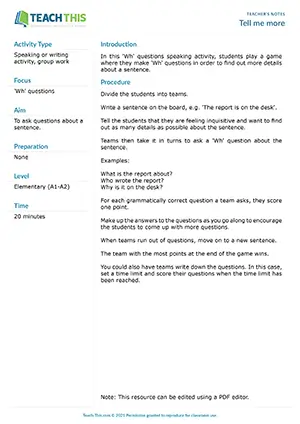
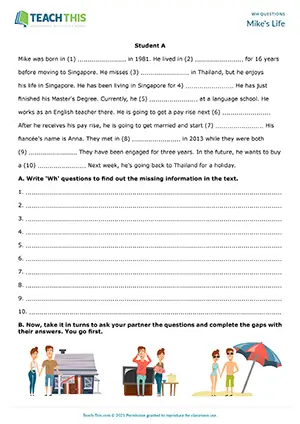
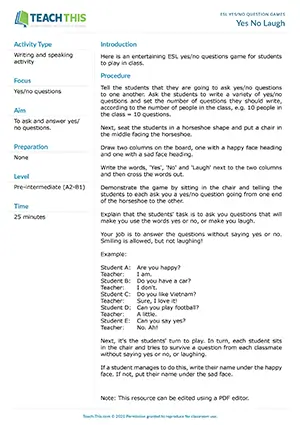
ESL Houses and Rooms Game - Vocabulary: Sentence Completion, Miming, Guessing
This engaging houses and rooms vocabulary game helps students practice making associations between particular activities and different rooms or parts of a house. First, students complete a sentence on a card with an activity that is associated...
ESL Houses and Rooms Game - Vocabulary: Sentence Completion, Miming, Guessing This engaging houses and rooms vocabulary game helps students practice making associations between particular activities and different rooms or parts of a house. First, students complete a sentence on a card with an activity that is associated with the room or part of the house shown, e.g. 'I'm making dinner in the kitchen.' Students then play a game where they mime and guess the sentences to find out which room or part of the house the other students are in, and what they are doing there. Students go around asking a classmate a 'Where are you?' question. Their classmate then mimes the sentence on their card. The first student then asks yes/no questions to help them guess the activity and part of the house, e.g. 'Are you eating breakfast?' 'Are you in the dining room?' When the student receives a nod for yes to both questions, they write their partner's name, what they are doing, and where they are in the relevant columns on their worksheet. The first student to complete their worksheet with ten different rooms or parts of the house and related activities is the winner.
ESL Furniture Game - Vocabulary and Speaking: Matching, Asking and Answering questions, Controlled Practice - Group Work
In this productive furniture vocabulary game, students match furniture and household item picture cards to word cards and ask and answer 'Is there...?'/'Are there...?' questions using the vocabulary...
ESL Furniture Game - Vocabulary and Speaking: Matching, Asking and Answering questions, Controlled Practice - Group Work In this productive furniture vocabulary game, students match furniture and household item picture cards to word cards and ask and answer 'Is there...?'/'Are there...?' questions using the vocabulary. To begin, students match furniture and household item picture and word cards together. Next, students play a pelmanism game where they take it in turns to turn over two cards. If the picture and word cards match, the student asks another student an 'Is there...? or 'Are there...?' question, linking the piece of furniture or household item to an appropriate room, e.g. 'Is there a wardrobe in your bedroom?' The other student responds 'Yes, there is.' or 'No, there isn't.' If the question is correct, the student keeps the two cards and has another turn. If the question is incorrect or the cards don't match, the student turns them back over, keeping them in the same place. The game continues until all the cards have been matched. The student with the most pairs of cards at the end of the game wins.
ESL Furniture Board Game - Vocabulary and Speaking: Gap-fill, Impromptu Speech, Communicative Practice - Group Work
Here is a fast-paced furniture board game to help students practice vocabulary related to furniture and household equipment. Students take turns picking up a card and reading the sentence to the other...
ESL Furniture Board Game - Vocabulary and Speaking: Gap-fill, Impromptu Speech, Communicative Practice - Group Work Here is a fast-paced furniture board game to help students practice vocabulary related to furniture and household equipment. Students take turns picking up a card and reading the sentence to the other students, using the word 'blank' for the word in bold, e.g. 'I went to the living room and sat on the BLANK.' The other students listen to the sentence and race to choose a furniture-related word from the word bank on the game board and say it aloud to complete the sentence, e.g. sofa. The first student to say the correct word shown on the card rolls the dice and moves their counter along the board. If a student lands on a 'Talk about...' square, they talk for 20 seconds about the prompt to remain on the square. If they are unsuccessful, they move back one space. The first student to reach the finish wins the game.
ESL Furniture Activity - Vocabulary and Speaking: Information Gap, Asking and Answering questions, Table Completion, Unscrambling, Matching - Group Work
Here is a free furniture vocabulary speaking activity to help students practice words related to furniture and things found in the home. In the activity...
ESL Furniture Activity - Vocabulary and Speaking: Information Gap, Asking and Answering questions, Table Completion, Unscrambling, Matching - Group Work Here is a free furniture vocabulary speaking activity to help students practice words related to furniture and things found in the home. In the activity, each student bought a household item or piece of furniture from a market that has a problem. To start, students take on the role of the person on their card and write their own information in the table. Students then go around their group, asking each group member the intended location of the item they bought and the problem, writing their answers in the table. When the students have finished, they unscramble words related to furniture and things found in the home. Lastly, students refer to the information in the table and write the item that each person bought in the last column. Afterwards, review the correct answers with the class.
ESL Rooms and Furniture Game - Vocabulary: Brainstorming, Listing - Pair Work
In this enjoyable rooms and furniture vocabulary game, students brainstorm furniture and decor words for different parts of a house. Start the game by calling out a random part of the house...
ESL Rooms and Furniture Game - Vocabulary: Brainstorming, Listing - Pair Work In this enjoyable rooms and furniture vocabulary game, students brainstorm furniture and decor words for different parts of a house. Start the game by calling out a random part of the house from the caller's sheet, e.g. bedroom. Each pair then writes that part of the house in the first column. Pairs then have one minute to brainstorm and write down all the furniture and decor words they can think of that go with that part of the house, e.g. bed, wardrobe, etc. When the time limit has been reached, pairs compare their answers. Teams cross off any words from their list that the competing team has on theirs and any words that both teams agree are not appropriate. Teams score one point for each correctly spelt remaining word on their list that the opposing team does not have. The pair with the most points at the end of the game wins.
ESL Houses, Rooms and Furniture Activity - Vocabulary and Speaking: Gap-fill, Information Gap, Asking and Answering questions, Matching - Group and Pair Work
In this fun house vocabulary speaking activity, students complete instructions for staying in someone's house and then race to exchange information for different parts...
ESL Houses, Rooms and Furniture Activity - Vocabulary and Speaking: Unscrambling, Gap-fill, Information Gap, Asking and Answering questions, Matching - Group and Pair Work In this fun house vocabulary speaking activity, students complete instructions for staying in someone's house and then race to exchange information for different parts of the house with a partner. In two groups, students start by unscrambling words related to parts of a house and furniture. Students then use the words to complete instructions for different parts of a house. Next, students pair up with someone from the other group. Explain that the students are going to be staying in a friend's home while they are away and that they have been left instructions for different parts of the house. Each student has the instructions for the parts of the house listed on their partner's worksheet and their task is to race to complete the instructions and match them to the different parts of the house. Students then take turns asking their partner for instructions for the parts of the house on their worksheet and write their partner's responses in the table in sentence form. The first pair to correctly complete the instructions for all the places wins.
ESL Houses, Rooms and Furniture Game - Vocabulary and Speaking: Describing, Guessing - Group Work
In this imaginative houses, rooms and furniture game, students play taboo by describing and guessing topic-related words. In groups, students take turns picking up a card without showing it to...
ESL Houses, Rooms and Furniture Game - Vocabulary and Speaking: Describing, Guessing - Group Work In this imaginative houses, rooms and furniture game, students play taboo by describing and guessing topic-related words. In groups, students take turns picking up a card without showing it to anyone. The student with the card then describes the word in bold connected with houses, rooms, and furniture to the other students without mentioning any of the words shown or variations of the words. The first student to guess the word being described wins the card. Students continue playing until all the cards have been used. The student with the most cards at the end of the game is the winner.
ESL Houses, Rooms and Furniture Game - Vocabulary and Speaking: Asking and Answering questions, Guessing, Controlled and Freer practice - Group and Pair Work
In this entertaining house vocabulary game, students answer home and decor questions and try to hide a word in their responses for a partner to guess. In two...
ESL Houses, Rooms and Furniture Game - Vocabulary and Speaking: Asking and Answering questions, Guessing, Controlled and Freer practice - Group and Pair Work In this entertaining house vocabulary game, students answer home and decor questions and try to hide a word in their responses for a partner to guess. In two groups, students begin by matching sentence halves to form home and decor questions. Next, students pair up with someone from the other group and take turns asking each question to their partner, who answers by talking for 30 seconds using a corresponding hidden word somewhere in their response without it being too obvious. When their partner has finished talking, the other student has two chances to guess the hidden word. If the student guesses correctly on the first try, they score two points. If they guess correctly on the second try, they get one point. If the student doesn't guess correctly, their partner reveals the answer and no points are awarded. The student with the most points at the end of the game wins.
ESL Houses, Rooms and Furniture Activity - Vocabulary and Speaking: Gap-fill, Discussion, Controlled and Freer Practice - Pair Work
In this insightful houses, rooms and furniture speaking activity, students practice home and decor vocabulary and talk about different home and decor options...
ESL Houses, Rooms and Furniture Activity - Vocabulary and Speaking: Gap-fill, Guided Discussion, Controlled and Freer Practice - Pair Work In this insightful houses, rooms and furniture speaking activity, students practice home and decor vocabulary and talk about different home and decor options. First, in pairs, students complete each set of options with a home or decor word, e.g. Which is better buying a brand-new house or buying an older house and renovating it? Pairs then discuss the pros and cons for each set of home or decor options and try to agree on which one is better. When the students have decided, they circle their choice and write down two reasons for their decision in the corresponding column. When the students have completed all the options, conduct a class survey to see which home and decor options are the most popular and why.
ESL Houses, Rooms and Furniture Activity - Vocabulary: Writing and Giving Clues, Guessing - Group and Pair Work
In this creative house-related vocabulary activity, students complete a crossword by describing and guessing words related to houses, rooms and furniture. In two groups, students invent and write...
ESL Houses, Rooms and Furniture Activity - Vocabulary: Writing and Giving Clues, Guessing - Group and Pair Work In this creative house-related vocabulary activity, students complete a crossword by describing and guessing words related to houses, rooms and furniture. In two groups, students invent and write down clues for the words related to houses, rooms and furniture written on their crossword. Next, students pair up with someone from the other group and take turns asking their partner for a clue to one of their missing words. Their partner reads out the clue for that house-related word, and the other student tries to guess what it is. If the student guesses the word successfully, they write it on their crossword. If not, their partner continues to give more clues until the student is able to guess the house-related word. Afterwards, students check their spelling by comparing crosswords.
ESL Going Out and Entertainment Game - Vocabulary: Gap-fill, Guessing - Speaking Activity: Asking and Answering questions, Controlled and Freer practice - Pair Work
This fun going out and entertainment game helps students practice vocabulary for places they can go on a day out and activities associated with these places...
ESL Going Out and Entertainment Game - Vocabulary: Gap-fill, Guessing - Speaking Activity: Asking and Answering questions, Controlled and Freer practice - Pair Work This fun going out and entertainment game helps students practice vocabulary for places they can go on a day out and activities associated with these places. First, in two groups, students use verbs to complete clues for different places they can go on a day out. Next, students pair up with someone from the other group and take turns reading each clue to their partner, who guesses which place is being described from the choices provided. For each correct guess, students score one point. The student with the most points at the end of the game wins. Finally, students ask and answer conversation questions about the places with their partner.
ESL Going Out Survey - Speaking Activity: Forming, Asking and Answering questions, Freer Practice - Group and Pair Work
This insightful going out survey helps students practice going out and entertainment vocabulary by asking and answering questions about likes and dislikes. First, students find out which...
ESL Going Out Survey - Speaking Activity: Forming, Asking and Answering questions, Controlled and Freer Practice - Group and Pair Work This insightful going out survey helps students practice going out and entertainment vocabulary by asking and answering questions about likes and dislikes. First, students find out which activities their group members like to do when they go out by asking 'Do you like...?' questions. The group members respond 'Yes, I do', or 'No, I don't' accordingly, and the student marks the answers in a chart. Next, students pair up with someone from another group and take turns asking their partner who they spoke to and their likes and dislikes using the third person, e.g. 'Does Jon like going to the cinema?' Afterwards, the two students review their answers and complete a sentence on the worksheet with the name of the person they are most similar to. Finally, students report back to the class on their findings.
ESL Entertainment Game - Vocabulary and Speaking: Describing, Guessing, Freer Practice - Group Work
In this creative entertainment vocabulary game, students describe and guess places and actions related to going out and entertainment. In groups of four, students take turns picking up a card...
ESL Entertainment Game - Vocabulary and Speaking: Describing, Guessing, Freer Practice - Group Work In this creative entertainment vocabulary game, students describe and guess places and actions related to going out and entertainment. In groups of four, students take turns picking up a card and describing the place or action at the top of the card to the other students without saying any of the words shown on the card. The first student to successfully guess the place or action being described wins and keeps the card. The student with the most cards at the end of the game wins.
ESL Going Out and Entertainment Worksheet - Vocabulary Exercises: Word Search, Matching, Categorising, Gap-fill - Speaking Activity: Discussion - Pair Work
In this comprehensive going out and entertainment worksheet, students learn and practice vocabulary related to a day out. In pairs, students begin by...
ESL Going Out and Entertainment Worksheet - Vocabulary Exercises: Word Search, Matching, Categorising, Gap-fill - Speaking Activity: Discussion, Freer Practice - Pair Work In this comprehensive going out and entertainment worksheet, students learn and practice vocabulary related to a day out. In pairs, students begin by discussing two questions about spending a day out. Students then find ten places to go on a day out in a word search. Next, students match the places to their definitions. After that, students categorise each place according to its cost in their town or city. Following that, students match nouns with verbs to make going out and entertainment collocations. Students then use the collocations to complete plans for a day out, adding four ideas of their own. Finally, in pairs, students discuss the plans and answer questions about them. When the students have finished, they share and discuss their answers with the class.
ESL Going Out Activity - Vocabulary, Reading and Speaking Activity: Gap-fill, Information Gap, Matching, Asking and Answering questions - Pair Work
In this engaging going-out information gap activity, students complete sentences about problems people had on a day out and exchange information with...
ESL Going Out Activity - Vocabulary, Reading and Speaking Activity: Gap-fill, Information Gap, Matching, Asking and Answering questions, Controlled Practice - Pair Work In this engaging going-out information gap activity, students complete sentences about problems people had on a day out and exchange information with a partner to find out where each person went. First, in two groups, students complete sentences about problems people had when they went out to different places with words from a box. Next, students pair up with someone from the other group and take turns asking their partner about the problems experienced by the people whose details are missing from their worksheet and writing their partner's responses in the table in sentence form. After that, pairs race to complete sentences by writing the correct person's name next to the corresponding place or event that they went to. The first pair to complete all their sentences correctly wins.
ESL Going Out and Entertainment Game - Vocabulary: Gap-fill, Multiple-choice questions, Guessing - Pair Work
Here is a free going out and entertainment vocabulary game in which students ask a partner hypothetical questions about going out and guess which answers they would choose. Working alone...
ESL Going Out and Entertainment Game - Vocabulary: Gap-fill, Multiple-Choice questions, Guessing - Pair Work Here is a free going out and entertainment vocabulary game in which students ask a partner hypothetical questions about going out and guess which answers they would choose. Working alone, students begin by completing questions with words from a box. Next, students underline the multiple-choice answer in each question they think their partner will choose. Students then take turns reading each question along with its three multiple-choice options to their partner, who chooses the answer that is true for them. If students guess correctly, they put a tick next to the question and score a point. The student with the most points at the end of the game wins.
ESL Going Out and Entertainment Worksheet - Vocabulary Exercises: Matching, Unscrambling, Binary Choice, Gap-fill - Speaking Activity - Pair Work
In this productive entertainment vocabulary worksheet, students learn and practice vocabulary related to going out and entertainment. To begin...
ESL Going Out and Entertainment Worksheet - Vocabulary Exercises: Matching, Unscrambling, Binary Choice, Gap-fill - Speaking Activity - Pair Work In this productive entertainment vocabulary worksheet, students learn and practice vocabulary related to going out and entertainment. To begin, students complete collocations related to going out and entertainment with verbs from a box. Next, students rearrange letters to spell place names and write the letter of the activity from Exercise A that someone would do at that place. Students then underline the correct place in each sentence. After that, students complete sentences with vocabulary from a box and write the place each sentence refers to. Next, students match sentence halves and complete the endings with words from a box. Lastly, in pairs, students ask and answer conversation questions about going out and entertainment.
ESL Theme Park Worksheet - Vocabulary Exercises: Matching, Categorising - Speaking Activity: Discussion, Communicative Practice - Pair Work
In this useful theme park worksheet, students learn theme park vocabulary and engage in theme park discussions by sharing opinions and expressing agreement...
ESL Theme Park Worksheet - Vocabulary Exercises: Matching, Categorising - Speaking Activity: Guided Discussion, Communicative Practice - Pair Work In this useful theme park worksheet, students learn theme park vocabulary and engage in theme park discussions by sharing opinions and expressing agreement and disagreement. First, students match theme park attractions to pictures. Students then match each attraction to its description. Next, students sort agreeing and disagreeing phrases into four categories. After that, students read a theme park situation and use the phrases to discuss the positives and negatives of each theme park attraction and come to an agreement for the situation. Finally, students read and discuss statements about theme parks, giving their opinion and saying whether they agree or disagree.
ESL Going Out and Entertainment Worksheet - Vocabulary Exercises: Matching, Gap-fill, Binary Choice - Speaking Activity: Asking and Answering questions - Pair Work
In this handy going out and entertainment worksheet, students practice vocabulary related to having a night out. First, students discuss three questions...
ESL Going Out and Entertainment Worksheet - Vocabulary Exercises: Matching, Gap-fill, Binary Choice - Speaking Activity: Asking and Answering questions - Pair Work In this handy going out and entertainment worksheet, students practice vocabulary related to having a night out. First, students discuss three questions about nights out in pairs. Students then match places for a night out to their definitions. Next, students use verbs to complete the names of different night-out activities and then match each activity with a suitable place. After that, students write down two additional adjectives that can be used to describe each noun. Following that, students use night-out vocabulary to complete sentences about what people did on Friday night. Finally, students underline the correct word to complete each conversation question and then ask and answer the questions with a partner.
ESL Entertainment Worksheet - Vocabulary Exercises: Matching, Binary Choice, Gap-fill - Speaking Activity: Asking and Answering questions - Pair Work
This free entertainment vocabulary worksheet helps students practice words related to going out and entertainment. In pairs, students begin by asking each other...
ESL Entertainment Worksheet - Vocabulary Exercises: Matching, Binary Choice, Gap-fill - Speaking Activity: Asking and Answering questions - Pair Work This free entertainment vocabulary worksheet helps students practice words related to going out and entertainment. In pairs, students begin by asking each other conversation questions about going out. Students then match sentence halves to make sentences about going out and entertainment. Next, students match the sentences with activities and underline the correct verb in each sentence. After that, students match verbs with their definitions. Students then underline the correct word in each sentence. Lastly, students complete conversation questions about entertainment and going out with words from a box and then ask and answer the questions with a partner.
We use cookies to ensure you to get the best experience on our website. If you decline the use of cookies, this website may not function as expected.
Accept all
Decline all
Analytics
We use Google Analytics cookies to understand how our website is used and to improve your experience. These cookies collect information anonymously, such as the number of visitors and the most popular pages.
Google Analytics
Accept
Decline
Essential/Strictly Necessary Cookies
This cookie is set by Cloudflare to identify trusted web traffic and verify legitimate users after completing security checks, such as a CAPTCHA. It ensures the website remains secure and accessible without impacting performance. This cookie is essential for the proper functioning and security of the site and cannot be disabled.
Cloudflair
Accept
Decline
Advertisement
If you accept, the ads on the page will be adapted to your preferences.