
Sense Verbs & Adjectives ESL Games, Activities & Worksheets
Five Senses Board Game
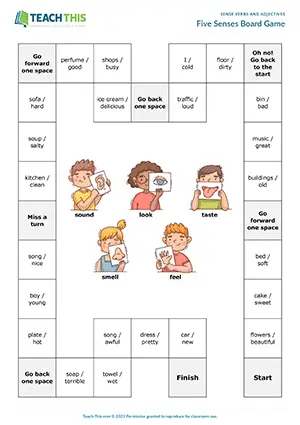
ESL Sense Verbs Game - Vocabulary and Speaking: Forming Sentences, Controlled Practice - Pair Work
In this free sense verbs board game, students practice forming sentences with the verbs: look, smell, taste, sound, and feel. In pairs, students take turns rolling the dice and moving their counter along...
Sensational Adjectives
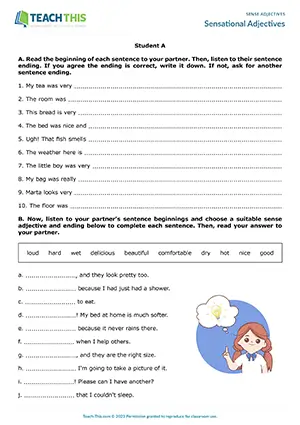
ESL Sense Adjectives Activity - Vocabulary: Matching, Sentence Completion - Pair Work
In this enjoyable sense adjectives activity, students race to match sentence halves and complete them with sensory adjectives. First, Student A reads each sentence beginning to their partner, who chooses a suitable sense adjective and ending from...
Makes Sense
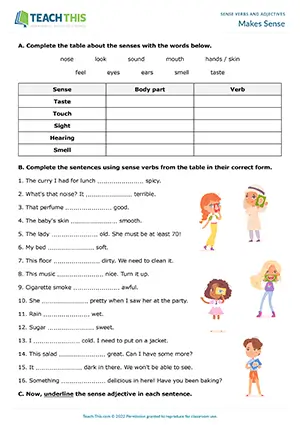
ESL Sense Verbs and Adjectives Worksheet - Vocabulary Exercises: Table Completion, Gap-fill, Matching, Error Correction
In this comprehensive sense verbs and adjectives worksheet, students learn and practice how to use the verbs taste, feel, look, sound and smell with sense adjectives. First, students complete a five...
Sensational Pairs
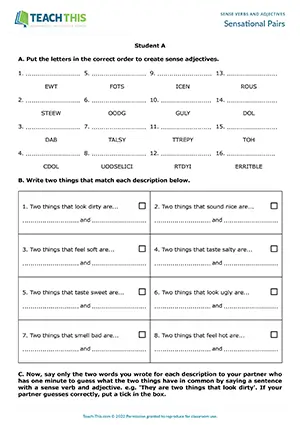
ESL Sense Verbs and Adjectives Activity - Vocabulary Exercises: Unscrambling, Gap-fill - Speaking Game: Forming Sentences, Guessing - Pair Work
In this useful sense verbs and adjectives activity, students unscramble sense adjectives and then use them in a guessing game along with the sense verbs look, feel...
Super Senses
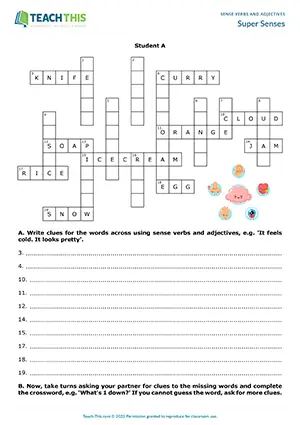
ESL Sense Verbs and Adjectives Activity - Vocabulary and Speaking: Writing Crossword Clues, Describing, Guessing - Group and Pair Work
In this creative sense verbs and adjectives speaking activity, students describe words with sensory verbs and adjectives for a partner to guess in order to...
Name Two

ESL Five Senses Board Game - Vocabulary and Speaking: Naming, Forming Sentences - Group Work
In this fun five senses board game, students name two things that match with sensory adjectives. One team member starts by picking up a card and asking their partner to name two things that...
Sensational Orders
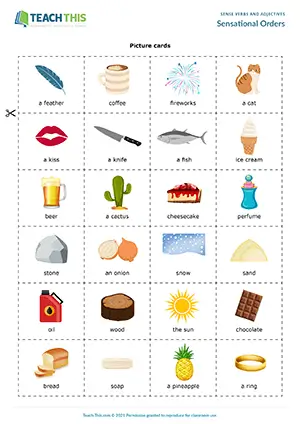
ESL Sense Adjectives and Verbs Game - Vocabulary and Speaking: Describing, Matching, Asking and Answering Questions - Pair Work
In this free sense adjectives and verbs game, students order pictures by listening to descriptions of how the items look, feel, taste and smell. Student A places...
Sense Verbs
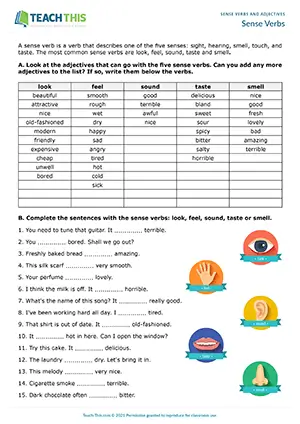
ESL Sense Verbs Worksheet - Vocabulary Exercises: Table Completion, Gap-fill, Sentence Completion - Speaking Activity: Forming Sentences - Pair Work
In this productive sense verbs worksheet, students learn and practice sensory verbs and adjectives. Students begin by reading about sense verbs (look, feel...
Sweet Sensations
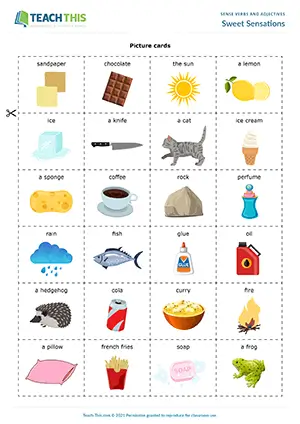
ESL Sense Adjective Games - Vocabulary and Speaking: Pelmanism, Matching, Describing, Guessing - Group Work
In these two engaging sense adjective games, students play a matching game where they match sense adjectives to pictures and then play a describing game in which they describe the pictures in terms of...
Five Senses Game
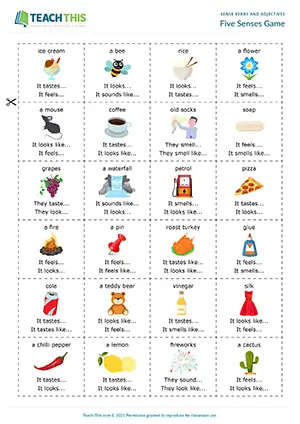
ESL Five Senses Game - Vocabulary: Describing, Guessing - Group Work
Here is an entertaining five senses game to help students practice sensory verbs and adjectives. In groups, students take it in turns to pick up a card and describe the word on the card to the group using the two prompts on the card and then...
What is it?
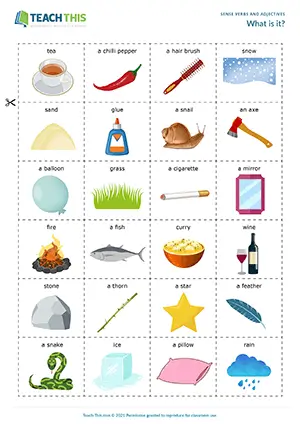
ESL Sense Adjectives and Verbs Game - Vocabulary: Describing Things, Guessing - Group Work
In this imaginative sense adjectives and verbs game, students describe different things using sensory adjectives and verbs for others to guess. In groups, students look at their cards and think about how they...
Understanding Sense Verbs and Adjectives
Sense verbs are linking verbs such as 'look', 'feel', 'taste', 'smell', and 'sound' that connect a subject to an adjective describing a sensory quality. Students who confuse sense verbs with action verbs and add an adverb instead of an adjective produce errors like 'It smells nicely' rather than 'It smells nice', which immediately signals a gap in their grammar accuracy.
This page covers sense verbs and adjectives across A1-A2, A2, B1, and B2 levels, with eleven resources spanning board games, worksheets, pair activities, and group guessing games, two of which are available as free downloads.
The table below lists each sense verb with its associated sense type, a set of typical adjectives, and an example sentence showing the verb used naturally.
| Sense Verb | Sense Type | Example Adjectives | Example Sentence |
|---|---|---|---|
| look | sight | beautiful, bright, dark, pale, shiny, dull | 'The sky looks grey today.' |
| sound | hearing | loud, quiet, strange, familiar, harsh, soothing | 'Her voice sounds familiar.' |
| smell | scent | fresh, stale, sweet, musty, strong, unpleasant | 'The bread smells fresh.' |
| taste | flavour | sweet, bitter, salty, sour, spicy, bland | 'This soup tastes too salty.' |
| feel | touch | soft, rough, smooth, cold, warm, sticky | 'The fabric feels soft.' |
When to Use Sense Verbs and Adjectives
Describing food and drink: Sense verbs are the natural choice when a speaker or writer wants to describe how food or drink registers across the senses, making descriptions feel immediate and vivid rather than abstract, as in 'The coffee smells rich and tastes slightly bitter.'
Describing places and atmosphere: Writers use sense verbs to bring settings to life by appealing directly to the reader's senses rather than stating facts about a location, as in 'The old library felt cold and smelled of dust.'
Expressing a personal reaction or impression: A speaker uses 'feel', 'sound', or 'look' to signal a subjective impression rather than an objective fact, which softens a statement and makes it sound less blunt, as in 'That sounds like a good idea' rather than 'That is a good idea.'
3-Step Framework for Teaching Sense Verbs and Adjectives
1. Map the Verbs and Adjectives: Start with a structured worksheet that builds the full vocabulary set before any speaking practice begins. Students complete a five senses table using words from a box, then work through gap-fill and matching exercises, and finish by correcting errors in sentences that contain sense verbs and adjectives, which tests both verb choice and adjective use in one step.
2. Describe to Match: Move students into a communicative picture description task where one partner arranges picture cards on a numbered board and describes each one using sense verbs and adjectives while the other student listens and tries to arrange their own cards in the same order. If the listener is unsure, they ask questions such as 'What does it look/feel/taste/smell like?' to get more detail.
3. Describe to Guess: Push students to produce extended, multi-sense descriptions under pressure with a group guessing game. Students prepare descriptions covering how things look, feel, taste, sound, and smell, then deliver them one clue at a time while the group races to guess the word. A description like 'It can be various colours. It tastes very sweet. It doesn't make any noise. It feels soft and sticky' shows the level of detail students are aiming for.
Common Mistakes with Sense Verbs and Adjectives
Using 'be' instead of a sense verb: Students often default to 'is' or 'are' in descriptive sentences where a sense verb would be more natural and precise, because they reach for the simplest linking verb rather than choosing the one that specifies which sense is involved. Wrong: 'This soup is very salty.' Correct: 'This soup tastes very salty.'
Using the progressive form of a sense verb: Students often write sense verbs in the continuous tense by analogy with action verbs, not realizing that sense verbs in this linking function are stative and do not take the -ing form. Wrong: 'The soup is tasting salty.' Correct: 'The soup tastes salty.'
Common Questions About Teaching Sense Verbs and Adjectives
What is a fun board game for practicing sense verbs and adjectives?
The board game Five Senses Board Game gives students controlled practice with look, smell, taste, sound, and feel. Players roll the dice, land on a square showing a noun and adjective such as 'flowers/beautiful,' and build a grammatically correct sense verb sentence. Using the wrong sense verb or adjective form sends them back two squares, so accuracy matters throughout.
What is a useful worksheet for teaching sense verbs and adjectives?
The worksheet Sense Verbs opens with a reference section explaining which adjectives pair with each of the five sense verbs, so students see the full picture before they practice. They then brainstorm additional adjectives, complete gap-fill and sentence completion exercises, and finish with a speaking stage where they describe items using sense verbs and adjectives together.
What is an engaging activity for practicing sense adjectives?
In the activity Sweet Sensations, students describe picture cards using sense adjectives and field live questions like 'What does it feel like?' from the group, which pushes them to produce accurate sense adjective sentences on the spot. The activity opens with a competitive pelmanism stage where students match sense adjective cards to pictures, building the vocabulary they need before describing.
Become a Teach This Member
Get unlimited access to the full library, plus new resources added every week.
Unlimited Resource Access
Download from 3000+ worksheets, activities, and games.
Save 5+ Hours Weekly
Cut lesson prep time with ready-to-use resources, plus teacher notes and answer keys.
Trusted Professional Quality
Classroom-tested, editable resources created by experienced ESL professionals.
Fresh Content Weekly
Get 5 new resources added to the library each week.
Here's what our members are saying...


