
- Polite Email Requests and Clarifying Questions
-
polite Email Requests & Clarifying Questions: Business English Worksheets
Responding to an Email Enquiry
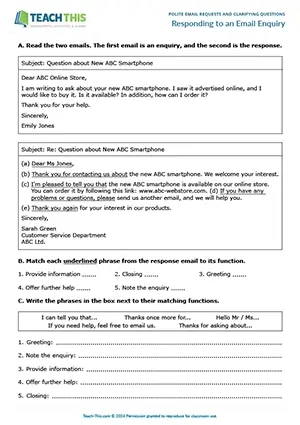
Business English Email Enquiries Worksheet - Reading, Vocabulary and Writing Exercises: Matching, Sentence Completion, Writing Emails - Pair Work
In this email enquiries worksheet, students learn and practice how to write an email that responds to a customer enquiry. First, students read an enquiry email...
Business English Email Enquiries Worksheet - Reading, Vocabulary and Writing Exercises: Matching, Sentence Completion, Writing Emails from Prompts - Pair Work In this email enquiries worksheet, students learn and practice how to write an email that responds to a customer enquiry. First, students read an enquiry email and a response. Students then match phrases in the response email with their functions. Next, students match additional phrases from a box to their functions. After that, students swap worksheets with a partner and write an email enquiry by completing sentences with their own ideas. Students then give back the worksheet to their partner, who writes an email response using the phrases from the worksheet. Finally, students read their email to their partner and discuss whether they think it was a good response or not.Writing an Invitation Email
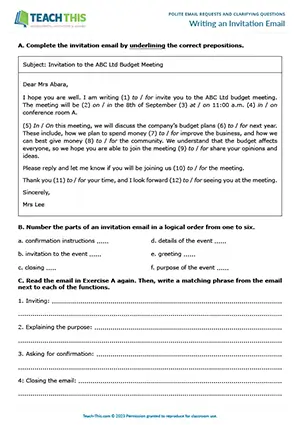
Business English Invitation Emails Worksheet - Reading and Writing Exercises: Binary Choice, Ordering, Identifying, Matching, Email Writing
In this useful business invitation emails worksheet, students learn and practice how to write emails issuing work-related invitations. First, students complete an...
Business English Invitation Emails Worksheet - Reading and Writing Exercises: Binary Choice, Ordering, Identifying, Unscrambling, Matching, Email Writing, Peer Feedback In this useful business invitation emails worksheet, students learn and practice how to write emails issuing work-related invitations. First, students complete an invitation email by underlining the correct prepositions. Students then number the parts of an invitation email so that they are in a logical order. Next, students scan the email again to find phrases that match different functions and write them down. After that, students unscramble words to form sentences and use them to complete an invitation email. Following that, students write an invitation email inviting someone to a marketing meeting. Finally, students exchange their completed emails with a partner and use a checklist to provide feedback, putting a tick for each item achieved. Students then revise their emails to address any of the unachieved items.polite Replacement Requests
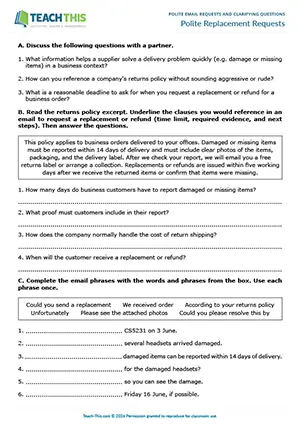
Business English Email Requests Worksheet - Reading, Vocabulary and Writing Exercises: Gap-fill, Ordering, Email Writing - Speaking Activity: Discussion - Pair Work
In this comprehensive request emails worksheet, students practice writing polite replacement or refund request emails and asking clarifying questions...
Business English polite Email Requests Worksheet - Reading, Vocabulary and Writing Exercises: Short-Answer Questions, Gap-fill, Ordering, Email Writing, Peer Feedback - Speaking Activity: Guided Discussion, Communicative Practice - Pair Work In this comprehensive request emails worksheet, students practice writing polite replacement or refund request emails and asking clarifying questions using a returns policy. First, in pairs, students discuss questions related to the topic. Students then read a returns policy excerpt and underline the clauses they would reference in an email to request a replacement or refund. They then answer comprehension questions to check their understanding of the time limit, required evidence and process. Next, students complete useful email phrases for reporting damage or shortages and making polite requests with words and phrases from a box. After that, students put sentences in order to form a replacement request email. Students then read a situation about a notebook order with missing and damaged items. Following that, students use the situation to write a replacement or refund request email to a supplier, including at least one clarifying question. Finally, students exchange emails with a partner, read their partner's email and make useful suggestions to improve it by answering questions. Students then provide feedback and revise any parts they want to improve.Clarifying Invoice Discrepancies
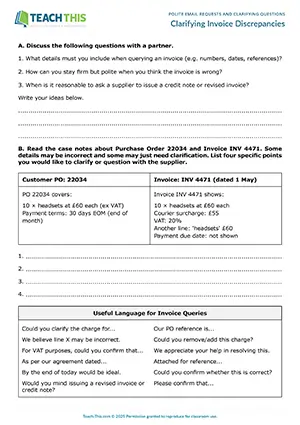
Business English Email Requests and Clarifying Questions Worksheet - Reading and Writing Exercises: Identifying, Email Writing - Speaking Activity - Pair Work
In this Business English worksheet on email requests and clarifying questions, students practice clarifying invoice discrepancies and requesting revised invoices or...
Business English Email Requests and Clarifying Questions Worksheet - Reading and Writing Exercises: Identifying, Writing Questions and Statements, Email Writing, Peer Feedback - Speaking Activity: Guided Discussion, Freer Practice - Pair Work In this Business English worksheet on email requests and clarifying questions, students practice clarifying invoice discrepancies and requesting revised invoices or credit notes in clear, polite professional emails. In pairs, students begin by discussing questions about invoice details and credit notes. Pairs then share their ideas with the class. Next, students read case notes about an invoice and list the items they want to clarify or question. After that, students write four clarifying questions or requests about the invoice, using the useful language provided. Students then write an email to the accounts department, enquiring about the unexpected charges and requesting a correction if necessary. Finally, students swap emails with a partner and give feedback on clarity, politeness and completeness.From Vague to Clear
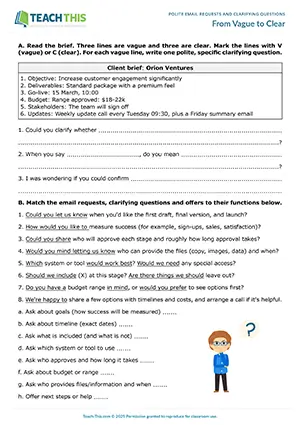
Business English Email Clarifying Questions Worksheet - Reading, Vocabulary and Writing Exercises: Sentence Completion, Matching, Rewriting Sentences and Emails
In this clarifying questions in business emails worksheet, students practice identifying vague information in client emails and briefs and writing polite, specific...
Business English Email Clarifying Questions Worksheet - Reading, Vocabulary and Writing Exercises: Categorising, Sentence Completion, Matching, Rewriting Sentences and Emails In this clarifying questions in business emails worksheet, students practice identifying vague information in client emails and briefs and writing polite, specific clarifying questions to obtain necessary project information. To begin, students read a brief and mark each line with V (vague) or C (clear). Students then write one polite, specific clarifying question for each vague line. Next, students match email requests, clarifying questions and offers to their functions. After that, students rewrite blunt email lines so they are polite and specific, clarifying questions. Finally, students rewrite an email so that the tone is polite and suitable for professional business communication.Handover Email Requests
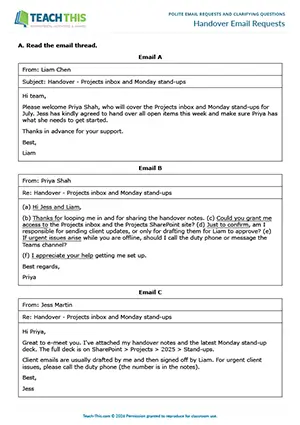
Business English Email Requests Worksheet - Reading, Vocabulary and Writing Exercises: Ordering, Sentence Completion, Writing Emails - Pair Work
In this business email requests worksheet, students practice writing polite handover emails to request access, clarify responsibilities and ask...
Business English Email Requests Worksheet - Reading, Vocabulary and Writing Exercises: Ordering, Matching, Sentence Completion, Rewriting Sentences, Writing Emails, Peer Feedback - Pair Work In this business email requests worksheet, students practice writing polite handover emails to request access, clarify responsibilities and ask about urgent issues. First, students read an email thread, put the emails in a logical order and then match each email to its function. Next, students look at one email again and match the underlined phrases to their functions. After that, students complete handover email requests and questions with their own ideas. Students then rewrite direct requests to make them more polite and appropriate for a handover email. Following that, students write a follow-up handover email, using the information from the email thread and exercises. Finally, students read their email to a partner, who uses a checklist to give feedback. Students then revise their email, taking the feedback into account.The Question Funnel
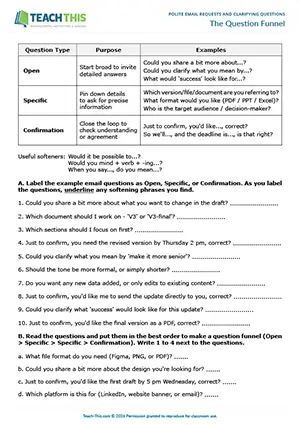
Business English Email Clarifying Questions Worksheet - Reading and Writing Exercises: Ordering, Writing and Rewriting Questions - Speaking - Discussion - Pair Work
In this email clarifying questions worksheet, students identify, soften, and sequence follow-up questions using a question funnel framework. First, students review...
Business English Email Clarifying Questions Worksheet - Reading and Writing Exercises: Ordering, Writing and Rewriting Questions - Speaking - Discussion, Communicative Practice - Pair Work In this email clarifying questions worksheet, students identify, soften, and sequence follow-up questions using a question funnel framework. First, students review a 'Question Type' table and 'Useful softeners'. Students then read example email questions and label each one as Open, Specific, or Confirmation. As students label the questions, they underline any softening phrases they find in each question. Next, students put email questions in the most effective order to form a question funnel. After that, students rewrite direct questions using more indirect and polite forms. In pairs, students then discuss what is unclear in each message. Each student then writes four clarification questions for each scenario using the question funnel. Finally, students compare their four-question funnels and discuss which confirming question works best. - Being Polite ESL Games, Activities and Worksheets | Teach-This
-
Being polite ESL Games, Activities & Worksheets
So polite!

ESL Could You Game - Speaking: Forming and Reforming Sentences, Miming, Freer Practice - Group Work
In this free polite requests game, students make polite requests with 'Could you..., please?' and respond with 'Thank you' and 'You're welcome'. In groups, students take turns picking up a card...
ESL Could You Game - Speaking: Forming and Reforming Sentences, Miming, Freer Practice - Group Work In this free polite requests game, students make polite requests with 'Could you..., please?' and respond with 'Thank you' and 'You're welcome'. In groups, students take turns picking up a card and changing the command on the card into a polite request starting with 'Could you' and ending with please, e.g. 'Could you tell me your name, please?' The other group members then race to do or mime the requested action. The student who made the request says 'Thank you' to the first student who does the action correctly. That student wins the round, keeps the card, and replies with 'You're welcome'. The student with the most cards at the end of the game wins.Perfectly polite
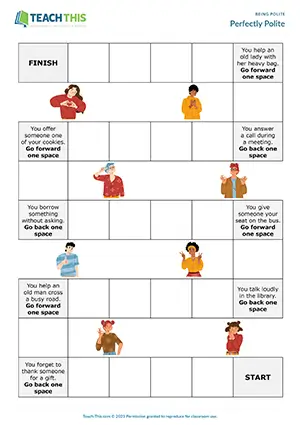
ESL polite Expressions Board Game - Vocabulary and Speaking: Forming Sentences, Guessing, Freer Practice - Group Work
In this engaging polite expressions board game, students race to say polite expressions and requests that match different situations. In groups of three, one student...
ESL polite Expressions Board Game - Vocabulary and Speaking: Forming Sentences from Prompts, Guessing, Freer Practice - Group Work In this engaging polite expressions board game, students race to say polite expressions and requests that match different situations. In groups of three, one student starts by picking up a card and reading the situation to the student on their right, who responds with a polite expression or request. If the student says the correct polite expression shown in bold on the card, they roll the dice and move their counter along the board accordingly. If not, the next student gives their answer. If no one answers correctly, the reader gives clues to the two students and the first to answer correctly moves their counter along the board. It is then the next student's turn to pick up and read out a card to the student on their right. The first student to reach the finish wins the game.Ask Me Nicely
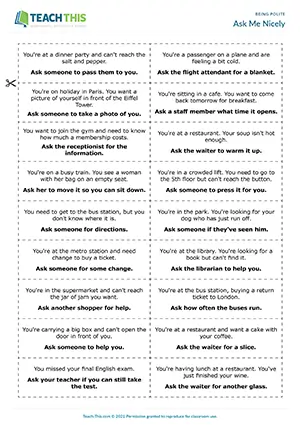
ESL polite Requests Game - Speaking: Forming Responses, Communicative Practice - Group Work
In this imaginative polite requests game, students compete against each other to come up with polite requests for various situations. In groups, students take turns picking up a card and reading the...
ESL polite Requests Game - Speaking: Forming Responses, Communicative Practice - Group Work In this imaginative polite requests game, students compete against each other to come up with polite requests for various situations. In groups, students take turns picking up a card and reading the situation on the card to the group. The other students then race to make a polite request. The first student to make an appropriate polite request for the situation wins and keeps the card. It's then the next student's turn to pick up a card and for the group to use another polite request phrase, and so on. The student with the most cards at the end of the game is the winner.Levels of politeness
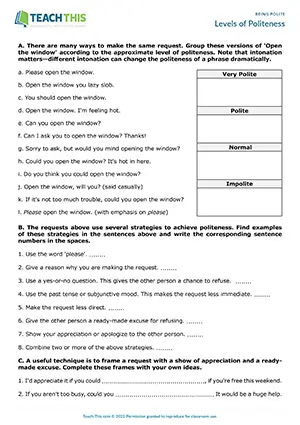
ESL politeness Worksheet - Vocabulary Exercises: Categorising, Identifying, Gap-fill, Rewriting Sentences, Writing Questions
This useful being polite worksheet helps students learn how to achieve different levels of politeness in various situations. First, students categorise variations of the request 'Open the window' according...
ESL politeness Worksheet - Vocabulary Exercises: Categorising, Identifying, Gap-fill, Rewriting Sentences, Writing Questions from Prompts This useful being polite worksheet helps students learn how to achieve different levels of politeness in various situations. First, students categorise variations of the request 'Open the window' according to their level of politeness. Students then find examples of different politeness strategies in the requests. Next, students complete polite request frames with their own ideas. After that, students rewrite requests to make them more polite and appropriate for each situation. Finally, students write requests that are appropriate for different situations.I'm sorry to interrupt, but...

ESL polite Interruptions Activity - Vocabulary Exercises: Gap-fill, Table Completion - Speaking Activity: Debating, Communicative Practice - Pair and Group Work
In this creative being polite activity, students review expressions for interrupting politely and then participate in mini debates to practice the expressions...
ESL polite Interruptions Activity - Vocabulary Exercises: Gap-fill, Table Completion - Speaking Activity: Debating, Freer and Communicative Practice - Pair and Group Work In this creative being polite activity, students review expressions for interrupting politely and then participate in mini debates to practice the expressions. First, in pairs, students discuss two questions about interrupting. Students then complete expressions used to interrupt politely with words from a box. Next, students read expressions used to accept or reject an interruption and add more expressions of their own under each heading. After that, students participate in a debating activity to practice using the interrupting expressions. In groups of three, one student takes on the role of judge and timekeeper. That student picks up a debate card and reads it aloud. The other two students decide between them which side of the debate they will argue. The two students then debate the topic for two minutes, arguing their stances and using the expressions to interrupt their partner at least once. When the time is up, the judge stops the debate and declares the student whose argument they found the most convincing the winner and gives them the debate card. Students then swap roles and begin a new round. The student with the most cards at the end of the activity wins.polite Partners
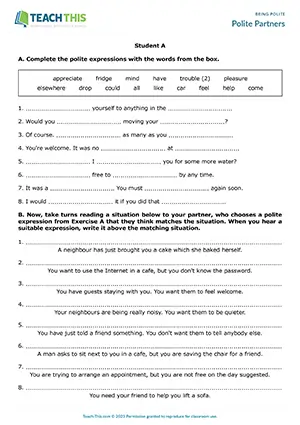
ESL polite Expressions Activity - Vocabulary, Reading and Listening: Gap-fill, Matching, Dictation - Pair Work
Here is a rewarding being polite activity to help students practice commonly used polite expressions. First, working alone, students complete polite expressions with words from a box. Next, students take...
ESL polite Expressions Activity - Vocabulary, Reading and Listening: Gap-fill, Matching, Dictation - Pair Work Here is a rewarding being polite activity to help students practice commonly used polite expressions. First, working alone, students complete polite expressions with words from a box. Next, students take turns reading out a situation to their partner, who chooses a polite expression from Exercise A that they think matches the situation. If their partner agrees that the expression matches, they write it above the situation. The activity continues until all the situations have been matched with a suitable polite expression. Afterwards, check the correct answers with the class.polite Phrases
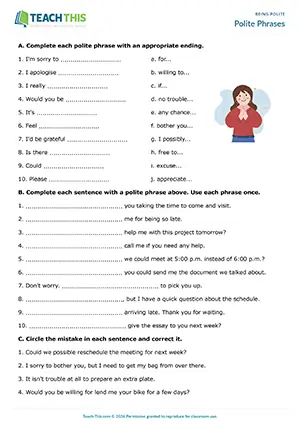
ESL polite Phrases Worksheet - Writing and Vocabulary Exercises: Matching, Gap-fill, Error Correction, Binary Choice, Writing Sentences
This politeness worksheet helps students practice common polite phrases. First, students complete each polite phrase with its correct ending. Students...
ESL polite Phrases Worksheet - Writing and Vocabulary Exercises: Matching, Gap-fill, Error Correction, Binary Choice, Writing Sentences from Prompts This politeness worksheet helps students practice common polite phrases. First, students complete each polite phrase with its correct ending. Students then use the polite phrases to complete sentences. Next, students find mistakes in sentences that contain polite phrases and correct them. After that, students underline the correct polite phrase to complete each sentence. Finally, students read each situation and write a corresponding polite sentence using the phrases from the worksheet. - Scheduling, Confirming and Rescheduling by Email
-
Scheduling, Confirming and Rescheduling by Email: Business English Worksheets
Confirming Arrangements by Email
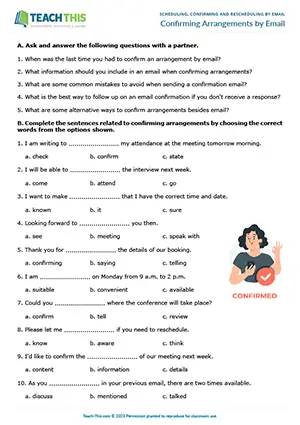
Business English Confirming Arrangements by Email Worksheet - Vocabulary, Reading and Writing: Gap-fill, Matching, Email Writing - Speaking: Discussion - Pair Work
In this insightful confirming arrangements worksheet, students practice phrases for confirming arrangements by email. In pairs, students begin by discussing...
Business English Confirming Arrangements by Email Worksheet - Vocabulary, Reading and Writing: Multiple Choice, Gap-fill, Matching, Email Writing - Speaking: Guided Discussion - Pair Work In this insightful confirming arrangements worksheet, students practice phrases for confirming arrangements by email. In pairs, students begin by discussing questions related to confirming arrangements by email. Students then complete sentences related to confirming arrangements by choosing the correct words from the options shown. Next, students complete a confirmation email with a set of phrases. After that, students match the phrases from the email with their functions. Lastly, students reply to an email, confirming their attendance at a job interview and asking for confirmation on certain points.Declining an Invitation by Email

Business English Declining Invitations by Email Worksheet - Reading and Writing Exercises: Unscrambling, Gap-fill, Ordering, Rewriting Sentences, Email Writing
In this free declining invitations worksheet, students learn and practice writing professional and polite emails declining work-related invitations. First,...
Business English Declining Invitations by Email Worksheet - Reading and Writing Exercises: Unscrambling, Gap-fill, Ordering, Rewriting Sentences, Email Writing In this free declining invitations worksheet, students learn and practice writing professional and polite emails declining work-related invitations. First, students unscramble common email expressions and then write them in an invitation email. In pairs, students then discuss possible reasons why the invitee is not able to accept the invitation. Next, students write an email declining the invitation by putting sentences in the correct order to form the email. Lastly, students write an email declining an invitation to a work-related meeting or event, following requirements outlined in a prompt.Rescheduling Emails

Business English Rescheduling by Email Worksheet - Reading, Vocabulary and Writing: Identifying, Labelling, Gap-fill, Email Writing, Peer Review
In this rescheduling by email worksheet, students practice how to reschedule meetings politely by using softening language, clear time options and brief reasons...
Business English Rescheduling by Email Worksheet - Reading, Vocabulary and Writing: Identifying, Labelling, Gap-fill, Email Writing, Peer Review In this rescheduling by email worksheet, students practice how to reschedule meetings politely by using softening language, clear time options and brief reasons to minimise inconvenience. First, students read two rescheduling emails. The first email is too direct, and the second is polite and complete. Students then underline the two phrases that sound too direct in Email 1 and tick which elements are missing. Next, students label the sentence in Email 2 that shows each element. After that, students use phrases in the box to complete a rescheduling email. Students then write their own rescheduling email using the scenario provided and the phrases from the worksheet. Finally, students swap their emails with a partner, who peer reviews their email by checking the required elements, language and time options. Students then give feedback to their partner, giving one positive comment and making one suggestion for improvement.When are you available?
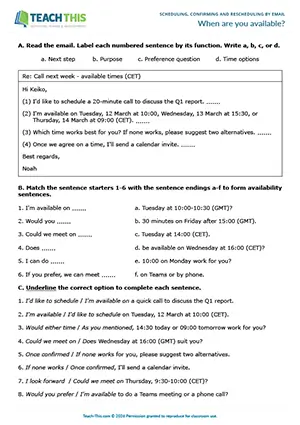
Business English Scheduling by Email Worksheet - Reading, Vocabulary and Writing: Matching, Binary Choice, Rewriting Sentences, Email Writing
In this scheduling by email worksheet, students practice writing short scheduling emails that offer clear time options with time zones, ask for a preference...
Business English Scheduling by Email Worksheet - Reading, Vocabulary and Writing: Matching, Binary Choice, Rewriting Sentences, Email Writing, Peer Feedback In this scheduling by email worksheet, students practice writing short scheduling emails that offer clear time options with time zones, ask for a preference, and confirm the next step. First, students read a model email and label each numbered sentence by its function. Students then form availability sentences by matching sentence starters and endings. Next, students underline the correct options to complete key scheduling phrases. After that, students rewrite unclear or incorrect lines to make dates, times and time zones clear. Finally, students write a short scheduling email offering two or three time options. Afterwards, students swap emails with a partner, complete a checklist and provide feedback.Rescheduling Deliveries
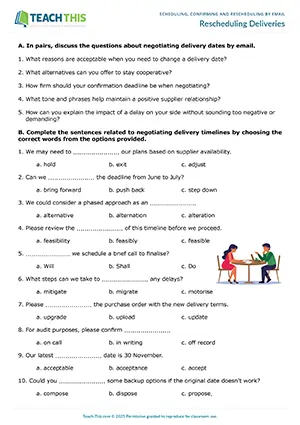
Business English Rescheduling by Email Worksheet - Reading and Writing Exercises: Multiple Choice, Gap-fill, Matching, Email Writing, Peer Feedback
In this rescheduling by email worksheet, students learn and practice the language for requesting revised delivery dates, proposing alternatives, and confirming...
Business English Rescheduling by Email Worksheet - Reading and Writing Exercises: Multiple Choice, Gap-fill, Matching, Email Writing, Peer Feedback In this rescheduling by email worksheet, students learn and practice the language for requesting revised delivery dates, proposing alternatives, and confirming deadlines and next steps in professional emails. In pairs, students begin by discussing questions related to negotiating delivery dates by email. Students then complete sentences related to negotiating delivery timelines by choosing the correct words from the options provided. Next, students complete a negotiation email with key phrases. After that, students match five key phrases from the email with their functions. Students then write a reply to the email, negotiating a new delivery date and confirming next steps. Finally, students exchange emails with a partner, conduct a review using a checklist, and provide feedback.Writing a Confirmation Email
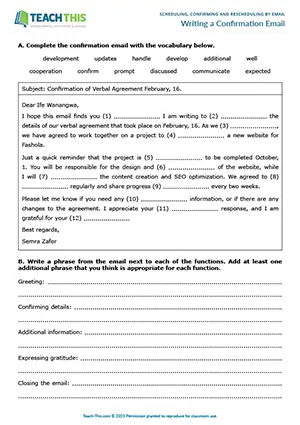
Business English Confirmation Emails Worksheet - Vocabulary, Reading and Writing Exercises: Gap-fill, Identifying, Email Writing Practice, Peer Review
Here is a productive business confirmation emails worksheet to help students practice writing emails confirming the terms of a verbal agreement. Students begin by...
Business English Confirmation Emails Worksheet - Vocabulary, Reading and Writing Exercises: Gap-fill, Identifying, Unscrambling, Email Writing Practice, Peer Review Here is a productive business confirmation emails worksheet to help students practice writing emails confirming the terms of a verbal agreement. Students begin by completing an example confirmation email with related vocabulary. Students then scan the example email for phrases that perform the functions shown and write them down. For each function, students also add at least one appropriate phrase that they are already familiar with. Next, students unscramble two example email confirmation sentences. Lastly, students take on the role of an owner of a fashion label and write a confirmation email to the owner of a clothing retail chain, by addressing the details outlined in the prompt provided. Lastly, students swap their email with a partner and conduct a quick peer review. - Follow‑up and Update Emails
-
Follow‑up & Update Emails: Business English Worksheets
First Meeting Follow-up
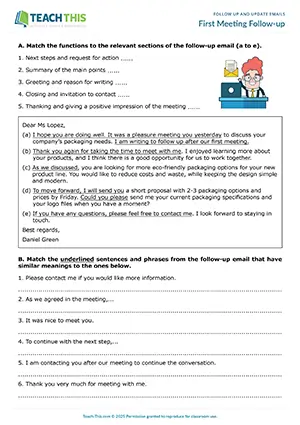
Business English Follow-up Emails Worksheet - Reading, Vocabulary and Writing Exercises: Identifying, Gap-fill, Email Writing - Pair Work
In this comprehensive business follow-up emails worksheet, students learn and practice the structure and language needed for writing effective follow-up emails after...
Business English Follow-up Emails Worksheet - Reading, Vocabulary and Writing Exercises: Matching, Identifying Phrases, Gap-fill, Sentence Writing, Email Writing, Peer Feedback - Pair Work In this comprehensive business follow-up emails worksheet, students learn and practice the structure and language needed for writing effective follow-up emails after first business meetings. First, students read a follow-up email and match each function to a section of the email. Students then match the underlined sentences and phrases from the follow-up email to sentences that have similar meanings. Next, students complete useful phrases for follow-up emails with words from a box. After that, students read details of a first business meeting and use prompts to write follow-up email sentences about it using the phrases from the previous exercises. Students then write a complete business follow-up email using the details of the first meeting and their own sentences. Finally, students swap emails with a partner and use a checklist of criteria to review and provide feedback, giving one positive comment and one suggestion for improvement.Job Applications Follow-Up Emails
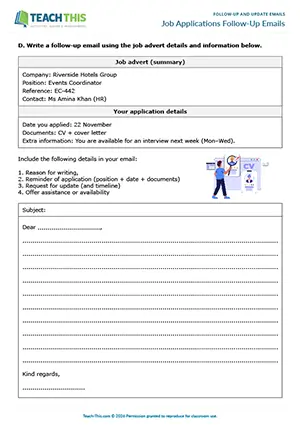
Business English Follow-up Emails Worksheet - Reading, Vocabulary and Writing Exercises: Rewriting Sentences, Email Writing
In this job application follow-up emails worksheet, students learn and practice polite, formal language for following up on a job application and then write...
Business English Follow-up Emails Worksheet - Reading, Vocabulary and Writing Exercises: Comprehension Questions, Ordering, Rewriting Sentences, Email Writing, Peer Feedback In this job application follow-up emails worksheet, students learn and practice polite, formal language for following up on a job application and then write a short email to HR. First, students read a model follow-up email to HR and answer comprehension questions about it. Students then put a follow-up email for a job application in the correct order. Next, students rewrite informal email lines in a more formal register. After that, students read a short job advertisement and application details and write a job application follow-up email. Finally, students exchange emails with a partner and give feedback.polite Follow‑up Emails
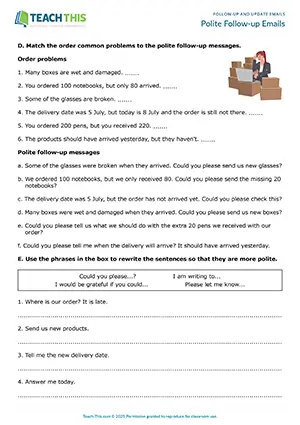
Business English Follow-up Emails Worksheet - Reading, Vocabulary and Writing Exercises: Identifying, Matching, Email Writing
In this free follow-up emails worksheet, students practice useful language for checking on an order and following up on delivery problems, and then...
Business English Follow-up Emails Worksheet - Reading, Vocabulary and Writing Exercises: Identifying, Matching, Rewriting Sentences, Email Writing, Peer Feedback In this free follow-up emails worksheet, students practice useful language for checking on an order and following up on delivery problems, and then write their own polite follow-up email. First, students read two follow-up emails about a late order and compare them. Students then read the two emails again, look at a table and decide whether each sentence describes Email 1 or Email 2, putting a tick in the appropriate column or in both columns. Next, students write sentences about which email they would send and why. After that, students match common order problems to suitable polite follow-up messages. Students then rewrite short, direct sentences to make them more polite using phrases from a box. Following that, students use a situation and prompts to write a follow-up email to a supplier. Next, students exchange emails with a partner, read their partner's email and then tick the boxes for the criteria that their email meets. Finally, students give their partner two positive comments about their email and one suggestion for improvement. Then, students edit their own email, making any changes as needed.Project Status Update Emails

Business English Update Emails Worksheet - Reading, Vocabulary and Writing Exercises: Matching, True or False, Gap-fill, Email Writing
In this project status update email worksheet, students read a model internal project update email, complete controlled practice tasks and then write their own short...
Business English Update Emails Worksheet - Reading, Vocabulary and Writing Exercises: Matching, True or False, Gap-fill, Writing Sentences, Email Writing, Peer Feedback In this project status update email worksheet, students read a model internal project update email, complete controlled practice tasks and then write their own short, professional update email to a manager. To begin, students read a short internal project update email and match headings to each section of the email. Students then read the email again and decide whether the statements are true or false. Next, students complete sentences with time expressions and sequencing words from a box. After that, students find and correct mistakes in project update sentences. Students then read notes about another project and write one sentence for each part of the update. Following that, students use their sentences to write a project update email to their manager. Finally, students swap emails with a partner, read their partner's email, complete a checklist and then give feedback.Short Follow-up Emails
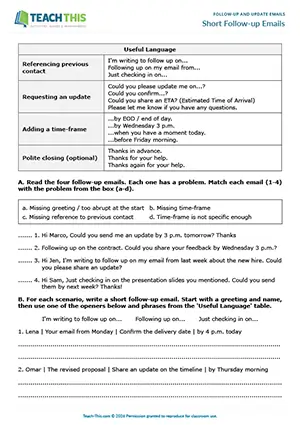
Business English Follow-up Emails Worksheet - Reading, Vocabulary and Writing Exercises: Matching, Writing Sentences from Prompts, Email Writing
In this business follow‑up emails worksheet, students identify common problems in follow-up emails and practice writing short, professional follow‑up emails...
Business English Follow-up Emails Worksheet - Reading, Vocabulary and Writing Exercises: Matching, Writing Sentences from Prompts, Email Writing In this business follow‑up emails worksheet, students identify common problems in follow-up emails and practice writing short, professional follow‑up emails that include a clear greeting, a reference to previous contact, and a specific time frame. First, students read four short follow‑up emails and match each one with its main problem. Students then read two scenarios and write short follow-up emails using openers and phrases. Next, students rewrite four abrupt or unclear follow-up messages to make them more professional. After that, students write four short follow‑up emails based on the given scenarios. Finally, students compare and discuss their emails with a partner.Action-Owner Follow-up
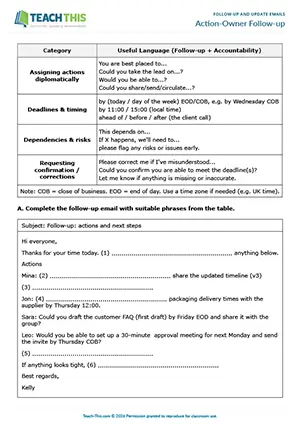
Business English Follow-up Emails Worksheet - Reading, Vocabulary and Writing Exercises: Gap-fill, Rewriting Sentences, Email Writing, Peer Feedback
In this follow-up emails worksheet, students learn to write professional post-meeting emails that assign actions diplomatically and establish clear accountability...
Business English Follow-up Emails Worksheet - Reading, Vocabulary and Writing Exercises: Gap-fill, Matching, Rewriting Sentences, Writing Questions, Email Writing, Peer Feedback In this follow-up emails worksheet, students learn to write professional post-meeting emails that assign actions diplomatically and establish clear accountability for deliverables and deadlines. First, students complete a follow-up email using phrases from a useful language table. Students then match meeting notes to action lines, focusing on deliverables, deadlines and details. Next, students rewrite direct or unclear lines so that they sound professional, making the owner, deliverable and deadline clear. After that, students read each unclear action item, identify what's missing and then write two clarifying questions. Students then write a meeting follow-up email using the scenario provided. Finally, students swap emails with a partner and use a checklist to revise and edit for clarity and tone before giving feedback.Business Follow-up Emails

Business English Follow-up Emails Worksheet - Reading and Writing Exercises: Matching, Rewriting an Email - Speaking Activity: Discussion - Pair Work
In this handy follow-up emails worksheet, students learn and practice the structure of a business follow-up email and review and practice formal register...
Business English Follow-up Emails Worksheet - Reading and Writing Exercises: Matching, Rewriting an Email - Speaking Activity: Guided Discussion - Pair Work In this handy follow-up emails worksheet, students learn and practice the structure of a business follow-up email and review and practice formal register. To begin, students discuss three questions about follow-up emails in pairs. When the pairs have finished, they share their answers with the class. Next, students read an example follow-up business email and match underlined sentences from the email to functions. After that, students work in pairs to read a follow-up email that has an inappropriate register. Together, students discuss how to make the tone more formal so that the email is suitable for professional business communication. Each student then writes a revised version of the email on their worksheet. Finally, review the students' emails as a class.Follow Up Like a Pro
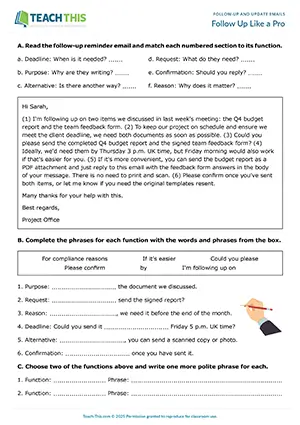
Business English Follow-up Emails Worksheet - Vocabulary and Writing Exercises: Identifying, Matching, Gap-fill, Error Correction, Email Writing
In this follow‑up reminder emails worksheet, students practice identifying the key components of polite follow-up reminder emails and writing their own...
Business English Follow-up Emails Worksheet - Vocabulary and Writing Exercises: Identifying, Matching, Gap-fill, Error Correction, Email Writing In this follow‑up reminder emails worksheet, students practice identifying the key components of polite follow-up reminder emails and writing their own professional reminder emails. Students begin by reading a follow‑up reminder email and matching each numbered section to its function. Students then complete phrases for each function with words and phrases from a box. Next, students choose two of the functions and write one more polite phrase for each. Following that, students complete a timesheet follow‑up reminder email using words from a word bank. Students then identify and correct problematic lines from an NDA follow‑up reminder email, making them polite and clear. Next, students read an email and then write a polite follow-up reminder email in response, incorporating all six key functions. Finally, students swap their emails with a partner and use a checklist to revise and edit their partner's email, ensuring all components are included and the tone is appropriate before providing feedback.Traffic-Light Project Updates
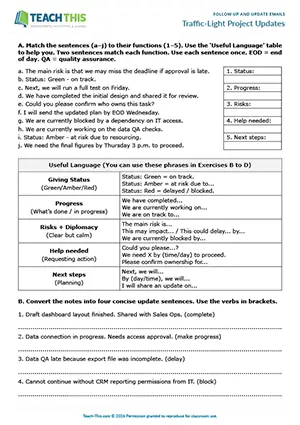
Business English Update Emails Worksheet - Reading and Writing Exercises: Matching, Writing and Rewriting Sentences, Email Writing
In this project update email worksheet, students learn a clear structure for project update emails and practice using Green, Amber, and Red status...
Business English Update Emails Worksheet - Reading and Writing Exercises: Matching, Writing and Rewriting Sentences, Email Writing In this project update email worksheet, students learn a clear structure for project update emails and practice using Green, Amber, and Red status language to report progress, flag risks, and request support diplomatically. First, students match sentences to their functions (Status, Progress, Risks, Help needed, Next steps). Students then convert notes into four concise update sentences using verb prompts. After that, students rewrite blunt 'bad news' lines to sound professional and diplomatic. Finally, students write a project update email using a template and prompts.Update Emails
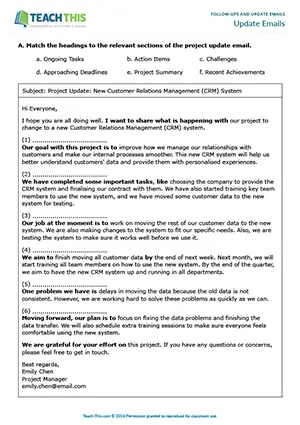
Business English Update Emails Worksheet - Reading, Vocabulary and Writing Exercises: Matching, Writing Sentences, Email Writing, Error Correction
In this update emails worksheet, students learn useful expressions for update emails and use them to write an email about a project update. First, students read...
Business English Update Emails Worksheet - Reading, Vocabulary and Writing Exercises: Matching, Writing Sentences from Prompts, Email Writing, Error Correction In this update emails worksheet, students learn useful expressions for update emails and use them to write an email about a project update. First, students read an update email and match headings to each section. Next, students match the language in bold from the email with similar expressions. Students then read the details of a project update and write sentences about it using the expressions. After that, students write a complete update email using the details of the project update and sentences. Lastly, students exchange emails with a partner and correct any mistakes they find. - Expressing Preferences ESL Games, Activities and Worksheets | Teach-This
-
Expressing Preferences ESL Games, Activities & Worksheets
Both, Either or Neither?
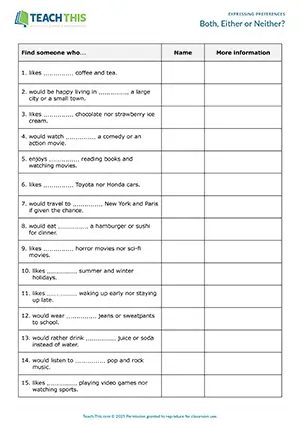
ESL Both, Either and Neither Activity - Vocabulary and Speaking: Gap-fill, Asking and Answering Questions, Controlled and Freer Practice
In this both, either and neither speaking activity, students ask and answer questions to learn about their classmates' preferences using the conjunctions...
ESL Both, Either and Neither Activity - Vocabulary and Speaking: Gap-fill, Asking and Answering Questions from Prompts, Controlled and Freer Practice In this both, either and neither speaking activity, students ask and answer questions to learn about their classmates' preferences using the conjunctions 'both', 'either' and 'neither'. First, students complete 'Find someone who...' prompts with both, either or neither. Students then go around the class asking the questions to their classmates, who respond accordingly using 'both', 'either' or 'neither' when appropriate. If a classmate answers with the corresponding conjunction that's in the question, the student writes down their name and asks a follow-up question to gain more information, noting down the answer in the last column. If not, the student moves on to speak to someone else or asks a different question. Afterwards, students give feedback to the class on what they found out.Hypothetical Bets
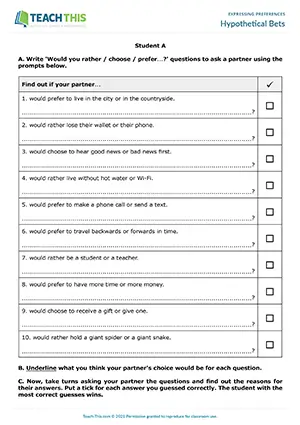
ESL Expressing Preferences Game - Speaking: Writing, Asking and Answering Questions, Guessing - Pair Work
In this free expressing preferences game, students write hypothetical 'Would you...?' questions for a partner and guess which choices they would make. First, in groups, students write 'Would you...
ESL Expressing Preferences Game - Speaking: Writing, Asking and Answering Questions from Prompts, Guessing - Pair Work In this free expressing preferences game, students write hypothetical 'Would you...?' questions for a partner and guess which choices they would make. First, in groups, students write 'Would you rather / choose / prefer...?' questions to ask a partner from prompts. Next, students pair up with someone from the other group. Working alone, students guess and underline what they think their partner's choice would be for each question. Students then take turns asking their partner the questions and reasons for their answers. Students put a tick for each answer they guessed correctly. The student with the most correct guesses wins the game.Would you rather...?
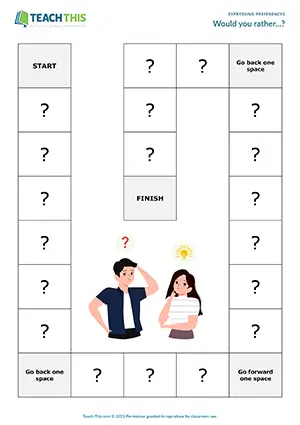
ESL Would You Rather Board Game - Speaking: Discussions, Responding to Questions, Giving Reasons - Group and Pair Work
In this intriguing expressing preferences board game, students discuss 'Would you rather...?' questions with a partner and race to make choices they agree on...
ESL Would You Rather Board Game - Speaking: Guided Discussions, Responding to Questions, Giving Reasons - Group and Pair Work In this intriguing expressing preferences board game, students discuss 'Would you rather...?' questions with a partner and race to make choices they agree on along with a justified reason for each answer. In groups, students take turns turning over a card and reading the 'Would you rather...?' question to the group, e.g. 'Would you rather own your own boat or your own plane?' The students in both teams then express their preferences, discuss the question with their partner, and race to make a choice they agree on along with a justified reason for their answer. The first team to make a choice and come up with a grammatically correct response, justifying their answer rolls the dice and moves their counter along the board. If a team makes a grammar mistake or comes up with an unjustified reason, the other team can steal the win by creating a suitable response of their own. The first team to reach the finish wins the game.I'd opt to...
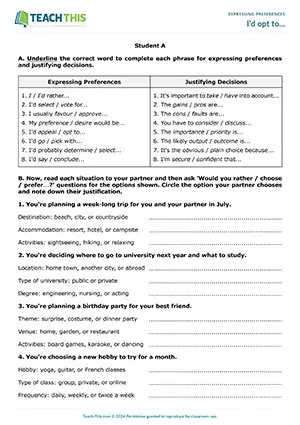
ESL Expressing Preferences Activity - Vocabulary and Speaking: Binary Choice, Asking and Answering Questions, Controlled and Freer Practice - Pair Work
This useful expressing preferences activity helps students practice language to express preferences and justify decisions. First, students underline the...
ESL Expressing Preferences Activity - Vocabulary and Speaking: Binary Choice, Asking and Answering Questions from Prompts, Controlled and Freer Practice - Pair Work This useful expressing preferences activity helps students practice language to express preferences and justify decisions. First, students underline the correct words to complete phrases for expressing preferences and justifying decisions. Next, students take turns reading each situation to a partner and asking 'Would you rather / choose / prefer...?' questions about the given choices, e.g. 'Would you rather take a trip to the beach, the city, or the countryside?' Their partner listens to each question and then uses the language from the worksheet to make a choice and justify it. The other student then circles their partner's answer and notes down their justification. This continues until students have received their partner's answers for all four situations. Afterwards, students report back to the class on their partners' choices and justifications.Mastering Preference Phrases
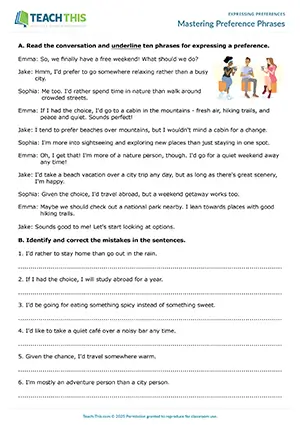
ESL Expressing Preferences Worksheet - Reading and Vocabulary Exercises: Error Correction - Speaking Activity: Delivering a Dialogue, Freer Practice - Group Work
In this comprehensive expressing preferences worksheet, students practice ten phrases to express preferences. First, students read a dialogue and identify...
ESL Expressing Preferences Worksheet - Reading and Vocabulary Exercises: Error Correction - Speaking Activity: Delivering a Dialogue, Freer Practice - Group Work In this comprehensive expressing preferences worksheet, students practice ten phrases to express preferences. First, students read a dialogue and identify ten phrases for expressing a preference. Students then identify and correct errors in sentences containing the phrases. Next, students complete sentences that use the preference phrases with words from a box. After that, in groups of three, students read a situation and write an expressing preferences dialogue that includes all ten phrases practiced in the worksheet. Finally, groups present their dialogues to the class.Make Your Choice!
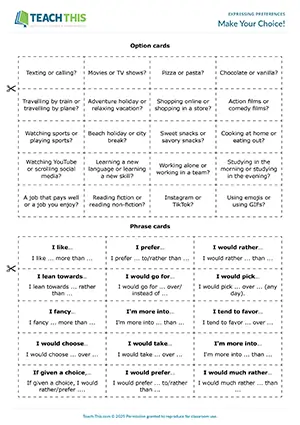
ESL Expressing Preferences Game - Vocabulary and Speaking: Forming Sentences, Freer Practice - Pair Work
In this fun expressing preferences game, students practice phrases to express a preference between two options. In pairs, students take turns picking up an option card that shows two choices...
ESL Expressing Preferences Game - Vocabulary and Speaking: Forming Sentences from Prompts, Freer Practice - Pair Work In this fun expressing preferences game, students practice phrases to express a preference between two options. In pairs, students take turns picking up an option card that shows two choices while their partner picks up a phrase card. Their partner then reads the phrase in bold on their card, and the student tries to make a sentence expressing a preference between the two options using the phrase. For example, if the option card shows 'Texting or calling?' and the expression is 'I like...', they should say, 'I like texting more than calling.' Their partner then checks the sentence uses the correct structure by looking at their card. If it does, the student wins the option card. The student with the most option cards at the end of the game wins.Rank and Defend
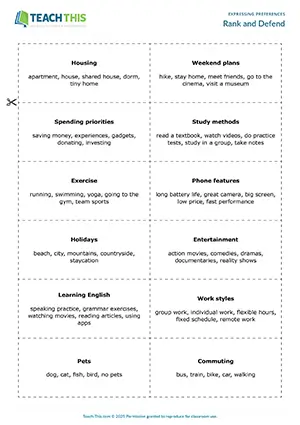
ESL Expressing Preferences Activity - Vocabulary and Speaking: Ranking, Presenting, Discussion, Freer and Communicative Practice - Group Work
In this engaging expressing preferences activity, students rank everyday options by category, present and justify their top choices with target phrases, and...
ESL Expressing Preferences Activity - Vocabulary and Speaking: Ranking, Presenting, Discussion, Freer and Communicative Practice - Group Work In this engaging expressing preferences activity, students rank everyday options by category, present and justify their top choices with target phrases, and respond to questions or challenges from classmates. In groups, students take turns picking up a card, reading the category and items aloud, and placing the card face up on the table. Starting with the student who drew the card, students present their top three choices in turn, using at least two target phrases from a language support card and giving short reasons. After each turn, the other students ask one follow-up question or give a polite challenge. When all the students have had their turn, the group agrees on a shared top three list and writes it on the back of the card. The next student then picks up a category card, and so on. At the end of the activity, each group briefly presents and defends their shared top three list for one category, using at least two target phrases. After each presentation, the class votes on whether they agree with the list.Would Rather and Would Prefer

ESL Would Rather and Would Prefer Board Game - Grammar: Reforming Sentences, Freer practice - Group Work
In this productive would rather and would prefer board game, students practice reforming sentences and questions with 'would rather' and 'would prefer'. One student begins by picking up a...
ESL Would Rather and Would Prefer Board Game - Grammar: Reforming Sentences, Freer practice - Group Work In this productive would rather and would prefer board game, students practice reforming sentences and questions with 'would rather' and 'would prefer'. One student begins by picking up a card and reading the sentence or question on the card to the first player along with a 'would rather' or 'would prefer' prompt, e.g. 'Do you want to take a break now or later? (would rather)' The player then tries to reformulate the sentence or question using 'would rather' or 'would prefer' as indicated, e.g. 'Would you rather take a break now or later?' If the player does this successfully, they roll the dice and move their counter along the board. If the prompt ends with because, the player completes the sentence with their own ideas. This process is repeated with the next player, and so on. The first player to reach the finish wins the game. - Intercultural Communication
-
Intercultural Communication EAP Activities, Worksheets & Role-Plays
Cross-Cultural Challenge
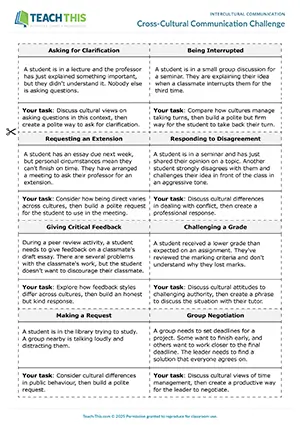
EAP Intercultural Communication Activity - Vocabulary and Speaking: Discussion, Problem-solving, Presenting, Communicative Practice - Group Work
In this rewarding intercultural communication activity, students explore how different cultures approach common academic challenges, collaboratively...
EAP Intercultural Communication Activity - Vocabulary and Speaking: Discussion, Problem-solving, Presenting, Communicative Practice - Group Work In this rewarding intercultural communication activity, students explore how different cultures approach common academic challenges, collaboratively build polite academic English phrases to address them, and present their solutions. In teams, students pick up one scenario card at a time and discuss the situation, following the steps and language on the reference sheet. Next, each team chooses one of the scenarios they discussed and prepares to present it to the class using questions on the planning sheet to prepare for the presentation. Teams then take turns presenting their chosen scenario, with each team member contributing during the presentation. Teams score up to two points for each of the following criteria: cultural insight, practicality, and language. The team with the most points at the end wins.Direct and Indirect Communication Styles
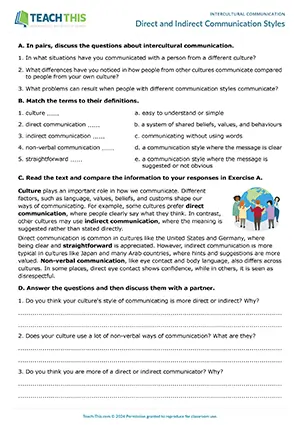
EAP Intercultural Communication Worksheet - Reading and Writing Exercises: Comprehension Questions, Paragraph Writing - Speaking Activity: Discussion
In this useful intercultural communication worksheet, students learn about direct and indirect communication styles and the importance of understanding...
EAP Intercultural Communication Worksheet - Reading and Writing Exercises: Comprehension Questions, Paragraph Writing - Speaking Activity: Guided Discussion, Freer Practice In this useful intercultural communication worksheet, students learn about direct and indirect communication styles and the importance of understanding cultural differences. First, in pairs, students discuss questions related to intercultural communication. Students then match terms from a text they are going to read to definitions. Next, students read the text and compare the information presented to their responses in the first exercise. After that, students answer questions about intercultural communication and then discuss their answers with a partner. Students then read a text about communication styles and answer comprehension questions. Finally, students reflect on the ideas from the text and write a paragraph that explains how they can use their knowledge of direct and indirect communication styles to improve their intercultural interactions in a specific context of their life.Cultural Dimensions Analysis
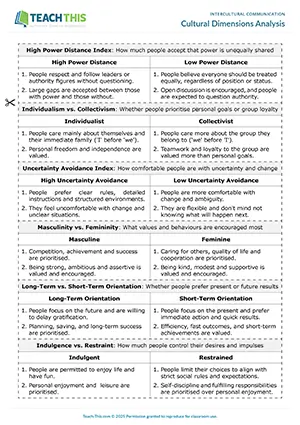
EAP Intercultural Communication Activity - Speaking and Writing: Discussion, Answering Questions, Presenting, Communicative Practice - Group Work
In this insightful intercultural communication activity, students analyse academic scenarios using Hofstede's cultural dimensions theory and propose solutions for...
EAP Intercultural Communication Activity - Speaking and Writing: Discussion, Identifying, Problem Solving, Answering Questions, Presenting, Communicative Practice - Group Work In this insightful intercultural communication activity, students analyse academic scenarios using Hofstede's cultural dimensions theory and propose solutions for resolving intercultural misunderstandings. First, in groups, students read a set of cultural dimension reference cards based on Hofstede's cultural dimensions. Students then take turns picking up a situation card and reading it aloud. The group then discusses questions from the board and chooses at least two strategies from a Solution Strategies sheet for each situation, explaining why they believe those strategies would be effective. After 15 minutes, groups choose one situation card they discussed to prepare a case analysis presentation. Students then complete a case analysis worksheet and prepare to present to the class, with each group member contributing during the presentation. Groups then take turns presenting their case analysis to the class, who listen and ask follow-up questions at the end. Finally, in pairs, students discuss one interesting thing they learned about cultural differences during the activity and one thing they could do to prevent an intercultural misunderstanding in the future.Direct and Indirect Conflict-Resolution
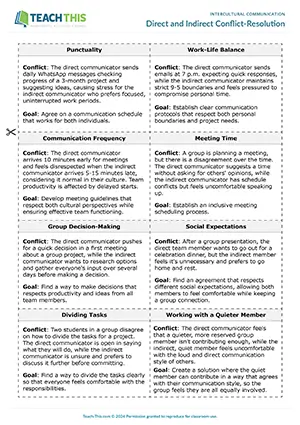
EAP Intercultural Communication Activity - Speaking: Role-Play, Discussion, Freer and Communicative Practice - Group Work
This intriguing intercultural communication role-play helps students identify direct and indirect communication styles across cultures and reflect and adapt their own style to prevent misunderstandings...
EAP Intercultural Communication Activity - Speaking: Role-Play, Guided Discussion, Freer and Communicative Practice - Group Work This intriguing intercultural communication role-play helps students identify direct and indirect communication styles across cultures and reflect and adapt their own style to prevent misunderstandings and resolve conflicts in multicultural settings. Students are divided into multicultural teams, with each member taking on a specific role: direct communicator, indirect communicator, mediator, or observer. Teams then engage in a 15-minute discussion aimed at resolving a conflict, during which the direct and indirect communicators exchange perspectives while the mediator facilitates mutual understanding and guides the group toward a solution. Throughout this process, the observer carefully monitors the interaction, taking notes on communication patterns and any misunderstandings that arise. Afterwards, the observers present their insights and provide feedback on how effectively their groups navigated cultural differences. Each group then gives feedback on their communication approaches and share how they achieved their resolution. Finally, students discuss questions related to communication styles as a class.Global Classroom Match
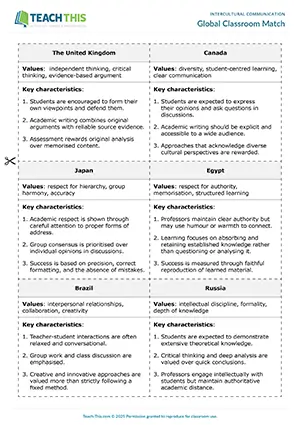
EAP Intercultural Communication Game - Reading and Speaking: Matching, Discussion, Problem-Solving, Presenting, Communicative Practice - Group Work
In this thought-provoking intercultural communication game, students match cultural academic values to different country profiles, discuss potential intercultural...
EAP Intercultural Communication Game - Reading and Speaking: Matching, Discussion, Brainstorming, Problem-solving, Presenting, Communicative Practice - Group Work In this thought-provoking intercultural communication game, students match cultural academic values to different country profiles, discuss potential intercultural conflicts and develop strategies to resolve them. First, in teams, students read country profile cards that represent cultural academic values in different countries around the world. Teams then match three academic expectations to each country profile, scoring one point for each correctly matched expectation. Next, teams choose two country profiles with distinct or opposing values, discuss a possible conflict that could arise when students from these cultures meet in an international programme, and brainstorm possible resolutions to the conflict. After that, teams fill in a conflict resolution card with the conflict and a summary of the best resolution strategy they brainstormed. This process repeats for the remaining two cards. Finally, teams present their conflict and resolution strategies to the class. Teams score up to three points for each conflict and resolution presented, based on the clarity of the presentation, the validity of the potential conflict and the effectiveness of the resolution strategy. The team with the most points at the end of the game wins.Global Classroom Mixer
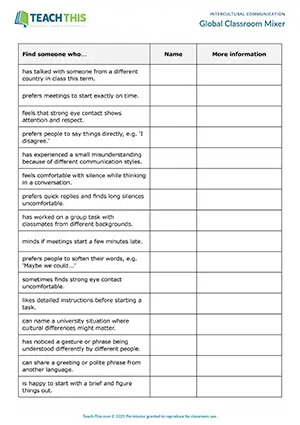
EAP Intercultural Communication Activity - Speaking: Asking and Answering Questions, Freer and Communicative Practice
In this free intercultural communication 'Find Someone Who' activity, students ask and answer questions about cultural differences and cross-cultural experiences in academic settings. First, students review...
EAP Intercultural Communication Activity - Speaking: Asking and Answering Questions, Freer and Communicative Practice In this free intercultural communication 'Find Someone Who' activity, students ask and answer questions about cultural differences and cross-cultural experiences in academic settings. First, students review the yes/no questions they need to ask in the activity, e.g. 'Have you talked with someone from a different country in class this term?' Students then go around the class, asking their classmates the intercultural communication questions. When a student finds someone who answers 'yes' to a question, they write down the person's name and ask a follow-up question to gain more information, noting down the answer in the last column. If a classmate replies 'no', the student repeats the question with another person or asks a different question. This process continues until the students have completed each item on the worksheet with a different name and answer, one classmate per item. Afterwards, students give feedback to the class on the answers they collected, e.g. contrasting preferences or surprising responses.Intercultural Communication Bingo
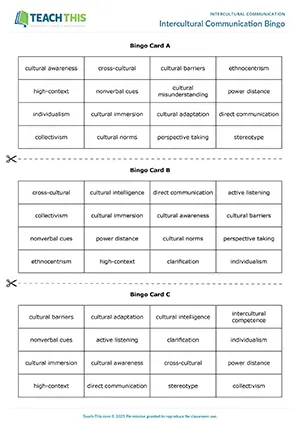
EAP Intercultural Communication Game - Vocabulary: Bingo, Matching - Group Work
In this engaging intercultural communication game, students play bingo by matching intercultural terms with their meanings and briefly using them in context. In groups, the bingo caller reads a definition at random from the caller's sheet, e.g...
EAP Intercultural Communication Game - Vocabulary: Bingo, Matching - Group Work In this engaging intercultural communication game, students play bingo by matching intercultural terms with their meanings and briefly using them in context. In groups, the bingo caller reads a definition at random from the caller's sheet, e.g. 'Understanding and recognising differences between cultures.' The players listen and look at the intercultural communication words and phrases written on their bingo cards to see if they have one that matches the definition, e.g. cultural awareness. If they do, they cross it off. The game continues until a player has crossed off four words or phrases in a row. When this happens, the player shouts 'Bingo!' and then makes a related sentence with each crossed-off word or phrase to verify their win. If the player makes a mistake in any of the four sentences, they are allowed one chance to fix it. If they correct it, the win counts. If the player fails to correct the mistake or the words and phrases are wrong, the bingo is void, and the game continues. If the sentences are correct and the words or phrases match the definitions, the player wins the round. Players then continue to see who can cross off all 16 intercultural terms first without making sentences. Groups play several rounds, with students taking turns being the bingo caller and players using a different bingo card each time. - Dealing with Complaints
-
Dealing with Complaints: Business English Activities & Worksheets
Customer Complaints
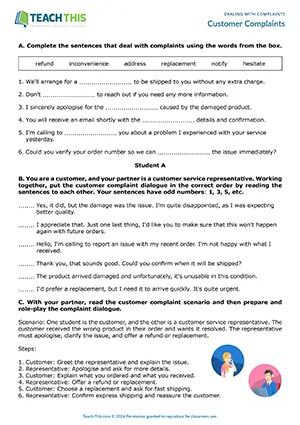
Business English Dealing with Complaints Activity - Vocabulary, Reading, Listening and Speaking: Gap-fill, Ordering, Role-play, Freer Practice - Pair Work
In this dealing with complaints activity, students practice language for dealing with customer complaints and role-play complaint dialogues. First, students...
Business English Dealing with Complaints Activity - Vocabulary, Reading, Listening and Speaking: Gap-fill, Ordering, Role-play, Freer Practice - Pair Work In this dealing with complaints activity, students practice language for dealing with customer complaints and role-play complaint dialogues. First, students complete sentences that deal with complaints using words from a box. In pairs, students then put a complaint dialogue between a customer and a customer service representative in the correct order by reading the sentences to each other and numbering them accordingly. After that, pairs read a customer complaint scenario and role-play a complaint dialogue between a customer and a customer service representative. Finally, pairs role-play their dialogues to the class.Dealing with Customer Complaints
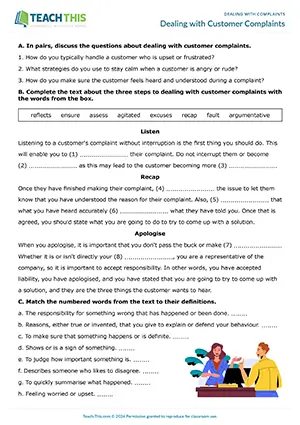
Business English Dealing with Complaints Worksheet - Reading and Writing Exercises: Gap-fill, Error Correction, Ordering - Speaking Activity: Role-Play - Pair Work
Here is a useful customer complaints worksheet to help students learn how to deal with customer complaints. First, in pairs, students discuss questions...
Business English Dealing with Complaints Worksheet - Reading and Writing Exercises: Gap-fill, Error Correction, Ordering - Speaking Activity: Role-Play - Pair Work Here is a useful customer complaints worksheet to help students learn how to deal with customer complaints. First, in pairs, students discuss questions about dealing with customer complaints. Students then complete a text about three steps to dealing with customer complaints with words from a box. Next, students match the numbered words from the text to their definitions. After that, students underline and correct errors in sentences that may be said by either a customer or a customer service agent. Students then move on to put a telephone complaint dialogue in the correct order. Finally, in pairs, students role-play a scenario between a customer and a customer service agent, taking turns playing each role and using the language and steps for handling complaints. Afterwards, pairs perform their role-plays to the class. After each presentation, students give feedback on how well each pair addressed the three steps for dealing with customer complaints.Find Someone Who Can...
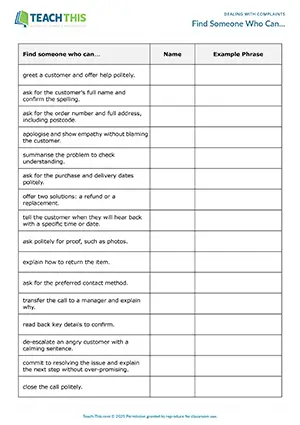
Business English Dealing with Complaints Activity - Speaking: Asking and Answering Questions, Controlled and Freer Practice
In this free 'Find Someone Who' activity on dealing with complaints, students ask and answer questions about customer service language and complaint‑handling phrases. To begin, students review the...
Business English Dealing with Complaints Activity - Speaking: Asking and Answering Questions, Controlled and Freer Practice In this free 'Find Someone Who' activity on dealing with complaints, students ask and answer questions about customer service language and complaint‑handling phrases. To begin, students review the 'Can you...?' questions they need to ask in the activity, e.g. 'Can you greet a customer and offer help politely?' Students then go around the class, asking their classmates 'Can you...?' questions about the complaint‑handling skills. When a student finds someone who answers 'yes' to a question, they note the person's name and their example phrase. If a classmate answers 'no', the student asks a different question or repeats the question with other classmates until one of them says 'yes'. This process continues until the students have completed each item on the worksheet with a different name and answer, one classmate per item. Afterwards, students give feedback to the class on the example phrases they collected, e.g. best apology lines, good closing lines, etc.From Complaint to Resolution
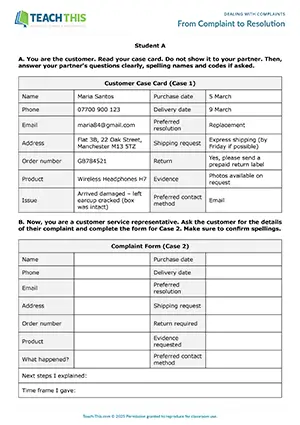
Business English Dealing with Complaints Activity - Speaking: Role-Play, Asking and Answering Questions, Form Completion, Freer Practice - Pair Work
In this complaints‑handling activity, students practice collecting and confirming customer details on a call, clarifying the issue, reading back key information, and...
Business English Dealing with Complaints Activity - Speaking: Role-Play, Asking and Answering Questions, Form Completion, Freer Practice - Pair Work In this complaints‑handling activity, students practice collecting and confirming customer details on a call, clarifying the issue, reading back key information, and outlining next steps and time frames. Pairs begin by role-playing the first case with Student A acting as the customer, and Student B as the customer service representative. The representative asks the customer for the details of the complaint using polite questions and completes a form. At the end of the call, the representative reads back the key details to confirm the information. The representative then states the steps they will take to resolve the issue, gives a general time frame, and closes politely. Afterwards, students switch roles and repeat the process for the second case. When the pairs have finished, they review their completed forms together to check for any missed details. Finally, some pairs role‑play their dialogues to the class.The Complaint Clinic
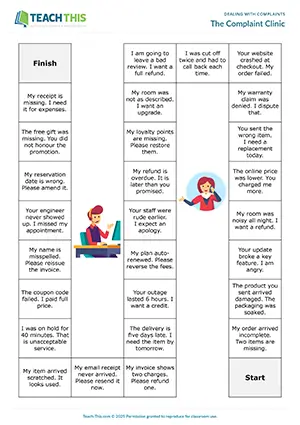
Business English Dealing with Complaints Game - Speaking: Impromptu Speech, Freer Practice - Group Work
In this productive complaint-handling board game, students give 30-second impromptu responses to realistic customer complaints while using professional phrases and techniques. In groups, students...
Business English Dealing with Complaints Game - Speaking: Impromptu Speech, Freer Practice - Group Work In this productive complaint-handling board game, students give 30-second impromptu responses to realistic customer complaints while using professional phrases and techniques. In groups, students take turns rolling the dice and moving their counters along the board. When a student lands on a square, they act as a company representative and respond to the customer complaint on the square for 30 seconds without stopping, using as many techniques from the complaint response card as possible. Students score one point for each distinct complaint‑handling technique they use appropriately during their 30‑second turn. If a student can't think of anything to say, uses inappropriate language, or stops talking before the 30 seconds are up, no points are awarded for that turn, but they remain on the square. When a student reaches the finish, the game ends, and students add up their points. The student with the most points wins the game. - Email Openings, Closings and Etiquette
-
Email Openings, Closings & Etiquette: Business English Worksheets
Email Greetings and Opening Lines
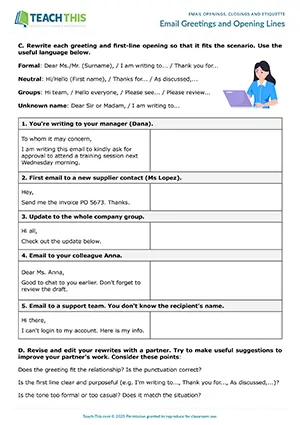
Business Email Openings Worksheet - Vocabulary and Writing Exercises: Categorising, Matching, Rewriting
In this business email openings worksheet, students practice greetings and first-line openings according to relationship and level of formality. Students begin by sorting greetings by levels of...
Business Email Openings Worksheet - Vocabulary and Writing Exercises: Categorising, Matching, Rewriting In this business email openings worksheet, students practice greetings and first-line openings according to relationship and level of formality. Students begin by sorting greetings by levels of formality or relationship. Students then match greetings and first-line openings to situations. Next, students rewrite greetings and first-line openings so that they fit the scenarios. Finally, students revise and edit their rewrites with a partner using the questions provided.Email Greetings and Sign-offs
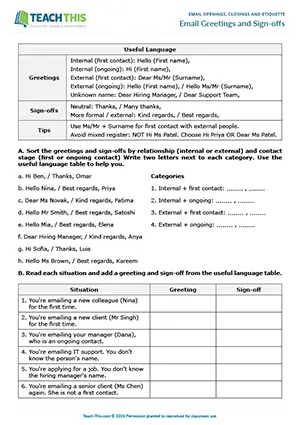
Business Email Closings Worksheet - Vocabulary and Writing Exercises: Categorising, Table Completion, Rewriting Sentences, Writing Sentences
In this email greetings and sign-offs worksheet, students practice choosing and writing appropriate email greetings and sign-offs for internal and external...
Business Email Closings Worksheet - Vocabulary and Writing Exercises: Categorising, Table Completion, Rewriting Sentences, Writing Sentences In this email greetings and sign-offs worksheet, students practice choosing and writing appropriate email greetings and sign-offs for internal and external emails in first and ongoing contact. First, students sort greetings and sign-offs by relationship and contact stage. Students then write the most appropriate greeting and sign-off for each situation using the relationship information in each prompt. After that, students rewrite openings and closings so they fit the situations. Finally, students use prompts to write three short emails that include appropriate greetings and sign-offs.Email Subject Line Builder
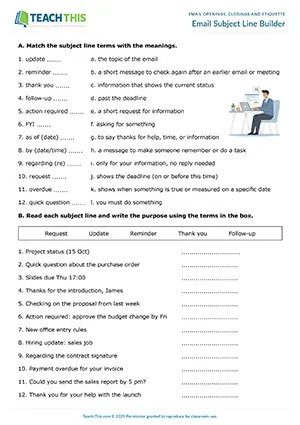
Business Email Subject Lines Worksheet - Vocabulary and Writing Exercises: Identifying, Gap-fill, Error Correction, Writing Subject Lines
In this business email subject lines worksheet, students practice recognising the purpose of a subject line and writing clear, concise subjects for common work...
Business Email Subject Lines Worksheet - Vocabulary and Writing Exercises: Matching, Identifying, Gap-fill, Error Correction, Writing Subject Lines In this business email subject lines worksheet, students practice recognising the purpose of a subject line and writing clear, concise subjects for common work emails. First, students match subject line terms with their meanings. Students then read each subject line and write the purpose using terms in a box. Next, students complete subject lines with words from a box. After that, students identify one main problem in each subject line and then rewrite it clearly without purpose tags. Finally, students write a clear subject line for each prompt, adding a purpose tag where needed.Getting Your First Line Right
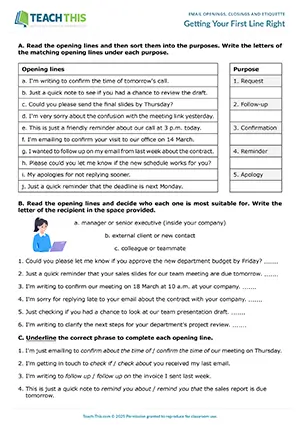
Business Email Openings Worksheet - Reading, Vocabulary and Writing Exercises: Categorising, Identifying, Gap‑fill, Sentence Writing - Pair Work
In this free email openings worksheet, students practice recognising and writing first‑line openings that clearly show the purpose of the email and...
Business Email Openings Worksheet - Reading, Vocabulary and Writing Exercises: Categorising, Identifying, Gap‑fill, Sentence Writing - Pair Work In this useful email openings worksheet, students practice recognising and writing first‑line openings that clearly show the purpose of the email and suit different recipients (managers, clients, and colleagues). Students begin by reading opening lines and sorting them into the five purposes given. Students then read opening lines and decide who each one is most suitable for. Next, students underline the best phrase in each sentence to create a correct and natural opening line. After that, students read opening lines and write the best answer that indicates what the email is about. Students then complete six opening lines with words and phrases from a box. Finally, students read four situations and write an appropriate opening line for each one.Open Strong, Close Smart
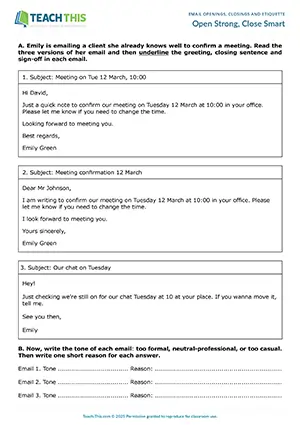
Business Email Openings and Closings Worksheet - Reading, Vocabulary and Writing Exercises: Categorising, Rewriting Sentences
In this useful worksheet on adjusting tone in email openings and closings, students learn to choose and use formal or neutral‑professional greetings and closings...
Business Email Openings and Closings Worksheet - Reading, Vocabulary and Writing Exercises: Categorising, Rewriting Sentences In this worksheet on adjusting tone in email openings and closings, students learn to choose and use formal or neutral‑professional greetings and closings in business emails. First, students read three versions of the same email and underline the greeting, closing sentence and sign-off in each one. Students then write the tone of each email and one short reason for each answer. Next, students sort greetings and sign-offs into two categories, either formal or neutral‑professional. After that, students rewrite the greeting, closing sentence and sign‑off in emails so the tone matches the instruction. Finally, students choose suitable tones, greetings and closing sentences and sign‑offs for four scenarios.Professional Email Closing Lines
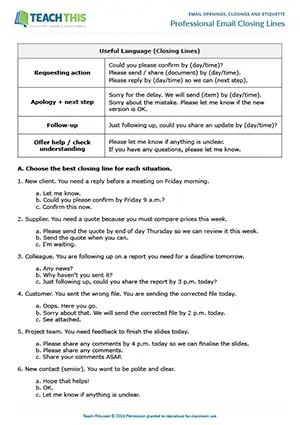
Business Email Openings and Closings Worksheet - Reading and Writing Exercises: Multiple Choice, Matching, Writing and Rewriting Sentences
In this email closing lines worksheet, students practice choosing and writing clear, polite closing lines that include a next step and a time frame. Students begin...
Business Email Openings and Closings Worksheet - Reading and Writing Exercises: Multiple Choice, Matching, Writing and Rewriting Sentences In this email closing lines worksheet, students practice choosing and writing clear, polite closing lines that include a next step and a time frame. Students begin by choosing the best closing line for each situation. Students then match sentence halves to make logical closing lines. Next, students rewrite closing lines to adjust the tone. Finally, students write a closing line for each situation.Smart Email Etiquette
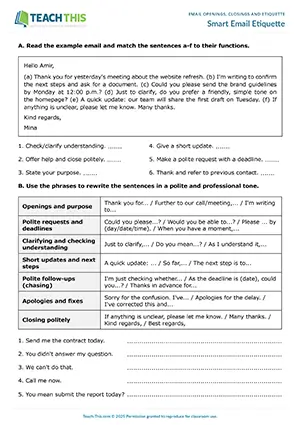
Business Email Etiquette Worksheet - Vocabulary and Writing Exercises: Matching, Rewriting Sentences, Gap‑fill, Identifying, Writing a Short Email
In this email openings, closings, and etiquette worksheet, students review useful phrases and practice writing clear, polite messages for professional contexts. First...
Business Email Etiquette Worksheet - Vocabulary and Writing Exercises: Matching, Rewriting Sentences, Gap‑fill, Identifying, Writing a Short Email In this email openings, closings, and etiquette worksheet, students review useful phrases and practice writing clear, polite messages for professional contexts. First, students read an example email and match sentences to their functions. Students then use phrases to rewrite direct sentences in a polite, professional tone. Next, students complete an email using phrases from a box. After that, students read each email opening and match it to a purpose. Finally, students select one purpose and write a short email using the phrases from Exercise B and the correct structure.Business Email Structure
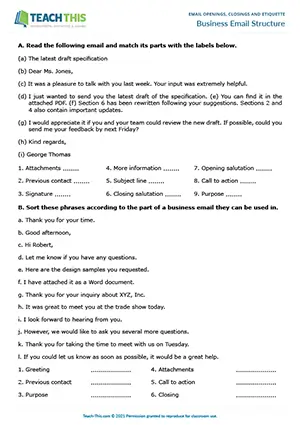
Business Email Structure Worksheet - Vocabulary and Writing Exercises: Matching, Categorising, Writing Emails
In this detailed business email structure worksheet, students review the structure of a typical business email and practice using it to write emails. Students start by reading an email and matching its parts...
Business Email Structure Worksheet - Vocabulary and Writing Exercises: Matching, Categorising, Writing Emails In this detailed business email structure worksheet, students review the structure of a typical business email and practice using it to write emails. Students start by reading an email and matching its parts with labels. Next, students sort phrases according to the part of a business email they can be used in. After that, students write an email according to a given scenario, following the structure of the email in Exercise A. When the students have finished, they revise and edit their email with a partner using a set of questions. Finally, students write a new email for a different scenario, revising and editing their email with their partner as before.Closings and Sign-offs
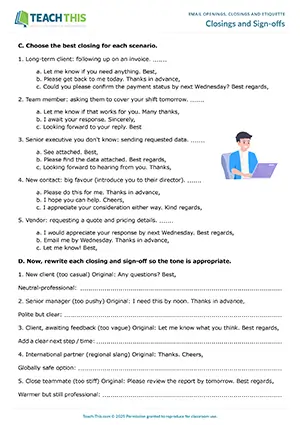
Business Email Closings and Sign-offs Worksheet - Vocabulary and Writing Exercises: Matching, Gap‑fill, Multiple Choice, Rewriting
In this email closings and sign-offs worksheet, students learn to select appropriate closings and sign-offs and adjust the tone for different recipients. First, students label...
Business Email Closings and Sign-offs Worksheet - Vocabulary and Writing Exercises: Matching, Gap‑fill, Multiple Choice, Rewriting In this email closings and sign-offs worksheet, students learn to select appropriate closings and sign-offs and adjust the tone for different recipients. First, students label each closing and sign‑off as 'Formal', 'Neutral' (professional), or 'Familiar' and then underline the single strongest tone signal in each line and circle the sign-off. Students then complete the closing and sign‑off for each scenario using phrases from a box. Next, students choose the correct closing for each scenario. Finally, students rewrite each closing and sign‑off so the tone is appropriate.First-Contact Emails
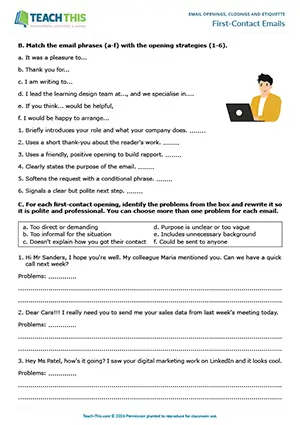
Business Email Openings Worksheet - Reading and Writing Exercises: Matching, Identifying, Rewriting Sentences, Writing Emails, Peer Feedback - Pair Work
In this business email openings worksheet, students practice writing strong, polite openings for first-contact emails by referencing context and...
Business Email Openings Worksheet - Reading and Writing Exercises: Matching, Identifying, Rewriting Sentences, Writing Emails, Peer Feedback - Pair Work In this business email openings worksheet, students practice writing strong, polite openings for first-contact emails by referencing context and managing tone. First, students read two first-contact emails and decide whether each statement about clarity, tone, and etiquette is true for Email 1, Email 2, or both. Students then analyse the stronger email in more detail by matching the email phrases with opening strategies. Next, students identify the problems in weak first-contact openings and then rewrite them so the tone, context, and purpose are appropriate. After that, students write their own first-contact email for one of the scenarios, following the structure and strategies from the previous exercises. Finally, students exchange emails with a partner and use a peer review checklist to give each other feedback on context, tone, and clarity of the opening. Students then revise and edit their own emails.Softening Bad News
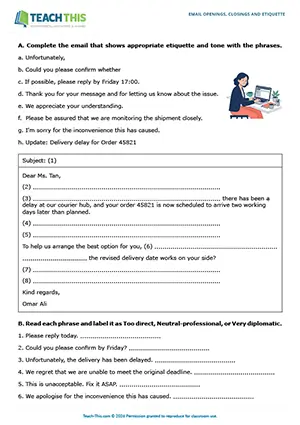
Business Email Etiquette Worksheet - Reading, Vocabulary and Writing Exercises: Sentence Completion, Rewriting Sentences, Writing Emails, Peer Feedback - Pair Work
In this business email etiquette and tone worksheet, students practice diplomatic language for handling complaints, delays, and apologies. Students begin by...
Business Email Etiquette Worksheet - Reading, Vocabulary and Writing Exercises: Gap-fill, Labelling, Sentence Completion, Rewriting Sentences, Writing Emails, Peer Feedback - Pair Work In this business email etiquette and tone worksheet, students practice diplomatic language for handling complaints, delays, and apologies. Students begin by completing a business email that shows appropriate etiquette and tone with phrases from a box. Students then read each phrase and label it as too direct, neutral-professional, or very diplomatic. Next, students rewrite blunt sentences so that they are more diplomatic and professional, using phrases in brackets. After that, students match etiquette problems with email excerpts. Students then use a scenario and phrase bank to write an email that uses appropriate etiquette and tone to soften bad news. Finally, students revise and edit their email with a partner using a set of questions, discuss whether the tone is too formal, too casual, or just right, and adjust their emails as needed. - Business Meetings
-
Meetings: Business English Worksheets & Activities
Clarifying in Meetings

Business English Meetings Worksheet - Reading and Vocabulary Exercises: Categorising, Gap-Fill - Speaking Activity: Role-Play, Freer Practice - Group Work
In this handy business meetings worksheet, students practice language to clarify information and role-play a meeting using the expressions. To begin, students...
Business English Meetings Worksheet - Reading and Vocabulary Exercises: Categorising, Gap-Fill - Speaking Activity: Role-Play, Freer Practice - Group Work In this handy business meetings worksheet, students practice language to clarify information and role-play a meeting using the expressions. To begin, students read a business meeting dialogue with clarifying expressions written in bold. Students then categorise the clarifying expressions according to their functions. Next, students complete another meeting dialogue with other clarifying expressions. After that, students practice the dialogue in groups of three. Next, students role-play a business meeting between three people using the clarifying expressions from the worksheet. Afterwards, groups role-play their meetings in front of the class.The Meeting Zone
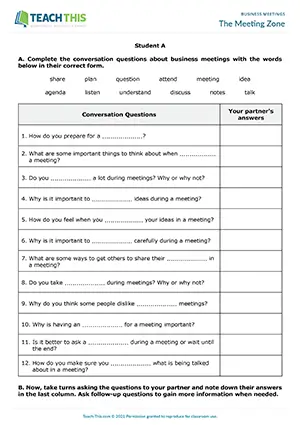
Business English Meetings Activity - Vocabulary and Speaking: Gap-fill, Asking and Answering Questions, Freer Practice - Group and Pair Work
In this engaging talking about meetings activity, students practice useful vocabulary related to meetings by completing conversation questions with...
Business English Meetings Activity - Vocabulary and Speaking: Gap-fill, Asking and Answering Questions from Prompts, Controlled and Freer Practice - Group and Pair Work In this engaging talking about meetings activity, students practice useful vocabulary related to meetings by completing conversation questions with the words and then asking and answering the questions with a partner. Working together in two groups, students complete conversation questions about business meetings with the words provided in their correct form. Students then pair up with someone from the other group and take turns asking each other the conversation questions, noting down their partner's answers in the last column of the table. Afterwards, students report back to the class on the things they found out about their partner.Beginning a Meeting
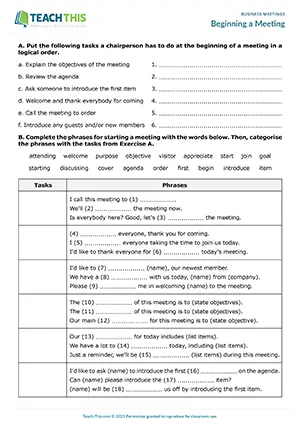
Business English Meetings Worksheet - Reading and Vocabulary Exercises: Gap-fill, Categorising, Error Correction - Speaking Activity: Role-Play
In this free business meetings worksheet, students practice language a chairperson would use for beginning a meeting. First, students put the tasks a...
Business English Meetings Worksheet - Reading and Vocabulary Exercises: Ordering, Gap-fill, Categorising, Error Correction, Writing Sentences - Speaking Activity: Role-Play In this free business meetings worksheet, students practice language a chairperson would use for beginning a meeting. First, students put the tasks a chairperson has to do at the beginning of a meeting in a logical order. Next, students complete phrases for starting a meeting with the words shown. Students then categorise the phrases with the tasks from the first exercise. After that, students rewrite the opening comments of a meeting to make them more polite and appropriate. Next, working alone, in groups of five or six, students write the opening comments for a meeting using prompts. Lastly, students take it in turns to be a chairperson and use their comments to practice chairing the beginning of a meeting.Setting the Agenda
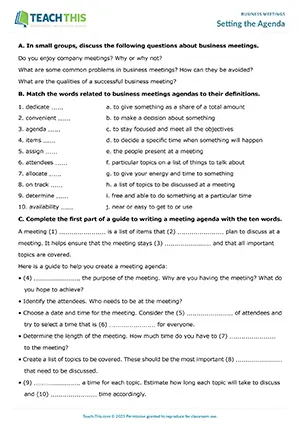
Business English Meeting Agendas Worksheet - Vocabulary and Reading Exercises: Matching, Gap-fill, Form Completion, Ordering
In this comprehensive business meeting agenda worksheet, students learn the basic elements of a typical business meeting agenda. Students begin by...
Business English Meeting Agendas Worksheet - Vocabulary and Reading Exercises: Matching, Gap-fill, Form Completion, Ordering In this comprehensive business meeting agenda worksheet, students learn the basic elements of a typical business meeting agenda. Students begin by discussing three questions about business meetings. Working alone, students then match ten keywords related to business meetings agendas to their definitions and complete the first part of a guide to writing business meeting agendas with the words. Next, students complete the first part of a business meeting agenda with their own ideas. Students then read some examples of typical business meeting agenda items and list them in a logical order, assigning a start time to each item. Lastly, students complete the final part of the meeting agenda writing guide with the words provided.Who's taking the minutes?
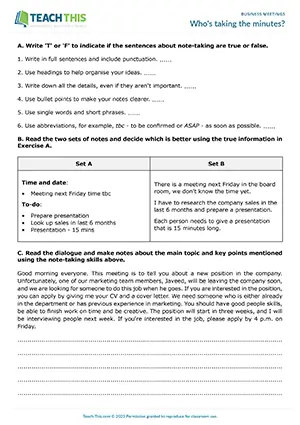
Business English Meeting Minutes Worksheet - Reading and Writing Exercises: True or False, Note-taking - Listening and Speaking Activity: Role-play, Freer Practice
In this productive note-taking worksheet and activity, students practice taking notes in a business meeting context. First, students decide if sentences about note...
Business English Meeting Minutes Worksheet - Reading and Writing Exercises: True or False, Identifying, Note-taking - Listening and Speaking Activity: Role-play, Freer Practice In this productive note-taking worksheet and activity, students practice taking notes in a business meeting context. First, students decide if sentences about note-taking are true or false. Next, students read two sets of notes and decide which is better using the true information from Exercise A. After that, students read a dialogue from a business meeting and take notes about the text using the note-taking skills from the worksheet. Following that, students participate in a role-play activity where they speak as if in a business meeting while another student takes notes on what they say. In pairs, one student speaks as if in a meeting using information on a card, and the other student takes notes. When the student has finished, the two students swap roles. Finally, students change partners and use their notes to summarise what the other student said.Business Meeting Expressions
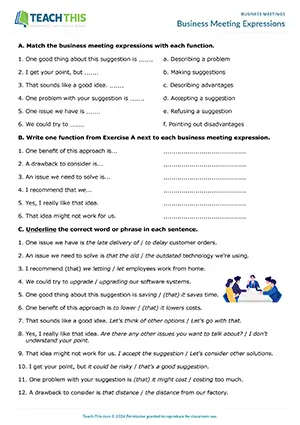
Business English Meetings Worksheet - Vocabulary and Reading Exercises: Binary Choice - Speaking Activity: Role-Play, Communicative Practice - Group Work
In this comprehensive business meetings worksheet, students learn and practice useful expressions for business meetings. First, students match business...
Business English Meetings Worksheet - Vocabulary and Reading Exercises: Matching, Binary Choice - Speaking Activity: Role-Play, Communicative Practice - Group Work In this comprehensive business meetings worksheet, students learn and practice useful expressions for business meetings. First, students match business meeting expressions with their functions. Students then write one function next to other business meeting expressions. Next, students underline the correct word or phrase in each sentence. After that, students read a business meeting dialogue and circle the meeting expressions. Next, in groups of three, students conduct a business meeting role-play in which they practice the meeting expressions from the worksheet. Finally, groups give feedback on the outcomes of their meetings.Meeting Dialogues
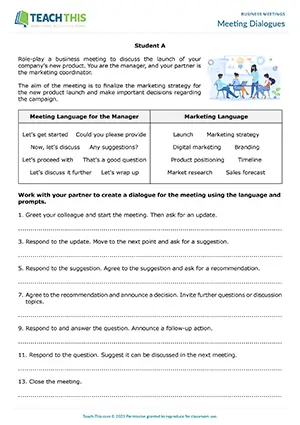
Business English Meetings Activity - Vocabulary and Writing Exercises: Writing a Dialogue - Speaking Activity: Delivering a Dialogue, Freer Practice - Pair Work
In this useful business meetings role-play activity, students practice words and phrases related to meetings and use them in a meeting role-play. First, students...
Business English Meetings Activity - Reading, Vocabulary and Writing Exercises: Writing a Dialogue - Speaking Activity: Delivering a Dialogue, Freer Practice - Pair Work In this useful business meetings role-play activity, students practice words and phrases related to meetings and use them in a meeting role-play. First, students complete a meeting dialogue with words and phrases from a box. Next, in pairs, students prepare and role-play a business meeting dialogue, similar to the one in the first exercise. Pairs do this by reading a role-play scenario and creating a dialogue for a meeting using language in boxes and prompts. Finally, pairs perform their dialogues to the class.That's a Great Idea!
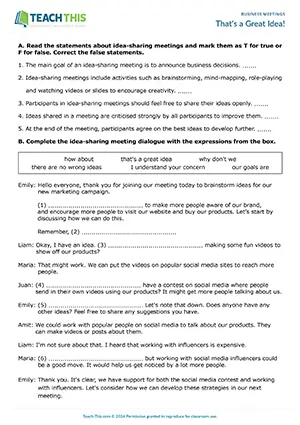
Business English Meetings Worksheet - Reading and Vocabulary Exercises: True or False, Gap-fill - Speaking Activity: Role-play, Freer Practice - Group Work
In this business meetings worksheet, students practice useful expressions for idea-sharing meetings. To begin, students read statements about idea-sharing meetings...
Business English Meetings Worksheet - Reading and Vocabulary Exercises: True or False, Gap-fill, Identifying - Speaking Activity: Role-play, Freer Practice - Group Work In this business meetings worksheet, students practice useful expressions for idea-sharing meetings. To begin, students read statements about idea-sharing meetings and mark them as true or false, correcting the false ones. Students then complete an idea-sharing meeting dialogue with expressions from a box. Next, students circle the meeting expression that does not belong in each set. Finally, in groups of four, students role-play an idea-sharing meeting at a car manufacturing company using the expressions from Exercise C. - Etiquette and Manners ESL Activities and Games | Teach-This
-
Etiquette & Manners ESL Activities & Games
Predictably polite
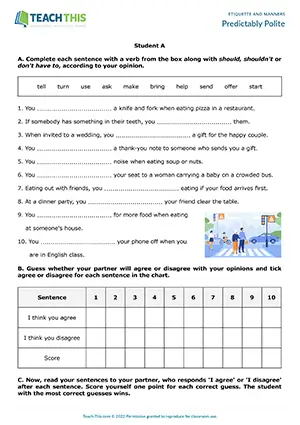
ESL Manners and Etiquette Activity - Speaking: Sentence Completion, Guessing - Pair Work
In this free manners and etiquette speaking activity, students give opinions on appropriate behaviour in certain situations and then play a guessing game where they decide whether a partner would agree or...
ESL Manners and Etiquette Activity - Speaking: Sentence Completion, Guessing - Pair Work In this free manners and etiquette speaking activity, students give opinions on appropriate behaviour in certain situations and then play a guessing game where they decide whether a partner would agree or disagree with their opinions. First, students complete each sentence with a verb from a box along with should, shouldn't or don't have to, according to their opinion. Working alone, students then guess whether a partner will agree or disagree with their opinions and indicate their answers in a chart. Next, students read their sentences to their partner, who responds 'I agree' or 'I disagree' after each sentence. Students score one point for each correct guess. The student with the most correct guesses wins.Etiquette Around the World
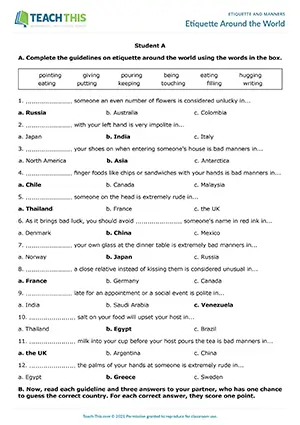
ESL Etiquette Activity - Vocabulary and Speaking: Gap-fill, Multiple-Choice Quiz, Guessing - Pair Work
In this fun etiquette speaking activity, students complete guidelines on etiquette around the world and then take part in a quiz using the advice. First, in two groups, students complete guidelines on...
ESL Etiquette Activity - Vocabulary and Speaking: Gap-fill, Multiple-Choice Quiz, Guessing - Pair Work In this fun etiquette speaking activity, students complete guidelines on etiquette around the world and then take part in a quiz using the advice. First, in two groups, students complete guidelines on etiquette around the world using words from a box. Next, students pair up with someone from the other group. Students then take turns reading each guideline along with three possible answers to their partner, who has one chance to guess the correct country from the choices. For each correct answer, students score one point. The student with the most points at the end of the quiz wins.Etiquette Trivia Board Game
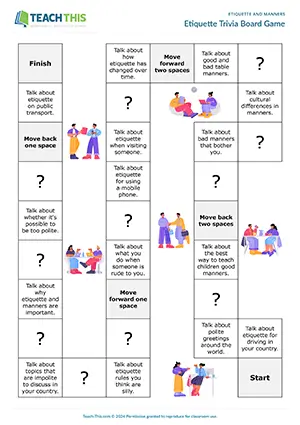
ESL Etiquette and Manners Board Game - Vocabulary and Speaking: Impromptu Speech, Multiple-choice, Guessing, Freer Practice - Group Work
In this enjoyable etiquette board game, students practice talking about etiquette and manners using topic-related vocabulary. Players take turns rolling...
ESL Etiquette and Manners Board Game - Vocabulary and Speaking: Impromptu Speech, Multiple-choice, Guessing, Freer Practice - Group Work In this enjoyable etiquette board game, students practice talking about etiquette and manners using topic-related vocabulary. Players take turns rolling the dice and moving their counter along the board. If a player lands on a 'Talk about' square, they talk in response to the etiquette-related prompt for 30 seconds without stopping. If a player can't think of anything to say or stops talking before the 30 seconds are up, they go back two squares. If a player lands on a 'Question mark' square, another student picks up an etiquette trivia card and reads out the question on the card, followed by three possible multiple-choice answers. The player then has ten seconds to choose an answer. If the player chooses the correct answer, they remain on the square. If not, they move their counter back two squares. The first player to reach the finish wins the game.Manners in the Moment
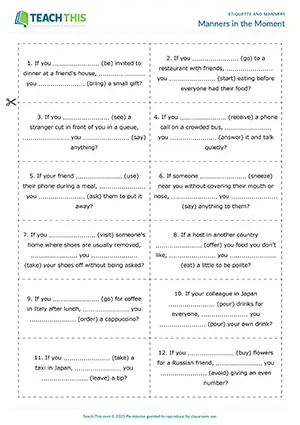
ESL Etiquette and Manners Activity - Grammar and Speaking: Completing Asking and Answering Questions, Discussion, Freer and Communicative Practice - Group Work
In this etiquette and manners discussion activity, students use the second conditional to discuss everyday and cross-cultural situations regarding etiquette...
ESL Etiquette and Manners Activity - Grammar and Speaking: Completing Asking and Answering Questions, Discussion, Freer and Communicative Practice - Group Work In this etiquette and manners discussion activity, students use the second conditional to discuss everyday and cross-cultural situations regarding etiquette and manners and agree on group responses. In groups, students take turns picking up a card and completing the etiquette or manners question with the second conditional, e.g. 'If you visited someone's home where shoes are usually removed, would you take your shoes off?' The student then asks the group members the question. Each group member answers in turn, giving explanations or justifications as needed. Next, students discuss the situation or cultural norm and agree on the best answer. The student who drew the card writes the agreed group answer on the back of the card. When the groups have finished, go through each question and have the groups tell the class their answers. - Imperatives ESL Worksheets, Games and Activities | Teach-This
-
Imperatives ESL Worksheets, Games & Activities
Classroom Instructions
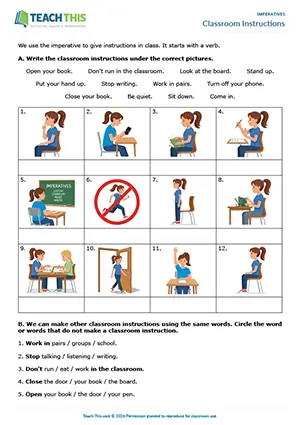
ESL Classroom Imperatives Worksheet - Grammar Exercises: Matching, Identifying, Ordering, Gap-fill
This useful classroom imperatives worksheet helps students learn and practice imperatives related to common classroom instructions. First, students write classroom instructions under the correct pictures...
ESL Classroom Imperatives Worksheet - Grammar Exercises: Matching, Identifying, Ordering, Gap-fill This useful classroom imperatives worksheet helps students learn and practice imperatives related to common classroom instructions. First, students write classroom instructions under the correct pictures. Students then look at similar classroom instructions that use the same words and circle the odd word out. Next, students put words in order to make classroom instructions. After that, students complete classroom instructions using words from a box. Finally, students work with a partner. One student is the teacher, and the other student reads a sentence about a classroom situation. The teacher then says a matching classroom instruction from the worksheet and writes it down. The two students then swap roles. When the pairs have finished, review the students' answers together as a class.Treasure Map
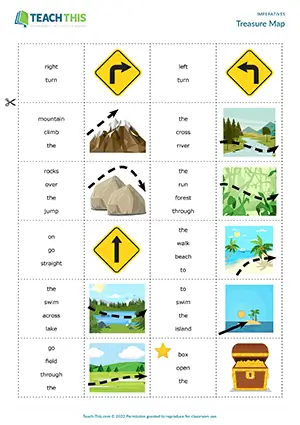
ESL Imperatives Activity - Speaking: Unscrambling, Matching, Controlled Practice - Pair Work
In this free imperatives speaking activity, students make a treasure map by giving each other instructions using imperatives. In pairs, students take turns picking up a word card without showing it to their...
ESL Imperatives Activity - Speaking: Unscrambling, Matching, Controlled Practice - Pair Work In this free imperatives speaking activity, students make a treasure map by giving each other instructions using imperatives. In pairs, students take turns picking up a word card without showing it to their partner. The student then reads the words on the card and says them in the correct order to make a command, e.g. 'Climb the mountain.' Their partner listens and finds the matching picture card. The two students then place the matching word and picture cards together, face up, in sequence to form the map. This process continues until the students complete the instructions to the treasure chest which is the bottom word card in the pile.Imperative Dominoes
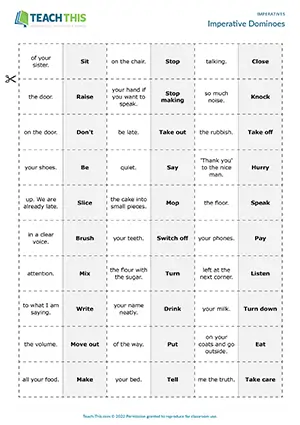
ESL Imperatives Game - Grammar: Matching - Group Work
In this engaging imperatives game, students play dominoes by matching base verbs with objects and complements to make complete imperative sentences. In groups, the first player tries to make an imperative by placing one of their dominoes...
ESL Imperatives Game - Grammar: Matching - Group Work In this engaging imperatives game, students play dominoes by matching base verbs with objects and complements to make complete imperative sentences. In groups, the first player tries to make an imperative by placing one of their dominoes at either end of the domino on the table. The other players then take turns matching their dominoes in the same way by putting them down at either end of the domino chain. If a player is unable to make an imperative, they take a domino from the pile and put it down if they can. If there are no dominoes left in the pile, play passes to the next student. The first player to get rid of all their dominoes wins the game.Imperative Mood
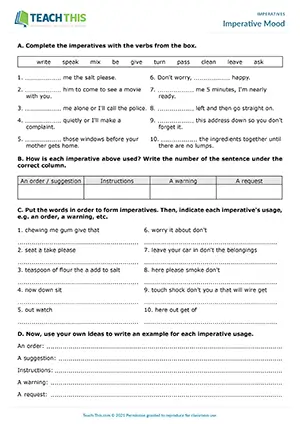
ESL Imperative Mood Worksheet - Grammar Exercises: Gap-fill, Categorising, Unscrambling, Writing Sentences
This productive imperatives worksheet helps students practice using the imperative mood to give orders and instructions, make suggestions, issue warnings, and make polite requests. Students start by...
ESL Imperative Mood Worksheet - Grammar Exercises: Gap-fill, Categorising, Unscrambling, Writing Sentences This productive imperatives worksheet helps students practice using the imperative mood to give orders and instructions, make suggestions, issue warnings, and make polite requests. Students start by completing imperatives with verbs from a box. Students then sort the sentences, according to how each imperative is used. Next, students put words in the correct order to form imperatives. After that, students indicate each imperative's usage, i.e. an order, a warning, a suggestion, an instruction, or a request. Lastly, students use their own ideas to write an example for each imperative usage.Introduction to Imperatives
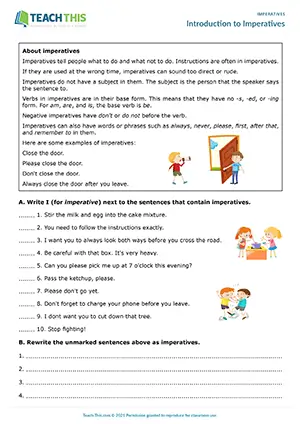
ESL Imperatives Worksheet - Grammar Exercises: Labelling, Writing and Rewriting Sentences, Gap-fill, Identifying
This free imperatives worksheet helps students to learn and practice affirmative and negative imperatives for instructions, requests, warnings, and orders. First, students read through an introduction...
ESL Imperatives Worksheet - Grammar Exercises: Labelling, Writing and Rewriting Sentences, Gap-fill, Identifying This free imperatives worksheet helps students to learn and practice affirmative and negative imperatives for instructions, requests, warnings, and orders. First, students read through an introduction to imperatives and then write 'I' (for imperative) next to the sentences that contain imperatives. Next, students rewrite the unmarked sentences from Exercise A as imperatives. After that, students complete imperatives with words from a box and then underline the imperatives in each sentence. Finally, students read each situation and use the verb in brackets to write an appropriate imperative.Let's Practice Imperatives
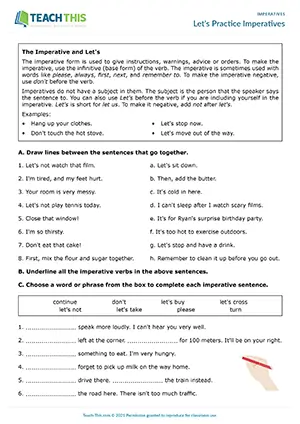
ESL Imperatives Worksheet - Grammar and Writing Exercises: Matching, Gap-fill, Writing Sentences, Sentence Completion
This comprehensive worksheet helps students practice the imperative form, including using 'let's' to give instructions, advice, warnings and suggestions that include the speaker. First, students match...
ESL Imperatives Worksheet - Grammar and Writing Exercises: Matching, Gap-fill, Writing Sentences, Sentence Completion This comprehensive worksheet helps students practice the imperative form, including using 'let's' to give instructions, advice, warnings and suggestions that include the speaker. First, students match sentences together. One or both sentences in each pair uses the imperative. Students then underline the imperative verbs in the sentences. Next, students choose words and phrases from a box to complete imperative sentences. Students then move on to read statements and then write what each person says using an imperative. Finally, students complete each imperative with their own ideas and write another sentence to give more information about it.Silent Crossword
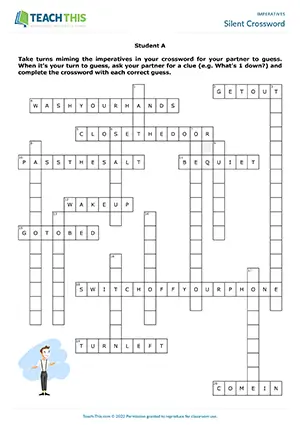
ESL Imperatives Activity - Vocabulary: Miming, Guessing
In this amusing imperatives activity, students mime common imperatives to a partner to help them complete a crossword. In pairs, students take turns asking their partner for a clue to one of their missing imperatives. Their partner indicates the number of...
ESL Imperatives Activity - Vocabulary: Miming, Guessing In this amusing imperatives activity, students mime common imperatives to a partner to help them complete a crossword. In pairs, students take turns asking their partner for a clue to one of their missing imperatives. Their partner indicates the number of words in the imperative and then mimes it for the other student to guess. If the student correctly guesses the imperative, they write it on their crossword. If not, their partner continues to mime until the student is able to guess the imperative. When the students have finished, they check their answers by comparing crosswords.Imperative Push-ups and Stretches
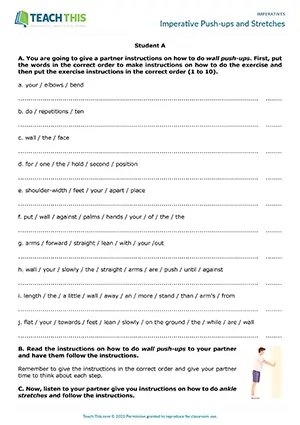
ESL Imperatives Activity - Reading and Listening: Unscrambling, Ordering, Following Instructions - Group and Pair Work
In this inventive imperatives activity, students unscramble and sequence exercise instructions, then take turns giving the steps to a partner, who follows the instructions. In two groups, students put...
ESL Imperatives Activity - Reading and Listening: Unscrambling, Ordering, Following Instructions - Group and Pair Work In this inventive imperatives activity, students unscramble and sequence exercise instructions, then take turns giving the steps to a partner, who follows the instructions. In two groups, students put words in the correct order to make instructions on how to do an exercise. Next, students put the exercise instructions in the correct order. Students then pair up with someone from the other group and take turns reading their instructions while their partner follows them.Who would say that?
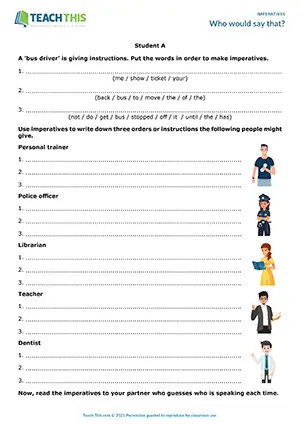
ESL Imperatives Game - Grammar: Unscrambling, Writing Sentences, Guessing, Freer Practice - Pair Work
In this fun imperatives game, students write orders and instructions that certain people would say and read them to a partner who guesses who would say them. First, students put words in the correct order...
ESL Imperatives Game - Grammar: Unscrambling, Writing Sentences, Guessing, Freer Practice - Pair Work In this fun imperatives game, students write orders and instructions that certain people would say and read them to a partner who guesses who would say them. First, students put words in the correct order to form imperatives given by the person shown on their worksheet. Next, in two groups, students use imperatives to write down three orders or instructions for each person shown on their worksheet. Students then pair up with someone from the other group and take turns reading the three imperatives for each person to their partner, who guesses who is speaking each time, saying 'I think a ... would say these things.' For each correct guess, students score a point. The student with the most points at the end of the game wins. - Telephoning ESL Role-Plays, Activities, Games and Worksheets | Teach-This
-
Telephoning ESL Role-Plays, Activities, Games & Worksheets
Ending a Phone Call
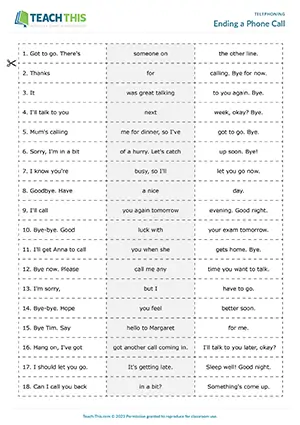
ESL Ending a Phone Call Games - Reading and Speaking: Matching, Forming Sentences - Pair Work
Here are two enjoyable telephoning games to help students practice phrases to end informal phone calls. First, in pairs, students race to arrange sentence beginning cards in order and then match them...
ESL Ending a Phone Call Games - Reading and Speaking: Matching, Forming Sentences from Prompts - Pair Work Here are two enjoyable telephoning games to help students practice phrases to end informal phone calls. First, in pairs, students race to arrange sentence beginning cards in order and then match them to other cards to form sentences ending a phone call. The first pair to do this correctly wins. Next, students play a game in which they take turns picking up a card and reading the situation on the card to their partner, who has 30 seconds to form a suitable sentence ending the call. If a student uses a sentence from the cards on the table, they score one point. If a student forms their own answer, they score two points. The student with the most points at the end of the game wins.Telephone Language Game
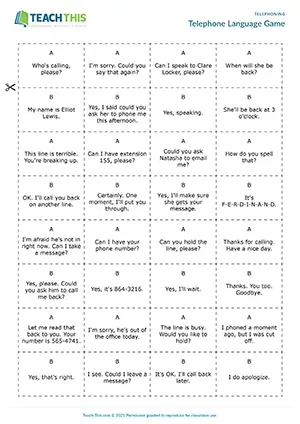
ESL Telephoning Game - Speaking: Matching - Group Work
In this free telephone language game, students race to match common telephone phrases with appropriate responses. The aim of the game is to race to find the students who have matching replies to common telephone phrases. One student begins...
ESL Telephoning Game - Speaking: Matching - Group Work In this free telephone language game, students race to match common telephone phrases with appropriate responses. The aim of the game is to race to find the students who have matching replies to common telephone phrases. One student begins the game by reading a card to one of the other students, e.g. 'Who's calling, please?' That student then looks for a matching reply on their cards. If the student has a matching response, they read it aloud to the group, e.g. 'My name is Elliot Lewis.' If everyone agrees the cards go together, the group member gives the card to the student who wins the matching pair. If the student doesn't have a matching response, the first student waits until their next turn before saying the telephone phrase to another student. The second student then reads a card to one of the other students, and so on. The first student to get four matching pairs of cards wins the game.Who's calling, please?
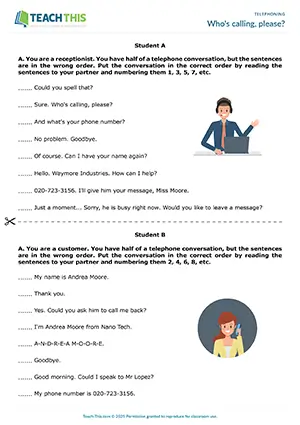
ESL Telephoning Activity - Reading, Writing and Speaking: Ordering, Matching, Writing Sentences, Role-Plays, Freer Practice - Pair Work
In this engaging telephoning activity, students learn telephone phrases and practice taking and leaving messages over the phone. First, in pairs, students put a...
ESL Telephoning Activity - Reading, Writing and Speaking: Ordering, Matching, Writing Sentences, Role-Plays, Freer Practice - Pair Work In this engaging telephoning activity, students learn telephone phrases and practice taking and leaving messages over the phone. First, in pairs, students put a telephone conversation in the correct order by reading sentences to their partner and numbering them from 1 to 16. Next, students write the phrases from the telephone dialogue in a table according to their functions, writing one more phrase of their own for each function. Finally, pairs role-play three telephone scenarios using the phrases, taking turns to be the caller and the receiver.Are You Following Me?
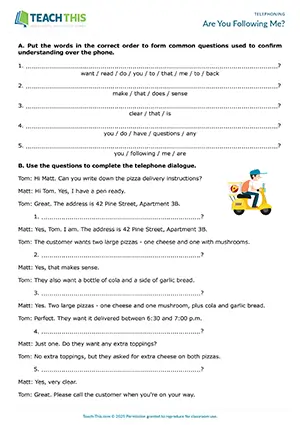
ESL Confirming Activity - Vocabulary: Unscrambling, Dialogue Completion - Speaking Activity: Role-Play, Communicative Practice - Pair Work
Here is a productive telephoning activity to help students practice confirming instructions and checking understanding during phone conversations. Students...
ESL Confirming Activity - Vocabulary: Unscrambling, Dialogue Completion - Speaking Activity: Role-Play, Asking and Answering Questions, Communicative Practice - Pair Work Here is a productive telephoning activity to help students practice confirming instructions and checking understanding during phone conversations. Students begin by unscrambling common questions used to confirm understanding over the phone. Students then use the confirmation questions to complete a telephone dialogue. Next, in pairs, students role-play two telephone dialogues where they take turns giving instructions or information to their partner, pausing at several points to confirm understanding using the questions. Once their partner responds appropriately, the conversation continues. Afterwards, pairs role-play their dialogues in front of the class.Arranging a Delivery

ESL Arranging Deliveries Role-Play - Vocabulary Exercise: Gap-fill - Speaking Activity: Role-Play, Communicative Practice - Group Work
Here is a communicative arranging deliveries role-play to help students practice arranging delivery times over the phone. First, students complete an arranging a...
ESL Arranging Deliveries Role-Play - Vocabulary Exercise: Gap-fill - Speaking Activity: Role-Play, Asking and Answering Questions, Communicative Practice - Group Work Here is a communicative arranging deliveries role-play to help students practice arranging delivery times over the phone. First, students complete an arranging a delivery dialogue between a shop assistant and a customer using words from a box. In groups of six, students then take part in a role-play where three students are customers, and three are shop assistants responsible for arranging deliveries. Each customer has recently purchased an item from each shop, so the shop assistants call the customers to arrange a time for the item on their role card to be delivered. The shop assistant asks for confirmation of their name and order number, as well as their address, mobile number, and any details the driver needs to know about. When a pair agrees on a delivery day and time, they write it down on their role cards. Once all three pairs have arranged a delivery time, the shop assistants move on to the next customer to arrange the delivery of the next item. When all deliveries have been arranged, students swap roles so everyone gets a chance to be both a customer and a shop assistant.Be polite!

ESL polite Telephone Language Worksheet - Writing and Speaking Activity: Rewriting and Role-Playing a Dialogue - Pair Work
In this free telephoning worksheet, students practice polite telephone phrases and requests by rewriting a telephone dialogue. First, students rewrite a telephone dialogue to make it more polite and...
ESL polite Telephone Language Worksheet - Writing and Speaking Activity: Rewriting and Role-Playing a Dialogue - Pair Work In this free telephoning worksheet, students practice polite telephone phrases and requests by rewriting a telephone dialogue. First, students rewrite a telephone dialogue to make it more polite and appropriate. Afterwards, students compare what they have written with a partner, editing any telephone phrases or requests as necessary. Pairs then share their ideas by role-playing their dialogues in front of the class. Afterwards, go through the phone conversation with the class and review the telephone language and polite requests.Booking Tickets
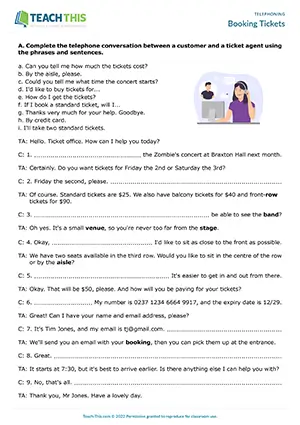
ESL Telephone Bookings Worksheet - Reading and Vocabulary: Gap-fill, Matching, Unscrambling - Writing and Speaking: Writing a Dialogue, Role-Play - Pair Work
Here is a comprehensive telephone bookings worksheet to help students practice vocabulary and phrases for booking tickets over the phone. Students begin...
ESL Telephone Bookings Worksheet - Reading and Vocabulary: Gap-fill, Matching, Unscrambling - Writing and Speaking: Writing a Dialogue, Role-Play - Pair Work Here is a comprehensive telephone bookings worksheet to help students practice vocabulary and phrases for booking tickets over the phone. Students begin by completing a telephone conversation between a customer and a ticket agent using a list of related phrases. Students then match keywords in bold from the conversation to their definitions. Next, students complete sentences using the words. After that, students unscramble words to form common phrases used when booking tickets over the phone. Lastly, in pairs, students use the vocabulary and phrases from the worksheet to role-play two telephone conversations between a customer and a ticket agent.Clarifying and Confirming
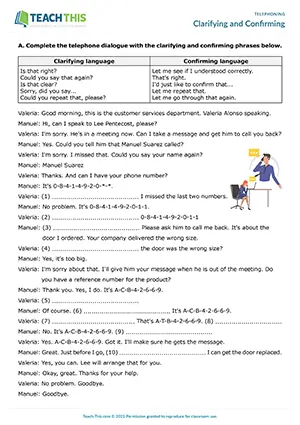
ESL Clarifying and Confirming Activity - Vocabulary and Speaking: Gap-fill, Role-Play, Asking and Answering Questions, Communicative Practice - Pair Work
In this clarifying and confirming worksheet and role-play, students learn and practice ten phrases for clarifying and confirming information over the phone...
ESL Clarifying and Confirming Activity - Vocabulary and Speaking: Gap-fill, Role-Play, Asking and Answering Questions from Prompts, Communicative Practice - Pair Work In this clarifying and confirming worksheet and role-play, students learn and practice ten phrases for clarifying and confirming information over the phone. Students begin by completing a telephone dialogue with ten clarifying and confirming phrases. Next, in pairs, students conduct two telephone role-plays to practice the clarifying and confirming phrases. In the first role-play, one student takes on the role of the caller and finds out, clarifies and confirms information about a party with their partner. In the second role-play, one student calls their partner to find out, clarify and confirm information about a weekend beach trip. Afterwards, pairs present their dialogues to the class.Rescheduling an Appointment
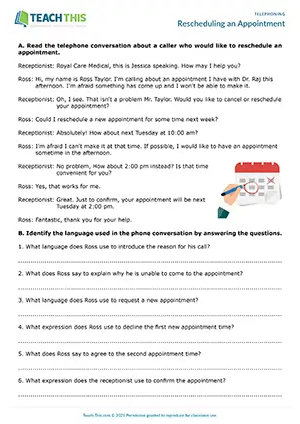
ESL Rescheduling Appointments Worksheet - Reading and Vocabulary Exercises: Answering Questions, Identifying, Matching - Speaking Activity: Role-Play - Pair Work
In this rescheduling appointments worksheet and role-play, students learn and practice phrases for rescheduling an appointment over the phone. First, students...
ESL Rescheduling Appointments Worksheet - Reading and Vocabulary Exercises: Answering Questions, Identifying, Matching - Speaking Activity: Role-Play - Pair Work In this rescheduling appointments worksheet and role-play, students learn and practice phrases for rescheduling an appointment over the phone. First, students read a telephone conversation about rescheduling an appointment. Students then answer questions to identify the key rescheduling phrases used in the dialogue. Next, students match telephone phrases that have the same meaning. After that, students complete a telephone conversation using the rescheduling phrases. Finally, in pairs, students choose two scenarios and role-play phone calls to reschedule appointments with students taking turns to be the caller and the receptionist.Telephone Role-Plays
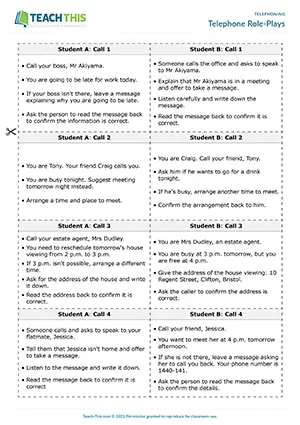
ESL Telephone Role-Plays - Speaking Activity: Communicative Practice - Pair Work
In these communicative telephone role-plays, students practice essential telephone phrases for taking and leaving messages, making and changing arrangements, and confirming information over the phone. In pairs, students take turns making and...
ESL Telephone Role-Plays - Speaking Activity: Communicative Practice - Pair Work In these communicative telephone role-plays, students practice essential telephone phrases for taking and leaving messages, making and changing arrangements, and confirming information over the phone. In pairs, students take turns making and receiving calls using prompts on role cards. Students continue the activity until all four scenarios have been completed. Afterwards, students perform one of their telephone conversations in front of the class.Ring, Ring!

ESL Telephone Phrasal Verbs Game - Vocabulary: Matching, Forming and Writing Sentences - Pair Work
This fun telephone phrasal verbs game helps students practice telephone phrasal verbs and common telephone expressions. In pairs, students use cards to make sentences connected with telephone...
ESL Telephone Phrasal Verbs Game - Vocabulary: Matching, Forming and Writing Sentences - Pair Work This fun telephone phrasal verbs game helps students practice telephone phrasal verbs and common telephone expressions. In pairs, students use cards to make sentences connected with telephone language. Each sentence or pair of sentences consists of four cards and contains one or two telephone phrasal verbs. When the students successfully put four cards together, they lay them out in order and write the sentence or sentences on a piece of paper, underlining the telephone phrasal verbs. The first pair to complete all the sentences correctly wins the game. As an extension, pairs prepare and then role-play a telephone dialogue using the phrasal verbs.Telephone Language Review

ESL Telephone Language Worksheet - Vocabulary Exercises: Matching, Categorising, Multiple Choice, Gap-fill, Role-Play
This useful telephoning worksheet helps students review common telephone expressions and phrasal verbs used over the phone. Students start by...
ESL Telephone Language Worksheet - Vocabulary Exercises: Matching, Categorising, Multiple Choice, Gap-fill, Role-Play This useful telephoning worksheet helps students review common telephone expressions and phrasal verbs used over the phone. Students start by matching sentence halves together to form common telephone expressions. Next, students sort the sentences into telephone expressions used by a 'caller' and telephone expressions used by a 'receiver'. Students then choose the correct prepositions to complete telephone phrasal verbs in sentences. After that, students complete telephone dialogues with words from a box. Lastly, students role-play telephone dialogues with a partner, taking turns to be the caller and the receiver.Telephone Phrasal Verb Frenzy
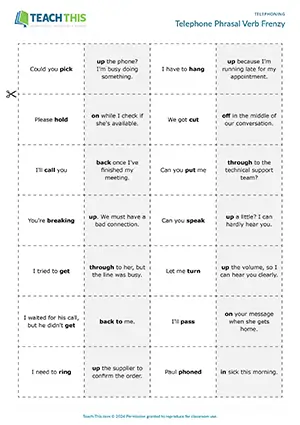
ESL Telephone Language Games - Vocabulary: Pelmanism, Matching, Forming Sentences - Pair Work
Here are two rewarding telephone phrasal verb games to help students practice telephone phrasal verbs and common telephone expressions. First, students play a pelmanism game where...
ESL Telephone Language Games - Vocabulary: Pelmanism, Matching, Forming Sentences from Prompts - Pair Work Here are two rewarding telephone phrasal verb games to help students practice telephone phrasal verbs and common telephone expressions. First, students play a pelmanism game where they connect sentence halves by matching verbs to prepositions to form telephone phrasal verbs. In pairs, students take turns turning over one card from each set. If the verb matches the preposition to form a telephone phrasal verb and the sentence makes sense, the student keeps the two cards and has another turn. The student with the most pairs of cards at the end of the game wins. Next, students play a game where they take turns picking up a card and reading a scenario to their partner, who forms an appropriate response using a telephone phrasal verb. If the answer uses the phrasal verb in bold on the card and is similar to the example answer, the student wins and keeps the card. If not, the card is placed at the bottom of the pile to be used again later. The student with the most cards at the end of the game wins. - Asking for Permission ESL Games, Activities and Worksheets | Teach-This
-
Asking for Permission ESL Games, Activities & Worksheets
May I...?

ESL May I Activity - Speaking: Asking and Answering Questions, Controlled and Communicative Practice
In this free asking for permission speaking activity, students practice asking for, giving and refusing permission using cards as prompts. On one side of the card is a permission prompt and on...
ESL May I Activity - Speaking: Asking and Answering Questions from Prompts, Controlled and Communicative Practice In this free asking for permission speaking activity, students practice asking for, giving and refusing permission using cards as prompts. On one side of the card is a permission prompt and on the other is a tick or cross. Students hold their cards so the permission prompt is facing towards them and the tick or cross is facing away. Students then go around the class asking for, giving and refusing permission with as many partners as possible. If students see a tick, they give permission. If there is a cross, students refuse permission. When the students have finished, they repeat the activity, but this time they hold their card the other way around so the permission prompt is facing away. Students then go around the class, asking for permission to do different things each time they speak to a classmate.Picture This
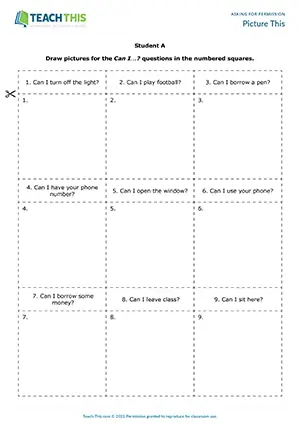
ESL Asking for Permission Game - Speaking: Drawing Pictures, Guessing, Forming Questions - Pair Work
In this creative asking for permission game, students draw pictures of situations where people ask for permission and a partner tries to guess the 'Can I...?' question for each one. First, in two groups, students...
ESL Asking for Permission Game - Speaking: Drawing Pictures from Prompts, Guessing, Forming Questions - Pair Work In this creative asking for permission game, students draw pictures of situations where people ask for permission and a partner tries to guess the 'Can I...?' question for each one. First, in two groups, students draw pictures that illustrate 'Can I...?' questions in numbered squares. For example, if the question was 'Can I borrow a pencil?', the student might draw a picture of someone with a piece of paper and nothing in their hand. Students then cut the worksheet so the drawings and questions are separate. Next, students pair up with someone from the other group and give their partner the drawings. Students then take turns guessing the 'Can I...?' question for each of their partner's pictures. Students have three chances to guess the question for each picture. If a student guesses correctly the first time, they score three points. On the second try, they get two points. On the third try, they score one point. The student with the most points at the end of the game wins.Can I...?

ESL Can I Game - Speaking: Matching Questions and Answers - Group Work
In this engaging asking for permission game, students ask permission to do different things using 'Can I...?' and race to find the person who gives permission. Each card contains three 'Can I...?' questions that ask for permission and nine replies...
ESL Can I Game - Speaking: Matching Questions and Answers - Group Work In this engaging asking for permission game, students ask permission to do different things using 'Can I...?' and race to find the person who gives permission. Each card contains three 'Can I...?' questions that ask for permission and nine replies that give or refuse permission. In groups, students take turns asking a 'Can I...?' question on their card to one of the other group members, e.g. 'Can I try on these jeans?' The chosen student then looks for a matching reply on their card. If the student gives permission by saying 'Yes, of course...', the other student crosses off the question. If the student refuses permission by saying 'I'm sorry...', the other student waits until their next turn before asking permission from another person. The first student to cross off all their 'Can I...?' questions wins the game.Can I... yes or no?

ESL Modals of Permission Game - Speaking: Asking and Answering Questions, Guessing, Communicative Practice - Pair Work
In this fun modal verbs of permission game, students ask for permission to do various things and guess whether their partner is going to grant or refuse permission. This game helps students...
ESL Modals of Permission Game - Speaking: Asking and Answering Questions from Prompts, Guessing, Communicative Practice - Pair Work In this fun modal verbs of permission game, students ask for permission to do various things and guess whether their partner is going to grant or refuse permission. This game helps students practice the modals of permission can, may and could as well as various phrases for granting and refusing permission. In pairs, students take turns picking up a permission card and using the modal verb of permission and prompt shown on the card to ask for permission to do something, e.g. 'May I use your computer?' The student then guesses whether their partner will grant or refuse permission. Their partner then picks up a response card and grants or refuses permission using the expression on the card, e.g. 'Yes, no problem.' If the student guessed correctly, they score a point. If not, their partner scores a point. The student with the most points at the end of the game wins.Perfect Partners

ESL Asking for Permission Activity - Speaking: Asking and Answering Questions, Communicative Practice
In this communicative asking for permission activity, students practice asking for, giving and refusing permission. Students imagine that they are going to try to find their perfect partner by asking, giving...
ESL Asking for Permission Activity - Speaking: Asking and Answering Questions from Prompts, Communicative Practice In this communicative asking for permission activity, students practice asking for, giving and refusing permission. Students imagine that they are going to try to find their perfect partner by asking, giving and refusing permission for the things on their card. If they find someone who asks or gives permission for all four items on their card, they have found their perfect partner. The students with card A sit down. Their task is to give or refuse permission. If a student asks permission for an item on their card, they give it. If a student asks permission for something that isn't on their card, they refuse permission and give a reason. The students with card B go around asking the students sitting down permission for the things shown on their card, e.g. 'Can I borrow a pen?' If a student gets permission for all four things on their card, they have found their perfect partner and sit down with them. If a student is refused permission for anything on their card, they move on and speak to another student. When everyone has found their partner, students swap roles to give them practice using all the language.Asking for Permission Board Game

ESL Asking for Permission Board Game - Speaking: Forming Questions - Group Work
This free asking for permission board game helps students practice asking for, granting and refusing permission using a variety of phrases. In groups, players take turns rolling the dice and moving their counter along the board. When a player lands...
ESL Asking for Permission Board Game - Speaking: Forming Questions from Prompts - Group Work This free asking for permission board game helps students practice asking for, granting and refusing permission using a variety of phrases. In groups, players take turns rolling the dice and moving their counter along the board. When a player lands on a square, they pick up a card and ask for permission using the verb on the card and the phrase on the square. For example, if the player lands on the 'Do you think I could...?' square and picks up the 'have' verb card, the student might say 'Do you think I could have another cup of coffee?' The other students in the group judge whether the question has been phrased correctly and is appropriate. If it is, the students grant permission, e.g. 'Go right ahead.' If not, the students refuse permission (e.g. I'm afraid that's not possible.), and the player goes back two squares. The first player to reach the finish wins the game.Do you mind if I...?

ESL Asking for Permission Activity - Speaking: Asking and Answering Questions, Communicative Practice
Here is a communicative asking for permission activity to help students practice asking for permission with 'Do you mind if I...?' and responding by either granting or refusing permission. Students go...
ESL Asking for Permission Activity - Speaking: Asking and Answering Questions from Prompts, Communicative Practice Here is a communicative asking for permission activity to help students practice asking for permission with 'Do you mind if I...?' and responding by either granting or refusing permission. Students go around the class asking permission for the things shown on their worksheet using 'Do you mind if I...?' Students only give permission if they genuinely think they don't mind. If students do mind, they refuse permission and explain why. When a classmate gives or refuses permission, the student writes down their name and answer on the worksheet. This continues until each student has two responses for each item. Afterwards, students give feedback to the class on the people who gave and refused permission.12 Ways to Ask Permission

ESL Asking for Permission Game - Speaking: Gap-fill, Guessing - Pair Work
In this enjoyable asking for permission game, students practice 12 ways to ask permission by guessing missing words in questions. In pairs, one student begins by guessing the missing words in the first question that asks for permission. Their partner...
ESL Asking for Permission Game - Speaking: Gap-fill, Guessing - Pair Work In this enjoyable asking for permission game, students practice 12 ways to ask permission by guessing missing words in questions. In pairs, one student begins by guessing the missing words in the first question that asks for permission. Their partner listens and tells them if they are correct or not. If the student guesses correctly the first time, they score three points and write the words in the gaps. On the second try, they get two points. On the third try, they score one point. After the missing words have been guessed correctly or three chances have passed, their partner guesses the missing words in the second question, and so on. The student with the most points at the end of the game is the winner.Is it alright if I connect four?

ESL Asking for Permission Game - Vocabulary and Speaking: Forming Questions, Freer Practice - Pair Work
In this useful asking for permission game, students play Connect Four by using common phrases to form questions that ask for permission. To begin, the first player chooses a square. The other player...
ESL Asking for Permission Game - Vocabulary and Speaking: Forming Questions from Prompts, Freer Practice - Pair Work In this useful asking for permission game, students play Connect Four by using common phrases to form questions that ask for permission. To begin, the first player chooses a square. The other player then picks up a situation card and reads it aloud. The first player then uses the phrase from the square to form a relevant question based on the situation that asks for permission. For example, for the square 'Is there any chance...' and the situation 'You have been invited to a party and would like to bring a guest', the player could say 'Is there any chance I could bring a guest to the party?' If the other player agrees that the question is correct and appropriate, the player marks the square with an 'X' or an 'O', and the situation card is set aside. If not, the player doesn't mark the square, and the situation card is placed at the bottom of the pile. It is then the other player's turn to choose a square. The first player to get four squares in a row wins the game. Afterwards, pairs play a second game using the remaining situation cards.Permission Granted!
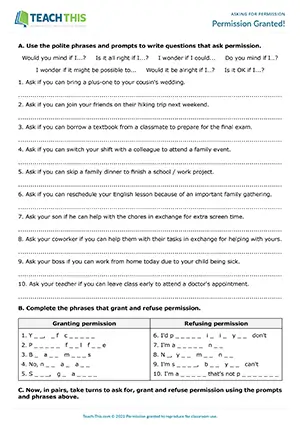
ESL Asking for Permission Worksheet - Vocabulary Exercises: Writing Sentences, Word Completion - Speaking Activity - Pair Work
Here is a productive asking for permission worksheet to help students practice language for asking, granting and refusing permission. First, students use polite...
ESL Asking for Permission Worksheet - Vocabulary Exercises: Writing Sentences from Prompts, Word Completion - Speaking Activity - Pair Work Here is a productive asking for permission worksheet to help students practice language for asking, granting and refusing permission. First, students use polite phrases and prompts to write questions that ask for permission. Students then complete phrases that grant and refuse permission. Finally, in pairs, students take turns to ask for, grant and refuse permission using the prompts and polite phrases.Permission to Play
ESL Asking for Permission Games - Vocabulary: Miming, Guessing, Matching - Pair Work
Here are two entertaining asking for permission games to help students practice a variety of common phrases that ask for permission. In pairs, students begin by playing a miming game where they...
ESL Asking for Permission Games - Vocabulary: Miming, Guessing, Matching - Pair Work Here are two entertaining asking for permission games to help students practice a variety of common phrases that ask for permission. In pairs, students begin by playing a miming game where they mime questions that ask permission for a partner to guess. Students take turns picking up a question card and saying the asking for permission phrase written in bold, e.g. 'Do you mind if I..' The student then mimes the rest of the question to their partner, who has 30 seconds to guess what it is. If the student guesses correctly (e.g. Do you mind if I open the window?), they win and keep the card. If not, their partner keeps the card. The student with the most cards at the end wins. Next, students play a game where they match each question that asks for permission with a suitable response. Students take turns turning over a question card and a response card. If the response matches the question, the student keeps the two cards and has another turn. If not, the student turns both cards back over and play passes to the other student. The student with the most cards at the end of the game wins.Would it be alright if I...?

ESL Asking for Permission Worksheet - Vocabulary Exercises: Gap-fill, Categorising, Forming Questions and Answers, Rewriting Sentences - Speaking Activity - Pair Work
In this comprehensive asking for permission worksheet, students practice phrases for asking, giving and refusing permission. First, students read two...
ESL Asking for Permission Worksheet - Vocabulary Exercises: Gap-fill, Categorising, Forming Questions and Answers, Rewriting Sentences - Speaking Activity - Pair Work In this comprehensive asking for permission worksheet, students practice phrases for asking, giving and refusing permission. First, students read two dialogues and complete them with words from a box. Students then identify the phrases used to ask for, give and refuse permission in the two dialogues and write them in a table, adding other phrases they can think of in the empty squares. Next, students write questions that ask for permission using the phrases from the table and write a response to each question, giving or refusing permission. After that, students rewrite short dialogues that ask for permission to make them more polite. Finally, students write questions that ask for permission and then practice asking for, giving and refusing permission with a partner. - Indirect Questions ESL Worksheets, Games, Role-Plays and Activities | Teach-This
-
Indirect Questions ESL Worksheets, Activities, Role-Plays & Games
Ask politely
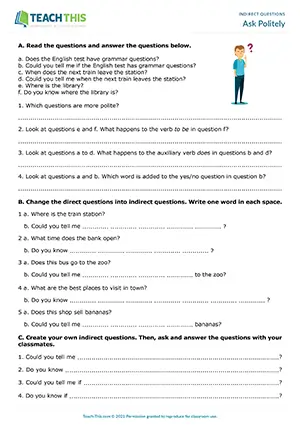
ESL Indirect Questions Worksheet - Grammar Exercises: Answering, Reforming and Completing Questions - Speaking Activity: Freer Practice
This productive indirect questions worksheet helps students learn how to form indirect questions. First, students examine three direct questions and their indirect...
ESL Indirect Questions Worksheet - Grammar Exercises: Answering, Reforming and Completing Questions - Speaking Activity: Asking and Answering Questions, Freer Practice This productive indirect questions worksheet helps students learn how to form indirect questions. First, students examine three direct questions and their indirect equivalents and answer questions about how indirect questions are formed. Next, students change direct questions into indirect questions. Students then complete indirect questions with their own ideas. Lastly, students practice asking and answering the indirect questions with their classmates.Direct and Indirect Questions

ESL Direct vs. Indirect Questions Worksheet - Grammar Exercises: Writing and Rewriting Questions - Speaking Activity: Asking and Answering Questions
In this free direct and indirect questions worksheet, students learn and practice three rules for changing direct questions into indirect questions. First...
ESL Direct vs. Indirect Questions Worksheet - Grammar Exercises: Writing and Rewriting Questions, Unscrambling - Speaking Activity: Asking and Answering Questions In this free direct and indirect questions worksheet, students learn and practice three rules for changing direct questions into indirect questions. First, students read through an introduction to indirect questions and a grammar rule for verb placement. Students then use the information to change direct questions into indirect questions using the polite expressions: 'Could you tell me...?' and 'Do you know...?' After that, students read the second rule that talks about how the helping verbs do, does or did are omitted from indirect questions. Next, students put words in order to form direct questions with do, does and did, which they then make into indirect questions. After that, students learn the last rule which looks at how to change direct yes/no questions into indirect ones. Students then change yes/no questions into indirect questions using a polite expression with 'if'. Lastly, students write three indirect questions of their own and ask them to their classmates.I was wondering...

ESL Indirect Questions Activity - Speaking: Asking and Answering Questions, Communicative Practice
In this communicative indirect questions activity, students practice using indirect question phrases to make polite requests and respond by politely accepting or declining them. Each student receives...
ESL Indirect Questions Activity - Speaking: Asking and Answering Questions from Prompts, Communicative Practice In this communicative indirect questions activity, students practice using indirect question phrases to make polite requests and respond by politely accepting or declining them. Each student receives a card with a situation and a request. Students then go around the class, explaining their situation and using indirect questions to make polite requests to their classmates. Classmates only agree to a request if they genuinely wouldn't mind doing it. For example, a student should agree to drive someone to the airport at 6 a.m. only if they have a car and don't mind waking up early. If a classmate doesn't want to do something, they politely decline and explain why. Students record the names of classmates who accept their request on the back of their card. At the end of the activity, each student gives feedback to the class on how many people agreed to their request.Indirect Questions Practice

ESL Indirect Questions Worksheet - Grammar Exercises: Gap-fill, Unscrambling, Error Correction, Rewriting Questions
Here is a comprehensive indirect questions worksheet to help students learn and practice how to ask questions politely. First, students complete indirect questions with words and phrases from a box. Next...
ESL Indirect Questions Worksheet - Grammar Exercises: Gap-fill, Unscrambling, Error Correction, Rewriting Questions Here is a comprehensive indirect questions worksheet to help students learn and practice how to ask questions politely. First, students complete indirect questions with words and phrases from a box. Next, students put words in the correct order to form indirect questions. Students then correct mistakes in indirect questions. Lastly, students change direct questions into indirect questions using the polite phrases from the worksheet.Street Interviews
ESL Indirect Questions Role-Play - Speaking Activity: Forming, Asking and Answering Questions, Communicative Practice
In this engaging indirect questions speaking activity, students ask and answer indirect questions in a street interview. Students imagine that they are reporters for a local radio or TV station and...
ESL Indirect Questions Role-Play - Speaking Activity: Forming, Asking and Answering Questions, Communicative Practice In this engaging indirect questions speaking activity, students ask and answer indirect questions in a street interview. Students imagine that they are reporters for a local radio or TV station and that they are going to interview people on the street to find out public opinion on a chosen topic. Students then select a topic and complete five indirect questions based on the topic, e.g. 'Could you tell me how you feel about cryptocurrency?' Next, in two groups, reporters and passers-by, the passers-by walk around the class as if they were walking along the street. The reporters stop the passers-by and ask if they would mind answering a few questions. The reporter then writes the person's name and interviews them, noting down their answers. When all the reporters have spoken to three people, students swap roles. Finally, students report back to the class on the answers they received.Super polite

ESL Indirect Questions Role-Play - Speaking Activity: Asking and Answering Questions, Communicative Practice - Pair Work
In this free indirect questions speaking activity, students role-play two situations where someone politely asks for information using indirect questions. In pairs, students begin by reading their role...
ESL Indirect Questions Role-Play - Speaking Activity: Asking and Answering Questions from Prompts, Communicative Practice - Pair Work In this free indirect questions speaking activity, students role-play two situations where someone politely asks for information using indirect questions. In pairs, students begin by reading their role cards for the first situation, which takes place at a ticket office. One student assumes the role of the ticket agent, while the other plays the customer. Next, the two students participate in a role-play where the customer politely asks for information about a flight to London, using indirect questions. Afterwards, pairs move on to a hotel role-play. In this scenario, one student takes on the role of a hotel guest, and the other acts as the hotel receptionist. The guest then uses indirect questions to politely ask for information about the hotel. Finally, pairs present their role-plays to the class.Would you mind telling me...?
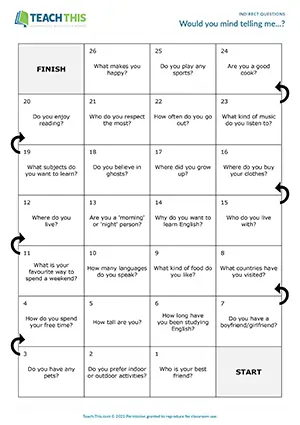
ESL Indirect Questions Board Game - Speaking: Forming, Asking and Answering Questions - Group Work
In this fun indirect questions board game, students change direct personal information questions into indirect questions and ask them to other students. In groups, players take turns rolling the dice and...
ESL Indirect Questions Board Game - Speaking: Forming, Asking and Answering Questions - Group Work In this fun indirect questions board game, students change direct personal information questions into indirect questions and ask them to other students. In groups, players take turns rolling the dice and moving their counter along the board. When a player lands on a square, they read the direct question, change it into an indirect question and ask it to another student in the group, e.g. 'Would you mind telling me who your best friend is?' After the question has been answered, the group members judge the player's question. If the question is grammatically correct and the polite phrase is different from the previous question, the player stays on the square. If the question is wrong, the player goes back two squares. The first player to reach the finish wins the game.Celebrity Interviews
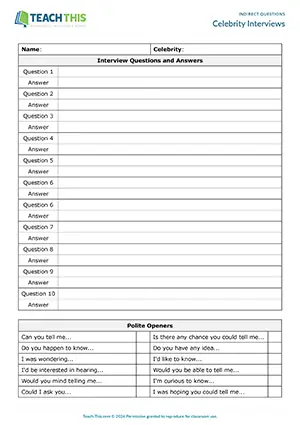
ESL Indirect Questions Activity - Writing, Grammar, and Speaking: Writing, Reforming, Asking, and Answering Questions, Role-Play, Freer Practice - Pair Work
In this imaginative indirect questions role-play activity, students practice forming, asking, and answering indirect questions in celebrity interviews. First, students...
ESL Indirect Questions Activity - Writing, Grammar, and Speaking: Writing, Reforming, Asking, and Answering Questions, Role-Play, Freer Practice - Pair Work In this imaginative indirect questions role-play activity, students practice forming, asking, and answering indirect questions in celebrity interviews. First, students write the name of the celebrity they want to be for the interview. Another student then writes ten direct interview questions for the celebrity. Next, in pairs, one student acts as the interviewer and the other as the celebrity. The interviewer reads the first direct question and reforms it as an indirect question using a polite opener from the worksheet. The interviewer then ticks the polite opener. Students may only use each polite opener once. If the celebrity agrees that the indirect question is grammatically correct, they answer it. If not, the celebrity asks the interviewer to repeat the question. After that, the interviewer notes down the celebrity's answer and then reforms the second question, and so on. When the students have finished, they report back to the class on the celebrities' answers. Afterwards, students swap roles and repeat the activity.Indirect Questions Race

ESL Indirect Questions Game - Grammar: Rewriting Questions - Pair Work
In this enjoyable indirect questions game, students race to rewrite direct questions as indirect questions using different polite phrases. One student from each pair runs to your desk, picks up the first question strip, and takes it back to their...
ESL Indirect Questions Game - Grammar: Rewriting Questions - Pair Work In this enjoyable indirect questions game, students race to rewrite direct questions as indirect questions using different polite phrases. One student from each pair runs to your desk, picks up the first question strip, and takes it back to their partner. Pairs then race to rewrite the direct question as an indirect question using the given polite phrase. As soon as a pair has completed the indirect question, a student from the pair comes to you with their strip. If the indirect question is correct, give the student the second strip, and so on. If an indirect question is incorrect, the pair has to rewrite it. The first pair to rewrite all 20 indirect questions correctly wins the game. - Greetings and Introductions ESL Role-Plays, Worksheets, Games and Activities | Teach-This
-
Greetings & Introductions ESL Role-Plays, Worksheets, Games & Activities
Excuse me, are you...?
ESL Introducing Yourself Role-Play - Speaking Activity: Asking and Answering Questions, Communicative Practice
In this engaging introducing yourself role-play activity, students find famous people and introduce themselves as another famous person. First, students take on the role of the famous person marked on...
ESL Introducing Yourself Role-Play - Speaking Activity: Asking and Answering Questions from Prompts, Communicative Practice In this engaging introducing yourself role-play activity, students find famous people and introduce themselves as another famous person. First, students take on the role of the famous person marked on their card. Their task is to find and introduce themselves to the two other famous people shown on the card. Students then go around the class and ask one another 'Excuse me, are you...?' questions. If the person isn't who they are looking for, students say 'Sorry' and move on to speak to someone else. If it is one of the people they are looking for, students introduce themselves by saying 'Hello, I'm... Nice to meet you.' Other phrases are also possible such as 'Let me introduce myself', 'Pleased to meet you', etc. When the students have found and introduced themselves to the two famous people on their cards, they sit down. Afterwards, repeat the activity by giving each student a different card. Finally, students tell the class which famous people they met.Greetings

ESL Greetings Worksheet - Vocabulary Exercises: Matching, Unscrambling, Sentence Completion, Gap-fill - Speaking Activity: Dialogue Practice - Pair Work
In this useful greetings worksheet, students learn and practice language used to greet people. First, students match greetings and introductory questions...
ESL Greetings Worksheet - Vocabulary Exercises: Matching, Unscrambling, Sentence Completion, Gap-fill - Speaking Activity: Dialogue Practice - Pair Work In this useful greetings worksheet, students learn and practice language used to greet people. First, students match greetings and introductory questions with responses. Students then unscramble words to form greetings. Next, students complete greetings and introductory phrases with words from a box. After that, students practice the language with a partner by completing a dialogue using the phrases from the worksheet and their own personal information. Lastly, students practice the conversation with their partner and present their dialogue to the class.Meeting People

ESL Introducing Yourself and Others Role-Play - Speaking Activity: Forming Sentences, Asking and Answering Questions, Freer Practice - Group Work
Here is a free introducing yourself and others speaking activity to help students practice greetings and introducing themselves and others. Students take on...
ESL Introducing Yourself and Others Role-Play - Speaking Activity: Forming Sentences, Asking and Answering Questions, Freer Practice - Group Work Here is a free introducing yourself and others speaking activity to help students practice greetings and introducing themselves and others. Students take on the identity of the person on their card. Their task is to find the two people on their task card and introduce them to each other. All the names and jobs are very similar, so students need to listen carefully to make sure they have the right two people. Students then go around their group introducing themselves and asking each other's names and jobs until they find the two people who are to be introduced. When a student finds the two people, they introduce them to each other using the target language.Nice to Meet You
ESL Greetings and Introductions Game - Vocabulary and Reading: Matching, Ordering - Pair Work
This productive greetings and introductions game is ideal for introducing phrases for greetings, making introductions and saying goodbye. In pairs, students take turns turning over two cards. If the...
ESL Greetings and Introductions Game - Vocabulary and Reading: Matching, Ordering - Pair Work This productive greetings and introductions game is ideal for introducing phrases for greetings, making introductions and saying goodbye. In pairs, students take turns turning over two cards. If the greetings and introductions language on the cards match, the student says the two lines aloud and keeps the cards. If the two cards don't match, the student turns them back over. The student with the most cards at the end of the game wins. Next, students spread the cards out face-up and read them, matching them together to form two dialogues.Portraits

ESL Introducing Yourself Activity - Speaking: Drawing, Asking and Answering Questions, Labelling, Freer Practice - Group Work
Here is a fun introducing yourself speaking activity to help students introduce themselves and find out each other's names on the first day of class. In groups, students begin by randomly drawing a portrait...
ESL Introducing Yourself Activity - Speaking: Drawing, Asking and Answering Questions, Labelling, Freer Practice - Group Work Here is a fun introducing yourself speaking activity to help students introduce themselves and find out each other's names on the first day of class. In groups, students begin by randomly drawing a portrait of themselves in one of the picture frames on the worksheet. Students then pass their worksheet to the person on their right, who draws themselves anywhere on the worksheet and passes the sheet to the person on their right. This process is repeated until students receive the worksheet they started with, complete with pictures in every frame. After that, students go around the group, identify their classmates from the portraits, find out their names, write them down, and introduce themselves. Finally, students go around the group again without the worksheet and see how many names they can remember.Hi! It's Nice to Meet You!
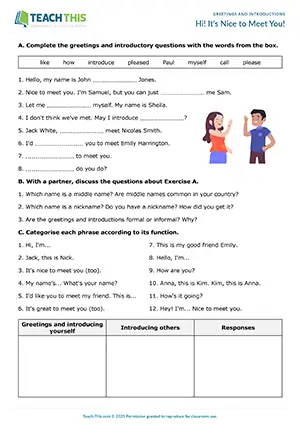
ESL Greetings and Introductions Worksheet - Reading and Vocabulary Exercises: Gap-Fill, Categorising, Ordering - Speaking Activity: Role-Play, Freer Practice - Group Work
In this comprehensive greetings and introductions worksheet helps students learn and practice formal and informal phrases for greeting others, making...
ESL Greetings and Introductions Worksheet - Reading and Vocabulary Exercises: Gap-Fill, Categorising, Ordering - Speaking Activity: Role-Play, Freer Practice - Group Work In this comprehensive greetings and introductions worksheet helps students learn and practice formal and informal phrases for greeting others, making introductions, engaging in polite conversation, and saying goodbye. To begin, students complete greetings and introductory questions with words from a box. Students then discuss three questions about the language with a partner. Next, students categorise phrases according to their functions. After that, students underline the correct words to complete related sentences and questions. Students then move on to arrange sentences in the correct order to create a conversation involving greetings and introductions. Next, students answer questions about the conversation. Finally, in groups of three, students prepare and present a role-play conversation where one student greets another and introduces them to a third person. The group then engages in a polite conversation and says goodbye.It's Good to See You
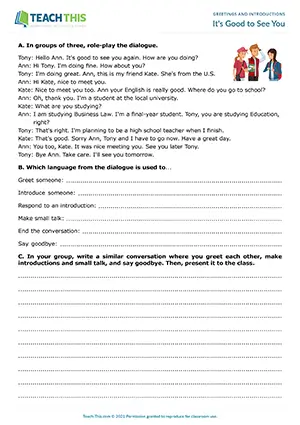
ESL Greetings and Introductions Role-Play - Reading, Writing and Speaking Activity: Categorising, Delivering a Dialogue, Controlled and Freer Practice - Group Work
This enjoyable greetings and introductions role-play activity helps students to learn and practice language for greetings, introductions, making small talk and ending...
ESL Greetings and Introductions Role-Play - Reading, Writing and Speaking Activity: Categorising, Preparing and Delivering a Dialogue, Controlled and Freer Practice - Group Work This enjoyable greetings and introductions role-play activity helps students to learn and practice language for greetings, introductions, making small talk and ending a conversation. First, in groups, students role-play a greetings and introductions dialogue. Students then write down the language used in the conversation to greet someone, introduce someone, make small talk, end the conversation, and say goodbye. Students also suggest other possible phrases for each function. Finally, students write and present a similar dialogue where they greet each other, make introductions and small talk, and say goodbye.Meet and Greet Role-Play
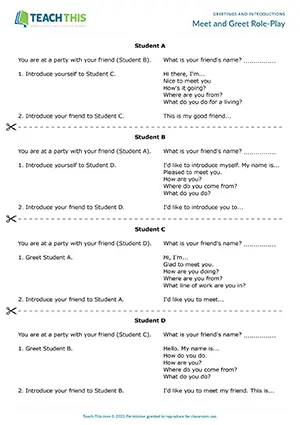
ESL Greetings and Introductions Role-Play - Speaking Activity: Communicative Practice - Group and Pair Work
This communicative greetings and introductions role-play activity helps to teach students various formal and informal phrases for greetings and introductions. In two pairs, students write their partner's...
ESL Greetings and Introductions Role-Play - Speaking Activity: Communicative Practice - Group and Pair Work This communicative greetings and introductions role-play activity helps to teach students various formal and informal phrases for greetings and introductions. In two pairs, students write their partner's name on a card. Each student then greets and introduces themselves to a student in the other pair using specific introductory phrases. Students then ask follow-up questions to get to know each other. Next, students introduce their friend to the person they are speaking to using the phrase on the card. Afterwards, students swap roles and repeat the activity to give them practice at using the formal and informal phrases. Finally, groups act out their role-plays in front of the class.Pleased to Meet You
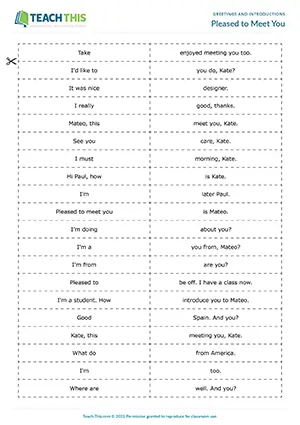
ESL Greetings and Introductions Game - Grammar and Vocabulary: Pelmanism - Speaking Activity: Ordering a Dialogue, Role-Play, Controlled Practice - Group Work
Here is an engaging greetings and introductions game to help students practice formal and informal phrases for greetings, making introductions and...
ESL Greetings and Introductions Game - Grammar and Vocabulary: Pelmanism - Speaking Activity: Ordering a Dialogue, Role-Play, Controlled Practice - Group Work Here is an engaging greetings and introductions game to help students practice formal and informal phrases for greetings, making introductions and saying goodbye. First, in groups, students take turns turning over two cards. The aim of the game is to find the beginning and ending of a phrase for greeting, introducing or saying goodbye. If a student matches a beginning and ending successfully, they say the phrase aloud, keep the cards and have another turn. If not, they turn the cards back over. The student with the most cards at the end of the game wins. Afterwards, students sort the cards into a conversation between three people. Students then take on the role of the three people and role-play the conversation. Finally, go through the conversation and phrases with the class and elicit other formal or informal phrases that could be used in the conversation. As an extension, groups create similar conversations using the language from the activity and present them to the class.Warm Welcomes

ESL Greetings and Introductions Worksheet - Vocabulary and Reading Exercises: Gap-fill, Ordering a Dialogue, Comprehension Questions
This free greetings and introductions worksheet helps students learn phrases for greetings and introductions in different settings. Students begin...
ESL Greetings and Introductions Worksheet - Vocabulary and Reading Exercises: Gap-fill, Ordering a Dialogue, Comprehension Questions This free greetings and introductions worksheet helps students learn phrases for greetings and introductions in different settings. Students begin by completing a conversation where two roommates are meeting each other for the first time with words from a box. Next, students read lines from a conversation where three people greet each other and make introductions at a party. Students then put the conversation in order by indicating who says each line. Afterwards, students answer four questions based on the two conversations. As an extension, in pairs or groups of three, students create their own greetings and introductions conversation using the language from the worksheet and then present it to the class.Sociable Dominoes

ESL Greetings and Introductions Game - Vocabulary: Matching - Group Work
In this rewarding greetings and introductions game, students match language for greetings, introductions and saying goodbye with suitable responses. The first player puts down one of their dominoes on either side of the domino on the table...
ESL Greetings and Introductions Game - Vocabulary: Matching - Group Work In this rewarding greetings and introductions game, students match language for greetings, introductions and saying goodbye with suitable responses. The first player puts down one of their dominoes on either side of the domino on the table, making sure that the language matches with a suitable response. Players then take turns matching their dominoes in the same way by putting a domino down at either end of the domino chain. If a player is unable to put down one of their dominoes, they take one from the top of the pile and put it down if they can. If there are no dominoes left in the pile, play passes to the next student. The first player to get rid of all their dominoes wins the game.Casual Greetings
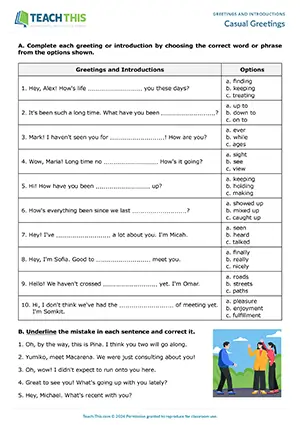
ESL Greetings and Introductions Worksheet - Vocabulary and Writing Exercises: Multiple Choice, Error Correction, Gap-fill, Writing Sentences
This informative greetings and introductions worksheet helps students practice informal phrases for greeting and introducing people. First, students complete...
ESL Greetings and Introductions Worksheet - Vocabulary and Writing Exercises: Multiple Choice, Error Correction, Gap-fill, Writing Sentences from Prompts This informative greetings and introductions worksheet helps students practice informal phrases for greeting and introducing people. First, students complete greetings and introductions by choosing the correct words or phrases from the options shown. Next, students find mistakes in greetings and introductions and correct them. Students then use words from a box to complete four related conversations. Finally, students read situations and write appropriate greetings or introductions using the language from the worksheet. - Making Requests ESL Games, Activities and Worksheets | Teach-This
-
Making Requests ESL Games, Activities & Worksheets
Guess the Request

ESL Making Requests Game - Speaking: Drawing Pictures, Guessing, Forming Questions - Pair Work
In this creative making requests game, students draw pictures of 'Can you...?' requests and try to guess requests from pictures a partner has drawn. First, in two groups, students draw...
ESL Making Requests Game - Speaking: Drawing Pictures from Prompts, Guessing, Forming Questions - Pair Work In this creative making requests game, students draw pictures of 'Can you...?' requests and try to guess requests from pictures a partner has drawn. First, in two groups, students draw pictures that illustrate 'Can you...?' requests in numbered squares. Students then pair up with someone from the other group and give their partner the drawings. Next, students take turns guessing the 'Can you...?' request for each of their partner's pictures. Students have three chances to guess the request for each picture. If a student guesses correctly the first time, they score three points. On the second try, they get two points. On the third try, they score one point. The student with the most points at the end of the game wins.Requests Mingle
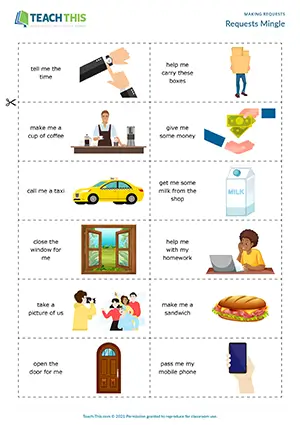
ESL Making, Accepting and Declining Requests Activity - Speaking: Asking and Answering Questions, Communicative Practice
In this free making requests speaking activity, students practice making, accepting and declining requests using prompts on cards. Give each student a request...
ESL Making, Accepting and Declining Requests Activity - Speaking: Asking and Answering Questions from Prompts, Communicative Practice In this free making requests speaking activity, students practice making, accepting and declining requests using prompts on cards. Give each student a request card. On one side is a picture and request prompt and on the other side is a tick or cross. Students hold their cards so the request prompt is facing towards them and the tick or cross is facing away. Students then go around the class making, accepting and declining requests with as many different partners as possible. If students see a tick, they accept the request. If there is a cross, students decline the request. When the students have finished, they exchange cards and repeat the activity, but this time they hold their cards the other way around so the request prompt is facing away. Students then go around the class, making a different request each time they speak to a classmate.Could you...?
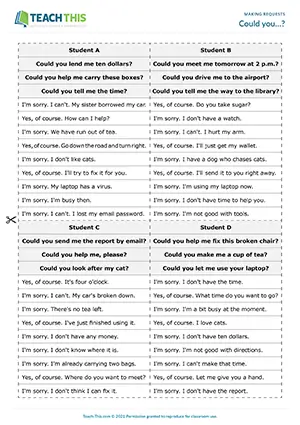
ESL Could You Requests Game - Speaking: Asking and Answering Questions, Controlled Practice - Group Work
In this engaging making requests game, students race to find someone to accept their requests. The aim of the game is for students to make requests and find the person in their group who has the 'Yes, of...
ESL Could You Requests Game - Speaking: Asking and Answering Questions from Prompts, Controlled Practice - Group Work In this engaging making requests game, students race to find someone to accept their requests. The aim of the game is for students to make requests and find the person in their group who has the 'Yes, of course...' response to each request. Student A begins by reading the first request to one of the other students, e.g. 'Could you lend me ten dollars?' That student then looks for a matching reply on their card. If the chosen student accepts the request by saying 'Yes, of course...', Student A crosses off the request. If the chosen student declines the request by saying 'I'm sorry...', Student A has to wait until their next turn before making the request to another student. Student B then reads the first request on their card to one of the other students, and so on. The first student to cross off all three requests wins the game.Help Me Out!

ESL Making Requests Game - Speaking: Asking and Answering Questions, Communicative Practice
In this communicative making requests game, students practice making, accepting and declining requests by racing to find classmates who are free to help them with five tasks. First, students write five...
ESL Making Requests Game - Speaking: Asking and Answering Questions from Prompts, Communicative Practice In this communicative making requests game, students practice making, accepting and declining requests by racing to find classmates who are free to help them with five tasks. First, students write five tasks they plan to do and need help with in a diary, e.g. wash the car, clean the house, etc. Students then go around the class making requests to find classmates who are free to help them with each task, e.g. 'Could you help me wash my car on Tuesday afternoon?' Students also fill in the rest of their diary with tasks their classmates have asked them for help with. If a student is free, they accept the request and write the task in their diary. The student then signs their name in the square under the task on their partner's worksheet. If a student already has something to do, they decline the request and give their reason, e.g. 'I'm sorry, I can't. I'm helping Tim clean his house.' The first student to find classmates to help them with their five tasks wins the game. Afterwards, continue the game to see who can complete their diary with the most tasks.Race to Respond
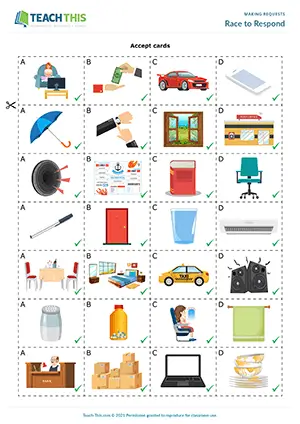
ESL Accepting and Declining Requests Game - Speaking: Asking and Answering Questions, Freer Practice - Group Work
In this fast-paced making requests game, students race to accept and decline requests. In groups, students take turns picking up a card, making an appropriate request based on the situation and placing the...
ESL Accepting and Declining Requests Game - Speaking: Asking and Answering Questions from Prompts, Freer Practice - Group Work In this fast-paced making requests game, students race to accept and decline requests. In groups, students take turns picking up a card, making an appropriate request based on the situation and placing the card face-up on the table. Students with a matching accept or decline picture card then race to respond to the request. The first student to accept or decline the request and lay their matching picture card down on top of the request card wins and keeps the two cards. The student with the most pairs of cards at the end of the game wins.Special Requests

ESL polite Requests Worksheet - Grammar Exercises: Binary Choice, Gap-fill, Matching, Unscrambling, Error Correction, Rewriting and Writing Sentences
In this comprehensive making requests worksheet, students learn and practice how to make polite requests with 'Could you...?' and 'Would you mind...?' Students...
ESL polite Requests Worksheet - Grammar Exercises: Binary Choice, Gap-fill, Matching, Unscrambling, Error Correction, Rewriting and Writing Sentences In this comprehensive making requests worksheet, students learn and practice how to make polite requests with 'Could you...?' and 'Would you mind...?' Students start by underlining the correct phrase to complete each request. Students then complete polite requests with the correct form of the verbs in brackets. Next, students match polite requests to suitable responses. After that, students put words in the correct order to form polite requests and complete an error correction exercise. Lastly, students write a polite request for each situation using 'Could you..?' or 'Would you mind...?'Be polite

ESL polite Requests Worksheet - Vocabulary Exercises: Forming Questions, Word Completion - Speaking Activity: Asking and Answering Questions - Pair Work
Here is a free polite requests worksheet to help students practice a variety of phrases for making, accepting and declining requests politely. First, students use...
ESL polite Requests Worksheet - Vocabulary Exercises: Forming Questions, Word Completion - Speaking Activity: Asking and Answering Questions from Prompts - Pair Work Here is a free polite requests worksheet to help students practice a variety of phrases for making, accepting and declining requests politely. First, students use polite phrases to write requests for ten situations. Next, students complete phrases that accept and decline requests. Finally, in pairs, students take turns making, accepting and declining requests using the situations and phrases.Deal With It
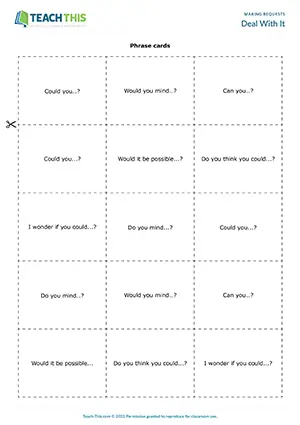
ESL Making Requests Game - Speaking: Forming Questions, Communicative Practice - Group Work
In this productive making requests game, students practice a variety of request phrases by racing to make suitable requests for common situations. In groups of three, one student picks up a situation...
ESL Making Requests Game - Speaking: Forming Questions, Communicative Practice - Group Work In this productive making requests game, students practice a variety of request phrases by racing to make suitable requests for common situations. In groups of three, one student picks up a situation card, while the other two students each take a phrase card. The student then reads the response or statement on the situation card, e.g. 'The plants need watering.' The two students then race to come up with an appropriate request using the phrase on their card. The first student to make a suitable request wins and keeps the situation card, e.g. 'Would you mind watering them for me?' The next student then picks up a situation card, and so on. The student with the most cards at the end of the game wins.Let's Practice Requests

ESL Requests Worksheet - Vocabulary Exercises: Gap-fill, Writing Sentences, Error Correction - Speaking Activity: Role-Play, Freer Practice - Pair Work
In this free making requests worksheet, students practice making, accepting and declining requests using various phrases. First, students read two...
ESL Requests Worksheet - Vocabulary Exercises: Gap-fill, Identifying, Writing Sentences, Error Correction - Speaking Activity: Role-Play, Freer Practice - Pair Work In this free making requests worksheet, students practice making, accepting and declining requests using various phrases. First, students read two dialogues and complete them with words from a box. Students then role-play the dialogues with a partner to compare their answers. Next, students identify the phrases to make requests in the two dialogues and write them in a table. After that, students identify and write the phrase used to accept or decline each request. Next, students use the phrases from the table to write a request and reply for each prompt. Following that, students write four requests of their own and practice making, accepting and declining the requests with their partner. Students then read short impolite dialogues and rewrite the requests and responses to make them more polite. Finally, in pairs, students write and then present a conversation where they make, accept and decline requests.Making Requests Board Game
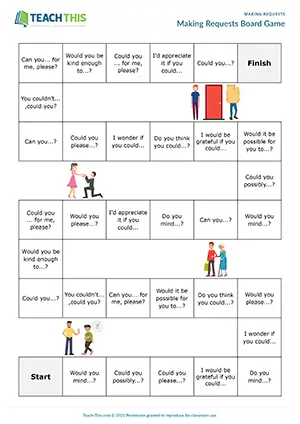
ESL Requests Board Game - Speaking: Forming Questions - Group Work
In this fun making requests board game, students practice making requests in everyday situations using various phrases. Players take turns rolling the dice and moving their counter along the board. When a player lands on a square, the...
ESL Requests Board Game - Speaking: Forming Questions from Prompts - Group Work In this fun making requests board game, students practice making requests in everyday situations using various phrases. Players take turns rolling the dice and moving their counter along the board. When a player lands on a square, the student to their right takes a card and reads the situation on the card to the player, e.g. 'You are at a hotel reception. You need a taxi. Make a request.' The player then tries to make a request for the situation using the request phrase on the square, e.g. 'Do you mind calling a taxi for me?' If the request is grammatically correct and appropriate, the student who read the situation accepts the request, e.g. 'Sure. No problem.' If the request is incorrect, the student refuses the request, e.g. 'Sorry, but I do mind.' The player then goes back two squares. The first player to reach the finish wins the game.Party Time
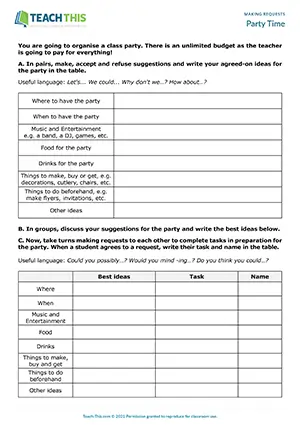
ESL Suggestions and Requests Activity - Speaking: Asking and Answering Questions, Table Completion, Discussion, Presenting - Pair and Group Work
In this imaginative making suggestions and requests activity, students plan and organise a class party by making, accepting and refusing suggestions and requests...
ESL Suggestions and Requests Activity - Speaking: Planning, Asking and Answering Questions, Table Completion, Guided Discussion, Presenting - Pair and Group Work In this imaginative making suggestions and requests activity, students plan and organise a class party by making, accepting and refusing suggestions and requests. Students imagine that they are going to organize a class party and that there is an unlimited budget as the teacher is going to pay for everything! In pairs, students then make, accept and refuse suggestions and write down their agreed-on ideas for the party. Next, each pair discusses their suggestions for the party with another pair and writes down the best ideas. After that, students take turns making requests to each other to complete tasks in preparation for the party, e.g. 'Could you possibly go to the shop and buy ten bottles of Champagne?' Students only agree to a request if they genuinely think they wouldn't mind doing it. When a student agrees, the group writes down their name and task. If students don't want to do something, they decline the request and explain why. Afterwards, groups tell the class about their party plans and what each student is going to do in preparation for the party. Finally, the class votes for the group with the best party ideas.Would you mind...?
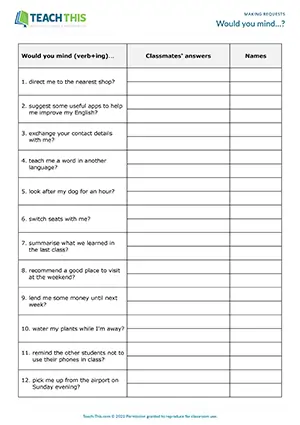
ESL Would You Mind Activity - Speaking: Asking and Answering Questions, Communicative Practice
In this communicative making requests activity, students practice making 'Would you mind -ing...?' requests and accepting and declining them. Students go around the class making requests for the...
ESL Would You Mind Activity - Speaking: Asking and Answering Questions from Prompts, Communicative Practice In this communicative making requests activity, students practice making 'Would you mind -ing...?' requests and accepting and declining them. Students go around the class making requests for the things shown on their worksheet using 'Would you mind -ing...?' Students only agree to a classmate's request if they think they wouldn't mind doing it. If students don't want to do something, they decline the request and explain why. For each request, students speak to two people. When a classmate responds to a request, the student writes down their reply and name. When everyone has finished, students give feedback to the class on the people who accepted and declined their requests.What's missing?

ESL Requests Game - Vocabulary, Gap-fill, Guessing - Pair Work
In this entertaining making requests game, students practice phrases for making requests. In pairs, one student begins by guessing the missing words in the first request. Their partner listens and tells them if they are correct or not...
ESL Requests Game - Vocabulary, Gap-fill, Guessing - Pair Work In this entertaining making requests game, students practice phrases for making requests. In pairs, one student begins by guessing the missing words in the first request. Their partner listens and tells them if they are correct or not. If the student guesses correctly the first time, they score three points and write the words in the gaps. On the second try, they get two points. On the third try, they score one point. After the missing words have been guessed correctly or three chances have passed, their partner guesses the missing words in the second request, and so on. The student with the most points at the end of the game is the winner. - Giving Opinions ESL Activities, Games and Worksheets | Teach-This
-
Giving Opinions ESL Activities, Games & Worksheets
I think that...
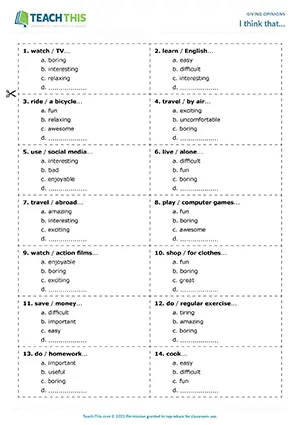
ESL Giving Opinions Activity - Speaking: Gap-Fill, Forming Sentences, Asking and Answering Questions, Communicative Practice - Pair Work
Here is a free giving opinions and reasons activity to help students practice phrases for giving opinions, adjectives of opinion, 'why' and 'because'. In pairs...
ESL Giving Opinions Activity - Speaking: Gap-Fill, Forming Sentences from Prompts, Asking and Answering Questions, Communicative Practice - Pair Work Here is a free giving opinions and reasons activity to help students practice phrases for giving opinions, adjectives of opinion, 'why' and 'because'. In pairs, students take turns picking up a card and laying it face-up on the table. The student then gives their opinion about the topic by making a sentence from the prompt, e.g. 'I think that learning English is easy.' Their partner then asks them why. The student then explains the reason for their opinion, starting with the word 'because'. Their partner then gives their opinion on the topic, and so on. Afterwards, students report back to the class on their partner's opinions and reasons. This activity can also be used to practice other phrases for giving opinions, e.g. 'In my opinion...'In my Opinion

ESL Giving Opinions Worksheet - Vocabulary Exercises: Writing Sentences, Sentence Completion - Speaking Activity: Freer Practice - Pair Work
This comprehensive giving opinions worksheet helps students learn and practice how to give opinions using three positive and negative phrases. Students...
ESL Giving Opinions Worksheet - Vocabulary Exercises: Writing Sentences from Prompts, Sentence Completion - Speaking Activity: Freer Practice - Pair Work This comprehensive giving opinions worksheet helps students learn and practice how to give opinions using three positive and negative phrases. Students begin by underlining the adjective in each statement that is closest to their opinion. Students then write their opinions using three phrases, e.g. 'In my opinion, reading is fun.' Next, students read how to give an opinion by making the phrases negative to show disagreement. After that, students write four things they disagree with from the first exercise using the negative phrases, e.g. 'I don't think that reading is boring.' Students then read ten statements and write each one in an agree or disagree column based on their opinion. Finally, students take turns sharing their opinions with a partner, who responds by agreeing or disagreeing using the phrases from the worksheet.Really?
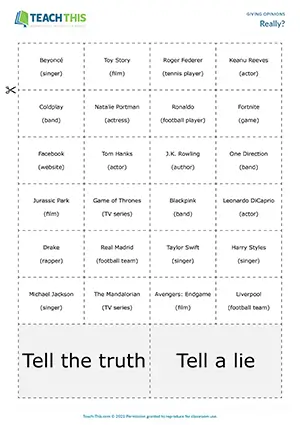
ESL Giving Opinions Game - Speaking: Asking and Answering Questions, True or False - Group Work
In this fun giving opinions game, students give true or false opinions about famous people or things. In groups, players take turns picking up a card and placing it face-up on the desk. Next, the student on the...
ESL Giving Opinions Game - Speaking: Asking and Answering Questions, True or False - Group Work In this fun giving opinions game, students give true or false opinions about famous people or things. In groups, players take turns picking up a card and placing it face-up on the desk. Next, the student on the player's right asks them for their opinion of the person or thing on the card, e.g. 'What do you think of Beyoncé?' The player then takes a 'Tell the truth' or 'Tell a lie' card and gives a true or false opinion as indicated on the card. Next, the other students each ask the player one follow-up question to help them decide if they are lying or telling the truth, e.g. 'What's your favourite Beyoncé song?' Each student then decides if the player is lying or telling the truth, and the player reveals the answer. If a student guesses correctly, they score one point. The student with the most points at the end of the game wins.European Vacation
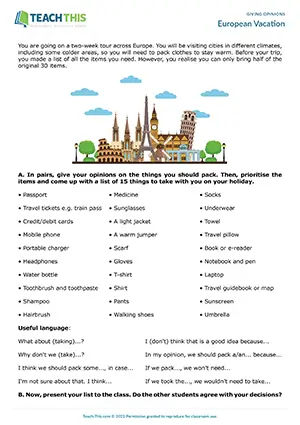
ESL Giving Opinions and Prioritizing Activity - Speaking: Discussion, Communicative Practice, Presenting - Pair Work
In this communicative giving opinions activity, students share opinions, prioritise, and agree on a list of items to pack for a European holiday. First, in pairs, students give their opinions on the things they...
ESL Giving Opinions and Prioritizing Activity - Speaking: Guided Discussion, Communicative Practice, Presenting - Pair Work In this communicative giving opinions activity, students share opinions, prioritise, and agree on a list of items to pack for a European holiday. First, in pairs, students give their opinions on the things they should pack for their tour of Europe. Students then prioritise the items and come up with a list of 15 things to take with them on their holiday. Afterwards, pairs present their list of items to the class, who listen and then say whether they agree or disagree with the items chosen, pointing out any problems they see with the list, and the pair justifies their opinions if need be. Finally, students come up with a list together as a class.Four Corners
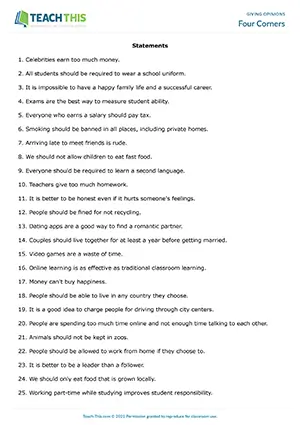
ESL Giving and Defending Opinions Activity - Speaking: Discussions, Explaining, Reporting, Refuting, Communicative Practice - Group Work
In this free giving and defending opinions speaking activity, students practice expressing and defending their opinions. Place a sign in each corner...
ESL Giving and Defending Opinions Activity - Speaking: Guided Discussions, Explaining, Reporting, Refuting, Communicative Practice - Group Work In this free giving and defending opinions speaking activity, students practice expressing and defending their opinions. Place a sign in each corner of the classroom (strongly agree, agree, disagree, and strongly disagree). Read a statement to the class, e.g. 'Celebrities earn too much money.' Students then go to the corner that best matches their opinion, e.g. strongly agree. Next, the students in the same corner discuss why they chose that opinion and then report their reasons to the class. After each corner has given reasons for their opinion, students from the different corners politely refute another corner's opinion. Afterwards, students who felt persuaded by any of the arguments switch corners. The process is then repeated with a new statement, and so on.How to improve your English
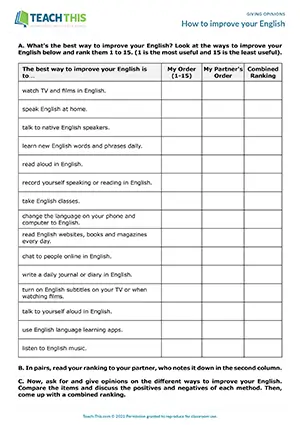
ESL Giving Opinions Activity - Speaking: Ranking Items, Discussion, Controlled and Freer Practice - Pair Work
In this useful giving opinions speaking activity, students ask for and express opinions on ways to improve their English. First, students rank 15 ways to improve their English (1 is the most useful and 15 is the...
ESL Giving Opinions Activity - Speaking: Ranking Items, Guided Discussion, Controlled and Freer Practice - Pair Work In this useful giving opinions speaking activity, students ask for and express opinions on ways to improve their English. First, students rank 15 ways to improve their English (1 is the most useful and 15 is the least useful). In pairs, students then read their ranking to their partner who notes it down. Next, students ask for and give their opinions on the different methods, comparing them and discussing the merits and drawbacks of each method. Using their ideas, pairs then come up with a combined ranking. Afterwards, students work with a new partner and compare their combined rankings, discussing any similarities or differences. Finally, students rejoin with their original partner and report back to the class on their top three methods for improving their English.Our Opinions
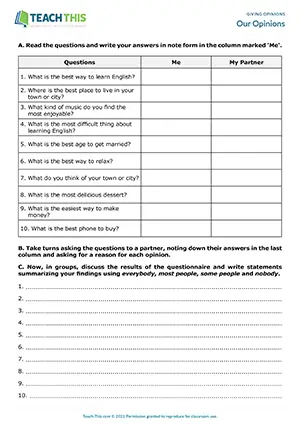
ESL Expressing Opinions Activity - Speaking: Asking and Answering Questions, Discussion, Summarising - Pair and Group Work
In this insightful expressing opinions speaking activity, students practice giving, explaining and summarizing opinions. First, students read questions and write...
ESL Expressing Opinions Activity - Speaking: Asking and Answering Questions from Prompts, Discussion, Summarising - Pair and Group Work In this insightful expressing opinions speaking activity, students practice giving, explaining and summarising opinions. First, students read questions and write their answers in note form. Students then take turns asking the questions to a partner, noting down their answers and asking for a reason for each opinion. Next, in groups, students discuss the results of the questionnaire and write statements summarising their findings, e.g. 'Most people think the best way to learn English is to practice it every day.' Groups then present their answers to the class. Finally, students discuss the findings as a class and groups debate any differences of opinion.Rant or Rave
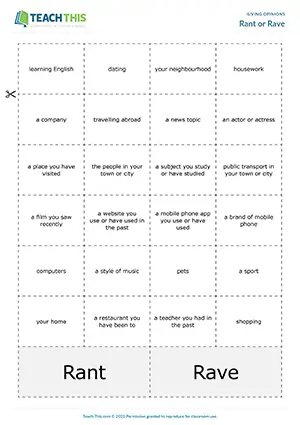
ESL Giving Opinions Game - Speaking: Impromptu Speech, Communicative Practice - Group Work
In this entertaining giving opinions game, students rant or rave about various topics using positive or negative opinion adjectives. In groups, players take turns picking up a topic card and placing it...
ESL Giving Opinions Game - Speaking: Impromptu Speech, Communicative Practice - Group Work In this entertaining giving opinions game, students rant or rave about various topics using positive or negative opinion adjectives. In groups, players take turns picking up a topic card and placing it face up on the desk. The player then picks up a 'Rant' or 'Rave' card. If the player turns over a 'Rant' card, they express negative opinions about the topic on the card for one minute without stopping. If the player picks up a 'Rave' card, they express positive opinions. The other students listen and award one point to the player for each appropriate opinion adjective they use during their rant or rave. If a player can't think of anything to say or stops talking before the time limit has been reached, no points are awarded. The player with the most points at the end of the game wins.What's your Opinion?

ESL Giving Opinions Activity - Speaking: Gap-fill, Asking and Answering Questions, Writing Sentences - Pair Work
In this enjoyable giving opinions speaking activity, students ask for and share opinions on school subjects. First, students complete questions with different school subjects from a box or using their own...
ESL Giving Opinions Activity - Speaking: Gap-fill, Asking and Answering Questions from Prompts, Writing Sentences - Pair Work In this enjoyable giving opinions speaking activity, students ask for and share opinions on school subjects. First, students complete questions with different school subjects from a box or using their own ideas. In pairs, Students then ask for their partner's opinions using the questions and write sentences about their answers, e.g. 'Terry doesn't think that science is difficult. He scored 95% on his last test.' Afterwards, students check their partner's sentences for errors. Finally, students present their partner's opinions on school subjects to the class.Controversial Statements

ESL Giving and Justifying Opinions Activity - Speaking: Discussions, Communicative Practice - Group Work
In this engaging giving and justifying opinions speaking activity, students express and justify opinions by arguing for or against a set of controversial statements. Working alone, students read statements...
ESL Giving and Justifying Opinions Activity - Speaking: Guided Discussions, Communicative Practice - Group Work In this engaging giving and justifying opinions speaking activity, students express and justify opinions by arguing for or against a set of controversial statements. Working alone, students read statements and write down two reasons why someone might agree or disagree with each one. Next, in groups, comprising of two 'for' students and two 'against' students, students discuss the controversial statements, giving and justifying their opinions, and arguing for or against each statement. When the groups have finished, they tell the class who gave the most convincing arguments and why. As an extension, students discuss their real opinions on the controversial statements in their groups.Explain Yourself

ESL Giving Opinions Activity - Speaking: Sentence Completion, Guessing, Asking Questions, Discussions, Communicative Practice - Group Work
In this communicative giving opinions activity, students practice giving opinions and asking embedded questions to gain more information. In groups...
ESL Giving Opinions Activity - Speaking: Sentence Completion, Guessing, Asking Questions, Guided Discussions, Communicative Practice - Group Work In this communicative giving opinions activity, students practice giving opinions and asking embedded questions to gain more information. In groups, students take turns choosing a numbered card and a controversial issue from the board. Each student then completes the opinion phrase on that numbered card with their opinion on the topic. Students then mix the opinion cards together. Next, the first student picks up one of the cards and reads the opinion to the group, who guesses which student the card belongs to. The writer then reveals themselves to the group, who then ask the student embedded questions to get them to explain more about their opinion and feelings on the issue. If the students have opposing views on their cards, they have a brief debate on the topic. The next student then chooses a number and controversial issue, and so on. Afterwards, groups give feedback on which topics caused the most debate and who gave the most convincing arguments.It's Debatable
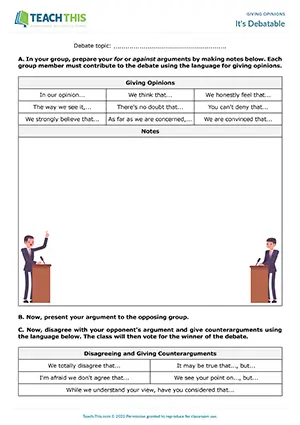
ESL Giving Opinions Activity - Speaking: Debating, Communicative Practice - Group Work
In this free debating activity, students participate in a debate to help them practice phrases for giving opinions, disagreeing and giving counterarguments. In competing groups, students write a...
ESL Giving Opinions Activity - Speaking: Debating, Communicative Practice - Group Work In this free debating activity, students participate in a debate to help them practice phrases for giving opinions, disagreeing and giving counterarguments. In competing groups, students write a debate topic on the worksheet and prepare their for or against arguments. When everyone is ready, two groups debate their topic in front of the class with each group member contributing to the debate. After each group has presented their arguments, the two groups respond to each other by disagreeing and giving counterarguments. Afterwards, the class votes for the winner. Two new groups then come to the front of the class and begin the next debate, and so on.My Opinion

ESL Giving Opinions and Persuading Activity - Speaking: Discussions, Persuading, Communicative Practice - Group Work
In this rewarding giving opinions speaking activity, students express opinions on controversial statements and try to persuade others with differing opinions to change their minds. In groups, students...
ESL Giving Opinions and Persuading Activity - Speaking: Guided Discussions, Persuading, Communicative Practice - Group Work In this rewarding giving opinions speaking activity, students express opinions on controversial statements and try to persuade others with differing opinions to change their minds. In groups, students take turns picking up a statement card and reading it to the group. Next, each student chooses an opinion card to show how much they agree or disagree with the statement and places it in front of them, e.g. strongly agree, undecided, disagree, etc. The reader then gives their opinion and the other students respond with their own opinion in turn. After that, students try to persuade the group members with differing opinions to change their minds. If anyone changes their mind during the discussion, they show this by changing the opinion card in front of them. Afterwards, groups give feedback on which statements caused the greatest argument and say who was the most persuasive.


