
- Writing Exam Preparation
-
writing Exam Preparation EAP Activities, worksheets & Games
Conclusion Clinic
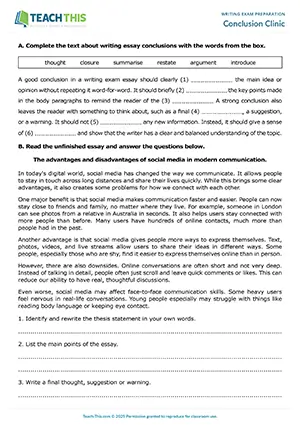
EAP Essay Conclusions Worksheet - Reading and writing Exercises: Gap-fill, Answering Questions, writing and Revising a Conclusion, Peer Review - Pair Work
In this productive essay conclusions worksheet, students practice writing and revising an essay conclusion based on peer feedback. Students begin by...
EAP Essay Conclusions Worksheet - Reading and writing Exercises: Gap-fill, Answering Questions, writing and Revising a Conclusion, Peer Review and Feedback - Pair Work In this productive essay conclusions worksheet, students practice writing and revising an essay conclusion based on peer feedback. Students begin by completing a text about essay conclusions with words from a box. Students then read an unfinished essay, without a conclusion, and answer questions about it. Next, students use their answers to write a conclusion for the essay. After that, students exchange their conclusion with a partner and answer questions to help give each other feedback. Finally, students return the conclusion to their partner, who rewrites their conclusion based on the feedback.Editing in Action
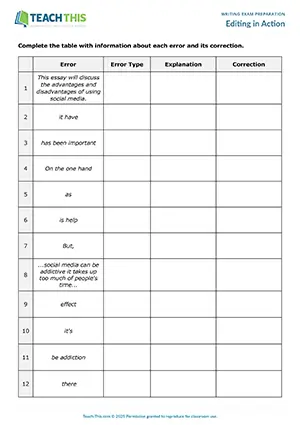
EAP Editing and Revising Activity - Reading, Grammar, Vocabulary and writing: Identifying, Error Correction - Speaking: Discussion, Freer practice - Pair Work
In this comprehensive writing exam preparation activity, students practice their editing and revision skills by identifying common writing errors...
EAP Editing and Revising Activity - Reading, Grammar, Vocabulary and writing: Identifying, Error Correction - Speaking: Guided Discussion, Freer practice - Pair Work In this comprehensive writing exam preparation activity, students practice their editing and revision skills by identifying common writing errors, explaining them, and making corrections. First, students read and underline three errors in each paragraph of an essay, focusing on error types written on the board. Next, in pairs, students compare answers and discuss why each underlined word, phrase or sentence is an error and suggest corrections. Working together, students then compare their identified errors with those in an 'error' column on a worksheet. Following that, students complete the worksheet by identifying the type of error, explaining why it's incorrect, and then correcting it. Afterwards, elicit answers and explanations from the class and write the corrections on the board. Finally, pairs discuss why editing and revision skills are important for writing essays and then give feedback to the class on their answers.Essay Station Rotation
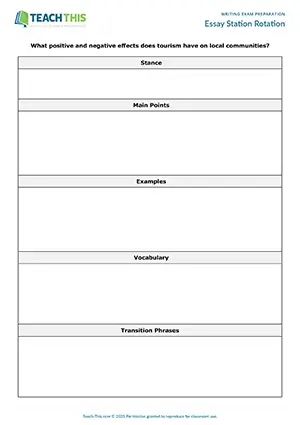
EAP writing Exam Preparation Activity -writing and Speaking: Brainstorming, Creating an Essay Outline, Presenting, Communicative practice - Group Work
In this collaborative outlining activity, students generate, organise and expand on ideas for answering essay questions and then present their developed outlines...
EAP writing Exam Preparation Activity -writing and Speaking: Brainstorming, Creating an Essay Outline, Presenting, Communicative practice - Group Work In this collaborative outlining activity, students generate, organise and expand on ideas for answering essay questions and then present their developed outlines. In the activity, groups rotate around stations, building essay outlines together. At each station, the first group reads the essay question, chooses a stance or focus and writes it clearly in the appropriate box. After three minutes, the groups rotate to the next station. At the new stations, groups read what is already written and add new ideas or expand on existing ones. Groups can work on the sections in any order and write in multiple sections during each turn, building on weaker sections for a more balanced response. The process continues until each group has visited every station. Groups then return to their original station, review the added ideas and prepare to present them to the class using a framework. Next, each group presents their outline to the class. Afterwards, groups discuss one idea from another group's work they found useful and how they might use it.Perfect Punctuation

EAP writing Exam Preparation Worksheet - Reading and writing Exercises: Matching, Identifying, Error Correction, Paragraph writing, Peer Review - Pair Work
In this punctuation errors worksheet, students learn to identify and correct common punctuation errors to improve their ability to construct grammatically...
EAP writing Exam Preparation Worksheet - Reading and writing Exercises: Matching, Identifying, Error Correction, Paragraph writing, Peer Review - Pair Work In this punctuation errors worksheet, students learn to identify and correct common punctuation errors to improve their ability to construct grammatically correct sentences. First, students match each type of punctuation error to its explanation. Students then read sentences and write the punctuation errors they contain. Next, students read about how to avoid the most common writing exam punctuation errors. After that, students rewrite sentences, applying the correct punctuation. Students then move on to read an extract from a student's writing exam paper, identify the errors, and rewrite the paragraph so that the punctuation is correct. Following that, students choose a topic and write a short paragraph that has one introductory phrase, a compound sentence, a complex sentence, and a relative clause to practice the different comma rules. Finally, students swap worksheets with a partner and review their paragraph for punctuation errors, giving feedback and suggesting improvements.writing Jeopardy
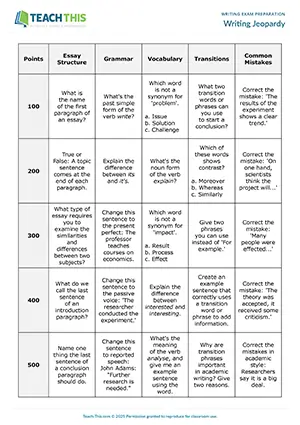
EAP writing Exam Preparation Game - Grammar, Vocabulary, and Speaking: Answering Quiz Questions, Freer practice - Group Work
In this free writing exam preparation game, students review key writing concepts by answering quiz questions in different categories. This Jeopardy-style...
EAP writing Exam Preparation Game - Grammar, Vocabulary, and Speaking: Answering Quiz Questions, Freer practice - Group Work In this free writing exam preparation game, students review key writing concepts by answering quiz questions in different categories. This Jeopardy-style game covers quiz questions on five writing categories with questions of varying difficulty levels. Start by choosing a square to begin the game, e.g. essay structure 100. Read the quiz question to the class. The first student to put up their hand and give the correct answer wins that square for their team. Write the winning team's name in the square. If a student gives an incorrect answer, their team is out of the round and can only answer again if all the other teams give a wrong answer. The winning team then chooses the next square, and all the teams race to answer as before. The team with the most points at the end of the game wins.writing Task Match Up
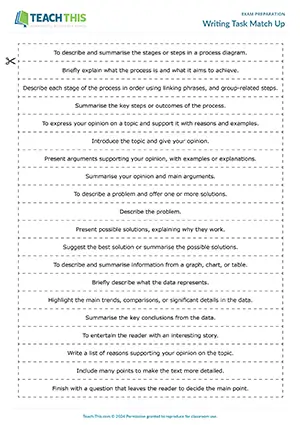
EAP writing Exam Preparation Activity - Reading, writing and Speaking: Matching, writing Instructions, Discussion, Freer practice - Pair Work
This useful writing exam preparation activity introduces students to four common writing exam task types, familiarising them with their purpose and general structure...
EAP writing Exam Preparation Activity - Reading, writing and Speaking: Matching, writing Instructions, Discussion, Freer practice - Pair Work This useful writing exam preparation activity introduces students to four common writing exam task types, familiarising them with their purpose and general structure. First, in pairs, students turn over one task card representing a common writing task type (explaining a process, opinion essay, problem-solution essay, or summarising data). Students then complete the purpose, introduction, body and conclusion on the card with four corresponding task instruction strips, writing the sentences on the card. When a pair completes a task card, they show it to you. If the answers are correct, they move on to the next task card. If not, students go back and revise their mistakes accordingly. The activity continues until all the task cards are completed with the correct instructions. After that, students reflect on the activity by discussing three task-related questions in their pairs. Finally, pairs share their responses with the class. As an extension, students choose one of the task types and write a plan in response to the task instructions.Time Management Challenge
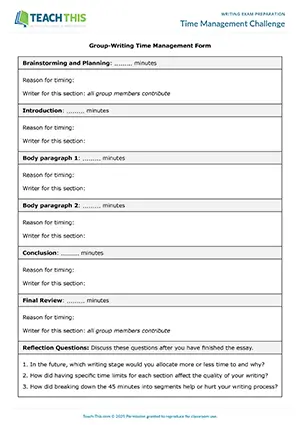
EAP writing Exam Preparation Activity - writing and Speaking: Discussion, Form Completion, Brainstorming, writing Sentences, Essay writing, - Group Work
In this engaging writing exam preparation activity, students organise an essay writing process into timed segments and then collaboratively plan and write...
EAP writing Exam Preparation Activity - writing and Speaking: Discussion, Form Completion, Brainstorming, writing Sentences, Essay writing, - Group Work In this engaging writing exam preparation activity, students organise an essay writing process into timed segments and then collaboratively plan and write the essay. First, in groups, students allocate specific times to each stage of the writing process, explaining their reasoning and assigning a group member to write each stage of the essay. The times should total 45 minutes. Next, groups choose an essay question and have 45 minutes to write the essay, following their proposed timing structure and ensuring smooth transitions between paragraphs. When the students have finished, they discuss reflection questions and give feedback on their time management strategy to the class. Finally, elicit the timings and key considerations at each stage of the writing process from the class and give the suggested answers.Here's what our members are saying...
- The Writing Process
-
The writing Process EAP worksheets & Activities
Analysing Essay Questions
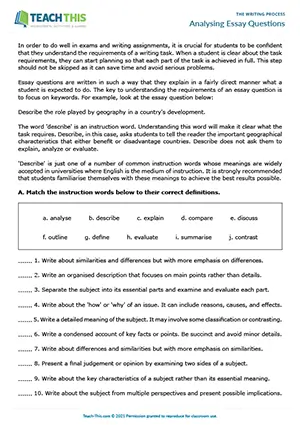
EAP Analysing Essay Questions Worksheet - Reading and writing Exercises: Matching, writing a Thesis Statement and Main Ideas
In this comprehensive analysing essay questions worksheet, students learn instruction words and practice strategies for understanding and clarifying writing task requirements. Students begin...
EAP Analysing Essay Questions Worksheet - Reading and writing Exercises: Matching, writing a Thesis Statement and Main Ideas In this comprehensive analysing essay questions worksheet, students learn instruction words and practice strategies for understanding and clarifying writing task requirements. Students begin by reading information about instruction words used in essay questions and writing assignments. Students then reorder letters to reveal common essay instruction words. Next, students read ten definitions and match them to the correct instruction words. Afterwards, students read about a three-step strategy for breaking down and analysing essay questions. Students then use this information to help them examine an essay question and develop a working outline for an essay.Brainstorming and Mind Mapping

EAP Brainstorming and Mind Mapping Worksheet - Reading and writing Exercises: Brainstorming, Creating a Mind Map and an Essay Outline, writing an Essay
In this useful brainstorming and mind mapping worksheet, students learn and practice two common pre-writing techniques. Students then use one of the techniques...
EAP Brainstorming and Mind Mapping Worksheet - Reading and writing Exercises: Brainstorming, Creating a Mind Map and an Essay Outline, writing an Essay In this useful brainstorming and mind mapping worksheet, students learn and practice two common pre-writing techniques. Students then use one of the techniques to produce an essay outline and write a complete essay. Students start by reading information about brainstorming and mind mapping. Students then practice creating either a brainstorming list or a mind map for an essay about work-life balance. Next, students use their brainstorming list or mind map to produce an essay outline on the topic. In the last exercise, students use the essay outline to write a complete essay.Revising and Editing an Essay
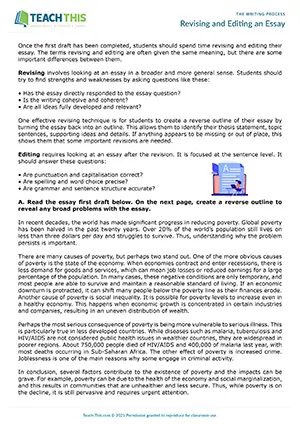
EAP Revising and Editing an Essay Worksheet - Reading and writing Exercises: Creating an Essay Outline, writing Notes, Editing and Revising a Paragraph
In this free revising and editing worksheet, students learn the differences between revising and editing and use revising and editing techniques to identify...
EAP Revising and Editing an Essay Worksheet - Reading and writing Exercises: Creating an Essay Outline, writing Notes, Editing and Revising a Paragraph In this free revising and editing worksheet, students learn the differences between revising and editing and use revising and editing techniques to identify problems in the first draft of an essay. First, students read information about revising and editing and use the reverse outlining technique to identify needed revisions in an essay first draft. After creating the reverse outline, students review it to make notes about necessary revisions. Finally, students read another version of a body paragraph from the essay. Students scan it twice, once to identify errors with grammar and punctuation and once for vocabulary use and spelling. Students then fix the errors by rewriting the paragraph.Two-Draft Sprint
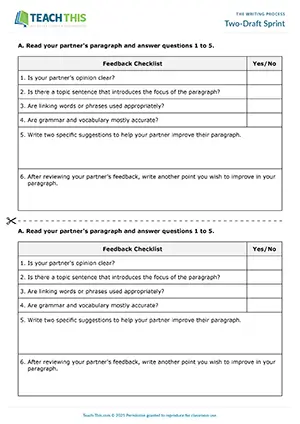
EAP Drafting and Revising Activity - Reading and writing: Paragraph writing, Peer Review and Feedback, Self-Reflection
In this handy drafting and revising activity, students draft a paragraph and then use peer feedback and self-reflection to revise and improve their work. First, students have five minutes to read a prompt and...
EAP Drafting and Revising Activity - Reading and writing: Paragraph writing, Peer Review and Feedback, Self-Reflection In this handy drafting and revising activity, students draft a paragraph and then use peer feedback and self-reflection to revise and improve their work. First, students have five minutes to read a prompt and plan their response, noting down key points, examples, and a basic paragraph structure. Students then have 15 minutes to write a 150 to 200-word paragraph in response to the prompt, supporting their opinions with evidence and examples. When the 15 minutes are up, students swap papers with a partner. Next, students use a checklist to review their partner's paragraph and write two points for improvement. Students then return the original paragraph and feedback to their partner, who reads the feedback and identifies an additional point to improve. After that, students redraft their paragraph, implementing the two peer suggestions, their self-identified improvement point, and highlighting or underlining the changes they make. Finally, students write a brief reflection paragraph explaining their changes and improvements.writing Process Relay
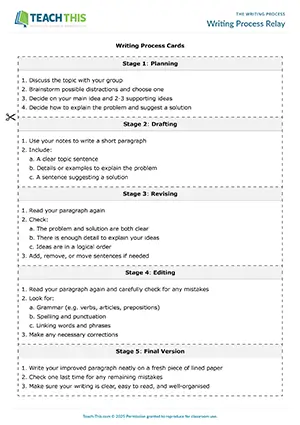
EAP writing Process Activity - writing: Brainstorming, Outlining, Drafting, Revising, Editing, Peer Feedback - Group Work
In this collaborative writing process activity, students plan, draft, revise, and edit a short academic paragraph, then exchange focused peer feedback in a gallery walk to refine their writing. In groups, students...
EAP writing Process Activity - writing: Brainstorming, Outlining, Drafting, Revising, Editing, Peer Feedback - Group Work In this collaborative writing process activity, students plan, draft, revise, and edit a short academic paragraph, then exchange focused peer feedback in a gallery walk to refine their writing. In groups, students follow each stage of the writing process using prompts on cards, with different members taking turns as the main writer. To begin, students turn over the first card and brainstorm ideas for their paragraph on the planning sheet. Students then proceed through the cards in order, drafting, revising, editing for spelling, grammar and punctuation, and finally writing the final version of their paragraph. Next, groups leave their final version and a feedback form on their table and circulate in a gallery walk. At each stop, groups read the paragraph, record one strength and one area to improve on the feedback form, and then rotate to the next table. When each group has given feedback on three paragraphs, they return to their table to read the feedback on their own paragraph. Finally, groups decide on one thing to continue in their next piece of writing and one thing to improve or do differently, then report back to the class.Gallery Walk Peer Review
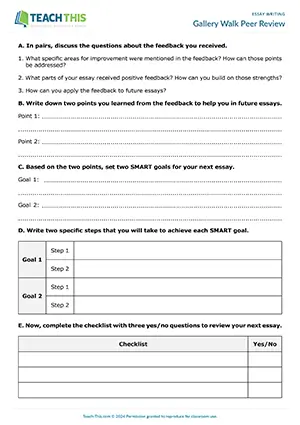
EAP writing Process Activity - Reading, writing and Speaking Activity: Peer Review, writing Sentences, Discussion, Setting SMART goals, Freer practice - Pair Work
In this engaging writing process activity, students participate in a gallery walk where they give and receive peer feedback on essay writing and set related SMART...
EAP writing Process Activity - Reading, writing and Speaking Activity: Peer Review, writing Sentences, Discussion, Setting SMART goals, Freer practice - Pair Work In this engaging writing process activity, students participate in a gallery walk where they give and receive peer feedback on essay writing and set related SMART goals. This activity can be used after students have each written a short essay or a timed 250-word essay. First, each student goes to an essay and has five minutes to read it and complete a feedback card, detailing one strength and one area of improvement. After five minutes, students place the feedback card face-down and move on to the next essay. The activity continues until each student has completed four feedback cards. Next, students find their own essays and read the feedback. After that, in pairs, students discuss questions about the feedback they received. Students then write two points they learned from the feedback to help them in future essays. Based on the two points, students then move on to set two SMART goals for their next essay. Afterwards, students write two specific steps that they will take to achieve each SMART goal. Finally, students create three questions to use as a checklist to review their next essay.How to Analyse an Essay Question

EAP writing Process Worksheet - writing Exercises: Matching, Identifying, writing an Essay Question and Essay, Peer Review
In this productive analysing essay questions worksheet, students learn and practice topic words, instruction words and limiting words that can be used to decode essay writing prompts. Students then...
EAP writing Process Worksheet - writing Exercises: Matching, Identifying, writing an Essay Question and Essay, Peer Review In this productive analysing essay questions worksheet, students learn and practice topic words, instruction words and limiting words that can be used to decode essay writing prompts. Students then apply this knowledge by creating their own essay question and writing an essay that responds to a question set by their partner. First, students read a short text that explains the importance of analyzing an essay question and the meanings of topic words, limiting words and instruction words. Students then match a set of instruction words to their definitions. Next, students read essay questions and identify the topic words, instruction words and limiting words. Students then choose a topic and create their own essay question using the instruction words. After that, students swap papers with a partner and attempt an analysis of their partner's essay question. Students then write an essay that addresses the question set by their partner. Finally, students conduct a peer review and feedback for the essay their partner wrote.The writing Assignment Research Process
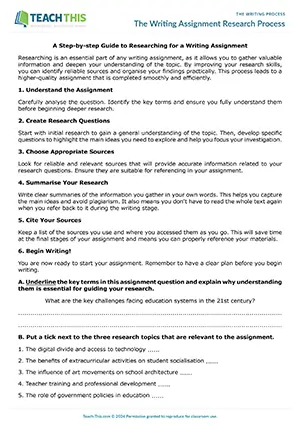
EAP writing Process Worksheet - Reading and writing Exercises: Research Questions, Summary writing - Speaking Activity: Peer Review, Freer practice - Pair Work
In this informative writing process worksheet, students learn key steps in the research process with a particular focus on developing research questions and...
EAP writing Process Worksheet - Reading and writing Exercises: Research Questions, Summary writing - Speaking Activity: Peer Review, Freer practice - Pair Work In this informative writing process worksheet, students learn key steps in the research process with a particular focus on developing research questions and writing source summaries. First, students read information about how to research for a writing assignment. Students then read an example assignment question, underline the key terms and explain why it's important to understand them. Next, students read a list of research topics and identify three that are relevant to the assignment. After that, students choose one of the topics and identify three key features. Students then use the details to form two relevant and effective research questions. Next, students review eight sources and decide which are appropriate or not for an academic assignment. For those that are not, they explain why. Students then read an article extract and complete a summary of the extract. Afterwards, students read a second article extract and write a source summary. Finally, in pairs, students conduct a brief peer review of their summaries by discussing three questions.Here's what our members are saying...
- Essay Writing
-
Essay writing EAP worksheets & Games
Academic Style
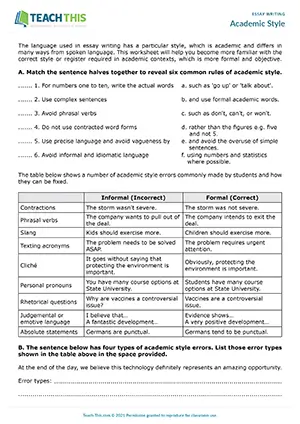
EAP Academic Style Worksheet - Vocabulary and Reading Exercises: Matching, Identifying, Providing Synonyms
In this free academic style worksheet, students learn and practice some common rules of academic style for essay writing. First, students match sentence halves together to reveal six common...
EAP Academic Style Worksheet - Vocabulary and Reading Exercises: Matching, Identifying, Providing Synonyms In this free academic style worksheet, students learn and practice some common rules of academic style for essay writing. First, students match sentence halves together to reveal six common rules of academic style in essay writing. Next, students review a table that shows a number of academic style errors commonly made by students and how they can be fixed. Students then analyse an example sentence to identify and categorise the academic style errors. After that, students look at a table containing a number of informal words and phrases and replace them with appropriate formal words. Next, students read an essay to identify and underline academic style errors. Finally, students review the provided revised version of the essay that adheres to academic style rules.Body Paragraphs
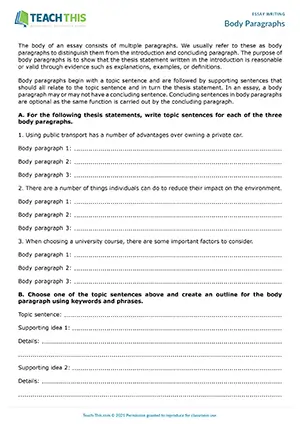
EAP Body Paragraphs Worksheet -Reading and writing Exercises: writing Sentences, Creating a Paragraph Outline, writing Paragraphs
In this informative body paragraphs worksheet, students practice planning and writing body paragraphs that support a thesis statement. To begin, students...
EAP Body Paragraphs Worksheet -Reading and writing Exercises: writing Sentences, Creating a Paragraph Outline, writing Paragraphs In this informative body paragraphs worksheet, students practice planning and writing body paragraphs that support a thesis statement. To begin, students read an introductory text about body paragraphs. Students then write topic sentences for body paragraphs that support a thesis statement. Next, students choose one of the topic sentences and create an outline for the body paragraph using keywords and phrases. After that, students use the paragraph outline to write a complete body paragraph. Finally, students read the first body paragraph from an essay and then write a follow-up paragraph that supports an additional and related point on the topic.Concluding Paragraphs

EAP Concluding Paragraphs Worksheet - Reading and writing Exercises: Paraphrasing, writing Sentences from Prompts, writing a Concluding Paragraph
In this useful concluding paragraphs worksheet, students learn and practice writing concluding paragraphs that restate a thesis statement, summarise key...
EAP Concluding Paragraphs Worksheet - Reading and writing Exercises: Paraphrasing, writing Sentences from Prompts, writing a Concluding Paragraph In this useful concluding paragraphs worksheet, students learn and practice writing concluding paragraphs that restate a thesis statement, summarise key points and end with a final statement. First, students read a short text explaining the elements that make up a concluding paragraph and examine an example concluding paragraph and its structure. Students then write concluding sentences by reading thesis statements and rewriting them so that the language is new but the ideas are unchanged. Next, students use notes from basic essay outlines to write the first two sentences of three concluding paragraphs. The first sentence is a concluding sentence and the second sentence summarises the main ideas of the body paragraphs. Finally, students use essay questions to write their own concluding paragraphs that contain a concluding sentence beginning with a transition, a summary of the key points from the body paragraphs and a final statement.Essay Cohesion, Coherence and Unity
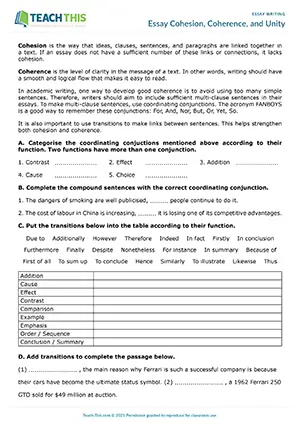
EAP Essay Cohesion, Coherence and Unity Worksheet - Reading and writing Exercises: Categorising, Gap-fill, Identifying, Rewriting a Paragraph
In this comprehensive essay writing worksheet, students learn and practice essay cohesion, coherence and unity. Students start by reading information about...
EAP Essay Cohesion, Coherence and Unity Worksheet - Reading and writing Exercises: Categorising, Gap-fill, Identifying, Rewriting a Paragraph In this comprehensive essay writing worksheet, students learn and practice essay cohesion, coherence and unity. Students start by reading information about cohesion, coherence, coordinating conjunctions and transitions. Students then categorise coordinating conjunctions according to their function. Next, students complete compound sentences with the correct coordinating conjunction. After that, students place transitions into a table according to their function. Students then move on to complete a short passage with suitable transitions. Afterwards, students read about how pronouns can be used to improve coherence in writing. Students then rewrite a paragraph by replacing nouns with pronouns from a table to improve the paragraph's overuse of key terms. Next, students read a brief explanation of 'unity' and then identify the sentence in a paragraph that is off-topic and breaks unity. In the final exercise, students review an essay to identify and underline errors with cohesion, coherence and unity.Essay Outlines

EAP Essay Outlines Worksheet - Reading and writing Exercises: Identifying, Brainstorming, Creating an Essay Outline, writing an Essay
This productive essay outlines worksheet helps to teach students how to create outlines as part of the essay writing process. To start, students read about the...
EAP Essay Outlines Worksheet - Reading and writing Exercises: Identifying, Brainstorming, Creating an Essay Outline, writing an Essay This productive essay outlines worksheet helps to teach students how to create outlines as part of the essay writing process. To start, students read about the importance of an outline in the essay writing process. Students then read an example essay and use it to complete an essay outline. Next, students read and analyse an essay question and brainstorm ideas to include in an essay outline about the topic. After that, students create an outline for the essay based on their brainstormed ideas. In the last exercise, students write a complete essay based on the outline.Essay Structure Running Dictation

EAP Essay Activity - Reading, writing and Speaking: Comprehension Questions, writing Explanations, Discussion, Freer practice - Pair and Group Work
This essay writing running dictation activity helps students practice the key components of essay structure. First, one student in each pair stands up, runs to...
EAP Essay Activity - Reading, writing and Speaking: Running Dictation, Comprehension Questions, writing Explanations, Discussion, Freer practice - Pair and Group Work This essay writing running dictation activity helps students practice the key components of essay structure. First, one student in each pair stands up, runs to paragraph text A, B, C or D, reads a sentence or two, runs back and dictates what they read to their partner, who writes it down. Halfway through the two students swap roles. When the paragraph has been dictated, pairs compare their text with the original. Pairs then read about different parts of an essay and write short answers about which part of an essay their paragraph is from and the elements that make it so. After that, pairs expand on their answers by writing a complete explanation. Next, go through the four paragraphs that form an essay and the students' explanations by having pairs read their dictated paragraphs in order starting with the introduction. After each paragraph has been read out, pairs read their explanations. Finally, in groups, students discuss two questions about the structure of essays.Essay writing Review

EAP Essay writing Review Worksheet - Reading and writing Exercises: writing Paragraphs, Identifying, Error Correction, Matching, True or False Questions
In this handy essay writing review worksheet, students revise basic academic essay writing and practice the skills covered in previous worksheets in this series...
EAP Essay writing Review Worksheet - Reading and writing Exercises: writing Paragraphs, Identifying, Error Correction, Matching, True or False Questions In this handy essay writing review worksheet, students revise basic academic essay writing and practice the skills covered in previous worksheets in this series. Students begin by adding a background to a thesis statement in order to create an introduction paragraph that follows a funnel structure. Next, students read the first body paragraph from an essay and write a second body paragraph that maintains unity and coherence with the first. Students then use a basic essay outline to help them write a concluding paragraph. After that, students identify academic style issues in a body paragraph and rewrite the paragraph so that it shows an appropriate register. Next, students rewrite sentences, so they are structurally and grammatically correct. Students then move on to read an essay that is missing cohesive devices such as transitions and sentence connectors. Students then match cohesive devices with the gaps to complete the essay. Students end by reviewing some basic knowledge about essay writing by answering true or false statements.Fragments, Run-ons, and Comma Splices
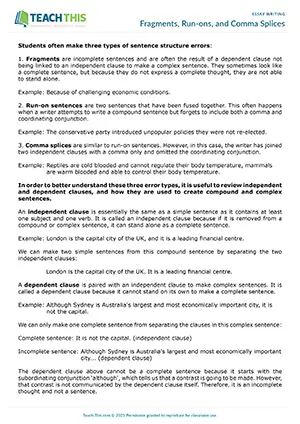
EAP Fragments, Run-ons, and Comma Splices Worksheet - Reading and writing Exercises: Identifying, Categorising, Error Correction
In this insightful sentence structure errors worksheet, students practice identifying and correcting fragments, run-on sentences, and comma splices. First...
EAP Fragments, Run-ons, and Comma Splices Worksheet - Reading and writing Exercises: Identifying, Categorising, Error Correction In this insightful sentence structure errors worksheet, students practice identifying and correcting fragments, run-on sentences, and comma splices. First, students read explanations of fragments, run-on sentences and comma splices. Students also review independent and dependent clauses, and how they are used to create compound and complex sentences to better understand the three error types. Students then read sentences and identify coordinating conjunctions, subordinating conjunctions, subjects and verbs. Next, students identify independent clauses and dependent clauses in sentences and classify them as either compound or complex. Lastly, students identify three sentences with errors and rewrite them so that they are correct, categorising the errors as either being a fragment, run-on sentence, or comma splice.Introduction Paragraphs

EAP Introduction Paragraphs Worksheet - Reading and writing Exercises: Ordering, writing a Thesis Statement, Paragraph Completion, writing Introduction Paragraphs
In this engaging introduction paragraphs worksheet, students learn and practice how to write introduction paragraphs that have a background and thesis...
EAP Introduction Paragraphs Worksheet - Reading and writing Exercises: Ordering, writing a Thesis Statement, Paragraph Completion, writing Introduction Paragraphs In this engaging introduction paragraphs worksheet, students learn and practice how to write introduction paragraphs that have a background and thesis statement and show a funnel type structure. First, students read a short passage, explaining the parts and structure of an introduction paragraph. Students also examine an example introduction paragraph and its organisation to reinforce introduction paragraph structure. Students then move on to reorder sentences so that they make a logical and coherent introduction paragraph that shows a funnel type structure. Next, students add a thesis statement to general statements in order to complete an introduction paragraph. Students then write a complete introduction paragraph by adding general statements to a thesis statement. After that, students use prompts to write an introduction paragraph that begins with general statements and ends with a thesis statement. In the final exercise, students are given freer practice to write an introduction paragraph on a specific topic without the guidance of prompts.Paragraph and Essay Structure Comparison
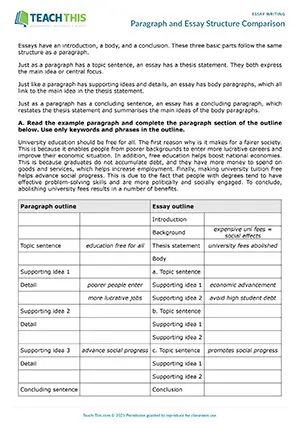
EAP Paragraph and Essay Structure Worksheet - Reading and writing Exercises: Table Completion, Short Answer Questions
In this detailed paragraph and essay structure worksheet, students compare paragraph and essay structure to familiarise themselves with the basic parts of an academic essay. Students begin by reading...
EAP Paragraph and Essay Structure Worksheet - Reading and writing Exercises: Table Completion, Short Answer Questions In this detailed paragraph and essay structure worksheet, students compare paragraph and essay structure to familiarise themselves with the basic parts of an academic essay. Students begin by reading about the similarities between paragraph structure and basic essay structure. Students then read an example paragraph and complete a paragraph outline to understand its structure. Next, students read an example essay and complete an essay outline to reinforce their understanding of essay structure. In the final exercise, students read the example essay one more time and answer questions about the essay's organisation.Parts of an Essay

EAP Parts of an Essay Worksheet - Reading and writing Exercises: True or False, Matching, Labelling, Brainstrorming, Creating an Essay Outline, writing an Essay
In this free parts of an essay worksheet, students learn about the various parts that make up an academic essay and practice writing a structured, logical,...
EAP Parts of an Essay Worksheet - Reading and writing Exercises: True or False, Matching, Labelling, Brainstrorming, Creating an Essay Outline, writing an Essay In this free parts of an essay worksheet, students learn about the various parts that make up an academic essay and practice writing a structured, logical, and cohesive essay. Students start by answering three true or false statements to review some basic essay structure knowledge. Next, students unscramble letters to reveal the key terms used to describe the various parts of an academic essay and match them to their definitions. After that, students read an example essay to identify its key parts. In the last exercise, students create an essay outline on the topic of healthy eating and then use the outline to write a short essay that demonstrates all the parts of an academic essay.Peer Feedback Workshop

EAP Peer Feedback Worksheet - Reading and writing Exercises: writing Sentences, Peer Review - Speaking Activity: Discussion, Communicative practice - Pair Work
This informative essay writing worksheet develops students' ability to give effective peer feedback for academic writing, focusing on content, organisation, and...
EAP Peer Feedback Worksheet - Reading and writing Exercises: writing Sentences, Peer Review - Speaking Activity: Discussion, Communicative practice - Pair Work This informative essay writing worksheet develops students' ability to give effective peer feedback for academic writing, focusing on content, organisation, and language features. Students begin by reading a peer feedback advice table. In pairs, students then discuss why three feedback comments are unhelpful. After that, students categorise feedback phrases according to their function. Next, students rewrite the comments from Exercise B using the feedback phrases. Following that, students read feedback comments and label each as referring to either content, organisation, or language. Students then read an example essay introduction and write one positive feedback comment and one suggestion for improvement, focusing on two different aspects: content, organisation or language. After that, students choose an essay question and write a four-sentence introduction. Finally, students swap paragraphs with a partner and complete a form to give each other feedback using the advice and phrases from the worksheet.Hedging Language

EAP Essay writing Worksheet - Reading and writing Exercises: Identifying, Rewriting Sentences, Unscrambling, Sentence Combining, Changing Sentence Structure
In this useful hedging language worksheet, students learn and practice words and phrases that can be used in academic writing and speaking to soften a claim...
EAP Essay writing Worksheet - Reading and writing Exercises: Identifying, Rewriting Sentences, Unscrambling, Sentence Combining, Changing Sentence Structure In this useful hedging language worksheet, students learn and practice words and phrases that can be used in academic writing and speaking to soften a claim and maintain academic integrity. To start, students compare four sentences and identify those that use hedging language, underlining the words that express caution. Next, students read the various parts of speech that can be used to hedge a claim. Students then choose from the words provided to rewrite each sentence, hedging claims that may be too strong or without evidence. After that, students unscramble each 'that clause' and use two sentences provided to make a single sentence that contains a claim that is hedged. In the last exercise, students use 'adjective + to clauses' to hedge the claims made.Essay writing Dominoes
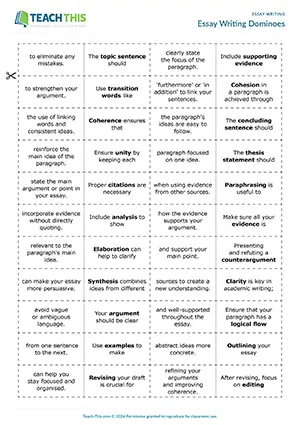
EAP Essay writing Game - Vocabulary: Matching - Group Work
Here is a fun essay writing game to help students review and reinforce their understanding of key terms and concepts in essay writing. To begin, students turn over the top domino from the pile and place it face-up on the table. The first player...
EAP Essay writing Game - Vocabulary: Matching - Group Work Here is a fun essay writing game to help students review and reinforce their understanding of key terms and concepts in essay writing. To begin, students turn over the top domino from the pile and place it face-up on the table. The first player then puts a domino down before or after the domino on the table, making sure that the two sentence halves match to form a sentence that expresses a key term or concept in essay writing. The other players then take turns matching their dominoes in the same way by putting them down at either end of the domino chain. If a player cannot put down one of their dominoes, they take one from the pile and put it down if they can. If there are no dominoes left in the pile, play passes to the next student. The first player to get rid of all their dominoes wins the game.Here's what our members are saying...
- Paragraph Writing
-
Paragraph writing EAP worksheets & Games
Compound and Complex Sentences
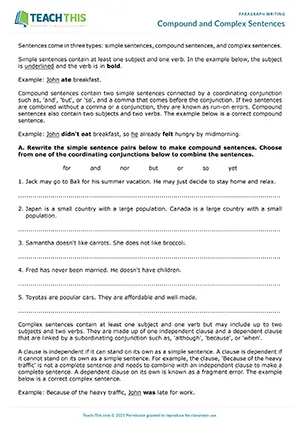
EAP Compound and Complex Sentences Worksheet - writing Exercises: Rewriting Sentences, Matching, Identifying, Error Correction
In this insightful compound and complex sentences worksheet, students review and practice sentence structure and sentence types. Students begin by...
EAP Compound and Complex Sentences Worksheet - writing Exercises: Rewriting Sentences, Matching, Identifying, Error Correction In this insightful compound and complex sentences worksheet, students review and practice sentence structure and sentence types. Students begin by reading about the characteristics of simple and compound sentences. Students then rewrite pairs of simple sentences to make compound sentences with coordinating conjunctions. Next, students read information about complex sentences. Students then combine pairs of simple sentences to make complex sentences using subordinating conjunctions. In the last exercise, students read a paragraph to identify run-on and fragment errors and then rewrite the paragraph so that the sentences are correct.Concluding Sentences
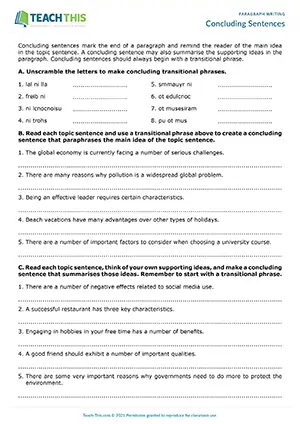
EAP Concluding Sentences Worksheet - Reading and writing Exercises: Unscrambling, Paraphrasing, writing Sentences, Identifying, Error Correction
In this concluding sentences worksheet, students practice writing concluding sentences by restating topic sentences and summarising supporting ideas...
EAP Concluding Sentences Worksheet - Reading and writing Exercises: Unscrambling, Paraphrasing, writing Sentences, Identifying, Error Correction In this handy concluding sentences worksheet, students practice writing concluding sentences by restating topic sentences and summarising supporting ideas. To start, students read about concluding sentences and unscramble letters to make concluding transitional phrases. Students then read each topic sentence shown and use a transitional phrase to create a concluding sentence that paraphrases the main idea of the topic sentence. Next, students read topic sentences, think of their own supporting ideas and use transitional phrases to make concluding sentences that summarise those ideas. After that, students read paragraphs and add a concluding sentence that either restates the topic sentence or summarises the supporting ideas. Finally, students read topic sentence and concluding sentence pairs, and try to identify any errors in the concluding sentences. If students find any errors, they highlight them and rewrite the concluding sentence to make it more suitable.Paragraph Outlines
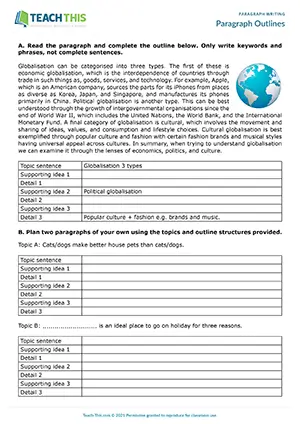
EAP Paragraph Outlines Worksheet - Reading and writing Exercises: Table Completion, Creating an Outline, writing a Paragraph, Peer Feedback
In this free paragraph outlines worksheet, students practice using outlines to structure and write paragraphs. To start, students read an example paragraph and...
EAP Paragraph Outlines Worksheet - Reading and writing Exercises: Table Completion, Creating an Outline, writing a Paragraph, Peer Feedback In this free paragraph outlines worksheet, students practice using outlines to structure and write paragraphs. To start, students read an example paragraph and complete a paragraph outline with the supporting ideas and details from the text. Next, students follow the example and plan two paragraphs of their own using the topics and outline structures provided. Students then choose one of the topics from the previous exercise and use the outline to write a paragraph. Finally, students do a peer review exercise where they swap paragraphs with a classmate and use a paragraph writing checklist to give each other feedback.Paragraph Puzzle Sprint
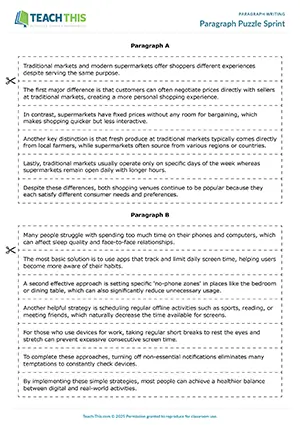
EAP Paragraph Coherence Game - Reading: Ordering, Answering Questions - Pair Work
In this enjoyable paragraph organisation game, students race to correctly order sentences into coherent paragraphs. When you say 'go', students turn over the first set of sentence strips and race to arrange them into the correct order to form a...
EAP Paragraph Coherence Game - Reading: Ordering, Answering Questions - Pair Work In this enjoyable paragraph organisation game, students race to correctly order sentences into coherent paragraphs. When you say 'go', students turn over the first set of sentence strips and race to arrange them into the correct order to form a paragraph with a clear topic sentence, supporting details, and conclusion. When a pair has finished, they raise their hands and read out their order. If the order is correct, the pair wins the round and scores two points. If it is incorrect, the pair is out of the round, and the other pairs continue to put the strips in order. After a pair has correctly ordered the paragraph, students race to answer a bonus question for one point. Students then move on to the second round using the next set of sentence strips. This process continues until four paragraphs have been ordered correctly. The pair with the most points at the end of the game wins.Paragraph Unity and Coherence
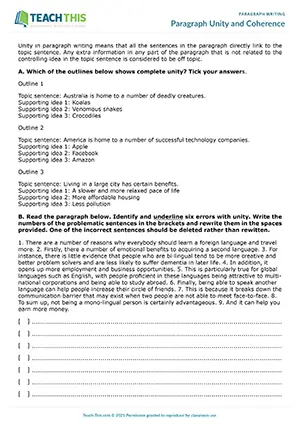
EAP Paragraph Unity and Coherence Worksheet - Reading and writing Exercises: Identifying, Rewriting Sentences, Gap-fill
In this paragraph unity and cohesion worksheet, students analyse and revise a paragraph with unity problems and complete another paragraph to improve its coherence with transition words and...
EAP Paragraph Unity and Coherence Worksheet - Reading and writing Exercises: Identifying, Rewriting Sentences, Table Completion, Gap-fill In this comprehensive paragraph unity and cohesion worksheet, students analyse and revise a paragraph with unity problems and complete another paragraph to improve its coherence with transition words and phrases. Firstly, students read an explanation of unity in paragraph writing. Students then choose the outline that has complete unity. Next, students read a paragraph and identify six errors with unity. Students then rewrite the problematic sentences and choose the sentence that does not belong in the paragraph. After that, students read about coherence in paragraph writing. Students then add transition words and phrases to a table according to their function. Finally, students complete a paragraph by adding appropriate transition words and phrases to improve its coherence.Paragraph writing Review
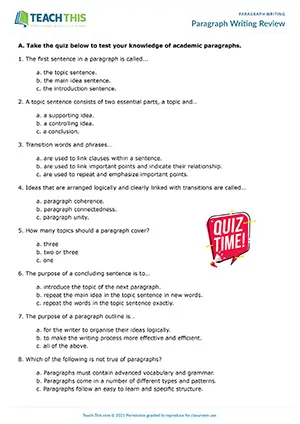
EAP Paragraph writing Review Worksheet - Reading and writing Exercises: Multiple Choice, writing Sentences, Identifying, Editing and Revising
In this useful paragraph writing review worksheet, students revise academic paragraph structure and writing. First, students complete a multiple...
EAP Paragraph writing Review Worksheet - Reading and writing Exercises: Multiple Choice, writing Sentences, Identifying, Editing and Revising In this useful paragraph writing review worksheet, students revise academic paragraph structure and writing. First, students complete a multiple-choice quiz to test their knowledge of academic paragraphs. Students then complete missing parts of a paragraph with a suitable topic sentence, a supporting idea, and a concluding sentence. In the last exercise, students read a paragraph to find errors with unity and coherence. Students then rewrite the paragraph making the necessary improvements.Supporting Sentences
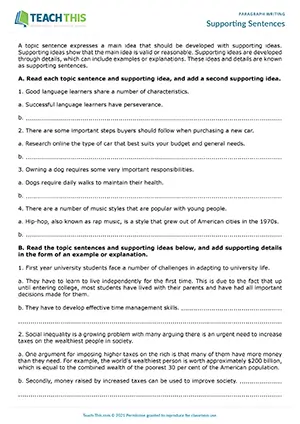
EAP Supporting Sentences Worksheet - Reading and writing Exercises: writing Sentences
In this in-depth supporting sentences worksheet, students practice developing a main idea expressed in a topic sentence through supporting ideas and details. First, students read about...
EAP Supporting Sentences Worksheet - Reading and writing Exercises: writing Sentences In this in-depth supporting sentences worksheet, students practice developing a main idea expressed in a topic sentence through supporting ideas and details. First, students read about supporting ideas and details. Students then read each topic sentence and supporting idea, and add a second supporting idea. Next, students read the topic sentences and supporting ideas provided, and add supporting details in the form of an example or explanation. Finally, students use the prompts provided to write a topic sentence, a supporting idea, and supporting details.The Four Parts of a Paragraph
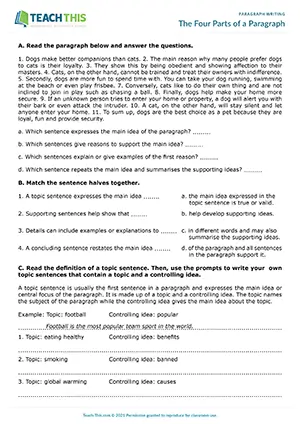
EAP Paragraph Structure Worksheet - Reading and writing Exercises: Matching, writing Sentences, Paraphrasing
In this free paragraph structure worksheet, students review the four basic parts of an academic paragraph and practice writing topic sentences, supporting ideas, details, and concluding sentences...
EAP Paragraph Structure Worksheet - Reading and writing Exercises: Short Answer Questions, Matching, writing Sentences, Paraphrasing In this free paragraph structure worksheet, students review the four basic parts of an academic paragraph and practice writing topic sentences, supporting ideas, supporting details, and concluding sentences. Students begin by reading a paragraph to identify its basic structural components. Students then match sentence halves to reveal an explanation of each part of a paragraph. Next, students read a definition of a topic sentence and use prompts to write their own topic sentences that contain a topic and a controlling idea. After that, students use the topic sentences provided to write a supporting idea that is then developed further with either an example or an explanation. Finally, students paraphrase topic sentences in their own words to make concluding sentences using the transition phrases: In conclusion, In summary, or To sum up.Topic Sentences
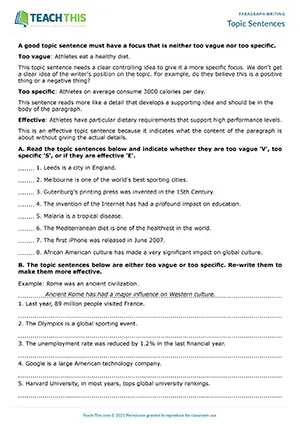
EAP Topic Sentences Worksheet - Reading and writing Exercises: Categorising, Rewriting and writing Sentences
In this productive topic sentences worksheet, students learn to identify and produce effective topic sentences. Students start by reading notes on ineffective versus effective topic sentences. Next...
EAP Topic Sentences Worksheet - Reading and writing Exercises: Categorising, Rewriting and writing Sentences In this productive topic sentences worksheet, students learn to identify and produce effective topic sentences. Students start by reading notes on ineffective versus effective topic sentences. Next, students categorize sample topic sentences as either being vague, specific, or effective. Students then examine more sample topic sentences that are either vague or specific and re-write them so that they are effective. Finally, students read paragraphs that are missing a topic sentence and write an effective topic sentence for each.Presenting a Strong Argument
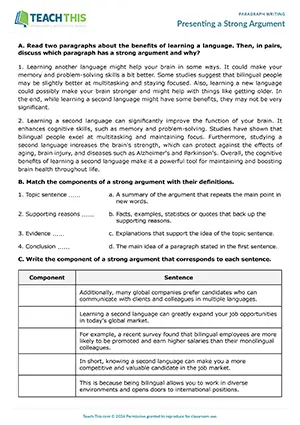
EAP Paragraph writing Worksheet - Reading and writing Exercises: Identifying, Matching, Paragraph writing, Peer Review
In this useful paragraph writing worksheet, students learn and practice how to write a paragraph that presents a strong argument. First, students read two paragraphs and decide which has a strong...
EAP Paragraph writing Worksheet - Reading and writing Exercises: Identifying, Matching, Paragraph writing, Peer Review In this useful paragraph writing worksheet, students learn and practice how to write a paragraph that presents a strong argument. First, students read two paragraphs and decide which has a strong argument and why. Students then match the four parts of a strong argument to their definitions. Next, students write the component of a strong argument that corresponds to each sentence. Afterwards, students choose a statement and use it to write a paragraph that presents a strong argument and includes a topic sentence that states the main idea, supporting reasons, evidence, and a conclusion. When the students have finished, they swap worksheets with a partner and peer review their partner's paragraph using a checklist. Finally, students listen to their partner's feedback and revise their paragraph accordingly.Here's what our members are saying...
- Integrating Sources
-
Integrating Sources EAP worksheets
Citation practice Workshop
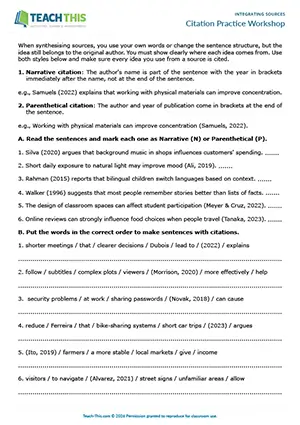
EAP Integrating Sources Worksheet - Reading and writing Exercises: Binary Choice, Rewriting Sentences, Rewriting a Paragraph, Peer Feedback - Pair Work
In this integrating sources worksheet, students practice identifying and using narrative and parenthetical citations and correcting citation errors in a...
EAP Integrating Sources Worksheet - Reading and writing Exercises: Binary Choice, Unscrambling, Rewriting Sentences, Rewriting a Paragraph, Peer Feedback - Pair Work In this integrating sources worksheet, students practice identifying and using narrative and parenthetical citations and correcting citation errors in a short synthesis paragraph. First, students read a short introduction about narrative and parenthetical citation forms. Students then read sentences with citations and identify each one as 'Narrative' or 'Parenthetical'. Next, students put words in the correct order to make sentences with citations. After that, students rewrite sentences to include a correct citation, using two narrative and two parenthetical forms in total. Following that, students read a synthesis paragraph and underline five citation problems. Students then rewrite the synthesis paragraph using correct citations and both narrative and parenthetical forms. Finally, students swap worksheets and complete a checklist to give each other feedback, discussing any issues and making corrections if needed.Introduce, Quote, Explain
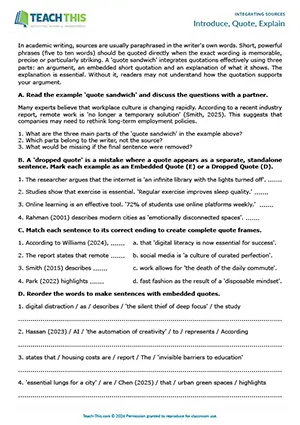
EAP Integrating Sources Worksheet - Reading, Vocabulary and writing Exercises: Categorising, Matching, Binary Choice, writing Sentences, writing Direct Quotes
In this integrating sources worksheet, students practice integrating short quotations by building complete 'quote sandwiches' that include an argument, an...
EAP Integrating Sources Worksheet - Reading, Vocabulary and writing Exercises: Categorising, Matching, Unscrambling, Binary Choice, writing Sentences, writing Direct Quotes In this integrating sources worksheet, students practice integrating short quotations by building complete 'quote sandwiches' that include an argument, an embedded quotation and an analytical explanation. First, students read a short introduction and an example quote sandwich and discuss questions with a partner. Next, students identify each sentence as an 'Embedded Quote' or 'Dropped Quote'. After that, students match each sentence to its correct ending to create complete quote frames. Students then reorder words to make sentences. Following that, students read each embedded quote and choose the more effective explanation, discussing their reasoning with a partner. Next, students read each argument and embedded quote and then write an explanation sentence showing what the quote demonstrates. Finally, students choose two quotes from a table and write a three-sentence quote sandwich for each one.Source Synthesis practice
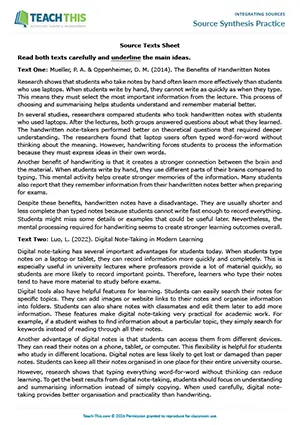
EAP Integrating Sources Worksheet - Reading and writing Exercises: Identifying, Categorising, Paragraph writing
In this useful synthesising sources worksheet, students practice writing a short synthesis paragraph about two texts in their own words, using compare and contrast linkers and simple citations. First, students read...
EAP Integrating Sources Worksheet - Reading and writing Exercises: Identifying, Categorising, Paragraph writing In this useful synthesising sources worksheet, students practice writing a short synthesis paragraph about two texts in their own words, using compare and contrast linkers and simple citations. First, students read two texts and underline the main ideas. Students then read a short text about synthesising sources on the worksheet and review compare and contrast linkers, sentence starters and guidelines for citations. Next, students make notes in a table on the main ideas of each text. After that, students put the source texts sheet face down so that they only see their notes. Finally, students use their notes to write a three- to four-sentence synthesis paragraph that includes at least one similarity and one difference, uses appropriate compare and contrast linkers, and cites both sources in their own words.Here's what our members are saying...
- Paraphrasing Techniques
-
Paraphrasing Techniques EAP worksheets & Activities
Joining or Splitting Ideas
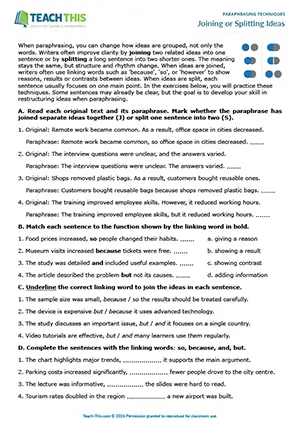
EAP Paraphrasing Techniques Worksheet - Reading, Vocabulary and writing Exercises: Categorising, Matching, Gap-fill, Rewriting Sentences, Paraphrasing
In this productive paraphrasing techniques worksheet, students practice joining and splitting ideas using linking words and punctuation to keep the...
EAP Paraphrasing Techniques Worksheet - Reading, Vocabulary and writing Exercises: Categorising, Matching, Binary Choice, Gap-fill, Rewriting Sentences, Paraphrasing In this productive paraphrasing techniques worksheet, students practice joining and splitting ideas using linking words and punctuation to keep the meaning the same. First, students read a short introduction to joining or splitting sentences. Students then read each original text and its paraphrase and mark whether the paraphrase has joined separate ideas together or split one sentence into two. Next, students match each sentence to the function shown by the linking word. After that, students underline the correct linking word to join the ideas in each sentence. Students then complete sentences with the linking words: so, because, and, but. Following that, students read each item and write if it needs joining into one sentence, or if it needs splitting into two sentences. Next, students rewrite the sentences, either joining them with a linking word or splitting them into two. Afterwards, students read short paragraphs and rewrite them, joining the first two sentences with a linking word, and splitting the last sentence into two. Finally, students answer questions about their rewrites to check their writing.Paraphrasing Key Terms
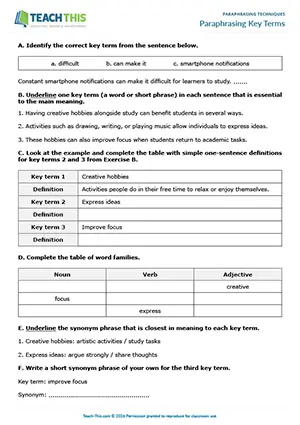
EAP Paraphrasing Techniques Worksheet - Reading, Vocabulary and writing Exercises: Identifying, writing Definitions, Paraphrasing, Peer Feedback - Pair Work
In this comprehensive paraphrasing techniques worksheet, students identify key terms in a short text and build a small glossary to help them rewrite sentences...
EAP Paraphrasing Techniques Worksheet - Reading, Vocabulary and writing Exercises: Identifying, writing Definitions, Table Completion, Binary Choice, Paraphrasing, Peer Feedback - Pair Work In this comprehensive paraphrasing techniques worksheet, students identify key terms in a short text and build a small glossary to help them rewrite sentences and produce a simple paraphrase while keeping the meaning the same. First, students identify the correct key term from a sentence. Students then read a text and underline one key term in each sentence. Next, students write simple one-sentence definitions for two key terms in their own words. After that, students complete a table of word families. Students then underline the synonym phrase that is closest in meaning to each key term. Following that, students write a synonym phrase for the third key term. Students then complete a glossary with their answers from Exercises C, D, E and F. Next, students paraphrase sentences, replacing the underlined key term with an item from their glossary. Students then move on to choose one sentence from Exercise B and paraphrase it in their own words, using at least one item from their glossary. Finally, students swap worksheets with a partner, answer questions about their partner's paraphrased sentence, and then provide feedback.Paraphrasing in Five Steps

EAP Paraphrasing Techniques Worksheet - Reading, Vocabulary and writing Exercises: Using Synonyms, Paraphrasing, Peer Feedback
In this useful paraphrasing techniques worksheet, students use synonyms and follow a five-step process to paraphrase a short text while keeping the original...
EAP Paraphrasing Techniques Worksheet - Reading, Vocabulary and writing Exercises: Using Synonyms, Paraphrasing, Peer Feedback In this useful paraphrasing techniques worksheet, students use synonyms and follow a five-step process to paraphrase a short text while keeping the original meaning and a similar length. First, students read the short text carefully two or three times. Students then write one sentence that states the main idea of the text in their own words to check their understanding of the passage. Next, students identify keywords in the text and write synonyms or short phrases for each one. After that, students write how they would explain the text to a friend, using their synonyms and simple language. Students then take turns explaining the text to a partner using their ideas. Following that, students cover the text and use their notes to write a paraphrase of the text in clear, formal English, keeping a similar length and including all the original ideas. Finally, students swap worksheets with their partner and use the checklist to review each other's paraphrases before providing feedback.Nominalisation for Paraphrasing
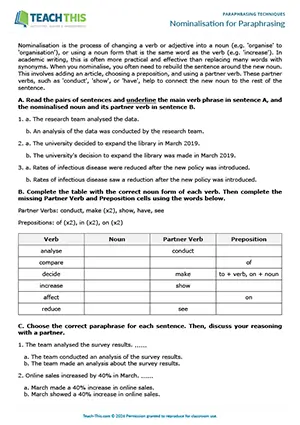
EAP Paraphrasing Techniques Worksheet - Reading, Vocabulary and writing Exercises: Table Completion, Binary Choice, Gap-fill, Paraphrasing Peer Feedback
In this comprehensive paraphrasing techniques worksheet, students practice nominalisation by changing verbs into nouns and rebuilding sentence...
EAP Paraphrasing Techniques Worksheet - Reading, Vocabulary and writing Exercises: Identifying, Table Completion, Binary Choice, Gap-fill, Paraphrasing Peer Feedback In this comprehensive paraphrasing techniques worksheet, students practice nominalisation by changing verbs into nouns and rebuilding sentence structure, using correct prepositions and partner verbs. First, students read a short introduction to nominalisation. Students then read pairs of sentences and underline the main verb phrase in sentence A, and the nominalised noun and its partner verb in sentence B. Next, students complete a table with the correct noun form of each verb and then complete the remaining Partner Verb and Preposition cells using the words provided. After that, students choose the correct paraphrase of each sentence and then discuss their reasoning with a partner. Students then complete sentences with a noun from Exercise B. Following that, students paraphrase sentences using nominalisation, making any necessary changes to the sentence to keep the meaning the same. Finally, students swap worksheets with a partner and complete a checklist about the sentences before giving feedback to their partner.Paraphrasing Challenge
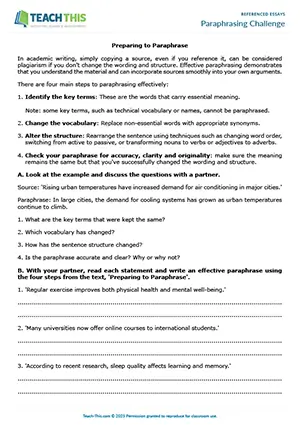
EAP Paraphrasing Game - writing and Speaking Activity: Discussion, writing Sentences - Game: Paraphrasing - Pair Work
This engaging paraphrasing game introduces students to a step-by-step method for academic paraphrasing in referenced essays before putting their skills to the test in a timed paraphrasing challenge...
EAP Paraphrasing Game - writing and Speaking Activity: Discussion, writing Sentences - Game: Paraphrasing - Pair Work This engaging paraphrasing game introduces students to a step-by-step method for academic paraphrasing in referenced essays before putting their skills to the test in a timed paraphrasing challenge. First, in pairs, students read about how to paraphrase effectively using four steps. Students then look at an example paraphrase and discuss questions about it with their partner. Next, pairs read statements and write an effective paraphrase for each one using the four steps. Afterwards, each pair reads their paraphrases to the class. Next, pairs play a game where they listen to statements, write them down and then have three minutes to paraphrase them. When the time is up, each pair reads their paraphrase aloud. Pairs score up to three points based on accuracy, clarity and originality. The pair with the most points at the end of the game wins.Paraphrasing with Reporting Verbs
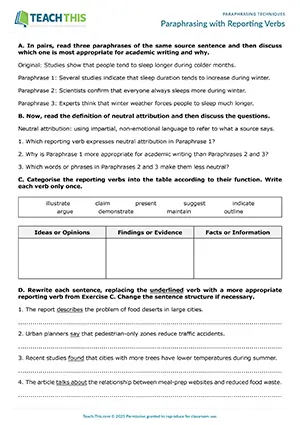
EAP Paraphrasing Techniques Worksheet - Reading, Vocabulary and writing Exercises: Categorising, Sentence Transformation, Paraphrasing, Peer Feedback - Pair Work
In this useful paraphrasing techniques worksheet, students learn about neutral attribution and practice using reporting verbs to paraphrase information...
EAP Paraphrasing Techniques Worksheet - Reading, Vocabulary and writing Exercises: Answering Questions, Categorising, Sentence Transformation, Paraphrasing, Peer Feedback - Pair Work In this useful paraphrasing techniques worksheet, students learn about neutral attribution and practice using reporting verbs to paraphrase information from sources in an impartial, academic style. First, in pairs, students read three paraphrases of the same source sentence and then discuss which one is most appropriate for academic writing and why. Students then read a definition of neutral attribution and discuss three questions with their partner. Next, working alone, students categorise reporting verbs into a table according to their function. After that, students rewrite sentences, replacing the underlined verb with a more appropriate reporting verb. Students then complete sentences with a suitable reporting verb. Following that, students write paraphrases of four sentences, using the information in brackets to choose an appropriate reporting verb. Finally, students swap worksheets with a partner, answer checklist questions about their paraphrases and then give each other feedback.Here's what our members are saying...
- Summarising Sources
-
Summarising Sources EAP worksheets, Games & Activities
One-Sentence Summaries
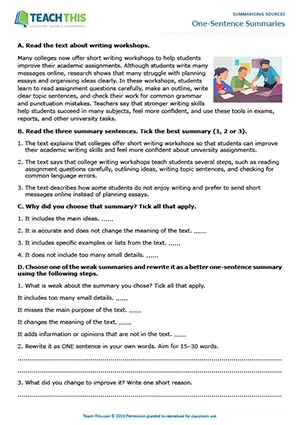
EAP Summarising Worksheet - Reading and writing Exercises: Identifying, Summarising, Peer Review - Pair Work
In this productive summarising worksheet, students choose the best one-sentence summary, improve weak summaries, and write a one-sentence summary of a short academic text. First, students read...
EAP Summarising Worksheet - Reading and writing Exercises: Identifying, Summarising, Peer Review - Pair Work In this productive summarising worksheet, students choose the best one-sentence summary, improve weak summaries, and write a one-sentence summary of a short academic text. First, students read a short text about writing workshops and choose the best one-sentence summary. Students then tick reasons why that sentence is the best. Next, students choose one of the weak summaries and rewrite it as a better one-sentence summary using the steps shown. After that, students read a text about map-reading courses, underline the main ideas about the problem, what the courses teach and why these skills are useful, and make short notes using those ideas. Following that, students cover the text and write a one-sentence summary in their own words, using their notes and sentence starters from a box. Finally, students swap worksheets with a partner and use a checklist to give feedback to their partner. Students then rewrite their summary using the feedback.Signals and Summaries
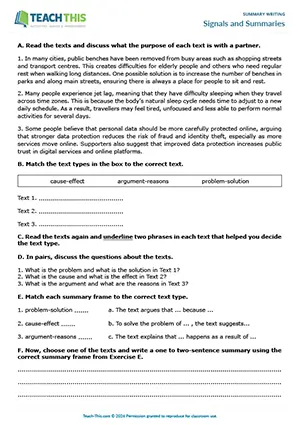
EAP Summary writing Worksheet - Reading and writing Exercises: Matching, Identifying, Summary writing - Speaking Activity: Discussion, Freer practice - Pair Work
In this free summary writing worksheet, students identify common text types, find signal phrases that indicate each type, and practice writing summaries...
EAP Summary writing Worksheet - Reading and writing Exercises: Matching, Identifying, Summary writing - Speaking Activity: - Guided Discussion, Freer practice - Pair Work In this free summary writing worksheet, students identify common text types, find signal phrases that indicate each type, and practice writing summaries using frames to keep the meaning the same. First, students read three texts and discuss the purpose of each one with a partner. Students then match text types in a box to the correct text. Next, students underline two signal phrases in each text that helped them decide the text type. After that, students discuss questions about the texts in pairs. Students then match summary frames to the text types. Finally, students choose one of the texts and write a one to two-sentence summary using the correct summary frame.Summarising a Process
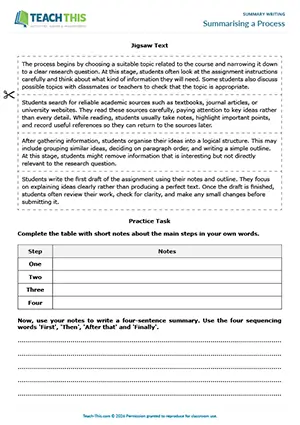
EAP Summarising Activity - Reading and writing Exercises: Identifying, Table Completion, Summary Paragraph writing - Pair Work
In this two-part summarising activity, students practice summarising processes by identifying main steps, reducing information to notes, and using sequencing...
EAP Summarising Activity - Reading and writing Exercises: Identifying, Table Completion, Summary Paragraph writing, Peer Feedback - Pair Work In this two-part summarising activity, students practice summarising processes by identifying main steps, reducing information to notes, and using sequencing language to write clear, concise summaries. First, in pairs, students arrange jigsaw strips in the correct order (first to last) to create a text about a process. Students then underline the main steps of each process, separating them from the additional details. Next, students complete a table with short notes about each step, writing in their own words. After that, pairs write a four-sentence summary of the process using four sequencing words. Pairs then compare a model summary with their own work and check if they used the sequencing words correctly. Working individually, students then read another text about a process and underline the main steps. Following that, students complete a table with short notes about the main steps. Next, students cover the text and write a four-sentence summary using sequencing words. Finally, students swap worksheets with a partner, complete a checklist and then give each other feedback.Attribution and Hedging in Summaries
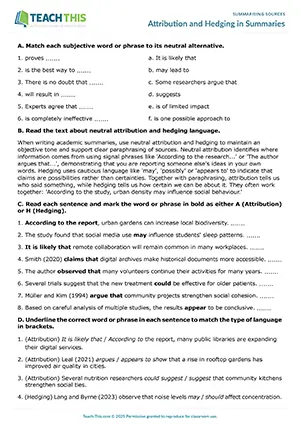
EAP Summarising Sources Worksheet - Reading, Vocabulary and writing Exercises: Categorising, Binary Choice, Paraphrasing, Summary writing
In this comprehensive summarising sources worksheet, students practice using neutral attribution and hedging language to paraphrase source extracts...
EAP Summarising Sources Worksheet - Reading, Vocabulary and writing Exercises: Matching, Categorising, Binary Choice, Paraphrasing, Summary writing, Peer Feedback In this comprehensive summarising sources worksheet, students practice using neutral attribution and hedging language to paraphrase source extracts and write short objective summaries. First, students match each word or phrase to its neutral alternative. Students then read a text about neutral attribution and hedging language. Next, students read each sentence and mark the word or phrase in bold as either A (Attribution) or H (Hedging). After that, students underline the correct word or phrase in each sentence to match the type of language in brackets. Students then paraphrase each source extract in one sentence, using at least one attribution or hedging phrase. Following that, students identify three main ideas in a short text, and then use them to write a one or two-sentence summary that includes at least one neutral attribution and one hedging phrase, paraphrasing the main ideas in their own words. Finally, students swap worksheets with a partner and complete a checklist about each other's summaries. Students then discuss their feedback, explaining their answers and suggesting improvements where needed.From Weak to Strong Summaries
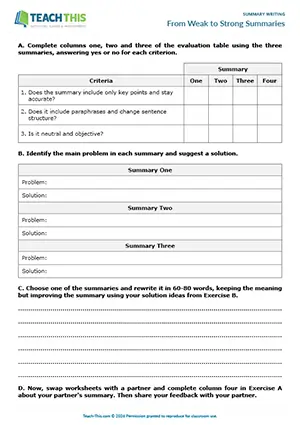
EAP Summary writing Worksheet - Reading and writing Exercises: Evaluating, Problem-solving, Summary Rewriting - Pair Work
In this useful summary-writing worksheet, students evaluate weak and strong summaries, identify common problems, and rewrite a summary in 60–80 words. First, students review a text...
EAP Summary-writing Worksheet - Reading and writing Exercises: Evaluating, Problem-solving, Summary Rewriting, Peer Feedback - Pair Work In this useful summary-writing worksheet, students evaluate weak and strong summaries, identify common problems, and rewrite a summary in 60–80 words. First, students review a text about summary writing and then read an original text and three summaries of it. Students then complete columns one, two and three of an evaluation table using the three summaries, answering yes or no for each criterion. Next, students identify the main problem and suggest a solution for each summary. After that, students choose one of the summaries and rewrite it in 60-80 words, using their suggested solution. Finally, students swap worksheets with a partner, complete column four of the evaluation table about their partner's summary, and share their feedback.Summarising in Four Steps
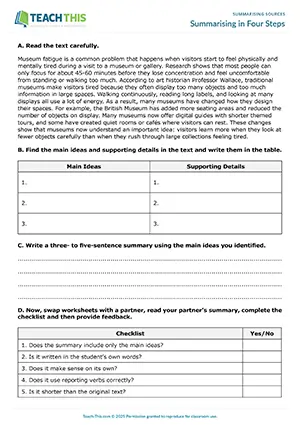
EAP Summarising Sources Worksheet - Reading and writing Exercises: Identifying, Categorising, Summarising - Pair Work
This useful summarising sources worksheet helps students separate main ideas from supporting details through a four-step process, then apply words. First, students review the four steps and...
EAP Summarising Sources Worksheet - Reading and writing Exercises: Identifying, Categorising, Summarising, Peer Feedback - Pair Work This useful summarising sources worksheet helps students separate main ideas from supporting details through a four-step process, then apply words. First, students review the four steps and the difference between main ideas and supporting details. Students then read a text about museum fatigue and decide which parts of the text express main ideas and which provide supporting details, completing the table with their answers. After that, students write a three- to five-sentence summary using the main ideas they identified. Finally, students swap worksheets with a partner, read their summary, complete a checklist, and provide feedback to their partner.Summary Ladder Challenge

EAP Summary writing Game - Reading and writing: Summary writing, Peer Review - Pair Work
In this engaging summary-writing game, students write one-sentence, 50-word and 100-word summaries of the same academic text using reporting verbs, summary frames and expansion strategies...
EAP Summary-writing Game - Reading and writing: Summary writing, Peer Review - Pair Work In this engaging summary-writing game, students write one-sentence, 50-word and 100-word summaries of the same academic text using reporting verbs, summary frames and expansion strategies, then peer review each round using a scoring rubric. First, pairs read an academic text carefully and then review reference boxes about summarising sources. Next, pairs play a game in rounds where they write three summaries of the same text, increasing in length each round. In round one, pairs have three minutes to write a one-sentence summary. When the time is up, each pair swaps worksheets with another pair for marking. Pairs use the scoring rubric to award one point for each criterion that is met and record the score on the worksheet. Each pair then returns the worksheet to the original pair. In round two, pairs have six minutes to write a 50-word summary, aiming for 45-55 words in total. Afterwards, pairs repeat the scoring process, this time awarding two points for each criterion. In round three, pairs have 12 minutes to write a 100-word summary, aiming for 90-110 words. When the time limit has been reached, pairs repeat the scoring process, this time awarding three points for each criterion. The pair with the highest total score at the end of the game wins.Summary Opening Sentences
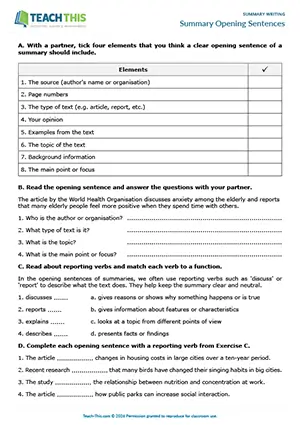
EAP Summarising Worksheet - Reading, Vocabulary and writing Exercises: Gap-fill, writing Opening Sentences - Speaking Activity: Discussion - Pair Work
In this comprehensive opening sentences for summaries worksheet, students identify the key elements of an effective opening sentence, practice using...
EAP Summarising Worksheet - Reading, Vocabulary and writing Exercises: Identifying, Matching, Gap-fill, Multiple Choice, writing Opening Sentences - Speaking Activity: Guided Discussion, Freer practice - Pair Work In this comprehensive opening sentences for summaries worksheet, students identify the key elements of an effective opening sentence, practice using common reporting verbs, and write opening sentences for short academic summaries. First, students work with a partner to identify four elements that they think a clear opening sentence of a summary should include. Students then read an example opening sentence and discuss questions about it with their partner. Next, working alone, students read about reporting verbs and match each verb to its function. After that, students complete each opening sentence with a reporting verb. Students then read a set of opening sentences and write which of the four elements is missing from each one. Following that, students read a short paragraph and choose the main point of the text. Next, students write a clear opening sentence about the paragraph. Afterwards, in pairs, students swap worksheets and use an opening sentence checklist to give feedback on their partner's sentence. Finally, students discuss three reflection questions.Annotated Bibliography Basics
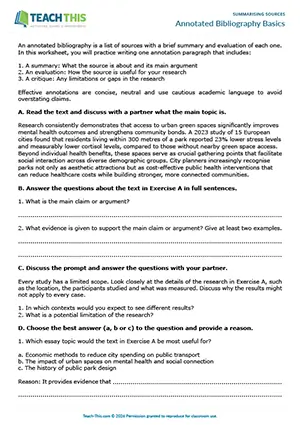
EAP Summarising Sources Worksheet - Reading and writing Exercises: Comprehension Questions, Multiple-choice, Note-taking, Paragraph writing, Peer Review
In this summarising worksheet, students practice writing an annotation paragraph that summarises, evaluates, and critiques a source using neutral, cautious academic...
EAP Summarising Sources Worksheet - Reading and writing Exercises: Comprehension Questions, Multiple-choice, Note-taking, Paragraph writing, Peer Review In this summarising worksheet, students practice writing an annotation paragraph that summarises, evaluates, and critiques a source using neutral, cautious academic language. Students begin by reading a short introduction. Students then read a text and discuss its main topic with a partner. Next, students answer questions about the text. After that, students discuss a prompt, which focuses on the scope of the study and asks where you might expect different results and what a key limitation of the research is. Students then choose which essay topic the text would be most useful for and justify their choice using evidence from the text. Following that, students write six to eight keywords or short phrases from the text that are essential for a summary. Next, students use their keywords and ideas from Exercises C and D to complete sentences about the main idea, key findings, usefulness and limitations of the source. Students then write a short annotation paragraph using their notes and linking words to improve the flow between sentences. Finally, students complete a checklist and make any changes to their paragraph based on their review.Here's what our members are saying...
- Conditionals Review
-
Conditionals Review ESL Games, Activities & worksheets
First vs. Second Conditional
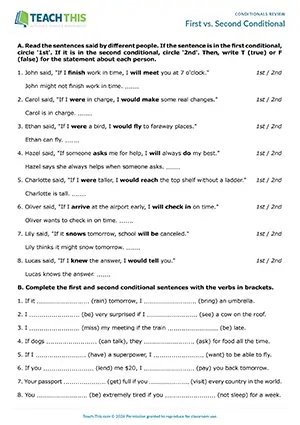
ESL First vs. Second Conditional Worksheet - Grammar Exercises: Binary Choice, True or False, Gap-fill, Rewriting Sentences, Sentence Completion
This useful first vs. second conditional worksheet helps students understand and use both structures, focusing on the difference between real future...
ESL First vs. Second Conditional Worksheet - Grammar Exercises: Binary Choice, True or False, Gap-fill, Rewriting Sentences, Sentence Completion This useful first vs. second conditional worksheet helps students understand and use both structures, focusing on the difference between real future possibilities and hypothetical situations. First, students read statements made by different people and circle '1st' if the sentence is in the first conditional or '2nd' if it is in the second. Students then mark a statement about each person as most likely true or false. Next, students complete first and second conditional sentences with verbs in brackets. After that, students rewrite sentences, changing the first conditional into the second conditional. Lastly, students complete second conditional sentences with their own ideas by writing an if-clause for each sentence. show lessZero and First Conditional Challenge

ESL Zero and First Conditional Board Game - Grammar and Speaking: Forming Sentences - Group Work
In this useful zero vs. first conditional board game, students use verb prompts to make zero and first conditional sentences. Players take turns rolling the dice and moving their counter along the board...
ESL Zero and First Conditional Board Game - Grammar and Speaking: Forming Sentences from Prompts - Group Work In this useful zero vs. first conditional board game, students use verb prompts to make zero and first conditional sentences. Players take turns rolling the dice and moving their counter along the board. When a player lands on a square, they pick up a verb card, e.g. exercise / stay. The player then makes a zero or first conditional sentence as indicated on the square using the two verbs, e.g. 'If people exercise regularly, they stay fit and healthy.' If the group agrees that the sentence uses the correct conditional form and makes sense, the player stays on the square. If not, the player goes back to their previous square. The first player to reach the finish wins the game. show lessConditional Battleships
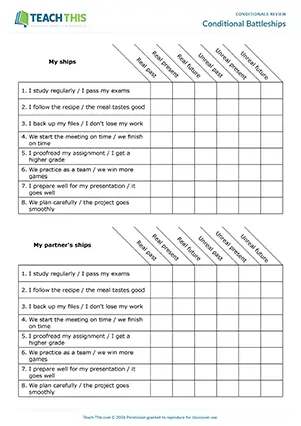
ESL Conditionals Game - Grammar and Speaking: Forming Sentences, Freer practice - Pair Work
In this rewarding conditionals game, students play battleships by producing conditional sentences from prompts, practicing real and unreal past, present and future forms. First, students mark four ships on...
ESL Conditionals Game - Grammar and Speaking: Forming Sentences from Prompts, Freer practice - Pair Work In this rewarding conditionals game, students play battleships by producing conditional sentences from prompts, practicing real and unreal past, present and future forms. First, students mark four ships on their grid. Students then take turns choosing a square on their 'My partner's ships' grid, stating the conditional type and the prompt number, e.g. 'Unreal past, prompt 3', and then making a sentence according to the prompt and conditional type. If the sentence is correct, the other student looks at their 'My ships' grid and says hit or miss. The student who made the sentence then marks the square with an 'H' for hit or 'X' for miss on their 'My partner's ships' grid. If the sentence is incorrect, the shot is invalid. The first student to sink all of their partner's ships wins the game. show lessConditional Cards

ESL Conditionals Review Game - Grammar, writing and Speaking: Sentence Completion, Freer practice - Group Work
In this fast-paced conditionals review game, students race each other to complete zero to third conditional sentences. In groups, one student begins by turning over a card and reading the if-clause of...
ESL Conditionals Review Game - Grammar, writing and Speaking: Sentence Completion, Freer practice - Group Work In this fast-paced conditionals review game, students race each other to complete zero to third conditional sentences. In groups, one student begins by turning over a card and reading the if-clause of the conditional sentence aloud. The other students in the group then race to complete the main clause of the conditional sentence. This can be done in written form with each student racing to write down an answer, or the students shout out an ending to the sentence. The first student to produce a grammatically correct and appropriate main clause to complete the conditional sentence wins and keeps the card. The next student then picks up a card, and so on. The student with the most cards at the end of the game wins. show lessConditional Completion

ESL Conditionals Review Activity - Grammar, writing and Speaking: Sentence Completion, Discussion, Communicative practice - Group Work
In this conditionals review activity, students complete sentence stems using a range of conditional forms and then compare and discuss their answers...
ESL Conditionals Review Activity - Grammar, writing and Speaking: Sentence Completion, Discussion, Communicative practice - Group Work In this conditionals review activity, students complete sentence stems using a range of conditional forms and then compare and discuss their answers. First, students complete conditional sentences with their own ideas using a variety of conditional forms (zero, first, second and third). When everyone has finished, students compare and discuss their answers in groups of three or four. Afterwards, groups share interesting things they found out about their classmates. show lessConditional Conundrum

ESL Conditionals Review Game - Grammar: Matching, Changing Word Forms, Forming Sentences - Group Work
In this productive conditionals review game, students practice using first, second and third conditionals with a range of subordinate conjunctions to form complex sentences. In each group, two students are...
ESL Conditionals Review Game - Grammar: Matching, Changing Word Forms, Forming Sentences from Prompts - Group Work In this productive conditionals review game, students practice using first, second and third conditionals with a range of subordinate conjunctions to form complex sentences. In each group, two students are players, and one student is the referee. Players take turns turning over one subordinate conjunction card and one sentence card. If the player thinks the two cards make a correct pair, the player forms a complex sentence, changing verb forms as needed to make a correct first, second, or third conditional sentence. If the referee confirms the pair matches the answer key and the sentence is grammatically correct, the player keeps the two cards and has another turn. If not, the player turns the cards back over, keeping them in the same place, and the next player takes a turn. After eight correct matches, roles rotate so everyone is the referee once. The game continues until all the cards have been matched. The student with the most pairs of cards at the end of the game wins. show lessConditional Thoughts
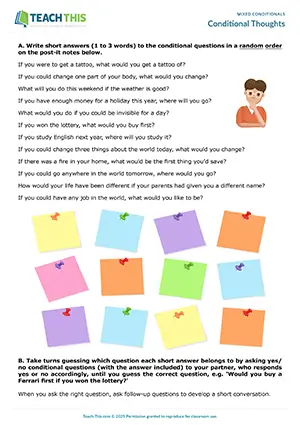
ESL Conditionals Review Activity - Grammar and Speaking: writing Short Answers, Asking and Answering Questions, Freer practice - Pair Work
In this insightful conditionals review activity, students practice asking and answering questions using different conditional forms. First, students answer the...
ESL Conditionals Review Activity - Grammar and Speaking: writing Short Answers, Asking and Answering Questions, Freer practice - Pair Work In this insightful conditionals review activity, students practice asking and answering questions using different conditional forms. First, students answer the conditional questions by writing short answers in a random order on the post-it notes. Next, in pairs, students swap worksheets and take turns guessing which question each short answer belongs to. They do this by asking yes/no conditional questions (with the answer included) to their partner, who responds yes or no accordingly, until their partner guesses the correct question. When the student asks the right question, they ask follow-up questions to develop a short conversation. The activity continues until both students have guessed what all 12 answers refer to. Finally, students report back to the class on the most interesting things they found out about their partner. show lessConditional Chains
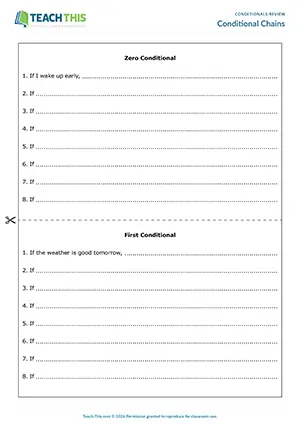
ESL Conditionals Review Activity - Grammar and writing: writing Sentences - Group Work
In this creative conditionals activity, students review the zero, first, second and third conditionals by writing chain sentences. In groups of four, students write a result clause for the first zero, first, second or third conditional sentence on...
ESL Conditionals Review Activity - Grammar and writing: writing Sentences from Prompts - Group Work In this creative conditionals activity, students review the zero, first, second and third conditionals by writing chain sentences. In groups of four, students write a result clause for the first zero, first, second or third conditional sentence on their card and on the next line write the result clause as an if-clause by changing the verb form. Next, students pass their card to the person on their right. The next student then repeats the process. This continues until the card is complete with eight conditional sentences in a chain. Finally, students read out their conditional chain sentences to the class. show lessCountdown
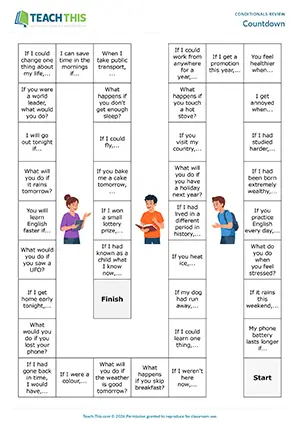
ESL Conditionals Review Board Game - Grammar and Speaking: Sentence Completion, Answering Questions, Freer practice - Group Work
In this free conditionals review board game, students race to complete zero, first, second and third conditional sentences and answer conditional questions in a...
ESL Conditionals Review Board Game - Grammar and Speaking: Sentence Completion, Answering Questions, Freer practice - Group Work In this free conditionals review board game, students race to complete zero, first, second and third conditional sentences and answer conditional questions in a 15-second time frame. In groups, students take turns rolling the dice and moving their counters along the board. When a student lands on a square, they have 15 seconds to complete the conditional sentence using the clause in the square or answer the question. If the other students agree that the sentence completion or answer is correct, the student stays on the square. If a student can't think of anything to say, makes a grammatical mistake, or doesn't complete the task within 15 seconds, they move back two squares. The first student to reach the finish wins the game. show lessFirst to Third Conditionals Review
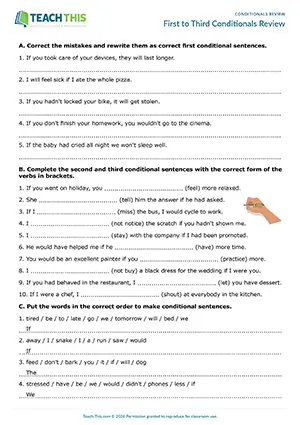
ESL Conditionals Review Worksheet - Grammar Exercises: Error Correction, Gap-fill, Unscrambling, Matching, Identifying, Sentence Completion
Here is a free conditionals review worksheet to help students practice or review first, second and third conditionals. Students begin by correcting mistakes in...
ESL Conditionals Review Worksheet - Grammar Exercises: Error Correction, Gap-fill, Changing Word Forms, Unscrambling, Matching, Identifying, Sentence Completion Here is a free conditionals review worksheet to help students practice or review first, second and third conditionals. Students begin by correcting mistakes in first conditional sentences and rewriting them. Next, students complete second and third conditional sentences with the correct form of the verbs in brackets. Students then put words in the correct order to make conditional sentences. After that, students match sentence halves to form conditional sentences and then indicate which conditional is being used in each sentence. Finally, students complete conditional sentences with their own ideas by adding an if-clause or a main clause to each sentence. show lessMake your Own Dominoes
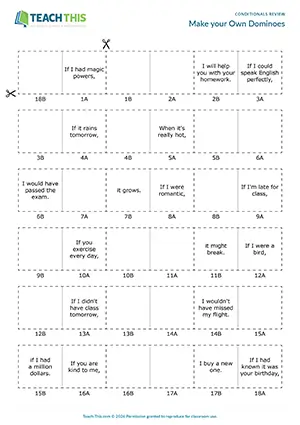
ESL Conditionals Review Game - Grammar: Sentence Completion, Matching - Group Work
In this enjoyable conditionals review game, students practice zero, first, second and third conditionals by completing sentences and playing games of dominoes. In groups, students read and complete...
ESL Conditionals Review Game - Grammar: Sentence Completion, Matching - Group Work In this enjoyable conditionals review game, students practice zero, first, second and third conditionals by completing sentences and playing games of dominoes. In groups, students read and complete each conditional sentence with an if-clause or main clause as indicated on the dominoes. Next, students cut the dominoes out and swap them with another group. Students then play dominoes with the first player trying to make a conditional sentence by placing a domino down either before or after the domino on the table. If the player can make a sentence, they read it to the group to show the match is correct. The next player then tries to put down one of their dominoes at either end of the domino chain, and so on. The first player to get rid of all their dominoes wins the game. show lessSecond vs. Third Conditional

ESL Second vs. Third Conditional Worksheet - Grammar Exercises: Error Correction, Sentence Completion - Speaking Activity: Asking and Answering Questions - Pair Work
This comprehensive second vs. third conditional worksheet helps students distinguish between and practice forming and using these two conditional...
ESL Second vs. Third Conditional Worksheet - Grammar Exercises: Error Correction, Sentence Completion - Speaking Activity: Asking and Answering Questions - Pair Work This comprehensive second vs. third conditional worksheet helps students distinguish between and practice forming and using these two conditional structures. Students begin by reading second and third conditional sentence examples and underlining the correct information about the two tenses. Next, students match second and third conditional sentence halves together and underline the correct tenses. Students then find and correct mistakes in second and third conditional sentences. After that, students complete each sentence with a verb from a box in its second or third conditional form. Students then complete second and third conditional sentence pairs with their own answers and guesses about a partner. Finally, students ask their partner 'What would you do/have done if...?' questions to find out if their guesses were correct. show lessThe Conditionals Race

ESL Conditionals Review Game - Grammar: Matching - Speaking Activity: Discussion, Communicative practice - Group Work
In this engaging conditionals review game, students play dominoes by matching halves of zero, first, second and third conditional sentences together. The first player tries to make a conditional sentence...
ESL Conditionals Review Game - Grammar: Matching - Speaking Activity: Discussion, Communicative practice - Group Work In this engaging conditionals review game, students play dominoes by matching halves of zero, first, second and third conditional sentences together. The first player tries to make a conditional sentence by placing one of their dominoes at either end of the first domino and matching an if clause with an appropriate result clause. When a player makes a sentence, they read it to the group. The next player then tries to put down one of their dominoes at either end of the domino chain, and so on. The first player to get rid of all their dominoes wins the game. Finally, students discuss the conditional sentences and say whether they are true for them or not, and if they agree or disagree with what each sentence says. show lessThe Farmer and His Sons
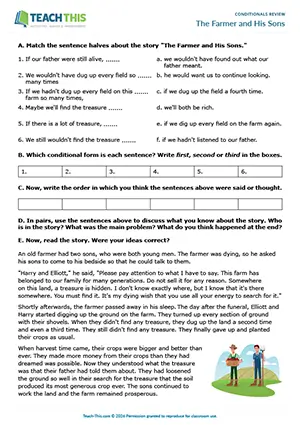
ESL Conditionals Review Worksheet - Grammar, Reading and writing Exercises: Matching, Categorising, writing Sentences - Pair Work
In this thought-provoking conditionals review worksheet, students work with an Aesop fable to practice the first, second and third conditionals. First, students...
ESL Conditionals Review Worksheet - Grammar, Reading and writing Exercises: Matching, Categorising, writing Sentences - Pair WorkIn this thought-provoking conditionals review worksheet, students work with an Aesop fable to practice the first, second and third conditionals. First, students match sentence halves together about a story. Students then write whether each sentence is in the first, second or third conditional. Next, students write the order in which they think the sentences were said or thought. After that, in pairs, students discuss what they know about the story from the sentences. Students then read the story to find out if their ideas were correct. Following that, students look at their sentence order and correct it if necessary. With their partner, students then write a possible moral for the story. Finally, working alone, students imagine that it's ten years later in the story and write first, second, and third conditional sentences about the two people in the story. show lessUnder What Condition?

ESL Real Conditionals Activity - Grammar and writing: writing Sentences, Guessing, Discussion - Pair Work
In this fun real conditionals activity, students guess the circumstances in which a partner did, does or will do certain things using past, present and future real conditionals. First, students write ten sentences...
ESL Real Conditionals Activity - Grammar and writing: writing Sentences from Prompts, Guessing, Discussion - Pair Work In this fun real conditionals activity, students guess the circumstances in which a partner did, does or will do certain things using past, present and future real conditionals. First, students write ten sentences about their past, present or expected future habits or plans using phrases from a box and the appropriate verb tense, choosing habits that they sometimes did, do or will do under certain conditions. Next, in pairs, students swap worksheets and write real conditional sentences explaining the circumstances in which they think their partner did, does or will do what they wrote. Finally, students read the complete conditional sentences to their partner to see if their guesses are correct and then discuss the actual circumstances. show lessWe will finish first unless...
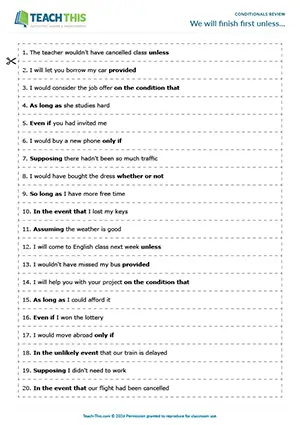
ESL Conditionals Review Game - Grammar: Sentence Completion - Group Work
In this lively conditionals review game, students race to complete first, second, and third conditional sentences with various conditional words and phrases such as 'unless' and 'as long as'. A member from each team runs to your desk...
ESL Conditionals Review Game - Grammar: Sentence Completion - Group Work In this lively conditionals review game, students race to complete first, second, and third conditional sentences with various conditional words and phrases such as 'unless' and 'as long as'. A member from each team runs to your desk, picks up the first sentence strip, and takes it back to their team. Teams then race to complete the sentence, making sure it is logical and grammatically correct, e.g. 'The teacher wouldn't have cancelled class unless it had been an emergency.' As soon as a team has completed the sentence, a student from the team comes to you with their strip. If the sentence is correct, give the student the second strip, and so on. If a sentence is incorrect, the team has to rewrite it. Teams can only get the next strip by producing a logical and grammatically correct sentence. The first team to complete all 20 sentences correctly wins the game. show lessHere's what our members are saying...
- Past Simple vs Past Perfect
-
Past Simple vs. Past Perfect ESL Activities & worksheets
Cause and Effect Dominoes
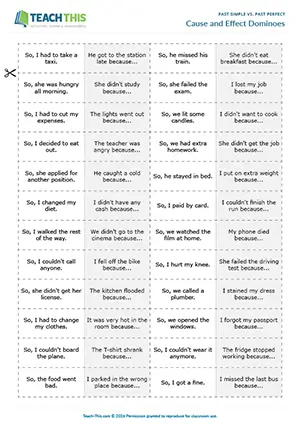
ESL Past Simple vs. Past Perfect Game - Grammar: Forming Sentences, Matching - Group Work
In this productive past simple vs. past perfect game, students play dominoes by matching problems with their effects and creating logical cause-and-effect sentences. The first player places a domino down...
ESL Past Simple vs. Past Perfect Game - Grammar: Forming Sentences, Matching - Group Work In this productive past simple vs. past perfect game, students play dominoes by matching problems with their effects and creating logical cause-and-effect sentences. The first player places a domino down either before or after the domino on the table, ensuring the problem matches the correct effect or vice versa. The player then explains a possible cause by completing the because-clause using the past perfect, e.g. 'He got to the station late because he had overslept. So, he missed his train.' If the other students agree that the sentence is grammatically correct and appropriate, the domino stays in place. If a player cannot put down a domino or cannot complete the because-clause in the past perfect, they take one domino from the pile and play passes to the next student. The other players then take turns matching their dominoes in the same way by putting them down at either end of the domino chain. The first player to get rid of all their dominoes wins the game.Double-Past Detective
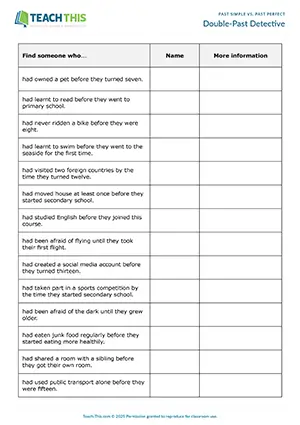
ESL Past Simple vs. Past Perfect Activity - Speaking: Asking and Answering Questions, Controlled and Freer practice
In this engaging past simple vs. past perfect activity, students ask 'Had you...?' questions about earlier and later past events, and then ask past simple follow-up questions to find out more information...
ESL Past Simple vs. Past Perfect Activity - Speaking: Asking and Answering Questions from Prompts, Controlled and Freer practice In this engaging past simple vs. past perfect activity, students ask 'Had you...?' questions about earlier and later past events, and then ask past simple follow-up questions to find out more information. This activity works best with older teenagers and adults. First, students go through the items on the worksheet and review the past perfect 'Had you...?' questions they need to ask in the activity, e.g. 'Had you owned a pet before you turned seven?' Students then go around the class, asking their classmates the 'Had you...?' questions. When a student finds someone who answers 'Yes, I had', they write down the person's name and then ask a past simple follow-up question to gain more information, noting down the answer in the last column before moving on to speak to someone else. If a classmate replies 'No, I hadn't', the student asks a different question or repeats the question with another person. This process continues until the students have completed each item on the worksheet with a different name and answer, one classmate per item. Afterwards, students give feedback to the class on the answers they collected.Past Simple or Past Perfect?
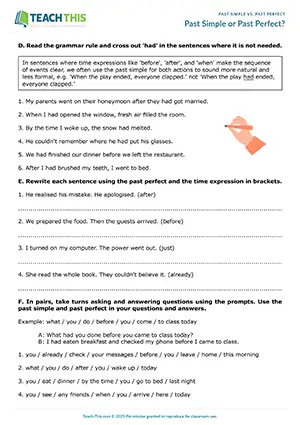
ESL Past Simple vs. Past Perfect Worksheet - Grammar Exercises: Binary Choice, Matching - Speaking Activity: Asking and Answering, Freer practice - Pair Work
In this productive past simple vs. past perfect worksheet, sstudents practice using the past simple and the past perfect with time words and expressions to...
ESL Past Simple vs. Past Perfect Worksheet - Grammar Exercises: Binary Choice, Matching, Gap-fill, Identifying, Rewriting Sentences - Speaking Activity: Asking and Answering Questions from Prompts, Controlled and Freer practice - Pair Work In this productive past simple vs. past perfect worksheet, students practice using the past simple and the past perfect with time words and expressions to show which past action happened first and then use the target language to talk about their own experiences. First, students read two example sentences and underline the correct answers in the grammar statements. Students then match sentence halves together and underline the correct tense in each complete sentence. Next, students complete sentences with the verbs in brackets in the correct past simple or past perfect form. After that, students read a grammar rule and cross out 'had' in the sentences in which it can be omitted. Next, students rewrite pairs of past simple sentences as one sentence using the past perfect and the word in brackets. Finally, in pairs, students ask and answer questions using prompts to practice using the past simple and past perfect in mstudents practice using the past simple and the past perfect with time words and expressions to show which past action happened first and then use the target language to talk about their own experiences.eaningful contexts.Timeline Detectives

ESL Past Simple vs. Past Perfect Activity - Grammar and Speaking: Guessing, Asking and Answering Questions, Labelling, Describing, Freer practice - Pair Work
In this challenging past simple vs. past perfect activity, students practice ordering past events on timelines by asking and answering questions in the past simple...
ESL Past Simple vs. Past Perfect Activity - Grammar and Speaking: Guessing, Asking and Answering Questions, Labelling, Describing, Freer practice - Pair Work In this challenging past simple vs. past perfect activity, students practice ordering past events on timelines by asking and answering questions in the past simple and past perfect, and then describing the completed timelines. To begin, Student A picks up a card showing the order of activities of a weekday and reads out the sentence in bold, e.g. 'On Monday, I worked in the office.' Student B then completes the corresponding sentence on their worksheet and looks at the activity marked in the middle of that day's timeline and the other four activities for the day shown beneath. Next, Student B uses the activity marked in the middle as a starting point and asks past simple and past perfect questions to find out which activities happened before or after it. Student B can then compare any two activities to work out the exact order. If Student A answers 'Yes', their partner uses that information to place the letter on the timeline or ask the next question. If not, their partner tries a different question. As more of the order becomes clear, Student B uses that information to form more questions and work out the remaining order. When the timeline is complete, the card is removed, and the students swap roles. When all the timelines have been completed, students take turns describing their partner's weekdays using the past simple and past perfect.When Everything Went Wrong
ESL Past Simple vs. Past Perfect Activity - Grammar and writing: Binary Choice, Gap-fill, writing Stories, Peer Review, Freer practice - Pair Work
In this rewarding past simple vs. past perfect activity, students practice using the past perfect for background events and the past simple for the main sequence...
ESL Past Simple vs. Past Perfect Activity - Grammar and writing: Binary Choice, Gap-fill, writing Stories, Peer Review, Freer practice - Pair Work In this rewarding past simple vs. past perfect activity, students practice using the past perfect for background events and the past simple for the main sequence of events in stories. First, students underline the correct verb forms in a story, using the past perfect for earlier background events and the past simple for the main events in the story. Students then work with a partner and take turns reading the story aloud, one sentence at a time. After each sentence, students check their answers and agree on the correct verb form. Next, students complete grammar rules for the past simple and past perfect. After that, students write a short story about a holiday that went wrong, using the past perfect to describe background experiences before the main events and the past simple to tell the main sequence of events in the story. Students then take turns reading their story to their partner, who listens and uses a checklist to give feedback. Finally, students edit their stories based on their partner’s comments.Past Perfect Travel Disasters
ESL Past Simple vs. Past Perfect Game - Grammar: Forming Sentences, Guessing, Controlled practice - Group and Pair Work
In this useful past simple vs. past perfect game, students complete sentence starters with past perfect endings about unexpected travel problems and then guess their partner’s endings. First, in two groups...
ESL Past Simple vs. Past Perfect Game - Grammar: Forming Sentences, Guessing, Controlled practice - Group and Pair Work In this useful past simple vs. past perfect game, students complete sentence starters with past perfect endings about unexpected travel problems and then guess their partner’s endings. First, in two groups, students use past simple sentence starters to write clear, realistic past perfect endings about unexpected travel problems. Next, students pair up with someone from the other group. Students then take turns reading one sentence starter without the ending to their partner, who has three chances to guess the ending. A guess is correct if it matches the main idea, not the exact wording. If their partner guesses correctly on the first try, the other student awards them three points. On the second try, two points. On the last try, one point. For each wrong guess, the other student gives one keyword from the ending to help their partner guess the answer. After three failed attempts, the student reveals the ending, and no points are awarded. The student with the most points at the end of the game wins.Story Fix Challenge
ESL Past Simple vs. Past Perfect Activity - Grammar, Reading and writing: Identifying, Error Correction, writing Short Stories - Group and Pair Work
In this enjoyable past simple vs. past perfect activity, students improve tense choices in short stories, compare their answers with a partner, and then write and...
ESL Past Simple vs. Past Perfect Activity - Grammar, Reading and writing: Identifying, Error Correction, writing Short Stories - Group and Pair Work In this enjoyable past simple vs. past perfect activity, students improve tense choices in short stories, compare their answers with a partner, and then write and share a short story with one deliberate tense mistake. First, in two groups, students read each story, underline six verb forms that need changing, and write the correct form of each verb in boxes 1-6 below each story in the order the verbs appear. Next, students pair up with someone from the other group. Students then take turns reading the model versions of the stories to their partner, who listens and puts a tick next to each verb form they got correct. After that, students write a short story about a memorable first-time experience (e.g. first day of school), deliberately including one past simple or past perfect verb form in the wrong tense that makes the order of events unclear. Finally, students take turns reading their stories to a new partner, who identifies the verb in the wrong tense and suggests a correction.Here's what our members are saying...
- Scheduling, Confirming and Rescheduling by Email
-
Scheduling, Confirming and Rescheduling by Email: Business English worksheets
Confirming Arrangements by Email
Business English Confirming Arrangements by Email Worksheet - Vocabulary, Reading and writing: Gap-fill, Matching, Email writing - Speaking: Discussion - Pair Work
In this insightful confirming arrangements worksheet, students practice phrases for confirming arrangements by email. In pairs, students begin by discussing...
Business English Confirming Arrangements by Email Worksheet - Vocabulary, Reading and writing: Multiple Choice, Gap-fill, Matching, Email writing - Speaking: Guided Discussion - Pair Work In this insightful confirming arrangements worksheet, students practice phrases for confirming arrangements by email. In pairs, students begin by discussing questions related to confirming arrangements by email. Students then complete sentences related to confirming arrangements by choosing the correct words from the options shown. Next, students complete a confirmation email with a set of phrases. After that, students match the phrases from the email with their functions. Lastly, students reply to an email, confirming their attendance at a job interview and asking for confirmation on certain points.Declining an Invitation by Email

Business English Declining Invitations by Email Worksheet - Reading and writing Exercises: Unscrambling, Gap-fill, Ordering, Rewriting Sentences, Email writing
In this free declining invitations worksheet, students learn and practice writing professional and polite emails declining work-related invitations. First,...
Business English Declining Invitations by Email Worksheet - Reading and writing Exercises: Unscrambling, Gap-fill, Ordering, Rewriting Sentences, Email writing In this free declining invitations worksheet, students learn and practice writing professional and polite emails declining work-related invitations. First, students unscramble common email expressions and then write them in an invitation email. In pairs, students then discuss possible reasons why the invitee is not able to accept the invitation. Next, students write an email declining the invitation by putting sentences in the correct order to form the email. Lastly, students write an email declining an invitation to a work-related meeting or event, following requirements outlined in a prompt.Rescheduling Emails

Business English Rescheduling by Email Worksheet - Reading, Vocabulary and writing: Identifying, Labelling, Gap-fill, Email writing, Peer Review
In this rescheduling by email worksheet, students practice how to reschedule meetings politely by using softening language, clear time options and brief reasons...
Business English Rescheduling by Email Worksheet - Reading, Vocabulary and writing: Identifying, Labelling, Gap-fill, Email writing, Peer Review In this rescheduling by email worksheet, students practice how to reschedule meetings politely by using softening language, clear time options and brief reasons to minimise inconvenience. First, students read two rescheduling emails. The first email is too direct, and the second is polite and complete. Students then underline the two phrases that sound too direct in Email 1 and tick which elements are missing. Next, students label the sentence in Email 2 that shows each element. After that, students use phrases in the box to complete a rescheduling email. Students then write their own rescheduling email using the scenario provided and the phrases from the worksheet. Finally, students swap their emails with a partner, who peer reviews their email by checking the required elements, language and time options. Students then give feedback to their partner, giving one positive comment and making one suggestion for improvement.When are you available?
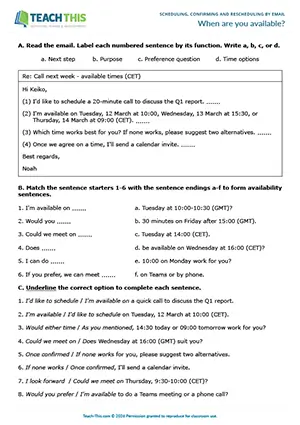
Business English Scheduling by Email Worksheet - Reading, Vocabulary and writing: Matching, Binary Choice, Rewriting Sentences, Email writing, Peer Feedback
In this scheduling by email worksheet, students practice writing short scheduling emails that offer clear time options with time zones, ask for a preference, and...
Business English Scheduling by Email Worksheet - Reading, Vocabulary and writing: Matching, Binary Choice, Rewriting Sentences, Email writing, Peer Feedback In this scheduling by email worksheet, students practice writing short scheduling emails that offer clear time options with time zones, ask for a preference, and confirm the next step. First, students read a model email and label each numbered sentence by its function. Students then form availability sentences by matching sentence starters and endings. Next, students underline the correct options to complete key scheduling phrases. After that, students rewrite unclear or incorrect lines to make dates, times and time zones clear. Finally, students write a short scheduling email offering two or three time options. Afterwards, students swap emails with a partner, complete a checklist and provide feedback.Rescheduling Deliveries
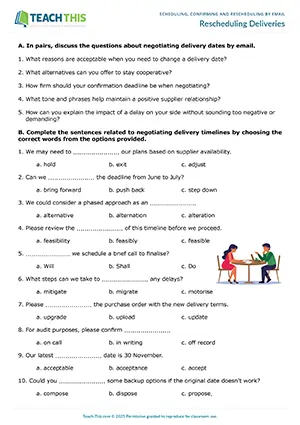
Business English Rescheduling by Email Worksheet - Reading and writing Exercises: Multiple Choice, Gap-fill, Matching, Email writing, Peer Feedback
In this rescheduling by email worksheet, students learn and practice the language for requesting revised delivery dates, proposing alternatives, and confirming...
Business English Rescheduling by Email Worksheet - Reading and writing Exercises: Multiple Choice, Gap-fill, Matching, Email writing, Peer Feedback In this rescheduling by email worksheet, students learn and practice the language for requesting revised delivery dates, proposing alternatives, and confirming deadlines and next steps in professional emails. In pairs, students begin by discussing questions related to negotiating delivery dates by email. Students then complete sentences related to negotiating delivery timelines by choosing the correct words from the options provided. Next, students complete a negotiation email with key phrases. After that, students match five key phrases from the email with their functions. Students then write a reply to the email, negotiating a new delivery date and confirming next steps. Finally, students exchange emails with a partner, conduct a review using a checklist, and provide feedback.writing a Confirmation Email
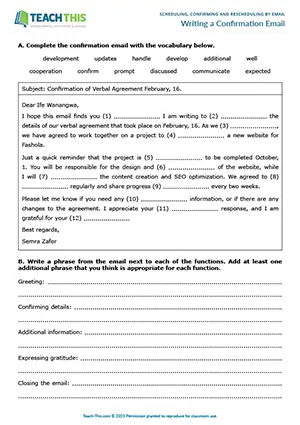
Business English Confirmation Emails Worksheet - Vocabulary, Reading and writing Exercises: Gap-fill, Identifying, Email writing practice, Peer Review
Here is a productive business confirmation emails worksheet to help students practice writing emails confirming the terms of a verbal agreement. Students begin by...
Business English Confirmation Emails Worksheet - Vocabulary, Reading and writing Exercises: Gap-fill, Identifying, Unscrambling, Email writing practice, Peer Review Here is a productive business confirmation emails worksheet to help students practice writing emails confirming the terms of a verbal agreement. Students begin by completing an example confirmation email with related vocabulary. Students then scan the example email for phrases that perform the functions shown and write them down. For each function, students also add at least one appropriate phrase that they are already familiar with. Next, students unscramble two example email confirmation sentences. Lastly, students take on the role of an owner of a fashion label and write a confirmation email to the owner of a clothing retail chain, by addressing the details outlined in the prompt provided. Lastly, students swap their email with a partner and conduct a quick peer review.Here's what our members are saying...
- Follow‑up and Update Emails
-
Follow‑up & Update Emails: Business English worksheets
First Meeting Follow-up
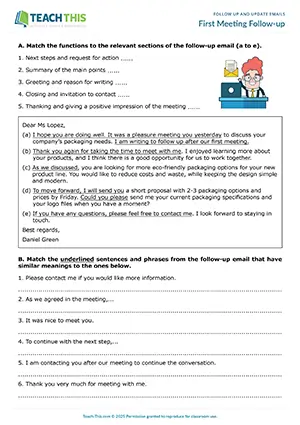
Business English Follow-up Emails Worksheet - Reading, Vocabulary and writing Exercises: Identifying, Gap-fill, Email writing - Pair Work
In this comprehensive business follow-up emails worksheet, students learn and practice the structure and language needed for writing effective follow-up emails after...
Business English Follow-up Emails Worksheet - Reading, Vocabulary and writing Exercises: Matching, Identifying Phrases, Gap-fill, Sentence writing, Email writing, Peer Feedback - Pair Work In this comprehensive business follow-up emails worksheet, students learn and practice the structure and language needed for writing effective follow-up emails after first business meetings. First, students read a follow-up email and match each function to a section of the email. Students then match the underlined sentences and phrases from the follow-up email to sentences that have similar meanings. Next, students complete useful phrases for follow-up emails with words from a box. After that, students read details of a first business meeting and use prompts to write follow-up email sentences about it using the phrases from the previous exercises. Students then write a complete business follow-up email using the details of the first meeting and their own sentences. Finally, students swap emails with a partner and use a checklist of criteria to review and provide feedback, giving one positive comment and one suggestion for improvement.Job Applications Follow-Up Emails
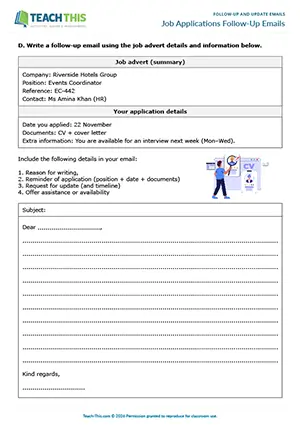
Business English Follow-up Emails Worksheet - Reading, Vocabulary and writing Exercises: Rewriting Sentences, Email writing
In this job application follow-up emails worksheet, students learn and practice polite, formal language for following up on a job application and then write...
Business English Follow-up Emails Worksheet - Reading, Vocabulary and writing Exercises: Comprehension Questions, Ordering, Rewriting Sentences, Email writing, Peer Feedback In this job application follow-up emails worksheet, students learn and practice polite, formal language for following up on a job application and then write a short email to HR. First, students read a model follow-up email to HR and answer comprehension questions about it. Students then put a follow-up email for a job application in the correct order. Next, students rewrite informal email lines in a more formal register. After that, students read a short job advertisement and application details and write a job application follow-up email. Finally, students exchange emails with a partner and give feedback.Polite Follow‑up Emails
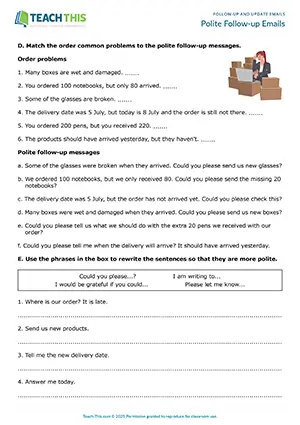
Business English Follow-up Emails Worksheet - Reading, Vocabulary and writing Exercises: Identifying, Matching, Email writing
In this free follow-up emails worksheet, students practice useful language for checking on an order and following up on delivery problems, and then...
Business English Follow-up Emails Worksheet - Reading, Vocabulary and writing Exercises: Identifying, Matching, Rewriting Sentences, Email writing, Peer Feedback In this free follow-up emails worksheet, students practice useful language for checking on an order and following up on delivery problems, and then write their own polite follow-up email. First, students read two follow-up emails about a late order and compare them. Students then read the two emails again, look at a table and decide whether each sentence describes Email 1 or Email 2, putting a tick in the appropriate column or in both columns. Next, students write sentences about which email they would send and why. After that, students match common order problems to suitable polite follow-up messages. Students then rewrite short, direct sentences to make them more polite using phrases from a box. Following that, students use a situation and prompts to write a follow-up email to a supplier. Next, students exchange emails with a partner, read their partner's email and then tick the boxes for the criteria that their email meets. Finally, students give their partner two positive comments about their email and one suggestion for improvement. Then, students edit their own email, making any changes as needed.Project Status Update Emails

Business English Update Emails Worksheet - Reading, Vocabulary and writing Exercises: Matching, True or False, Gap-fill, Email writing
In this project status update email worksheet, students read a model internal project update email, complete controlled practice tasks and then write their own short...
Business English Update Emails Worksheet - Reading, Vocabulary and writing Exercises: Matching, True or False, Gap-fill, writing Sentences, Email writing, Peer Feedback In this project status update email worksheet, students read a model internal project update email, complete controlled practice tasks and then write their own short, professional update email to a manager. To begin, students read a short internal project update email and match headings to each section of the email. Students then read the email again and decide whether the statements are true or false. Next, students complete sentences with time expressions and sequencing words from a box. After that, students find and correct mistakes in project update sentences. Students then read notes about another project and write one sentence for each part of the update. Following that, students use their sentences to write a project update email to their manager. Finally, students swap emails with a partner, read their partner's email, complete a checklist and then give feedback.Action-Owner Follow-up
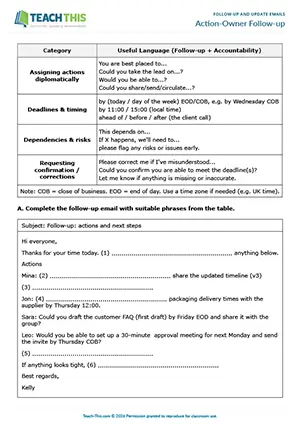
Business English Follow-up Emails Worksheet - Reading, Vocabulary and writing Exercises: Gap-fill, Rewriting Sentences, Email writing, Peer Feedback
In this follow-up emails worksheet, students learn to write professional post-meeting emails that assign actions diplomatically and establish clear accountability...
Business English Follow-up Emails Worksheet - Reading, Vocabulary and writing Exercises: Gap-fill, Matching, Rewriting Sentences, writing Questions, Email writing, Peer Feedback In this follow-up emails worksheet, students learn to write professional post-meeting emails that assign actions diplomatically and establish clear accountability for deliverables and deadlines. First, students complete a follow-up email using phrases from a useful language table. Students then match meeting notes to action lines, focusing on deliverables, deadlines and details. Next, students rewrite direct or unclear lines so that they sound professional, making the owner, deliverable and deadline clear. After that, students read each unclear action item, identify what's missing and then write two clarifying questions. Students then write a meeting follow-up email using the scenario provided. Finally, students swap emails with a partner and use a checklist to revise and edit for clarity and tone before giving feedback.Business Follow-up Emails

Business English Follow-up Emails Worksheet - Reading and writing Exercises: Matching, Rewriting an Email - Speaking Activity: Discussion - Pair Work
In this handy follow-up emails worksheet, students learn and practice the structure of a business follow-up email and review and practice formal register...
Business English Follow-up Emails Worksheet - Reading and writing Exercises: Matching, Rewriting an Email - Speaking Activity: Guided Discussion - Pair Work In this handy follow-up emails worksheet, students learn and practice the structure of a business follow-up email and review and practice formal register. To begin, students discuss three questions about follow-up emails in pairs. When the pairs have finished, they share their answers with the class. Next, students read an example follow-up business email and match underlined sentences from the email to functions. After that, students work in pairs to read a follow-up email that has an inappropriate register. Together, students discuss how to make the tone more formal so that the email is suitable for professional business communication. Each student then writes a revised version of the email on their worksheet. Finally, review the students' emails as a class.Follow Up Like a Pro
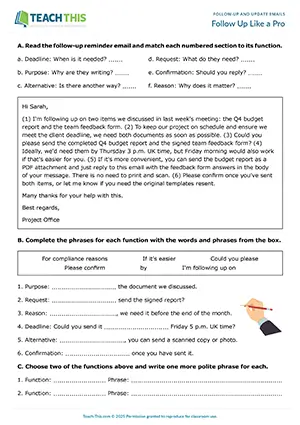
Business English Follow-up Emails Worksheet - Vocabulary and writing Exercises: Identifying, Matching, Gap-fill, Error Correction, Email writing
In this follow‑up reminder emails worksheet, students practice identifying the key components of polite follow-up reminder emails and writing their own...
Business English Follow-up Emails Worksheet - Vocabulary and writing Exercises: Identifying, Matching, Gap-fill, Error Correction, Email writing In this follow‑up reminder emails worksheet, students practice identifying the key components of polite follow-up reminder emails and writing their own professional reminder emails. Students begin by reading a follow‑up reminder email and matching each numbered section to its function. Students then complete phrases for each function with words and phrases from a box. Next, students choose two of the functions and write one more polite phrase for each. Following that, students complete a timesheet follow‑up reminder email using words from a word bank. Students then identify and correct problematic lines from an NDA follow‑up reminder email, making them polite and clear. Next, students read an email and then write a polite follow-up reminder email in response, incorporating all six key functions. Finally, students swap their emails with a partner and use a checklist to revise and edit their partner's email, ensuring all components are included and the tone is appropriate before providing feedback.Traffic-Light Project Updates
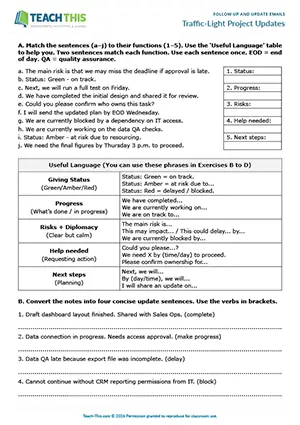
Business English Update Emails Worksheet - Reading and writing Exercises: Matching, writing and Rewriting Sentences, Email writing
In this project update email worksheet, students learn a clear structure for project update emails and practice using Green, Amber, and Red status language...
Business English Update Emails Worksheet - Reading and writing Exercises: Matching, writing and Rewriting Sentences, Email writing In this project update email worksheet, students learn a clear structure for project update emails and practice using Green, Amber, and Red status language to report progress, flag risks, and request support diplomatically. First, students match sentences to their functions (Status, Progress, Risks, Help needed, Next steps). Students then convert notes into four concise update sentences using verb prompts. After that, students rewrite blunt 'bad news' lines to sound professional and diplomatic. Finally, students write a project update email using a template and prompts.Update Emails
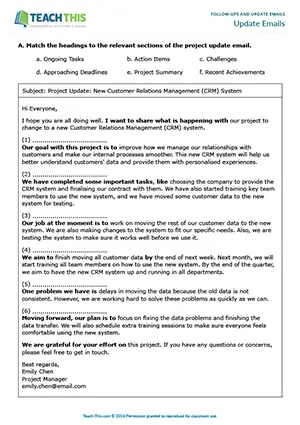
Business English Update Emails Worksheet - Reading, Vocabulary and writing Exercises: Matching, writing Sentences, Email writing, Error Correction
In this update emails worksheet, students learn useful expressions for update emails and use them to write an email about a project update. First, students read...
Business English Update Emails Worksheet - Reading, Vocabulary and writing Exercises: Matching, writing Sentences from Prompts, Email writing, Error Correction In this update emails worksheet, students learn useful expressions for update emails and use them to write an email about a project update. First, students read an update email and match headings to each section. Next, students match the language in bold from the email with similar expressions. Students then read the details of a project update and write sentences about it using the expressions. After that, students write a complete update email using the details of the project update and sentences. Lastly, students exchange emails with a partner and correct any mistakes they find.Here's what our members are saying...
- Polite Email Requests and Clarifying Questions
-
Polite Email Requests & Clarifying Questions: Business English worksheets
Responding to an Email Enquiry
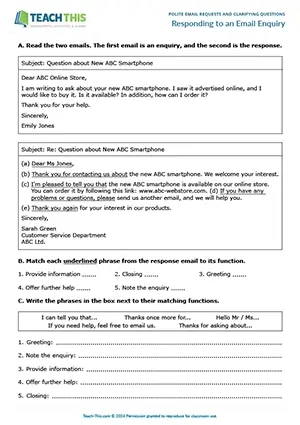
Business English Email Enquiries Worksheet - Reading, Vocabulary and writing Exercises: Matching, Sentence Completion, writing Emails - Pair Work
In this email enquiries worksheet, students learn and practice how to write an email that responds to a customer enquiry. First, students read an enquiry email...
Business English Email Enquiries Worksheet - Reading, Vocabulary and writing Exercises: Matching, Sentence Completion, writing Emails from Prompts - Pair Work In this email enquiries worksheet, students learn and practice how to write an email that responds to a customer enquiry. First, students read an enquiry email and a response. Students then match phrases in the response email with their functions. Next, students match additional phrases from a box to their functions. After that, students swap worksheets with a partner and write an email enquiry by completing sentences with their own ideas. Students then give back the worksheet to their partner, who writes an email response using the phrases from the worksheet. Finally, students read their email to their partner and discuss whether they think it was a good response or not.writing an Invitation Email
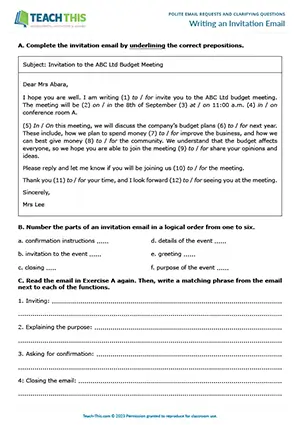
Business English Invitation Emails Worksheet - Reading and writing Exercises: Binary Choice, Ordering, Identifying, Matching, Email writing
In this useful business invitation emails worksheet, students learn and practice how to write emails issuing work-related invitations. First, students complete an...
Business English Invitation Emails Worksheet - Reading and writing Exercises: Binary Choice, Ordering, Identifying, Unscrambling, Matching, Email writing, Peer Feedback In this useful business invitation emails worksheet, students learn and practice how to write emails issuing work-related invitations. First, students complete an invitation email by underlining the correct prepositions. Students then number the parts of an invitation email so that they are in a logical order. Next, students scan the email again to find phrases that match different functions and write them down. After that, students unscramble words to form sentences and use them to complete an invitation email. Following that, students write an invitation email inviting someone to a marketing meeting. Finally, students exchange their completed emails with a partner and use a checklist to provide feedback, putting a tick for each item achieved. Students then revise their emails to address any of the unachieved items.Polite Replacement Requests
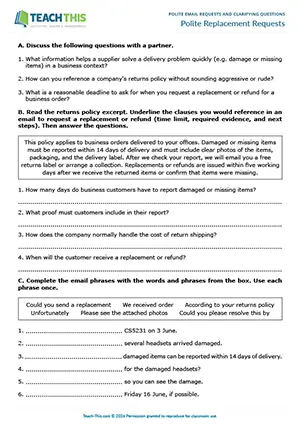
Business English Email Requests Worksheet - Reading, Vocabulary and writing Exercises: Gap-fill, Ordering, Email writing - Speaking Activity: Discussion - Pair Work
In this comprehensive request emails worksheet, students practice writing polite replacement or refund request emails and asking clarifying questions...
Business English Polite Email Requests Worksheet - Reading, Vocabulary and writing Exercises: Short-Answer Questions, Gap-fill, Ordering, Email writing, Peer Feedback - Speaking Activity: Guided Discussion, Communicative practice - Pair Work In this comprehensive request emails worksheet, students practice writing polite replacement or refund request emails and asking clarifying questions using a returns policy. First, in pairs, students discuss questions related to the topic. Students then read a returns policy excerpt and underline the clauses they would reference in an email to request a replacement or refund. They then answer comprehension questions to check their understanding of the time limit, required evidence and process. Next, students complete useful email phrases for reporting damage or shortages and making polite requests with words and phrases from a box. After that, students put sentences in order to form a replacement request email. Students then read a situation about a notebook order with missing and damaged items. Following that, students use the situation to write a replacement or refund request email to a supplier, including at least one clarifying question. Finally, students exchange emails with a partner, read their partner's email and make useful suggestions to improve it by answering questions. Students then provide feedback and revise any parts they want to improve.Clarifying Invoice Discrepancies
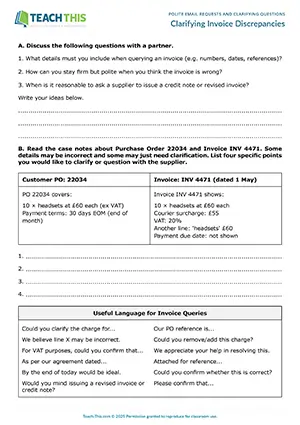
Business English Email Requests and Clarifying Questions Worksheet - Reading and writing Exercises: Identifying, Email writing - Speaking Activity - Pair Work
In this Business English worksheet on email requests and clarifying questions, students practice clarifying invoice discrepancies and requesting revised invoices or...
Business English Email Requests and Clarifying Questions Worksheet - Reading and writing Exercises: Identifying, writing Questions and Statements, Email writing, Peer Feedback - Speaking Activity: Guided Discussion, Freer practice - Pair Work In this Business English worksheet on email requests and clarifying questions, students practice clarifying invoice discrepancies and requesting revised invoices or credit notes in clear, polite professional emails. In pairs, students begin by discussing questions about invoice details and credit notes. Pairs then share their ideas with the class. Next, students read case notes about an invoice and list the items they want to clarify or question. After that, students write four clarifying questions or requests about the invoice, using the useful language provided. Students then write an email to the accounts department, enquiring about the unexpected charges and requesting a correction if necessary. Finally, students swap emails with a partner and give feedback on clarity, politeness and completeness.From Vague to Clear
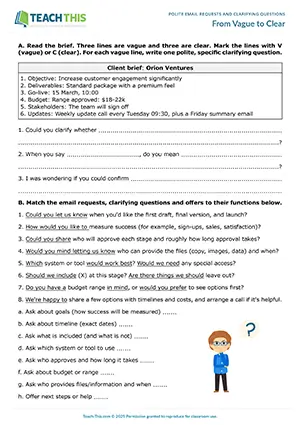
Business English Email Clarifying Questions Worksheet - Reading, Vocabulary and writing Exercises: Sentence Completion, Matching, Rewriting Sentences and Emails
In this clarifying questions in business emails worksheet, students practice identifying vague information in client emails and briefs and writing polite, specific...
Business English Email Clarifying Questions Worksheet - Reading, Vocabulary and writing Exercises: Categorising, Sentence Completion, Matching, Rewriting Sentences and Emails In this clarifying questions in business emails worksheet, students practice identifying vague information in client emails and briefs and writing polite, specific clarifying questions to obtain necessary project information. To begin, students read a brief and mark each line with V (vague) or C (clear). Students then write one polite, specific clarifying question for each vague line. Next, students match email requests, clarifying questions and offers to their functions. After that, students rewrite blunt email lines so they are polite and specific, clarifying questions. Finally, students rewrite an email so that the tone is polite and suitable for professional business communication.Handover Email Requests
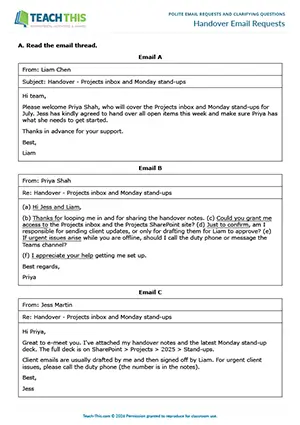
Business English Email Requests Worksheet - Reading, Vocabulary and writing Exercises: Ordering, Sentence Completion, writing Emails - Pair Work
In this business email requests worksheet, students practice writing polite handover emails to request access, clarify responsibilities and ask...
Business English Email Requests Worksheet - Reading, Vocabulary and writing Exercises: Ordering, Matching, Sentence Completion, Rewriting Sentences, writing Emails, Peer Feedback - Pair Work In this business email requests worksheet, students practice writing polite handover emails to request access, clarify responsibilities and ask about urgent issues. First, students read an email thread, put the emails in a logical order and then match each email to its function. Next, students look at one email again and match the underlined phrases to their functions. After that, students complete handover email requests and questions with their own ideas. Students then rewrite direct requests to make them more polite and appropriate for a handover email. Following that, students write a follow-up handover email, using the information from the email thread and exercises. Finally, students read their email to a partner, who uses a checklist to give feedback. Students then revise their email, taking the feedback into account.Here's what our members are saying...
- Clauses of Manner
-
Clauses of Manner ESL Games & worksheets
Clauses and Phrases of Manner
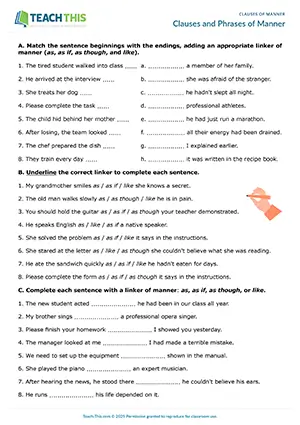
ESL Clauses and Phrases of Manner Worksheet - Grammar and writing Exercises: Matching, Gap-fill, writing Sentences and a Paragraph - Speaking Activity - Pair Work
In this comprehensive clauses and phrases of manner worksheet, students practice forming and using clauses and phrases of manner with as, as if, as though, and like...
ESL Clauses and Phrases of Manner Worksheet - Grammar and writing Exercises: Matching, Multiple Choice, Gap-fill, writing Sentences and a Paragraph - Pair Work In this comprehensive clauses and phrases of manner worksheet, students practice forming and using clauses and phrases of manner with as, as if, as though, and like. First, students match sentence beginnings with endings, adding an appropriate linker of manner (as, as if, as though, and like). Students then underline the correct linker to complete each sentence. Next, students complete sentences with a linker of manner. After that, students rewrite sentences combining the two parts using the linkers in brackets. Following that, in pairs, students discuss two situations using clauses and phrases of manner and then write sentences about them using as, as if, as though, or like. Finally, students write a short paragraph about their morning routine using at least three clauses or phrases of manner with the linkers.Clauses of Manner Challenge

ESL Clauses of Manner Board Game - Grammar and Speaking: Forming Sentences, Freer practice - Group Work
In this engaging clauses of manner board game, students practice forming sentences that express manner using as, like, as if, as though, and the way. Players take turns rolling the dice and moving their...
ESL Clauses of Manner Game - Grammar and Speaking: Forming Sentences, Freer practice - Group Work In this engaging clauses of manner board game, students practice forming sentences that express manner using as, like, as if, as though, and the way. Players take turns rolling the dice and moving their counter along the board. When a player lands on a prompt square, they pick up a linker card and read the word aloud to the group. The player then completes the prompt using the linker to express manner, e.g. if the prompt is 'She smiles...' and the card is 'as if', they say something like 'She smiles as if she has won a prize.' If the sentence is correct and logical, the player stays on the square. If not, the player moves back two squares. The card is then returned to the bottom of the pile. The first player to reach the finish square wins the game.As If and As Though Challenges
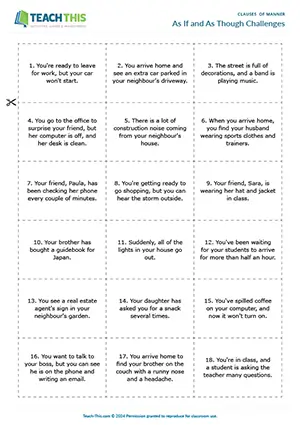
ESL As If and As Though Game - Grammar and Speaking: Matching, Forming Sentences, Controlled practice - Group Work
In this free 'as if' and 'as though' game, students practice forming sentences using 'as if' and 'as though' with the present simple and present continuous. The first student turns over the top situation card...
ESL As If and As Though Game - Grammar and Speaking: Matching, Forming Sentences from Prompts, Controlled practice - Group Work In this free 'as if' and 'as though' game, students practice forming sentences using 'as if' and 'as though' with the present simple and present continuous. The first student turns over the top situation card, reads it to the group, and then lays it face-up on the table. Next, all the students look at their cards and try to find the matching sentence prompt. The student with the matching card then uses the prompt to make an 'as if' or 'as though' sentence that refers to the situation, e.g. for the situation 'You're ready to leave for work, but your car won't start', the matching prompt would be 'It seems as if the battery is dead.' If everyone in the group agrees that the sentence corresponds to the situation and is grammatically correct, the two cards are removed from the game. If the sentence isn't grammatically correct, the situation card is placed at the bottom of the pile. If the sentence doesn't correspond to the situation, another student can try to answer. The second student then turns over the next situation card, and so on. The first student to get rid of all their sentence prompt cards wins the game. Afterwards, check the answers by eliciting the matching card for each situation and the corresponding 'as if' or 'as though' sentence.Clauses of Manner Bingo
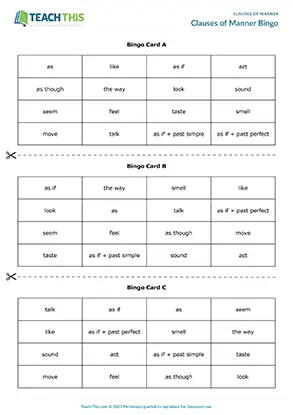
ESL Clauses of Manner Game - Grammar: Bingo, Guessing, Forming Sentences from Prompts - Group Work
In this enjoyable clauses of manner game, students practice clauses of manner and verbs of perception by producing context-appropriate sentences. To start the game, the caller picks up a situation card...
ESL Clauses of Manner Game - Grammar: Bingo, Guessing, Forming Sentences from Prompts - Group Work In this enjoyable clauses of manner game, students practice clauses of manner and verbs of perception by producing context-appropriate sentences. To start the game, the caller picks up a situation card and reads it aloud, e.g. 'The neighbours' lights are on and extra shoes are by the door.' Each player then chooses a square on their bingo card, says the target word or phrase aloud (e.g. as though), and gives their sentence, e.g. 'It looks as though they are having guests over.' The caller listens to each sentence and uses the reference card to check that the sentence clearly matches the situation, uses the exact target word or phrase on the square, and sounds natural and grammatically correct. If a player's sentence meets these requirements, they mark their square with a cross. If not, the square remains unmarked. The caller then picks up the next situation card, and so on. The first player to cross off four squares in a row shouts 'Bingo!' and wins the round. The game then continues to see who can mark all 16 squares. Groups play several games, with students taking turns being the caller and players using a different bingo card each time.It looks as if I'm going to win
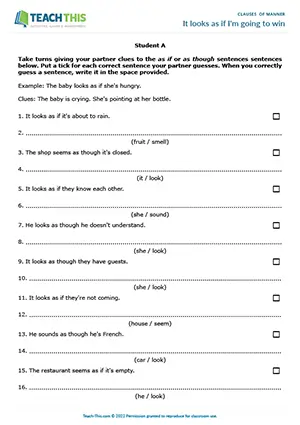
ESL As If and As Though Game - Grammar and Speaking: Giving Clues, Guessing, Forming Sentences, Controlled practice - Pair Work
In this fun 'as if' and 'as though' game, students guess 'as if' and 'as though' sentences from clues given by a partner. Students take turns giving...
ESL As If and As Though Game - Grammar and Speaking: Giving Clues, Guessing, Forming Sentences, Controlled practice - Pair Work In this fun 'as if' and 'as though' game, students guess 'as if' and 'as though' sentences from clues given by a partner. Students take turns giving clues to their partner to help them guess the 'as if' or 'as though' sentences written on their worksheet. For example, if the sentence read 'The baby looks as if she's hungry', the student might say 'The baby is crying. She's pointing at her bottle.' After hearing a few clues, the other student tries to guess the 'as if' or 'as though' sentence. If the other student guesses the sentence correctly, they write it down in the space provided, and their partner puts a tick next to the sentence. Students can use either 'as though' or 'as if', so long as the sentence is grammatically correct. If the other student is unable to guess the sentence after a few clues, their partner puts a cross. The two students then swap roles. The student with the most correct guesses at the end of the game is the winner.Here's what our members are saying...
- Similes and Metaphors
-
Similes & Metaphors ESL Games & worksheets
As Easy as ABC
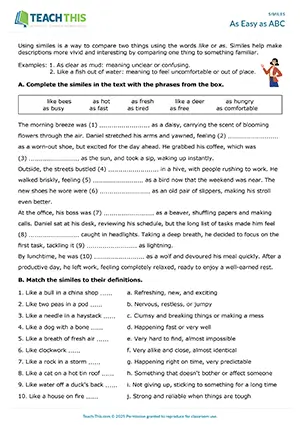
ESL Similes Worksheet - Reading and Vocabulary Exercises: Gap-fill, Matching - writing Game: Short Story writing, Freer practice - Pair Work
In this useful similes worksheet and game, students learn and practice common English similes to help them understand how similes make descriptions more vivid...
ESL Similes Worksheet - Reading and Vocabulary Exercises: Gap-fill, Matching - writing Game: Short Story writing, Freer practice - Pair Work In this useful similes worksheet and game, students learn and practice common English similes to help them understand how similes make descriptions more vivid and interesting by comparing one thing to something familiar. Students begin by completing similes in a text with phrases from a box. Students then match common similes to their definitions. Next, in pairs, students play a game in which they race to write a short story that uses three similes on a card correctly. The first pair to raise their hands reads their story aloud. If their story is coherent and uses the similes correctly, they score one point. If not, the pair is out of the round, and the other pairs race to complete their stories. When a pair has won, the students swap cards, play the next round, and so on. The pair with the most points at the end of the game wins.Metaphor Bingo
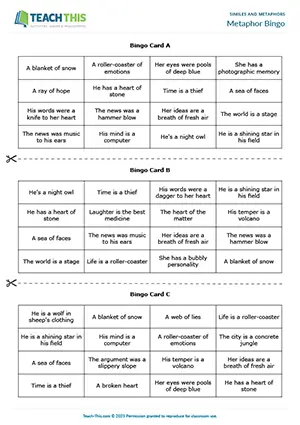
ESL Metaphors Game - Vocabulary: Bingo, Matching - Group Work
In this free metaphors game, students play bingo by matching metaphors with their meanings. In groups, the bingo caller reads a sentence explaining a metaphor at random from the caller's sheet, e.g. 'He is very kind and generous.' The players...
ESL Metaphors Game - Vocabulary: Bingo, Matching - Group Work In this free metaphors game, students play bingo by matching metaphors with their meanings. In groups, the bingo caller reads a sentence explaining a metaphor at random from the caller's sheet, e.g. 'He is very kind and generous.' The players listen and look at the metaphors written on their bingo card to see if they have one that matches the explanation, e.g. 'He has a heart of gold'. If they do, they cross it off. The game continues until a player has crossed off four metaphors in a row. When this happens, the player shouts 'Bingo!' and reads the metaphors they crossed off. If the metaphors match the explanations that were read, the student wins the round. Players then continue to see who can cross off all 16 metaphors first. Groups play several rounds, with students taking turns being the bingo caller and players using a different bingo card each time.Mighty Metaphors
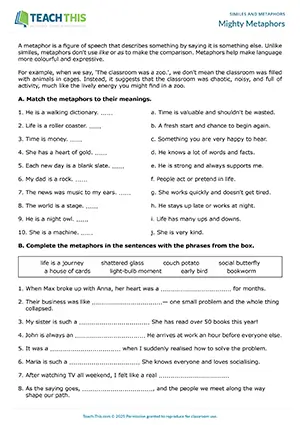
ESL Metaphors Worksheet - Reading and Vocabulary Exercises: Matching, Gap-fill, Identifying, writing Definitions, Paragraph writing
In this productive metaphors worksheet, students learn and practice common English metaphors. First, students read a short text explaining metaphors...
ESL Metaphors Worksheet - Reading and Vocabulary Exercises: Matching, Gap-fill, Identifying, writing Definitions, Paragraph writing In this productive metaphors worksheet, students learn and practice common English metaphors. First, students read a short text explaining metaphors. Students then match metaphors to their meanings. Next, students complete metaphors in sentences with phrases from a box. After that, students identify metaphors in sentences and explain their meanings in their own words. Students then move on to write a short story using at least five metaphors from the worksheet. Finally, students read their stories to the class, who actively listen and give feedback, focusing on the effectiveness and creativity of the metaphors.Similes Showdown
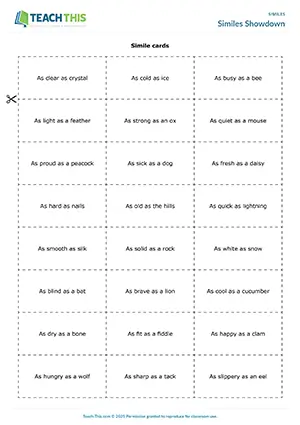
ESL Similes Games - Vocabulary and Speaking: Matching, Impromptu Speech, Freer and Communicative practice - Pair Work
In these fun simile games, students match common English similes with their definitions and then use them in conversational contexts. First, students play a...
ESL Similes Games - Vocabulary and Speaking: Matching, Impromptu Speech, Freer and Communicative practice - Pair Work In these fun simile games, students match common English similes with their definitions and then use them in conversational contexts. First, students play a pelmanism game where they take turns turning over one simile card and one definition card. If the simile with as and the definition match, the student keeps the two cards and has another turn. If not, the student turns the cards back over, keeping them in the same place, and play passes to the other student. The student with the most pairs of cards at the end wins. Next, students play an impromptu speech game where they take turns picking up a speech card and talking in response to the prompt for 30 seconds, incorporating an appropriate simile from the table naturally into what they say. For example, for the situation card 'Talk about how to explain directions to a tourist', the appropriate simile would be As clear as crystal. If the student is able to do this, they keep the pair of cards. If not, the speech card is removed from the game. The student with the most pairs of cards at the end of the game wins.Here's what our members are saying...
- Present Perfect Wh Questions
-
Present Perfect Wh Questions ESL Games, Activities & worksheets
Present Perfect Wh Questions
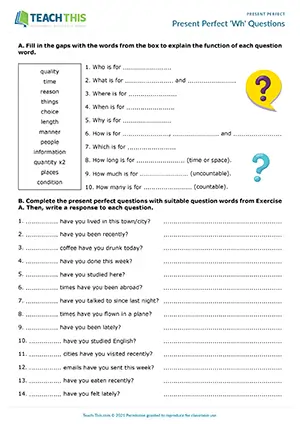
ESL Present Perfect Questions Worksheet - Grammar Exercises: Gap-fill, writing Questions and Answers - Speaking Activity: Freer practice - Pair Work
In this free present perfect Wh questions worksheet, students learn the functions of question words and how to form, ask and answer Wh questions in the...
ESL Present Perfect Questions Worksheet - Grammar Exercises: Gap-fill, writing Questions and Answers from Prompts - Speaking Activity: Freer practice - Pair Work In this free present perfect Wh questions worksheet, students learn the functions of question words and how to form, ask and answer Wh questions in the present perfect tense. First, students fill in gaps with words from a box to explain the functions of question words. Next, students complete present perfect questions with suitable question words from Exercise A and write a response to each question. Students then practice writing present perfect Wh questions using prompts. After that, students write present perfect Wh questions corresponding to the underlined information in responses. Finally, students ask and answer the questions in Exercise D with a partner.Write, Ask and Answer

ESL Present Perfect Wh Questions Activity - Grammar and Speaking: writing, Asking and Answering Questions, Controlled and Freer practice - Group and Pair Work
In this insightful present perfect speaking activity, students write, ask and answer present perfect Wh conversation questions. First, in two groups, students...
ESL Present Perfect Wh Questions Activity - Grammar and Speaking: writing, Asking and Answering Questions, Controlled and Freer practice - Group and Pair Work In this insightful present perfect speaking activity, students write, ask and answer present perfect Wh conversation questions. First, in two groups, students write present perfect conversation questions from prompts. Students then pair up with someone from the other group. Next, students take turns asking their partner the present perfect questions, noting down their answers, and asking follow-up questions to gain more information when possible. Finally, students report back to the class on the things they found out about their partner.Perfectly Played!
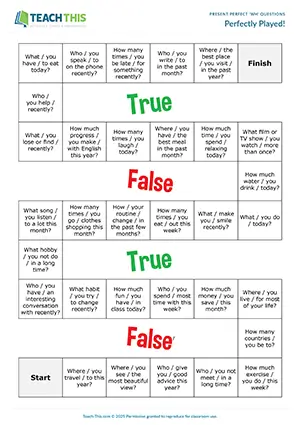
ESL Present Perfect Questions Board Game - Grammar and Speaking: Forming Questions, True or False, Guessing, Freer practice - Group Work
In this fun present perfect Wh questions board game, students practice asking and answering Wh questions in the present perfect. In groups, players take turns...
ESL Present Perfect Questions Board Game - Grammar and Speaking: Forming Questions from Prompts, Giving True or False Answers, Guessing, Freer practice - Group Work In this fun present perfect Wh questions board game, students practice asking and answering Wh questions in the present perfect. In groups, players take turns rolling the dice and moving their counter along the board. When a player lands on a square, they pick up a true or false card and look at it without showing anyone. Next, the player forms a present perfect Wh question from the prompt on the square, e.g. 'Where have you travelled to this year?' If the player forms the question correctly, they score a point. The player then gives a true or false present perfect answer to the question as indicated on the card. The other students then guess whether the player's response is true or false, and the player reveals the answer. Each student who guessed correctly scores one point. Then, the next player rolls the dice, and so on. When a player reaches the finish, the game ends and the points are added up. The player with the most points wins the game.Present Perfect Wh Question Time
ESL Present Perfect Wh Questions Game - Grammar and Speaking: Forming Questions, Freer practice - Group Work
In this entertaining present perfect Wh questions game, students race to make present perfect questions that elicit certain responses. In groups, students take turns taking an answer card from...
ESL Present Perfect Wh Questions Game - Grammar and Speaking: Forming Questions from Prompts, Freer practice - Group Work In this entertaining present perfect Wh questions game, students race to make present perfect questions that elicit certain responses. In groups, students take turns taking an answer card from an envelope and reading it aloud to the group, e.g. 'I have gone shopping.' All the students then race to make a present perfect Wh question to elicit the response using a question word from their card, e.g. 'Where have you gone?' The first student to form and ask a suitable question takes the answer card and crosses off the question word on their card, e.g. where. It's then the next student's turn to take an answer card, and so on. The first student to cross off all the question words on their card wins the game.Who has asked the right question?
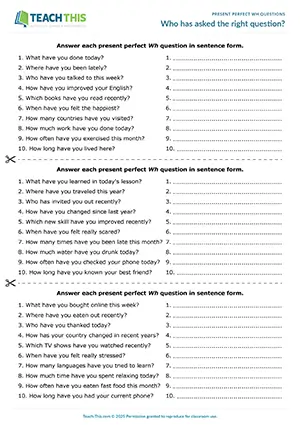
ESL Present Perfect Wh Questions Game - Grammar and Speaking: writing Sentences, Guessing, Forming Questions, Freer practice - Group Work
In this engaging present perfect Wh questions game, students guess questions from answers written by other students. First, students answer each present...
ESL Present Perfect Wh Questions Game - Grammar and Speaking: writing Sentences, Guessing, Forming Questions from Prompts, Freer practice - Group Work In this engaging present perfect Wh questions game, students guess questions from answers written by other students. First, students answer each present perfect question on their card in sentence form, adding any time adverbial shown in the question, e.g. today, recently, etc. Students then take turns reading an answer at random to the other two students, who race to guess the question from the answer. The first student to guess the correct present perfect Wh question scores one point. The game continues until all three students' questions have been guessed correctly. The student with the most points at the end of the game wins.Here's what our members are saying...
- Business Problems
-
Business Problems: Business English worksheets, Activities & Games
Business Problems and Solutions

Business Problems Worksheet - Vocabulary, Reading and writing Exercises: Matching, writing Sentences - Speaking: Discussion, Presenting, Freer practice - Group Work
In this useful business problems worksheet, students identify and discuss common business issues and practice linking causes to solutions and suggesting...
Business Problems Worksheet - Vocabulary, Reading and writing Exercises: Matching, writing Sentences - Speaking: Guided Discussions, Presenting, Freer practice - Group Work In this useful business problems worksheet, students identify and discuss common business issues and practice linking causes to solutions and suggesting reasoned proposals. First, students match common business problems to their definitions. Students then match the problems to potential causes. Next, students read a model for linking a business problem's cause to a potential solution and formulating a reason. After that, students choose a problem and cause from the worksheet and use the model to write a solution with reasoning. Following that, in groups, students discuss business scenarios, identify the main problem, explore possible causes using Exercise B, and suggest solutions using the model. Once a group agrees on the best solution, they formulate a clear reason and write it down. Finally, each group prepares a short presentation, with each student presenting a part of the talk: the problem, possible causes, the solution, and the reasoning. After each presentation, the class asks questions and discusses the proposed solution.Problem Solvers Board Game

Business Problems Board Game - Vocabulary and Speaking: Identifying, Problem Solving, Impromptu Speech, Freer practice - Group Work
Here is a free business problems board game to help students practice identifying business problems, implementing solutions, and responding to business...
Business Problems Board Game - Vocabulary and Speaking: Identifying, Problem Solving, Impromptu Speech, Freer practice - Group Work Here is a free business problems board game to help students practice identifying business problems, implementing solutions, and responding to business challenges. Players take turns rolling the dice and moving their counter along the board. When a player lands on a 'Problem' square, they pick up a corresponding card, read the business problem aloud, and identify the type of business problem shown in the middle of the game board. When a player lands on a 'Solution' square, they take a solution card, read it aloud, and say which business problem the solution helps fix and how they would implement it. When landing on a 'Challenge' square, the player picks up a challenge card, reads it aloud, and responds to the business scenario described by suggesting a suitable solution. For each response, the other students evaluate the answer or solution. If a player provides a correct answer or suitable solution, they stay on their square. If not, they move back to their previous square. The first player to reach the finish wins the game.Resolving Customer Issues
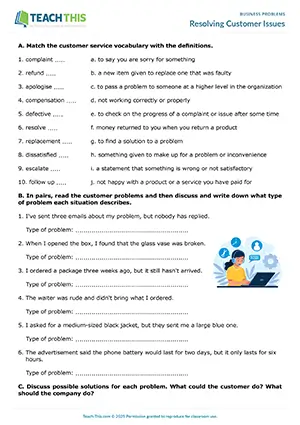
Customer Service Activity - Vocabulary Exercise: Matching - Speaking Activity: Guided Discussion, Role-Plays, Freer and Communicative practice - Pair Work
In this insightful customer service activity, students identify customer issues, discuss possible solutions, and role-play complaint dialogues between a customer...
Customer Service Activity - Vocabulary Exercise: Matching - Speaking Activity: Guided Discussion, Role-Plays, Freer and Communicative practice - Pair Work In this insightful customer service activity, students identify customer issues, discuss possible solutions, and role-play complaint dialogues between a customer and a representative. First, students match customer service vocabulary with definitions. In pairs, students then read customer problems and discuss and write down what type of problem each situation describes. Next, students discuss possible solutions for each problem, considering what the customer and the company could do to resolve the issue. After that, pairs role-play four customer service conversations between a customer with a complaint and a customer service representative using a framework, situations, and language that uses the target vocabulary, taking turns to be the customer and the representative. Finally, pairs present one of their role-plays to the class.Business Problem Discussion Cards
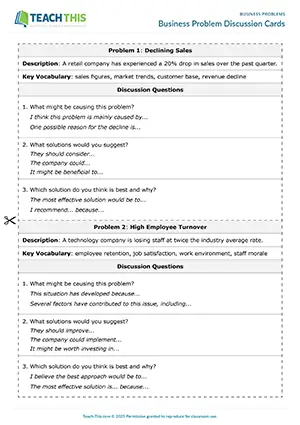
Business Problems Activity - Speaking: Problem Solving, Discussion, Freer and Communicative practice - Group Work
In this business problems discussion activity, students practice using business vocabulary and functional language to discuss business issues and suggest solutions. In groups, students take turns selecting...
Business Problems Activity - Speaking: Problem Solving, Discussion, Freer and Communicative practice - Group Work In this business problems discussion activity, students practice using business vocabulary and functional language to discuss business issues and suggest solutions. In groups, students take turns selecting a card and reading the business problem, its description, and the key vocabulary aloud to the group. The group then discusses the problem using the questions on the card and suggests solutions using the vocabulary and language prompts. At the end of the discussion, the group chooses the best solution and writes it on their worksheet, along with an explanation of why they chose it. For any new or difficult words on the cards, students look up the definitions and write them on the worksheet. After all four problems have been discussed, each group shares one problem they discussed and presents their recommended solution using the target vocabulary and language from the card.Staying Competitive
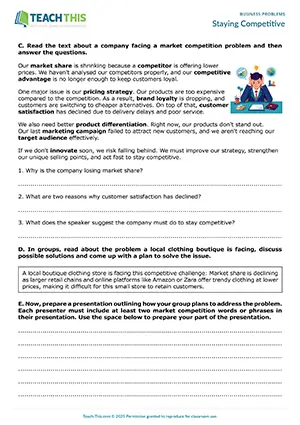
Business Problems Worksheet - Reading and Vocabulary Exercises: Matching, Gap-fill -Speaking Activity: Discussion, Delivering a Presentation, Freer practice - Group Work
In this market competition worksheet, students learn market competition vocabulary and practice using it by addressing and planning solutions to a...
Business Problems Worksheet - Reading and Vocabulary Exercises: Matching, Gap-fill -Speaking Activity: Discussion, Delivering a Presentation, Freer practice - Group Work In this market competition worksheet, students learn market competition vocabulary and practice using it by addressing and planning solutions to a business problem. First, students match market competition vocabulary to definitions. Students then complete sentences with the market competition words and phrases. Next, students read a text about a company facing a market competition problem and answer comprehension questions about it. After that, in groups, students read about a problem a local clothing boutique is facing, discuss possible solutions and come up with a plan to solve the issue. Students then prepare a short group presentation that outlines a plan to address the problem. Finally, groups present their plans to the class, who vote on which one they think is the most effective.The 4R Framework
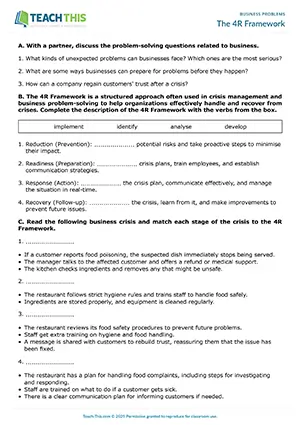
Business Problems Worksheet - Reading and Vocabulary Exercises: Gap-fill, Matching - Speaking Activity: Discussion, Problem-Solving, Freer practice - Group Work
In this informative business problems worksheet, students learn about the 4R Framework for crisis management and business problem-solving...
Business Problems Worksheet - Reading and Vocabulary Exercises: Gap-fill, Matching - Speaking Activity: Discussion, Problem-Solving, Freer practice - Group Work In this informative business problems worksheet, students learn about the 4R Framework for crisis management and business problem-solving and apply it to a hypothetical business crisis. First, in pairs, students discuss three problem-solving questions related to business. Students then complete a description of the 4R Framework with verbs from a box. Next, students read about a business crisis and match each stage of the crisis to the 4R Framework. After that, in groups, students read a business crisis scenario, discuss the problem and complete a 4R Framework to help solve the issue. Finally, students discuss follow-up questions in their group.Troubleshooting Talk
Business Problems Activity - Vocabulary and Speaking: Gap-fill, Asking and Answering Questions, Controlled and Freer practice - Group and Pair Work
In this business problems discussion activity, students complete, ask and answer conversation questions that contain business problem phrases. First, in two...
Business Problems Activity - Vocabulary and Speaking: Gap-fill, Asking and Answering Questions, Controlled and Freer practice - Group and Pair Work In this business problems discussion activity, students complete, ask and answer conversation questions that contain business problem phrases. First, in two groups, students complete conversation questions with business problem phrases. Students then pair up with someone from the other group and take turns asking the conversation questions to their partner, who responds accordingly. For the first question in each set, students include the corresponding phrase in their response. Afterwards, students share what they learned about their partner with the class.Here's what our members are saying...
- Speaking Test Preparation
-
Speaking Test Preparation EAP Activities, Games & worksheets
Express, Justify and Debate!

EAP Speaking Test Preparation Activity - Vocabulary and Speaking: Expressing and Justifying Opinions, Discussion, Communicative practice - Group Work
This intriguing speaking test preparation activity helps students build their confidence in expressing and justifying opinions on various common speaking test...
EAP Speaking Test Preparation Activity - Vocabulary and Speaking: Expressing and Justifying Opinions, Discussion, Communicative practice - Group Work This intriguing speaking test preparation activity helps students build their confidence in expressing and justifying opinions on various common speaking test topics. In groups, students take turns picking up a card, laying it on the table and reading the statement to the group. Each group member then decides whether they agree or disagree with the statement and why. Students then debate the topic for three minutes, starting with the reader, who shares and justifies their opinion. The other group members respond one at a time, either agreeing and adding additional reasons or disagreeing and providing counterarguments. When the time is up, the next student picks up a card, and so on. When the groups have finished, they discuss follow-up questions about their debates and then give feedback to the class on their answers.Fluency Quest

EAP Speaking Fluency Board Game - Speaking: Impromptu Speech, Answering Questions, Freer practice - Group Work
This free speaking test preparation board game develops students' speaking fluency by answering questions similar to those commonly asked in speaking tests. Students take turns rolling the dice...
EAP Speaking Fluency Board Game - Speaking: Impromptu Speech, Answering Questions, Freer practice - Group Work This free speaking test preparation board game develops students' speaking fluency by answering questions similar to those commonly asked in speaking tests. Students take turns rolling the dice and moving their counter along the board. When a student lands on a question square, they answer the speaking test question by talking for 30 seconds. If the student stops talking or can't think of anything to say, they go back two squares. If a student lands on an advantage card square, they take a card, read it and follow the instructions during their next answer. If an advantage card states 'Keep this card', the student keeps it face-up next to them and can use it anytime during the game. If a student lands on a challenge card square, they take a card, read it aloud, keep it and then attempt the challenge during their next answer. After answering, the group decides if the challenge has been completed successfully. If it hasn't, the student moves back two squares. The first student to reach the finish wins the game.Fluency Without Fillers
EAP Speaking Fluency Activity - Listening and Speaking: Brainstorming, Discussion, Identifying, Impromptu Speech, Fluency and Freer practice - Pair Work
This engaging speaking test preparation activity helps students improve fluency by reducing hesitation and filler words while speaking about various topics...
EAP Speaking Fluency Activity - Listening and Speaking: Brainstorming, Discussion, Identifying, Impromptu Speech, Fluency and Freer practice - Pair Work This engaging speaking test preparation activity helps students improve fluency by reducing hesitation and filler words while speaking about various topics. First, students brainstorm common filler words and discuss their use and impact on fluency. Students then listen to a text and count how often fillers are used. Next, students discuss strategies the speaker could use to reduce fillers. Next, in pairs, students take turns answering questions for 30 seconds without using fillers. If a filler is used, the student starts over. This continues until all the questions have been answered. After that, students play a game where they pick a card and speak for one minute on the topic without using fillers. If a student uses more than three fillers or pauses for over three seconds, they stop and hand the card to their partner, who attempts to talk for one minute. If a student successfully completes the task, they keep the card and play passes to the other student. The student with the most cards at the end of the game wins. Finally, students reflect on the activity and their performance in small groups.Mock Speaking Test
EAP Mock Speaking Test Activity - Speaking: Guided Discussion, Asking and Answering Questions, Peer Review and Feedback, Communicative practice - Pair Work
Here is a useful speaking test preparation activity in which students learn and practice answering typical speaking test questions following certain criteria...
EAP Mock Speaking Test Activity - Speaking: Guided Discussion, Asking and Answering Questions, Peer Review and Feedback, Communicative practice - Pair Work Here is a useful speaking test preparation activity in which students learn and practice answering typical speaking test questions following certain criteria. First, in pairs, students read responses to a typical speaking test question and then use three criteria (topic development, organisation, and grammar and vocabulary) to discuss the respective strengths and weaknesses of the responses. Next, students take part in a mock speaking test where one student is the examiner and the other is the candidate. The examiner's task is to ask the questions and complete a feedback form as they go to identify strengths and areas for improvement. The candidate's task is to provide full answers following the three criteria and speak clearly without pausing or hesitating. When the test is over, the examiner uses the feedback form to give their partner constructive feedback on how they did in the test. Afterwards, students swap roles and repeat the process.Question Types and Linking Phrases

EAP Speaking Test Question Types Worksheet - Reading and Vocabulary Exercises: Categorising, Gap-fill - Speaking Activity: Discussion - Pair Work
In this productive speaking test preparation worksheet, students learn about speaking test question types and practice their related linking phrases. First...
EAP Speaking Test Question Types Worksheet - Reading and Vocabulary Exercises: Categorising, Gap-fill - Speaking Activity: Discussion - Pair Work In this productive speaking test preparation worksheet, students learn about speaking test question types and practice their related linking phrases. First, students read a text giving general tips for success in speaking tests. In pairs, students then discuss which tip they think is the most useful to them and why. Next, students match speaking test question types to questions. After that, students put each linking phrase in the correct category according to its question-type function. Students then read speaking test questions that cover the various question types and complete answers with the linking phrases. Following that, students take turns asking the test questions to a partner, who replies using the linking phrases. While students listen to their partner's answers, they complete a checklist and use it to give constructive feedback at the end. Finally, students discuss reflection questions in pairs.Speaking Test Survival Challenge
EAP Speaking Test Preparation Worksheet and Game - Vocabulary and Speaking: Categorising, Multiple Choice, Matching, Forming Sentences - Group Work
This fun speaking test preparation worksheet and game introduces students to useful speaking test phrases that they can use to buy time, ask for clarification...
EAP Speaking Test Preparation Game - Vocabulary and Speaking: Categorising, Multiple Choice, Matching, Forming Sentences, Freer practice - Group Work This fun speaking test preparation worksheet and game introduces students to useful speaking test phrases that they can use to buy time, ask for clarification, correct themselves, and keep speaking if they forget a word in a speaking test. First, students categorise useful speaking test phrases according to their function. Students then choose the correct option to complete each speaking test response. After that, students play a game to practice using the phrases in various speaking test scenarios. In groups, the first player turns over a speaking test situation card and reads it aloud. All the players then look at their phrase cards to find a suitable phrase to use for the situation. Next, players race to place one of their phrase cards face up on the table and form a natural sentence to respond to the situation. If the situation is about forgetting a word, players try to paraphrase the word on the card. If the situation card requires self-correction, players try to correct the mistake. If everyone in the group agrees that a player's phrase corresponds to the situation and the response sounds natural, that player wins and keeps the two cards. If a player's phrase doesn't match the situation or sounds unnatural, that player is out of the round and the other players try to respond. The next player then turns over a new situation card, and so on. The first player to get rid of all their phrase cards wins the game.The REAL Formula
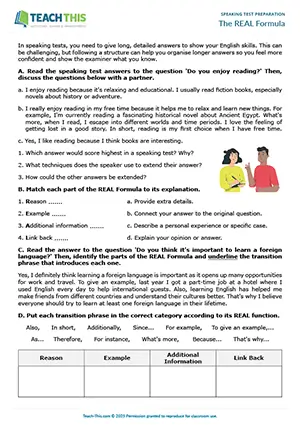
EAP Speaking Test Preparation Worksheet - Reading and Vocabulary Exercises: Identifying, Categorising - Speaking Activity: Impromptu Speech - Pair Work
In this comprehensive speaking test preparation worksheet, students learn about the REAL Formula and practice using it and related transition phrases to...
EAP Speaking Test Preparation Worksheet - Reading and Vocabulary Exercises: Identifying, Categorising - Speaking Activity: Impromptu Speech - Pair Work In this comprehensive speaking test preparation worksheet, students learn about the REAL Formula and practice using it and related transition phrases to extend answers. First, students read a short text about extending speaking test answers. Students then read three speaking test answers and discuss questions in pairs. Next, students match each part of the REAL Formula to its explanation. After that, students read an example speaking test answer and identify each part of the REAL Formula, underlining the transition phrase that introduces each one. Following that, students categorise each transition phrase according to its REAL function. Students then complete sentences with the transition phrases. Afterwards, students choose a question, plan an answer and say it to a partner using the REAL Formula. Next, students take turns asking speaking test questions to their partner, who replies using the REAL Formula and transition phrases to structure their answers. While students listen to their partner's answers, they complete a checklist and use it to give constructive feedback at the end. Finally, students discuss reflection questions with a new partner.Speaking Test Role-Play
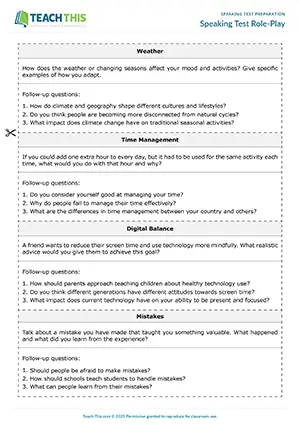
EAP Speaking Test Role-Play - Listening and Speaking Activity: Impromptu Speech, Peer Review and Feedback, Freer practice - Pair Work
In this effective speaking test preparation activity, students take turns as examiner and candidate, respond to timed prompts, and give concise, criteria-based...
EAP Speaking Test Role-Play - Listening and Speaking Activity: Impromptu Speech, Peer Review and Feedback, Freer practice - Pair Work In this effective speaking test preparation activity, students take turns as examiner and candidate, respond to timed prompts, and give concise, criteria-based feedback on each response. To begin, the examiner turns over the first speaking test card and reads the prompt to the candidate. The candidate then has 60 seconds to plan their answer. When the time is up, the candidate has 90 seconds to answer. The examiner listens carefully and scores the candidate using the criteria on the feedback sheet, writing down examples of effective language, significant mistakes, or other observations. Next, the examiner asks one of the follow-up questions on the card, and the candidate has 60 seconds to answer. Afterwards, the two students swap roles and repeat the process. This continues until both students have answered four cards. Afterwards, students write one positive feedback comment and one area for improvement on the feedback sheet. Students then compare scores and discuss their feedback. Next, each student identifies their weakest answer based on scores and self-reflection. Both students then retake their weakest topic. Finally, students provide feedback to the class on any improvements that were made in the second attempt.Here's what our members are saying...
- Expressing Preferences
-
Expressing Preferences ESL Games, Activities & worksheets
Both, Either or Neither?
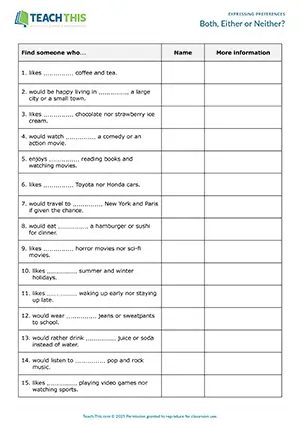
ESL Both, Either and Neither Activity - Vocabulary and Speaking: Gap-fill, Asking and Answering Questions, Controlled and Freer practice
In this both, either and neither speaking activity, students ask and answer questions to learn about their classmates' preferences using the conjunctions...
ESL Both, Either and Neither Activity - Vocabulary and Speaking: Gap-fill, Asking and Answering Questions from Prompts, Controlled and Freer practice In this both, either and neither speaking activity, students ask and answer questions to learn about their classmates' preferences using the conjunctions 'both', 'either' and 'neither'. First, students complete 'Find someone who...' prompts with both, either or neither. Students then go around the class asking the questions to their classmates, who respond accordingly using 'both', 'either' or 'neither' when appropriate. If a classmate answers with the corresponding conjunction that's in the question, the student writes down their name and asks a follow-up question to gain more information, noting down the answer in the last column. If not, the student moves on to speak to someone else or asks a different question. Afterwards, students give feedback to the class on what they found out.Hypothetical Bets
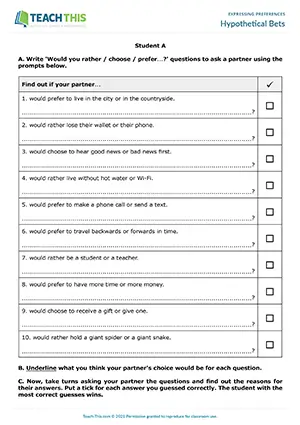
ESL Expressing Preferences Game - Speaking: writing, Asking and Answering Questions, Guessing - Pair Work
In this free expressing preferences game, students write hypothetical 'Would you...?' questions for a partner and guess which choices they would make. First, in groups, students write 'Would you...
ESL Expressing Preferences Game - Speaking: writing, Asking and Answering Questions from Prompts, Guessing - Pair Work In this free expressing preferences game, students write hypothetical 'Would you...?' questions for a partner and guess which choices they would make. First, in groups, students write 'Would you rather / choose / prefer...?' questions to ask a partner from prompts. Next, students pair up with someone from the other group. Working alone, students guess and underline what they think their partner's choice would be for each question. Students then take turns asking their partner the questions and reasons for their answers. Students put a tick for each answer they guessed correctly. The student with the most correct guesses wins the game.Would you rather...?
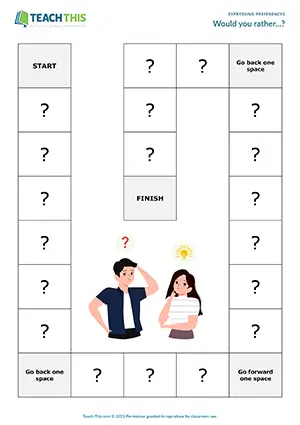
ESL Would You Rather Board Game - Speaking: Discussions, Responding to Questions, Giving Reasons - Group and Pair Work
In this intriguing expressing preferences board game, students discuss 'Would you rather...?' questions with a partner and race to make choices they agree on...
ESL Would You Rather Board Game - Speaking: Guided Discussions, Responding to Questions, Giving Reasons - Group and Pair Work In this intriguing expressing preferences board game, students discuss 'Would you rather...?' questions with a partner and race to make choices they agree on along with a justified reason for each answer. In groups, students take turns turning over a card and reading the 'Would you rather...?' question to the group, e.g. 'Would you rather own your own boat or your own plane?' The students in both teams then express their preferences, discuss the question with their partner, and race to make a choice they agree on along with a justified reason for their answer. The first team to make a choice and come up with a grammatically correct response, justifying their answer rolls the dice and moves their counter along the board. If a team makes a grammar mistake or comes up with an unjustified reason, the other team can steal the win by creating a suitable response of their own. The first team to reach the finish wins the game.I'd opt to...
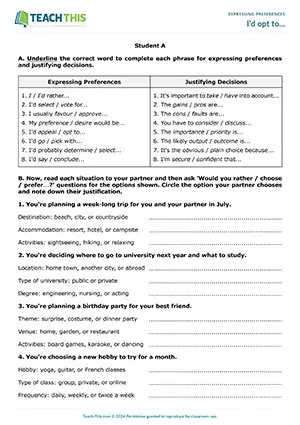
ESL Expressing Preferences Activity - Vocabulary and Speaking: Binary Choice, Asking and Answering Questions, Controlled and Freer practice - Pair Work
This useful expressing preferences activity helps students practice language to express preferences and justify decisions. First, students underline the...
ESL Expressing Preferences Activity - Vocabulary and Speaking: Binary Choice, Asking and Answering Questions from Prompts, Controlled and Freer practice - Pair Work This useful expressing preferences activity helps students practice language to express preferences and justify decisions. First, students underline the correct words to complete phrases for expressing preferences and justifying decisions. Next, students take turns reading each situation to a partner and asking 'Would you rather / choose / prefer...?' questions about the given choices, e.g. 'Would you rather take a trip to the beach, the city, or the countryside?' Their partner listens to each question and then uses the language from the worksheet to make a choice and justify it. The other student then circles their partner's answer and notes down their justification. This continues until students have received their partner's answers for all four situations. Afterwards, students report back to the class on their partners' choices and justifications.Mastering Preference Phrases
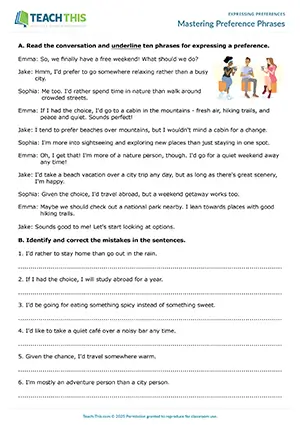
ESL Expressing Preferences Worksheet - Reading and Vocabulary Exercises: Error Correction - Speaking Activity: Delivering a Dialogue, Freer practice - Group Work
In this comprehensive expressing preferences worksheet, students practice ten phrases to express preferences. First, students read a dialogue and identify...
ESL Expressing Preferences Worksheet - Reading and Vocabulary Exercises: Error Correction - Speaking Activity: Delivering a Dialogue, Freer practice - Group Work In this comprehensive expressing preferences worksheet, students practice ten phrases to express preferences. First, students read a dialogue and identify ten phrases for expressing a preference. Students then identify and correct errors in sentences containing the phrases. Next, students complete sentences that use the preference phrases with words from a box. After that, in groups of three, students read a situation and write an expressing preferences dialogue that includes all ten phrases practiced in the worksheet. Finally, groups present their dialogues to the class.Make Your Choice!
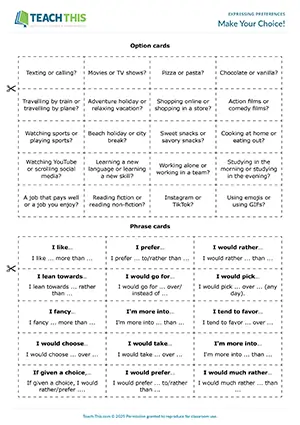
ESL Expressing Preferences Game - Vocabulary and Speaking: Forming Sentences, Freer practice - Pair Work
In this fun expressing preferences game, students practice phrases to express a preference between two options. In pairs, students take turns picking up an option card that shows two choices...
ESL Expressing Preferences Game - Vocabulary and Speaking: Forming Sentences from Prompts, Freer practice - Pair Work In this fun expressing preferences game, students practice phrases to express a preference between two options. In pairs, students take turns picking up an option card that shows two choices while their partner picks up a phrase card. Their partner then reads the phrase in bold on their card, and the student tries to make a sentence expressing a preference between the two options using the phrase. For example, if the option card shows 'Texting or calling?' and the expression is 'I like...', they should say, 'I like texting more than calling.' Their partner then checks the sentence uses the correct structure by looking at their card. If it does, the student wins the option card. The student with the most option cards at the end of the game wins.Rank and Defend
ESL Expressing Preferences Activity - Vocabulary and Speaking: Ranking, Presenting, Discussion, Freer and Communicative practice - Group Work
In this engaging expressing preferences activity, students rank everyday options by category, present and justify their top choices with target phrases, and...
ESL Expressing Preferences Activity - Vocabulary and Speaking: Ranking, Presenting, Discussion, Freer and Communicative practice - Group Work In this engaging expressing preferences activity, students rank everyday options by category, present and justify their top choices with target phrases, and respond to questions or challenges from classmates. In groups, students take turns picking up a card, reading the category and items aloud, and placing the card face up on the table. Starting with the student who drew the card, students present their top three choices in turn, using at least two target phrases from a language support card and giving short reasons. After each turn, the other students ask one follow-up question or give a polite challenge. When all the students have had their turn, the group agrees on a shared top three list and writes it on the back of the card. The next student then picks up a category card, and so on. At the end of the activity, each group briefly presents and defends their shared top three list for one category, using at least two target phrases. After each presentation, the class votes on whether they agree with the list.Would Rather and Would Prefer

ESL Would Rather and Would Prefer Board Game - Grammar: Reforming Sentences, Freer practice - Group Work
In this productive would rather and would prefer board game, students practice reforming sentences and questions with 'would rather' and 'would prefer'. One student begins by picking up a...
ESL Would Rather and Would Prefer Board Game - Grammar: Reforming Sentences, Freer practice - Group Work In this productive would rather and would prefer board game, students practice reforming sentences and questions with 'would rather' and 'would prefer'. One student begins by picking up a card and reading the sentence or question on the card to the first player along with a 'would rather' or 'would prefer' prompt, e.g. 'Do you want to take a break now or later? (would rather)' The player then tries to reformulate the sentence or question using 'would rather' or 'would prefer' as indicated, e.g. 'Would you rather take a break now or later?' If the player does this successfully, they roll the dice and move their counter along the board. If the prompt ends with because, the player completes the sentence with their own ideas. This process is repeated with the next player, and so on. The first player to reach the finish wins the game.Here's what our members are saying...
- Reading Exam Preparation
-
Reading Exam Preparation EAP Activities, Games & worksheets
Common Reading Exam Question Types
EAP Reading Exam Question Types Worksheet - Reading Exercises: True, False or Not Given, Multiple Choice, Gap-Fill, Short Answer Questions - Speaking Activity
In this useful reading exam preparation worksheet, students read about strategies to answer four common reading question types and then practice them...
EAP Reading Exam Question Types Worksheet - Reading Exercises: True, False or Not Given, Multiple Choice, Gap-Fill, Short Answer Questions - Speaking Activity - Pair Work In this useful reading exam preparation worksheet, students read about strategies to answer four common reading question types and then practice them using a reading exam text. First, students read a text about strategies to answer reading exam questions and match headings to the paragraphs. Students then read an extract from a reading exam paper. Next, students answer true, false or not given questions based on the text. After that, students choose the correct option to answer each question about the text. Students then move on to complete sentences with no more than two words from the text. Following that, students answer questions using no more than three words from the text. Finally, students discuss questions about the question types with a partner.Context Clues in Action
EAP Context Clues Activity - Reading: Matching, Using Context Clues, Identifying - Pair Work
In this rewarding context clues activity, students work out the meaning of unfamiliar words using five types of context clues. First, students read an introduction to context clues along with five clue types...
EAP Context Clues Activity - Reading: Matching, Using Context Clues, Identifying - Pair Work In this rewarding context clues activity, students work out the meaning of unfamiliar words using five types of context clues. First, students read an introduction to context clues along with five clue types and examples. Students then have one minute to skim-read a text. In pairs, students then re-read the text and match the words in bold to definitions on cards using the context clues, underlining the context clue in the text and writing their answers on the cards. Next, students write the clue type provided in the text that helped them guess the meaning of the word in context. Finally, check and review the answers as a class.Gap-fill Relay

EAP Reading Exam Preparation Game - Reading: Skimming, Scanning, Gap-fill - Pair Work
This fun reading exam preparation game helps students practice skills for answering gap-fill questions. First, in pairs, students skim-read a gap-fill text for two minutes, predicting what kind of word would go...
EAP Reading Exam Preparation Game - Reading: Skimming, Scanning, Gap-fill - Pair Work This fun reading exam preparation game helps students practice skills for answering gap-fill questions. First, in pairs, students skim-read a gap-fill text for two minutes, predicting what kind of word would go in each space. Next, when you say 'go', one student from each pair runs to a word bank, selects a word they think fits a gap in the text, remembers it, runs back to their partner and tells them the word. If both students agree that the word correctly fills the gap, their partner writes it in the space. The two students then switch roles, and the other student runs to select the next word, and so on. The first pair to correctly complete the text wins the game.Jigsaw Reading
EAP Reading Exam Preparation Activity - Reading, writing and Speaking: Discussion, Summary writing, Presenting, Comprehension Questions - Group Work
In this free reading exam preparation activity, students practice analysing a text, summarising key information, presenting their findings and answering...
EAP Reading Exam Preparation Activity - Reading, writing and Speaking: Discussion, Summary writing, Presenting, Comprehension Questions, Freer practice - Group Work In this free reading exam preparation activity, students practice analysing a text, summarising key information, presenting their findings and answering comprehension questions. In the activity, students work in groups to understand a reading text using the jigsaw method. First, students start in their 'home groups' before moving into 'expert groups,' where each group focuses on one paragraph of a text. In their expert groups, students discuss key points and write a short summary. Afterwards, students return to their home groups and take turns presenting their paragraph summaries so the group gains a full understanding of the text. Finally, students answer reading comprehension questions about the text and discuss reflection questions in their groups.Mastering Multiple Choice
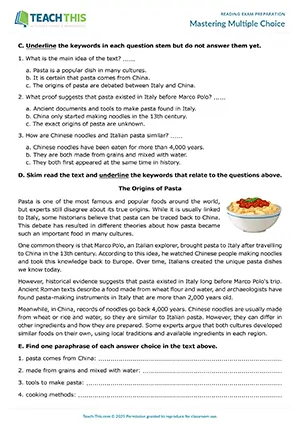
EAP Reading Exam Multiple-Choice Questions Worksheet- Reading Exercises: Multiple Choice, Identifying - Speaking Activity: Discussion - Pair Work
In this reading exam preparation worksheet, students learn and practice five strategies to answer multiple-choice questions. First, students read about...
EAP Reading Exam Multiple-Choice Questions Worksheet- Reading Exercises: Multiple Choice, Identifying - Speaking Activity: Discussion, Freer practice - Pair Work In this reading exam preparation worksheet, students learn and practice five strategies to answer multiple-choice questions. First, students read about five strategies for answering multiple-choice questions. Students then check their understanding by answering multiple-choice questions based on the strategies. Next, students practice identifying keywords in question stems and scanning a text to underline related keywords. After that, students find paraphrased versions of each answer choice in the text to help them recognize correct answers and eliminate incorrect ones. Following that, students identify one obvious distractor in each question and discuss why it is incorrect with a partner. Next, students answer the questions in Exercise C using a process of elimination if they are unsure. Finally, students read the second part of the text and apply all five strategies to answer another set of questions.Reading Rotation Challenge

EAP Skimming and Scanning Game - Reading, writing and Speaking: Skimming, Scanning, Answering Comprehension Questions - Pair Work
In this fast-paced reading exam preparation game, students use skimming and scanning techniques to answer comprehension questions about various texts...
EAP Skimming and Scanning Game - Reading, writing and Speaking: Skimming, Scanning, Answering Comprehension Questions - Pair Work In this fast-paced reading exam preparation game, students use skimming and scanning techniques to answer comprehension questions about various texts. When you say go, teams have 20 seconds to skim-read a text and identify the topic, underlining the correct one on the worksheet. Teams then turn over a question card and have two minutes to scan the text and answer comprehension questions about it. After two minutes, teams put the question card face-down and move on to the next text. The process repeats until each team has read and answered questions about six texts. Next, teams swap worksheets to mark each other's answers. For each correct topic, teams score one point. For each correct answer, teams score two points. The team with the most points at the end of the game wins.Reading Response Race
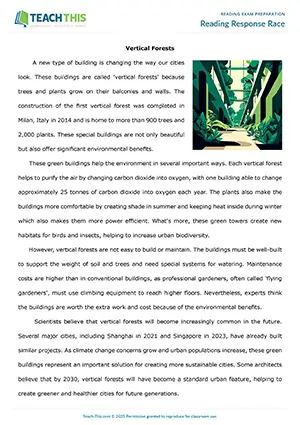
EAP Reading Exam Preparation Game - Reading and Speaking: Answering Comprehension Questions, Citing Evidence, Discussion - Group Work
In this engaging reading exam preparation game, students race to answer comprehension questions by locating and citing evidence, and making...
EAP Reading Exam Preparation Game - Reading and Speaking: Answering Comprehension Questions, Citing Evidence, Discussion, Communicative practice - Group Work In this engaging reading exam preparation game, students race to answer comprehension questions by locating and citing evidence, and making inferences based on a text. In teams, students race to answer each comprehension question about a text using context clues to locate and underline the relevant information. When a team has found the correct answer, they raise their hands and cite the evidence from the text, scoring one point for a correct answer and another point for supporting evidence using context clues. For the final question, teams each give a prepared response by making inferences based on the text, scoring two points for a response that is well-supported with evidence. The team with the most points at the end of the game wins.True, False or Not Given
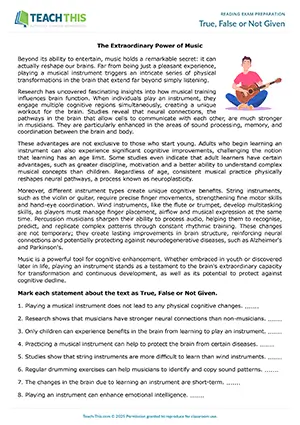
EAP Reading Exam Preparation Activity - Reading and Speaking: True, False or Not Given, Identifying, Citing Evidence, Discussion - Pair Work
This handy reading exam preparation activity helps students develop their skills in answering True, False or Not Given questions by justifying their responses...
EAP Reading Exam Preparation Activity - Reading and Speaking: True, False or Not Given, Identifying, Citing Evidence, Discussion, Communicative practice - Pair Work This handy reading exam preparation activity helps students develop their skills in answering True, False or Not Given questions by justifying their responses and citing evidence from a text. First, students read a text and mark each statement as True, False or Not Given. Students then compare answers and explain their choices in pairs. If a statement is True or False, they identify and underline the part of the text that supports their answer. If it is Not Given, they explain why. Pairs then agree on a final set of answers. Next, elicit the correct answers from the pairs, who support their True or False answers with direct quotes from the text. Finally, students discuss reflection questions with a new partner.Here's what our members are saying...
- Critical Thinking
-
Critical Thinking EAP worksheets, Games & Activities
Evidence Detectives
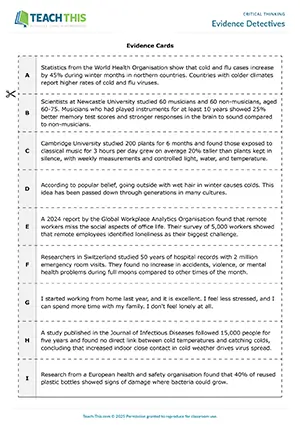
EAP Critical Thinking Game - Reading and Speaking: Matching, Discussion, Giving Reasons, Presenting, Communicative practice - Group Work
In this rewarding critical thinking game, students evaluate the reliability of different types of evidence by matching evidence cards to claims, ranking...
EAP Critical Thinking Game - Reading and Speaking: Matching, Discussion, Giving Reasons, Presenting, Communicative practice - Group Work In this rewarding critical thinking game, students evaluate the reliability of different types of evidence by matching evidence cards to claims, ranking each set from strongest to weakest, and justifying their choices. In teams, students read the first claim on the worksheet and match three evidence cards to it. After finding three matches, teams rank the evidence cards from strongest to weakest by reliability, discussing their reasons. Students record their answers, in order, next to the corresponding claim along with a brief justification. Students then move on to the second claim, and so on. When all the claims have been completed, teams swap worksheets with another team for marking. Go through the claims one by one, reveal the correct ranking by reliability, and elicit example justifications. Teams score one point for each correctly matched evidence card, plus an extra point if all three are in the correct order. The team with the most points wins the game. As an extension, teams present one claim to the class, explaining their ranking and justification of each piece of evidence, with each team member explaining one evidence card and why they ranked it in that position.Fact vs. Opinion
EAP Critical Thinking Worksheet - Reading and writing Exercises:, Answering Questions - Speaking Activity: Discussion, Communicative practice - Pair Work
In this free critical thinking worksheet, students learn the differences between facts and opinions and practice distinguishing between the two. First, students...
EAP Critical Thinking Worksheet - Reading and writing Exercises: Identifying, Answering Questions - Speaking Activity: Discussion, Communicative practice - Pair Work In this free critical thinking worksheet, students learn the differences between facts and opinions and practice distinguishing between the two. First, students read a text explaining the differences between facts and opinions and answer questions in their own words. Students then read four statements and discuss them with a partner to decide if each one is a fact or an opinion. Next, students complete statements using words and phrases from a box. After that, students categorise the words and phrases according to whether they signal a fact or an opinion. Following that, students read a text about opinions that are disguised as facts. Students then choose a statement and analyse it by answering questions. Finally, students read a rewritten statement to a partner and ask them if it is a fact or an opinion, and why they think so.Identifying Logical Fallacies
EAP Logical Fallacies Worksheet - Reading and writing Exercises: Matching, Identifying, Rewriting a Speech - Speaking Activity: Discussion, Freer practice - Pair Work
In this useful logical fallacies worksheet, students learn about common logical fallacies and practice identifying them. First, in pairs, students discuss three...
EAP Logical Fallacies Worksheet - Reading and writing Exercises: Matching, Identifying, Rewriting a Speech, Peer Review - Speaking Activity: Discussion, Freer practice - Pair Work In this useful logical fallacies worksheet, students learn about common logical fallacies and practice identifying them. First, in pairs, students discuss three questions that introduce the topic. Students then read a text about logical fallacies and match the words in bold from the text to their definitions. Next, students read about common logical fallacies and match statements to the correct fallacy. After that, students read two opening speeches of a debate and underline the logical fallacies. Students then answer questions about the opening speeches. Following that, students choose an opening speech and rewrite it, removing the logical fallacies and improving the strength of the argument. Finally, students swap opening speeches with a partner, who provides feedback.Critical Analysis Challenge
EAP Critical Thinking Activity - Speaking Activity: Discussion, Communicative practice - Pair and Group Work
In this comprehensive critical thinking activity, students discuss realistic academic scenarios to practice key critical thinking skills, such as evaluating sources, identifying bias, and explaining logical fallacies...
EAP Critical Thinking Activity - Speaking Activity: Guided Discussion, Communicative practice - Pair and Group Work In this comprehensive critical thinking activity, students discuss realistic academic scenarios to practice key critical thinking skills, such as evaluating sources, identifying bias, and explaining logical fallacies. In pairs, students take turns picking up a scenario card and reading it aloud. The scenarios focus on key critical thinking competencies: evaluating source reliability, identifying logical fallacies, questioning research claims, recognising bias, and strengthening arguments. Next, the two students discuss the scenario for three minutes using the questions on the card. Then, the other student turns over the next card, and so on. The activity continues until students have discussed all eight cards. Next, pairs choose one scenario that they found interesting or challenging and discuss three questions from the board. After a few minutes, pairs join together to make groups of four. In their groups, each pair discusses their chosen scenario with the other pair. Groups then give a summary of their discussion to the class. Finally, students tell the class how they can apply the critical thinking skills they practiced in the activity to their academic work and everyday life.Identifying Bias
EAP Critical Thinking Worksheet- Reading Exercises: Identifying, Making Inferences - Speaking Activity: Discussion, Presenting, Freer practice - Pair Work
In this identifying bias worksheet, students practice identifying bias through text analysis. First, students read a short introduction to bias. In pairs, students then...
EAP Critical Thinking Worksheet- Reading Exercises: Identifying, Making Inferences, Form Completion - Speaking Activity: Discussion, Presenting, Freer practice - Pair Work In this identifying bias worksheet, students practice identifying bias through text analysis. First, students read a short introduction to bias. In pairs, students then discuss two questions related to bias. Students then compare two news excerpts describing the same event and analyze how bias is presented in each one. Next, students read an extract from an academic article and answer bias-related questions. Students then select a topic, conduct an online search to find two articles from different sources and use a checklist to assess bias in each, recording their findings in a Bias Analysis Table. After that, each pair prepares a short presentation summarizing their analysis and presents it to the class. Finally, pairs discuss questions about their two articles and then give feedback to the class.Introduction to Critical Thinking
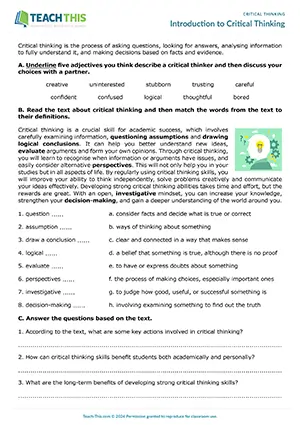
EAP Critical Thinking Worksheet- Reading and writing Exercises: Paragraph writing - Speaking Activity: Discussion, Freer practice - Pair Work
In this critical thinking worksheet, students learn about critical thinking and examine a case study of the famous detective Sherlock Holmes, analysing how he uses...
EAP Critical Thinking Worksheet- Reading and writing Exercises: Comprehension Questions, Paragraph writing - Speaking Activity: Discussion, Freer practice - Pair Work In this critical thinking worksheet, students learn about critical thinking and examine a case study of the famous detective Sherlock Holmes, analysing how he uses critical thinking skills, and applying those skills to solve a mystery of their own. First, students identify five adjectives they think describe a critical thinker and discuss them with a partner. Students then read a text about critical thinking and match words from the text to their definitions. Next, students answer comprehension questions based on the text. After that, students read a text about Sherlock Holmes and answer true or false questions. In pairs, students then imagine they are detectives using critical thinking to solve a case. Students then discuss notes they took at the crime scene and write a paragraph about what they think happened. Finally, pairs share their deductions with the class and explain their reasoning.Logical Fallacy Auction
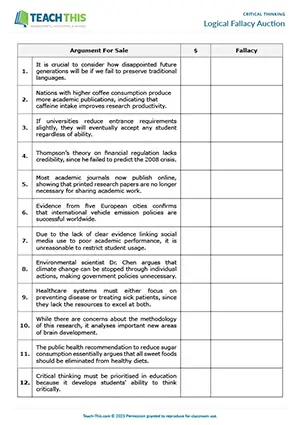
EAP Critical Thinking Game - Reading and Speaking: Identifying, Discussion, Giving Reasons - Group Work
In this entertaining logical fallacy game, students bid on arguments presented in an academic context and earn points by correctly identifying and explaining the logical fallacies they contain. Each team...
EAP Critical Thinking Game - Reading and Speaking: Identifying, Discussion, Giving Reasons, Communicative practice - Group Work In this entertaining logical fallacy game, students bid on arguments presented in an academic context and earn points by correctly identifying and explaining the logical fallacies they contain. Each team receives $100 in play money and a reference sheet explaining common fallacies like Appeal to Emotion, Ad Hominem, and Straw Man arguments. The teacher acts as an auctioneer, presenting each argument for bidding starting at $5, with teams strategically deciding which arguments to purchase based on their confidence in identifying the underlying fallacy. After all arguments have been sold, teams take turns identifying and explaining the fallacy in each argument they purchased, earning one point for each correct answer. If a team incorrectly identifies their fallacy, other teams can challenge and steal the point by providing the correct answer. The team that scores the most points by correctly identifying fallacies wins the game.Logical Fallacy Bingo

EAP Critical Thinking Game - Listening and Speaking Game: Bingo, Identifying, Explaining, Communicative practice - Group Work
In this intriguing critical thinking game, students play bingo by identifying and explaining common logical fallacies in arguments. In groups, the...
EAP Critical Thinking Game - Listening and Speaking Game: Bingo, Identifying, Explaining, Communicative practice - Group Work In this intriguing critical thinking game, students play bingo by identifying and explaining common logical fallacies in arguments. In groups, the bingo caller reads a scenario that contains a logical fallacy from the caller's sheet. The players listen and look at the logical fallacies on their bingo cards to see if they have a fallacy that matches the scenario. If they do, they cross it off. When a player has crossed off three fallacies in a row, they shout 'Bingo!' and read the logical fallacies they crossed off. If the logical fallacies match the scenarios ticked on the caller's sheet, the caller reads each scenario again, and the player explains the logical fallacy. If the player is unable to explain the fallacies, the game continues. If the player can, they win the round. Players then continue to see who can cross off all nine logical fallacies. Groups play several rounds, with students taking turns being the bingo caller and players using a different bingo card each time.Logical Fallacy Detectives
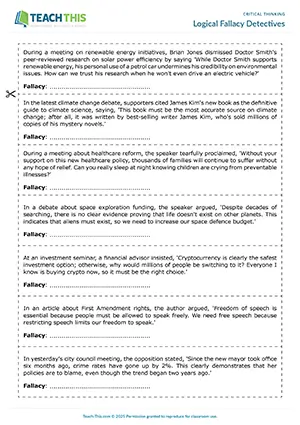
EAP Critical Thinking Game - Reading and Speaking: Identifying, Discussion, Giving Reasons, Communicative practice - Group Work
This engaging critical thinking game helps students practice identifying and explaining logical fallacies in arguments. In groups, students read a logical fallacy...
EAP Critical Thinking Game - Reading and Speaking: Identifying, Discussion, Giving Reasons, Communicative practice - Group Work This engaging critical thinking game helps students practice identifying and explaining logical fallacies in arguments. In groups, students read a logical fallacy cheat sheet and then turn over one card at a time, read the scenario aloud and discuss if it contains a logical fallacy, focusing on how the scenario demonstrates or fails to demonstrate a logical fallacy. If a fallacy is present, students underline the text that contains the fallacy and write the type of fallacy on the card. If not, students write 'no fallacy'. Afterwards, go through the scenarios with the class and elicit answers and reasons from each group. When all the groups have given their responses, reveal the correct answer. For each correct answer, groups score one point. The group with the most points at the end of the game wins. Finally, lead a brief class discussion on how identifying logical fallacies strengthens critical thinking, emphasising its impact on analytical reasoning, decision-making, and argument formation.Here's what our members are saying...
- Intercultural Communication
-
Intercultural Communication EAP Activities, worksheets & Role-Plays
Cross-Cultural Challenge
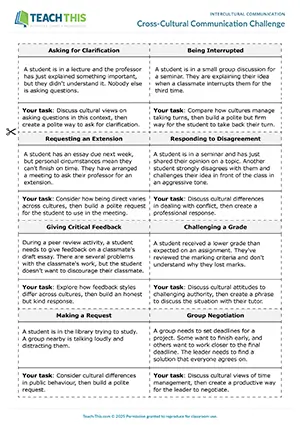
EAP Intercultural Communication Activity - Vocabulary and Speaking: Discussion, Problem-solving, Presenting, Communicative practice - Group Work
In this rewarding intercultural communication activity, students explore how different cultures approach common academic challenges, collaboratively...
EAP Intercultural Communication Activity - Vocabulary and Speaking: Discussion, Problem-solving, Presenting, Communicative practice - Group Work In this rewarding intercultural communication activity, students explore how different cultures approach common academic challenges, collaboratively build polite academic English phrases to address them, and present their solutions. In teams, students pick up one scenario card at a time and discuss the situation, following the steps and language on the reference sheet. Next, each team chooses one of the scenarios they discussed and prepares to present it to the class using questions on the planning sheet to prepare for the presentation. Teams then take turns presenting their chosen scenario, with each team member contributing during the presentation. Teams score up to two points for each of the following criteria: cultural insight, practicality, and language. The team with the most points at the end wins.Direct and Indirect Communication Styles
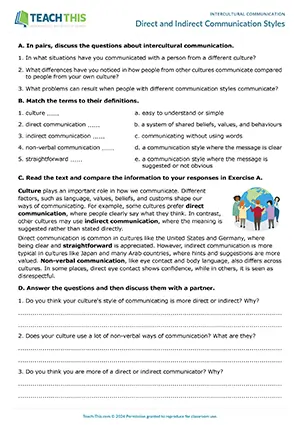
EAP Intercultural Communication Worksheet - Reading and writing Exercises: Comprehension Questions, Paragraph writing - Speaking Activity: Discussion
In this useful intercultural communication worksheet, students learn about direct and indirect communication styles and the importance of understanding...
EAP Intercultural Communication Worksheet - Reading and writing Exercises: Comprehension Questions, Paragraph writing - Speaking Activity: Guided Discussion, Freer practice In this useful intercultural communication worksheet, students learn about direct and indirect communication styles and the importance of understanding cultural differences. First, in pairs, students discuss questions related to intercultural communication. Students then match terms from a text they are going to read to definitions. Next, students read the text and compare the information presented to their responses in the first exercise. After that, students answer questions about intercultural communication and then discuss their answers with a partner. Students then read a text about communication styles and answer comprehension questions. Finally, students reflect on the ideas from the text and write a paragraph that explains how they can use their knowledge of direct and indirect communication styles to improve their intercultural interactions in a specific context of their life.Cultural Dimensions Analysis
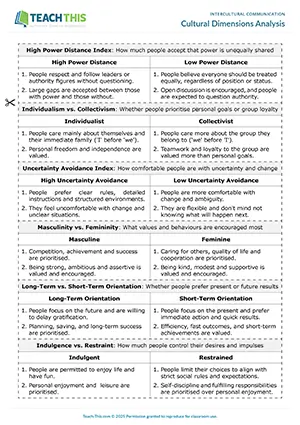
EAP Intercultural Communication Activity - Speaking and writing: Discussion, Answering Questions, Presenting, Communicative practice - Group Work
In this insightful intercultural communication activity, students analyse academic scenarios using Hofstede's cultural dimensions theory and propose solutions for...
EAP Intercultural Communication Activity - Speaking and writing: Discussion, Identifying, Problem Solving, Answering Questions, Presenting, Communicative practice - Group Work In this insightful intercultural communication activity, students analyse academic scenarios using Hofstede's cultural dimensions theory and propose solutions for resolving intercultural misunderstandings. First, in groups, students read a set of cultural dimension reference cards based on Hofstede's cultural dimensions. Students then take turns picking up a situation card and reading it aloud. The group then discusses questions from the board and chooses at least two strategies from a Solution Strategies sheet for each situation, explaining why they believe those strategies would be effective. After 15 minutes, groups choose one situation card they discussed to prepare a case analysis presentation. Students then complete a case analysis worksheet and prepare to present to the class, with each group member contributing during the presentation. Groups then take turns presenting their case analysis to the class, who listen and ask follow-up questions at the end. Finally, in pairs, students discuss one interesting thing they learned about cultural differences during the activity and one thing they could do to prevent an intercultural misunderstanding in the future.Direct and Indirect Conflict-Resolution
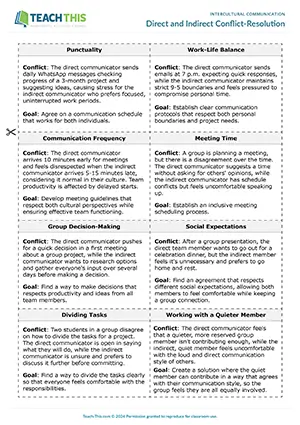
EAP Intercultural Communication Activity - Speaking: Role-Play, Discussion, Freer and Communicative practice - Group Work
This intriguing intercultural communication role-play helps students identify direct and indirect communication styles across cultures and reflect and adapt their own style to prevent misunderstandings...
EAP Intercultural Communication Activity - Speaking: Role-Play, Guided Discussion, Freer and Communicative practice - Group Work This intriguing intercultural communication role-play helps students identify direct and indirect communication styles across cultures and reflect and adapt their own style to prevent misunderstandings and resolve conflicts in multicultural settings. Students are divided into multicultural teams, with each member taking on a specific role: direct communicator, indirect communicator, mediator, or observer. Teams then engage in a 15-minute discussion aimed at resolving a conflict, during which the direct and indirect communicators exchange perspectives while the mediator facilitates mutual understanding and guides the group toward a solution. Throughout this process, the observer carefully monitors the interaction, taking notes on communication patterns and any misunderstandings that arise. Afterwards, the observers present their insights and provide feedback on how effectively their groups navigated cultural differences. Each group then gives feedback on their communication approaches and share how they achieved their resolution. Finally, students discuss questions related to communication styles as a class.Global Classroom Match
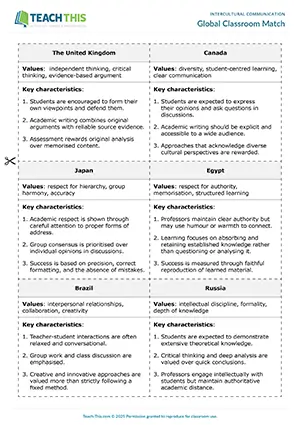
EAP Intercultural Communication Game - Reading and Speaking: Matching, Discussion, Problem-Solving, Presenting, Communicative practice - Group Work
In this thought-provoking intercultural communication game, students match cultural academic values to different country profiles, discuss potential intercultural...
EAP Intercultural Communication Game - Reading and Speaking: Matching, Discussion, Brainstorming, Problem-solving, Presenting, Communicative practice - Group Work In this thought-provoking intercultural communication game, students match cultural academic values to different country profiles, discuss potential intercultural conflicts and develop strategies to resolve them. First, in teams, students read country profile cards that represent cultural academic values in different countries around the world. Teams then match three academic expectations to each country profile, scoring one point for each correctly matched expectation. Next, teams choose two country profiles with distinct or opposing values, discuss a possible conflict that could arise when students from these cultures meet in an international programme, and brainstorm possible resolutions to the conflict. After that, teams fill in a conflict resolution card with the conflict and a summary of the best resolution strategy they brainstormed. This process repeats for the remaining two cards. Finally, teams present their conflict and resolution strategies to the class. Teams score up to three points for each conflict and resolution presented, based on the clarity of the presentation, the validity of the potential conflict and the effectiveness of the resolution strategy. The team with the most points at the end of the game wins.Global Classroom Mixer
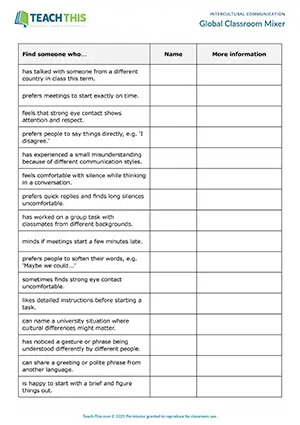
EAP Intercultural Communication Activity - Speaking: Asking and Answering Questions, Freer and Communicative practice
In this free intercultural communication 'Find Someone Who' activity, students ask and answer questions about cultural differences and cross-cultural experiences in academic settings. First, students review...
EAP Intercultural Communication Activity - Speaking: Asking and Answering Questions, Freer and Communicative practice In this free intercultural communication 'Find Someone Who' activity, students ask and answer questions about cultural differences and cross-cultural experiences in academic settings. First, students review the yes/no questions they need to ask in the activity, e.g. 'Have you talked with someone from a different country in class this term?' Students then go around the class, asking their classmates the intercultural communication questions. When a student finds someone who answers 'yes' to a question, they write down the person's name and ask a follow-up question to gain more information, noting down the answer in the last column. If a classmate replies 'no', the student repeats the question with another person or asks a different question. This process continues until the students have completed each item on the worksheet with a different name and answer, one classmate per item. Afterwards, students give feedback to the class on the answers they collected, e.g. contrasting preferences or surprising responses.Intercultural Communication Bingo
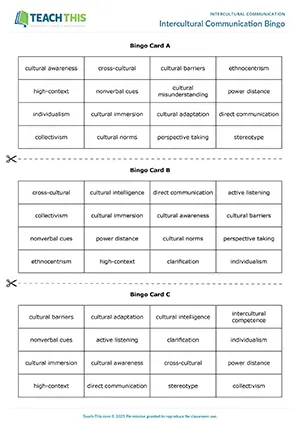
EAP Intercultural Communication Game - Vocabulary: Bingo, Matching - Group Work
In this engaging intercultural communication game, students play bingo by matching intercultural terms with their meanings and briefly using them in context. In groups, the bingo caller reads a definition at random from the caller's sheet, e.g...
EAP Intercultural Communication Game - Vocabulary: Bingo, Matching - Group Work In this engaging intercultural communication game, students play bingo by matching intercultural terms with their meanings and briefly using them in context. In groups, the bingo caller reads a definition at random from the caller's sheet, e.g. 'Understanding and recognising differences between cultures.' The players listen and look at the intercultural communication words and phrases written on their bingo cards to see if they have one that matches the definition, e.g. cultural awareness. If they do, they cross it off. The game continues until a player has crossed off four words or phrases in a row. When this happens, the player shouts 'Bingo!' and then makes a related sentence with each crossed-off word or phrase to verify their win. If the player makes a mistake in any of the four sentences, they are allowed one chance to fix it. If they correct it, the win counts. If the player fails to correct the mistake or the words and phrases are wrong, the bingo is void, and the game continues. If the sentences are correct and the words or phrases match the definitions, the player wins the round. Players then continue to see who can cross off all 16 intercultural terms first without making sentences. Groups play several rounds, with students taking turns being the bingo caller and players using a different bingo card each time.Here's what our members are saying...
- Dealing with Problems
-
Dealing with Problems ESL Activities, worksheets & Games
Household Heroes

ESL Problems and Solutions Board Game - Speaking: Forming Sentences, Freer practice - Group Work
In this engaging problem-solution board game, students practice identifying common household problems and suggesting appropriate solutions. To begin, students place their counters on the...
ESL Dealing with Problems Game - Speaking: Forming Sentences, Freer practice - Group Work In this engaging problem-solution board game, students practice identifying common household problems and suggesting appropriate solutions. To begin, students place their counters on the start square. Next, students take turns picking up a card and reading the situation aloud. The other students then race to identify the household problem that may have caused the situation, using one of the identifying problem phrases displayed in the centre of the game board. The first student to identify the problem shown on the card rolls the dice and moves their counter along the board. The exact wording from the card is not required. When the student lands on a square, they suggest a solution to the problem using the phrase on that square. If the group agrees that the sentence is grammatically correct and the solution matches the problem, the student stays on the square. Otherwise, they move back two squares. The first student to reach the finish wins the game.Identifying and Clarifying Problems
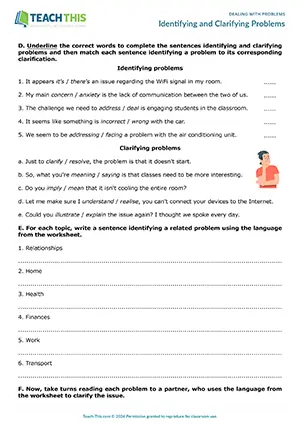
ESL Dealing with Problems Worksheet - Vocabulary and writing Exercises: Gap-fill, Matching - Speaking Activities: Asking and Answering Questions - Pair Work
In this free dealing with problems worksheet, students practice common phrases for identifying and clarifying everyday problems. First, students discuss...
ESL Dealing with Problems Worksheet - Vocabulary and writing Exercises: Gap-fill, Matching - Speaking Activities: Asking and Answering Questions - Pair Work In this free dealing with problems worksheet, students practice common phrases for identifying and clarifying everyday problems. First, students discuss two questions about everyday problems in pairs. Students then complete phrases that identify and clarify problems with words from a box and then indicate the function of each phrase. Next, students match sentence halves to create statements related to identifying and clarifying problems. After that, students underline the correct words to complete sentences and then match each statement identifying a problem to its corresponding clarification. Students then use the language from the worksheet to write sentences identifying topic-related problems. Finally, students take turns reading each sentence to a partner, who clarifies the issue.What if we tried...?
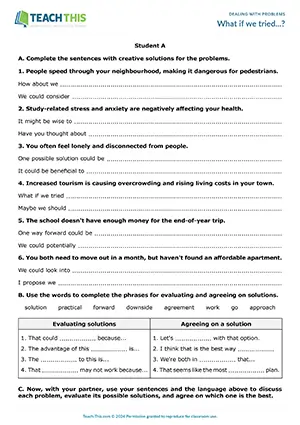
ESL Dealing with Problems Activity - Vocabulary and Speaking: Sentence Completion, Gap-fill, Discussion, Freer and Communicative practice - Pair Work
Here is a dealing with problems speaking activity to help students practice language for suggesting, evaluating, and agreeing on solutions. First, in two groups...
ESL Dealing with Problems Activity - Vocabulary and Speaking: Sentence Completion, Gap-fill, Discussion, Freer and Communicative practice - Pair Work Here is a dealing with problems speaking activity to help students practice language for suggesting, evaluating, and agreeing on solutions. First, in two groups, students read each problem and complete two sentences with creative solutions. Next, students complete phrases to evaluate and agree on solutions using the words provided. Students then pair up with someone from the other group and use their sentences and the language from the worksheet to discuss each problem, evaluate its possible solutions, and agree on which one is the best, ticking the solution they agree on. Finally, pairs report back to the class on the solutions they agreed on for each problem and explain their reasoning.Here's what our members are saying...
- Dealing with Complaints
-
Dealing with Complaints: Business English Activities & worksheets
Customer Complaints
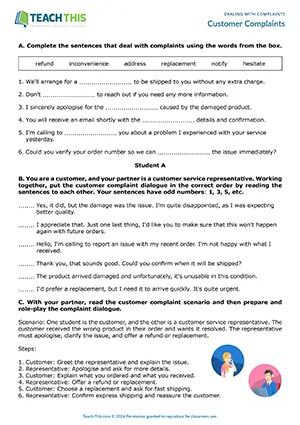
Business English Dealing with Complaints Activity - Vocabulary, Reading, Listening and Speaking: Gap-fill, Ordering, Role-play, Freer practice - Pair Work
In this dealing with complaints activity, students practice language for dealing with customer complaints and role-play complaint dialogues. First, students...
Business English Dealing with Complaints Activity - Vocabulary, Reading, Listening and Speaking: Gap-fill, Ordering, Role-play, Freer practice - Pair Work In this dealing with complaints activity, students practice language for dealing with customer complaints and role-play complaint dialogues. First, students complete sentences that deal with complaints using words from a box. In pairs, students then put a complaint dialogue between a customer and a customer service representative in the correct order by reading the sentences to each other and numbering them accordingly. After that, pairs read a customer complaint scenario and role-play a complaint dialogue between a customer and a customer service representative. Finally, pairs role-play their dialogues to the class.Dealing with Customer Complaints
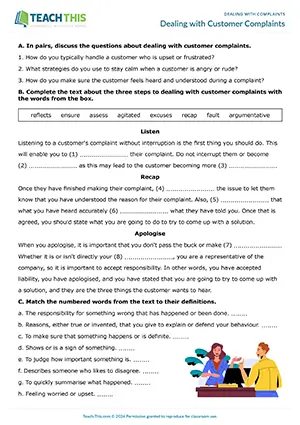
Business English Dealing with Complaints Worksheet - Reading and writing Exercises: Gap-fill, Error Correction, Ordering - Speaking Activity: Role-Play - Pair Work
Here is a useful customer complaints worksheet to help students learn how to deal with customer complaints. First, in pairs, students discuss questions...
Business English Dealing with Complaints Worksheet - Reading and writing Exercises: Gap-fill, Error Correction, Ordering - Speaking Activity: Role-Play - Pair Work Here is a useful customer complaints worksheet to help students learn how to deal with customer complaints. First, in pairs, students discuss questions about dealing with customer complaints. Students then complete a text about three steps to dealing with customer complaints with words from a box. Next, students match the numbered words from the text to their definitions. After that, students underline and correct errors in sentences that may be said by either a customer or a customer service agent. Students then move on to put a telephone complaint dialogue in the correct order. Finally, in pairs, students role-play a scenario between a customer and a customer service agent, taking turns playing each role and using the language and steps for handling complaints. Afterwards, pairs perform their role-plays to the class. After each presentation, students give feedback on how well each pair addressed the three steps for dealing with customer complaints.Find Someone Who Can...
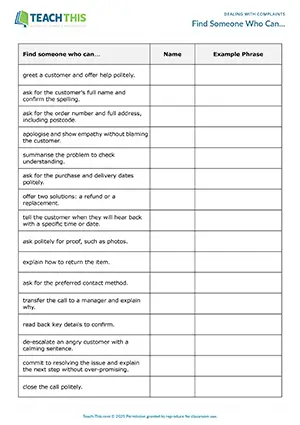
Business English Dealing with Complaints Activity - Speaking: Asking and Answering Questions, Controlled and Freer practice
In this free 'Find Someone Who' activity on dealing with complaints, students ask and answer questions about customer service language and complaint‑handling phrases. To begin, students review the...
Business English Dealing with Complaints Activity - Speaking: Asking and Answering Questions, Controlled and Freer practice In this free 'Find Someone Who' activity on dealing with complaints, students ask and answer questions about customer service language and complaint‑handling phrases. To begin, students review the 'Can you...?' questions they need to ask in the activity, e.g. 'Can you greet a customer and offer help politely?' Students then go around the class, asking their classmates 'Can you...?' questions about the complaint‑handling skills. When a student finds someone who answers 'yes' to a question, they note the person's name and their example phrase. If a classmate answers 'no', the student asks a different question or repeats the question with other classmates until one of them says 'yes'. This process continues until the students have completed each item on the worksheet with a different name and answer, one classmate per item. Afterwards, students give feedback to the class on the example phrases they collected, e.g. best apology lines, good closing lines, etc.From Complaint to Resolution
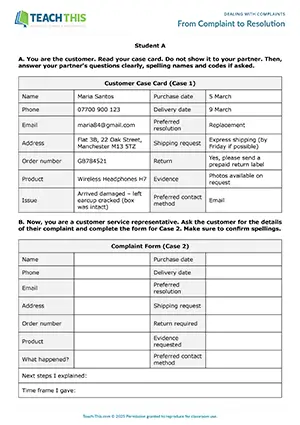
Business English Dealing with Complaints Activity - Speaking: Role-Play, Asking and Answering Questions, Form Completion, Freer practice - Pair Work
In this complaints‑handling activity, students practice collecting and confirming customer details on a call, clarifying the issue, reading back key information, and...
Business English Dealing with Complaints Activity - Speaking: Role-Play, Asking and Answering Questions, Form Completion, Freer practice - Pair Work In this complaints‑handling activity, students practice collecting and confirming customer details on a call, clarifying the issue, reading back key information, and outlining next steps and time frames. Pairs begin by role-playing the first case with Student A acting as the customer, and Student B as the customer service representative. The representative asks the customer for the details of the complaint using polite questions and completes a form. At the end of the call, the representative reads back the key details to confirm the information. The representative then states the steps they will take to resolve the issue, gives a general time frame, and closes politely. Afterwards, students switch roles and repeat the process for the second case. When the pairs have finished, they review their completed forms together to check for any missed details. Finally, some pairs role‑play their dialogues to the class.The Complaint Clinic
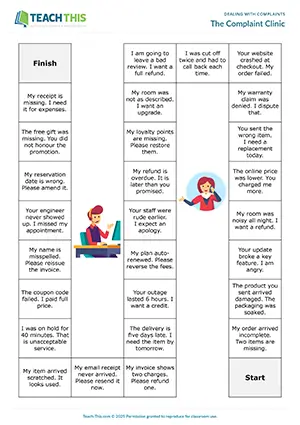
Business English Dealing with Complaints Game - Speaking: Impromptu Speech, Freer practice - Group Work
In this productive complaint-handling board game, students give 30-second impromptu responses to realistic customer complaints while using professional phrases and techniques. In groups, students...
Business English Dealing with Complaints Game - Speaking: Impromptu Speech, Freer practice - Group Work In this productive complaint-handling board game, students give 30-second impromptu responses to realistic customer complaints while using professional phrases and techniques. In groups, students take turns rolling the dice and moving their counters along the board. When a student lands on a square, they act as a company representative and respond to the customer complaint on the square for 30 seconds without stopping, using as many techniques from the complaint response card as possible. Students score one point for each distinct complaint‑handling technique they use appropriately during their 30‑second turn. If a student can't think of anything to say, uses inappropriate language, or stops talking before the 30 seconds are up, no points are awarded for that turn, but they remain on the square. When a student reaches the finish, the game ends, and students add up their points. The student with the most points wins the game.Here's what our members are saying...
- Talking about Companies
-
Talking About Companies: Business English worksheets & Games
Company Department Bingo

Business English Company Departments Game - Vocabulary: Bingo, Matching - Group Work
In this fun company departments game, students play bingo by matching company departments with descriptions of their functions. In groups, the bingo caller begins by reading a sentence...
Business English Job Descriptions Worksheet - Vocabulary Exercises: Matching, Gap-fill - writing Activity: Describing, Freer practice In this fun company departments game, students play bingo by matching company departments with descriptions of their functions. In groups, the bingo caller begins by reading a sentence describing the function of a department at random from the caller's sheet, e.g. 'This department creates advertising campaigns and promotes products.' The players listen and look at the departments written on their bingo cards to see if they have one that matches the sentence, e.g. Marketing. If they do, they cross it off. The game continues until a player has crossed off four departments in a row. When this happens, the player shouts 'Bingo!' and reads the departments they crossed off. If the departments match the sentences that were ticked on the caller's sheet, the student wins the round. Players then continue to see who can cross off all 16 departments first. Groups play several rounds, with students taking turns being the bingo caller and players using a different bingo card each time.Comparing Companies
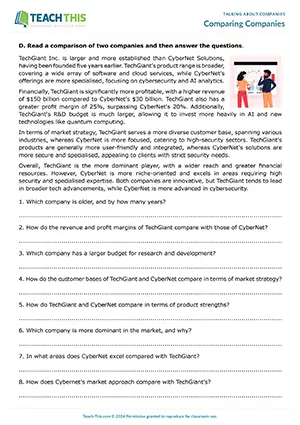
Business English Comparing Companies Worksheet - Vocabulary and Reading Exercises: Gap-fill - Speaking Activity: Discussion, Freer practice - Pair Work
In this useful talking about companies worksheet, students practice making direct and general comparisons of companies using a variety of comparative and...
Business English Comparing Companies Worksheet - Vocabulary and Reading Exercises: Gap-fill, Binary Choice - Speaking Activity: Discussion, Freer practice - Pair Work In this useful talking about companies worksheet, students practice making direct and general comparisons of companies using a variety of comparative and superlative structures. First, students complete sentences with adjectives from a box in their comparative forms. Students then choose the correct comparative or superlative adjective to complete each sentence. After that, students identify and correct errors in three questions. Students then move on to read a text that compares two technology companies and answer a set of comprehension questions. In pairs, students then take turns asking superlative questions to their partner about three companies and their products. Students write down the answers and then say which company they would buy from and why. Finally, pairs discuss their company and its main competitor using comparative questions.Company Knowledge Exchange
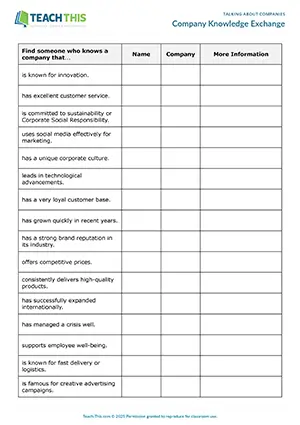
Business English Talking About Companies Activity - Speaking: Asking and Answering Questions, Controlled and Freer practice
In this 'Find Someone Who' activity about companies, students ask and answer questions about company characteristics and business practices. Students begin by reviewing the yes/no questions...
Business English Talking About Companies Activity -Speaking: Asking and Answering Questions, Controlled and Freer practice In this 'Find Someone Who' activity about companies, students ask and answer questions about company characteristics and business practices. Students begin by reviewing the yes/no questions they need to ask to do the activity, e.g. 'Do you know a company that is known for innovation?' Students then go around the class, asking their classmates the questions. When a student finds someone who answers 'yes' to a question, they write down the person's name, record the company name mentioned (e.g. Apple), and ask a follow-up question to gain more information, e.g. 'What is an example of one of their innovations?' If a classmate replies 'no', the student repeats the question with another person or asks a different question. This process continues until all the items on the worksheet are completed, each with a different classmate's name, the company they named, and a brief follow-up detail. Afterwards, students give feedback to the class on what they found out.Company Types
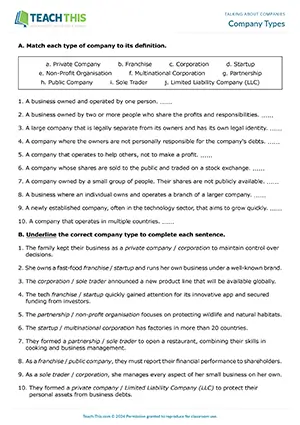
Business English Company Types Worksheet - Vocabulary, Reading and writing Exercises: Matching, Binary Choice, Ordering, writing a Description
In this informative company types worksheet, students learn the names of different types of companies and practice giving a company description. First, students...
Business English Company Types Worksheet - Vocabulary, Reading and writing Exercises: Matching, Binary Choice, Ordering, writing a Description In this informative company types worksheet, students learn the names of different types of companies and practice giving a company description. First, students match company types to their definitions. Students then complete sentences by underlining the correct type of company. Next, students order parts of a text to create a description of a company. After that, students write a description of the company they work for using the text as a guide. Finally, students read their company descriptions to the class, replacing the company type with the word 'blank' for other students to guess at the end of each presentation.Corporate Quest
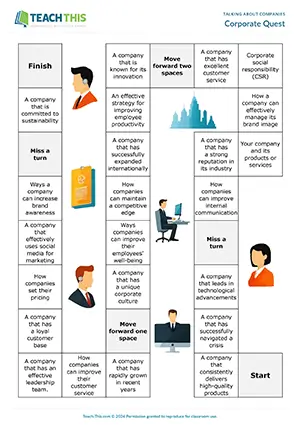
Business English Talking About Companies Board Game - Vocabulary and Speaking: Impromptu Speech, Communicative practice - Group Work
In this free talking about companies board game, students practice talking about companies, business scenarios, traits and strategies. Players take turns...
Business English Talking About Companies Board Game - Vocabulary and Speaking: Impromptu Speech, Communicative practice - Group Work In this free talking about companies board game, students practice talking about companies, business scenarios, traits and strategies. Players take turns rolling the dice and moving their counter along the board. When a player lands on a square, they talk about the company-related topic on the square for 30 seconds without stopping. If a player can't think of anything to say or stops talking before the 30 seconds are up, they go back two squares. The first player to reach the finish wins the game.Here's what our members are saying...
- Discussion Skills
-
Discussion Skills EAP worksheets & Activities
Rapid-Fire Discussions
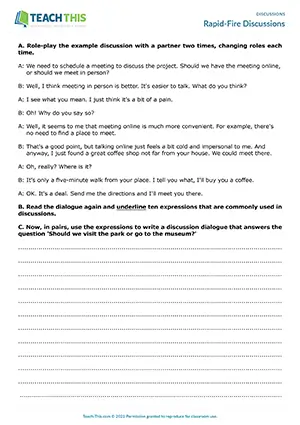
EAP Discussion Skills Activity - Vocabulary and Speaking: Identifying, Preparing and Delivering a Dialogue, Discussion, Communicative practice - Pair Work
In this free discussion skills speaking activity, students practice discussion expressions and then take part in rapid-fire discussions where they answer questions...
EAP Discussion Skills Activity - Vocabulary and Speaking: Identifying, Preparing and Delivering a Dialogue, Guided Discussions, Controlled and Communicative practice - Pair Work In this free discussion skills speaking activity, students practice discussion expressions and then take part in rapid-fire discussions where they answer questions that ask them to choose between two things and reach an agreement within a specific time period. Students start by role-playing an example discussion with a partner. Students then read the dialogue one more time and underline ten expressions that are commonly used in discussions. Next, each pair uses the expressions to write a discussion dialogue that answers the question 'Should we visit the park or go to the museum?' After that, students take part in rapid-fire discussions with their partner where they discuss questions that ask them to choose between two things each time.Discussion Phrases
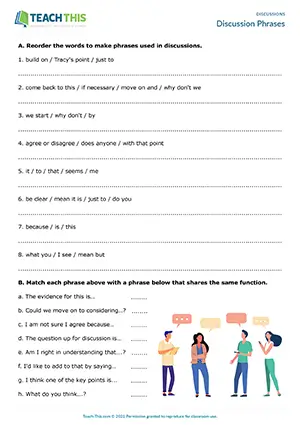
EAP Discussion Phrases Worksheet - Vocabulary Exercises: Matching, Gap-fill - Speaking Activity: Discussion, Communicative practice
In this discussion phrases worksheet, students learn and practice phrases that are commonly used in discussions and their functions. First, students...
EAP Discussion Phrases Worksheet - Vocabulary Exercises: Unscrambling, Matching, writing Phrases, Gap-fill - Speaking Activity: Discussion, Communicative practice In this discussion phrases worksheet, students learn and practice phrases that are commonly used in discussions and their functions. First, students reorder words to make phrases used in discussions and match each phrase to another phrase that has the same function. After that, students match the phrases to their functions and write a new phrase for each one. Students then move on to complete gaps in a discussion with phrases from the worksheet. Finally, students practice the phrases by having a group discussion.Interaction Techniques

EAP Discussion Skills Worksheet - Reading and Vocabulary Exercises: Matching, Gap-fill - Speaking Activity: Discussion, Communicative practice
In this interaction techniques worksheet, students learn and practice three effective discussion interaction techniques and their associated language...
EAP Discussion Interactive Techniques Worksheet - Reading and Vocabulary Exercises: Matching, Gap-fill - Speaking Activity: Discussion, Communicative practice In this interaction techniques worksheet, students learn and practice three effective discussion interaction techniques and their associated language. First, students read about three discussion interaction techniques. Students then read a discussion dialogue that demonstrates the techniques being used and number the parts in bold according to the interaction technique they represent. After that, students complete interaction technique questions and expressions with words from a box. Finally, in groups of four, students prepare their ideas and then discuss the pros and cons of public transport using the techniques and language introduced in the worksheet.Leading a Discussion

EAP Leading Discussions Worksheet - Vocabulary Exercises: Categorising, writing Sentences - Speaking Activity: Discussion, Communicative practice - Group Work
In this comprehensive leading discussions worksheet, students learn and practice the responsibilities of and language for leading a discussion. First, students...
EAP Leading Discussions Worksheet - Vocabulary Exercises: Categorising, writing Sentences - Speaking Activity: Discussion, Communicative practice - Group Work In this comprehensive leading discussions worksheet, students learn and practice the responsibilities of and language for leading a discussion. First, students read suggestions for class discussions and label them as either 'do' or 'don't', depending on whether they think they are appropriate or not. Next, in pairs, students brainstorm two more dos or don'ts to add to the suggestions and write them down. After that, students read six responsibilities of leading discussions and accompanying language examples and add more phrases a person could use for each responsibility. In groups of three, students then discuss three topics in turn with students taking it in turn to lead the discussion.Phrases for Disagreeing
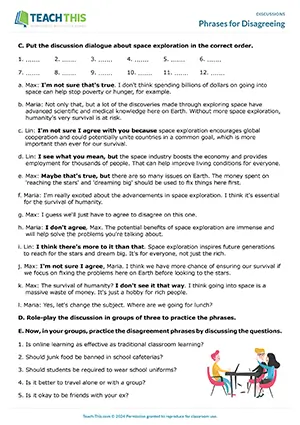
EAP Discussion Skills Worksheet - Vocabulary and Reading Exercises: Gap-fill - Speaking Activity: Discussion, Communicative practice - Group Work
In this expressing disagreement worksheet, students practice eight phrases for disagreeing in a discussion. Students begin by ordering words...
EAP Discussion Skills Worksheet - Vocabulary and Reading Exercises: Unscrambling, Gap-fill - Speaking Activity: Discussion, Communicative practice - Group Work In this expressing disagreement worksheet, students practice eight phrases for disagreeing in a discussion. Students begin by ordering words to make phrases that express disagreement. Next, students complete responses in discussions with the phrases for disagreeing. After that, students put a discussion dialogue about space exploration in the correct order. Students then role-play the discussion in groups of three to practice the phrases for disagreeing. Finally, in their groups, students discuss five questions using the disagreement phrases as much as possible.Reciprocal Speech

EAP Discussion Skills Worksheet - Reading and Vocabulary Exercises: Matching, writing Sentences - Speaking Activites: Asking and Answering Questions, Discussion
In this informative reciprocal speech worksheet, students learn and practice discussion interaction patterns and hesitation expressions. First, students...
EAP Discussion Skills Worksheet - Reading and Vocabulary Exercises: Matching, writing Sentences - Speaking Activites: Asking and Answering Questions, Discussion In this informative reciprocal speech worksheet, students learn and practice discussion interaction patterns and hesitation expressions. First, students read a brief introduction to the three A's interaction pattern (ask, answer, and add) and review a model interaction. Students then read four questions and give their opinions by answering each question yes or no. Next, students look at their answers and match the statements that can be used to add comments to their answers. After that, students match follow-up questions to the comments. Students then read a list of hesitation expressions and add two more phrases of their own. Next, in pairs, students take turns responding to questions using the hesitation expressions. Finally, students practice the ask, answer and add technique and hesitation expressions by discussing four questions.The Discussion Director

EAP Discussion Skills Game - Vocabulary and Speaking: Categorising, Matching, Discussion, Role-Play, Communicative practice - Group Work
In this communicative discussion skills game, students practice phrases for facilitating discussions and put them into practice in role-plays. First, students...
EAP Discussion Skills Game - Vocabulary and Speaking: Categorising, Matching, Discussion, Role-play, Communicative practice - Group Work In this communicative discussion skills game, students practice phrases for facilitating discussions and put them into practice in role-plays. First, students categorise phrases for facilitating discussions according to their function. Next, students read four situations and write a phrase they could use in each one. After that, in groups of four, students take turns facilitating short discussions. One student is the facilitator for the first round and takes a facilitator card and a topic card. Another student takes a role card. The group then discusses the topic. The student with the role card participates according to their instructions, and the facilitator manages the discussion using their card and appropriate phrases. When the four minutes are up, the role-player reveals their card. The group then decides whether the facilitator handled the situation effectively, e.g. by responding to disruptions or ensuring equal participation. If they decide yes, the facilitator keeps the topic card. If they decide no, the role-player keeps the topic card. The game continues for eight rounds, with each student acting as the facilitator twice. The student with the most topic cards at the end of the game wins.Voicing and Responding to Opinions

EAP Discussion Skills Worksheet - Reading and Vocabulary Exercises: Matching, Table Completion, Preparing Notes - Speaking Activity: Discussion, Freer practice
In this useful expressing opinions worksheet, students learn and practice expressing and responding to opinions in a discussion. First, students read an excerpt...
EAP Discussion Skills Worksheet - Reading and Vocabulary Exercises: Matching, Table Completion, Preparing Notes - Speaking Activity: Discussion, Freer practice In this useful expressing opinions worksheet, students learn and practice expressing and responding to opinions in a discussion. First, students read an excerpt from a seminar discussion where someone is expressing their opinion. Next, students write each underlined phrase from the discussion under its corresponding function. In pairs, students then brainstorm more phrases for each of the three functions and write them in a table. After that, students read the second part of the seminar discussion where someone responds to the opinion. Again, students write each underlined phrase from the discussion under its corresponding function, brainstorming other phrases as before. In two groups, students then prepare an argument for or against social media use and a response to the opposing side of the argument. Finally, students pair up with someone from the other group and have a discussion on the topic of social media following the procedure given.Here's what our members are saying...
- Academic Phrasal Verbs
-
Phrasal Verbs EAP worksheets, Activities & Games
Academic Phrasal Verb Dash
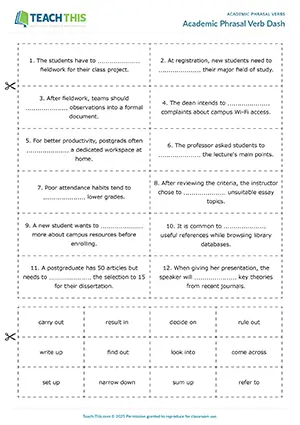
EAP Phrasal Verbs Game - Vocabulary and Speaking: Matching, Gap-fill, Forming Sentences, Freer practice - Group Work
In this academic phrasal verbs game, students race to complete sentences with phrasal verbs commonly used in academic contexts. First, students match academic phrasal verbs to their definitions. Next...
EAP Phrasal Verbs Game - Vocabulary and Speaking: Gap-fill, Forming Sentences, Freer practice - Group Work In this academic phrasal verbs game, students race to complete sentences with phrasal verbs commonly used in academic contexts. First, students match academic phrasal verbs to their definitions. Next, in groups, students play two games in which they race to complete sentences with the correct academic phrasal verb. Players take turns choosing to 'Swap' or 'Play'. If the player says 'Swap', they take a phrasal verb card from another player, give one of their own cards in return and their turn ends. If the player says 'Play', they select a phrasal verb card from their hand to complete a sentence on the table, reading the full sentence aloud. If the phrasal verb correctly completes the sentence, the player wins the pair of cards. The player then takes a new phrasal verb card from the pile and adds it to their hand. If not, play passes to the next student. The player with the most pairs of cards at the end of the game wins. In the second game, students take turns playing again, choosing to 'Swap' or 'Play' as before. However, when a player successfully matches and completes a sentence, they then create their own example sentence using the same phrasal verb. If the group agrees that the match is right and the sentence is grammatically correct and appropriate, the player wins the pair of cards. If not, play passes to the next student. The student with the most pairs of cards at the end of the game is the winner.Academic Phrasal Verbs Quest
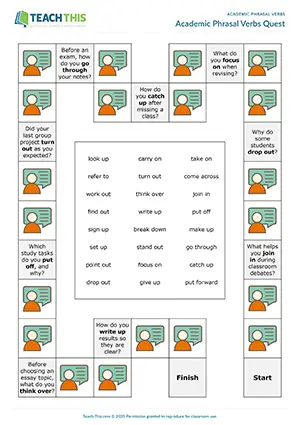
EAP Phrasal Verbs Board Game - Vocabulary and Speaking: Gap-fill, Impromptu Speech, Answering Questions, Freer practice - Group Work
In this enjoyable academic phrasal verbs board game, students practice using commonly used phrasal verbs and answer questions about their studies...
EAP Phrasal Verbs Game - Vocabulary and Speaking: Gap-fill, Impromptu Speech, Answering Questions, Freer practice - Group Work In this enjoyable academic phrasal verbs board game, students practice using commonly used phrasal verbs and answer questions about their studies and academic experiences. In groups, players take turns rolling the dice and moving their counter along the board. When a player lands on a square, another student picks up a card and reads out the sentence using the word 'blank' for the phrasal verb in bold, e.g. 'She BLANK an interesting idea during the seminar.' The player listens to the sentence, chooses a phrasal verb from the game board, and says it aloud to complete the sentence, e.g. put forward. If the player says the correct phrasal verb shown on the card, they stay on the square. If not, they move their counter back two squares. If a player lands on a question square, they talk for 30 seconds in response to the question to remain on the square. If the student stops talking or can't think of anything to say, they go back two squares. The first player to reach the finish wins the game.Let's Go Through This!

EAP Phrasal Verbs Worksheet - Vocabulary Exercises: Matching, Gap-fill, Binary Choice, Rewriting Sentences
In this free academic phrasal verb worksheet, students practice commonly used phrasal verbs for academic contexts. Students start by matching phrasal verbs in sentences to their definitions. Students...
EAP Phrasal Verbs Worksheet - Vocabulary Exercises: Matching, Gap-fill, Binary Choice, Rewriting Sentences In this free academic phrasal verb worksheet, students practice commonly used phrasal verbs for academic contexts. Students start by matching phrasal verbs in sentences to their definitions. Students then use the phrasal verbs to complete a conversation. Next, students underline the correct phrasal verb to complete each sentence. Lastly, students rewrite sentences by replacing verbs with the phrasal verbs.Study Habits

EAP Study-Related Phrasal Verbs Worksheet - Reading and Vocabulary Exercises: Binary Choice, Gap-fill - Speaking Activity and Game: Answering Questions - Pair Work
In this academic phrasal verbs worksheet, students practice the study-related phrasal verbs: hand in, go over, look up, write down, catch up, drop out, put off...
EAP Study-Related Phrasal Verbs Worksheet - Reading and Vocabulary Exercises: Binary Choice, Gap-fill - Speaking Activity and Game: Asking and Answering Questions - Pair Work In this academic phrasal verbs worksheet, students practice the study-related phrasal verbs: hand in, go over, look up, write down, catch up, drop out, put off, give up, join in, and sign up. First, students read a text about study habits that shows the phrasal verbs in context. Students then write the phrasal verbs from the text next to their definitions. Next, students underline the correct phrasal verb in each sentence. After that, students match halves to form sentences that contain the study-related phrasal verbs. Students then move on to complete sentences with the phrasal verbs. In pairs, students then ask and answer conversation questions about study habits. Finally, students play a guessing game in pairs to practice the study-related phrasal verbs. Students take turns reading a sentence to their partner, replacing the study-related phrasal verb in bold with the word 'Coffeepot.' Their partner then has one chance to guess the missing phrasal verb. For each correct guess, students award their partner one point. The student with the most points at the end of the game wins.Academic Phrasal Verb Antics
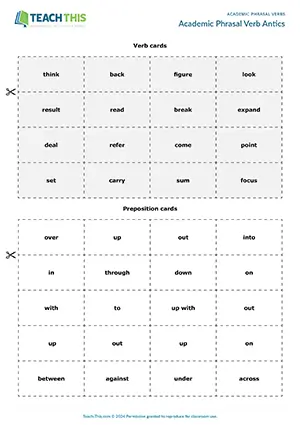
EAP Phrasal Verbs Game - Vocabulary, Reading and writing: Matching, Forming Sentences, Controlled and Freer practice - Group Work
In this engaging academic phrasal verbs game, students race to pair verbs with prepositions to form phrasal verbs and then match them to definitions and...
EAP Phrasal Verbs Game - Vocabulary, Reading and writing: Matching, Forming Sentences from Prompts, Controlled and Freer practice - Group Work In this engaging academic phrasal verbs game, students race to pair verbs with prepositions to form phrasal verbs and then match them to definitions and use them in sentences. Start the game by calling out a verb from the cards. Teams then race to find the correct preposition and definition cards to form an academic phrasal verb. When a team thinks they have matched three cards together (verb + preposition + definition), they raise their hands. The first team to match the cards correctly scores two points. Next, teams have two minutes to write a sentence using the phrasal verb in an academic context. When the time limit has been reached, each team reads their sentence aloud. Award one point for using the phrasal verb in the correct context and one point for grammatical accuracy. The game continues until all the academic phrasal verbs have been matched and used in sentences. The team with the most points at the end of the game wins.Academic Phrasal Verbs in Action
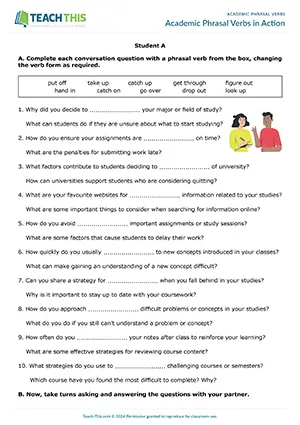
EAP Phrasal Verbs Activity - Vocabulary and Speaking: Gap-fill, Asking and Answering Questions, Controlled and Freer practice - Group and Pair Work
In this useful academic phrasal verbs speaking activity, students complete, ask and answer conversation questions with study-related phrasal verbs. First...
EAP Phrasal Verbs Activity - Vocabulary and Speaking: Gap-fill, Asking and Answering Questions from Prompts, Controlled and Freer practice - Group and Pair Work In this useful academic phrasal verbs speaking activity, students complete, ask and answer conversation questions with study-related phrasal verbs. First, in two groups, students complete conversation questions with academic phrasal verbs from a box, changing the verb form as needed. Next, students pair up with someone from the other group and take turns asking the conversation questions to their partner, who responds accordingly. For the first question in each set, students include the corresponding phrasal verb in their response. Afterwards, students share what they found out about their partner with the class.Academic Phrasal Verbs Jeopardy

EAP Phrasal Verbs Game - Vocabulary: Quiz, Guessing - Group Work
In this academic phrasal verbs quiz game, students guess phrasal verbs from clues. Choose a square to start the game, e.g. 'Research and Methods' for 100 points. Read the clue for the phrasal verb, e.g. 'to do an experiment.' The first student...
EAP Phrasal Verbs Game - Vocabulary: Quiz, Guessing - Group Work In this academic phrasal verbs quiz game, students guess phrasal verbs from clues. Choose a square to start the game, e.g. 'Research and Methods' for 100 points. Read the clue for the phrasal verb, e.g. 'to do an experiment.' The first student to raise their hand and give the correct academic phrasal verb (e.g. carry out) wins that square for their team and the number of points shown in the square. Write the winning team's name in the square. If a student gives an incorrect answer, their team is out for that question and may only answer again if all other teams answer incorrectly. The winning team then chooses the next square, and all the teams raise their hands to answer, as before. At the end of the game, add up the points for each team. The team with the most points wins the game. As a variation, when a student answers correctly, the winning team tries to make a sentence with the academic phrasal verb. If they do this successfully, the points for the square are doubled.Academic Phrasal Verbs for Research
EAP Phrasal Verbs Worksheet - Reading and Vocabulary Exercises: Matching, Rewriting Sentences - Speaking Activity: Discussion, Freer practice - Pair Work
In this informative phrasal verbs worksheet, students practice academic phrasal verbs used in research and academic writing. First, students read a text about...
EAP Phrasal Verbs Worksheet - Reading and Vocabulary Exercises: Matching, Rewriting Sentences - Speaking Activity: Discussion, Freer practice - Pair Work In this informative phrasal verbs worksheet, students practice academic phrasal verbs used in research and academic writing. First, students read a text about research projects. Students then match sentence halves to complete key ideas from the text. Next, students match phrasal verbs from the text to their definitions. After that, students rewrite sentences by replacing the underlined verb with a phrasal verb. Finally, students discuss five questions with a partner using the target phrasal verbs and specific examples.Phrasal Verbs for Humanities
EAP Phrasal Verbs Worksheet - Reading and Vocabulary Exercises: Identifying, Matching, Gap-fill, Paragraph writing - Speaking Activity: Discussion - Pair Work
In this academic phrasal verbs worksheet, students learn and practice phrasal verbs commonly used in humanities subjects. First, students read a text...
EAP Phrasal Verbs Worksheet - Reading and Vocabulary Exercises: Identifying, Matching, Gap-fill, Paragraph writing - Speaking Activity: Discussion, Asking and Answering Questions, Freer practice - Pair Work In this academic phrasal verbs worksheet, students learn and practice phrasal verbs commonly used in humanities subjects. First, students read a text and discuss two questions with a partner. Students then re-read the text, underline ten phrasal verbs and use context clues to discuss the meaning of each one with their partner. Next, students write phrasal verbs from the text next to their synonyms. After that, students match the phrasal verbs to noun phrases. Afterwards, students complete four questions with phrasal verbs in their correct form. Students then ask and answer the questions in pairs. Next, students complete an extract from a research paper with the target phrasal verbs, using each phrasal verb once. Finally, students write a short paragraph explaining to what extent the points made in the extract reflect their personal experience, using at least five phrasal verbs from the worksheet.Scientific Phrasal Verbs in Action
EAP Phrasal Verbs Worksheet - Reading and Vocabulary Exercises: Identifying, Matching, Gap-fill, writing a Paragraph - Speaking Activity: Discussion - Pair Work
In this insightful academic phrasal verbs worksheet, students learn and practice phrasal verbs commonly used in science subjects. First, students read...
EAP Phrasal Verbs Worksheet - Reading and Vocabulary Exercises: Identifying, Matching, Categorising, Gap-fill, Rewriting Sentences, writing a Paragraph - Speaking Activity: Discussion, Communicative practice - Pair Work In this insightful academic phrasal verbs worksheet, students learn and practice phrasal verbs commonly used in science subjects. First, students read a text about phrasal verbs and discuss two questions with a partner. Students then re-read the text, underline ten phrasal verbs and use context clues to discuss their meanings in pairs. Next, students match the phrasal verbs to their definitions. After that, students complete a table by adding two phrasal verbs under each heading. Following that, students complete presentation notes with the phrasal verbs in their correct form, using each phrasal verb once. Next, students rewrite sentences by replacing the underlined verb with a phrasal verb. Students then write a paragraph about a recent science experiment using at least five phrasal verbs from the worksheet. Finally, students share and discuss their paragraphs with a partner.Here's what our members are saying...
- Daily Routines
-
Daily Routines ESL Games, Activities & worksheets
Daily Routines Chain Game
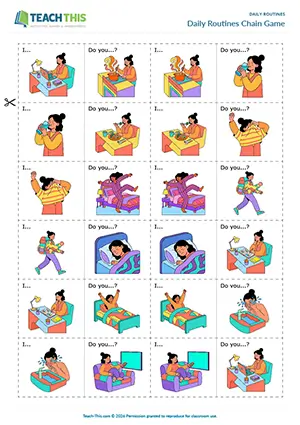
ESL Daily Routines Game - Vocabulary and Grammar: Matching, Controlled practice - Group Work
In this daily routines game, students practice the names of 12 common daily routines by matching pictures in an 'I..., Do you...?' chain. In groups, one student starts by placing one of their cards face up on the desk...
ESL Daily Routines Game - Vocabulary and Grammar: Matching, Controlled practice - Group Work In this daily routines game, students practice the names of 12 common daily routines by matching pictures in an 'I..., Do you...?' chain. In groups, one student starts by placing one of their cards face up on the desk. Each card has two halves. The left half is 'I...' plus a picture prompt, and the right half is 'Do you...?' plus a picture prompt. The student then says the pair of sentences shown on the card by reading the prompts and saying the daily routines in the pictures, e.g. 'I cook. Do you drink?' All the students then look for the matching 'I...' card that shows the correct picture. Whoever has that card places it next to the card on the desk, saying, 'Yes, I do. I...', and then reads the next question on their card, e.g. 'Yes, I do. I drink. Do you eat?' The process continues with the next card, and so on. Students continue in this way, placing cards so the pictures match, until all the cards have been matched correctly. The group that matches all the cards correctly first wins. Groups can play several rounds to reinforce the vocabulary and give different players a chance to start. This resource can also be used with our 'Daily Routines Flashcards and Worksheet' and 'Daily Routine Riddles' game.Daily Routines Flashcards and Worksheet
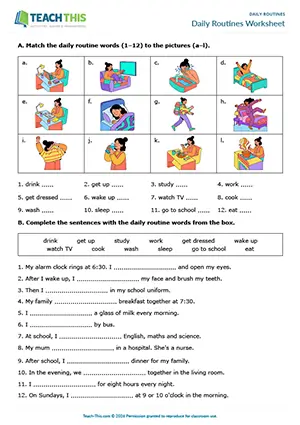
ESL Daily Routines Worksheet - Vocabulary and Grammar Exercises: Matching, Gap-fill, Controlled practice
In this daily routines worksheet, students learn and practice the names of 12 common daily routines. To begin, hold up each flashcard. Point to the picture and elicit the daily routine. Then model and drill...
ESL Daily Routines Worksheet - Vocabulary and Grammar Exercises: Matching, Gap-fill, Controlled practice In this daily routines worksheet, students learn and practice the names of 12 common daily routines. To begin, hold up each flashcard. Point to the picture and elicit the daily routine. Then model and drill pronunciation chorally and individually. Next, write the following frames on the board: 'What do you do in the morning/evening?' 'I...' and 'What time do you...?' 'I... at...' Students then practice the questions and answers while you show the flashcards. Next, students match the daily routines to pictures. After that, students complete sentences with the daily routine words. As an extension, play a quick review game with the flashcards, e.g. slap-the-card, sorting, what's missing? Or have students write six sentences about their own daily routine using the words. This resource can also be used with our 'Daily Routines Chain Game' and 'Daily Routine Riddles' game.Daily Routines Board Game

ESL Daily Routines Board Game - Vocabulary and Speaking: Gap-fill, Impromptu Speech, Freer practice - Group Work
In this free daily routines board game, students practice vocabulary related to daily routines and talk in response to topic-related prompts. Players take turns rolling the dice and moving their counters...
ESL Daily Routines Board Game - Vocabulary and Speaking: Gap-fill, Impromptu Speech, Freer practice - Group Work In this free daily routines board game, students practice vocabulary related to daily routines and talk in response to topic-related prompts. Players take turns rolling the dice and moving their counters along the board. When a player lands on a square, another student picks up a card and reads out the sentence using the word 'blank' for the daily routine word in bold, e.g. 'I BLANK at 6:00 a.m. and turn off my alarm clock.' The player listens to the sentence, chooses a daily routine word from the game board, and says it aloud to complete the sentence, e.g. wake up. If the player says the correct word shown on the card in bold, they stay on the square. If not, they move their counter back two squares. If a player lands on a 'Talk about' square, they talk for 20 seconds in response to a prompt to remain on the square. If a player can't think of anything to say or stops talking before the 20 seconds are up, they go back two squares. The first player to reach the finish wins the game.Daily Routine Dash
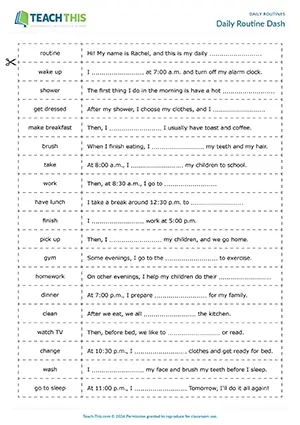
ESL Daily Routines Games - Vocabulary and Reading: Matching, Pelmanism, Gap-fill, Ordering - Pair Work
In these fun daily routines games, students complete sentences with vocabulary related to daily activities and then race to put the sentences in order to create a text about someone's daily routine...
ESL Daily Routines Games - Vocabulary and Reading: Matching, Pelmanism, Gap-fill, Ordering - Pair Work In these fun daily routines games, students complete sentences with vocabulary related to daily activities and then race to put the sentences in order to create a text about someone's daily routine. First, students play a pelmanism game where they match and complete sentences about a person's daily routine with related vocabulary. In pairs, students take turns turning over one vocabulary card and one gap-fill sentence card. If the daily routine word or phrase logically completes the gap-fill sentence, the student reads the sentence aloud, keeps the two cards, and has another turn. If not, the student turns the two cards back over. The student with the most pairs of cards at the end of the game wins. Afterwards, ask the students to look at their matched cards and elicit the answers from the class. As you go through each answer, students write the daily routine word or phrase into the gap-fill sentence. Next, pairs race to put the sentence cards in order to form a text about someone's daily routine. The first pair to do this wins. Finally, go through the order of the text with the class and review the daily routines vocabulary.Daily Routines Survey
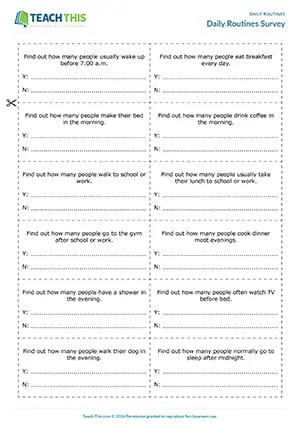
ESL Daily Routines Activity - Speaking: Forming, Asking and Answering Questions, Controlled practice - Group Work
In this insightful daily routines activity, students conduct a survey where they ask and answer 'Do you...?' questions about daily routines. First, each student creates the daily routine 'Do you...?' question...
ESL Daily Routines Activity - Speaking: Forming, Asking and Answering Questions from Prompts, Controlled practice - Group Work In this insightful daily routines activity, students conduct a survey where they ask and answer 'Do you...?' questions about daily routines. First, each student creates the daily routine 'Do you...?' question they need to ask from the prompt on their card, e.g. 'Do you usually wake up before 7:00 a.m.?' Students then go around their group, asking and answering the daily routine questions. Students note the number of people who answer yes or no to their question on the card. Finally, each student reports their findings to the class, e.g. 'Four people usually wake up before 7:00 a.m.'Daily Routine Vocabulary
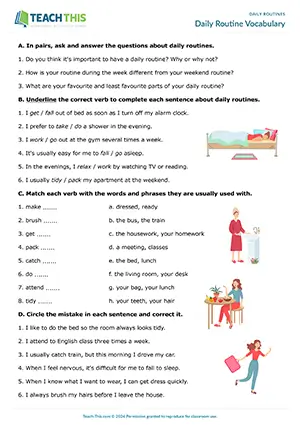
ESL Daily Routines Worksheet - Vocabulary and writing Exercises: Binary Choice, Matching, Error Correction, Gap-fill, writing a Paragraph
Here is a useful daily routines worksheet to help students practice vocabulary related to daily routines. Students begin by discussing three questions about daily...
ESL Daily Routines Worksheet - Vocabulary and writing Exercises: Binary Choice, Matching, Error Correction, Gap-fill, writing a Paragraph Here is a useful daily routines worksheet to help students practice vocabulary related to daily routines. Students begin by discussing three questions about daily routines in pairs. Students then underline the correct verb in each sentence about daily routines. Next, students match each verb with words or phrases they are usually used with. After that, students find mistakes in routine-related sentences and correct them. Following that, students use words from a box to complete a text about a person's daily routine. Students then write a paragraph about their own daily routines using the vocabulary from the worksheet. Finally, students take turns presenting their daily routines to the other students, who listen and decide whose daily routine is the most similar to their own.Find Someone Who Usually...
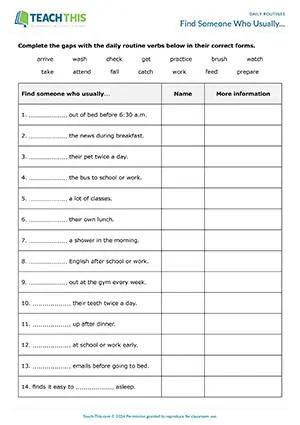
ESL Daily Routines Activity - Vocabulary and Speaking: Gap-fill, Asking and Answering Questions, Controlled and Freer practice
In this engaging daily routines speaking activity, students ask and answer questions about their daily routines and habits. First, students complete 'Find someone who...' prompts with daily routine...
ESL Daily Routines Activity - Vocabulary and Speaking: Gap-fill, Asking and Answering Questions from Prompts, Controlled and Freer practice In this engaging daily routines speaking activity, students ask and answer questions about their daily routines and habits. First, students complete 'Find someone who...' prompts with daily routine verbs in their correct form. Next, students go through the prompts and prepare the yes/no questions they need to ask in the activity, e.g. 'Do you usually get out of bed before 6:30 a.m.?' Students then go around the class asking each other the daily routine questions. When a classmate answers 'yes' to a question, the student writes down their name and asks a follow-up question to gain more information, noting down the answer in the last column. Afterwards, students give feedback to the class on what they found out.Daily Life Discussion

ESL Daily Routines Activity - Vocabulary and Speaking: Asking and Answering Questions, Discussion, Freer practice - Group Work
Here is a daily routines discussion activity that helps students practice vocabulary related to daily routines and discuss their habits and routines. In groups, students take turns picking up a card and asking the...
ESL Daily Routines Activity - Vocabulary and Speaking: Asking and Answering Questions, Discussion, Freer practice - Group Work Here is a daily routines discussion activity that helps students practice vocabulary related to daily routines and discuss their habits and routines. In groups, students take turns picking up a card and asking the other students in the group the daily routine discussion question on the card. Each student responds to the question in turn, and the students then discuss the daily routines topic. This process continues until all the daily routine question cards have been discussed. When the students have finished, review the questions on the cards and elicit answers from around the class.Which Routine is Better?
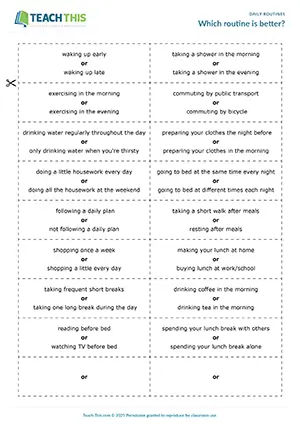
ESL Daily Routines Activity - Speaking: Asking and Answering Questions, Discussion, Freer practice - Group Work
In this daily routines discussion activity, students use comparative structures to express and justify preferences about daily routines. In groups, students take turns picking up a card and asking...
ESL Daily Routines Activity - Speaking: Asking and Answering Questions, Discussion, Freer practice - Group Work In this daily routines discussion activity, students use comparative structures to express and justify preferences about daily routines. In groups, students take turns picking up a card and asking the other students in the group a 'Which is better, ... or ...? Why?' question from the prompt on the card, e.g. 'Which is better, exercising in the morning or exercising in the evening? Why?' After each student has given their answer, including at least one reason, the group discusses the topic before moving on to the next card. If a student picks up a blank card with 'or' on it, they can ask any 'Which is better...?' question they like. Finally, get feedback from around the class on which routines the students think are better and why.Eco-Friendly Daily Routines

ESL Daily Routines Worksheet - Vocabulary Exercises: Matching, Binary Choice, Gap-fill - Speaking Activity: Asking and Answering Questions, Freer practice - Pair Work
Here is an informative daily routines worksheet to help students learn and practice verbs related to eco-friendly daily routines. Students begin by...
ESL Daily Routines Worksheet - Vocabulary Exercises: Matching, Binary Choice, Gap-fill, writing Sentences - Speaking Activity: Asking and Answering Questions, Freer practice - Pair Work Here is an informative daily routines worksheet to help students learn and practice verbs related to eco-friendly daily routines. Students begin by matching halves together to form sentences about eco-friendly routines. Students then match the verbs in bold from Exercise A with their correct definitions. Next, students underline the correct verb to complete each sentence. After that, students complete sentences about eco-friendly routines using verbs from a box. Students then move on to complete sentences about eco-friendly practices with their own ideas and compare them with a partner. Finally, in their pairs, students ask and answer conversation questions about environmental habits.Routine Reset
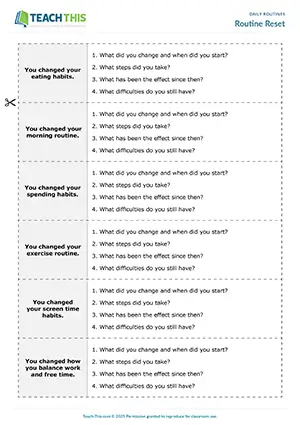
ESL Daily Routines Activity - Listening and Speaking: Planning and Delivering a Short Talk, Peer Review, Freer practice - Pair Work
In this daily routines speaking activity, students give short talks about a routine change they have made, contrast the present perfect simple and continuous, and use sequencing and result language...
ESL Daily Routines Activity - Listening and Speaking: Planning and Delivering a Short Talk, Peer Review, Freer practice - Pair Work In this daily routines speaking activity, students give short talks about a routine change they have made, contrast the present perfect simple and continuous, and use sequencing and result language. In pairs, students take turns giving short talks about a routine change they have made to their partner, who gives feedback. First, the speaker turns over a card, reads the routine change and guiding questions, and plans what to say for 30 seconds, while the listener writes the routine change on their worksheet and reviews a checklist. Next, the speaker gives a 60–90 second talk. The other student listens and ticks the criteria met on the checklist, and then gives feedback. The two students then swap roles and repeat with a new card. This continues until each student has given three talks. Finally, pairs give feedback to the class on their talks.Here's what our members are saying...
- Actions
-
Actions ESL Games & Activities
Action Verbs Bingo
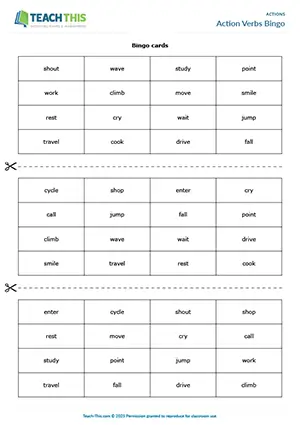
ESL Action Verbs Game - Vocabulary and Speaking: Bingo, Matching, Forming Sentences, Freer practice - Group Work
In this enjoyable action verbs game, students play bingo by listening to definitions and matching them to common action verbs. To begin, the bingo caller reads a definition at random from the caller's sheet...
ESL Action Verbs Game - Vocabulary and Speaking: Bingo, Matching, Forming Sentences, Freer practice - Group Work In this enjoyable action verbs game, students play bingo by listening to definitions and matching them to common action verbs. To begin, the bingo caller reads a definition at random from the caller's sheet without saying the verb in brackets, e.g. 'Something you do when you are angry and speak very loudly.' The caller then puts a tick beside the definition to show it has been read out. The players listen and look at the action verbs on their bingo cards to see if they have an action verb that matches the definition, e.g. shout. If they do, they cross it off. The game continues until a player has crossed off four action verbs in a row. When this happens, the player shouts 'Bingo!' and then makes a sentence with each crossed-off verb to verify their win. If the player makes a mistake in any of the four sentences, they are allowed one chance to fix it. If they correct it, the win counts. If not, the bingo is void, and the game continues. If the sentences are correct and the action verbs match the definitions that were ticked on the caller's sheet, the player wins the round. Players then continue to see who can cross off all 16 verbs first without making sentences. Groups play several rounds, with students taking turns being the bingo caller and players using a different bingo card each time.Action Verb Races
ESL Action Verb Games - Vocabulary and Speaking: Matching, Gap-fill, Forming Sentences, Freer practice - Group Work
Here are two free action verb games to help students practice everyday actions. First, students play a gap-fill and matching game. In groups, students take turns picking up a sentence card, reading it...
ESL Action Verb Games - Vocabulary and Speaking: Matching, Gap-fill, Forming Sentences, Freer practice - Group Work Here are two free action verb games to help students practice everyday actions. First, students play a gap-fill and matching game. In groups, students take turns picking up a sentence card, reading it aloud and placing it face-up on the table. All the students then race to find the correct action verb card to complete the sentence. When a student finds the right action verb card, they pick it up and read the complete sentence aloud. If the other students agree the action verb matches the sentence, the student wins and keeps the cards. If not, the student puts down the verb card, is out of the round and other students can answer. The student with the most pairs of cards at the end of the game wins. After that, students play a game where they form sentences using the action verbs. Students take turns turning over an action verb card so it's visible to everyone. The other students then race to put up their hands and say a sentence using the action verb. The first student to make a suitable sentence wins and keeps the card. The student with the most cards at the end of the game is the winner.Everyday Actions
ESL Action Verbs Worksheet - Vocabulary and writing Exercises: writing Sentences - Speaking Activities: Asking and Answering Questions, Freer practice - Group Work
Here is a comprehensive actions worksheet to help students practice common verbs related to everyday actions. First, students match action verbs with words...
ESL Action Verbs Worksheet - Vocabulary and writing Exercises: writing Sentences - Speaking Activities: Asking and Answering Questions, Freer practice - Group Work Here is a comprehensive actions worksheet to help students practice common verbs related to everyday actions. First, students match action verbs with words and phrases. Students then underline the correct action verb to complete each sentence. Next, students circle the odd verb out in each set and write why the action verb doesn't belong. After that, students complete sentences with action verbs from a box. Students then move on to use action verbs from the worksheet to write three true and three false sentences about themselves. Students then take turns reading the sentences to a partner, who guesses whether they are true or false. Finally, in pairs, students ask and answer conversation questions that use the action verbs.Physical Movement Mime
ESL Actions Game - Vocabulary: Miming, Guessing - Group Work
In this fun actions game, students read sentences and then mime or guess the missing verbs of physical movement. In competing teams of two, students take turns picking up a card and reading the sentence using the word 'blank' for...
ESL Actions Game - Vocabulary: Miming, Guessing - Group Work In this fun actions game, students read sentences and then mime or guess the missing verbs of physical movement. In competing teams of two, students take turns picking up a card and reading the sentence using the word 'blank' for the missing action verb. The reader then mimes the missing action verb shown in brackets on the card to their partner, who tries to guess it. If the student successfully guesses the verb within 30 seconds, the team wins and keeps the card. If not, the other team has one chance to guess the verb and steal the card. The team with the most cards at the end of the game wins.Action Talk
ESL Action Verbs Activity - Vocabulary and Speaking: Gap-fill, Asking and Answering Questions, Controlled and Freer practice - Group and Pair Work
In this insightful action verbs activity, students complete, ask and answer conversation questions that contain action verbs. First, students complete each...
ESL Action Verbs Activity - Vocabulary and Speaking: Gap-fill, Asking and Answering Questions, Controlled and Freer practice - Group and Pair Work In this insightful action verbs activity, students complete, ask and answer conversation questions that contain action verbs. First, students complete each conversation question with a suitable action verb from a box. Next, students pair up with someone from the other group and take turns asking and answering the conversation questions with their partner, discussing each topic for a minute. Finally, students share what they learned about their partner with the class.Move It!
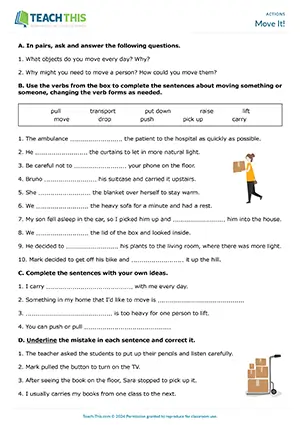
ESL Actions Worksheet - Vocabulary Exercises: Sentence Completion - Speaking Activity: Asking and Answering Questions, Freer practice - Pair Work
Here is a useful actions worksheet to help students practice common verbs related to moving something or someone. First, in pairs, students discuss two...
ESL Actions Worksheet - Vocabulary Exercises: Sentence Completion, Error Correction - Speaking Activity: Asking and Answering Questions, Freer practice - Pair Work Here is a useful actions worksheet to help students practice common verbs related to moving something or someone. First, in pairs, students discuss two questions about moving objects and people. Next, students use action verbs from a box to complete sentences related to moving something or someone, changing the verb forms as needed. Students then complete sentences about moving and carrying objects with their own ideas. After that, students find mistakes in sentences and correct them. Following that, students complete sentences by choosing the correct action verb. Finally, students ask and answer topic-related conversation questions with a partner.Say it, Do it, Describe it
ESL Actions Activity - Vocabulary, Grammar and Speaking: Giving and Following Instructions, Miming, Describing Actions, Sequencing Routines - Pair Work
In this entertaining actions activity, students give and follow simple instructions, describe actions in progress and sequence short action routines. In pairs, one student...
ESL Actions Activity - Vocabulary, Grammar and Speaking: Giving and Following Instructions, Miming, Describing Actions, Sequencing Routines - Pair Work In this entertaining actions activity, students give and follow simple instructions, describe actions in progress and sequence short action routines. In pairs, one student takes on the role of a director, gives instructions and describes the actions, while the other student takes on the role of an actor and mimes the actions. First, pairs follow the 'Say and Do' section of the instruction sheet. The director picks up two action cards and reads the instructions aloud. The actor mimes the actions, and the director says what is happening using the present continuous. After four pairs of cards have been used, students switch roles and repeat the process. Next, students move on to the 'Sequence It' section. The director picks up three action cards, puts them together to create a short three-step routine, and reads the instructions to the actor, who does the steps in order. The director then describes the steps using sequencers and the present continuous. After three routines, the students swap roles and repeat the process. Following that, students move on to the 'Speed Round' in which the director has three minutes to draw cards, read each instruction, and describe each action in the present continuous while the actor mimes quickly. The director scores one point for each correctly described action. After three minutes, students switch roles and repeat. The student with the most points wins.True or False Actions Game

ESL Action Verbs Game - Vocabulary and Speaking: Forming Sentences, True or False, Asking and Answering Questions, Freer practice - Group Work
Here is an entertaining actions game to help students practice common action verbs. In groups, players take turns picking up a verb card and placing it face-up...
ESL Action Verbs Game - Vocabulary and Speaking: Forming Sentences from Prompts, True or False, Asking and Answering Questions, Freer practice - Group Work Here is an entertaining actions game to help students practice common action verbs. In groups, players take turns picking up a verb card and placing it face-up on the table. The player then mixes up the 'Make a true statement' and 'Make a false statement' cards and takes one without showing it to anyone. Next, the player makes a true or false statement as indicated on the card using the action verb, e.g. 'Yesterday, I washed my car.' The other students then each ask the player one follow-up question to help them decide if the player's statement is true or false, e.g. 'What type of car do you have?' After the questions have been answered, each student says whether they think the statement is true or false. The player then reveals the answer. The students who guessed correctly each score one point. If a player is unable to make a statement using the action verb, the other students each receive a point. The student with the most points at the end of the game is the winner.Here's what our members are saying...
- Birthdays
-
Birthdays ESL worksheets & Activities
Birthday Bash
ESL Birthdays Activity - Vocabulary and Speaking: Role-play, Asking and Answering Questions, Table Completion, Brainstorming, Controlled practice - Group and Pair Work
In this useful birthdays role-play activity, students ask and answer questions about people's birthdays and birthday parties and then brainstorm gift ideas...
ESL Birthdays Activity - Vocabulary and Speaking: Role-play, Asking and Answering Questions, Table Completion, Brainstorming, Controlled practice - Group and Pair Work In this useful birthdays role-play activity, students ask and answer questions about people's birthdays and birthday parties and then brainstorm gift ideas. In groups, students take on the role of different people who live in the same neighbourhood. The students' task is to find out each person's name, age, birthday, and the place and activities for their next birthday party by asking questions and writing the answers in a table. Students begin by writing the information from their role card in the table. Students then go around the group, asking and answering the questions and noting the answers in their tables. When the students have finished, they think of and write down an appropriate birthday present for each person. Finally, students tell the class what presents they wrote for some of the people and why.Birthday Basics
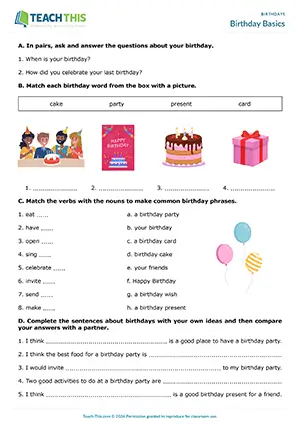
ESL Birthdays Worksheet - Vocabulary Exercises: Matching, Gap-fill, Identifying - Speaking Activities: Asking and Answering Questions, Controlled practice - Pair Work
This free birthdays worksheet helps students learn and practice common birthday-related vocabulary. First, students discuss two questions about birthdays...
ESL Birthdays Worksheet - Vocabulary Exercises: Matching, Gap-fill, Identifying - Speaking Activities: Asking and Answering Questions, Controlled practice - Pair Work This free birthdays worksheet helps students learn and practice common birthday-related vocabulary. First, students discuss two questions about birthdays. Students then match birthday vocabulary from a box with pictures. Next, students match verbs with nouns to create common birthday phrases. After that, students complete sentences about birthdays with their own ideas and then compare their answers with a partner. Students then use birthday vocabulary from a box to complete a text about someone's birthday. Following that, students identify the odd word out in each set and write why the word doesn't belong. Lastly, students ask and answer birthday conversation questions in pairs.Birthday Bonanza
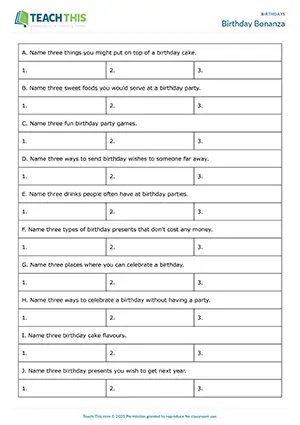
ESL Birthdays Game - Vocabulary and Speaking: Listing, Forming Sentences, Freer practice - Pair Work
In this fun birthday vocabulary game, students race to name three things associated with birthday celebrations. Read the first item on the worksheet to the class, i.e. 'Name three things you might put on...
ESL Birthdays Game - Vocabulary and Speaking: Listing, Forming Sentences from Prompts, Freer practice - Pair Work In this fun birthday vocabulary game, students race to name three things associated with birthday celebrations. Read the first item on the worksheet to the class, i.e. 'Name three things you might put on top of a birthday cake.' The teams then start writing down three suitable answers. When a team has three answers, they put up their hand and the other teams stop writing. The team then gives their answers. If the team gives three suitable answers, they score a point, e.g. candles, chocolate pieces, and fruit slices. The team then tries to make a sentence with the three answers for an extra point, e.g. 'We put candles, chocolate pieces, and fruit slices on top of the birthday cake.' If a team gives an unsuitable answer, they are out of the round and the other teams race to answer. The team with the most points at the end of the game wins.Birthday Banter
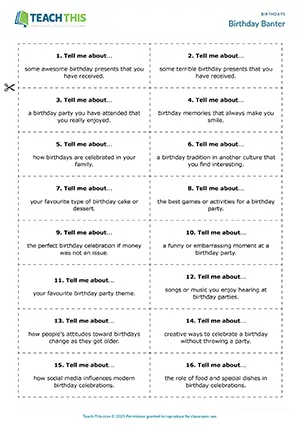
ESL Birthdays Activity - Speaking: Asking and Answering Questions, Discussion, Freer practice - Pair Work
In this insightful birthdays discussion activity, students discuss various topics related to birthdays. In pairs, students take turns picking up a card and asking their partner to tell them about the birthday-related...
ESL Birthdays Activity - Speaking: Asking and Answering Questions from Prompts, Guided Discussion, Freer practice - Pair Work In this insightful birthdays discussion activity, students discuss various topics related to birthdays. In pairs, students take turns picking up a card and asking their partner to tell them about the birthday-related topic on the card. Their partner then talks about the birthday topic and the other student asks follow-up questions to gain more information. Together, the two students develop a short discussion about the topic before moving on to the next card. At the end of the activity, go through the questions and have the pairs give feedback to the class on their answers.Here's what our members are saying...
- Business Idioms
-
Idioms: Business English Games, Activities & worksheets
Bite the Bullet
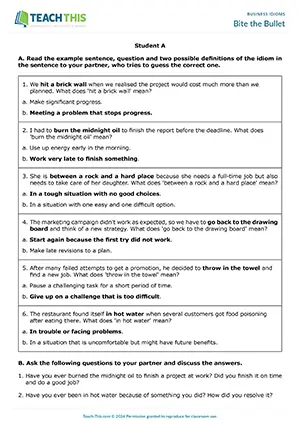
Business English Idioms Game and Activity - Vocabulary: Guessing - Speaking and Reading Activity: Answering Questions, Gap-fill, Freer practice - Pair Work
In this engaging business idioms game and activity, students learn and practice idioms related to challenges and problems. First, in pairs, students take turns...
Business English Idioms Game and Activity - Vocabulary: Guessing - Speaking and Reading Activity: Asking and Answering Questions, Gap-fill, Freer practice - Pair Work In this engaging business idioms game and activity, students learn and practice idioms related to challenges and problems. First, in pairs, students take turns reading an example sentence, question and two possible definitions of the idiom in the sentence to their partner, who tries to guess the correct one. For each correct guess, students put a tick next to the idiom. The student with the most correct guesses at the end of the game wins. Next, students ask their partner questions that contain idioms from the game and discuss the answers. Pairs then complete a story by writing the missing idiom for each sentence in the column on the right in its correct form. Lastly, students fold the worksheet so that they cannot see the idioms, and then take turns re-telling the story, trying to remember the idioms.Financial Idioms

Business Idioms Worksheet - Vocabulary Exercises: Identifying, Matching - Speaking Activity: Asking and Answering Questions - Vocabulary Game: Gap-fill - Group Work
In this useful business idioms worksheet and game, students learn and practice some common financial idioms. Students begin by identifying and underlining...
Business Idioms Worksheet - Vocabulary Exercises: Identifying, Matching - Speaking Activity: Asking and Answering Questions - Vocabulary Game: Gap-fill - Group Work In this useful business idioms worksheet and game, students learn and practice some common financial idioms. Students begin by identifying and underlining financial idioms in sentences. Students then match the idioms with their definitions. After that, students discuss four conversation questions that contain the financial idioms in pairs. Next, in groups, students play a card game where they race to complete sentences with the idioms. Students take turns picking up a card and reading the sentence on the card to the group using the word 'blank' in place of the financial idiom written in bold, e.g. 'The contractor BLANK on the building materials, leading to serious structural issues.' The other students then race to complete the sentence with the correct idiom, e.g. cut corners. The first student to do this wins and keeps the card. The student with the most cards at the end of the game wins.Hit the Nail on the Head

Business English Idioms Game - Vocabulary: Identifying, Guessing
In this free business idioms game, students guess idioms commonly used in business from sentences that describe their meaning. To begin, write the business idioms from the cards on the board. In pairs, students then take turns picking up a card...
Business English Idioms Game - Vocabulary: Identifying, Guessing In this free business idioms game, students guess idioms commonly used in business from sentences that describe their meaning. To begin, write the business idioms from the cards on the board. In pairs, students then take turns picking up a card and reading the sentence on the card to their partner, signalling the words in bold that describe the idiom with air quotation marks. Their partner then repeats the sentence back, changing the words in bold to a business idiom from the board. If the student says the correct idiom, they win and keep the card. If not, the student with the card reads out the correct idiom shown in brackets and removes the card from the game. The student with the most cards at the end of the game wins.Business Idioms in Action
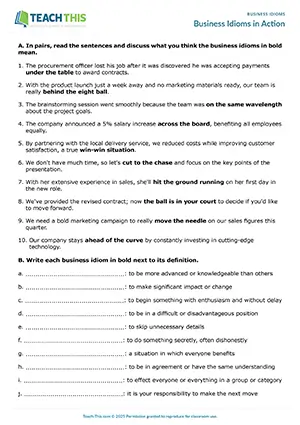
Business English Idioms Worksheet - Reading, writing and Vocabulary Exercises: writing a Dialogue - Speaking Activities: Role-Play, Freer practice - Pair Work
In this comprehensive business idioms worksheet, students learn and practice ten idioms commonly used in business. First, in pairs, students read sentences...
Business English Idioms Worksheet - Reading, writing and Vocabulary Exercises: writing a Dialogue - Speaking Activities: Discussion, Role-Play, Freer practice - Pair Work In this comprehensive business idioms worksheet, students learn and practice ten idioms commonly used in business. First, in pairs, students read sentences and discuss what they think the business idioms in bold mean from the contexts. Working alone, students then match each business idiom to its definition. Next, students read scenarios and write the corresponding business idioms. After that, assign each pair of students with a business idiom from the worksheet. Pairs then create a short workplace dialogue that demonstrates the business idiom without using it in their conversation. Finally, pairs role-play their dialogues to the class, who guess the business idiom being demonstrated each time.Competition Idioms

Business English Idioms Games - Vocabulary: Matching, Gap-fill, Guessing - Group and Pair Work
Here are two fun business idioms games to help students practice idioms related to competition. To begin, students play a game of dominoes to practice the competition idioms. In groups the first...
Business English Idioms Games - Vocabulary: Matching, Gap-fill, Guessing - Group and Pair Work Here are two fun business idioms games to help students practice idioms related to competition. To begin, students play a game of dominoes to practice the competition idioms. In groups, the first player tries to match a competition idiom with its definition by placing a domino down either before or after the domino on the table. The next player then tries to put down one of their dominoes at either end of the domino chain, and so on. The first player to get rid of all their dominoes wins. However, the game continues until all the dominoes have been used or the gameplay has been exhausted. Next, in pairs, students play a game where they complete sentences with the idioms. Student A reads each sentence using the word 'blank' for the competition idiom in bold to their partner, who listens, chooses a suitable idiom from their worksheet, and repeats the sentence, completing it with the correctly formed idiom. If the idiom is correct, the other student puts a tick next to the sentence. When Student A has read out all their sentences, the two students swap roles. The student with the most correct answers at the end of the game wins.Talk the Talk
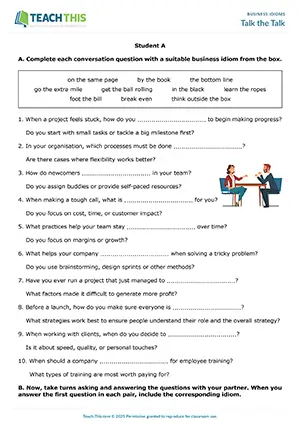
Business English Idioms Activity - Vocabulary and Speaking: Gap-fill, Asking and Answering Questions, Controlled and Freer practice - Group and Pair Work
In this insightful business idioms activity, students complete, ask and answer conversation questions containing useful idioms. First, in two groups...
Business English Idioms Activity - Vocabulary and Speaking: Gap-fill, Asking and Answering Questions, Controlled and Freer practice - Group and Pair Work In this insightful business idioms activity, students complete, ask and answer conversation questions containing useful idioms. First, in two groups, students complete conversation questions with business idioms from a box. Next, students pair up with someone from the other group and take turns asking the conversation questions to their partner, who responds accordingly. For the first question in each pair, students include the corresponding business idiom in their response. Afterwards, students share what they found out about their partner with the class.Here's what our members are saying...
- Business Collocations
-
Collocations: Business English worksheets & Games
Business Collocations Bingo
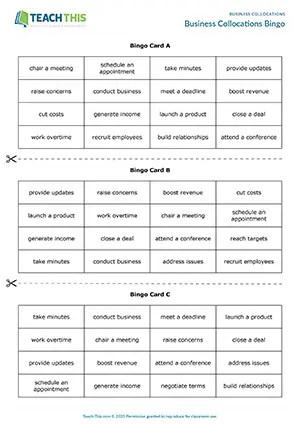
Business English Collocations Game - Vocabulary: Bingo, Matching - Group Work
In this engaging business collocations game, students play bingo by matching common business collocations with their meanings and briefly using them in context. To begin, the bingo caller reads a business collocation definition at random from the...
Business English Collocations Game - Vocabulary: Bingo, Matching - Group Work In this engaging business collocations game, students play bingo by matching common business collocations with their meanings and briefly using them in context. To begin, the bingo caller reads a business collocation definition at random from the caller's sheet, e.g. 'To lead and control a business meeting.' The players listen and look at the collocations written on their bingo cards to see if they have one that matches the definition, e.g. chair a meeting. If they do, they cross it off. The game continues until a player has crossed off four collocations in a row. When this happens, the player shouts 'Bingo!' and then makes a business-related sentence with each crossed-off collocation to verify their win. If the player makes a mistake in any of the four sentences, they are allowed one chance to fix it. If they correct it, the win counts. If the player fails to correct the mistake or the collocations are wrong, the bingo is void, and the game continues. If the sentences are correct and the collocations match the definitions, the player wins the round. Players then continue to see who can cross off all 16 collocations first without making sentences. Groups play several rounds, with students taking turns being the bingo caller and players using a different bingo card each time. show lessBusiness Collocations Jeopardy
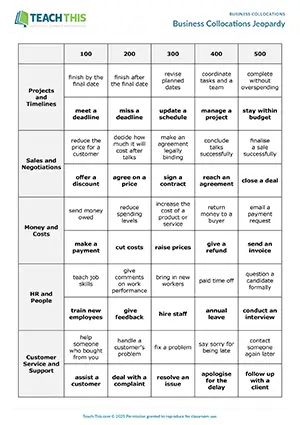
Business English Collocations Game - Vocabulary: Quiz, Guessing - Group Work
In this business collocations quiz game, students guess collocations based on their definitions. Choose a square to start the game, e.g. 'Projects and Timelines' for 100 points. Read the definition of the collocation, e.g. 'finish by the final date.'...
Business English Collocations Game - Vocabulary: Quiz, Guessing - Group Work In this business collocations quiz game, students guess collocations based on their definitions. Choose a square to start the game, e.g. 'Projects and Timelines' for 100 points. Read the definition of the collocation, e.g. 'finish by the final date.' The first student to raise their hand and give the correct business collocation (e.g. meet a deadline) wins that square for their team and the number of points shown in the square. Write the winning team's name in the square. If a student gives an incorrect answer, their team is out for that question and may only answer again if all other teams answer incorrectly. The winning team then chooses the next square, and all the teams raise their hands to answer, as before. At the end of the game, add up the points for each team. The team with the most points wins the game. As a variation, when a student answers correctly, the winning team tries to make a sentence with the business collocation. If they do this successfully, the points for the square are doubled. show lessCollocations at Work
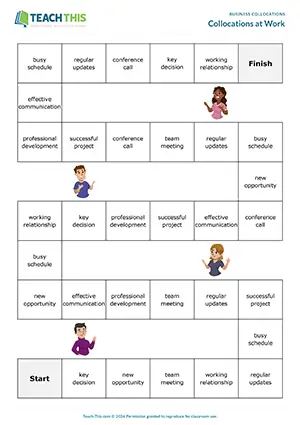
Business English Collocations Worksheet and Board Game - Vocabulary Exercises: Matching, Gap-fill - Speaking: Asking and Answering Questions, Freer practice
In this business collocations worksheet and board game, students learn and practice collocations commonly used at work. Students begin by matching...
Business English Collocations Worksheet and Board Game - Vocabulary Exercises: Matching, Gap-fill - Speaking: Asking and Answering Questions, Freer practice In this business collocations worksheet and board game, students learn and practice collocations commonly used at work. Students begin by matching each adjective to a noun to form collocations related to work. Students then use the work-related collocations to complete sentences. Next, students underline the correct collocation to complete each sentence. After that, students play a board game to practice the work-related collocations. In groups, players take turns rolling the dice and moving their counter along the board. When a player lands on a collocation, they pick up a card and follow the instructions in the prompt using the collocation in their response. The prompts cover making a question using the collocation, forming a sentence with the collocation, or sharing a personal experience related to the collocation. The other students listen and judge the player's response. If the player gives a suitable response, they stay on the square. If not, the player goes back two squares. The first student to reach the finish wins the game. show lessCollocations for Meetings
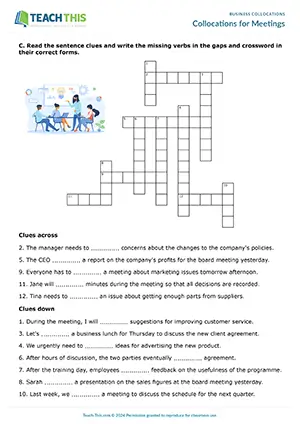
Business English Collocations Worksheet - Vocabulary Exercises: Matching, Error Correction, Crossword
Here is a useful business collocations worksheet to help students learn and practice verb-noun collocations for business meetings and discussions. Students begin by matching verbs to nouns to create...
Business English Collocations Worksheet - Vocabulary Exercises: Matching, Error Correction, Crossword Here is a useful business collocations worksheet to help students learn and practice verb-noun collocations for business meetings and discussions. Students begin by matching verbs to nouns to create collocations for meetings and discussions. Students then underline a verb-noun collocation mistake in each sentence and write the correct verb next to the sentence in its correct form. Finally, students complete a crossword by reading sentence clues and writing the missing verbs in the sentences and crossword in their correct forms. show lessFind Someone Who...
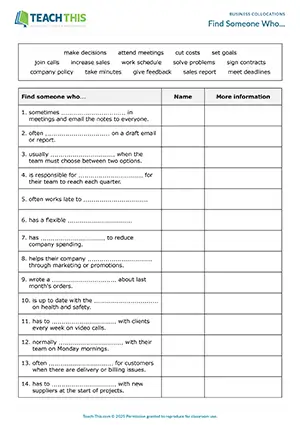
Business English Collocations Activity - Vocabulary and Speaking: Gap-fill, Asking and Answering Questions, Controlled and Freer practice
In this business collocations speaking activity, students ask and answer questions that use common business collocations. First, students complete 'Find someone who...
Business English Collocations Activity - Vocabulary and Speaking: Gap-fill, Asking and Answering Questions, Controlled and Freer practice In this business collocations speaking activity, students ask and answer questions that use common business collocations. First, students complete 'Find someone who...' prompts with business collocations in their correct forms. Next, students review the yes/no questions they need to ask in the activity, e.g. 'Do you sometimes take minutes in meetings and email the notes to everyone?' Students then go around the class, asking their classmates the questions. When a student finds someone who answers 'yes' to a question, they write down the person's name and ask a follow-up question to gain more information, noting down the answer in the last column. If a classmate replies 'no', the student repeats the question with another person or asks a different question. This process continues until the students have completed each item on the worksheet with a different name and answer, one classmate per item. Afterwards, students give feedback to the class on what they found out.. show lessBalanced Budgets Board Game
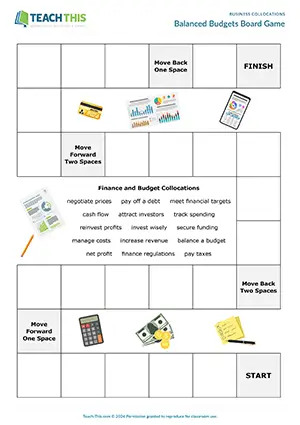
Business English Collocations Worksheet and Activity - Vocabulary Exercises: Matching, Binary Choice - Vocabulary Game: Gap-fill, Controlled practice - Group Work
Here is a business collocations board game and worksheet to help students learn and practice collocations related to finance and budgets. To begin, students...
Business English Collocations Worksheet and Activity - Vocabulary Exercises: Matching, Binary Choice - Vocabulary Game: Gap-fill, Controlled practice - Group Work Here is a business collocations board game and worksheet to help students learn and practice collocations related to finance and budgets. To begin, students match finance and budget collocations with their definitions. Students then complete sentences by underlining the correct collocation. Next, in groups, students play a board game to practice the finance and budget collocations. Students take turns picking up a card and reading the sentence to the student on their right using the word 'blank' for the missing collocation, e.g. 'Businesses have to BLANK on their profits to the government.' The other student listens to the sentence, chooses a suitable collocation from the game board, and says it aloud in its correct form to complete the sentence, e.g. pay taxes. If the student says the correct collocation shown on the card, they roll the dice and move their counter along the board. If the student gives a wrong answer, they don't roll the dice. The first student to reach the finish wins the game. show lessBusiness Collocations Challenge
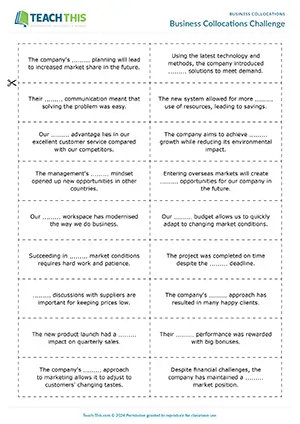
Business English Collocations Worksheet and Game - Vocabulary Exercises: Identifying, Gap-fill - Vocabulary Game: Gap-fill, Matching - Group Work
In this productive business collocations worksheet and game, students learn and practice adjective-noun collocations used in business and then play a game...
Business English Collocations Worksheet and Game - Vocabulary Exercises: Identifying, Gap-fill - Vocabulary Game: Gap-fill, Matching - Group Work In this productive business collocations worksheet and game, students learn and practice adjective-noun collocations used in business and then play a game matching adjectives to nouns in sentences. First, students cross out the incorrect adjective-noun collocation for each adjective. Students then use the adjectives to complete collocations in sentences. After that, students play a matching game to practice the adjective-noun collocations. In groups, students take turns picking up a sentence card and reading it to the group using the word 'blank' for the missing adjective. The other students listen and try to find the adjective card on the table that matches the noun in the sentence. The first student to place their hand on the correct adjective card and say it, wins the pair of cards. If a student chooses the wrong adjective, they are out of the round. The student with the most pairs of cards at the end of the game wins. As an extension, students play a pelmanism game using the two sets of cards. show lessHere's what our members are saying...
- Business Phrasal Verbs
-
Phrasal Verbs: Business English worksheets, Activities & Games
Business Phrasal Verbs Bingo
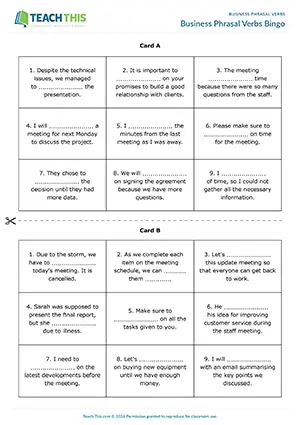
Business English Phrasal Verbs Game - Vocabulary: Matching, Gap-fill - Group Work
In this fun business phrasal verbs game, students play bingo by completing sentences with phrasal verbs for meetings and deadlines. In groups, the bingo caller picks up a phrasal verb card and reads it aloud to the players. Players then try to...
Business English Phrasal Verbs Game - Vocabulary: Matching, Gap-fill - Group Work In this fun business phrasal verbs game, students play bingo by completing sentences with phrasal verbs for meetings and deadlines. In groups, the bingo caller picks up a phrasal verb card and reads it aloud to the players. Players then try to complete one of the sentences on their bingo card with the phrasal verb in its correct form, writing it in the space provided using a pencil. The caller then picks up the next phrasal verb card, and so on. The first player to get three squares in a row shouts, 'Bingo!' The caller then checks the player's answers using the answer key. If the answers are correct, the player wins the first round. Players then take part in a second round to see who can be the first to complete all nine squares. When both rounds have been played, players erase their answers from the bingo cards. Groups play several games, with students taking turns to be the bingo caller and the players using a different bingo card each time.Business Phrasal Verb Jeopardy
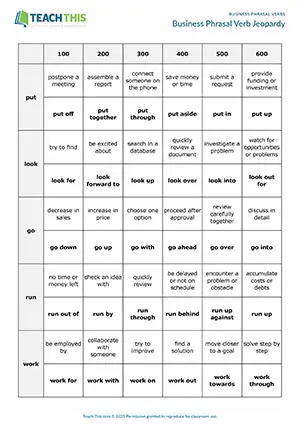
Business English Phrasal Verbs Game - Vocabulary: Quiz, Guessing - Group Work
In this entertaining business phrasal verbs quiz game, students guess phrasal verbs based on their definitions. Choose a square to start the game, e.g. 'put' for 100 points. Read the definition of the phrasal verb, e.g. 'postpone a meeting.' The...
Business English Phrasal Verbs Game - Vocabulary: Quiz, Guessing - Group Work In this entertaining business phrasal verbs quiz game, students guess phrasal verbs based on their definitions. Choose a square to start the game, e.g. 'put' for 100 points. Read the definition of the phrasal verb, e.g. 'postpone a meeting.' The first student to raise their hand and give the correct business phrasal verb (e.g. put off) wins that square for their team and the number of points shown in the square. Write the winning team's name in the square. If a student gives an incorrect answer, their team is out for that question and may only answer again if all other teams answer incorrectly. The winning team then chooses the next square, and all the teams raise their hands to answer, as before. At the end of the game, add up the points for each team. The team with the most points wins the game. As a variation, when a student answers correctly, the winning team tries to make a sentence with the business phrasal verb. If they do this successfully, the points for the square are doubled.Work as, in, on, for, at, with

Business English Phrasal Verbs with Work Worksheet - Vocabulary Exercises: Gap-fill, Error Correction, Rewriting sentences - Speaking Activity - Pair Work
In this productive business phrasal verbs worksheet, students practice talking about jobs and work using the phrasal verbs: work as, work in, work on, work for...
Business English Phrasal Verbs with Work Worksheet - Vocabulary Exercises: Gap-fill, Error Correction, Rewriting sentences - Speaking Activity - Pair Work In this productive business phrasal verbs worksheet, students practice talking about jobs and work using the phrasal verbs: work as, work in, work on, work for, work at, and work with. First, students match phrasal verbs with work to their definitions. Students then complete sentences with the six phrasal verbs in their correct form. Next, students correct phrasal verb mistakes in sentences. After that, students rewrite sentences, adding in one of the six phrasal verbs related to work. Lastly, students complete questions about work with the six phrasal verbs and then ask and answer the questions with a partner.Match Them Up
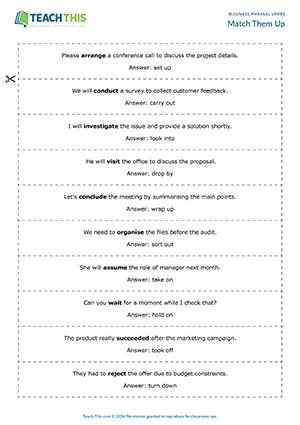
Business English Phrasal Verbs Game - Vocabulary: Matching, Rephrasing Sentences - Pair Work
In this engaging business phrasal verbs game, students practice phrasal verbs commonly used in business by matching them to verbs in sentences that have the same meaning. In pairs, students take turns...
Business English Phrasal Verbs Game - Vocabulary: Matching, Rephrasing Sentences - Pair Work In this engaging business phrasal verbs game, students practice phrasal verbs commonly used in business by matching them to verbs in sentences that have the same meaning. In pairs, students take turns picking up a sentence card from the pile and reading it to their partner, emphasising the verb in bold. The other student listens and then has one chance to find the phrasal verb on the table that matches the verb in the sentence. If the student finds the correct phrasal verb, they rephrase the sentence using the phrasal verb and keep the two cards. If a student chooses the wrong phrasal verb or cannot rephrase the sentence correctly, the sentence card is placed back at the bottom of the pile. The student with the most pairs of cards at the end of the game wins.Phrasal Verbs for Meetings
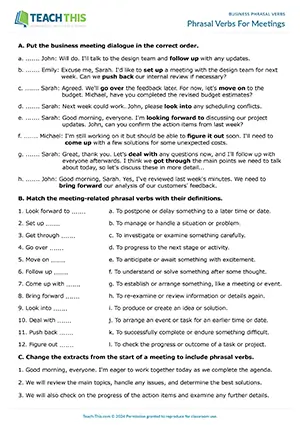
Business English Phrasal Verbs Worksheet- Reading and Vocabulary Exercises: Matching, Rewriting Sentences, Gap-fill - Speaking Activity: Roleplay - Group Work
In this phrasal verbs for meetings worksheet, students learn and practice phrasal verbs commonly used in business meetings. First, students put a business...
Business English Phrasal Verbs Worksheet- Reading and Vocabulary Exercises: Matching, Rewriting Sentences, Gap-fill - Speaking Activity: Roleplay - Group Work In this phrasal verbs for meetings worksheet, students learn and practice phrasal verbs commonly used in business meetings. First, students put a business meeting dialogue in the correct order. Students then match the phrasal verbs from the meeting dialogue with their definitions. Next, students change extracts from the start of a meeting to include phrasal verbs. After that, students complete sentences with meeting-related phrasal verbs from a box, changing the tenses as needed. Finally, in groups of four, students read a meeting scenario and then prepare and role-play a short meeting using the phrasal verbs from the worksheet.Problem-Solving Phrasal Verbs

Business English Phrasal Verbs Worksheet and Game - Vocabulary Exercises: Matching, Binary Choice - Vocabulary Game: Matching, Gap-fill - Group Work
In this useful business English phrasal verbs worksheet and game, students learn and practice problem-solving phrasal verbs and then race to complete...
Business English Phrasal Verbs Worksheet and Game - Vocabulary Exercises: Matching, Binary Choice - Vocabulary Game: Matching, Gap-fill - Group Work In this useful business English phrasal verbs worksheet and game, students learn and practice problem-solving phrasal verbs and then race to complete sentences using them. Students begin by matching problem-solving phrasal verbs to their definitions. Next, students choose the correct phrasal verb in each sentence. After that, students play a card game to practice the phrasal verbs. In groups of three, students take turns picking up a sentence card and reading it to the other two students using the word 'blank' where the problem-solving phrasal verb should go. The other two students listen to the sentence and then race to grab the correct phrasal verb card to complete the sentence. The first student to grab the correct card and say the phrasal verb wins and keeps the two cards. If neither student gives the right answer, the sentence card is placed at the bottom of the pile and the phrasal verb cards are put back in place. The student with the most cards at the end of the game wins.Sales Phrasal Verbs
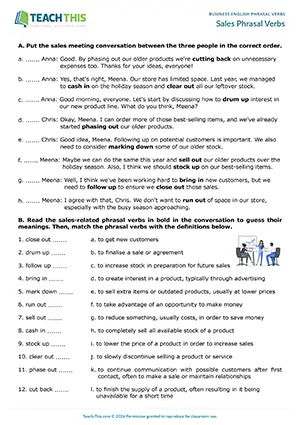
Business English Phrasal Verbs Worksheet - Reading and Vocabulary Exercises: Ordering, Matching - Speaking Activity: Answering Questions, Freer practice
In this free sales-related phrasal verbs worksheet, students learn and practice 12 phrasal verbs commonly used in sales. Students start by putting...
Business English Phrasal Verbs Worksheet - Reading and Vocabulary Exercises: Ordering, Matching - Speaking Activity: Asking and Answering Questions, Freer practice In this free sales-related phrasal verbs worksheet, students learn and practice 12 phrasal verbs commonly used in sales. Students start by putting a sales meeting conversation in the correct order. Students then read sales-related phrasal verbs in bold from the conversation to guess their meanings and then match each one with a definition. Next, students complete sentences with the sales phrasal verbs, changing the tense as needed. Lastly, in pairs, students ask and answer questions that contain the sales-related phrasal verbs.Talking Business
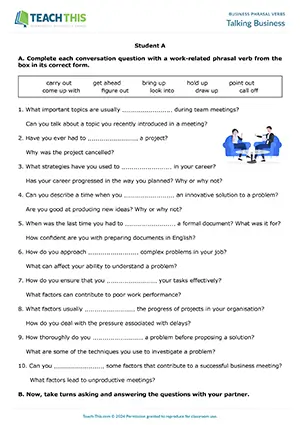
Business English Phrasal Verbs Activity - Vocabulary and Speaking: Gap-fill, Asking and Answering Questions, Controlled and Freer practice - Group and Pair Work
In this business phrasal verbs speaking activity, students complete, ask and answer conversation questions with work-related phrasal verbs. First, in two...
Business English Phrasal Verbs Activity - Vocabulary and Speaking: Gap-fill, Asking and Answering Questions, Controlled and Freer practice - Group and Pair Work In this business phrasal verbs speaking activity, students complete, ask and answer conversation questions with work-related phrasal verbs. First, in two groups, students complete conversation questions with business phrasal verbs from a box in their correct forms. Next, students pair up with someone from the other group and take turns asking the conversation questions to their partner, who responds accordingly. For the first question in each set, students include the corresponding phrasal verb in their response. Afterwards, students share what they found out about their partner with the class.Here's what our members are saying...
- Closing a Presentation
-
Closing a Presentation: Business English worksheets & Activities
Closing a Business Presentation
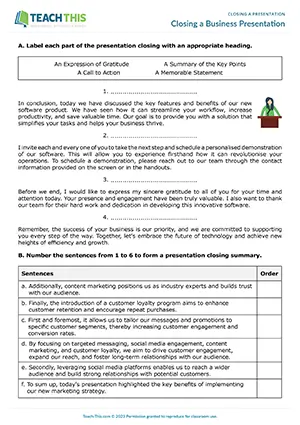
Business English Closing a Presentation Worksheet - Reading, Vocabulary and writing Exercises: Ordering, Gap-fill, writing Sentences - Speaking Activity: Presenting
In this comprehensive closing a presentation worksheet, students practice useful language, techniques, and steps for closing a business presentation. First, students...
Business English Closing a Presentation Worksheet - Reading, Vocabulary and writing Exercises: Labelling, Ordering, Gap-fill, writing Sentences - Speaking Activity: Presenting In this comprehensive closing a presentation worksheet, students practice useful language, techniques, and steps for closing a business presentation. First, students label each part of a business presentation closing with an appropriate heading. Students then arrange sentences in the correct order to form a presentation closing summary. Next, students complete calls to action with phrases from a box. After that, students unscramble sentences to form expressions of gratitude to an audience. Students then move on to complete memorable statements with words from a box. Next, students use the steps and language from the worksheet to create their own business presentation closing. Finally, in pairs, students take turns to deliver their presentation closing to their partner, who listens and provides feedback.Closing Call
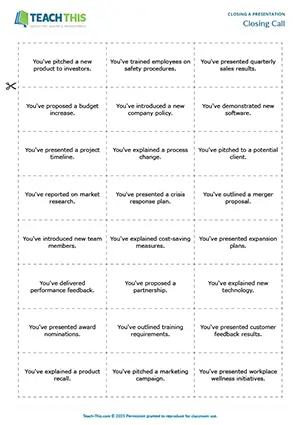
Business English Closing a Presentation Game - Speaking: Preparing and Delivering Part of a Presentation, Freer practice - Group Work
This challenging closing a presentation game helps students practice professional closing techniques for business presentations across various business situations. In...
Business English Closing a Presentation Game - Speaking: Preparing and Delivering Part of a Presentation, Freer practice - Group Work This challenging closing a presentation game helps students practice professional closing techniques for business presentations across various business situations. In groups of four, students take turns drawing a situation card describing a business context and rolling a dice to determine their specific closing challenge, e.g. drawing 'You've pitched a new product to investors' and rolling a 3, which requires creating a closing that expresses gratitude to the audience. The presenter has 30 seconds to prepare their closing, incorporating the required challenge element and must commence delivery within 10 seconds of preparation time. After delivering their closing, the other players vote thumbs up or thumbs down based on whether the closing included the challenge element, was appropriate for the situation, and sounded professional. Players score 2 points for a majority thumbs up, 1 point for a majority thumbs down, or 0 points if there are no thumbs up. The game continues with players taking turns until someone reaches 8 points and wins.Presentation Closers

Business English Ending a Presentation Activity - Listening: Matching - writing Exercises: writing Sentences, Guided writing - Speaking: Delivering a Presentation
Here is a useful presentation closers activity and worksheet to help students practice different ways to end a presentation. First, students do a group...
Business English Ending a Presentation Activity - Listening: Matching - writing Exercises: writing Sentences, Guided writing - Speaking: Delivering a Presentation Here is a useful presentation closers activity and worksheet to help students practice different ways to end a presentation. First, students do a group matching activity to help them become familiar with different types of presentation closers. Students take turns reading out presentation closers on cards. Together, students decide which description matches each presentation closer. Next, students take turns reading out phrases in bold on their cards and writing them under the corresponding closer description. Working alone, students then read a presentation conclusion and prepare three suitable presentation closers. After that, students prepare their own conclusion to a presentation using linking phrases and one of the closers from the worksheet. Lastly, in groups of four, students deliver their presentation endings to their group, who try to identify the type of closer used.Tailoring the Close
Business English Closing a Presentation Activity - Speaking: Preparing and Delivering Part of a Presentation, Peer Feedback, Freer practice - Pair Work
In this useful presentation-closing activity, students practice planning, writing, and delivering concise three-line closings tailored to a scenario and a single...
Business English Closing a Presentation Activity - Speaking: Preparing and Delivering Part of a Presentation, Peer Feedback, Freer practice - Pair Work In this useful presentation-closing activity, students practice planning, writing, and delivering concise three-line closings tailored to a scenario and a single decision-maker with a clear call to action. First, students review a model presentation closing. Students then create the closing part of a business presentation by choosing one scenario and one audience type. Next, students review a three-part presentation-closing structure and sentence starters. Students then use the structure and sentence starters to write a three-line presentation closing for their chosen scenario and audience. After that, in pairs, students deliver their three-part closing to their partner, who uses a checklist to provide constructive feedback, focusing on audience fit, CTA specificity, and tone. When the pairs have finished, invite students to present to the class or rotate partners and repeat the process.Here's what our members are saying...
- Resumes, CVs and Email Cover Letters
-
Resumes, CVs & Email Cover Letters: Business English worksheets & Activities
Resume Basics

Business English Resumes Worksheet - Reading and writing Exercises: Identifying, True or False, writing Sentences, writing a Basic Resume
Here is a handy resume worksheet to help students learn basic resume conventions and practice writing a simple resume. Students begin by reading a job...
Business English Resumes Worksheet - Reading and writing Exercises: Identifying, True or False, writing Sentences from Prompts, writing a Basic Resume Here is a handy resume worksheet to help students learn basic resume conventions and practice writing a simple resume. Students begin by reading a job advertisement and resume. Students then identify and underline three details in the resume that are not relevant to the advertisement. Next, students decide whether six statements about resumes are true or false, correcting the false statements. After that, students read a job advertisement and write a resume for the job using their own ideas. Lastly, in small groups, students read each others' resumes and discuss whether they think each applicant would get the job or not.CV Basics

Business English CV Worksheet - Reading, Vocabulary and writing Exercises: Matching, Comprehension Questions, Gap-fill, writing a CV
This comprehensive CV worksheet helps students learn and practice language and vocabulary commonly used in a CV as well as how CVs are written and...
Business English CV Worksheet - Reading, Vocabulary and writing Exercises: Matching, Comprehension Questions, Gap-fill, writing a CV This comprehensive CV worksheet helps students learn and practice language and vocabulary commonly used in a CV as well as how CVs are written and structured. First, students complete a CV with an appropriate heading for each section. Next, students read a personal profile and answer reading comprehension questions about it. Students then complete CV-related sentences with vocabulary from a box. Lastly, students write their own CV by following prompts and using the language from the worksheet and example CV as a guide.Cover Letter Clinic
Business English Email Cover Letters Activity - Reading, Grammar and Vocabulary: Error Correction
In this free email cover letter activity, students identify and correct common grammar and spelling mistakes in a cover letter email. This activity provides practice in accuracy and a model for an email cover letter...
Business English Email Cover Letters Activity - Reading, Grammar and Vocabulary: Error Correction In this free email cover letter activity, students identify and correct common grammar and spelling mistakes in a cover letter email. This activity provides practice in accuracy and a model for an email cover letter. Working alone, students find and correct six grammar or spelling mistakes in each paragraph of the cover letter email. Afterwards, elicit the answers from the class. Students score one point for each identified and corrected mistake. The student with the most points wins.Email Cover Letters

Business English Email Cover Letters Worksheet - Reading, Vocabulary and writing Exercises: Gap-fill, Matching, Sentence Completion - Speaking Activity
In this useful email cover letter worksheet, students learn and practice the key elements of writing an email cover letter. First, students read an email cover letter...
Business English Email Cover Letters Worksheet - Reading, Vocabulary and writing Exercises: Gap-fill, Matching, Binary Choice, Sentence Completion - Speaking Activity In this useful email cover letter worksheet, students learn and practice the key elements of writing an email cover letter. First, students read an email cover letter and complete collocations in bold with the words provided. Students then match sentence halves to create definitions for key email cover letter terms. Next, students complete example sentences from an email cover letter by underlining the correct words. After that, in pairs, students discuss six cover letter-related questions as a lead into the next exercise. Lastly, students think of a job they would like to apply for and create a first draft of an email cover letter by following prompts and using the example email cover letter and language used in the worksheet as a guide.Internal Promotion Email Cover Letters
Business English Email Cover Letters Worksheet - Reading, Vocabulary and writing Exercises: Matching, Gap-fill, writing an Email
In this email cover letters worksheet, students learn phrases for writing internal promotion email cover letters and then practice them by writing the body of an email...
Business English Email Cover Letters Worksheet - Reading, Vocabulary and writing Exercises: Matching, Gap-fill, writing an Email In this email cover letters worksheet, students learn phrases for writing internal promotion email cover letters and then practice them by writing the body of an email cover letter. First, students discuss two questions about email cover letters in pairs. Students then read a model internal promotion email cover letter and match functions to each part of the email. Next, students complete another email cover letter with other useful phrases. Lastly, students write the body of an internal promotion email cover letter using the information provided and phrases from the worksheet.Tackling Tenses

Business English Email Cover Letters Activity - Grammar and Vocabulary: Gap-fill, Matching
Here is an insightful email cover letter activity to help students review tenses and standard phrases in an email cover letter. First, students read the phrase on their card, decide where to put it in the email cover letter,...
Business English Email Cover Letters Activity - Grammar and Vocabulary: Gap-fill, Matching Here is an insightful email cover letter activity to help students review tenses and standard phrases in an email cover letter. First, students read the phrase on their card, decide where to put it in the email cover letter, and write it in the space provided. After that, take back the cards from the students. Students then stand up and go around the class telling each other the phrase they have written in their cover letter without showing their worksheets to each other. The other students decide where they think each phrase they hear should go in their letter and write it down in the space. This continues until all the students have completed the letter. Afterwards, check the correct answers as a class and review the tenses and standard phrases.Here's what our members are saying...
- Presentation Skills and Language
-
Presentation Skills & Language: Business English Games, worksheets & Activities
Presentations Pelmanism
Business English Presentation Language Game - Vocabulary: Matching, Pelmanism - Group Work
In this free business presentations language game, students match presentation expressions to parts of a presentation. In pairs, students take turns turning over one presentation card and one...
Business English Presentation Language Game - Vocabulary: Matching, Pelmanism - Group Work In this free business presentations language game, students match presentation expressions to parts of a presentation. In pairs, students take turns turning over one presentation card and one expression card. If the presentation part matches the expression (e.g. 'Opening a Presentation' and 'Thank you for coming.'), the student reads the two cards aloud, keeps them and has another turn. If the two cards don't match, the student turns them back over, keeping them in the same place. There are 20 presentation expressions in total - two expressions for each part of a presentation. The student with the most pairs of cards at the end of the game wins. Afterwards, check the correct answers with the class and elicit other possible expressions for each part of a presentation.Presentation Scramble

Business English Presentations Game - Vocabulary and Reading: Unscrambling, Gap-fill - Speaking Activity: Delivering a Presentation, Freer practice - Pair Work
In this fun presentation language game, students race to put words in the correct order to make presentation and signposting phrases and then use them...
Business English Presentations Game - Vocabulary and Reading: Unscrambling, Gap-fill - Speaking Activity: Preparing and Delivering a Presentation, Freer practice - Pair Work In this fun presentation language game, students race to put words in the correct order to make presentation and signposting phrases and then use them in presentations. First, in teams of two, students race to put words in the first presentation or signposting phrase in the correct order, adding in any necessary punctuation. The first team to put up their hands and read the phrase in the right order scores one point. This continues until all the phrases have been completed. Next, teams race to complete a presentation text with the presentation and signposting phrases. The first team to complete the text correctly scores an additional three points. The team with the highest score at the end of the game wins. Finally, pairs practice the language by preparing and delivering a short presentation on a topic of their choice.Sales Pitch Pro
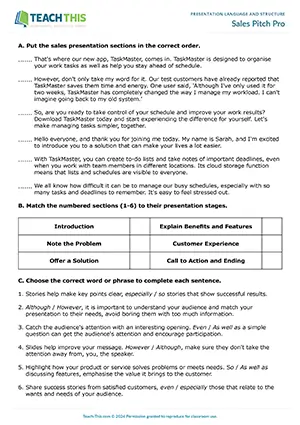
Business English Presentation Worksheet - Reading Exercises: Ordering, Matching - Vocabulary Game: Forming Sentences - Speaking Activity: Presenting - Pair Work
This engaging presentation language worksheet, game and activity helps students learn and practice a wide range of language for each stage of a sales...
Business English Presentation Worksheet - Reading Exercises: Ordering, Matching - Vocabulary Game: Forming Sentences - Speaking Activity: Presenting - Pair Work This engaging presentation language worksheet, game and activity helps students learn and practice a wide range of language for each stage of a sales presentation. Students begin by putting parts of a sales presentation in the correct order. Students then match the parts to the stages of a sales presentation. Next, students choose the correct connector to complete each sentence. After that, students play a game in pairs to practice sales presentation language, where they take turns picking up a language card and matching it to the correct stage of a presentation, completing the expression with their own idea. If students do this successfully, they score a point. The student with the most points at the end of the game wins. Students then move on to prepare a sales presentation for a new product or service using the language and expressions from the game and worksheet. Finally, students deliver their presentations in small groups.Plan and Present
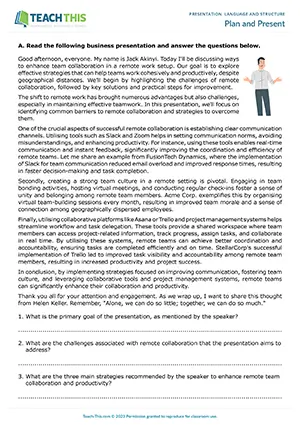
Business English Presentation Activity - Reading and writing: Comprehension Questions, Outlining - Speaking Activity: Presenting, Fluency practice - Pair Work
In this business presentation structure activity, students complete a reverse outline of a business presentation, and then plan and present their own business...
Business English Presentation Activity - Reading and writing: Comprehension Questions, Outlining - Speaking Activity: Presenting, Fluency practice - Pair Work In this business presentation structure activity, students complete a reverse outline of a business presentation, and then plan and present their own business presentation. First, students read a business presentation and answer comprehension questions about it. Next, students complete an outline of the business presentation in note form. In pairs, students then discuss six business presentation topics and each choose one to plan and present. After that, students write an outline for their business presentation. Finally, students deliver their presentations one-on-one to three different students in a 4-3-2 fluency practice activity.Presentation Vocabulary Challenge
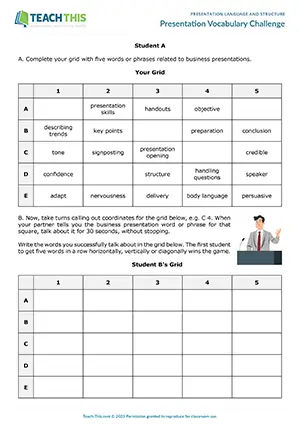
Business English Presentation Language Game - Vocabulary and Speaking: Impromptu Speech - Pair Work
In this enjoyable business presentation vocabulary game, students talk about words or phrases related to business presentations for 30 seconds. First, students add five business presentation words...
Business English Presentation Language Game - Vocabulary and Speaking: Impromptu Speech - Pair Work In this enjoyable business presentation vocabulary game, students talk about words or phrases related to business presentations for 30 seconds. First, students add five business presentation words to their grid on the worksheet. Students then take turns calling out coordinates for the second grid. The other student tells them the corresponding business presentation word or phrase for that square. The student then talks about the word or phrase for 30 seconds, without stopping. Students can talk about things like the meaning of the presentation word, its importance, how it refers to presentations, etc. If the student successfully talks about the word or phrase for 30 seconds, they write the word in the second grid, and the other student crosses the word off their grid. If the student is unsuccessful, they can choose the same word or phrase again or pick another grid reference on their next turn. The first student to get five words in a row wins the game.Signposting a Presentation
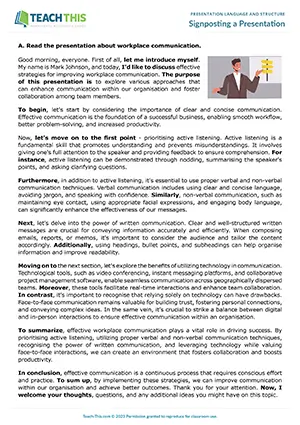
Business English Presentations Worksheet - Reading, Vocabulary and writing Exercises: Categorising, writing a Presentation - Speaking Activity: Delivering a Presentation
This useful signposting language worksheet helps students practice different types of signposting language for a business presentation. First, students...
Business English Presentations Worksheet - Reading, Vocabulary and writing Exercises: Categorising, writing a Presentation - Speaking Activity: Delivering a Presentation This useful signposting language worksheet helps students practice different types of signposting language for a business presentation. First, students read a business presentation about workplace communication that shows signposting language in bold. Students then match eight types of signposting language to descriptions of their functions. Next, students write the signposting language in bold from the presentation in a table next to its corresponding type. After that, students work with a partner and brainstorm ideas for a presentation that can incorporate the signposting language. Students then move on to write a short presentation that uses the language. Finally, students present or read their presentations in small groups or to the class.The Four-Part Pitch

Business Presentations Worksheet - Reading and writing Exercises: Identifying, Matching, Gap-fill - Speaking Activity: Delivering a Presentation, Freer practice - Pair Work
In this productive elevator pitch worksheet, students learn about effective elevator pitches, explore essential phrases for each section, and create and...
Business English Presentations Worksheet - Reading, Vocabulary, and writing Exercises: Identifying, Matching, Gap-fill, writing Sentences - Speaking Activity: Preparing and Delivering a Presentation, Freer practice - Pair Work In this productive elevator pitch worksheet, students learn about effective elevator pitches, explore essential phrases for each section, and create and deliver their own elevator pitch. First, students read an explanation of elevator pitches and their four-part structure. Students then use the essential language for each section and identify the four parts of an elevator pitch. Next, students match phrases to their appropriate elevator pitch sections. After that, students complete an elevator pitch using phrases from a box. Students then move on to choose one of the professional scenarios or use their own situation to create an original elevator pitch using the four-part structure prompts. Finally, students take turns presenting their 30-60 second elevator pitches to a partner, who uses a checklist to provide them with feedback on the content and language used in their pitch.Here's what our members are saying...
- Starting a Presentation
-
Starting a Presentation: Business English worksheets, Activities & Games
Ace the Opening!

Business English Starting Presentations Worksheet - Reading, Vocabulary and writing Exercises: Ordering, Matching, Gap-fill - Speaking Activity: Presenting
This free starting presentations worksheet and role-play help students learn and practice steps used to start a business presentation together with related...
Business English Starting Presentations Worksheet - Reading, Vocabulary and writing Exercises: Ordering, Matching, Gap-fill - Speaking Activity: Delivering Part of a Presentation This free starting presentations worksheet and role-play help students learn and practice steps used to start a business presentation together with related language. First, students read the start of a business presentation and put a tick next to the steps the speaker covers. Students then order the steps the speaker goes through. Next, students match other phrases to the steps. After that, students complete the start of another presentation with words from a box. Students then move on to underline phrases in the presentation opening that cover the steps in Exercise A. Afterwards, students role-play the start of a presentation of their choice using ordered steps shown on role cards. Working alone, students prepare their presentations using the steps and corresponding language from the worksheet. Finally, students deliver their presentation openings to the class or group.Multiple Starts

Business English Presentation Openings Game - Reading, Listening and Vocabulary Game: Gap-fill, Listening for Detail
This fun presentation openings game helps students practice phrases and vocabulary used at the start of a business presentation. Read the presentation opening from the answer sheet sentence-by...
Business English Presentation Openings Game - Reading, Listening and Vocabulary Game: Gap-fill, Listening for Detail This fun presentation openings game helps students practice phrases and vocabulary used at the start of a business presentation. Read the presentation opening from the answer sheet sentence-by-sentence to the class. However, instead of saying each word in brackets, say the part of speech indicated by the abbreviation next to it, e.g. 'Good morning (pronoun) and thank you all for being (adverb).' As the teams listen, they mark each gap with the part of speech they hear. When you have completed the opening, teams have three minutes to complete the gaps with appropriate business opening words. When the time limit has been reached, go through the answers by eliciting the words in each sentence. Teams score one point for each correct word. Afterwards, repeat the process for Presentation Openings 2 and 3. The team with the most points at the end of the game wins. Finally, review the presentation openings and elicit other words that could be used for each gap if applicable.Openings for Update Presentations

Business English Presentation Opening Activities - Reading, writing and Speaking: Ordering, Matching, writing and Giving a Presentation Opening - Group Work
In this engaging presentation openings activity, students learn and practice four types of openings that can be used for update presentations. First...
Business English Presentation Opening Activities - Reading, writing and Speaking: Ordering, Matching, writing and Giving a Presentation Opening - Group Work In this engaging presentation openings activity, students learn and practice four types of openings that can be used for update presentations. First, in groups, students order four presentation openings. The student with strip number 1 starts by reading the presentation opening aloud to the group and placing the strip face-up on the table. All the students then look at their strips and decide whether one of them follows the start of the presentation. If a student has a suitable strip, they read it aloud and place it below the first strip. This continues until a strip cannot be put down. When that happens, the student with strip number 2 reads out their presentation opening, and so on. When all four presentation openings have been laid on the table, check the correct answers with the class. After that, each student matches a presentation opening type on a card with one of the presentations from the strips. Students then write an opening for an update presentation using the type shown on their card and the information provided. Finally, in their groups, students present their openings to each other and explain what type of opening it is.Interesting Openings
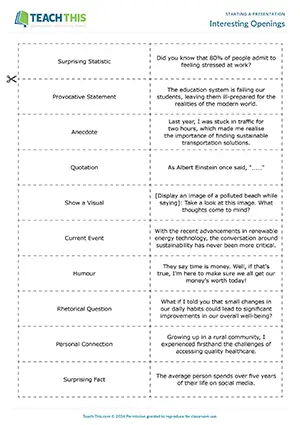
Business English Presentation Openings Resource - Vocabulary Game - Matching - Reading and writing Exercises - Speaking Activity - Role-Play
Here is a useful presentation openers game, worksheet and activity to help students learn and practice using openers for starting presentations. First...
Business English Presentation Openings Resource - Vocabulary Game - Matching - Reading and writing Exercises - Speaking Activity - Role-Play Here is a useful presentation openers game, worksheet and activity to help students learn and practice using openers for starting presentations. First, students play a pelmanism game to practice matching types of presentation openers to language examples. In pairs, students take turns turning over one opener card and one example card. If the cards form a matching pair of an opener and related language example, the student keeps the two cards and has another turn. If not, the student turns the cards back over. The student with the most pairs of cards at the end of the game wins. Next, students choose four types of opener from the game and write their own example sentence for each one. After that, students read a presentation opening and identify the type of opener and the language used. Working alone, students then prepare the opening of a presentation using sequence words and an opener of their choice. Finally, in small groups, students present their openings to their audience, who try to guess the type of opener and the language used.Let's Get Started!
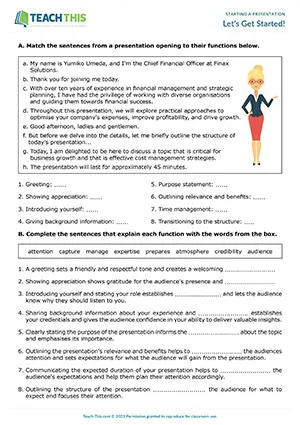
Business English Presentation Openings Worksheet - Vocabulary and writing Exercises: Matching, Gap-fill, writing Sentences - Speaking Activity: Presenting
Here is a comprehensive business presentation openings worksheet to help students learn and practice a structure for opening a presentation...
Business English Presentation Openings Worksheet - Vocabulary and writing Exercises: Matching, Gap-fill, writing Sentences - Speaking Activity: Delivering a Presentation Here is a comprehensive business presentation openings worksheet to help students learn and practice a structure for opening a business presentation. Students begin by matching sentences from a presentation opening to their functions. Students then complete sentences that explain each function with words from a box. Next, students complete an example presentation where someone is explaining their presentation's structure by underlining the correct words. After that, students prepare an opening for a business presentation of their choice using the structure from the worksheet. Finally, in pairs, students practice delivering their presentation openings, focusing on the key aspects of verbal delivery shown.Here's what our members are saying...
- Describing Graphs and Charts
-
Describing Graphs & Charts: Business English Activities, Games & worksheets
Charting Success
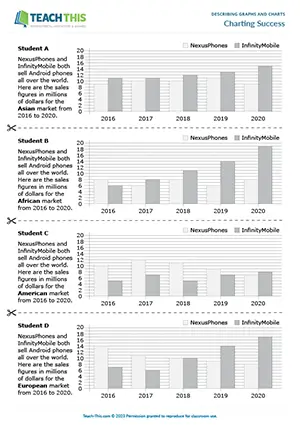
Business English Describing Charts and Trends Activity - writing, Listening and Speaking: Table Completion, Summarising, Freer practice - Group Work
In this productive describing charts and trends activity, students describe sales figures and trends in bar charts. First, in groups, each student completes a table on...
Business English Describing Charts and Trends Activity - writing, Listening and Speaking: Describing, Table Completion, writing Sentences, Summarising, Freer practice - Group Work In this productive describing charts and trends activity, students describe sales figures and trends in bar charts. First, in groups, each student completes a table on their worksheet with sales figures of two Android phone manufacturers shown in a bar chart. Each student then describes their bar chart showing the sales figures for each company over five years to the other students, who complete their tables with the numbers. e.g. 'Here are the sales figures for NexusPhones in Asia. In 2016, sales were nine million dollars. In 2017, sales rose slightly to ten million, etc...' When the students have finished, they write sentences describing the trends in sales for each company in the different regions and then the overall global trend, e.g. 'Sales in Asia have remained stable with slight increases and decreases over the five years.' Finally, students share their sentences with the group to check they all have similar trends for each region.Trend Tracker
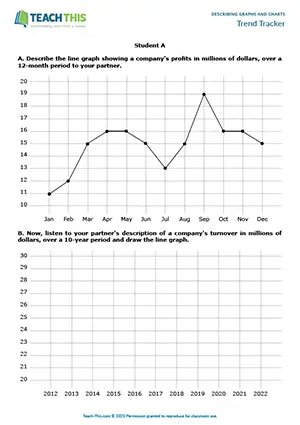
Business English Describing Graphs Activity - Speaking: Describing, Drawing, Controlled and Freer practice - Pair Work
In this free describing graphs and trends speaking activity, students describe and draw trends in a line graph. In pairs, Student A begins by describing a line graph showing a company's profits in millions...
Business English Describing Graphs Activity - Speaking: Describing, Drawing, Controlled and Freer practice - Pair Work In this free describing graphs and trends speaking activity, students describe and draw trends in a line graph. In pairs, Student A begins by describing a line graph showing a company's profits in millions of dollars, over a 12-month period to their partner, who listens and draws the graph on their worksheet, e.g. 'In January, the company's profits were 11 million dollars. In February, there was a steady rise in profits from 11 million to 12 million dollars. In March, profits increased dramatically from 12 million to 15 million, etc...' When the students have finished, Student B describes a line graph showing a company's turnover in millions of dollars, over a 10-year period to Student A, who listens and draws the graph. Afterwards, students compare their graph with their partner to check they have drawn it correctly.Trend Terminology
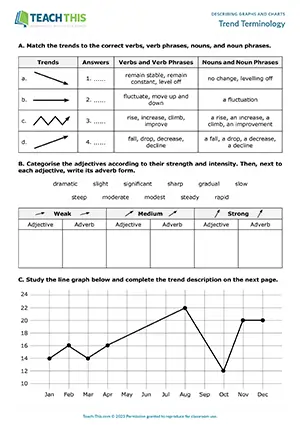
Business English Describing Trends Worksheet - Vocabulary, Reading and writing Exercises: Matching, Categorising, Gap-fill, writing a Paragraph
In this useful describing trends worksheet, students practice verbs, nouns, adjectives and adverbs that describe trends. Students begin by matching symbols that...
Business English Describing Trends Worksheet - Vocabulary, Reading and writing Exercises: Matching, Categorising, Gap-fill, writing a Paragraph In this useful describing trends worksheet, students practice verbs, nouns, adjectives and adverbs that describe trends. Students begin by matching symbols that show trend directions to verbs, verb phrases, nouns, and noun phrases. Next, students categorise adjectives according to their strength and intensity - weak, medium, or strong. Students then write the adverb form of each adjective. After that, students study a line graph showing the annual sales for a new product and complete a description describing the trend over the year. Finally, students study a second line graph and create their own trend description using the language from the worksheet.Bar Chart Dominoes

Business English Describing Bar Charts Game - Vocabulary: Matching - Pair Work
In this describing bar charts game, students use a picture to match dominoes together and form a description of a bar chart and its trend. The first player looks at the...
Business English Describing Bar Charts Game - Vocabulary: Matching - Pair Work In this describing bar charts game, students use a picture to match dominoes together and form a description of a bar chart and its trend. The first player looks at the bar chart to see what part of the trend is being described on the domino on the table. The player then puts a domino down either before or after the domino on the table, making sure that the two parts of the sentence match to continue describing the trend according to the bar chart. It's then the other player's turn to match a domino in the same way by putting one down at either end of the domino chain, and so on. If a player cannot put down one of their dominoes, they take a domino from the top of the pile and put it down if they can. If there are no dominoes left in the pile, play passes to the other student. The first player to get rid of all their dominoes wins the game.Here's what our members are saying...
- Present Simple vs. Present Perfect
-
Present Simple vs. Present Perfect ESL Activities & Games
Question Quest

ESL Present Simple vs. Present Perfect Activity - Grammar and Speaking: Forming, Asking and Answering Questions, Freer practice - Group and Pair Work
This free present simple vs. present perfect speaking activity helps students practice forming, asking and answering conversation questions in the present...
ESL Present Simple vs. Present Perfect Activity - Grammar and Speaking: Forming, Asking and Answering Questions, Controlled and Freer practice - Group and Pair Work This free present simple vs. present perfect speaking activity helps students practice forming, asking and answering conversation questions in the present simple and present perfect tense. First, in two groups, students complete each conversation question in the present simple or present perfect using the verb in brackets. Next, students pair up with someone from the other group and take turns asking and answering the conversation questions with their partner, responding in the present simple or present perfect, according to the tense of each question. Afterwards, students share what they found out about their partner with the class.Simply Perfect Guesses

ESL Present Simple vs. Present Perfect Game - Grammar, writing and Speaking: Gap-fill, Guessing, writing, Asking and Answering Questions - Pair Work
In this fun present simple vs. present perfect game, students complete sentences about their partner using the two tenses and then ask them questions to find out...
ESL Present Simple vs. Present Perfect Game - Grammar, writing and Speaking: Gap-fill, Guessing, writing, Asking and Answering Questions - Pair Work In this fun present simple vs. present perfect game, students complete sentences about their partner using the two tenses and then ask them questions to find out if their guesses were right or wrong. Working alone, students complete sentences with verbs in the present simple or present perfect, guessing and adding the numbers they think are true for their partner, e.g. 'I think my partner has two siblings.' After that, students rewrite the sentences as questions to ask their partner, e.g. 'How many siblings do you have?' Next, students take turns asking their partner each question and writing their answer in the second column. In the 'points' column, students write the difference between their guess and their partner's answer. For example, if they guess their partner has two siblings but the correct answer is three, they score one point. The student with the lowest number of points at the end of the game is the winner.Which is which?

ESL Present Simple vs. Present Perfect Activity - Grammar and Speaking: writing, Asking and Answering Questions, Freer practice - Group and Pair Work
In this insightful present simple vs. present perfect speaking activity, students write questions on different topics using both tenses and then ask and...
ESL Present Simple vs. Present Perfect Activity - Grammar and Speaking: writing Questions, Asking and Answering Questions, Controlled and Freer practice - Group and Pair Work In this insightful present simple vs. present perfect speaking activity, students write questions on different topics using both tenses and then ask and answer the questions with a partner. First, in two groups, students look at two question prompts for each topic and decide which one should be in the present simple and which should be in the present perfect. Students then write one present simple question and one present perfect question for each topic. Next, students pair up with someone from the other group and take turns asking and answering the questions, giving as much information as possible when answering. Afterwards, students share what they found out about their partner with the class.Here's what our members are saying...
- Love, Romance and Dating
-
Love, Romance & Dating ESL Games & worksheets
Let's Talk about Love!
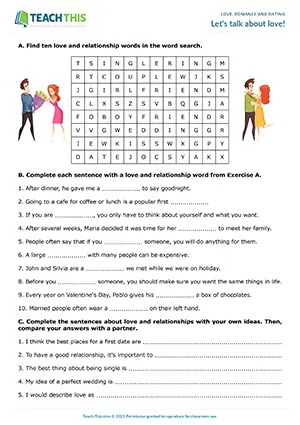
ESL Love and Dating Worksheet - Vocabulary and writing Exercises: Word Search, Gap-fill, Sentence Completion, Listing - Speaking Activity - Pair Work
In this intriguing love and dating worksheet, students practice love and relationship vocabulary. First, students find ten love and relationship words in a word...
ESL Love and Dating Worksheet - Vocabulary and writing Exercises: Word Search, Gap-fill, Sentence Completion, Listing - Speaking Activity: Freer practice - Pair Work In this intriguing love and dating worksheet, students practice love and relationship vocabulary. First, students find ten love and relationship words in a word search. Students then use the love and relationship words to complete sentences. Next, students complete sentences about love and relationships with their own ideas and then compare their answers with a partner. After that, students write down two additional adjectives that can be used to describe each noun. Following that, students underline the correct word in each sentence to complete a love story. Finally, students ask and answer questions about love and relationships with a partner.Love Story Scramble
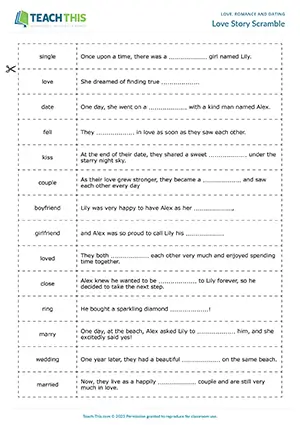
ESL Love Story Game - Vocabulary: Matching, Pelmanism, Gap-fill, Ordering - Pair Work
In this enjoyable love story game, students match gap-fill sentences from a love story with related vocabulary and then race to put the story in order. First, students play a pelmanism game where...
ESL Love Story Game - Vocabulary: Matching, Pelmanism, Gap-fill, Ordering - Pair Work In this enjoyable love story game, students match gap-fill sentences from a love story with related vocabulary and then race to put the story in order. First, students play a pelmanism game where they match and complete sentences from a love story with related vocabulary. In pairs, students take turns turning over one vocabulary card and one gap-fill sentence card. If the word completes the sentence, the student reads the sentence aloud, keeps the two cards and has another turn, e.g. 'Once upon a time, there was a single girl named Lily'. If the two cards don't match, the student turns them back over. The student with the most pairs of cards at the end of the game wins. Next, pairs race to order the sentences to form a love story. Students place their pairs of cards face-up on the table and write the words into the gap-fill sentences. Students then order the sentence to form a love story by numbering the sentence cards. The first pair to do this wins. Afterwards, go through the order of the story with the class and review the related vocabulary.What makes you feel loved?
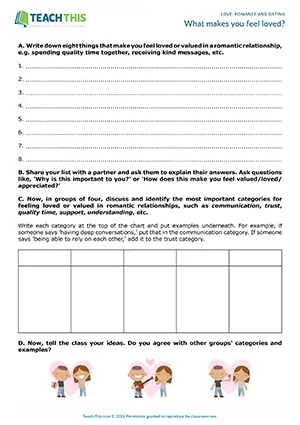
ESL Love and Relationships Activity - Speaking: Listing, Discussions, Categorising - Pair and Group Work
In this intriguing love and relationships activity, students consider what makes them feel loved and valued in a romantic relationship, share the information with their classmates, and discuss...
ESL Love and Relationships Activity - Speaking: Listing, Guided Discussions, Categorising, Freer practice - Pair and Group Work In this intriguing love and relationships activity, students consider what makes them feel loved and valued in a romantic relationship, share the information with their classmates, and discuss their ideas. Students begin by writing down eight things that make them feel loved and valued in a romantic relationship. Next, students share the information with a partner and discuss why those things make them feel loved. In groups of four, students then discuss the most popular categories for feeling loved, e.g. communication, trust, quality time, support, understanding, etc. Students then write the most popular categories from their group at the top of a chart and put examples underneath. Afterwards, each group reports their ideas to the class who listen and give their opinions on the categories and examples. Finally, write the most popular categories on the board and discuss them as a class, including the reasons for feeling loved and how it's important to consider these when choosing a partner.Happily Ever After
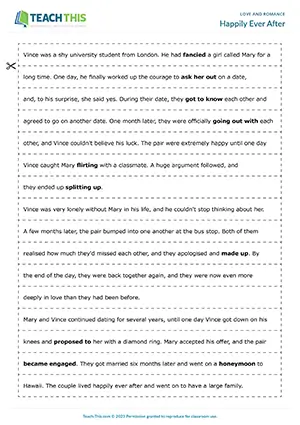
ESL Love and Romance Activity - Vocabulary and Reading Exercises: Ordering, Matching - Speaking Activity: Asking and Answering Questions, Freer practice - Pair Work
This free love story activity helps students practice vocabulary related to love and romance. First, in pairs, students arrange sentence strips in the...
ESL Love and Romance Activity - Vocabulary and Reading Exercises: Ordering, Matching - Speaking Activity: Asking and Answering Questions, Freer practice - Pair Work This free love story activity helps students practice vocabulary related to love and romance. First, in pairs, students arrange sentence strips in the correct order to reveal a love story. Working alone, students then match love and romance words and phrases from a box with their definitions using the bold words from the story to help give context. After that, students complete love and romance conversation questions with the words and phrases in their correct form. Lastly, students discuss the conversation questions in pairs.The Game of Love
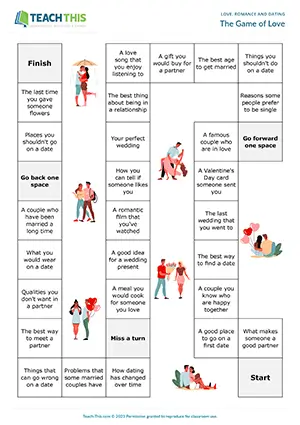
ESL Love, Romance and Dating Board Game - Vocabulary and Speaking: Impromptu Speech, Communicative practice - Group Work
Here is an engaging love-themed board game to help students practice talking about love, romance and dating. In groups, students take turns rolling the dice and...
ESL Love, Romance and Dating Board Game - Vocabulary and Speaking: Impromptu Speech, Communicative practice - Group Work Here is an engaging love-themed board game to help students practice talking about love, romance and dating. In groups, students take turns rolling the dice and moving their counter along the board. When a student lands on a square, they talk about the love, romance or dating topic on the square for 30 seconds. If a student can't think of anything to say or stops talking before the 30 seconds are up, they go back two squares. The first student to reach the finish wins the game.The Language of Love
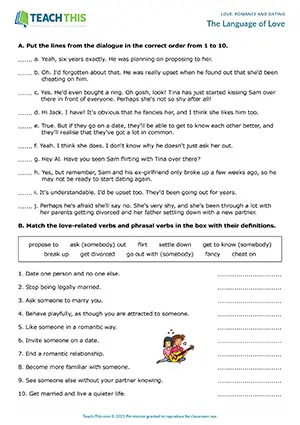
ESL Love and Dating Board Worksheet - Reading and Vocabulary Exercises: Binary Choice, Gap-fill - Speaking Activity: Discussion - Pair Work
This love vocabulary worksheet helps students practice verbs and phrasal verbs related to love, romance and dating. First, students put lines from a...
ESL Love and Dating Board Worksheet - Reading and Vocabulary Exercises: Binary Choice, Gap-fill - Speaking Activity: Discussion, Communicative practice - Pair Work This love vocabulary worksheet helps students practice verbs and phrasal verbs related to love, romance and dating. First, students put lines from a dialogue in the correct order. Students then match verbs and phrasal verbs related to love with their definitions. Next, students underline the correct love-related verb or phrasal verb in each sentence. After that, students complete love conversation questions with verbs from a box in their correct form. Students then move on to discuss the questions with a partner. Afterwards, in pairs, students discuss the advantages of being single versus being in a relationship, listing their reasons in a table. Lastly, students find a new partner and compare their lists.Here's what our members are saying...
- Active vs. Passive Voice
-
Active vs. Passive Voice ESL Games & worksheets
Active vs. Passive Snap
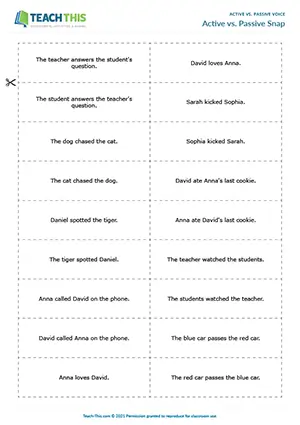
ESL Active vs. Passive Voice Games - Grammar: writing and Reading Sentences, Matching - Pair Work
In these fun active vs. passive games, students match active and passive sentences that have the same meaning. First, students write down five active sentences in different tenses and their passive...
ESL Active vs. Passive Voice Games - Grammar: writing and Reading Sentences, Matching - Pair Work In these fun active vs. passive games, students match active and passive sentences that have the same meaning. First, students write down five active sentences in different tenses and their passive equivalents. In pairs, students then take turns reading one of their active or passive sentences to their partner, who provides the active or passive equivalent. After that, students play a game of snap by matching active and passive sentences that have the same meaning. One student has a set of active sentence cards and the other has a set of passive sentence cards. Both students then turn over a card from their pile at the same time. If the active and passive sentences match, the first student to say 'snap' scores a point. Students then pick up their own cards, shuffle them and play again. If a student says 'snap' when the cards don't match, the other student scores a point and the game continues. To make the game challenging, for each sentence, there is another similar sentence. The first student to score 15 points wins the game. As an extension, students can play a pelmanism game with the cards.Changing Voices Challenge

ESL Active vs. Passive Voice Game - Grammar and writing: Rewriting Sentences, Changing Verb Forms, True or False, Guessing - Pair Work
In this free active vs. passive voice game, students practice rewriting statements from active to passive voice or vice versa. First, students rewrite trivia...
ESL Active vs. Passive Voice Game - Grammar and writing: Rewriting Sentences, Changing Verb Forms, True or False, Guessing - Pair Work In this free active vs. passive voice game, students practice rewriting statements from active to passive voice or vice versa. First, students rewrite trivia statements from active to passive voice or vice versa. Next, in pairs, students discuss which statements they think are true and false and write their guesses on the worksheet. Afterwards, elicit the correct answers from the class. Pairs score one point for each correct guess. If a pair thinks a statement is false, ask them to guess the right person or people for an extra point. The pair with the most points at the end of the game wins.Active vs. Passive Pursuit
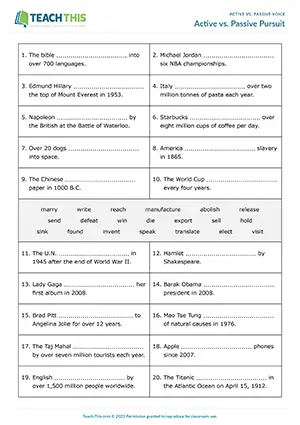
ESL Active vs. Passive Voice Board Game - Grammar and Vocabulary: Matching, Gap-fill, Forming Verbs - Group Work
In this engaging active vs. passive board game, students race to claim as many squares as they can by completing factual sentences with verbs in the correct active or passive form. Teams take turns...
ESL Active vs. Passive Voice Board Game - Grammar and Vocabulary: Matching, Gap-fill, Reforming Verbs - Group Work In this engaging active vs. passive board game, students race to claim as many squares as they can by completing factual sentences with verbs in the correct active or passive form. Teams take turns rolling the dice. If a team rolls an odd number, they can only complete an odd-numbered sentence. If they roll an even number, they can only complete an even-numbered sentence. The team members then choose a sentence and complete it with a verb from the centre of the board in the correct active or passive form, writing the verb in the space provided. If the other team agrees the verb and form are correct, the team wins the square. If not, the verb is erased from the sentence. It is then the other team's turn to roll the dice and try to claim a square. The team with the most squares at the end of the game wins.Choosing the Right Voice
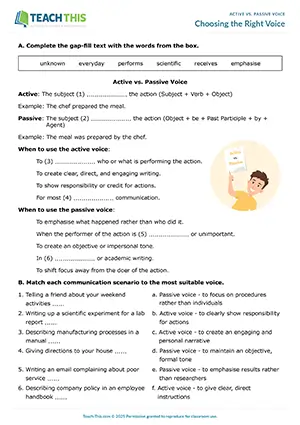
ESL Active vs. Passive Voice Worksheet - Grammar, Reading and writing Exercises: Gap-fill, writing and Rewriting Sentences
In this informative active vs. passive voice worksheet, students practice choosing between active and passive voice based on real-world communication contexts. First, students complete a gap-fill...
ESL Active vs. Passive Voice Worksheet - Grammar, Reading and writing Exercises: Gap-fill, Matching, writing and Rewriting Sentences In this informative active vs. passive voice worksheet, students practice choosing between active and passive voice based on real-world communication contexts. Students begin by completing a gap-fill text about when to use the active and passive voice with words from a box. Students then match each communication scenario to the most suitable voice (active or passive). Next, students rewrite sentences using the active or passive voice as appropriate for the scenarios. Finally, students decide whether the active or passive voice would be appropriate for each scenario and explain why, writing an example passive sentence for each one.Police Interview Role-Play
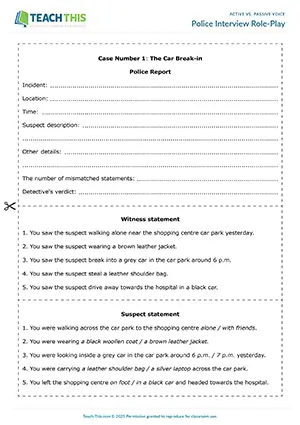
ESL Active vs. Passive Voice Activity - Grammar, writing and Speaking: Role-play, Asking and Answering Questions, Freer practice - Group Work
This active vs. passive voice speaking activity helps students practice using the active and passive voice appropriately in different contexts through crime...
ESL Active vs. Passive Voice Activity - Grammar, writing and Speaking: Role-play, Asking and Answering Questions, Transforming Sentences, Freer practice - Group Work This active vs. passive voice speaking activity helps students practice using the active and passive voice appropriately in different contexts through crime investigation role-plays. In groups of three, one student takes on the role of a detective, one is a suspect, and the other is a witness. First, the suspect chooses and underlines one option for each statement on their card about what they were doing on the day of the crime. Next, the detective interviews the witness, who describes what they saw in the active voice. The detective records the answers in formal report language to complete the police report (Incident, Location, Time, Suspect Description, Other Details) using the passive voice for crimes and actions done to objects or people, and the active voice for suspect descriptions and movements. When the report is complete, the detective reads it to the teacher for verification. Once verified, the detective interviews the suspect, who answers using their statement card. The detective begins with an accusation, then asks active-voice questions and compares the suspect’s answers with the witness’s account in the report. Each answer that does not match the witness’s statement counts as one mismatch. If there are three or more mismatches, the detective arrests the suspect. If there are two or fewer, the suspect is released. Afterwards, students change roles and repeat the procedure with the next case, and so on, until all three cases have been completed.Something in Common
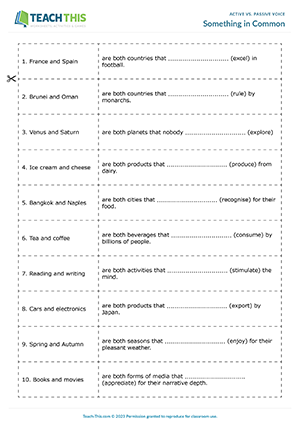
ESL Active vs. Passive Voice Game - Grammar: Matching, Changing Verb Forms, Gap-fill - Pair Work
In this enjoyable active vs. passive game, students race to complete sentences by putting the verb in brackets into the correct active or passive form. In pairs, students begin by lining up...
ESL Active vs. Passive Voice Game - Grammar: Matching, Changing Verb Forms, Gap-fill - Pair Work In this enjoyable active vs. passive game, students race to complete sentences by putting the verb in brackets into the correct active or passive form. In pairs, students begin by lining up sentence beginning cards in order and matching them with an ending card. Once all the sentences have been matched, students complete the endings by putting the verb in brackets in the correct active or passive form. The first pair to complete all their sentences correctly wins.Here's what our members are saying...
- Education
-
Education Vocabulary ESL Games, Activities & worksheets
Classroom Snap and Match
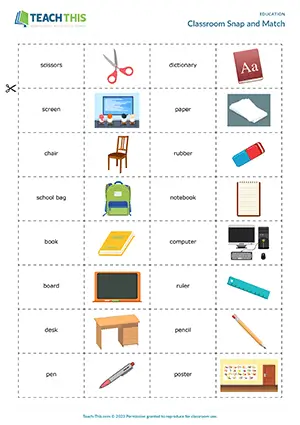
ESL Classroom Vocabulary Games - Vocabulary and Speaking: Snap, Matching, Pelmanism, Forming Sentences - Pair Work
Here are two free classroom object games to help students practice vocabulary related to the classroom. Students begin by playing a game of snap. In pairs, students turn over a card from their pile at the...
ESL Classroom Vocabulary Games - Vocabulary and Speaking: Snap, Matching, Pelmanism, Forming Sentences - Pair Work Here are two free classroom object games to help students practice vocabulary related to the classroom. Students begin by playing a game of snap. In pairs, students turn over a card from their pile at the same time. If the classroom object word card and picture card match, the first student to say 'Snap' scores a point. Students then pick up their own cards, shuffle them, and play again. If a student says 'Snap' when the cards don't match, the other student scores a point, and the game continues. The first student to get ten points wins the game. After that, students move on to play a pelmanism game. Students take turns turning over one classroom object word card and one picture card. If the word matches with the picture, the student scores one point and keeps the two cards. For an extra point, the student then tries to make a sentence with the classroom object word. If the student successfully makes a sentence, they have another turn. If the cards don't match, the student turns them back over. The student with the most points at the end of the game wins.Learning Lingo
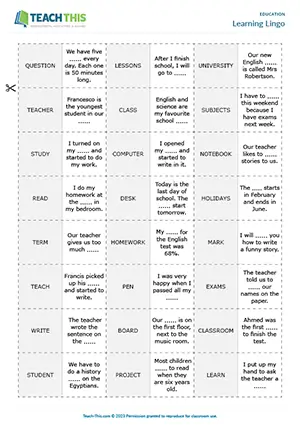
ESL Education Vocabulary Games - Vocabulary: Matching, Describing, Guessing - Group Work
These two engaging school vocabulary games help students practice words related to education and the classroom. First, in groups of four, students play a game of dominoes by completing sentences with...
ESL Education Vocabulary Games - Vocabulary: Matching, Describing, Guessing - Group Work These two engaging school vocabulary games help students practice words related to education and the classroom. First, in groups of four, students play a game of dominoes by completing sentences with education vocabulary. The first player tries to complete a sentence with an education word by placing a domino down either before or after the domino on the table. If the word matches the sentence, the player reads the complete sentence to the group to show the match is correct. The next player then tries to put down one of their dominoes at either end of the domino chain, and so on. The first player to get rid of all their dominoes wins the game. Next, students play a describing and guessing game with the vocabulary. In teams of two, students take turns picking up a card and describing the education word in the grey square to their partner, who has 30 seconds to guess and say the word. If the student successfully guesses the word, the team wins and keeps the card. If not, the other team has one chance to guess the word, keeping the card if they are successful. The team with the most cards at the end of the game wins.School Vocabulary Quest
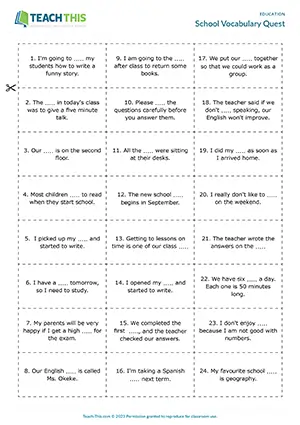
ESL School Vocabulary Games - Vocabulary and Speaking: Matching, Gap-fill, Creating Sentences, Freer practice - Group Work
Here are two entertaining educational vocabulary games to help students practice common words related to learning and school. First, students play a matching game. In groups, students take turns...
ESL School Vocabulary Games - Vocabulary and Speaking: Matching, Gap-fill, Creating Sentences, Freer practice - Group Work Here are two entertaining educational vocabulary games to help students practice common words related to learning and school. First, students play a matching game. In groups, students take turns picking up a sentence card, reading it aloud, and then placing it face-up on the table. All the students then race to find an educational word card on the table to complete the sentence. When a student finds the right card, they pick it up and read the complete sentence aloud. If the other students agree the word matches the sentence, the student wins and keeps the cards. If not, the student puts down the word card and is out of the round. The student with the most pairs of cards at the end of the game wins. Next, students play a sentence race game using the word cards. Students take turns turning over a word card so it's visible to everyone. Students then race to put up their hands and say a sentence using the education-related word. If a student makes a suitable sentence, they win and keep the card. The student with the most cards at the end of the game wins.What are they learning?
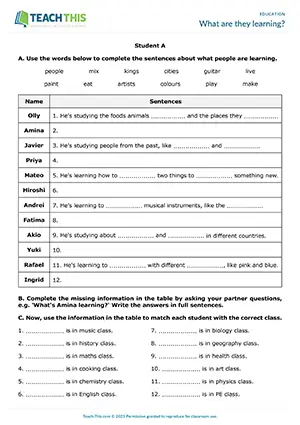
ESL Education Vocabulary Activity - Vocabulary, Reading and Speaking: Information Gap, Asking and Answering Questions - Group and Pair Work
In this enjoyable education information gap activity, students practice vocabulary related to school subjects. First, in two groups, students use education...
ESL Education Vocabulary Activity - Vocabulary, Reading and Speaking: Information Gap, Asking and Answering Questions, Controlled practice - Group and Pair Work In this enjoyable education information gap activity, students practice vocabulary related to school subjects. First, in two groups, students use education vocabulary to complete sentences about what people are learning. Next, students pair up with someone from the other group and take turns asking their partner what people are learning in order to complete missing sentences on their worksheet, e.g. 'What's Amina learning?' Students write their partner's responses in sentence form. After that, pairs race to complete sentences by writing the correct person's name next to the corresponding class they are in. The first pair to complete all their sentences correctly wins.Education Vocabulary Race
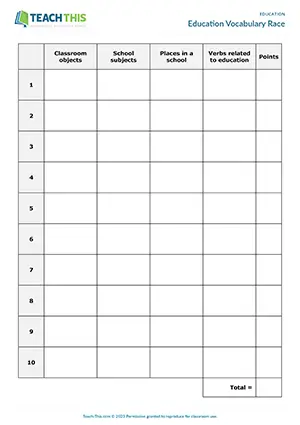
ESL Education Game - Vocabulary: Brainstorming, Categorising, Forming Sentences - Pair Work
In this productive educational vocabulary game, students brainstorm and write down words related to school and education and create sentences using the vocabulary. In teams, students have 30...
ESL Education Game - Vocabulary: Brainstorming, Categorising, Forming Sentences - Pair Work In this productive educational vocabulary game, students brainstorm and write down words related to school and education and create sentences using the vocabulary. In teams, students have 30 seconds to complete rows with words that fit four education-related categories. When the time limit has been reached, teams take it in turns to give their answers, spelling the words as they go. Teams score one point for each appropriate and correctly spelt word. However, if another team has written the same word in that round, neither team scores a point for that word. After the points have been awarded, each team has one chance to score bonus points by creating a sentence with the four words they have written. If a team only manage to include one word in their sentence, they score one point. If they manage to include two words, they score two points, and so on. This process is repeated until all ten rows have been completed. The team with the most points at the end of the game wins.Language for Learning

ESL Education Worksheet - Vocabulary Exercises: Matching, Binary Choice, Categorising, Gap-fill - Speaking Activity: Asking and Answering Questions - Pair Work
This free educational vocabulary worksheet helps students learn and practice words related to learning, school subjects and education. First, students...
ESL Education Worksheet - Vocabulary Exercises: Matching, Binary Choice, Categorising, Gap-fill - Speaking Activity: Asking and Answering Questions - Pair Work This free educational vocabulary worksheet helps students learn and practice words related to learning, school subjects and education. First, students match classroom object words with pictures. Students then underline the correct words or phrases to complete sentences about school subjects. After that, students rank the school subjects in order of importance, from one to eight and compare their rankings with a partner, explaining their choices. Next, students identify the odd word out in each set. Following that, students match different types of schoolwork to their definitions. Students then categorise each type of schoolwork according to the verb it is used with. Finally, students use words from a box to complete questions about education and then ask and answer the questions with a partner.Top of the Class
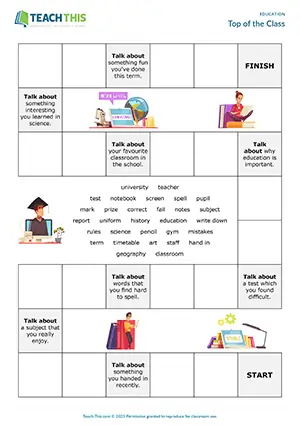
ESL Education Board Game - Vocabulary and Speaking: Gap-fill, Impromptu Speech, Freer practice - Group Work
Here is a fun educational vocabulary board game to help students practice words related to education and study. In groups, students take turns picking up a card and reading the sentence to the other...
ESL Education Board Game - Vocabulary and Speaking: Gap-fill, Impromptu Speech, Freer practice - Group Work Here is a fun educational vocabulary board game to help students practice words related to education and study. In groups, students take turns picking up a card and reading the sentence to the other students using the word 'blank' for the missing word, e.g. 'My favourite BLANK is English because I like languages.' The other students listen to the sentence and race to choose a word from the game board and say it aloud to complete the sentence, e.g. subject. The first student to say the correct word shown on the card rolls the dice and moves their counter along the board. If a student gives an incorrect answer, they are out and cannot answer again unless the other students each give a wrong answer. If a student lands on a square beginning with 'Talk about...', they talk about that topic for 20 seconds to remain on the square. If they are unsuccessful, they move back one space. The first student to reach the finish wins the game. As a variation, students take turns trying to complete a sentence with a word from the board rather than racing each other.Education Vocabulary Challenge
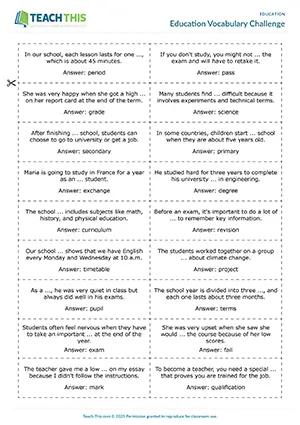
ESL Education Games - Vocabulary and Speaking: Gap-fill, Matching, Forming Sentences - Group Work
These two fast-paced education vocabulary games help students practice common words related to education. First, students play a game where they match education words to sentences. Students take...
ESL Education Games - Vocabulary and Speaking: Gap-fill, Matching, Forming Sentences from Prompts - Group Work These two fast-paced education vocabulary games help students practice common words related to education. First, students play a game where they match education words to sentences. Students take turns picking up a sentence card and reading it to the group using the word 'blank' for the missing word. The other students listen and then race to find the word card on the table that correctly completes the sentence. The first student to place their hand on the correct word card and say the sentence wins the pair of cards. The student with the most pairs of cards at the end of the game wins. Students then move on to play a game in which they race to form sentences that use the education words in context. Students take turns turning over a word card for everyone to see. All the students then race to think of a sentence that uses the education word in context. The first student to put their hand on the card and say a grammatically correct and suitable sentence wins and keeps the card. If a student puts their hand on the card and delays their answer or forms an incorrect sentence, they are out of the round. The student with the most word cards at the end of the game wins.A Scholarly Match
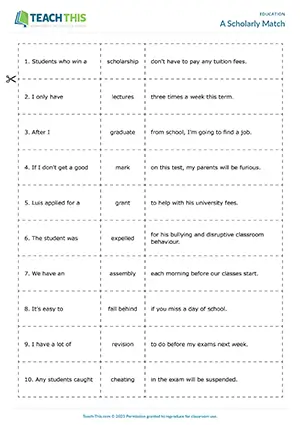
ESL Education Activity - Vocabulary: Matching, Forming Sentences - Pair Work
In this useful education vocabulary activity, students race to form sentences related to education. First, in pairs, students arrange sentence beginning cards, education vocabulary cards, and ending cards face-up on the table in three sets...
ESL Education Activity - Vocabulary: Matching, Forming Sentences - Pair Work In this useful education vocabulary activity, students race to form sentences related to education. First, in pairs, students arrange sentence beginning cards, education vocabulary cards, and ending cards face-up on the table in three sets. Next, students race to arrange the sentence beginning cards in numerical order and match each one with a suitable education word card and an ending card. The first pair to complete all their educational sentences correctly wins. Afterwards, review the correct answers with the class.Learner's Lexicon
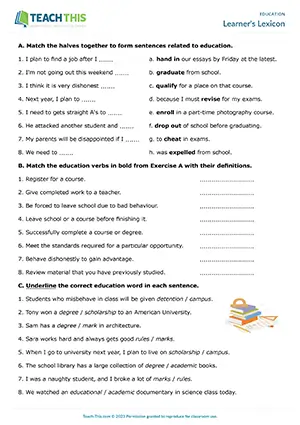
ESL Education Worksheet - Vocabulary Exercises: Matching, Multiple Choice, Gap-fill - Speaking Activity: Discussion, Freer and Communicative practice - Pair Work
This handy educational vocabulary worksheet helps students practice verbs, nouns and adjectives related to education. First, students match halves together to...
ESL Education Worksheet - Vocabulary Exercises: Matching, Multiple Choice, Gap-fill - Speaking Activity: Guided Discussion, Freer and Communicative practice - Pair Work This handy educational vocabulary worksheet helps students practice verbs, nouns and adjectives related to education. First, students match halves together to form sentences related to education. Students then match education verbs from Exercise A with their definitions. Next, students underline the correct education word in each sentence. Students then move on to complete statements by choosing the correct words from the multiple-choice options. After that, students pair up with a classmate and discuss whether or not they agree with each statement. Students then complete education conversation questions with verbs from a box in their correct form. Lastly, students discuss the questions with their partner.Here's what our members are saying...
- Going Out and Entertainment
-
Going Out & Entertainment ESL worksheets, Activities & Games
Out and About
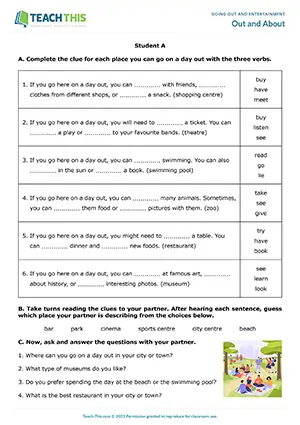
ESL Going Out and Entertainment Game - Vocabulary: Gap-fill, Guessing - Speaking Activity: Asking and Answering Questions, Controlled and Freer practice - Pair Work
This fun going out and entertainment game helps students practice vocabulary for places they can go on a day out and activities associated with these places...
ESL Going Out and Entertainment Game - Vocabulary: Gap-fill, Guessing - Speaking Activity: Asking and Answering Questions, Controlled and Freer practice - Pair Work This fun going out and entertainment game helps students practice vocabulary for places they can go on a day out and activities associated with these places. First, in two groups, students use verbs to complete clues for different places they can go on a day out. Next, students pair up with someone from the other group and take turns reading each clue to their partner, who guesses which place is being described from the choices provided. For each correct guess, students score one point. The student with the most points at the end of the game wins. Finally, students ask and answer conversation questions about the places with their partner.Going Out Survey
ESL Going Out Survey - Speaking Activity: Forming, Asking and Answering Questions, Freer practice - Group and Pair Work
This insightful going out survey helps students practice going out and entertainment vocabulary by asking and answering questions about likes and dislikes. First, students find out which...
ESL Going Out Survey - Speaking Activity: Forming, Asking and Answering Questions, Controlled and Freer practice - Group and Pair Work This insightful going out survey helps students practice going out and entertainment vocabulary by asking and answering questions about likes and dislikes. First, students find out which activities their group members like to do when they go out by asking 'Do you like...?' questions. The group members respond 'Yes, I do', or 'No, I don't' accordingly, and the student marks the answers in a chart. Next, students pair up with someone from another group and take turns asking their partner who they spoke to and their likes and dislikes using the third person, e.g. 'Does Jon like going to the cinema?' Afterwards, the two students review their answers and complete a sentence on the worksheet with the name of the person they are most similar to. Finally, students report back to the class on their findings.Going Out Taboo
ESL Entertainment Game - Vocabulary and Speaking: Describing, Guessing, Freer practice - Group Work
In this creative entertainment vocabulary game, students describe and guess places and actions related to going out and entertainment. In groups of four, students take turns picking up a card...
ESL Entertainment Game - Vocabulary and Speaking: Describing, Guessing, Freer practice - Group Work In this creative entertainment vocabulary game, students describe and guess places and actions related to going out and entertainment. In groups of four, students take turns picking up a card and describing the place or action at the top of the card to the other students without saying any of the words shown on the card. The first student to successfully guess the place or action being described wins and keeps the card. The student with the most cards at the end of the game wins.Leisure Lingo
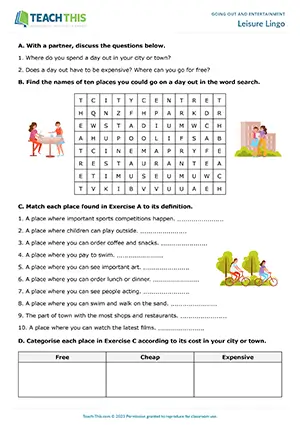
ESL Going Out and Entertainment Worksheet - Vocabulary Exercises: Word Search, Matching, Categorising, Gap-fill - Speaking Activity: Discussion - Pair Work
In this comprehensive going out and entertainment worksheet, students learn and practice vocabulary related to a day out. In pairs, students begin by...
ESL Going Out and Entertainment Worksheet - Vocabulary Exercises: Word Search, Matching, Categorising, Gap-fill - Speaking Activity: Discussion, Freer practice - Pair Work In this comprehensive going out and entertainment worksheet, students learn and practice vocabulary related to a day out. In pairs, students begin by discussing two questions about spending a day out. Students then find ten places to go on a day out in a word search. Next, students match the places to their definitions. After that, students categorise each place according to its cost in their town or city. Following that, students match nouns with verbs to make going out and entertainment collocations. Students then use the collocations to complete plans for a day out, adding four ideas of their own. Finally, in pairs, students discuss the plans and answer questions about them. When the students have finished, they share and discuss their answers with the class.A Bad Day Out
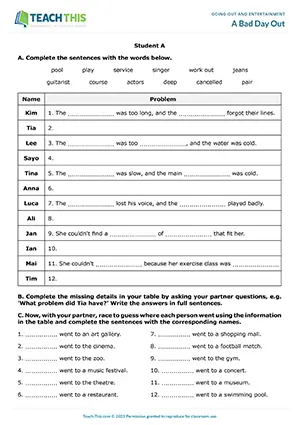
ESL Going Out Activity - Vocabulary, Reading and Speaking Activity: Gap-fill, Information Gap, Matching, Asking and Answering Questions - Pair Work
In this engaging going-out information gap activity, students complete sentences about problems people had on a day out and exchange information with...
ESL Going Out Activity - Vocabulary, Reading and Speaking Activity: Gap-fill, Information Gap, Matching, Asking and Answering Questions, Controlled practice - Pair Work In this engaging going-out information gap activity, students complete sentences about problems people had on a day out and exchange information with a partner to find out where each person went. First, in two groups, students complete sentences about problems people had when they went out to different places with words from a box. Next, students pair up with someone from the other group and take turns asking their partner about the problems experienced by the people whose details are missing from their worksheet and writing their partner's responses in the table in sentence form. After that, pairs race to complete sentences by writing the correct person's name next to the corresponding place or event that they went to. The first pair to complete all their sentences correctly wins.Entertainment Dilemmas

ESL Going Out and Entertainment Game - Vocabulary: Gap-fill, Multiple-choice Questions, Guessing - Pair Work
Here is a free going out and entertainment vocabulary game in which students ask a partner hypothetical questions about going out and guess which answers they would choose. Working alone...
ESL Going Out and Entertainment Game - Vocabulary: Gap-fill, Multiple-Choice Questions, Guessing - Pair Work Here is a free going out and entertainment vocabulary game in which students ask a partner hypothetical questions about going out and guess which answers they would choose. Working alone, students begin by completing questions with words from a box. Next, students underline the multiple-choice answer in each question they think their partner will choose. Students then take turns reading each question along with its three multiple-choice options to their partner, who chooses the answer that is true for them. If students guess correctly, they put a tick next to the question and score a point. The student with the most points at the end of the game wins.That's Entertainment!

ESL Going Out and Entertainment Worksheet - Vocabulary Exercises: Matching, Unscrambling, Binary Choice, Gap-fill - Speaking Activity - Pair Work
In this productive entertainment vocabulary worksheet, students learn and practice vocabulary related to going out and entertainment. To begin...
ESL Going Out and Entertainment Worksheet - Vocabulary Exercises: Matching, Unscrambling, Binary Choice, Gap-fill - Speaking Activity - Pair Work In this productive entertainment vocabulary worksheet, students learn and practice vocabulary related to going out and entertainment. To begin, students complete collocations related to going out and entertainment with verbs from a box. Next, students rearrange letters to spell place names and write the letter of the activity from Exercise A that someone would do at that place. Students then underline the correct place in each sentence. After that, students complete sentences with vocabulary from a box and write the place each sentence refers to. Next, students match sentence halves and complete the endings with words from a box. Lastly, in pairs, students ask and answer conversation questions about going out and entertainment.A Day at the Theme Park

ESL Theme Park Worksheet - Vocabulary Exercises: Matching, Categorising - Speaking Activity: Discussion, Communicative practice - Pair Work
In this useful theme park worksheet, students learn theme park vocabulary and engage in theme park discussions by sharing opinions and expressing agreement...
ESL Theme Park Worksheet - Vocabulary Exercises: Matching, Categorising - Speaking Activity: Guided Discussion, Communicative practice - Pair Work In this useful theme park worksheet, students learn theme park vocabulary and engage in theme park discussions by sharing opinions and expressing agreement and disagreement. First, students match theme park attractions to pictures. Students then match each attraction to its description. Next, students sort agreeing and disagreeing phrases into four categories. After that, students read a theme park situation and use the phrases to discuss the positives and negatives of each theme park attraction and come to an agreement for the situation. Finally, students read and discuss statements about theme parks, giving their opinion and saying whether they agree or disagree.After Dark
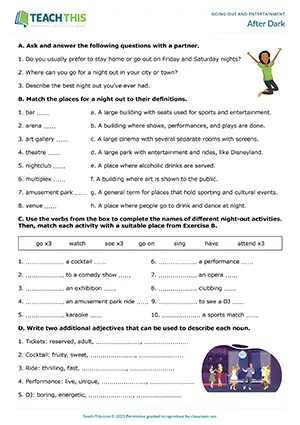
ESL Going Out and Entertainment Worksheet - Vocabulary Exercises: Matching, Gap-fill, Binary Choice - Speaking Activity: Asking and Answering Questions - Pair Work
In this handy going out and entertainment worksheet, students practice vocabulary related to having a night out. First, students discuss three questions...
ESL Going Out and Entertainment Worksheet - Vocabulary Exercises: Matching, Gap-fill, Binary Choice - Speaking Activity: Asking and Answering Questions - Pair Work In this handy going out and entertainment worksheet, students practice vocabulary related to having a night out. First, students discuss three questions about nights out in pairs. Students then match places for a night out to their definitions. Next, students use verbs to complete the names of different night-out activities and then match each activity with a suitable place. After that, students write down two additional adjectives that can be used to describe each noun. Following that, students use night-out vocabulary to complete sentences about what people did on Friday night. Finally, students underline the correct word to complete each conversation question and then ask and answer the questions with a partner.Out on the Town

ESL Entertainment Worksheet - Vocabulary Exercises: Matching, Binary Choice, Gap-fill - Speaking Activity: Asking and Answering Questions - Pair Work
This free entertainment vocabulary worksheet helps students practice words related to going out and entertainment. In pairs, students begin by asking each other...
ESL Entertainment Worksheet - Vocabulary Exercises: Matching, Binary Choice, Gap-fill - Speaking Activity: Asking and Answering Questions - Pair Work This free entertainment vocabulary worksheet helps students practice words related to going out and entertainment. In pairs, students begin by asking each other conversation questions about going out. Students then match sentence halves to make sentences about going out and entertainment. Next, students match the sentences with activities and underline the correct verb in each sentence. After that, students match verbs with their definitions. Students then underline the correct word in each sentence. Lastly, students complete conversation questions about entertainment and going out with words from a box and then ask and answer the questions with a partner.Here's what our members are saying...
- Cities, Towns and Places
-
Cities, Towns & Places ESL Activities, Games & worksheets
Bingo Town
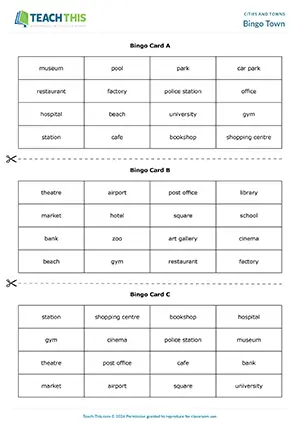
ESL Places Game: Vocabulary: Bingo, Matching - Group Work
In this free places vocabulary game, students play bingo by listening to definitions and matching them to the names of places commonly found in cities and towns. In groups, the bingo caller reads a place definition at random from...
ESL Places Game: Vocabulary: Bingo, Matching - Group Work In this free places vocabulary game, students play bingo by listening to definitions and matching them to the names of places commonly found in cities and towns. In groups, the bingo caller reads a place definition at random from the caller's sheet. The players listen and look at the places written on their bingo cards to see if they have a place that matches the definition. If they do, they cross it off. The game continues until a player has crossed off four places in a row. When this happens, the player shouts 'Bingo!' and then reads out the places they crossed off. If the places match the definitions that were read out from the caller's sheet, the player wins the round. Players then continue to see who can cross off all 16 places first. Groups play several rounds, with students taking turns being the bingo caller and with players using a different bingo card each time.Places in a Town
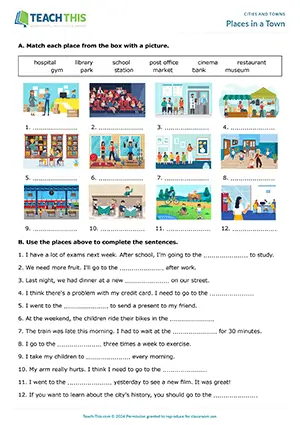
ESL Places in a Town Worksheet: Vocabulary Exercises: Matching, Gap-fill, Binary Choice, Listing, Sentence Completion
Here is a places in a town worksheet to help students learn and practice vocabulary for places in a town or city. First, students match places from a box with pictures. Students then use the places to complete...
ESL Places in a Town Worksheet: Vocabulary Exercises: Matching, Gap-fill, Binary Choice, Listing, Sentence Completion Here is a places in a town worksheet to help students learn and practice vocabulary for places in a town or city. First, students match places from a box with pictures. Students then use the places to complete sentences. Next, students underline the correct place to complete each sentence. After that, students write down two places from the worksheet that correspond to each statement. Finally, students complete sentences about places with their own ideas and then compare their answers with a partner.Places Match Up

ESL Places Games: Vocabulary and Speaking: Snap, Matching, Pelmanism, Forming Sentences - Pair Work
Here are two entertaining places games to help students practice the names of places found in a town or city. Students begin by playing a game of snap. In pairs, students turn over a card from their pile...
ESL Places Games: Vocabulary and Speaking: Snap, Matching, Pelmanism, Forming Sentences - Pair Work Here are two entertaining places games to help students practice the names of places found in a town or city. Students begin by playing a game of snap. In pairs, students turn over a card from their pile at the same time. If the description card and place card match, the first student to say 'Snap' scores a point. Students then pick up their own cards, shuffle them, and play again. If a student says 'Snap' when the cards don't match, the other student scores a point, and the game continues. The first student to get ten points wins the game. After that, students move on to play a pelmanism game. Students take turns turning over one description card and one place card. If the place matches the description, the student scores one point and keeps the two cards. For an extra point, the student then tries to make a sentence with the place word. If the student successfully makes a sentence, they have another turn. If the cards don't match, the student turns them back over. The student with the most points at the end of the game wins.Around Town
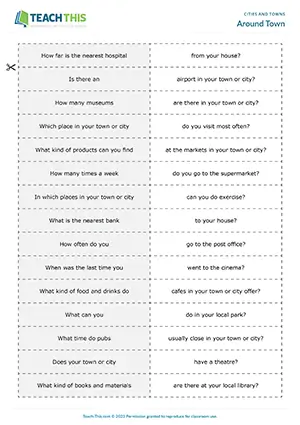
ESL Cities and Towns Activity: Speaking: Matching, Forming, Asking and Answering Questions, Freer practice - Pair Work
In this productive cities and towns speaking activity, students form, ask and answer questions about places in a town or city. In pairs, students take turns matching two cards together to form questions...
ESL Cities and Towns Activity: Speaking: Matching, Forming, Asking and Answering Questions, Freer practice - Pair Work In this productive cities and towns speaking activity, students form, ask and answer questions about places in a town or city. In pairs, students take turns matching two cards together to form questions about places in their town or city. When the students have finished, go through and review the questions with the class. Next, students ask and answer each question in turn with their partner, giving details and asking follow-up questions when needed. Afterwards, get feedback from the students on their answers.City Slickers
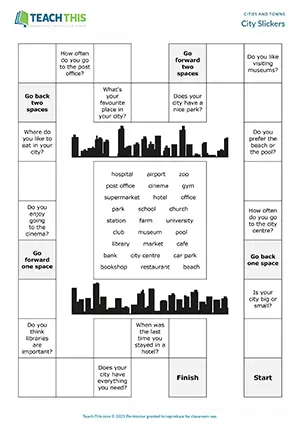
ESL Places in a City Board Game: Vocabulary and Speaking: Gap-fill, Asking and Answering Questions, Communicative practice - Group Work
In this creative city vocabulary board game, students practice words for places in a city and talk in response to city-related questions. Players take turns rolling...
ESL Places in a City Board Game: Vocabulary and Speaking: Gap-fill, Asking and Answering Questions, Communicative practice - Group Work In this creative city vocabulary board game, students practice words for places in a city and talk in response to city-related questions. Players take turns rolling the dice and moving their counters along the board. When a player lands on a square, another student picks up a card and reads out the sentence using the word 'blank' for the place in brackets, e.g. 'My arm really hurts. I need to go to the BLANK.' The player listens to the sentence, chooses a place word from the game board, and says it aloud to complete the sentence, e.g. hospital. If the player says the correct word shown on the card in bold, they stay on the square. If not, they move their counter back two squares. If a player lands on a question square, they answer the city-related question by talking for 20 seconds without stopping. If a player can't think of anything to say or stops talking before the 20 seconds are up, they go back two squares. The first player to reach the finish wins the game.Places in the City
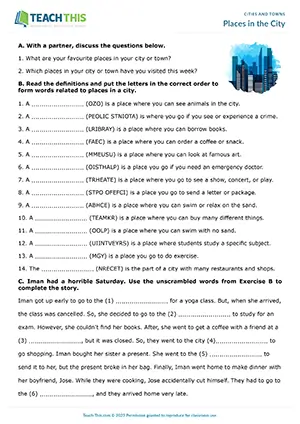
ESL Places in a City Worksheet - Vocabulary, Reading, and writing: Gap-fill, writing a Story - Speaking: Asking and Answering Questions, Freer practice - Pair Work
This free places in a city worksheet helps students practice vocabulary for public places in a city. Students begin by discussing two questions related to places...
ESL Places in a City Worksheet - Vocabulary, Reading, and writing: Unscrambling, Gap-fill, writing a Story - Speaking: Asking and Answering Questions, Freer practice - Pair Work This free places in a city worksheet helps students practice vocabulary for public places in a city. Students begin by discussing two questions related to places in their city or town. Students then complete definitions by unscrambling words related to public places. Next, students use the unscrambled words to complete a story about a horrible Saturday. After that, students use public places vocabulary in a box to write a short story about a great Sunday. When the students have finished, they read their stories to the class, who then vote on which story sounds like the best Sunday. Students then use the words from the box to complete conversation questions related to public places. Finally, in pairs, students ask and answer the questions, giving as much detail as possible.Urban Explorers

ESL Cities and Towns Activity - Vocabulary: Unscrambling, Matching, Guessing - Group and Pair Work
In this useful public places activity, students explain why people went to different public places and match the reasons with the places. In two groups, students unscramble sentences on their worksheet...
ESL Cities and Towns Activity - Vocabulary: Unscrambling, Matching, Guessing - Group and Pair Work In this useful public places activity, students explain why people went to different public places and match the reasons with the places. In two groups, students unscramble sentences on their worksheet and then match each name with a public place according to their sentence. Next, students pair up with someone from the other group and take it in turns to ask their partner where the people at the bottom of their worksheet went, e.g. 'Where did Marta go?' Their partner then reads the sentence for that person using the word 'blank' for the missing place, e.g. 'Marta went to the 'blank' because she wanted to see a new film.' The other student listens to the clue and tries to guess the place from the choices provided. When the student guesses correctly, they write the place in the space provided.City Limits Lingo
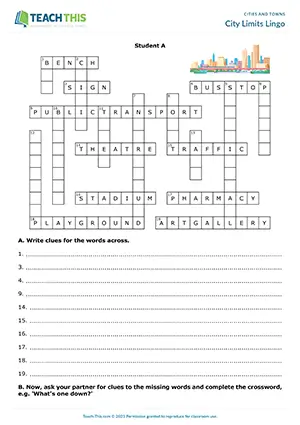
ESL Cities and Towns Activity - Vocabulary: writing Clues, Describing, Guessing - Group and Pair Work
In this handy city vocabulary activity, students complete a crossword by describing and guessing words related to cities, towns, and public places. In two groups, students invent and write down clues for...
ESL Cities and Towns Activity - Vocabulary: writing Clues, Describing, Guessing - Group and Pair Work In this handy city vocabulary activity, students complete a crossword by describing and guessing words related to cities, towns, and public places. In two groups, students invent and write down clues for the words written on their crossword. Next, students pair up with someone from the other group and take turns asking their partner for a clue to one of their missing words. Their partner reads out the clue for that word, and the other student tries to guess what it is. If the student guesses the word successfully, they write it on their crossword. If not, their partner continues to give more clues until the student is able to guess the word. Afterwards, students check their spelling by comparing crosswords.Exploring a New City
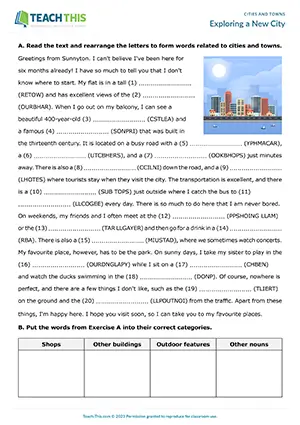
ESL Cities and Towns Worksheet - Vocabulary and writing Exercises: Unscrambling, Categorising, Binary Choice, Gap-fill, writing a Paragraph
Here is a comprehensive city vocabulary worksheet to help students practice words related to cities and towns. Students start by reading a text and...
ESL Cities and Towns Worksheet - Vocabulary and writing Exercises: Unscrambling, Categorising, Binary Choice, Gap-fill, writing a Paragraph Here is a comprehensive city vocabulary worksheet to help students practice words related to cities and towns. Students start by reading a text and unscrambling words related to cities and towns. Next, students put the words into their correct categories. Students then complete sentences using vocabulary from a box and underlining the correct word in each sentence. Lastly, students use cities and towns vocabulary in a box to write a short story about exploring a new city, changing word forms as required.Fun in the City
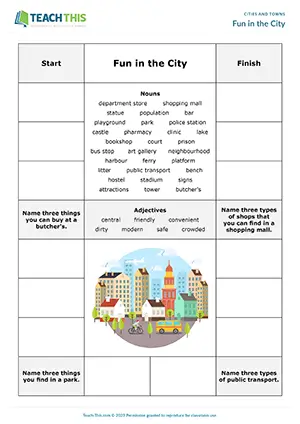
ESL Cities and Towns Board Game - Vocabulary: Matching, Sentence Completion, Guessing - Group Work
Here is a fun cities and towns board game to help students practice adjectives and nouns related to cities and towns. Students take turns picking up a card and reading the sentence aloud to the other...
ESL Cities and Towns Board Game - Vocabulary: Matching, Sentence Completion, Guessing - Group Work Here is a fun cities and towns board game to help students practice adjectives and nouns related to cities and towns. Students take turns picking up a card and reading the sentence aloud to the other students using the word 'blank' for the missing adjective or noun, e.g. 'There is a BLANK in the park with lots of things for children to play on'. The other students listen to the sentence and race to choose an adjective or noun from the centre of the game board and say it aloud to complete the sentence, e.g. playground. The first student to say the correct word shown on the card, rolls the dice and moves their counter along the board. If a student lands on a square beginning with 'Name three...', they have 30 seconds to name the three things required to remain on the square. If they are unsuccessful, they move back one space. The card is then placed at the bottom of the pile, and it's the next student's turn to pick up a card. The first player to reach the finish wins the game.Talk of the Town

ESL Cities and Towns Activity - Speaking: Asking and Answering Questions, Guided Discussion, Freer practice - Group Work
Here is a cities and towns discussion activity to help students practice urban vocabulary and conversation skills for describing cities, towns, and public transport. In groups, students take turns picking...
ESL Cities and Towns Activity - Speaking: Asking and Answering Questions, Guided Discussion, Freer practice - Group Work Here is a cities and towns discussion activity to help students practice urban vocabulary and conversation skills for describing cities, towns, and public transport. In groups, students take turns picking up a card and asking the other students in the group the city and town discussion question on the card. Each student responds to the question in turn, and the students then discuss the topic. This process continues until all the question cards have been discussed. When the students have finished, review the questions on the cards and elicit answers from around the class.Town Terminology
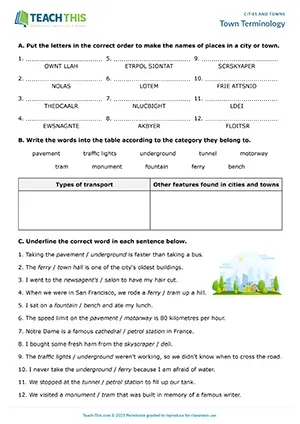
ESL Cities and Towns Worksheet - Vocabulary Exercises: Unscrambling, Categorising, Binary Choice, Gap-fill, Matching
Here is an insightful city and town vocabulary worksheet to help students review and practice words related to cities and towns. First, students unscramble...
ESL Cities and Towns Worksheet - Vocabulary Exercises: Unscrambling, Categorising, Binary Choice, Gap-fill, Matching Here is an insightful city and town vocabulary worksheet to help students review and practice words related to cities and towns. First, students unscramble words related to cities and towns. Students then put the words in their correct categories. Next, students underline the correct word in each sentence. After that, students complete sentences using vocabulary from a box and underline the correct preposition in each sentence. Lastly, students match sentence halves and complete the endings with words from a box.Urban Explorer
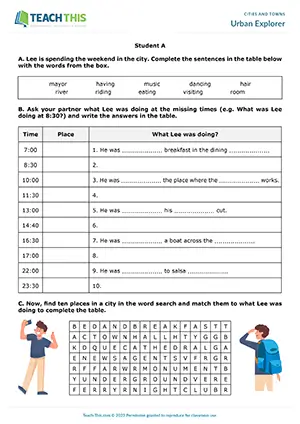
ESL Cities and Towns Activity - Vocabulary and Speaking: Gap-fill, Asking and Answering Questions, Word Search, Table Completion, Controlled practice - Pair Work
Here is an engaging places in a city speaking activity to help students review and practice words related to cities. Working alone, students begin by...
ESL Cities and Towns Activity - Vocabulary and Speaking: Gap-fill, Asking and Answering Questions, Word Search, Table Completion, Controlled practice - Pair Work Here is an engaging places in a city speaking activity to help students review and practice words related to cities. Working alone, students begin by completing sentences about Lee's weekend in the city with words from a box. Next, students take turns asking their partner what Lee was doing at the missing times on their worksheet. Their partner gives them the answer and the student writes the sentence down. Lastly, students find ten places in a city in a word search and match them to what Lee was doing.Urban Trivia Quiz
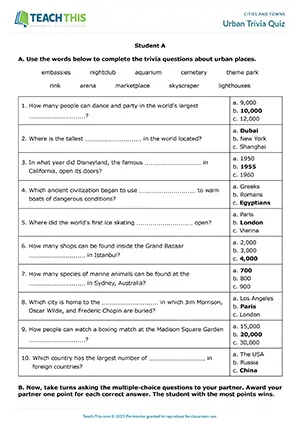
ESL Urban Places Activity - Vocabulary: Gap-fill, Multiple-Choice Quiz, Guessing - Group and Pair Work
In this enjoyable urban places quiz, students complete trivia questions about urban places and then take part in a quiz using the questions. In two groups, students begin by completing trivia questions...
ESL Urban Places Activity - Vocabulary: Gap-fill, Multiple-Choice Quiz, Guessing - Group and Pair Work In this enjoyable urban places quiz, students complete trivia questions about urban places and then take part in a quiz using the questions. In two groups, students begin by completing trivia questions about urban places using the words provided. Next, students pair up with someone from the other group and take turns reading each urban places trivia question along with three possible multiple-choice answers to their partner, who tries to guess the correct one. For each correct answer, students score one point. The student with the most points at the end of the quiz wins.Here's what our members are saying...
- Computers and Smartphones
-
Computers & Smartphones ESL Games, Activities & worksheets
Today's Tech
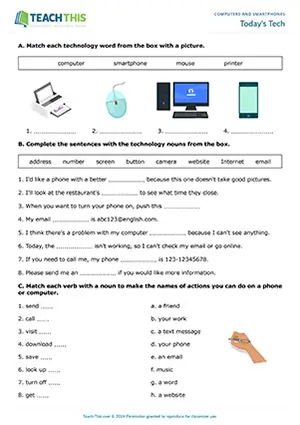
ESL Technology Worksheet - Vocabulary Exercises: Matching, Gap-fill, Sentence Completion - Speaking Activity: Asking and Answering Questions - Pair Work
This comprehensive technology vocabulary worksheet helps students practice words related to computers, smartphones and the Internet. Students begin by...
ESL Technology Worksheet - Vocabulary Exercises: Matching, Gap-fill, Sentence Completion - Speaking Activity: Asking and Answering Questions - Pair Work This comprehensive technology vocabulary worksheet helps students practice words related to computers, smartphones and the Internet. Students begin by matching technology words with pictures. Students then complete sentences with technology nouns from a box. Next, students match each verb with a noun to form the names of actions that can be done on a phone or computer. After that, students underline the correct technology word or phrase to complete each sentence. Students then move on to complete technology-related sentences with their own ideas and then compare them with a partner. Lastly, students ask and answer technology conversation questions in pairs.Typical Tech
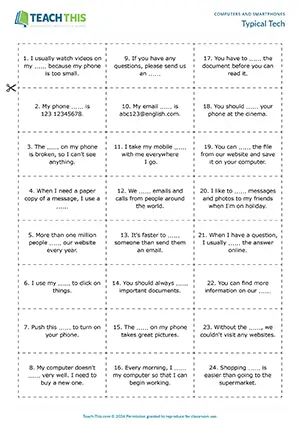
ESL Technology Vocabulary Games - Vocabulary and Speaking: Matching, Gap-fill, Forming Sentences, Freer practice - Group Work
Here are two enjoyable technology vocabulary games to help students practice basic vocabulary related to computers, smartphones and the Internet...
ESL Technology Vocabulary Games - Vocabulary and Speaking: Matching, Gap-fill, Forming Sentences, Freer practice - Group Work Here are two enjoyable technology vocabulary games to help students practice basic vocabulary related to computers, smartphones and the Internet. In groups, students take turns picking up a sentence card, reading it aloud, and placing it face-up on the table. Next, all the students race to find a technology-related word card to complete the sentence. When a student finds the right card, they pick it up and read the complete sentence aloud. If the other students agree the word matches the sentence, the student wins and keeps the cards. If not, the student puts down the word card and is out of the round. The student with the most pairs of cards at the end wins. Students then move on to a second game where they make sentences with the word cards. Students take turns turning over a word card, so it's visible to everyone. Students then race to put up their hands and say a sentence using the technology-related word. If a student makes a suitable sentence, they win and keep the card. If the sentence is incorrect, or if a student says a sentence before putting up their hand, they are out of the round, and the other students continue trying to come up with a sentence. The student with the most cards at the end of the game wins.Computer Dominoes
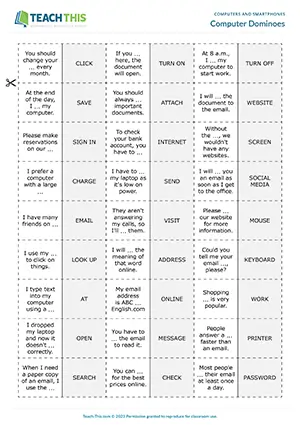
ESL Computer Vocabulary Game - Vocabulary: Matching, Gap-fill - Group Work
In this useful computer vocabulary game, students play dominoes by completing sentences with computer-related words. In groups of three, the first player puts down one of their dominoes on either side of the domino on the table, making sure...
ESL Computer Vocabulary Game - Vocabulary: Matching, Gap-fill - Group Work In this useful computer vocabulary game, students play dominoes by completing sentences with computer-related words. In groups of three, the first player puts down one of their dominoes on either side of the domino on the table, making sure that the computer-related word completes the gap-fill sentence. Players then take it in turns to complete the computer-related sentences with words by putting their dominoes down at either end of the domino chain. If a player cannot put down one of their dominoes, they take one from the top of the pile and put it down if they can. If there are no dominoes left in the pile, play passes to the next student. The first player to get rid of all their dominoes wins the game.Find Someone Who…
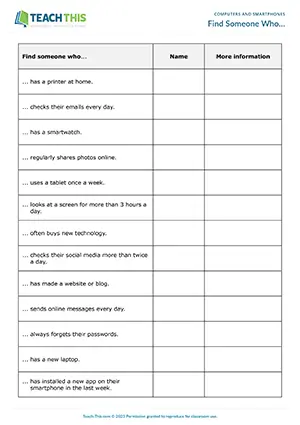
ESL Computers, Smartphones and Gadgets Activity - Speaking: Asking and Answering Questions, Controlled and Freer practice
In this insightful computers and smartphones speaking activity, students ask and answer questions about computers, smartphones, and gadgets. After reviewing the items on the worksheet, students go...
ESL Computers, Smartphones and Gadgets Activity - Speaking: Asking and Answering Questions from Prompts, Controlled and Freer practice In this insightful computers and smartphones speaking activity, students ask and answer questions about computers, smartphones, and gadgets. After reviewing the items on the worksheet, students go around the class, asking each other the questions on the worksheet, e.g. 'Do you have a printer at home?' When a student finds someone who answers 'yes' to a question, they write down that student's name and ask a follow-up question to gain more information, noting down the answer in the last column. When everyone has finished, students give feedback to the class on what they found out.Tech Talk
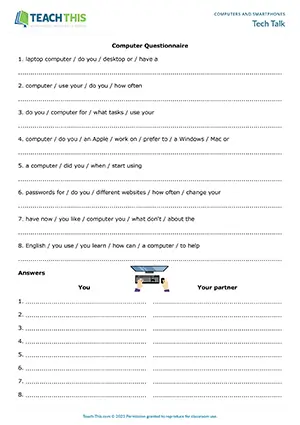
ESL Computers and Smartphones Activity - Speaking: Unscrambling, Asking and Answering Questions, Controlled and Freer practice - Group and Pair Work
In this free computers and smartphones speaking activity, students unscramble questions about computers or smartphones and then ask and answer...
ESL Computers and Smartphones Activity - Speaking: Unscrambling, Asking and Answering Questions, Controlled and Freer practice - Group and Pair Work In this free computers and smartphones speaking activity, students unscramble questions about computers or smartphones and then ask and answer the questions with a partner. In two groups, students put words in the correct order to form questions about computers or smartphones. Students then answer the questions and write down their answers on the worksheet. After that, students pair up with someone from the other group and take it in turns to ask their partner the questions, noting down their answers. Finally, students report back to the class on what they found out about their partner.Byte-sized Vocabulary
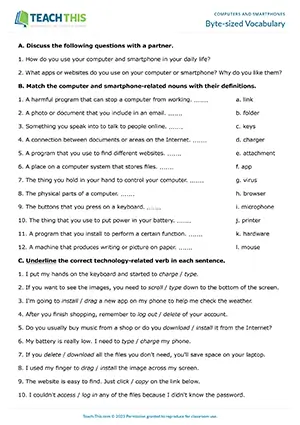
ESL Computers and Smartphones Worksheet - Vocabulary Exercises: Matching, Binary choice, Gap-fill - Speaking Activity: Asking and Answering Questions - Pair Work
Here is a productive computer and smartphone vocabulary worksheet to help students learn and practice verbs and nouns related to computers and...
ESL Computers and Smartphones Worksheet - Vocabulary Exercises: Matching, Binary choice, Gap-fill - Speaking Activity: Asking and Answering Questions - Pair Work Here is a productive computer and smartphone vocabulary worksheet to help students learn and practice verbs and nouns related to computers and smartphones. In pairs, students start by discussing two questions related to using computers and smartphones. Students then match computer and smartphone-related nouns with their definitions. Next, students underline the correct technology-related verbs in a set of sentences. After that, students match sentence halves together to form sentences about computers and smartphones. Lastly, students complete sentences with words from a box in their correct form.Smart Pairs
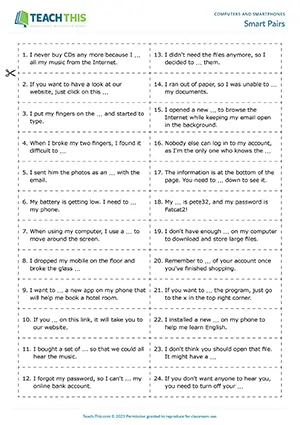
ESL Computers and Smartphones Game - Vocabulary - Matching, Gap-fill - Group Work
Here is an engaging computers and smartphones vocabulary game to help students practice or review computer and smartphone vocabulary. In groups, students take turns turning over...
ESL Computers and Smartphones Game - Vocabulary: Matching, Gap-fill - Group Work Here is an engaging computers and smartphones vocabulary game to help students practice or review computer and smartphone vocabulary. In groups, students take turns turning over one sentence card and one word card. If the computer or smartphone-related word completes the sentence, the student reads the sentence aloud, keeps the two cards and has another turn. If the word doesn't match the sentence, the student turns the cards back over, keeping them in the same place. It's then another student's turn to play. The student with the most pairs of cards at the end of the game wins. Afterwards, check the correct answers with the class.Tech Verb Take One
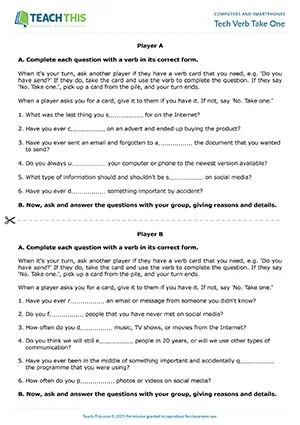
ESL Computers and Smartphones Game - Vocabulary Game: Gap-fill - Speaking Activity: Asking and Answering Questions, Controlled and Freer practice - Group Work
In this fun computer and smartphone verbs game, students race to collect verb cards and use them to complete, ask and answer questions. To begin...
ESL Computers and Smartphones Game - Vocabulary Game: Gap-fill - Speaking Activity: Asking and Answering Questions, Controlled and Freer practice - Group Work In this fun computer and smartphone verbs game, students race to collect verb cards and use them to complete, ask and answer questions. To begin, students read their worksheets and think about which verbs from the board they need to complete their questions. Player A then begins the game by choosing a question and asking another player if they have the verb card, e.g. 'Do you have send?' If the other player has the card, they give it to the player, who takes it and uses the verb in its correct form to complete the question. If not, the other player replies 'No. Take one.' Player A then takes a card from the pile and their turn ends. Play then passes to Player B and so on. If a player is dealt or draws a verb card that they need, they use their next turn to complete the corresponding question and do not ask for a card. The first player to complete all their questions correctly wins. The remaining players continue the game until all the students have completed their questions. Finally, in their groups, students take turns asking and answering the questions, giving as much detail as possible.AI and Smart Technology
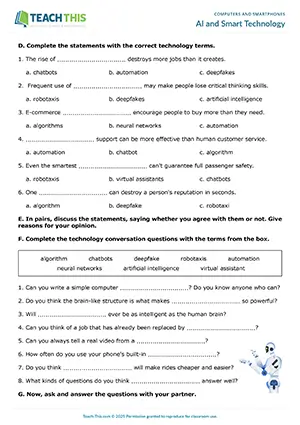
ESL AI Worksheet - Vocabulary Exercises - Matching, Binary Choice, Gap-fill - Speaking Activity - Discussion - Pair Work
This comprehensive technology vocabulary worksheet helps students practice words related to artificial intelligence, machine learning concepts, and emerging technologies. First, students...
ESL AI Worksheet - Vocabulary Exercises - Matching, Binary Choice, Multiple Choice, Gap-fill - Speaking Activity - Guided Discussion, Asking and Answering Questions, Freer and Communicative practice- Pair Work This comprehensive technology vocabulary worksheet helps students practice words related to artificial intelligence, machine learning concepts, and emerging technologies. First, students match halves together to form sentences related to technology. Students then match technology terms to their definitions. Next, students underline the correct technology term in each sentence. After that, students complete statements by choosing the correct technology terms from the multiple-choice options. Following that, in pairs, students discuss whether they agree with each statement, giving reasons for their opinion. Finally, students complete technology conversation questions with terms from a box and then discuss the questions with their partner.Caught in the Act

ESL Smartphone Vocabulary Activity - Vocabulary and writing: Gap-fill, Asking and Answering Questions, Sentence Completion, Story writing - Group and Pair Work
This handy smartphone vocabulary activity helps students review and practice verbs and nouns related to smartphones. In two groups, students start by...
ESL Smartphone Vocabulary Activity - Vocabulary and writing: Gap-fill, Asking and Answering Questions, Sentence Completion, Story writing - Group and Pair Work This handy smartphone vocabulary activity helps students review and practice verbs and nouns related to smartphones. In two groups, students start by completing sentences about people using their phones during a lesson with verbs and nouns from two boxes. Next, students pair up with someone from the other group and take turns asking their partner about the people whose details they are missing. Their partner reads the corresponding information, and the other student completes the sentence on their worksheet. Afterwards, check the answers with the class. Students then move on to choose five verbs and nouns from the two boxes and write a short story to practice the language from the activity. Finally, students share their stories with the class.Smarter than Smartphones

ESL Smartphones Board Game - Vocabulary: Multiple-Choice Questions, Guessing, Providing Vocabulary - Group Work
Here is an entertaining smartphone vocabulary board game to help students practice words related to smartphones. Students take turns rolling the dice and moving their counters along...
ESL Smartphones Board Game - Vocabulary: Multiple-Choice Questions, Guessing, Providing Vocabulary - Group Work Here is an entertaining smartphone vocabulary board game to help students practice words related to smartphones. Students take turns rolling the dice and moving their counters along the game board. If a student lands on a question mark square, another student picks up a card and reads the question on the card, followed by three multiple-choice options. If the student chooses the correct answer, they remain on the square. If not, they move their counter back two squares. The card is then placed at the bottom of the pile, and it's the next student's turn to roll the dice. If a student lands on a square beginning with 'Name two...', they have 15 seconds to name the two things required in order to remain on the square. If they are unsuccessful, they move their counter back two squares. The first player to reach the finish wins the game.Tech Team Taboo
ESL Computer Vocabulary Game - Vocabulary and Speaking: Word Association, Describing, Guessing, Freer practice - Group Work
In this creative computer vocabulary game, students describe and guess computer nouns without using associated words their opponents have prohibited...
ESL Computer Vocabulary Game - Vocabulary and Speaking: Word Association, Describing, Guessing, Freer practice - Group Work In this creative computer vocabulary game, students describe and guess computer nouns without using associated words their opponents have prohibited. First, in two teams, students look at each card and discuss how they would describe the computer noun shown on the card. Students then think of and write down three keywords associated with the computer noun on each card. The two teams then swap cards. Next, a student from Team A picks up a card and has 30 seconds to describe the computer noun to the other students in their team, without saying the noun or using the keywords on the card. The student is also not allowed to use variations of the words on the card, e.g. browsing instead of browser. If the team guesses the computer noun before the time is up, they win and keep the card. If not, the card is removed from the game. Play then passes to the other team, and so on. The team with the most cards at the end of the game wins.Here's what our members are saying...
- Study Skills
-
Study Skills EAP worksheets, Games & Activities
Find Someone Who…
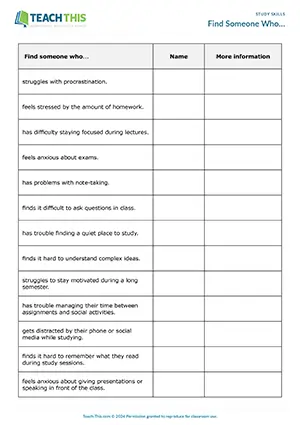
EAP Study Skills Activity - Speaking: Asking and Answering Questions, Discussion, Controlled, Freer and Communicative practice - Group Work
In this study skills speaking activity, students ask and answer questions about the difficulties of managing their academic studies and discuss strategies...
EAP Study Skills Activity - Speaking: Asking and Answering Questions, Discussion, Controlled, Freer and Communicative practice - Group Work In this study skills Find Someone Who activity, students ask and answer questions about the difficulties of managing their academic studies and discuss strategies for dealing with them. First, students go through the items on the worksheet and form the yes/no questions they need to ask for the activity, e.g. 'Do you struggle with procrastination?' Students then go around the class, asking each other the questions. When a student finds someone who answers 'yes' to a question, they write down that person's name and ask a follow-up question to gain more information, noting down the answer. Students then move on to speak with a new partner. Afterwards, students share their findings with the class. Next, a class survey is conducted to find out how many students face each challenge, and the numbers of students affected are recorded next to each item. In groups, students then discuss the three most common challenges identified from the survey results and brainstorm strategies for overcoming them. Finally, groups share their ideas with the class.Study Habits Exchange

EAP Study Skills Activity - Speaking and writing: Asking and Answering Questions, Giving Advice, writing Sentences, Communicative practice - Pair Work
In this communicative study skills activity, students discuss their study habits with multiple partners, exchange advice on areas for improvement, and then...
EAP Study Skills Activity - Speaking and writing: Asking and Answering Questions, Giving Advice, writing Sentences, Communicative practice - Pair Work In this communicative study skills activity, students discuss their study habits with multiple partners, exchange advice on areas for improvement, and then select three new habits to implement. First, students answer six questions about their study habits. Next, in pairs, students have five minutes to discuss the questions, sharing habits they are confident about and asking for advice on areas they wish to improve. Students make notes on any useful ideas they hear in a box on their worksheet. Students then change partners and repeat the activity. This continues until students have spoken to four people. Next, students look at the ideas they wrote in the box and reflect on the study habit ideas they discussed. After that, students write three study habits or tips they want to try, explaining when and how they are going to try them. Finally, students share their answers with the class.Study Skills Roundtable
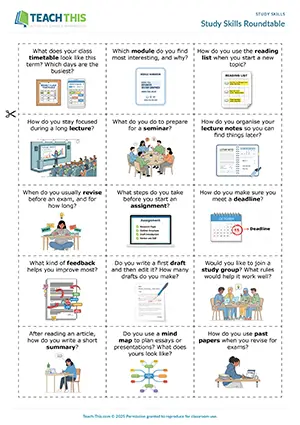
EAP Study Skills Activity - Speaking: Asking and Answering Questions, Discussion, Freer practice - Group Work
In this study skills discussion activity, students practice vocabulary related to study skills and discuss their study habits and routines. In groups, students take turns picking up a question card and asking the...
EAP Study Skills Activity - Speaking: Asking and Answering Questions, Discussion, Freer practice - Group Work In this study skills discussion activity, students practice vocabulary related to study skills and discuss their study habits and routines. In groups, students take turns picking up a question card and asking the other students in the group the study skills question. Each student responds to the question in turn, and the students then discuss the study skills topic. This process continues until all the question cards have been discussed. When the students have finished, review the questions on the cards and elicit answers from around the class.Time Management Strategies
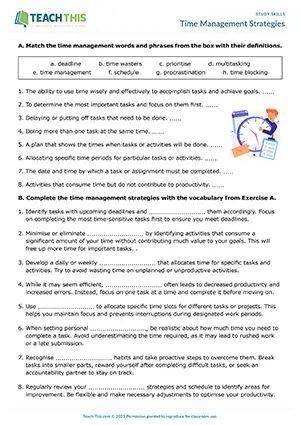
EAP Study Skills Worksheet - Vocabulary, Reading and writing Exercises: Matching, writing Paragraphs - Speaking Activity: Discussion - Pair Work
In this informative study skills worksheet, students learn about some practical time management strategies and apply them by recommending solutions...
EAP Study Skills Worksheet - Vocabulary, Reading and writing Exercises: Matching, writing Paragraphs - Speaking Activity: Discussion - Pair Work In this informative study skills worksheet, students learn about some practical time management strategies and apply them by recommending solutions to common time management problems. First, students match time management words and phrases with their definitions. Students then complete a series of time management strategies with the vocabulary. Next, in pairs, students read and analyse four time management scenarios. Together, the students identify the time management problem each person is facing and recommend and explain an effective solution for each one. Finally, students discuss three time management questions with their partner. When the pairs have finished, they share their ideas with the class.Types of Learning
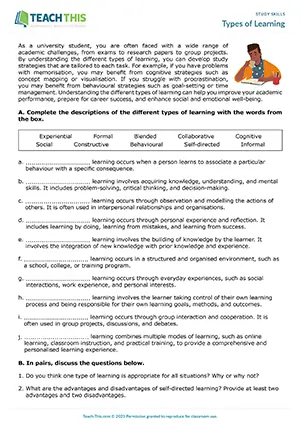
EAP Study Skills Worksheet - Reading, Vocabulary and writing Exercises: Gap-fill, writing Sentences - Speaking Activities: Discussion, Presentation - Pair Work
In this productive study skills worksheet, students learn about different types of learning and apply that knowledge to reflect and improve on their own...
EAP Study Skills Worksheet - Reading, Vocabulary and writing Exercises: Gap-fill, writing Sentences - Speaking Activities: Discussion, Presentation - Pair Work In this productive study skills worksheet, students learn about different types of learning and apply that knowledge to reflect and improve on their own learning processes. Students begin by reading a short introduction to learning types. Students then complete descriptions of ten types of learning with vocabulary from a box. Next, students discuss two questions about learning types with a partner and then share their answers with the class. After that, students match the types of learning with scenarios and add another example scenario of their own to each one. In pairs, students then move on to pick a skill or knowledge area they want to improve in. Students then choose one type of learning that they think would be most effective in helping them achieve that goal. Following that, students prepare and present a two-minute presentation where they explain why they chose that type of learning and how they would apply it to their learning process.Managing Procrastination
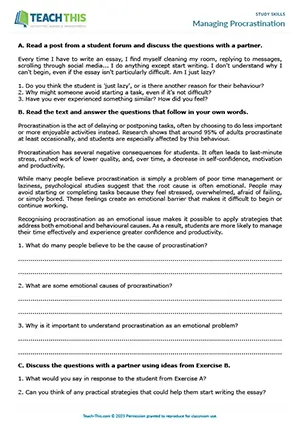
EAP Study Skills Worksheet - Reading and writing Exercises: Matching, Answering Questions, writing Sentences - Speaking Activity - Pair Work
In this insightful study skills worksheet, students learn about the causes of procrastination, explore strategies to manage it, and create a personal plan to...
EAP Study Skills Worksheet - Reading and writing Exercises: Matching, writing Sentences - Speaking Activity: Discussion, Communicative practice - Pair Work In this insightful study skills worksheet, students learn about the causes of procrastination, explore strategies to manage it, and create a personal plan to reduce procrastination in one area of their academic work. First, students read a post from a student forum and discuss questions with a partner. Next, students read a text about procrastination and answer comprehension questions in their own words. Students then discuss two related questions in pairs. After that, students match procrastination management strategies to their descriptions. Students then think of an academic task they have procrastinated on before and answer questions about it. Finally, students think of strategies to help them manage procrastination for their chosen task and write a paragraph about how they will implement them.SMART Goals

EAP Study Skills Worksheet - Reading and writing Exercises: Rating, Gap-fill, writing Sentences from Prompts
In this handy study skills worksheet, students conduct a self-assessment of their study skills and set practical and achievable SMART goals for improvement. Students begin by reading a series of statements...
EAP Study Skills Worksheet - Reading and writing Exercises: Rating, Gap-fill, writing Sentences from Prompts In this handy study skills worksheet, students conduct a self-assessment of their study skills and set practical and achievable SMART goals for improvement. Students begin by reading a series of statements, each grouped according to key macro study skills essential for success in tertiary-level academic study. Students then rate how often they engage in each behavior using the provided Likert scale. Next, students complete SMART goals for improving two study skills with words from a box. Finally, students choose a study skill they rated themselves poorly in the self-assessment and create their own SMART goals using the completed models as a guide.Spaced Repetition and Review Strategies
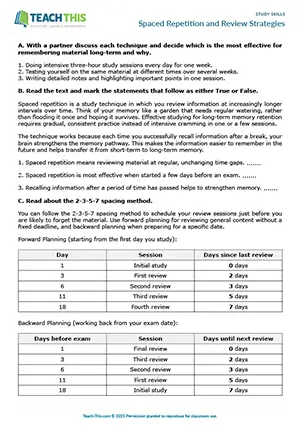
EAP Study Skills Worksheet - Reading and writing Exercises: Identifying, True or False, Table Completion, Matching - Speaking Activity: Discussion - Pair Work
In this useful study skills worksheet, students learn about spaced repetition and the 2-3-5-7 spacing method and practice planning and reviewing study sessions...
EAP Study Skills Worksheet - Reading and writing Exercises: True or False, Table Completion - Speaking Activity: Discussion, Communicative practice - Pair Work In this useful study skills worksheet, students learn about spaced repetition and the 2-3-5-7 spacing method and practice planning and reviewing study sessions using effective review strategies. First, students read about three review techniques and discuss which is the most effective for long-term memory and why. Students then read a text about spaced repetition and mark statements as true or false. Next, students read an explanation of the 2-3-5-7 spacing method and complete the dates in a study plan table using backward planning. After that, students match review strategies to their descriptions. Students then move on to discuss questions about the strategies in pairs. Next, students choose a topic they wish to improve or need to review for an exam. Students then use the 2-3-5-7 method to create a table with five study sessions, writing the date, session number and study method. Finally, students compare plans in pairs, explaining their topic and strategy choices.Study Skills Challenge
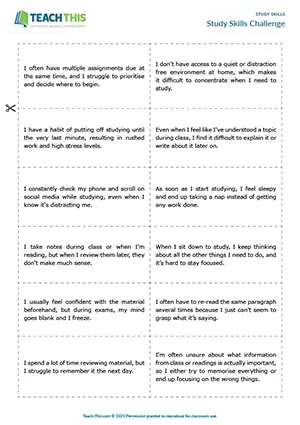
EAP Study Skills Game - Speaking: Discussion, Problem Solving, Giving Advice, Communicative practice
In this enjoyable study skills game, students discuss common study problems and share practical strategies to solve them. First, in pairs, students take turns turning over a study problem card and reading...
EAP Study Skills Game - Speaking: Discussion, Problem-solving, Giving Advice, Communicative practice In this enjoyable study skills game, students discuss common study problems and share practical strategies to solve them. First, in pairs, students take turns turning over a study problem card and reading it aloud. Next, the two students discuss possible strategies to solve the problem. Pairs discuss as many problem cards as they can in ten minutes. After that, students make new groups of four. Students then take turns picking up a study problem card, reading it aloud and asking the group how to solve the issue. The other students then each offer a possible strategy to deal with the study problem using the ideas generated during the pair discussion or by picking up a prompt card for help. The student with the problem card listens and awards the card to the person whose strategy they like most. If a student draws a prompt card, they use the guiding questions to help think of possible solutions. Players can only draw a maximum of three prompt cards during the entire game. Play continues until all the problem cards have been used. The student who collects the most problem cards by giving the best strategies wins the game.Study Skills Scavenger Hunt
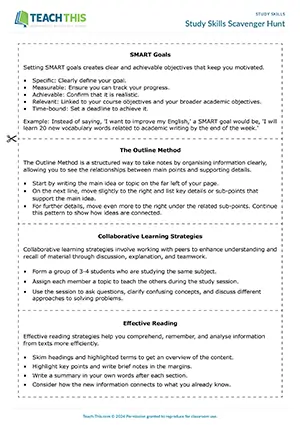
EAP Study Skills Game - Reading and writing: Scavenger Hunt, Answering Comprehension Questions, writing Paragraphs - Pair Work
Here is an engaging study skills scavenger hunt game to help students learn about effective study skills. In teams of two, students have 20 minutes to...
EAP Study Skills Game - Reading and writing: Scavenger Hunt, Answering Comprehension Questions, writing Paragraphs - Pair Work Here is an engaging study skills scavenger hunt game to help students learn about effective study skills. In teams of two, students have 20 minutes to answer questions by reading study skills information cards posted up around the classroom that cover different topics. When the time limit has been reached, teams swap worksheets for marking. For questions worth two points, answers must include two specific details. For questions worth three points, students must provide a clear answer that shows an understanding of the concept and details. The team with the most points at the end of the game wins.Study Skills Showdown
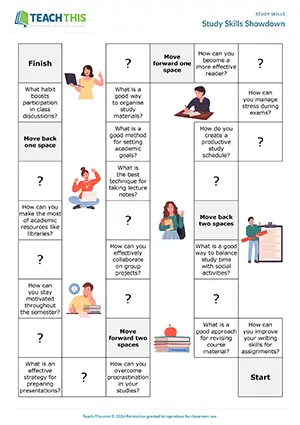
EAP Study Skills Board Game - Vocabulary and Speaking: Impromptu Speech, Multiple-Choice Questions, Communicative practice - Group Work
This free study skills board game helps students practice talking about study skills and habits. Players take turns rolling the dice and moving their counter...
EAP Study Skills Board Game - Vocabulary and Speaking: Impromptu Speech, Multiple-Choice Questions, Communicative practice - Group Work This free study skills board game helps students practice talking about study skills and habits. Players take turns rolling the dice and moving their counter along the board. If a player lands on a 'Question' square, they answer the question and talk about the study skills topic for 30 seconds without stopping. If a player can't think of anything to say or stops talking before the 30 seconds are up, they go back two squares. If a player lands on a 'Question Mark' square, another student picks up a card and reads out the study skills question along with three possible multiple-choice answers. The player then chooses an answer. If it's correct, the player stays on the square. If not, they move their counter back two squares. The first player to reach the finish wins the game.Here's what our members are saying...
- Email Openings, Closings and Etiquette
-
Email Openings, Closings & Etiquette: Business English worksheets
Email Greetings and Opening Lines
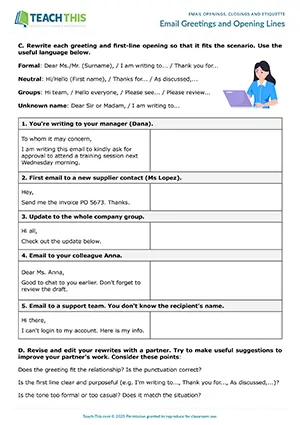
Business Email Openings Worksheet - Vocabulary and writing Exercises: Categorising, Matching, Rewriting
In this business email openings worksheet, students practice greetings and first-line openings according to relationship and level of formality. Students begin by sorting greetings by levels of...
Business Email Openings Worksheet - Vocabulary and writing Exercises: Categorising, Matching, Rewriting In this business email openings worksheet, students practice greetings and first-line openings according to relationship and level of formality. Students begin by sorting greetings by levels of formality or relationship. Students then match greetings and first-line openings to situations. Next, students rewrite greetings and first-line openings so that they fit the scenarios. Finally, students revise and edit their rewrites with a partner using the questions provided.Email Greetings and Sign-offs
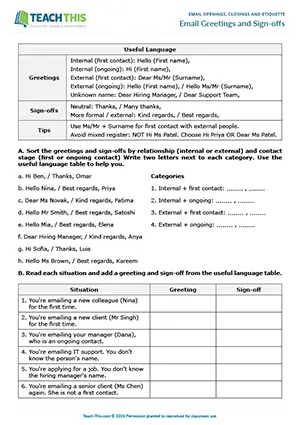
Business Email Closings Worksheet - Vocabulary and writing Exercises: Categorising, Table Completion, Rewriting Sentences, writing Sentences
In this email greetings and sign-offs worksheet, students practice choosing and writing appropriate email greetings and sign-offs for internal and external...
Business Email Closings Worksheet - Vocabulary and writing Exercises: Categorising, Table Completion, Rewriting Sentences, writing Sentences In this email greetings and sign-offs worksheet, students practice choosing and writing appropriate email greetings and sign-offs for internal and external emails in first and ongoing contact. First, students sort greetings and sign-offs by relationship and contact stage. Students then write the most appropriate greeting and sign-off for each situation using the relationship information in each prompt. After that, students rewrite openings and closings so they fit the situations. Finally, students use prompts to write three short emails that include appropriate greetings and sign-offs.Email Subject Line Builder
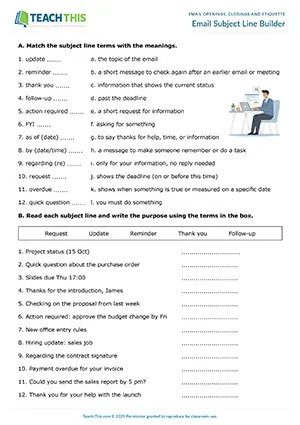
Business Email Subject Lines Worksheet - Vocabulary and writing Exercises: Identifying, Gap-fill, Error Correction, writing Subject Lines
In this business email subject lines worksheet, students practice recognising the purpose of a subject line and writing clear, concise subjects for common work...
Business Email Subject Lines Worksheet - Vocabulary and writing Exercises: Matching, Identifying, Gap-fill, Error Correction, writing Subject Lines In this business email subject lines worksheet, students practice recognising the purpose of a subject line and writing clear, concise subjects for common work emails. First, students match subject line terms with their meanings. Students then read each subject line and write the purpose using terms in a box. Next, students complete subject lines with words from a box. After that, students identify one main problem in each subject line and then rewrite it clearly without purpose tags. Finally, students write a clear subject line for each prompt, adding a purpose tag where needed.Getting Your First Line Right
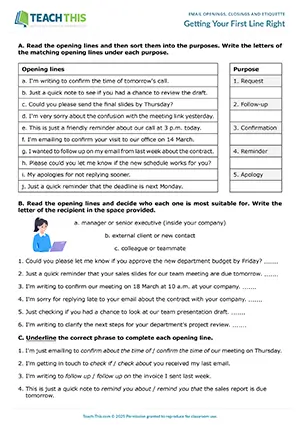
Business Email Openings Worksheet - Reading, Vocabulary and writing Exercises: Categorising, Identifying, Gap‑fill, Sentence writing - Pair Work
In this free email openings worksheet, students practice recognising and writing first‑line openings that clearly show the purpose of the email and...
Business Email Openings Worksheet - Reading, Vocabulary and writing Exercises: Categorising, Identifying, Gap‑fill, Sentence writing - Pair Work In this useful email openings worksheet, students practice recognising and writing first‑line openings that clearly show the purpose of the email and suit different recipients (managers, clients, and colleagues). Students begin by reading opening lines and sorting them into the five purposes given. Students then read opening lines and decide who each one is most suitable for. Next, students underline the best phrase in each sentence to create a correct and natural opening line. After that, students read opening lines and write the best answer that indicates what the email is about. Students then complete six opening lines with words and phrases from a box. Finally, students read four situations and write an appropriate opening line for each one.Open Strong, Close Smart
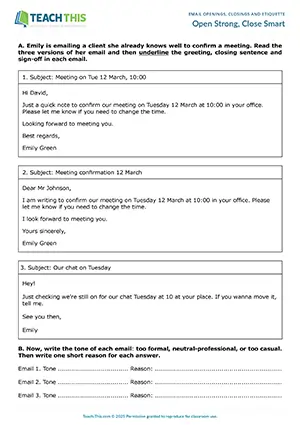
Business Email Openings and Closings Worksheet - Reading, Vocabulary and writing Exercises: Categorising, Rewriting Sentences
In this useful worksheet on adjusting tone in email openings and closings, students learn to choose and use formal or neutral‑professional greetings and closings...
Business Email Openings and Closings Worksheet - Reading, Vocabulary and writing Exercises: Categorising, Rewriting Sentences In this worksheet on adjusting tone in email openings and closings, students learn to choose and use formal or neutral‑professional greetings and closings in business emails. First, students read three versions of the same email and underline the greeting, closing sentence and sign-off in each one. Students then write the tone of each email and one short reason for each answer. Next, students sort greetings and sign-offs into two categories, either formal or neutral‑professional. After that, students rewrite the greeting, closing sentence and sign‑off in emails so the tone matches the instruction. Finally, students choose suitable tones, greetings and closing sentences and sign‑offs for four scenarios.Smart Email Etiquette
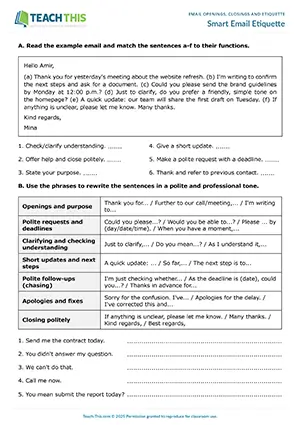
Business Email Etiquette Worksheet - Vocabulary and writing Exercises: Matching, Rewriting Sentences, Gap‑fill, Identifying, writing a Short Email
In this email openings, closings, and etiquette worksheet, students review useful phrases and practice writing clear, polite messages for professional contexts. First...
Business Email Etiquette Worksheet - Vocabulary and writing Exercises: Matching, Rewriting Sentences, Gap‑fill, Identifying, writing a Short Email In this email openings, closings, and etiquette worksheet, students review useful phrases and practice writing clear, polite messages for professional contexts. First, students read an example email and match sentences to their functions. Students then use phrases to rewrite direct sentences in a polite, professional tone. Next, students complete an email using phrases from a box. After that, students read each email opening and match it to a purpose. Finally, students select one purpose and write a short email using the phrases from Exercise B and the correct structure.Business Email Structure
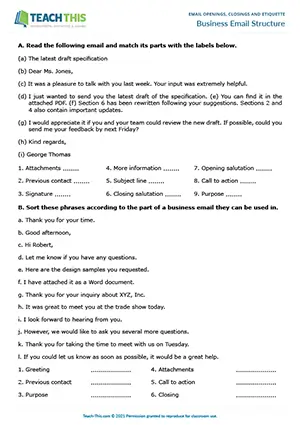
Business Email Structure Worksheet - Vocabulary and writing Exercises: Matching, Categorising, writing Emails
In this detailed business email structure worksheet, students review the structure of a typical business email and practice using it to write emails. Students start by reading an email and matching its parts...
Business Email Structure Worksheet - Vocabulary and writing Exercises: Matching, Categorising, writing Emails In this detailed business email structure worksheet, students review the structure of a typical business email and practice using it to write emails. Students start by reading an email and matching its parts with labels. Next, students sort phrases according to the part of a business email they can be used in. After that, students write an email according to a given scenario, following the structure of the email in Exercise A. When the students have finished, they revise and edit their email with a partner using a set of questions. Finally, students write a new email for a different scenario, revising and editing their email with their partner as before.Closings and Sign-offs
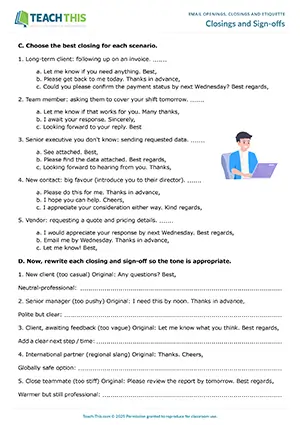
Business Email Closings and Sign-offs Worksheet - Vocabulary and writing Exercises: Matching, Gap‑fill, Multiple Choice, Rewriting
In this email closings and sign-offs worksheet, students learn to select appropriate closings and sign-offs and adjust the tone for different recipients. First, students label...
Business Email Closings and Sign-offs Worksheet - Vocabulary and writing Exercises: Matching, Gap‑fill, Multiple Choice, Rewriting In this email closings and sign-offs worksheet, students learn to select appropriate closings and sign-offs and adjust the tone for different recipients. First, students label each closing and sign‑off as 'Formal', 'Neutral' (professional), or 'Familiar' and then underline the single strongest tone signal in each line and circle the sign-off. Students then complete the closing and sign‑off for each scenario using phrases from a box. Next, students choose the correct closing for each scenario. Finally, students rewrite each closing and sign‑off so the tone is appropriate.First-Contact Emails
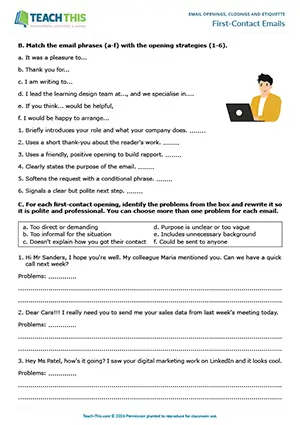
Business Email Openings Worksheet - Reading and writing Exercises: Matching, Identifying, Rewriting Sentences, writing Emails, Peer Feedback - Pair Work
In this business email openings worksheet, students practice writing strong, polite openings for first-contact emails by referencing context and...
Business Email Openings Worksheet - Reading and writing Exercises: Matching, Identifying, Rewriting Sentences, writing Emails, Peer Feedback - Pair Work In this business email openings worksheet, students practice writing strong, polite openings for first-contact emails by referencing context and managing tone. First, students read two first-contact emails and decide whether each statement about clarity, tone, and etiquette is true for Email 1, Email 2, or both. Students then analyse the stronger email in more detail by matching the email phrases with opening strategies. Next, students identify the problems in weak first-contact openings and then rewrite them so the tone, context, and purpose are appropriate. After that, students write their own first-contact email for one of the scenarios, following the structure and strategies from the previous exercises. Finally, students exchange emails with a partner and use a peer review checklist to give each other feedback on context, tone, and clarity of the opening. Students then revise and edit their own emails.Softening Bad News
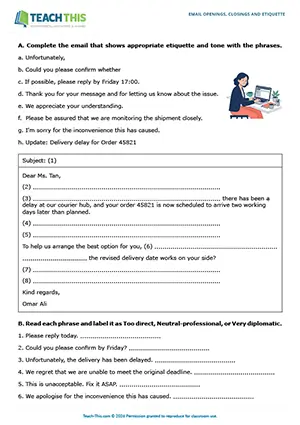
Business Email Etiquette Worksheet - Reading, Vocabulary and writing Exercises: Sentence Completion, Rewriting Sentences, writing Emails, Peer Feedback - Pair Work
In this business email etiquette and tone worksheet, students practice diplomatic language for handling complaints, delays, and apologies. Students begin by...
Business Email Etiquette Worksheet - Reading, Vocabulary and writing Exercises: Gap-fill, Labelling, Sentence Completion, Rewriting Sentences, writing Emails, Peer Feedback - Pair Work In this business email etiquette and tone worksheet, students practice diplomatic language for handling complaints, delays, and apologies. Students begin by completing a business email that shows appropriate etiquette and tone with phrases from a box. Students then read each phrase and label it as too direct, neutral-professional, or very diplomatic. Next, students rewrite blunt sentences so that they are more diplomatic and professional, using phrases in brackets. After that, students match etiquette problems with email excerpts. Students then use a scenario and phrase bank to write an email that uses appropriate etiquette and tone to soften bad news. Finally, students revise and edit their email with a partner using a set of questions, discuss whether the tone is too formal, too casual, or just right, and adjust their emails as needed.Here's what our members are saying...
- Talking about Jobs
-
Talking about Jobs: Business English Games, Activities & worksheets
Do you like your job?

Business English Work Likes and Dislikes Activity - Vocabulary, writing and Speaking: Matching, Gap-fill, Rewriting Sentences, Asking and Answering Questions - Pair Work
Here is a free work preferences worksheet and speaking activity to help students talk about what they like and don't like about their jobs. First, students match...
Business English Work Likes and Dislikes Activity - Vocabulary, writing and Speaking: Matching, Gap-fill, Rewriting Sentences, Asking and Answering Questions - Pair Work Here is a free work preferences worksheet and speaking activity to help students talk about what they like and don't like about their jobs. First, students match work-related vocabulary to definitions. Students then complete sentences with the work-related words in their correct form. Next, students rewrite the sentences, so they change from a like to a dislike or vice versa. Students then discuss the things they like and dislike about their jobs with a partner. After that, students take part in a Find someone who activity where they go around the class asking each other questions about work likes and dislikes. When a classmate answers 'yes' to a question, the student writes down their name and asks a follow-up question to gain more information. Afterwards, students give feedback to the class on what they found out.Employment Exchange

Business English Talking about Jobs Activity - Vocabulary and Speaking: Gap-fill, Asking and Answering Questions - Pair Work
In this useful talking about jobs activity, students practice work-related vocabulary by completing conversation questions with the words provided and then asking and answering the questions with...
Business English Talking about Jobs Activity - Vocabulary and Speaking: Gap-fill, Asking and Answering Questions, Controlled and Freer practice - Pair Work In this useful talking about jobs activity, students practice work-related vocabulary by completing conversation questions with the words provided and then asking and answering the questions with a partner. Working alone, students complete work-related conversation questions with the vocabulary provided. Students then take it in turns to ask each other the conversation questions, noting down their partner's answers. Afterwards, students report back to the class on the things they found out about their partner's job.I'm in...

Business English Jobs and Industries Game - Vocabulary: Matching, Forming Sentences - Pair Work
In this productive talking about jobs game, students match industries to jobs and form sentences with the phrases I'm in... and I work in the ... industry. In pairs, students take turns turning over one industry...
Business English Jobs and Industries Game - Vocabulary: Matching, Forming Sentences - Pair Work In this productive talking about jobs game, students match industries to jobs and form sentences with the phrases I'm in... and I work in the ... industry. In pairs, students take turns turning over one industry card and one job card. If the industry matches with the job (e.g. health care and nurse), the student picks up a phrase card from the pile and forms two sentences using the cards, e.g. 'I'm in health care. I'm a nurse', or 'I work in the health care industry. I'm a nurse.' The student then keeps the two cards and has another turn. If the two cards don't match, the student turns them back over, keeping them in the same place. The student with the most pairs of cards at the end of the game wins. After reviewing the correct answers, students practice forming sentences about their own jobs and industries using the two phrases.What do you do?

Business English Talking about Work Activity - Listening and Speaking: Dictation, Asking and Answering Questions, Controlled and Freer practice - Pair Work
Here is an engaging talking about work activity that students can use to practice common questions about jobs and work. First, dictate the 12 questions...
Business English Talking about Work Activity - Listening and Speaking: Dictation, Asking and Answering Questions from Prompts, Controlled and Freer practice - Pair Work Here is an engaging talking about work activity that students can use to practice common questions about jobs and work. First, dictate the 12 questions about work from the worksheet to the class, saying each question twice. When the dictation is complete, students check their answers using the worksheet. After reviewing the questions, students answer them by writing complete sentences in the column marked 'You'. Next, in pairs, students take it in turns to ask and answer the questions, noting down their partner's answers in the last column. Finally, students report back to the class on what they found out about their partner.Roles and Responsibilities

Business English Job Descriptions Worksheet - Vocabulary Exercises: Matching, Gap-fill - writing Activity: Describing, Freer practice
This comprehensive job descriptions worksheet helps students learn and practice common verbs used to describe job roles and responsibilities. To begin...
Business English Job Descriptions Worksheet - Vocabulary Exercises: Matching, Gap-fill - writing Activity: Describing, Freer practice This comprehensive job descriptions worksheet helps students learn and practice common verbs used to describe job roles and responsibilities. To begin, students match job titles to their descriptions. Next, students match the verbs in bold from Exercise A to their definitions. Students then complete job descriptions with the verbs. Afterwards, each student is given two job cards. Students then write descriptions for the two professions using verbs from a box. When the students have finished, they read out their descriptions to the class, who tries to guess which job is being described.Wei Ling's Job

Business English Job Responsibilities Activity - Reading, writing and Speaking: Information Gap, Asking and Answering Question, Discussion - Group and Pair Work
In this talking about jobs information gap activity, students practice asking and answering questions about work-related roles and responsibilities. First...
Business English Job Responsibilities Activity - Reading, writing and Speaking: Information Gap, Asking and Answering Question, Guided Discussion - Group and Pair Work In this talking about jobs information gap activity, students practice asking and answering questions about work-related roles and responsibilities. First, in two groups, students complete work-related questions to find out missing information in a text about someone's job. Next, students pair up with someone from the other group and take turns asking and answering the questions, completing the text with their partner's answers. After that, students compare their texts to check the answers. Lastly, students discuss their jobs by asking and answering similar work-related questions with their partner.Job Titles Pelmanism

Business English Job Titles Game - Vocabulary: Matching, Pelmanism - Group Work
Here is an enjoyable job titles game to help students review and practice common job titles used in companies. In groups, students take it in turns to turn over one job title card and one job description card...
Business English Job Titles Game - Vocabulary: Matching, Pelmanism - Group Work Here is an enjoyable job titles game to help students review and practice common job titles used in companies. In groups, students take it in turns to turn over one job title card and one job description card. If the job title matches the description, the student reads them both out aloud, keeps the two cards and has another turn. If not, the student turns them back over, keeping them in the same place. The game continues until all the cards have been matched. The student with the most pairs of cards at the end of the game wins.Professional Pursuit

Business English Talking About Jobs Board Game - Vocabulary and Speaking: Impromptu Speech, Communicative practice - Group Work
This rewarding jobs board game helps students practice talking about jobs and aspects of working life. Players take turns rolling the dice and moving...
Business English Talking About Jobs Board Game - Vocabulary and Speaking: Impromptu Speech, Communicative practice - Group Work This rewarding jobs board game helps students practice talking about jobs and aspects of working life. Players take turns rolling the dice and moving their counters along the board. When a player lands on a square, they talk about the jobs topic on the square for 30 seconds without stopping. If a player can't think of anything to say or stops talking before the 30 seconds are up, they go back two squares. The first player to reach the finish wins the game.Talking about your Industry

Business English Industry Worksheet, Game and Activity - Vocabulary Exercises: Gap-fill - Speaking: Pelmanism, Discussion, Freer practice - Pair Work
In this industry vocabulary worksheet, game and activity, students learn words and phrases for talking about industry and then ask and answer related questions...
Business English Industry Worksheet, Game and Activity - Vocabulary Exercises: Gap-fill - Speaking: Pelmanism, Guided Discussion, Freer practice - Pair Work In this industry vocabulary worksheet, game and activity, students learn words and phrases for talking about industry and then ask and answer related discussion questions. First, students complete definitions with industry vocabulary from a box. Students then use the industry-related vocabulary to complete discussion questions. Next, students use the discussion questions in a pelmanism game where they match the questions to example answers. In pairs, players take turns turning over one question card and one answer card. If the question and answer match, the player keeps the cards and has another turn. If not, the player turns the cards back over, keeping them in the same place, and play passes to the other student. The player with the most pairs of cards at the end wins the game. Lastly, pairs use the question cards to discuss their industry or an industry they know well.Remote Work Bluff

Business English Remote Work Game - writing and Vocabulary: writing Definitions, Guessing - Pair Work
In this fun remote work vocabulary game, students create false definitions for phrases related to remote working and then play a game where they guess which remote work definition is correct...
Business English Remote Work Game - writing and Vocabulary: writing Definitions, Guessing - Pair Work In this fun remote work vocabulary game, students create false definitions for phrases related to remote working and then play a game where they guess which remote work definition is correct. In competing teams of two, students create a second false definition for each remote work phrase on their worksheet. When both teams have finished, they take turns reading out each phrase and the three definitions to the other team, who guess which definition is correct. If the other team guesses the correct definition successfully, the team puts a tick next to the remote work phrase. The team with the most correct guesses at the end of the game wins.Here's what our members are saying...
- Business Negotiations
-
Negotiations: Business English worksheets, Role-Plays & Games
Expressing a Negotiation Position
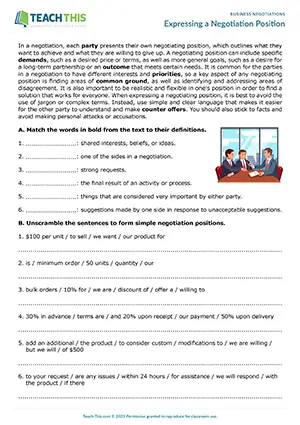
Business English Negotiations Worksheet - Vocabulary, Reading and writing Exercises: Matching, Unscrambling, Labelling, writing Sentences
In this useful negotiation positions worksheet, students learn and practice expressing simple negotiation positions. First, students match keywords related to...
Business English Negotiations Worksheet - Vocabulary, Reading and writing Exercises: Matching, Unscrambling, Labelling, writing Sentences from Prompts In this useful negotiation positions worksheet, students learn and practice expressing simple negotiation positions. First, students match keywords related to negotiations in a text to their definitions. Students then unscramble sentences to reveal six examples of simple negotiation positions. Next, students read about four common negotiation position types and match them to example sentences. Lastly, students imagine they are negotiating the sale of an apartment and use background information to write four negotiation positions that correspond to each of the four position types.Make the Deal
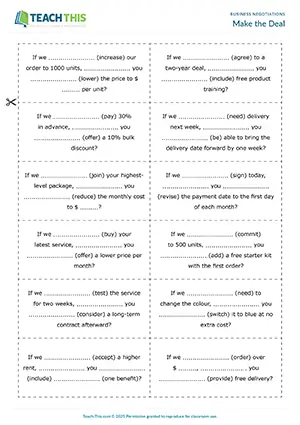
Business English Negotiations Activity - Completing, Asking and Answering Questions, Discussion, Freer and Communicative practice - Group Work
In this engaging business negotiations activity, students use second conditional questions to negotiate offers and counteroffers, justify choices...
Business English Negotiations Activity - Completing, Asking and Answering Questions, Discussion, Freer and Communicative practice - Group Work In this engaging business negotiations activity, students use second conditional questions to negotiate offers and counteroffers, justify choices, and agree on a group answer. In groups, students take turns picking up a question card and completing it in the second conditional with realistic numbers or terms, using the verbs and prompts in brackets, e.g. 'If we increased our order to 1000 units, would you lower the price to $9 per unit?' The student then asks the group the completed question, framing it from the buyer, client, or tenant side. Each group member answers in turn from the supplier, provider, or landlord side, using negotiation language where possible and giving brief reasons. Students then discuss the scenario and come up with a group answer that they think would be best for the situation. The student who drew the card writes the agreed group answer on the back of the card. This continues until all the question cards have been used or time is up. When the groups have finished, go through selected questions and have the groups share their answers with the class.Offers and Counteroffers
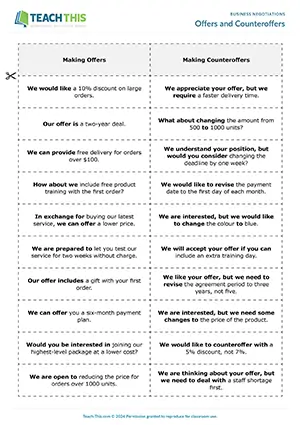
Business English Negotiation Games - Vocabulary and Speaking: Categorising, Gap-fill, Role Play, Controlled and Freer practice - Pair Work
Here are two engaging business negotiation games to help students learn and practice language for making offers and counteroffers in negotiations. First, in pairs...
Business English Negotiation Games - Vocabulary and Speaking: Categorising, Gap-fill, Role Play, Controlled and Freer practice - Pair Work Here are two engaging business negotiation games to help students learn and practice language for making offers and counteroffers in negotiations. First, in pairs, students race to correctly categorise language cards under 'making offers' or 'making counteroffers' headings. Students take turns picking up a card, reading it aloud, and categorising it under 'making offers' or 'making counteroffers'. The first pair to correctly categorise all the cards is the winner. Next, students play a role-play game where they score points for using the language in bold on the cards. For the first role-play, Student A takes the cards for making offers, and Student B takes the cards for making counteroffers. Students then role-play the first negotiation. Each time a student makes an offer or counteroffer, they try to use the language in bold on one of their cards. If a student uses the language successfully, they score one point and remove the card from the game. This continues until the negotiation is finished. Students then repeat the game with the second role-play. This time, Student A uses the counteroffer cards, and Student B uses the offer cards. The student with the most points at the end wins.Employment Contract Negotiation
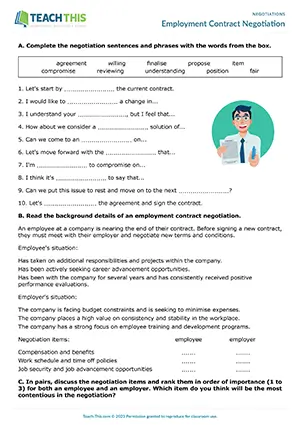
Business English Negotiations Role Play - Vocabulary, Reading and Speaking: Gap-fill, Discussion, Role-Play, Communicative practice - Pair and Group Work
In this authentic negotiations role-play activity, students simulate an employment contract negotiation between an employee and an employer. First, students...
Business English Negotiations Role Play - Vocabulary, Reading and Speaking: Gap-fill, Guided Discussion, Role-Play, Communicative practice - Pair and Group Work In this authentic negotiations role-play activity, students simulate an employment contract negotiation between an employee and an employer. First, students complete negotiation phrases with vocabulary from a box. Students then preview the background details of an upcoming employment contract negotiation between an employee and an employer and rank the negotiation items in order of importance for both parties. Next, in two groups, employees and employers, students formulate a negotiation strategy using information on cards and the background details. Each student then pairs up with someone from the other group and role-plays an employment contract negotiation, scoring points in the negotiation depending on the terms agreed to for each item. The aim is for both sides in the negotiation to score reasonably high and come to a mutually beneficial agreement. Afterwards, pairs share their scores with the class and give feedback on their negotiations.First Conditional Business
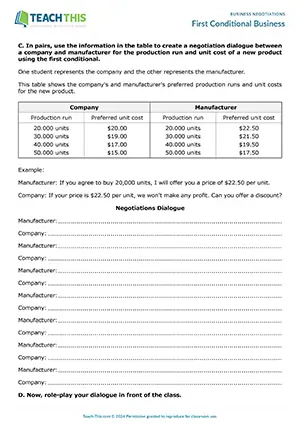
Business English Negotiations Worksheet and Role-Play - Grammar and Reading Exercises: Changing Word Forms - Speaking Activity: Creating a Dialogue - Pair Work
In this business negotiations worksheet and role-play, students practice the first conditional in a business negotiation context. First, students complete...
Business English Negotiations Worksheet and Role-Play - Grammar and Reading Exercises: Changing Word Forms, Ordering - Speaking Activity: Creating a Dialogue - Pair Work In this business negotiations worksheet and role-play, students practice the first conditional in a business negotiation context. First, students complete sentences using the first conditional and verbs in brackets. Next, students read a dialogue and number the parts to create a logical and coherent conversation between two people, negotiating a deal. Finally, in pairs, students use information in a table to create a negotiation dialogue between a company and manufacturer for the production run and unit cost of a new product using the first conditional. Afterwards, students role-play their dialogues to the class.Negotiations Pelmanism
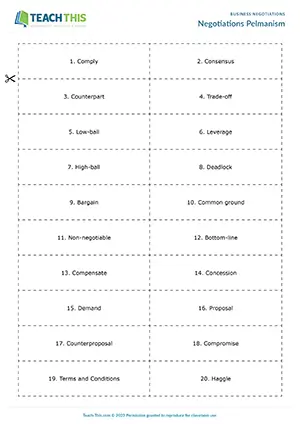
Business English Negotiations Game - Vocabulary: Matching, Pelmanism - Group Work
Here is a free business negotiations game to help students review and practice vocabulary that is commonly used in business negotiations. In groups, students take it in turns to turn over one...
Business English Negotiations Game - Vocabulary: Matching, Pelmanism - Group Work Here is a free business negotiations game to help students review and practice vocabulary that is commonly used in business negotiations. In groups, students take it in turns to turn over one negotiations vocabulary card and one definition card. If the negotiations vocabulary matches the definition, the student reads the two cards aloud, keeps the two cards and has another turn. If not, the student turns the cards back over, keeping them in the same place. The game continues until all the cards have been matched. The student with the most pairs of cards at the end of the game wins.Negotiation Stages
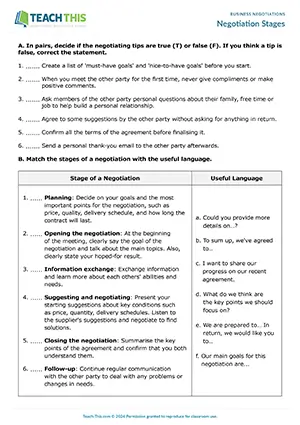
Business English Negotiations Worksheet - Reading and Vocabulary Exercises: True or False, Matching, Binary Choice - Speaking Activity: Role Play - Pair Work
In this productive business negotiations worksheet and role-play, students practice language for the various stages of a business negotiation. To begin, in pairs...
Business English Negotiations Worksheet - Reading and Vocabulary Exercises: True or False, Matching, Binary Choice - Speaking Activity: Role Play - Pair Work In this productive business negotiations worksheet and role-play, students practice language for the various stages of a business negotiation. To begin, in pairs, students decide whether tips for negotiating are true or false. If students think a tip is false, they correct the statement so that it's true. Working alone, students then match stages of a negotiation with useful language. Next, students read a negotiation dialogue and underline language that matches the negotiation stages. After that, students circle the correct preposition in each sentence. In pairs, students then take part in a negotiation role-play to practice the stages and language from the worksheet. Lastly, pairs report back to the class on the outcome of their role-play and what they agreed on.Price Negotiations
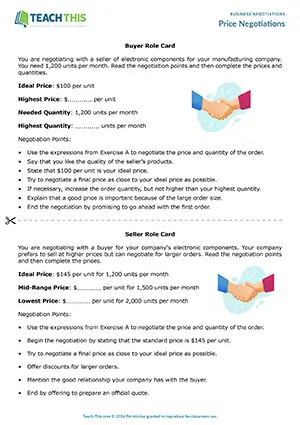
Business English Negotiations Worksheet - Reading and Vocabulary Exercises: Matching, Gap-Fill - Speaking Activity: Role-Play, Communicative practice - Pair Work
In this handy business negotiations worksheet and role-play, students practice expressions for price negotiations. First, students match expressions for price...
Business English Price Negotiations Worksheet - Reading and Vocabulary Exercises: Matching, Gap-Fill - Speaking Activity: Role-Play, Communicative practice - Pair Work In this handy business negotiations worksheet and role-play, students practice expressions for price negotiations. First, students match expressions for price negotiations to sentence endings. Students then indicate who would say each sentence by writing B for buyer or S for seller. Next, students complete a price negotiation dialogue between a buyer and seller with the price negotiation expressions. After that, in pairs, students take part in a price negotiation role-play to practice the expressions from the worksheet. Finally, pairs report back to the class on the outcome of their negotiations and the price they agreed on.Here's what our members are saying...
- Business Meetings
-
Meetings: Business English worksheets & Activities
Clarifying in Meetings

Business English Meetings Worksheet - Reading and Vocabulary Exercises: Categorising, Gap-Fill - Speaking Activity: Role-Play, Freer practice - Group Work
In this handy business meetings worksheet, students practice language to clarify information and role-play a meeting using the expressions. To begin, students...
Business English Meetings Worksheet - Reading and Vocabulary Exercises: Categorising, Gap-Fill - Speaking Activity: Role-Play, Freer practice - Group Work In this handy business meetings worksheet, students practice language to clarify information and role-play a meeting using the expressions. To begin, students read a business meeting dialogue with clarifying expressions written in bold. Students then categorise the clarifying expressions according to their functions. Next, students complete another meeting dialogue with other clarifying expressions. After that, students practice the dialogue in groups of three. Next, students role-play a business meeting between three people using the clarifying expressions from the worksheet. Afterwards, groups role-play their meetings in front of the class.The Meeting Zone
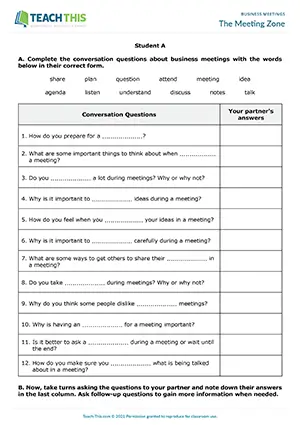
Business English Meetings Activity - Vocabulary and Speaking: Gap-fill, Asking and Answering Questions, Freer practice - Group and Pair Work
In this engaging talking about meetings activity, students practice useful vocabulary related to meetings by completing conversation questions with...
Business English Meetings Activity - Vocabulary and Speaking: Gap-fill, Asking and Answering Questions from Prompts, Controlled and Freer practice - Group and Pair Work In this engaging talking about meetings activity, students practice useful vocabulary related to meetings by completing conversation questions with the words and then asking and answering the questions with a partner. Working together in two groups, students complete conversation questions about business meetings with the words provided in their correct form. Students then pair up with someone from the other group and take turns asking each other the conversation questions, noting down their partner's answers in the last column of the table. Afterwards, students report back to the class on the things they found out about their partner.Beginning a Meeting
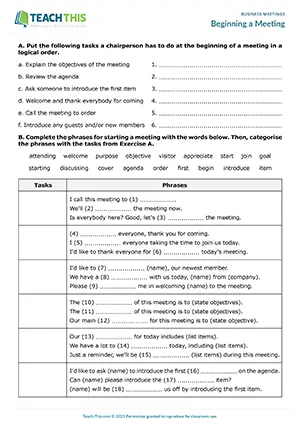
Business English Meetings Worksheet - Reading and Vocabulary Exercises: Gap-fill, Categorising, Error Correction - Speaking Activity: Role-Play
In this free business meetings worksheet, students practice language a chairperson would use for beginning a meeting. First, students put the tasks a...
Business English Meetings Worksheet - Reading and Vocabulary Exercises: Ordering, Gap-fill, Categorising, Error Correction, writing Sentences - Speaking Activity: Role-Play In this free business meetings worksheet, students practice language a chairperson would use for beginning a meeting. First, students put the tasks a chairperson has to do at the beginning of a meeting in a logical order. Next, students complete phrases for starting a meeting with the words shown. Students then categorise the phrases with the tasks from the first exercise. After that, students rewrite the opening comments of a meeting to make them more polite and appropriate. Next, working alone, in groups of five or six, students write the opening comments for a meeting using prompts. Lastly, students take it in turns to be a chairperson and use their comments to practice chairing the beginning of a meeting.Setting the Agenda
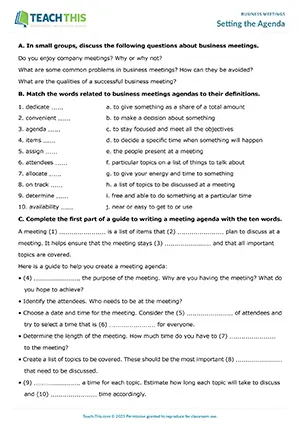
Business English Meeting Agendas Worksheet - Vocabulary and Reading Exercises: Matching, Gap-fill, Form Completion, Ordering
In this comprehensive business meeting agenda worksheet, students learn the basic elements of a typical business meeting agenda. Students begin by...
Business English Meeting Agendas Worksheet - Vocabulary and Reading Exercises: Matching, Gap-fill, Form Completion, Ordering In this comprehensive business meeting agenda worksheet, students learn the basic elements of a typical business meeting agenda. Students begin by discussing three questions about business meetings. Working alone, students then match ten keywords related to business meetings agendas to their definitions and complete the first part of a guide to writing business meeting agendas with the words. Next, students complete the first part of a business meeting agenda with their own ideas. Students then read some examples of typical business meeting agenda items and list them in a logical order, assigning a start time to each item. Lastly, students complete the final part of the meeting agenda writing guide with the words provided.Who's taking the minutes?
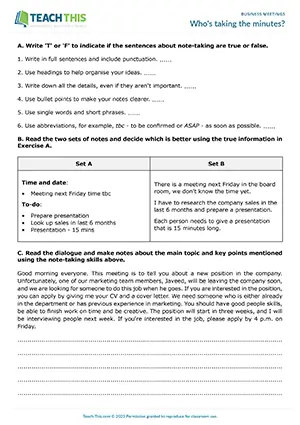
Business English Meeting Minutes Worksheet - Reading and writing Exercises: True or False, Note-taking - Listening and Speaking Activity: Role-play, Freer practice
In this productive note-taking worksheet and activity, students practice taking notes in a business meeting context. First, students decide if sentences about note...
Business English Meeting Minutes Worksheet - Reading and writing Exercises: True or False, Identifying, Note-taking - Listening and Speaking Activity: Role-play, Freer practice In this productive note-taking worksheet and activity, students practice taking notes in a business meeting context. First, students decide if sentences about note-taking are true or false. Next, students read two sets of notes and decide which is better using the true information from Exercise A. After that, students read a dialogue from a business meeting and take notes about the text using the note-taking skills from the worksheet. Following that, students participate in a role-play activity where they speak as if in a business meeting while another student takes notes on what they say. In pairs, one student speaks as if in a meeting using information on a card, and the other student takes notes. When the student has finished, the two students swap roles. Finally, students change partners and use their notes to summarise what the other student said.Business Meeting Expressions
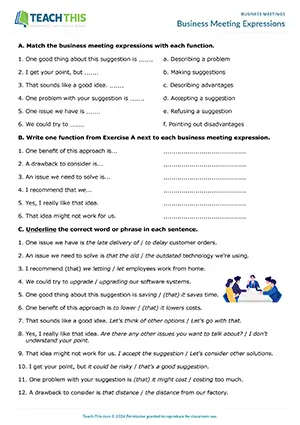
Business English Meetings Worksheet - Vocabulary and Reading Exercises: Binary Choice - Speaking Activity: Role-Play, Communicative practice - Group Work
In this comprehensive business meetings worksheet, students learn and practice useful expressions for business meetings. First, students match business...
Business English Meetings Worksheet - Vocabulary and Reading Exercises: Matching, Binary Choice - Speaking Activity: Role-Play, Communicative practice - Group Work In this comprehensive business meetings worksheet, students learn and practice useful expressions for business meetings. First, students match business meeting expressions with their functions. Students then write one function next to other business meeting expressions. Next, students underline the correct word or phrase in each sentence. After that, students read a business meeting dialogue and circle the meeting expressions. Next, in groups of three, students conduct a business meeting role-play in which they practice the meeting expressions from the worksheet. Finally, groups give feedback on the outcomes of their meetings.Meeting Dialogues
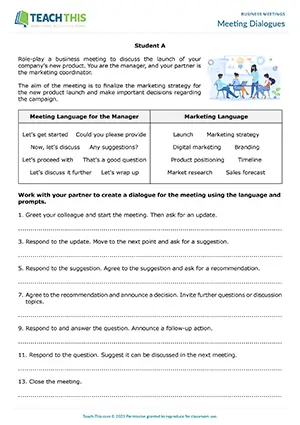
Business English Meetings Activity - Vocabulary and writing Exercises: writing a Dialogue - Speaking Activity: Delivering a Dialogue, Freer practice - Pair Work
In this useful business meetings role-play activity, students practice words and phrases related to meetings and use them in a meeting role-play. First, students...
Business English Meetings Activity - Reading, Vocabulary and writing Exercises: writing a Dialogue - Speaking Activity: Delivering a Dialogue, Freer practice - Pair Work In this useful business meetings role-play activity, students practice words and phrases related to meetings and use them in a meeting role-play. First, students complete a meeting dialogue with words and phrases from a box. Next, in pairs, students prepare and role-play a business meeting dialogue, similar to the one in the first exercise. Pairs do this by reading a role-play scenario and creating a dialogue for a meeting using language in boxes and prompts. Finally, pairs perform their dialogues to the class.That's a Great Idea!
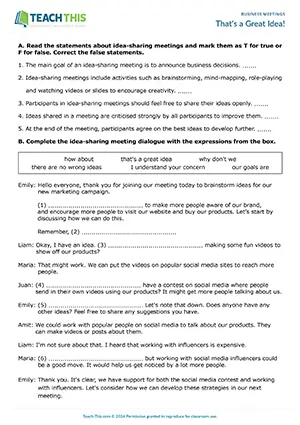
Business English Meetings Worksheet - Reading and Vocabulary Exercises: True or False, Gap-fill - Speaking Activity: Role-play, Freer practice - Group Work
In this business meetings worksheet, students practice useful expressions for idea-sharing meetings. To begin, students read statements about idea-sharing meetings...
Business English Meetings Worksheet - Reading and Vocabulary Exercises: True or False, Gap-fill, Identifying - Speaking Activity: Role-play, Freer practice - Group Work In this business meetings worksheet, students practice useful expressions for idea-sharing meetings. To begin, students read statements about idea-sharing meetings and mark them as true or false, correcting the false ones. Students then complete an idea-sharing meeting dialogue with expressions from a box. Next, students circle the meeting expression that does not belong in each set. Finally, in groups of four, students role-play an idea-sharing meeting at a car manufacturing company using the expressions from Exercise C.Here's what our members are saying...


